BigDataBench: Benchmarking
Big Data Systems

http://prof.ict.ac.cn/jfzhan

INSTITUTE OF COMPUTING TECHNOLOGY

1

Jianfeng Zhan
Computer Systems Research Center, ICT, CAS
CCF Big Data Technology Conference
2013-12-06
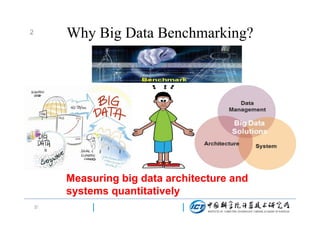
Why Big Data Benchmarking?

2

Measuring big data architecture and
systems quantitatively
2/
What is BigDataBench?


An open source project on big data
benchmarking:
•

3/

http://prof.ict.ac.cn/BigDataBench/

•

6 real-world data sets and 19 workloads
–

•

4V characteristics
–

3/

Extended in near future

Volume, Variety, Velocity, and Veracity
4/

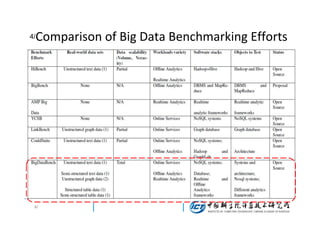
Comparison of Big Data Benchmarking Efforts

4/
5/

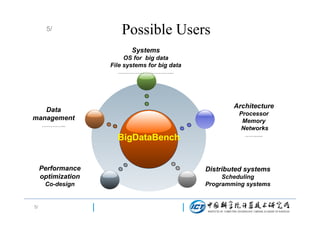
Possible Users
Systems
OS for big data
File systems for big data
…………………………..

Architecture

Data
management

Processor
Memory
Networks

…………..

BigDataBench
Performance
optimization
Co-design

5/

…….....

Distributed systems
Scheduling
Programming systems
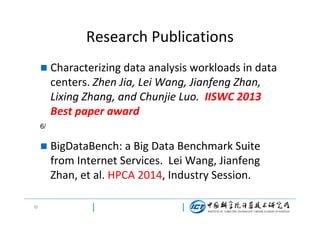
Research Publications


Characterizing data analysis workloads in data
centers. Zhen Jia, Lei Wang, Jianfeng Zhan,
Lixing Zhang, and Chunjie Luo. IISWC 2013
Best paper award

6/



6/

BigDataBench: a Big Data Benchmark Suite
from Internet Services. Lei Wang, Jianfeng
Zhan, et al. HPCA 2014, Industry Session.
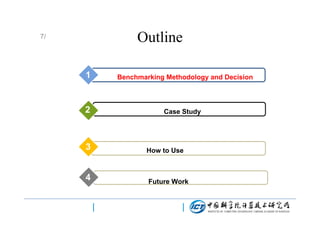
Outline

7/

1

2
3

Benchmarking Methodology and Decision

Case Study

3

How to Use

5
4

Future Work
8/

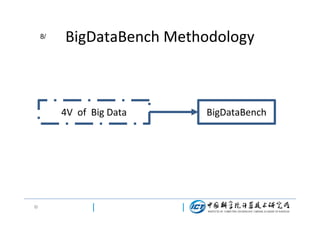
BigDataBench Methodology

4V of Big Data

8/

BigDataBench
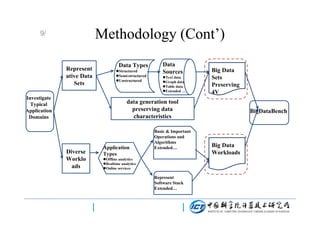
Methodology (Cont’)

9/

Represent
ative Data
Sets
Investigate
Typical
Application
Domains

Data Types
Structured
Semi-structured
Unstructured

Data
Sources
Text data
Graph data
Table data
Extended …

Big Data
Sets
Preserving
4V

data generation tool
preserving data
characteristics

Diverse
Worklo
ads

Application
Types

Basic & Important
Operations and
Algorithms
Extended…

Offline analytics
Realtime analytics
Online services

Represent
Software Stack
Extended…

BigDataBench

Big Data
Workloads
10/

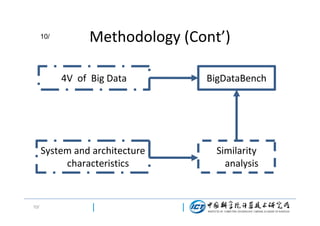
Methodology (Cont’)
4V of Big Data

System and architecture
characteristics

10/

BigDataBench

Similarity
analysis
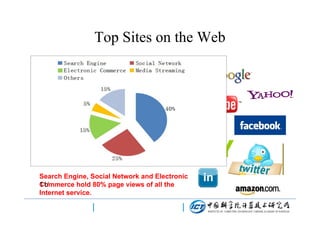
Top Sites on the Web

More details in http://www.alexa.com/topsites/global;0

Search Engine, Social Network and Electronic
Commerce hold 80% page views of all the
11/
Internet service.
12/

12/

and
atte
rep
nti
res
ons
ent
to
ativ
diff
• Inc
e
ere
lud
app
nt
e
lica
app
diff
tio
lica
ere
n
tio
nt
sce
n
dat
nar
typ
a
ios
es:
• •sou
Co
Se
onl
arc
ver
ine
rce
ser
rep
sh
En
vic
•res
Te
gin
e,
xt
ent
e,
rea
dat
Elativ
a,
tim
eco
Gr
m
e
ap
soft
me
ana
h
rce,
lyti
war
dat
cs,
eSo
a,
cia
off
Ta
sta
l
lin
ble
Ne
e
cks
dat

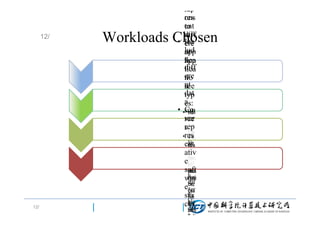
Workloads Chosen

tw
ana
a
ork
lyti
cs
13/

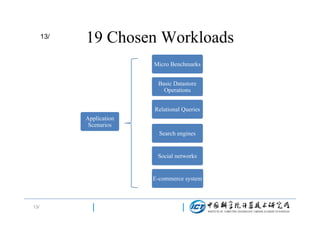
19 Chosen Workloads
Micro Benchmarks
Basic Datastore
Operations
Relational Queries
Application
Scenarios
Search engines

Social networks

E-commerce system

13/
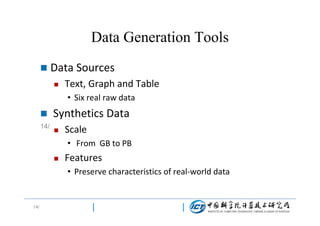
Data Generation Tools


Data Sources


Text, Graph and Table
• Six real raw data


14/

Synthetics Data


Scale
• From GB to PB



Features
• Preserve characteristics of real-world data

14/
15/

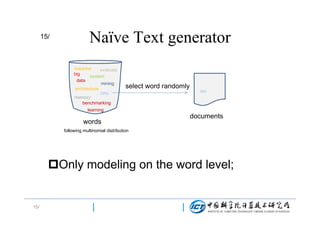
Naïve Text generator
machine
evaluate
big
system
data
mining
architecture

select word randomly

CPU

cpu

memory
benchmarking
learning

words

documents

following multinomial distribution

Only modeling on the word level;

15/
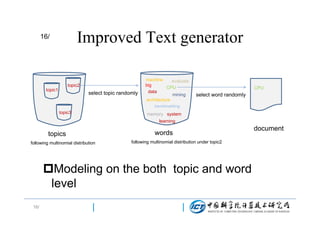
Improved Text generator

16/

topic2

topic1

select topic randomly

machine
evaluate
big
CPU
data
mining
architecture

CPU

select word randomly

benchmarking

topic3

memory system
learning

topics
following multinomial distribution

words
following multinomial distribution under topic2

Modeling on the both topic and word
level
16/

document
Outline

17/

1

2
3

Benchmarking Methodology and Decision

Case Study

3
5
4
17/

How to Use

Future Work
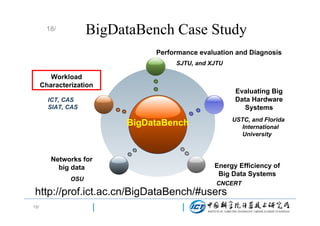
BigDataBench Case Study

18/

Performance evaluation and Diagnosis
SJTU, and XJTU

Workload
Characterization

Evaluating Big
Data Hardware
Systems

ICT, CAS
SIAT, CAS

USTC, and Florida
International
University

BigDataBench

Networks for
big data
OSU

Energy Efficiency of
Big Data Systems
CNCERT

http://prof.ict.ac.cn/BigDataBench/#users
18/
19/

19/

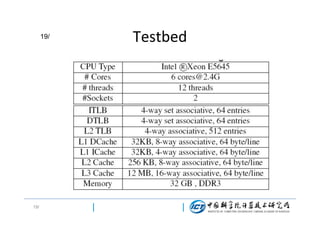
Testbed
20/

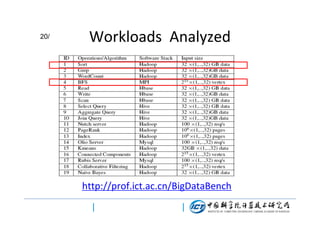
Workloads Analyzed

http://prof.ict.ac.cn/BigDataBench
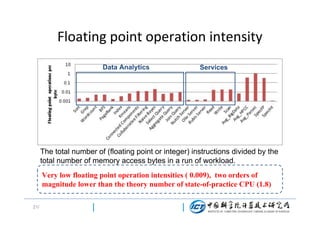
Floating point operation intensity
Data Analytics

Services

21

The total number of (floating point or integer) instructions divided by the
total number of memory access bytes in a run of workload.
Very low floating point operation intensities ( 0.009), two orders of
magnitude lower than the theory number of state-of-practice CPU (1.8)
21/
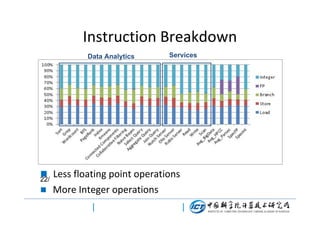
Instruction Breakdown
Data Analytics

Services

 Less floating point operations
22/


More Integer operations
23/

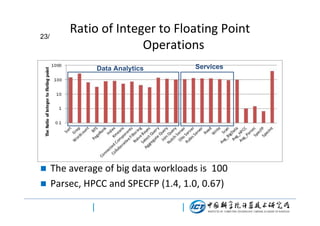
Ratio of Integer to Floating Point
Operations
Data Analytics




Services

The average of big data workloads is 100
Parsec, HPCC and SPECFP (1.4, 1.0, 0.67)
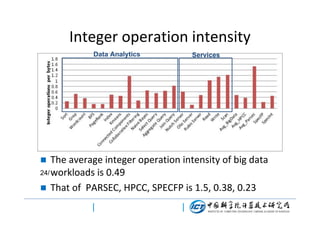
Integer operation intensity
Data Analytics

Services

The average integer operation intensity of big data
24/ workloads is 0.49
 That of PARSEC, HPCC, SPECFP is 1.5, 0.38, 0.23

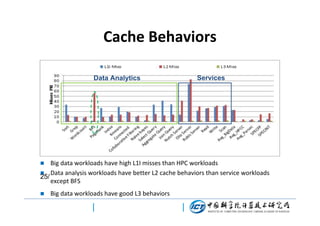
Cache Behaviors
Data Analytics

Services

Big data workloads have high L1I misses than HPC workloads
 Data analysis workloads have better L2 cache behaviors than service workloads
25/
except BFS




Big data workloads have good L3 behaviors
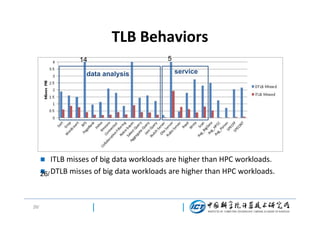
TLB Behaviors
14
data analysis

5
service

ITLB misses of big data workloads are higher than HPC workloads.
 DTLB misses of big data workloads are higher than HPC workloads.
26/


26/
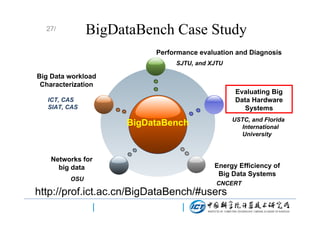
BigDataBench Case Study

27/

Performance evaluation and Diagnosis
SJTU, and XJTU

Big Data workload
Characterization

Evaluating Big
Data Hardware
Systems

ICT, CAS
SIAT, CAS

USTC, and Florida
International
University

BigDataBench

Networks for
big data
OSU

Energy Efficiency of
Big Data Systems
CNCERT

http://prof.ict.ac.cn/BigDataBench/#users
Evaluating Big Data Hardware Systems

28/
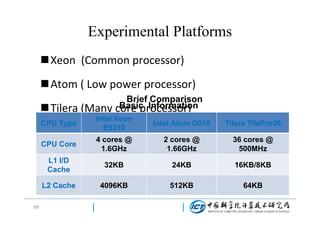
Experimental Platforms
Xeon (Common processor)
Atom ( Low power processor)
Tilera (Many

Brief Comparison
Basic Information
core processor)

CPU Type

Intel Atom D510

Tilera TilePro36

CPU Core

4 cores @
1.6GHz

2 cores @
1.66GHz

36 cores @
500MHz

L1 I/D
Cache

32KB

24KB

16KB/8KB

L2 Cache
29/

Intel Xeon
E5310

4096KB

512KB

64KB
Experimental Platforms
Hadoop Cluster
Information

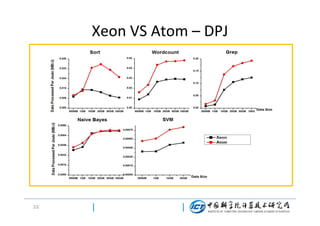
Xeon VS Atom

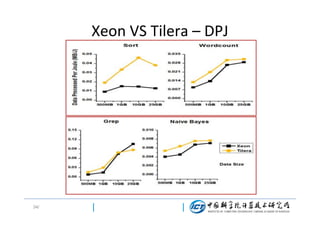
Xeon VS Tilera

[ 1 Xeon master+7
Comprison
[1 Xeon master+7 Xeon
Xeon slaves ] VS [ 1
(the same logical
slaves] VS [ 1 Xeon
Atom master +7 Atom
core number)
master +1 Tilera slave]
slaves]
Hadoop setting

30/

Following the guidance on Hadoop official
website
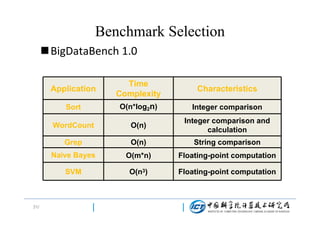
Benchmark Selection
BigDataBench 1.0
Application

Characteristics

Sort

O(n*log2n)

Integer comparison

WordCount

O(n)

Integer comparison and
calculation

Grep

O(n)

String comparison

Naïve Bayes

O(m*n)

Floating-point computation

SVM

31/

Time
Complexity

O(n3)

Floating-point computation
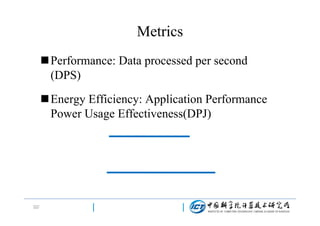
Metrics
Performance: Data processed per second
(DPS)
Energy Efficiency: Application Performance
Power Usage Effectiveness(DPJ)

32/
Xeon VS Atom – DPJ

33/
Xeon VS Tilera – DPJ

34/
Reference
Jing Quan, University of Science and Technology of China, Yingjie
Shi, Chinese Academy of Sciences, Ming Zhao, Florida
International University, Wei Yang, University of Science and
Technology of China.
”The Implications from Benchmarking Three Different Data
Center Platforms”
The First Workshop on Big Data Benchmarks, Performance
Optimization, and Emerging hardware (BPOE 2013) in
conjunction with 2013 IEEE International Conference on Big
Data (IEEE Big Data 2013)

35/
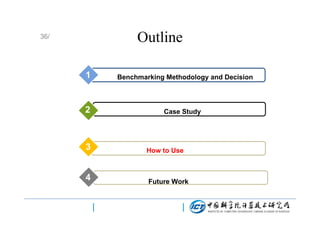
Outline

36/

1

2
3

Benchmarking Methodology and Decision

Case Study

3

How to Use

5
4

Future Work
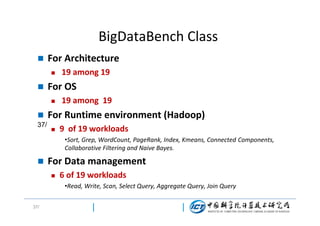
BigDataBench Class


For Architecture




For OS



37/

19 among 19
19 among 19

For Runtime environment (Hadoop)


9 of 19 workloads
•Sort, Grep, WordCount, PageRank, Index, Kmeans, Connected Components,
Collaborative Filtering and Naive Bayes.



For Data management


6 of 19 workloads
•Read, Write, Scan, Select Query, Aggregate Query, Join Query

37/
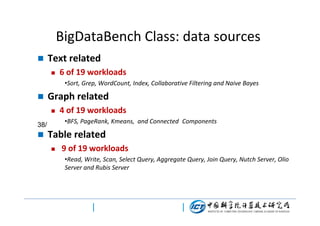
BigDataBench Class: data sources


Text related


6 of 19 workloads
•Sort, Grep, WordCount, Index, Collaborative Filtering and Naive Bayes



Graph related


•BFS, PageRank, Kmeans, and Connected Components

38/



4 of 19 workloads

Table related


9 of 19 workloads
•Read, Write, Scan, Select Query, Aggregate Query, Join Query, Nutch Server, Olio
Server and Rubis Server
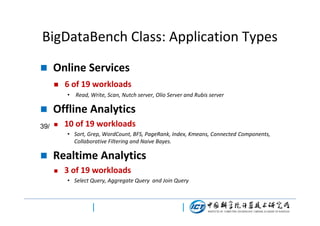
BigDataBench Class: Application Types


Online Services


6 of 19 workloads
• Read, Write, Scan, Nutch server, Olio Server and Rubis server



Offline Analytics

39/ 

10 of 19 workloads
• Sort, Grep, WordCount, BFS, PageRank, Index, Kmeans, Connected Components,
Collaborative Filtering and Naive Bayes.



Realtime Analytics


3 of 19 workloads
• Select Query, Aggregate Query and Join Query
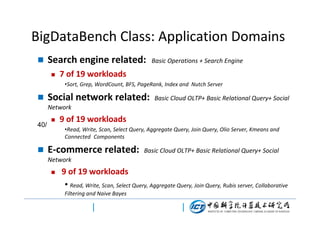
BigDataBench Class: Application Domains


Search engine related:


Basic Operations + Search Engine

7 of 19 workloads
•Sort, Grep, WordCount, BFS, PageRank, Index and Nutch Server



Social network related:

Basic Cloud OLTP+ Basic Relational Query+ Social

Network
40/





9 of 19 workloads
•Read, Write, Scan, Select Query, Aggregate Query, Join Query, Olio Server, Kmeans and
Connected Components

E-commerce related:

Basic Cloud OLTP+ Basic Relational Query+ Social

Network


9 of 19 workloads
• Read, Write, Scan, Select Query, Aggregate Query, Join Query, Rubis server, Collaborative
Filtering and Naive Bayes
Outline

41/

1

2
3

Benchmarking Methodology and Decision

Case Study

3

How to Use

5
4

Future Work
Near Future Work


Multi-media data



Deep learning workloads

42/




42/

HPC
Refine BigDataBench
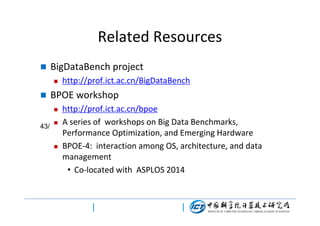
Related Resources


BigDataBench project




BPOE workshop


43/

http://prof.ict.ac.cn/BigDataBench





http://prof.ict.ac.cn/bpoe
A series of workshops on Big Data Benchmarks,
Performance Optimization, and Emerging Hardware
BPOE-4: interaction among OS, architecture, and data
management
• Co-located with ASPLOS 2014
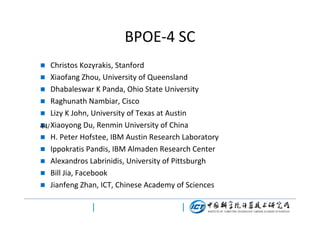
BPOE-4 SC
Christos Kozyrakis, Stanford
 Xiaofang Zhou, University of Queensland
 Dhabaleswar K Panda, Ohio State University
 Raghunath Nambiar, Cisco
 Lizy K John, University of Texas at Austin
 Xiaoyong Du, Renmin University of China
44/
 H. Peter Hofstee, IBM Austin Research Laboratory
 Ippokratis Pandis, IBM Almaden Research Center
 Alexandros Labrinidis, University of Pittsburgh
 Bill Jia, Facebook
 Jianfeng Zhan, ICT, Chinese Academy of Sciences

45/

THANKS

詹剑锋:Big databench—benchmarking big data systems

  • 1.
    BigDataBench: Benchmarking Big DataSystems http://prof.ict.ac.cn/jfzhan INSTITUTE OF COMPUTING TECHNOLOGY 1 Jianfeng Zhan Computer Systems Research Center, ICT, CAS CCF Big Data Technology Conference 2013-12-06
  • 2.
    Why Big DataBenchmarking? 2 Measuring big data architecture and systems quantitatively 2/
  • 3.
    What is BigDataBench?  Anopen source project on big data benchmarking: • 3/ http://prof.ict.ac.cn/BigDataBench/ • 6 real-world data sets and 19 workloads – • 4V characteristics – 3/ Extended in near future Volume, Variety, Velocity, and Veracity
  • 4.
    4/ Comparison of BigData Benchmarking Efforts 4/
  • 5.
    5/ Possible Users Systems OS forbig data File systems for big data ………………………….. Architecture Data management Processor Memory Networks ………….. BigDataBench Performance optimization Co-design 5/ ……..... Distributed systems Scheduling Programming systems
  • 6.
    Research Publications  Characterizing dataanalysis workloads in data centers. Zhen Jia, Lei Wang, Jianfeng Zhan, Lixing Zhang, and Chunjie Luo. IISWC 2013 Best paper award 6/  6/ BigDataBench: a Big Data Benchmark Suite from Internet Services. Lei Wang, Jianfeng Zhan, et al. HPCA 2014, Industry Session.
  • 7.
    Outline 7/ 1 2 3 Benchmarking Methodology andDecision Case Study 3 How to Use 5 4 Future Work
  • 8.
    8/ BigDataBench Methodology 4V ofBig Data 8/ BigDataBench
  • 9.
    Methodology (Cont’) 9/ Represent ative Data Sets Investigate Typical Application Domains DataTypes Structured Semi-structured Unstructured Data Sources Text data Graph data Table data Extended … Big Data Sets Preserving 4V data generation tool preserving data characteristics Diverse Worklo ads Application Types Basic & Important Operations and Algorithms Extended… Offline analytics Realtime analytics Online services Represent Software Stack Extended… BigDataBench Big Data Workloads
  • 10.
    10/ Methodology (Cont’) 4V ofBig Data System and architecture characteristics 10/ BigDataBench Similarity analysis
  • 11.
    Top Sites onthe Web More details in http://www.alexa.com/topsites/global;0 Search Engine, Social Network and Electronic Commerce hold 80% page views of all the 11/ Internet service.
  • 12.
  • 13.
    13/ 19 Chosen Workloads MicroBenchmarks Basic Datastore Operations Relational Queries Application Scenarios Search engines Social networks E-commerce system 13/
  • 14.
    Data Generation Tools  DataSources  Text, Graph and Table • Six real raw data  14/ Synthetics Data  Scale • From GB to PB  Features • Preserve characteristics of real-world data 14/
  • 15.
    15/ Naïve Text generator machine evaluate big system data mining architecture selectword randomly CPU cpu memory benchmarking learning words documents following multinomial distribution Only modeling on the word level; 15/
  • 16.
    Improved Text generator 16/ topic2 topic1 selecttopic randomly machine evaluate big CPU data mining architecture CPU select word randomly benchmarking topic3 memory system learning topics following multinomial distribution words following multinomial distribution under topic2 Modeling on the both topic and word level 16/ document
  • 17.
    Outline 17/ 1 2 3 Benchmarking Methodology andDecision Case Study 3 5 4 17/ How to Use Future Work
  • 18.
    BigDataBench Case Study 18/ Performanceevaluation and Diagnosis SJTU, and XJTU Workload Characterization Evaluating Big Data Hardware Systems ICT, CAS SIAT, CAS USTC, and Florida International University BigDataBench Networks for big data OSU Energy Efficiency of Big Data Systems CNCERT http://prof.ict.ac.cn/BigDataBench/#users 18/
  • 19.
  • 20.
  • 21.
    Floating point operationintensity Data Analytics Services 21 The total number of (floating point or integer) instructions divided by the total number of memory access bytes in a run of workload. Very low floating point operation intensities ( 0.009), two orders of magnitude lower than the theory number of state-of-practice CPU (1.8) 21/
  • 22.
    Instruction Breakdown Data Analytics Services Less floating point operations 22/  More Integer operations
  • 23.
    23/ Ratio of Integerto Floating Point Operations Data Analytics   Services The average of big data workloads is 100 Parsec, HPCC and SPECFP (1.4, 1.0, 0.67)
  • 24.
    Integer operation intensity DataAnalytics Services The average integer operation intensity of big data 24/ workloads is 0.49  That of PARSEC, HPCC, SPECFP is 1.5, 0.38, 0.23 
  • 25.
    Cache Behaviors Data Analytics Services Bigdata workloads have high L1I misses than HPC workloads  Data analysis workloads have better L2 cache behaviors than service workloads 25/ except BFS   Big data workloads have good L3 behaviors
  • 26.
    TLB Behaviors 14 data analysis 5 service ITLBmisses of big data workloads are higher than HPC workloads.  DTLB misses of big data workloads are higher than HPC workloads. 26/  26/
  • 27.
    BigDataBench Case Study 27/ Performanceevaluation and Diagnosis SJTU, and XJTU Big Data workload Characterization Evaluating Big Data Hardware Systems ICT, CAS SIAT, CAS USTC, and Florida International University BigDataBench Networks for big data OSU Energy Efficiency of Big Data Systems CNCERT http://prof.ict.ac.cn/BigDataBench/#users
  • 28.
    Evaluating Big DataHardware Systems 28/
  • 29.
    Experimental Platforms Xeon (Commonprocessor) Atom ( Low power processor) Tilera (Many Brief Comparison Basic Information core processor) CPU Type Intel Atom D510 Tilera TilePro36 CPU Core 4 cores @ 1.6GHz 2 cores @ 1.66GHz 36 cores @ 500MHz L1 I/D Cache 32KB 24KB 16KB/8KB L2 Cache 29/ Intel Xeon E5310 4096KB 512KB 64KB
  • 30.
    Experimental Platforms Hadoop Cluster Information XeonVS Atom Xeon VS Tilera [ 1 Xeon master+7 Comprison [1 Xeon master+7 Xeon Xeon slaves ] VS [ 1 (the same logical slaves] VS [ 1 Xeon Atom master +7 Atom core number) master +1 Tilera slave] slaves] Hadoop setting 30/ Following the guidance on Hadoop official website
  • 31.
    Benchmark Selection BigDataBench 1.0 Application Characteristics Sort O(n*log2n) Integercomparison WordCount O(n) Integer comparison and calculation Grep O(n) String comparison Naïve Bayes O(m*n) Floating-point computation SVM 31/ Time Complexity O(n3) Floating-point computation
  • 32.
    Metrics Performance: Data processedper second (DPS) Energy Efficiency: Application Performance Power Usage Effectiveness(DPJ) 32/
  • 33.
    Xeon VS Atom– DPJ 33/
  • 34.
    Xeon VS Tilera– DPJ 34/
  • 35.
    Reference Jing Quan, Universityof Science and Technology of China, Yingjie Shi, Chinese Academy of Sciences, Ming Zhao, Florida International University, Wei Yang, University of Science and Technology of China. ”The Implications from Benchmarking Three Different Data Center Platforms” The First Workshop on Big Data Benchmarks, Performance Optimization, and Emerging hardware (BPOE 2013) in conjunction with 2013 IEEE International Conference on Big Data (IEEE Big Data 2013) 35/
  • 36.
    Outline 36/ 1 2 3 Benchmarking Methodology andDecision Case Study 3 How to Use 5 4 Future Work
  • 37.
    BigDataBench Class  For Architecture   ForOS   37/ 19 among 19 19 among 19 For Runtime environment (Hadoop)  9 of 19 workloads •Sort, Grep, WordCount, PageRank, Index, Kmeans, Connected Components, Collaborative Filtering and Naive Bayes.  For Data management  6 of 19 workloads •Read, Write, Scan, Select Query, Aggregate Query, Join Query 37/
  • 38.
    BigDataBench Class: datasources  Text related  6 of 19 workloads •Sort, Grep, WordCount, Index, Collaborative Filtering and Naive Bayes  Graph related  •BFS, PageRank, Kmeans, and Connected Components 38/  4 of 19 workloads Table related  9 of 19 workloads •Read, Write, Scan, Select Query, Aggregate Query, Join Query, Nutch Server, Olio Server and Rubis Server
  • 39.
    BigDataBench Class: ApplicationTypes  Online Services  6 of 19 workloads • Read, Write, Scan, Nutch server, Olio Server and Rubis server  Offline Analytics 39/  10 of 19 workloads • Sort, Grep, WordCount, BFS, PageRank, Index, Kmeans, Connected Components, Collaborative Filtering and Naive Bayes.  Realtime Analytics  3 of 19 workloads • Select Query, Aggregate Query and Join Query
  • 40.
    BigDataBench Class: ApplicationDomains  Search engine related:  Basic Operations + Search Engine 7 of 19 workloads •Sort, Grep, WordCount, BFS, PageRank, Index and Nutch Server  Social network related: Basic Cloud OLTP+ Basic Relational Query+ Social Network 40/   9 of 19 workloads •Read, Write, Scan, Select Query, Aggregate Query, Join Query, Olio Server, Kmeans and Connected Components E-commerce related: Basic Cloud OLTP+ Basic Relational Query+ Social Network  9 of 19 workloads • Read, Write, Scan, Select Query, Aggregate Query, Join Query, Rubis server, Collaborative Filtering and Naive Bayes
  • 41.
    Outline 41/ 1 2 3 Benchmarking Methodology andDecision Case Study 3 How to Use 5 4 Future Work
  • 42.
    Near Future Work  Multi-mediadata  Deep learning workloads 42/   42/ HPC Refine BigDataBench
  • 43.
    Related Resources  BigDataBench project   BPOEworkshop  43/ http://prof.ict.ac.cn/BigDataBench   http://prof.ict.ac.cn/bpoe A series of workshops on Big Data Benchmarks, Performance Optimization, and Emerging Hardware BPOE-4: interaction among OS, architecture, and data management • Co-located with ASPLOS 2014
  • 44.
    BPOE-4 SC Christos Kozyrakis,Stanford  Xiaofang Zhou, University of Queensland  Dhabaleswar K Panda, Ohio State University  Raghunath Nambiar, Cisco  Lizy K John, University of Texas at Austin  Xiaoyong Du, Renmin University of China 44/  H. Peter Hofstee, IBM Austin Research Laboratory  Ippokratis Pandis, IBM Almaden Research Center  Alexandros Labrinidis, University of Pittsburgh  Bill Jia, Facebook  Jianfeng Zhan, ICT, Chinese Academy of Sciences 
  • 45.