AGENDA
INTRODUCTION TO INTEL® i7 EXTREME
 PROCESSORS
INTEL® QUICKPATH ARCHITECTURE
INTEL® SMART CACHE TECHNOLOGY
INTEL® HYPER-THREADING TECHNOLOGY
INTEL® TURBO-BOOST TECHNOLOGY
CONCLUSION
REFERENCES
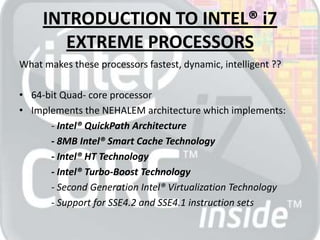
INTRODUCTION TO INTEL® i7
        EXTREME PROCESSORS
What makes these processors fastest, dynamic, intelligent ??

• 64-bit Quad- core processor
• Implements the NEHALEM architecture which implements:
      - Intel® QuickPath Architecture
      - 8MB Intel® Smart Cache Technology
      - Intel® HT Technology
      - Intel® Turbo-Boost Technology
      - Second Generation Intel® Virtualization Technology
      - Support for SSE4.2 and SSE4.1 instruction sets
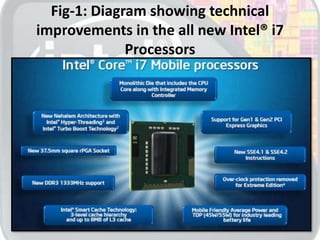
Fig-1: Diagram showing technical
improvements in the all new Intel® i7
              Processors
INTEL® QUICKPATH ARCHITECTURE
•   Earlier, when a Memory Action is performed; control signals followed the
    following path:
    Memory Controllers  Processor  Memory Controllers  Main Memory

•   Small Architectural change which realized significant increase in Memory
    Accessing Time, i.e.
    Memory Controller + Processor

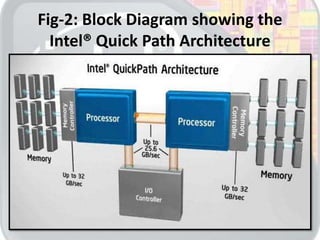
    Intel® QuickPath Architecture features an Integrated Memory Controller and
    High-Speed Interconnect Bus linking processors and other components to
    deliver:
   Dynamically scalable interconnect bandwidth
   Outstanding memory performance and flexibility
   Tightly integrated interconnect reliability, availability, and serviceability (RAS)
   Optimal balance of price, performance, and energy efficiency.
Fig-2: Block Diagram showing the
  Intel® Quick Path Architecture
8MB INTEL® SMART CACHE TECHNOLOGY
     (3-LEVEL CACHE HIERARCHY)
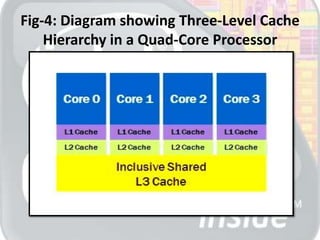
• Shared L2 cache is not suited to a native quad-core architecture as
  different cores can too frequently flush data needed by another core.
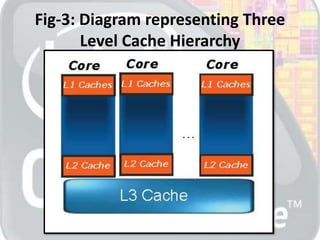
• Therefore in this NEHALAM architecture, each core is provided with a
  Level 2 cache of its own. Since it’s dedicated to a single core and
  relatively small (256 KB), enabled it to endow with very high
  performance; latency.
• Then comes the enormous 8MB L3 cache for managing
  communications between cores.
• ADVANTAGE OF CACHE HIERARCHY:
  If a core tries to access a data item and it’s not present in the Level 3
  cache, there’s no need to look in the other cores’ private caches—the
  data item won’t be there either.
• DISADVANTAGE OF CACHE HIERARCHY:
  Wasting part of the cache memory with data that is already in other
  cache levels.
Fig-3: Diagram representing Three
       Level Cache Hierarchy
Fig-4: Diagram showing Three-Level Cache
    Hierarchy in a Quad-Core Processor
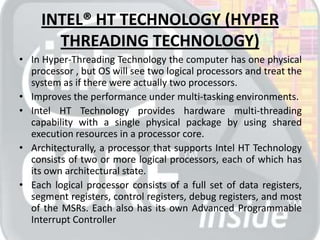
INTEL® HT TECHNOLOGY (HYPER
       THREADING TECHNOLOGY)
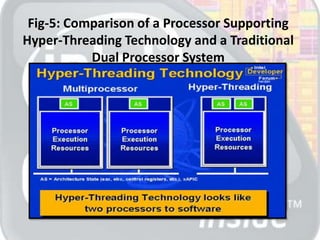
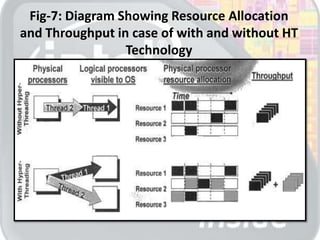
• In Hyper-Threading Technology the computer has one physical
  processor , but OS will see two logical processors and treat the
  system as if there were actually two processors.
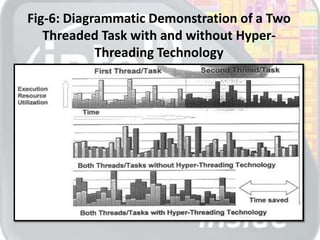
• Improves the performance under multi-tasking environments.
• Intel HT Technology provides hardware multi-threading
  capability with a single physical package by using shared
  execution resources in a processor core.
• Architecturally, a processor that supports Intel HT Technology
  consists of two or more logical processors, each of which has
  its own architectural state.
• Each logical processor consists of a full set of data registers,
  segment registers, control registers, debug registers, and most
  of the MSRs. Each also has its own Advanced Programmable
  Interrupt Controller
Fig-5: Comparison of a Processor Supporting
Hyper-Threading Technology and a Traditional
           Dual Processor System
Fig-6: Diagrammatic Demonstration of a Two
   Threaded Task with and without Hyper-
            Threading Technology
Fig-7: Diagram Showing Resource Allocation
and Throughput in case of with and without HT
                 Technology
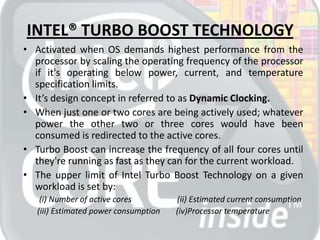
INTEL® TURBO BOOST TECHNOLOGY
• Activated when OS demands highest performance from the
  processor by scaling the operating frequency of the processor
  if it's operating below power, current, and temperature
  specification limits.
• It’s design concept in referred to as Dynamic Clocking.
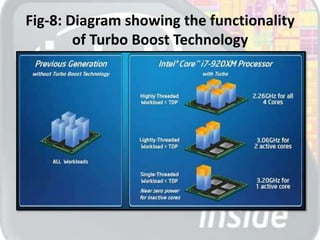
• When just one or two cores are being actively used; whatever
  power the other two or three cores would have been
  consumed is redirected to the active cores.
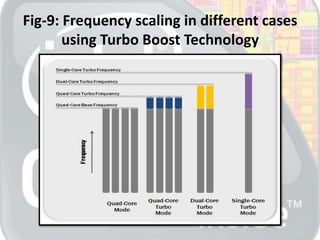
• Turbo Boost can increase the frequency of all four cores until
  they're running as fast as they can for the current workload.
• The upper limit of Intel Turbo Boost Technology on a given
  workload is set by:
    (i) Number of active cores         (ii) Estimated current consumption
   (iii) Estimated power consumption   (iv)Processor temperature
Fig-8: Diagram showing the functionality
        of Turbo Boost Technology
Fig-9: Frequency scaling in different cases
       using Turbo Boost Technology
CONCLUSION
Today's processor are expected to provide
higher performance. That’s what is exactly
provided by the INTEL® i7 processors. Being
the first of its kind, the INTEL® i7 processor
has continuously got good rating from all kind
of users. All the new technologies
implemented in INTEL® i7 processors will
surely lead to a great computing experience.
REFERENCES
[1]Intel i7 Developer’s Manual
[2]http://www.intel.com/content/www/us/en/processors/core/core-i7-
    processor.html
[3]http://reviews.cnet.com/processors/intel-core-i7-965/4505-3086_7-
    33366836.html
[4]http://www.intel.com/technology/product/demos/turboboost/demo.htm?
    iid=tech_demo+tb
[5]http://www.youtube.com/watch?v=llOXMPXH2VA
[6]http://www.youtube.com/watch?v=kkrqyEpINSQ
[7]http://www.intel.com/content/www/us/en/io/quickpath-
    technology/performance-quickpath-architecture-paper.html
[8]http://www.youtube.com/watch?v=bE9EbQOeb_U
[9]http://www.youtube.com/watch?v=An7w0laRGv8
Intel i7 Technologies

Intel i7 Technologies

  • 2.
    AGENDA INTRODUCTION TO INTEL®i7 EXTREME PROCESSORS INTEL® QUICKPATH ARCHITECTURE INTEL® SMART CACHE TECHNOLOGY INTEL® HYPER-THREADING TECHNOLOGY INTEL® TURBO-BOOST TECHNOLOGY CONCLUSION REFERENCES
  • 3.
    INTRODUCTION TO INTEL®i7 EXTREME PROCESSORS What makes these processors fastest, dynamic, intelligent ?? • 64-bit Quad- core processor • Implements the NEHALEM architecture which implements: - Intel® QuickPath Architecture - 8MB Intel® Smart Cache Technology - Intel® HT Technology - Intel® Turbo-Boost Technology - Second Generation Intel® Virtualization Technology - Support for SSE4.2 and SSE4.1 instruction sets
  • 4.
    Fig-1: Diagram showingtechnical improvements in the all new Intel® i7 Processors
  • 5.
    INTEL® QUICKPATH ARCHITECTURE • Earlier, when a Memory Action is performed; control signals followed the following path: Memory Controllers  Processor  Memory Controllers  Main Memory • Small Architectural change which realized significant increase in Memory Accessing Time, i.e. Memory Controller + Processor Intel® QuickPath Architecture features an Integrated Memory Controller and High-Speed Interconnect Bus linking processors and other components to deliver:  Dynamically scalable interconnect bandwidth  Outstanding memory performance and flexibility  Tightly integrated interconnect reliability, availability, and serviceability (RAS)  Optimal balance of price, performance, and energy efficiency.
  • 6.
    Fig-2: Block Diagramshowing the Intel® Quick Path Architecture
  • 7.
    8MB INTEL® SMARTCACHE TECHNOLOGY (3-LEVEL CACHE HIERARCHY) • Shared L2 cache is not suited to a native quad-core architecture as different cores can too frequently flush data needed by another core. • Therefore in this NEHALAM architecture, each core is provided with a Level 2 cache of its own. Since it’s dedicated to a single core and relatively small (256 KB), enabled it to endow with very high performance; latency. • Then comes the enormous 8MB L3 cache for managing communications between cores. • ADVANTAGE OF CACHE HIERARCHY: If a core tries to access a data item and it’s not present in the Level 3 cache, there’s no need to look in the other cores’ private caches—the data item won’t be there either. • DISADVANTAGE OF CACHE HIERARCHY: Wasting part of the cache memory with data that is already in other cache levels.
  • 8.
    Fig-3: Diagram representingThree Level Cache Hierarchy
  • 9.
    Fig-4: Diagram showingThree-Level Cache Hierarchy in a Quad-Core Processor
  • 10.
    INTEL® HT TECHNOLOGY(HYPER THREADING TECHNOLOGY) • In Hyper-Threading Technology the computer has one physical processor , but OS will see two logical processors and treat the system as if there were actually two processors. • Improves the performance under multi-tasking environments. • Intel HT Technology provides hardware multi-threading capability with a single physical package by using shared execution resources in a processor core. • Architecturally, a processor that supports Intel HT Technology consists of two or more logical processors, each of which has its own architectural state. • Each logical processor consists of a full set of data registers, segment registers, control registers, debug registers, and most of the MSRs. Each also has its own Advanced Programmable Interrupt Controller
  • 11.
    Fig-5: Comparison ofa Processor Supporting Hyper-Threading Technology and a Traditional Dual Processor System
  • 12.
    Fig-6: Diagrammatic Demonstrationof a Two Threaded Task with and without Hyper- Threading Technology
  • 13.
    Fig-7: Diagram ShowingResource Allocation and Throughput in case of with and without HT Technology
  • 14.
    INTEL® TURBO BOOSTTECHNOLOGY • Activated when OS demands highest performance from the processor by scaling the operating frequency of the processor if it's operating below power, current, and temperature specification limits. • It’s design concept in referred to as Dynamic Clocking. • When just one or two cores are being actively used; whatever power the other two or three cores would have been consumed is redirected to the active cores. • Turbo Boost can increase the frequency of all four cores until they're running as fast as they can for the current workload. • The upper limit of Intel Turbo Boost Technology on a given workload is set by: (i) Number of active cores (ii) Estimated current consumption (iii) Estimated power consumption (iv)Processor temperature
  • 15.
    Fig-8: Diagram showingthe functionality of Turbo Boost Technology
  • 16.
    Fig-9: Frequency scalingin different cases using Turbo Boost Technology
  • 17.
    CONCLUSION Today's processor areexpected to provide higher performance. That’s what is exactly provided by the INTEL® i7 processors. Being the first of its kind, the INTEL® i7 processor has continuously got good rating from all kind of users. All the new technologies implemented in INTEL® i7 processors will surely lead to a great computing experience.
  • 18.
    REFERENCES [1]Intel i7 Developer’sManual [2]http://www.intel.com/content/www/us/en/processors/core/core-i7- processor.html [3]http://reviews.cnet.com/processors/intel-core-i7-965/4505-3086_7- 33366836.html [4]http://www.intel.com/technology/product/demos/turboboost/demo.htm? iid=tech_demo+tb [5]http://www.youtube.com/watch?v=llOXMPXH2VA [6]http://www.youtube.com/watch?v=kkrqyEpINSQ [7]http://www.intel.com/content/www/us/en/io/quickpath- technology/performance-quickpath-architecture-paper.html [8]http://www.youtube.com/watch?v=bE9EbQOeb_U [9]http://www.youtube.com/watch?v=An7w0laRGv8