INTERFERING IONS AND THEIR ELIMINATIONS
IN QUALITATIVE ANALYSIS
DR P .RAJEESH
ASST.PROFESSOR ,DEPT.OF CHEMISTRY
NEHRU ARTS AND SCIENCE COLLEGE
KANHANGAD,KASARGOD
BY
4/6/2022
Interfering ions in qualitative analysis…
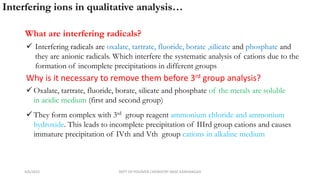
 Oxalate, tartrate, fluoride, borate, silicate and phosphate of the metals are soluble
in acidic medium (first and second group)
 Interfering radicals are oxalate, tartrate, fluoride, borate ,silicate and phosphate and
they are anionic radicals. Which interfere the systematic analysis of cations due to the
formation of incomplete precipitations in different groups
What are interfering radicals?
 They form complex with 3rd group reagent ammonium chloride and ammonium
hydroxide. This leads to incomplete precipitation of IIIrd group cations and causes
immature precipitation of IVth and Vth group cations in alkaline medium
Why is it necessary to remove them before 3rd group analysis?
4/6/2022 DEPT OF POLYMER CHEMISTRY NASC KANHANGAD
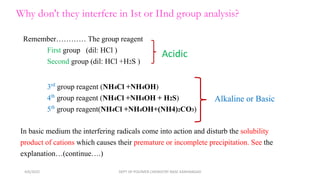
Why don't they interfere in Ist or IInd group analysis?
In basic medium the interfering radicals come into action and disturb the solubility
product of cations which causes their premature or incomplete precipitation. See the
explanation…(continue….)
Remember………… The group reagent
First group (dil: HCl )
Second group (dil: HCl +H2S )
Acidic
3rd group reagent (NH4Cl +NH4OH)
4th group reagent (NH4Cl +NH4OH + H2S)
5th group reagent(NH4Cl +NH4OH+(NH4)2CO3)
Alkaline or Basic
4/6/2022 DEPT OF POLYMER CHEMISTRY NASC KANHANGAD
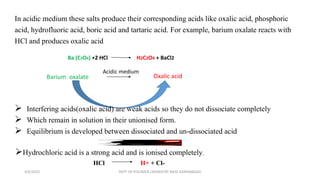
In acidic medium these salts produce their corresponding acids like oxalic acid, phosphoric
acid, hydrofluoric acid, boric acid and tartaric acid. For example, barium oxalate reacts with
HCl and produces oxalic acid
Ba (C2O4) +2 HCl H2C2O4 + BaCl2
Barium oxalate Oxalic acid
Acidic medium
 Interfering acids(oxalic acid) are weak acids so they do not dissociate completely
 Which remain in solution in their unionised form.
 Equilibrium is developed between dissociated and un-dissociated acid
Hydrochloric acid is a strong acid and is ionised completely.
HCl H+ + Cl-
H
2
C
2
O
4
2
H
+
+
C
2
O
4
2
-
4/6/2022 DEPT OF POLYMER CHEMISTRY NASC KANHANGAD
Hydrochloric acid is a strong acid and is ionised completely.
HCl H+ + Cl
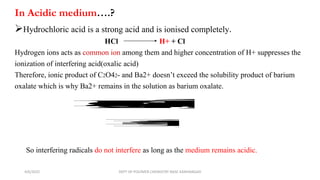
Hydrogen ions acts as common ion among them and higher concentration of H+ suppresses the
ionization of interfering acid(oxalic acid)
Therefore, ionic product of C2O42- and Ba2+ doesn’t exceed the solubility product of barium
oxalate which is why Ba2+ remains in the solution as barium oxalate.
B
a
C
2
O
4
C
2
O
4
2
-
B
a
2
+
+
K
s
p
=
C
2
O
4
2
-
B
a
2
+
So interfering radicals do not interfere as long as the medium remains acidic.
In Acidic medium….?
4/6/2022 DEPT OF POLYMER CHEMISTRY NASC KANHANGAD
In Alkaline medium….
• 3rd group reagent ammonium hydroxide NH4OH, OH- ions combine with H+ and
neutralise them.
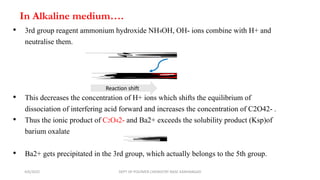
• This decreases the concentration of H+ ions which shifts the equilibrium of
dissociation of interfering acid forward and increases the concentration of C2O42- .
• Thus the ionic product of C2O42- and Ba2+ exceeds the solubility product (Ksp)of
barium oxalate
• Ba2+ gets precipitated in the 3rd group, which actually belongs to the 5th group.
H
2
C
2
O
4
2
H
+
+
C
2
O
4
2
-
N
H
4
O
H
N
H
4
+
+
O
H
-
Reaction shift
K
s
p
=
C
2
O
4
2
-
B
a
2
+
4/6/2022 DEPT OF POLYMER CHEMISTRY NASC KANHANGAD
Oxalate
tartrate
borate
fluoride
silicate
(last) phosphate.
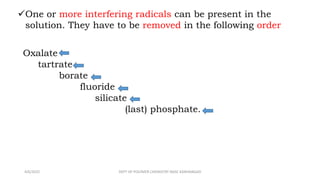
One or more interfering radicals can be present in the
solution. They have to be removed in the following order
4/6/2022 DEPT OF POLYMER CHEMISTRY NASC KANHANGAD
Interfering ions in qualitative analysis
ELIMINATION OF INTERFERING ACID RADICALS
The anions (Certain acid radicals) such as oxalate, borate, phosphate etc. Present in the give
mixture will interfere the analysis of cation. Hence these are to be eliminated before
proceeding for the analysis of the cations.
Elimination of oxalates and Tartrate
Oxalate is eliminated by dry ignition. The substance is heated in a broken china dish or a
crucible for about 15 minutes. The residue containing the carbonate or oxides of the metal is
extracted with hot dilute HCl and filtered. The filtrate which contains the chlorides of the
metal is used for the analysis of the basic radical.
4/6/2022 DEPT OF POLYMER CHEMISTRY NASC KANHANGAD
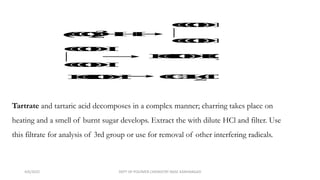
Tartrate and tartaric acid decomposes in a complex manner; charring takes place on
heating and a smell of burnt sugar develops. Extract the with dilute HCl and filter. Use
this filtrate for analysis of 3rd group or use for removal of other interfering radicals.
(
C
O
O
)
2
2
-
+
H
+
C
O
O
H
C
O
O
H
C
O
O
H
C
O
O
H
H
C
O
O
H
+
C
O
2
H
C
O
O
H C
O
+
H
2
O
4/6/2022 DEPT OF POLYMER CHEMISTRY NASC KANHANGAD
2. Elimination of fluorides and borates
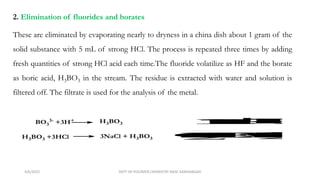
These are eliminated by evaporating nearly to dryness in a china dish about 1 gram of the
solid substance with 5 mL of strong HCl. The process is repeated three times by adding
fresh quantities of strong HCl acid each time.The fluoride volatilize as HF and the borate
as boric acid, H3BO3 in the stream. The residue is extracted with water and solution is
filtered off. The filtrate is used for the analysis of the metal.
BO3
3-
+3H+ H3BO3
H3BO3 +3HCl 3NaCl + H3BO3
F
-
+
H
+
H
F
C
a
F
2
+
H
C
l C
a
C
l
2
+
2
H
F
4/6/2022 DEPT OF POLYMER CHEMISTRY NASC KANHANGAD
Elimination of phosphate
To the boiled solution from the group II (free from H2S) a drop of conc.HNO3 is added and
boiled gently. One drop of saturated NH4Cl solution and three drops of zirconyl nitrate reagent
are added. It is digested for two minutes and centrifuged. The process is repeated till all the
phosphate has been precipitated. The residue of zirconium phosphate is rejected. Now five drops
of saturated NH4Cl and slight excess of ammonium hydroxide are added to the centrifuge. Boiled
again and centrifuged .
4/6/2022 DEPT OF POLYMER CHEMISTRY NASC KANHANGAD
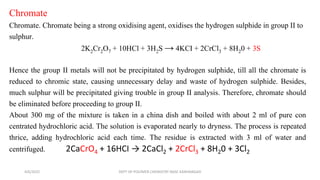
Chromate. Chromate being a strong oxidising agent, oxidises the hydrogen sulphide in group II to
sulphur.
2K2Cr2O7 + 10HCl + 3H2S → 4KCI + 2CrCl3 + 8H20 + 3S
Hence the group II metals will not be precipitated by hydrogen sulphide, till all the chromate is
reduced to chromic state, causing unnecessary delay and waste of hydrogen sulphide. Besides,
much sulphur will be precipitated giving trouble in group II analysis. Therefore, chromate should
be eliminated before proceeding to group II.
About 300 mg of the mixture is taken in a china dish and boiled with about 2 ml of pure con
centrated hydrochloric acid. The solution is evaporated nearly to dryness. The process is repeated
thrice, adding hydrochloric acid each time. The residue is extracted with 3 ml of water and
centrifuged. 2CaCrO4 + 16HCI → 2CaCl2 + 2CrCl3 + 8H20 + 3Cl2
Chromate
4/6/2022 DEPT OF POLYMER CHEMISTRY NASC KANHANGAD
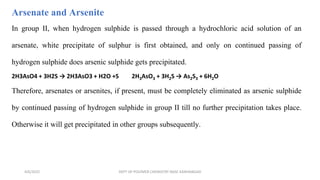
In group II, when hydrogen sulphide is passed through a hydrochloric acid solution of an
arsenate, white precipitate of sulphur is first obtained, and only on continued passing of
hydrogen sulphide does arsenic sulphide gets precipitated.
2H3AsO4 + 3H2S → 2H3AsO3 + H2O +S 2H3AsO3 + 3H2S → As2S3 + 6H2O
Therefore, arsenates or arsenites, if present, must be completely eliminated as arsenic sulphide
by continued passing of hydrogen sulphide in group II till no further precipitation takes place.
Otherwise it will get precipitated in other groups subsequently.
Arsenate and Arsenite
4/6/2022 DEPT OF POLYMER CHEMISTRY NASC KANHANGAD
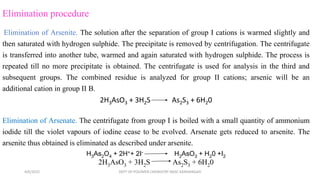
Elimination procedure
Elimination of Arsenite. The solution after the separation of group I cations is warmed slightly and
then saturated with hydrogen sulphide. The precipitate is removed by centrifugation. The centrifugate
is transferred into another tube, warmed and again saturated with hydrogen sulphide. The process is
repeated till no more precipitate is obtained. The centrifugate is used for analysis in the third and
subsequent groups. The combined residue is analyzed for group II cations; arsenic will be an
additional cation in group II B.
2H3AsO3 + 3H2S As2S3 + 6H20
Elimination of Arsenate. The centrifugate from group I is boiled with a small quantity of ammonium
iodide till the violet vapours of iodine cease to be evolved. Arsenate gets reduced to arsenite. The
arsenite thus obtained is eliminated as described under arsenite.
H3As2O4 + 2H++ 2I- H2AsO3 + H20 +I2
2H3AsO3 + 3H2S As2S3 + 6H20
4/6/2022 DEPT OF POLYMER CHEMISTRY NASC KANHANGAD

Interfering radicals in qualitative analysis

  • 1.
    INTERFERING IONS ANDTHEIR ELIMINATIONS IN QUALITATIVE ANALYSIS DR P .RAJEESH ASST.PROFESSOR ,DEPT.OF CHEMISTRY NEHRU ARTS AND SCIENCE COLLEGE KANHANGAD,KASARGOD BY 4/6/2022
  • 2.
    Interfering ions inqualitative analysis…  Oxalate, tartrate, fluoride, borate, silicate and phosphate of the metals are soluble in acidic medium (first and second group)  Interfering radicals are oxalate, tartrate, fluoride, borate ,silicate and phosphate and they are anionic radicals. Which interfere the systematic analysis of cations due to the formation of incomplete precipitations in different groups What are interfering radicals?  They form complex with 3rd group reagent ammonium chloride and ammonium hydroxide. This leads to incomplete precipitation of IIIrd group cations and causes immature precipitation of IVth and Vth group cations in alkaline medium Why is it necessary to remove them before 3rd group analysis? 4/6/2022 DEPT OF POLYMER CHEMISTRY NASC KANHANGAD
  • 3.
    Why don't theyinterfere in Ist or IInd group analysis? In basic medium the interfering radicals come into action and disturb the solubility product of cations which causes their premature or incomplete precipitation. See the explanation…(continue….) Remember………… The group reagent First group (dil: HCl ) Second group (dil: HCl +H2S ) Acidic 3rd group reagent (NH4Cl +NH4OH) 4th group reagent (NH4Cl +NH4OH + H2S) 5th group reagent(NH4Cl +NH4OH+(NH4)2CO3) Alkaline or Basic 4/6/2022 DEPT OF POLYMER CHEMISTRY NASC KANHANGAD
  • 4.
    In acidic mediumthese salts produce their corresponding acids like oxalic acid, phosphoric acid, hydrofluoric acid, boric acid and tartaric acid. For example, barium oxalate reacts with HCl and produces oxalic acid Ba (C2O4) +2 HCl H2C2O4 + BaCl2 Barium oxalate Oxalic acid Acidic medium  Interfering acids(oxalic acid) are weak acids so they do not dissociate completely  Which remain in solution in their unionised form.  Equilibrium is developed between dissociated and un-dissociated acid Hydrochloric acid is a strong acid and is ionised completely. HCl H+ + Cl- H 2 C 2 O 4 2 H + + C 2 O 4 2 - 4/6/2022 DEPT OF POLYMER CHEMISTRY NASC KANHANGAD
  • 5.
    Hydrochloric acid isa strong acid and is ionised completely. HCl H+ + Cl Hydrogen ions acts as common ion among them and higher concentration of H+ suppresses the ionization of interfering acid(oxalic acid) Therefore, ionic product of C2O42- and Ba2+ doesn’t exceed the solubility product of barium oxalate which is why Ba2+ remains in the solution as barium oxalate. B a C 2 O 4 C 2 O 4 2 - B a 2 + + K s p = C 2 O 4 2 - B a 2 + So interfering radicals do not interfere as long as the medium remains acidic. In Acidic medium….? 4/6/2022 DEPT OF POLYMER CHEMISTRY NASC KANHANGAD
  • 6.
    In Alkaline medium…. •3rd group reagent ammonium hydroxide NH4OH, OH- ions combine with H+ and neutralise them. • This decreases the concentration of H+ ions which shifts the equilibrium of dissociation of interfering acid forward and increases the concentration of C2O42- . • Thus the ionic product of C2O42- and Ba2+ exceeds the solubility product (Ksp)of barium oxalate • Ba2+ gets precipitated in the 3rd group, which actually belongs to the 5th group. H 2 C 2 O 4 2 H + + C 2 O 4 2 - N H 4 O H N H 4 + + O H - Reaction shift K s p = C 2 O 4 2 - B a 2 + 4/6/2022 DEPT OF POLYMER CHEMISTRY NASC KANHANGAD
  • 7.
    Oxalate tartrate borate fluoride silicate (last) phosphate. One ormore interfering radicals can be present in the solution. They have to be removed in the following order 4/6/2022 DEPT OF POLYMER CHEMISTRY NASC KANHANGAD
  • 8.
    Interfering ions inqualitative analysis ELIMINATION OF INTERFERING ACID RADICALS The anions (Certain acid radicals) such as oxalate, borate, phosphate etc. Present in the give mixture will interfere the analysis of cation. Hence these are to be eliminated before proceeding for the analysis of the cations. Elimination of oxalates and Tartrate Oxalate is eliminated by dry ignition. The substance is heated in a broken china dish or a crucible for about 15 minutes. The residue containing the carbonate or oxides of the metal is extracted with hot dilute HCl and filtered. The filtrate which contains the chlorides of the metal is used for the analysis of the basic radical. 4/6/2022 DEPT OF POLYMER CHEMISTRY NASC KANHANGAD
  • 9.
    Tartrate and tartaricacid decomposes in a complex manner; charring takes place on heating and a smell of burnt sugar develops. Extract the with dilute HCl and filter. Use this filtrate for analysis of 3rd group or use for removal of other interfering radicals. ( C O O ) 2 2 - + H + C O O H C O O H C O O H C O O H H C O O H + C O 2 H C O O H C O + H 2 O 4/6/2022 DEPT OF POLYMER CHEMISTRY NASC KANHANGAD
  • 10.
    2. Elimination offluorides and borates These are eliminated by evaporating nearly to dryness in a china dish about 1 gram of the solid substance with 5 mL of strong HCl. The process is repeated three times by adding fresh quantities of strong HCl acid each time.The fluoride volatilize as HF and the borate as boric acid, H3BO3 in the stream. The residue is extracted with water and solution is filtered off. The filtrate is used for the analysis of the metal. BO3 3- +3H+ H3BO3 H3BO3 +3HCl 3NaCl + H3BO3 F - + H + H F C a F 2 + H C l C a C l 2 + 2 H F 4/6/2022 DEPT OF POLYMER CHEMISTRY NASC KANHANGAD
  • 11.
    Elimination of phosphate Tothe boiled solution from the group II (free from H2S) a drop of conc.HNO3 is added and boiled gently. One drop of saturated NH4Cl solution and three drops of zirconyl nitrate reagent are added. It is digested for two minutes and centrifuged. The process is repeated till all the phosphate has been precipitated. The residue of zirconium phosphate is rejected. Now five drops of saturated NH4Cl and slight excess of ammonium hydroxide are added to the centrifuge. Boiled again and centrifuged . 4/6/2022 DEPT OF POLYMER CHEMISTRY NASC KANHANGAD
  • 12.
    Chromate. Chromate beinga strong oxidising agent, oxidises the hydrogen sulphide in group II to sulphur. 2K2Cr2O7 + 10HCl + 3H2S → 4KCI + 2CrCl3 + 8H20 + 3S Hence the group II metals will not be precipitated by hydrogen sulphide, till all the chromate is reduced to chromic state, causing unnecessary delay and waste of hydrogen sulphide. Besides, much sulphur will be precipitated giving trouble in group II analysis. Therefore, chromate should be eliminated before proceeding to group II. About 300 mg of the mixture is taken in a china dish and boiled with about 2 ml of pure con centrated hydrochloric acid. The solution is evaporated nearly to dryness. The process is repeated thrice, adding hydrochloric acid each time. The residue is extracted with 3 ml of water and centrifuged. 2CaCrO4 + 16HCI → 2CaCl2 + 2CrCl3 + 8H20 + 3Cl2 Chromate 4/6/2022 DEPT OF POLYMER CHEMISTRY NASC KANHANGAD
  • 13.
    In group II,when hydrogen sulphide is passed through a hydrochloric acid solution of an arsenate, white precipitate of sulphur is first obtained, and only on continued passing of hydrogen sulphide does arsenic sulphide gets precipitated. 2H3AsO4 + 3H2S → 2H3AsO3 + H2O +S 2H3AsO3 + 3H2S → As2S3 + 6H2O Therefore, arsenates or arsenites, if present, must be completely eliminated as arsenic sulphide by continued passing of hydrogen sulphide in group II till no further precipitation takes place. Otherwise it will get precipitated in other groups subsequently. Arsenate and Arsenite 4/6/2022 DEPT OF POLYMER CHEMISTRY NASC KANHANGAD
  • 14.
    Elimination procedure Elimination ofArsenite. The solution after the separation of group I cations is warmed slightly and then saturated with hydrogen sulphide. The precipitate is removed by centrifugation. The centrifugate is transferred into another tube, warmed and again saturated with hydrogen sulphide. The process is repeated till no more precipitate is obtained. The centrifugate is used for analysis in the third and subsequent groups. The combined residue is analyzed for group II cations; arsenic will be an additional cation in group II B. 2H3AsO3 + 3H2S As2S3 + 6H20 Elimination of Arsenate. The centrifugate from group I is boiled with a small quantity of ammonium iodide till the violet vapours of iodine cease to be evolved. Arsenate gets reduced to arsenite. The arsenite thus obtained is eliminated as described under arsenite. H3As2O4 + 2H++ 2I- H2AsO3 + H20 +I2 2H3AsO3 + 3H2S As2S3 + 6H20 4/6/2022 DEPT OF POLYMER CHEMISTRY NASC KANHANGAD
  • 15.
    4/6/2022 DEPT OFPOLYMER CHEMISTRY NASC KANHANGAD