DEPARTMENT OF CHEMISTRY
Presented by:
Madan S M
MSc Chemistry
UP222506
Contents:
• Introduction
• Electrolytes and non electrolytes
• Arrhenius Theory of acid and base
• Postulates of Arrhenius theory of ionization
• Achievements of Arrhenius theory of ionization
• Limitations of Arrhenius theory of ionization
• Reference
Introduction
• Arrhenius theory, theory, introduced in 1887 by the Swedish
scientist Svante Arrhenius, that acids are substances that dissociate in
water to yield electrically charged atoms or molecules, called ions, one
of which is a hydrogen ion (H+), and that bases ionize in water to yield
hydroxide ions (OH−).who got Nobel prize in 1903 from the work on
electrolytes, He focused on what ions were formed when acids and
base dissolve in water . He came up with the idea that acids and bases
dissociate in water to give hydrogen ion and hydroxide ions.
Electrolytes and Nonelectrolytes
• An electrolyte is a compound that conducts an electric current when it
is in an aqueous solution or melted. In order to conduct a current, a
substance must contain mobile ions that can move from one electrode
to the other. Example: potassium ion, sodium ion
• A nonelectrolyte is a compound that does not conduct an electric
current in either aqueous solution or in the molten state. Many
molecular compounds, such as sugar or ethanol, are nonelectrolytes.
When these compounds dissolve in water, they do not produce ions.
Arrhenius Theory of Acid and Base
• Arrhenius acid in the aqueous solution increases the concentration of
protons or H+ ions. For example, hydrochloric acid in the water. HCl
undergoes dissociation reaction to produce H+ ion and Cl– ion, as
explained below. The concentration of the H+ ions is increased by
forming hydronium ion.
• HCl (aq) → H+
(aq) + Cl–
(aq)
• Arrhenius base is a substrate that increases the concentration of
hydroxide ions in the aqueous solution. The example for Arrhenius
base is highly soluble sodium hydroxide compound in water, which
dissociates to give sodium ion and hydroxide ion.
• NaOH(aq) → Na+
(aq) + OH–
(aq)
Postulates Of Arrhenius Theory Of
Ionization
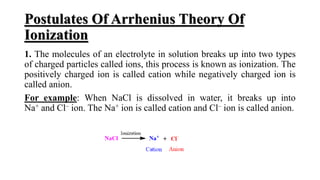
1. The molecules of an electrolyte in solution breaks up into two types
of charged particles called ions, this process is known as ionization. The
positively charged ion is called cation while negatively charged ion is
called anion.
For example: When NaCl is dissolved in water, it breaks up into
Na+ and Cl– ion. The Na+ ion is called cation and Cl– ion is called anion.
2. On applying electric field to a electrolytic solution the positively
charged ions move towards cathode and are called cations. while
negatively charged ions move towards anode and are called anions.
3. The total charge presented on the cation is equal and opposite to the
charge of anion.so that the solution as a whole is electrically neutral.
4. The oppositely charged ion formed it will completely reunite to form
undissociated molecule and a dynamic equilibrium always exist
between the dissociated molecule such a equilibrium is called ionic
equilibrium.
5. The extent of ionization is expressed in terms of the degree of
ionization. The degree of ionization is defined as the ratio of no. of
moles of ions to no. of moles of undissociated molecules.
Mathematically, the degree of ionization can be expressed as:
Achievement‘s Of The Theory
• Differentiate electrolyte from non electrolyte.
• Explain conductivity of weak electrolytes.
• Describes mechanism of electrolytes and ionic reaction.
• Explains heat of neutralization
Limitations Of Arrhenius Theory Of
Ionization
1. Fails to explain how ions are formed.
2. Fails to explain strong electrolyte conductivity.
3. Fails to explain equilibrium constant(k) for strong acids.
4. Fails to explain the variation of transport number with concentration.
5. Fails to explain for variation of conductivity with concentration of
strong electrolytes.
Reference:
• P.W. Atkins & J.D. Paula, Elements of Physical Chemistry, 4th
Edition, Oxford University Press, 2010
• https://youtu.be/1M-uCX6xOCw
Thank you

Arrhenius theory.pptx

  • 1.
    DEPARTMENT OF CHEMISTRY Presentedby: Madan S M MSc Chemistry UP222506
  • 2.
    Contents: • Introduction • Electrolytesand non electrolytes • Arrhenius Theory of acid and base • Postulates of Arrhenius theory of ionization • Achievements of Arrhenius theory of ionization • Limitations of Arrhenius theory of ionization • Reference
  • 3.
    Introduction • Arrhenius theory,theory, introduced in 1887 by the Swedish scientist Svante Arrhenius, that acids are substances that dissociate in water to yield electrically charged atoms or molecules, called ions, one of which is a hydrogen ion (H+), and that bases ionize in water to yield hydroxide ions (OH−).who got Nobel prize in 1903 from the work on electrolytes, He focused on what ions were formed when acids and base dissolve in water . He came up with the idea that acids and bases dissociate in water to give hydrogen ion and hydroxide ions.
  • 4.
    Electrolytes and Nonelectrolytes •An electrolyte is a compound that conducts an electric current when it is in an aqueous solution or melted. In order to conduct a current, a substance must contain mobile ions that can move from one electrode to the other. Example: potassium ion, sodium ion • A nonelectrolyte is a compound that does not conduct an electric current in either aqueous solution or in the molten state. Many molecular compounds, such as sugar or ethanol, are nonelectrolytes. When these compounds dissolve in water, they do not produce ions.
  • 5.
    Arrhenius Theory ofAcid and Base • Arrhenius acid in the aqueous solution increases the concentration of protons or H+ ions. For example, hydrochloric acid in the water. HCl undergoes dissociation reaction to produce H+ ion and Cl– ion, as explained below. The concentration of the H+ ions is increased by forming hydronium ion. • HCl (aq) → H+ (aq) + Cl– (aq) • Arrhenius base is a substrate that increases the concentration of hydroxide ions in the aqueous solution. The example for Arrhenius base is highly soluble sodium hydroxide compound in water, which dissociates to give sodium ion and hydroxide ion. • NaOH(aq) → Na+ (aq) + OH– (aq)
  • 6.
    Postulates Of ArrheniusTheory Of Ionization 1. The molecules of an electrolyte in solution breaks up into two types of charged particles called ions, this process is known as ionization. The positively charged ion is called cation while negatively charged ion is called anion. For example: When NaCl is dissolved in water, it breaks up into Na+ and Cl– ion. The Na+ ion is called cation and Cl– ion is called anion.
  • 7.
    2. On applyingelectric field to a electrolytic solution the positively charged ions move towards cathode and are called cations. while negatively charged ions move towards anode and are called anions.
  • 8.
    3. The totalcharge presented on the cation is equal and opposite to the charge of anion.so that the solution as a whole is electrically neutral.
  • 9.
    4. The oppositelycharged ion formed it will completely reunite to form undissociated molecule and a dynamic equilibrium always exist between the dissociated molecule such a equilibrium is called ionic equilibrium.
  • 10.
    5. The extentof ionization is expressed in terms of the degree of ionization. The degree of ionization is defined as the ratio of no. of moles of ions to no. of moles of undissociated molecules. Mathematically, the degree of ionization can be expressed as:
  • 11.
    Achievement‘s Of TheTheory • Differentiate electrolyte from non electrolyte. • Explain conductivity of weak electrolytes. • Describes mechanism of electrolytes and ionic reaction. • Explains heat of neutralization
  • 12.
    Limitations Of ArrheniusTheory Of Ionization 1. Fails to explain how ions are formed. 2. Fails to explain strong electrolyte conductivity. 3. Fails to explain equilibrium constant(k) for strong acids. 4. Fails to explain the variation of transport number with concentration. 5. Fails to explain for variation of conductivity with concentration of strong electrolytes.
  • 13.
    Reference: • P.W. Atkins& J.D. Paula, Elements of Physical Chemistry, 4th Edition, Oxford University Press, 2010 • https://youtu.be/1M-uCX6xOCw
  • 14.