STKT3243
LIQUID-LIQUID EXTRACTION
INTRODUCTION
• A process is often made up of a reaction step
followed by separations.
• When analyzing the process in details, one can
see that it consists of a reactor fed with
reagents and energy.
• The products of the reactions (main reaction,
but also secondary reactions) flow out of the
reactor, as well as the reagents that have not
reacted.
INTRODUCTION
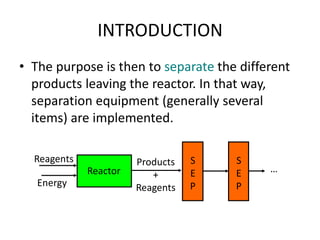
• The purpose is then to separate the different
products leaving the reactor. In that way,
separation equipment (generally several
items) are implemented.
S
E
P
Reactor
S
E
P
Reagents
Energy
Products
+
Reagents
…
INTRODUCTION
• In most cases, distillation is carried out. However, in certain
conditions, it is not suitable. Then, one may choose other
separation techniques, such as absorption, adsorption or
liquid extraction, also called solvent extraction.
• It is particularly the case when:
- Liquids have boiling points with are close to each other
- Their boiling points have a high value
- The mixture forms an azeotrope
- Distillation must be performed under high vacuum conditions
- The products are heat-sensitive (recovery of antibiotics or
vitamins)
GENERAL PRINCIPLES
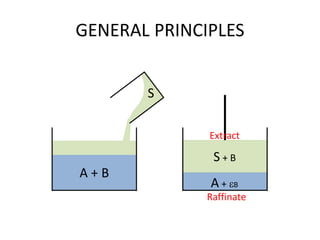
• Let us consider a homogeneous liquid mixture
constituted by a diluent A and a solute B which are
miscible. The objective is to recover the solute.
• Let us add a liquid solvent phase, non miscible with A.
Under the effect of agitation, the solvent phase is
dispersed as droplets in the diluent phase. A part of the
solute is transferred from the diluent phase to the
solvent phase.
• When agitation is stopped, the two phases are separated
by decantation, the lighter phase (it will be supposed
here that the solvent is lighter than the diluent) being
concentrated in the upper part of the vessel.
GENERAL PRINCIPLES
• The solvent phase is called the extract , the diluent phase
is called the raffinate.
• The two phases are at equilibrium. This equilibrium is
defined by an ideal stage.
• A stage is considered as ideal when the contact between
the phases is long enough in order to reach the solute
distribution equilibrium between the extract and the
raffinate
GENERAL PRINCIPLES
A + B
S
A + eB
S + B
Raffinate
Extract
GENERAL PRINCIPLES
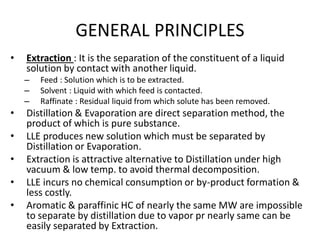
• Extraction : It is the separation of the constituent of a liquid
solution by contact with another liquid.
– Feed : Solution which is to be extracted.
– Solvent : Liquid with which feed is contacted.
– Raffinate : Residual liquid from which solute has been removed.
• Distillation & Evaporation are direct separation method, the
product of which is pure substance.
• LLE produces new solution which must be separated by
Distillation or Evaporation.
• Extraction is attractive alternative to Distillation under high
vacuum & low temp. to avoid thermal decomposition.
• LLE incurs no chemical consumption or by-product formation &
less costly.
• Aromatic & paraffinic HC of nearly the same MW are impossible
to separate by distillation due to vapor pr nearly same can be
easily separated by Extraction.
GENERAL PRINCIPLES
• Favorable properties (Mass transfer kinetics – equilibrium after
contact less than a few minutes ; Economy – cheap and available
solvent ; Safety of use – low toxicity, low flammability, low
volatility, low corrosion in comparison with usual construction
materials), but particularly a property called selectivity.
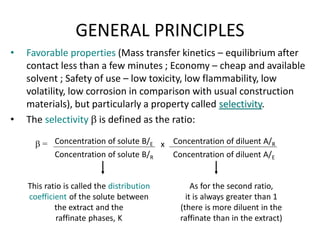
• The selectivity b is defined as the ratio:
b = Concentration of diluent A/R
Concentration of diluent A/E
Concentration of solute B/E
Concentration of solute B/R
x
This ratio is called the distribution
coefficient of the solute between
the extract and the
raffinate phases, K
As for the second ratio,
it is always greater than 1
(there is more diluent in the
raffinate than in the extract)
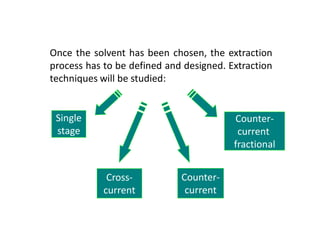
Once the solvent has been chosen, the extraction
process has to be defined and designed. Extraction
techniques will be studied:
Single
stage
Cross-
current
Counter-
current
Counter-
current
fractional
SINGLE STAGE EXTRACTION
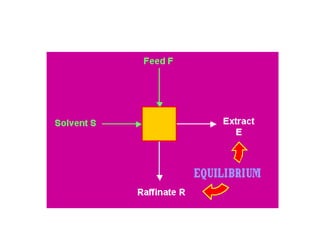
• Mixer and settler in separate units or same unit
• Mixer - a tank contains propeller agitator
• At the end of mixing: agitator shut off, layers
allowed to separate, extract & raffinate drawn off
to separate receivers
• Afterwards: distillation, crystallization,
evaporation, reextraction
• Often times, several extraction stages are
required
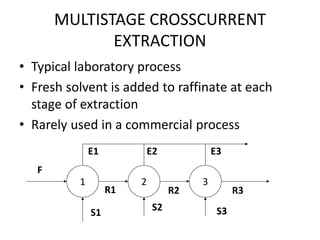
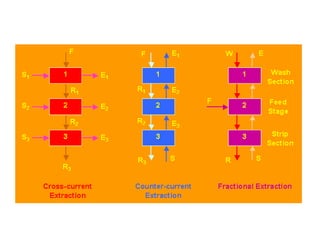
MULTISTAGE CROSSCURRENT
EXTRACTION
• Typical laboratory process
• Fresh solvent is added to raffinate at each
stage of extraction
• Rarely used in a commercial process
1 2 3
F
E1 E2 E3
S1
S2 S3
R1 R2 R3
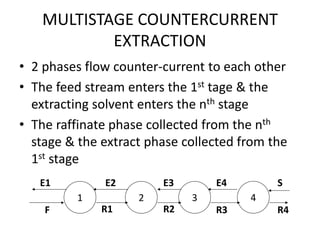
MULTISTAGE COUNTERCURRENT
EXTRACTION
• 2 phases flow counter-current to each other
• The feed stream enters the 1st tage & the
extracting solvent enters the nth stage
• The raffinate phase collected from the nth
stage & the extract phase collected from the
1st stage
1 2 3 4
F R1 R2 R3 R4
S
E1 E2 E3 E4
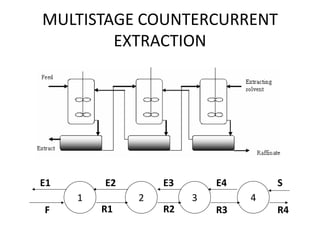
MULTISTAGE COUNTERCURRENT
EXTRACTION
1 2 3 4
F R1 R2 R3 R4
S
E1 E2 E3 E4
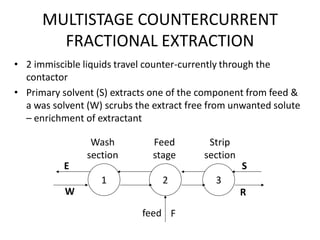
MULTISTAGE COUNTERCURRENT
FRACTIONAL EXTRACTION
• 2 immiscible liquids travel counter-currently through the
contactor
• Primary solvent (S) extracts one of the component from feed &
a was solvent (W) scrubs the extract free from unwanted solute
– enrichment of extractant
E S
1 2 3
R
feed F
Wash
section
Feed
stage
Strip
section
W
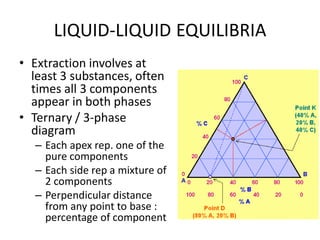
LIQUID-LIQUID EQUILIBRIA
• Extraction involves at
least 3 substances, often
times all 3 components
appear in both phases
• Ternary / 3-phase
diagram
– Each apex rep. one of the
pure components
– Each side rep a mixture of
2 components
– Perpendicular distance
from any point to base :
percentage of component
LIQUID-LIQUID EQUILIBRIUM SYSTEMS
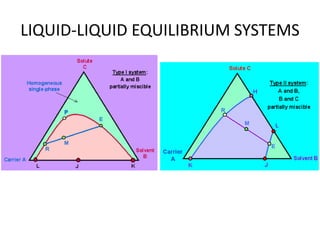
• Type I and Type II
LIQUID-LIQUID EQUILIBRIUM SYSTEMS
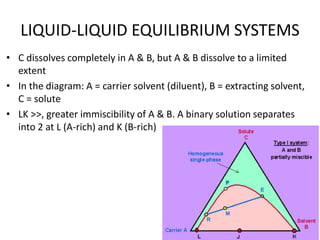
• C dissolves completely in A & B, but A & B dissolve to a limited
extent
• In the diagram: A = carrier solvent (diluent), B = extracting solvent,
C = solute
• LK >>, greater immiscibility of A & B. A binary solution separates
into 2 at L (A-rich) and K (B-rich)
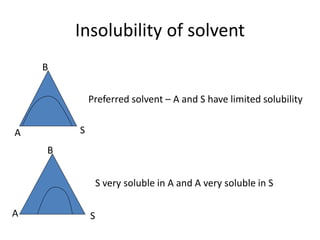
Insolubility of solvent
B
A S
B
A S
Preferred solvent – A and S have limited solubility
S very soluble in A and A very soluble in S
LIQUID-LIQUID EQUILIBRIUM SYSTEMS
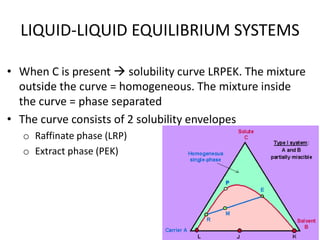
• When C is present  solubility curve LRPEK. The mixture
outside the curve = homogeneous. The mixture inside
the curve = phase separated
• The curve consists of 2 solubility envelopes
o Raffinate phase (LRP)
o Extract phase (PEK)
LIQUID-LIQUID EQUILIBRIUM SYSTEMS
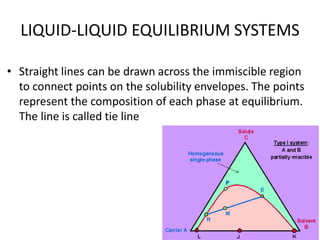
• Straight lines can be drawn across the immiscible region
to connect points on the solubility envelopes. The points
represent the composition of each phase at equilibrium.
The line is called tie line
PHASE COMPOSITIONS – Single Stage
Extraction
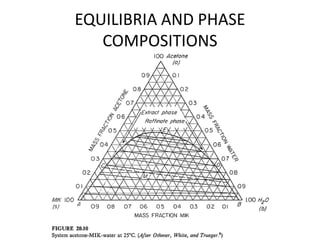
• Lets consider
acetone-water-methyl isobutyl ketone (MIBK)
system (Type I)
• Solvent (MIBK) & Diluent (water) are slightly
miscible
• Solute (acetone) completely soluble in both
MIBK & water
EQUILIBRIA AND PHASE
COMPOSITIONS
PHASE COMPOSITIONS – Single Stage
Extraction
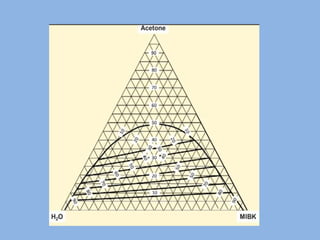
• Determination of phase composition
 CASE 1 – 70 % acetone, 10 % water, 20 % MIBK
 CASE 2 – 33 % acetone, 33 % water, 33 % MIBK
 CASE 3 – 40 : 60 kg acetone : water mixture added
with 100 kg MIBK
• Repeated contacts of the raffinate phase with
fresh solvent – crosscurrent extraction
• Some assumptions made for obtaining an
analytical solution for multistage crosscurrent
extraction are:
1. The raffinate and extract streams from each stage are
in equilibrium
2. There is negligible entrainment of the other phases
3. The same equilibrium relationship holds good for all
the stages, i.e. the value of K is independent of solute
concentration
PHASE COMPOSITIONS – Multi Stage
Crosscurrent (Concurrent) Extraction
PHASE COMPOSITIONS – Multi Stage
Crosscurrent (Concurrent) Extraction
• The calculation is the repeat of that for single stage extraction. The
amount of liquid can be different in each stage
• Consider solute C in carrier A, mixed with solvent B. For
crosscurrent (concurrent) contact with immiscible solvents a simple
mass balance for solute C at steady state gives the operating line:
• xn = [A/(A+Bm)]n xf
where xn = kg C/kg A in raffinate
A = mass of carrier A in feed
B = mass of solvent B added
m = distribution coefficient
xf = kg C/kg A in feed
PHASE COMPOSITIONS – Multi Stage
Crosscurrent (Concurrent) Extraction
• Compound A (10%) is in toluene and is to be extracted
with water in a five-stage concurrent unit. If 25 kg of water
is used per 100 kg feed, find the amount of Compound A
extracted and the final concentration of the raffinate.
Given that the equilibrium relation or diffusion coefficient,
KCompound A(water/toluene) = 2.20.
• xn = [A/(A+Bm)]n xf
where xn = kg C/kg A in raffinate
A = mass of carrier A in feed
B = mass of solvent B added
m = distribution coefficient
xf = kg C/kg A in feed
PHASE COMPOSITIONS – Multi Stage
Crosscurrent (Concurrent) Extraction
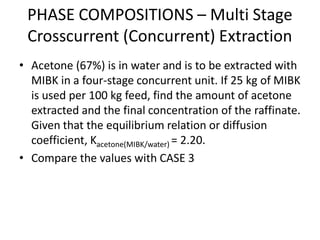
• Acetone (67%) is in water and is to be extracted with
MIBK in a four-stage concurrent unit. If 25 kg of MIBK
is used per 100 kg feed, find the amount of acetone
extracted and the final concentration of the raffinate.
Given that the equilibrium relation or diffusion
coefficient, Kacetone(MIBK/water) = 2.20.
• Compare the values with CASE 3
PHASE COMPOSITIONS – Multi Stage
Countercurrent Extraction
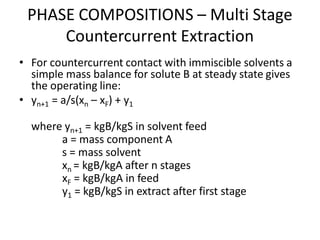
• For countercurrent contact with immiscible solvents a
simple mass balance for solute B at steady state gives
the operating line:
• yn+1 = a/s(xn – xF) + y1
where yn+1 = kgB/kgS in solvent feed
a = mass component A
s = mass solvent
xn = kgB/kgA after n stages
xF = kgB/kgA in feed
y1 = kgB/kgS in extract after first stage

topic liquid-liquid extraction process.pptx

  • 1.
  • 2.
    INTRODUCTION • A processis often made up of a reaction step followed by separations. • When analyzing the process in details, one can see that it consists of a reactor fed with reagents and energy. • The products of the reactions (main reaction, but also secondary reactions) flow out of the reactor, as well as the reagents that have not reacted.
  • 3.
    INTRODUCTION • The purposeis then to separate the different products leaving the reactor. In that way, separation equipment (generally several items) are implemented. S E P Reactor S E P Reagents Energy Products + Reagents …
  • 4.
    INTRODUCTION • In mostcases, distillation is carried out. However, in certain conditions, it is not suitable. Then, one may choose other separation techniques, such as absorption, adsorption or liquid extraction, also called solvent extraction. • It is particularly the case when: - Liquids have boiling points with are close to each other - Their boiling points have a high value - The mixture forms an azeotrope - Distillation must be performed under high vacuum conditions - The products are heat-sensitive (recovery of antibiotics or vitamins)
  • 5.
    GENERAL PRINCIPLES • Letus consider a homogeneous liquid mixture constituted by a diluent A and a solute B which are miscible. The objective is to recover the solute. • Let us add a liquid solvent phase, non miscible with A. Under the effect of agitation, the solvent phase is dispersed as droplets in the diluent phase. A part of the solute is transferred from the diluent phase to the solvent phase. • When agitation is stopped, the two phases are separated by decantation, the lighter phase (it will be supposed here that the solvent is lighter than the diluent) being concentrated in the upper part of the vessel.
  • 6.
    GENERAL PRINCIPLES • Thesolvent phase is called the extract , the diluent phase is called the raffinate. • The two phases are at equilibrium. This equilibrium is defined by an ideal stage. • A stage is considered as ideal when the contact between the phases is long enough in order to reach the solute distribution equilibrium between the extract and the raffinate
  • 7.
    GENERAL PRINCIPLES A +B S A + eB S + B Raffinate Extract
  • 8.
    GENERAL PRINCIPLES • Extraction: It is the separation of the constituent of a liquid solution by contact with another liquid. – Feed : Solution which is to be extracted. – Solvent : Liquid with which feed is contacted. – Raffinate : Residual liquid from which solute has been removed. • Distillation & Evaporation are direct separation method, the product of which is pure substance. • LLE produces new solution which must be separated by Distillation or Evaporation. • Extraction is attractive alternative to Distillation under high vacuum & low temp. to avoid thermal decomposition. • LLE incurs no chemical consumption or by-product formation & less costly. • Aromatic & paraffinic HC of nearly the same MW are impossible to separate by distillation due to vapor pr nearly same can be easily separated by Extraction.
  • 9.
    GENERAL PRINCIPLES • Favorableproperties (Mass transfer kinetics – equilibrium after contact less than a few minutes ; Economy – cheap and available solvent ; Safety of use – low toxicity, low flammability, low volatility, low corrosion in comparison with usual construction materials), but particularly a property called selectivity. • The selectivity b is defined as the ratio: b = Concentration of diluent A/R Concentration of diluent A/E Concentration of solute B/E Concentration of solute B/R x This ratio is called the distribution coefficient of the solute between the extract and the raffinate phases, K As for the second ratio, it is always greater than 1 (there is more diluent in the raffinate than in the extract)
  • 10.
    Once the solventhas been chosen, the extraction process has to be defined and designed. Extraction techniques will be studied: Single stage Cross- current Counter- current Counter- current fractional
  • 11.
    SINGLE STAGE EXTRACTION •Mixer and settler in separate units or same unit • Mixer - a tank contains propeller agitator • At the end of mixing: agitator shut off, layers allowed to separate, extract & raffinate drawn off to separate receivers • Afterwards: distillation, crystallization, evaporation, reextraction • Often times, several extraction stages are required
  • 13.
    MULTISTAGE CROSSCURRENT EXTRACTION • Typicallaboratory process • Fresh solvent is added to raffinate at each stage of extraction • Rarely used in a commercial process 1 2 3 F E1 E2 E3 S1 S2 S3 R1 R2 R3
  • 14.
    MULTISTAGE COUNTERCURRENT EXTRACTION • 2phases flow counter-current to each other • The feed stream enters the 1st tage & the extracting solvent enters the nth stage • The raffinate phase collected from the nth stage & the extract phase collected from the 1st stage 1 2 3 4 F R1 R2 R3 R4 S E1 E2 E3 E4
  • 15.
    MULTISTAGE COUNTERCURRENT EXTRACTION 1 23 4 F R1 R2 R3 R4 S E1 E2 E3 E4
  • 16.
    MULTISTAGE COUNTERCURRENT FRACTIONAL EXTRACTION •2 immiscible liquids travel counter-currently through the contactor • Primary solvent (S) extracts one of the component from feed & a was solvent (W) scrubs the extract free from unwanted solute – enrichment of extractant E S 1 2 3 R feed F Wash section Feed stage Strip section W
  • 18.
    LIQUID-LIQUID EQUILIBRIA • Extractioninvolves at least 3 substances, often times all 3 components appear in both phases • Ternary / 3-phase diagram – Each apex rep. one of the pure components – Each side rep a mixture of 2 components – Perpendicular distance from any point to base : percentage of component
  • 19.
  • 20.
    LIQUID-LIQUID EQUILIBRIUM SYSTEMS •C dissolves completely in A & B, but A & B dissolve to a limited extent • In the diagram: A = carrier solvent (diluent), B = extracting solvent, C = solute • LK >>, greater immiscibility of A & B. A binary solution separates into 2 at L (A-rich) and K (B-rich)
  • 21.
    Insolubility of solvent B AS B A S Preferred solvent – A and S have limited solubility S very soluble in A and A very soluble in S
  • 22.
    LIQUID-LIQUID EQUILIBRIUM SYSTEMS •When C is present  solubility curve LRPEK. The mixture outside the curve = homogeneous. The mixture inside the curve = phase separated • The curve consists of 2 solubility envelopes o Raffinate phase (LRP) o Extract phase (PEK)
  • 23.
    LIQUID-LIQUID EQUILIBRIUM SYSTEMS •Straight lines can be drawn across the immiscible region to connect points on the solubility envelopes. The points represent the composition of each phase at equilibrium. The line is called tie line
  • 24.
    PHASE COMPOSITIONS –Single Stage Extraction • Lets consider acetone-water-methyl isobutyl ketone (MIBK) system (Type I) • Solvent (MIBK) & Diluent (water) are slightly miscible • Solute (acetone) completely soluble in both MIBK & water
  • 25.
  • 26.
    PHASE COMPOSITIONS –Single Stage Extraction • Determination of phase composition  CASE 1 – 70 % acetone, 10 % water, 20 % MIBK  CASE 2 – 33 % acetone, 33 % water, 33 % MIBK  CASE 3 – 40 : 60 kg acetone : water mixture added with 100 kg MIBK
  • 28.
    • Repeated contactsof the raffinate phase with fresh solvent – crosscurrent extraction • Some assumptions made for obtaining an analytical solution for multistage crosscurrent extraction are: 1. The raffinate and extract streams from each stage are in equilibrium 2. There is negligible entrainment of the other phases 3. The same equilibrium relationship holds good for all the stages, i.e. the value of K is independent of solute concentration PHASE COMPOSITIONS – Multi Stage Crosscurrent (Concurrent) Extraction
  • 29.
    PHASE COMPOSITIONS –Multi Stage Crosscurrent (Concurrent) Extraction • The calculation is the repeat of that for single stage extraction. The amount of liquid can be different in each stage • Consider solute C in carrier A, mixed with solvent B. For crosscurrent (concurrent) contact with immiscible solvents a simple mass balance for solute C at steady state gives the operating line: • xn = [A/(A+Bm)]n xf where xn = kg C/kg A in raffinate A = mass of carrier A in feed B = mass of solvent B added m = distribution coefficient xf = kg C/kg A in feed
  • 30.
    PHASE COMPOSITIONS –Multi Stage Crosscurrent (Concurrent) Extraction • Compound A (10%) is in toluene and is to be extracted with water in a five-stage concurrent unit. If 25 kg of water is used per 100 kg feed, find the amount of Compound A extracted and the final concentration of the raffinate. Given that the equilibrium relation or diffusion coefficient, KCompound A(water/toluene) = 2.20. • xn = [A/(A+Bm)]n xf where xn = kg C/kg A in raffinate A = mass of carrier A in feed B = mass of solvent B added m = distribution coefficient xf = kg C/kg A in feed
  • 31.
    PHASE COMPOSITIONS –Multi Stage Crosscurrent (Concurrent) Extraction • Acetone (67%) is in water and is to be extracted with MIBK in a four-stage concurrent unit. If 25 kg of MIBK is used per 100 kg feed, find the amount of acetone extracted and the final concentration of the raffinate. Given that the equilibrium relation or diffusion coefficient, Kacetone(MIBK/water) = 2.20. • Compare the values with CASE 3
  • 32.
    PHASE COMPOSITIONS –Multi Stage Countercurrent Extraction • For countercurrent contact with immiscible solvents a simple mass balance for solute B at steady state gives the operating line: • yn+1 = a/s(xn – xF) + y1 where yn+1 = kgB/kgS in solvent feed a = mass component A s = mass solvent xn = kgB/kgA after n stages xF = kgB/kgA in feed y1 = kgB/kgS in extract after first stage