NOTHING IS IMPOSSIBLE
BECAUSE IMPOSSIBLE ITSELF SAYS
I’M POSSIBLE
SOXHLET
APPARATUS
DESCRIPTION
INVENTION
COMPONENTS
PROCEDURE
APPLICATIONS
LIMITATIONS
SOXHLET APPARATUS
A Soxhlet extractor is lab equipment designed
for processing certain kinds of solids.
These devices allow for continuous treatment of
a sample with a solvent over a period of hours or
days to extract compounds of interest.
Typically, a Soxhlet extraction is only required
where the desired compound has
a limited solubility in a solvent, and the
impurity is insoluble in that solvent.
INVENTION
 It was invented in 1879 by a scientist
named Franz von Soxhlet.
 It was first invented for the
quantification of fat in the milk.
 Then it has been frequently used for
the extraction of lipids in agricultural
chemistry.
COMPONENTS
1: Stirrer bar
2: Still pot (the still pot should
not be overfilled and the volume
of solvent in the still pot should
be 3 to 4 times the volume of the
soxhlet chamber)
3: Distillation path
4: Thimble
5: Solid
6: Siphon top
7: Siphon exit
8: Expansion adapter
9: Condenser
10: Cooling water in
11: Cooling water out
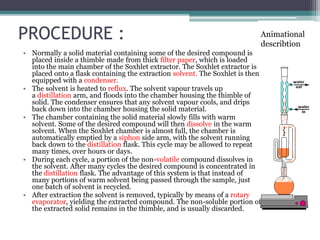
PROCEDURE :
• Normally a solid material containing some of the desired compound is
placed inside a thimble made from thick filter paper, which is loaded
into the main chamber of the Soxhlet extractor. The Soxhlet extractor is
placed onto a flask containing the extraction solvent. The Soxhlet is then
equipped with a condenser.
• The solvent is heated to reflux. The solvent vapour travels up
a distillation arm, and floods into the chamber housing the thimble of
solid. The condenser ensures that any solvent vapour cools, and drips
back down into the chamber housing the solid material.
• The chamber containing the solid material slowly fills with warm
solvent. Some of the desired compound will then dissolve in the warm
solvent. When the Soxhlet chamber is almost full, the chamber is
automatically emptied by a siphon side arm, with the solvent running
back down to the distillation flask. This cycle may be allowed to repeat
many times, over hours or days.
• During each cycle, a portion of the non-volatile compound dissolves in
the solvent. After many cycles the desired compound is concentrated in
the distillation flask. The advantage of this system is that instead of
many portions of warm solvent being passed through the sample, just
one batch of solvent is recycled.
• After extraction the solvent is removed, typically by means of a rotary
evaporator, yielding the extracted compound. The non-soluble portion of
the extracted solid remains in the thimble, and is usually discarded.
Animational
describtion
APPLICATIONS:
It is the most useful apparatus for solid–liquid
extraction in various fields such as
 pharmaceutics
 Environment & also
 foodstuffs
Nowadays, Soxhlet apparatus is still common and
widely used as a reference and standard
method in many laboratories for the extraction
of oil from various materials.
 Microwave Assisted Soxhlet
Extraction (MASE)
-Fat extraction from
 prefried and fried meat,
 fish &
 bakery products
 Microwave-Integrated Soxhlet
(MIS) extraction.
-extract oil from:
 olive seeds,
 oleaginous seeds,
 Meats &
 bakery products
ADVANTAGES & DISADVANTAGES
Advantages:
Mechanically gentle process yet quite efficient
extraction
Can perform elemental sulfur removal
simultaneously (activated Cu)
Disadvantages:
Lengthy process (>24 hrs)
Require azeotropic mixtures* to ensure efficient
extraction
References:
Websites :
 www.wiseGEEK.com
 www.anabolicminds.com
 www.wikipedia.com
 www.contaminantanalysistechniques.com
Books :
 Marine Organic Geochemistry
BY
R.ABARNA
BTH-12-001
T
HA
NK
Y
O
U

Soxhlet apparatus

  • 1.
    NOTHING IS IMPOSSIBLE BECAUSEIMPOSSIBLE ITSELF SAYS I’M POSSIBLE SOXHLET APPARATUS DESCRIPTION INVENTION COMPONENTS PROCEDURE APPLICATIONS LIMITATIONS
  • 2.
    SOXHLET APPARATUS A Soxhletextractor is lab equipment designed for processing certain kinds of solids. These devices allow for continuous treatment of a sample with a solvent over a period of hours or days to extract compounds of interest. Typically, a Soxhlet extraction is only required where the desired compound has a limited solubility in a solvent, and the impurity is insoluble in that solvent.
  • 3.
    INVENTION  It wasinvented in 1879 by a scientist named Franz von Soxhlet.  It was first invented for the quantification of fat in the milk.  Then it has been frequently used for the extraction of lipids in agricultural chemistry.
  • 4.
    COMPONENTS 1: Stirrer bar 2:Still pot (the still pot should not be overfilled and the volume of solvent in the still pot should be 3 to 4 times the volume of the soxhlet chamber) 3: Distillation path 4: Thimble 5: Solid 6: Siphon top 7: Siphon exit 8: Expansion adapter 9: Condenser 10: Cooling water in 11: Cooling water out
  • 5.
    PROCEDURE : • Normallya solid material containing some of the desired compound is placed inside a thimble made from thick filter paper, which is loaded into the main chamber of the Soxhlet extractor. The Soxhlet extractor is placed onto a flask containing the extraction solvent. The Soxhlet is then equipped with a condenser. • The solvent is heated to reflux. The solvent vapour travels up a distillation arm, and floods into the chamber housing the thimble of solid. The condenser ensures that any solvent vapour cools, and drips back down into the chamber housing the solid material. • The chamber containing the solid material slowly fills with warm solvent. Some of the desired compound will then dissolve in the warm solvent. When the Soxhlet chamber is almost full, the chamber is automatically emptied by a siphon side arm, with the solvent running back down to the distillation flask. This cycle may be allowed to repeat many times, over hours or days. • During each cycle, a portion of the non-volatile compound dissolves in the solvent. After many cycles the desired compound is concentrated in the distillation flask. The advantage of this system is that instead of many portions of warm solvent being passed through the sample, just one batch of solvent is recycled. • After extraction the solvent is removed, typically by means of a rotary evaporator, yielding the extracted compound. The non-soluble portion of the extracted solid remains in the thimble, and is usually discarded. Animational describtion
  • 6.
    APPLICATIONS: It is themost useful apparatus for solid–liquid extraction in various fields such as  pharmaceutics  Environment & also  foodstuffs Nowadays, Soxhlet apparatus is still common and widely used as a reference and standard method in many laboratories for the extraction of oil from various materials.
  • 7.
     Microwave AssistedSoxhlet Extraction (MASE) -Fat extraction from  prefried and fried meat,  fish &  bakery products  Microwave-Integrated Soxhlet (MIS) extraction. -extract oil from:  olive seeds,  oleaginous seeds,  Meats &  bakery products
  • 8.
    ADVANTAGES & DISADVANTAGES Advantages: Mechanicallygentle process yet quite efficient extraction Can perform elemental sulfur removal simultaneously (activated Cu) Disadvantages: Lengthy process (>24 hrs) Require azeotropic mixtures* to ensure efficient extraction
  • 9.
    References: Websites :  www.wiseGEEK.com www.anabolicminds.com  www.wikipedia.com  www.contaminantanalysistechniques.com Books :  Marine Organic Geochemistry
  • 10.