Solid waste management of
Dhaka city
Our Focus:
 To analysis the generation and
characteristic of solid waste in Dhaka city
& Use of updated technologies
 To discuss about source of solid waste
 To discuss the management system
Introduction
 Dhaka is one of the most heavily occupied
cities in the world. For this reason there are
huge environmental problems. Waste is
widespread problem of Dhaka city.
 At this moment we are concerned and have
to make sure the proper utilization of waste
and we have to recycle all types of waste.
Recycle is the intellectual salutation of urban
waste problem. Because of, if we can recycle
our waste we will also financially get benefits.
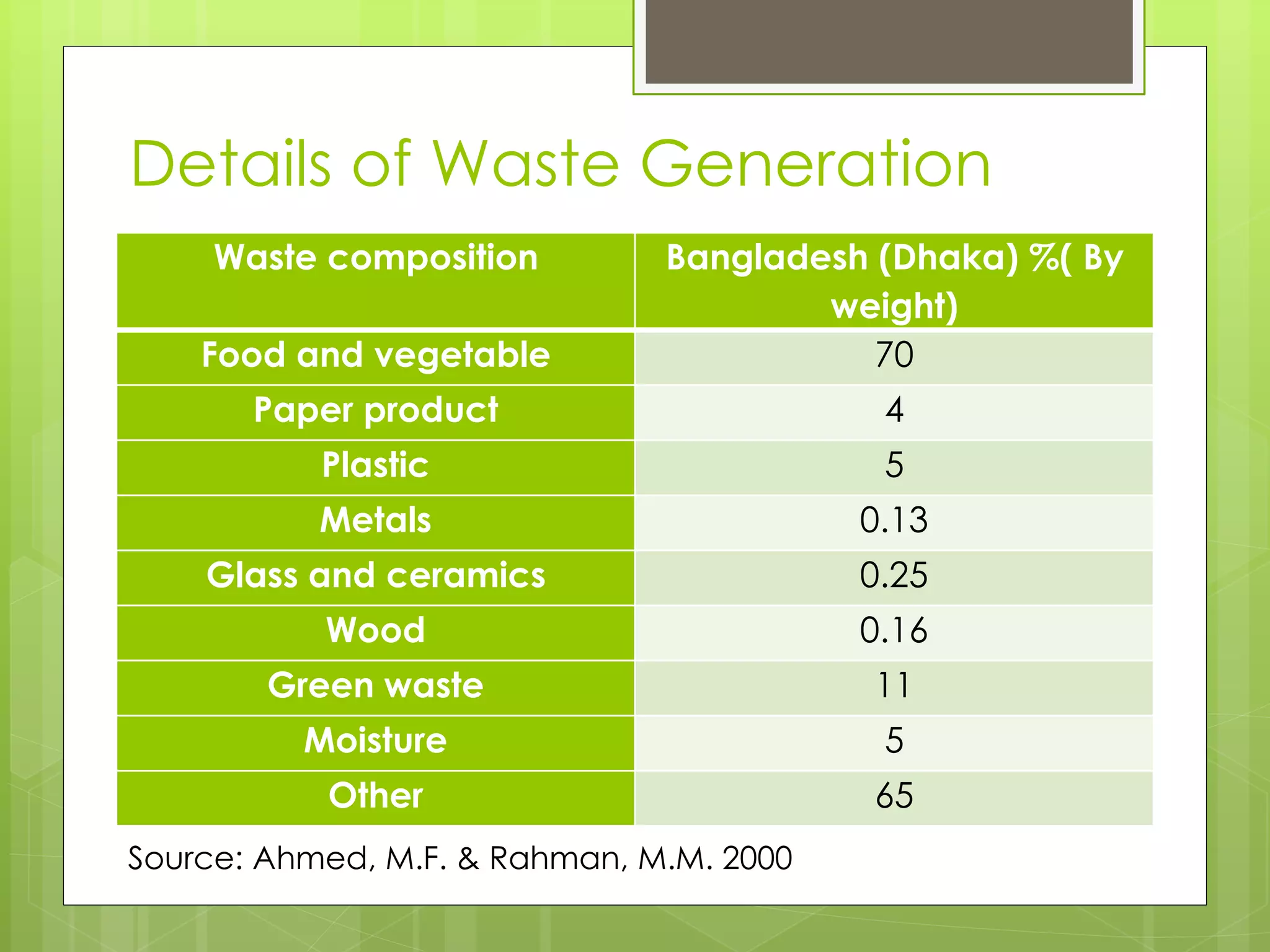
Details of Waste Generation
Waste composition Bangladesh (Dhaka) %( By
weight)
Food and vegetable 70
Paper product 4
Plastic 5
Metals 0.13
Glass and ceramics 0.25
Wood 0.16
Green waste 11
Moisture 5
Other 65
Source: Ahmed, M.F. & Rahman, M.M. 2000
Past, Present & Future Growth
Rate Comparison of Waste
Year Population(t
otal)
Urban
population(
%)
Waste rate
kg/c/day
Total waste
tones/day
1991 20872204 20.15 0.49 98735
2001 28808477 23.39 0.5 11695
2004 32765152 25.08 0.5 16382
2025 78440000 40 0.6 47064
Source: ADBI and ADB 2000 & Zurbrugg 2002
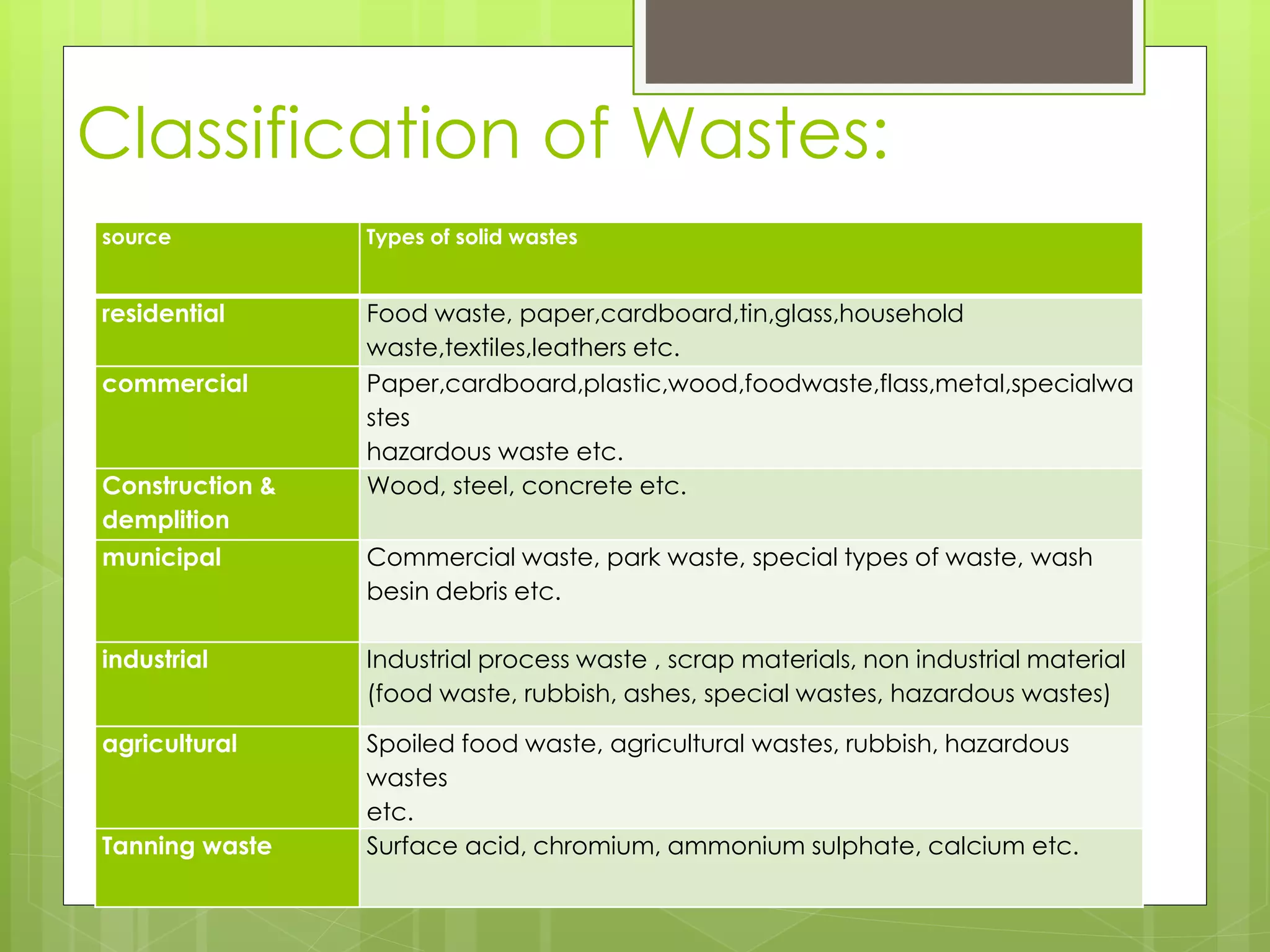
Classification of Wastes:
source Types of solid wastes
residential Food waste, paper,cardboard,tin,glass,household
waste,textiles,leathers etc.
commercial Paper,cardboard,plastic,wood,foodwaste,flass,metal,specialwa
stes
hazardous waste etc.
Construction &
demplition
Wood, steel, concrete etc.
municipal Commercial waste, park waste, special types of waste, wash
besin debris etc.
industrial Industrial process waste , scrap materials, non industrial material
(food waste, rubbish, ashes, special wastes, hazardous wastes)
agricultural Spoiled food waste, agricultural wastes, rubbish, hazardous
wastes
etc.
Tanning waste Surface acid, chromium, ammonium sulphate, calcium etc.
Tanning Waste Agricultural Waste
Resindential Waste Commercial Waste
Construction wastes Municipal Waste
Collection System of wastes:
There are two types of collection system :
1. Conventional based
2. Community based
 In some residential areas like Kalabagan, Dhanmondi,
Banani, Gulshan, Baridhara and Uttara, ‘house to house’
waste collection service has been organized by some
private initiatives. Rickshaw vans are used for collection
of waste from houses and conveying to municipal
containers (Yousuf 1996, Kazi 1999, Salam 2000)
Convential Based collection
System :
Final disposal
DCCtruck
Nearestroadside bin
House holder transporting
House hold wastes
Community Based collection
system :
Final disposal
DCCtruck
Primary transport point
Primary collector
Media vehicle
House hold waste
DCC Management:
 Dhaka city corporation (DCC) are mainly
maintaining this responsibility.DCC separated it’s
area into 10 zones for supervising of solid waste
production.
 The total solid waste management involves 3
departments namely conservancy, transport and
mechanical engineering
 DCC conservancy department currently holds 370
trucks and container carriers, 4,920 bin/container
and 300 handcarts per day
 It is supported by 7,156 cleaners/ sweepers and
190 supervising officers and only 1 officer to
supervise transports, for all desired activities
Total waste generation and its
distribution by source
Data
source
Solid
waste
generati
on
Tons/da
y
Residenti
al (%)
Commer
cial
(%)
Industrial
(%)
Hospital
(%)
Street
(%)
MMI
1991a
1300 46.8 17.3 12.9 0.5 22.6
PAS 1997a 3000-
5000
46.7 20.17 26.7 6.70 --
RSWC
1998a
1200-
1600
47.0 17 13.5 0.5 22
BCAS
1998b
2398 81.9 13.9 2.31 1.87 --
DCC 1999 3500 49.0 21 24.0 6 --
Final Disposal /Dumping:
There are six dumping sites of DCC have been
abandoned:
1.Khulshi
2.Amin bazar
3.Gabtoli
4.Lalbag shosan ghat
5.Mugdhapara
6.Jatrabari
 At present DCC selected two new sites for dumping
1.Matuali
2.Amin bazar
 88% wastes are dumped in Matuali site.This site started
from 2006
Dumping process and details
of Matuali site:
 In previous time this site has only 50 acres
but now it’s area is about 100 acers
 In early days it’s height was 5 meter but
now it’s height is 18 meter
 JICA and DCC founded this site
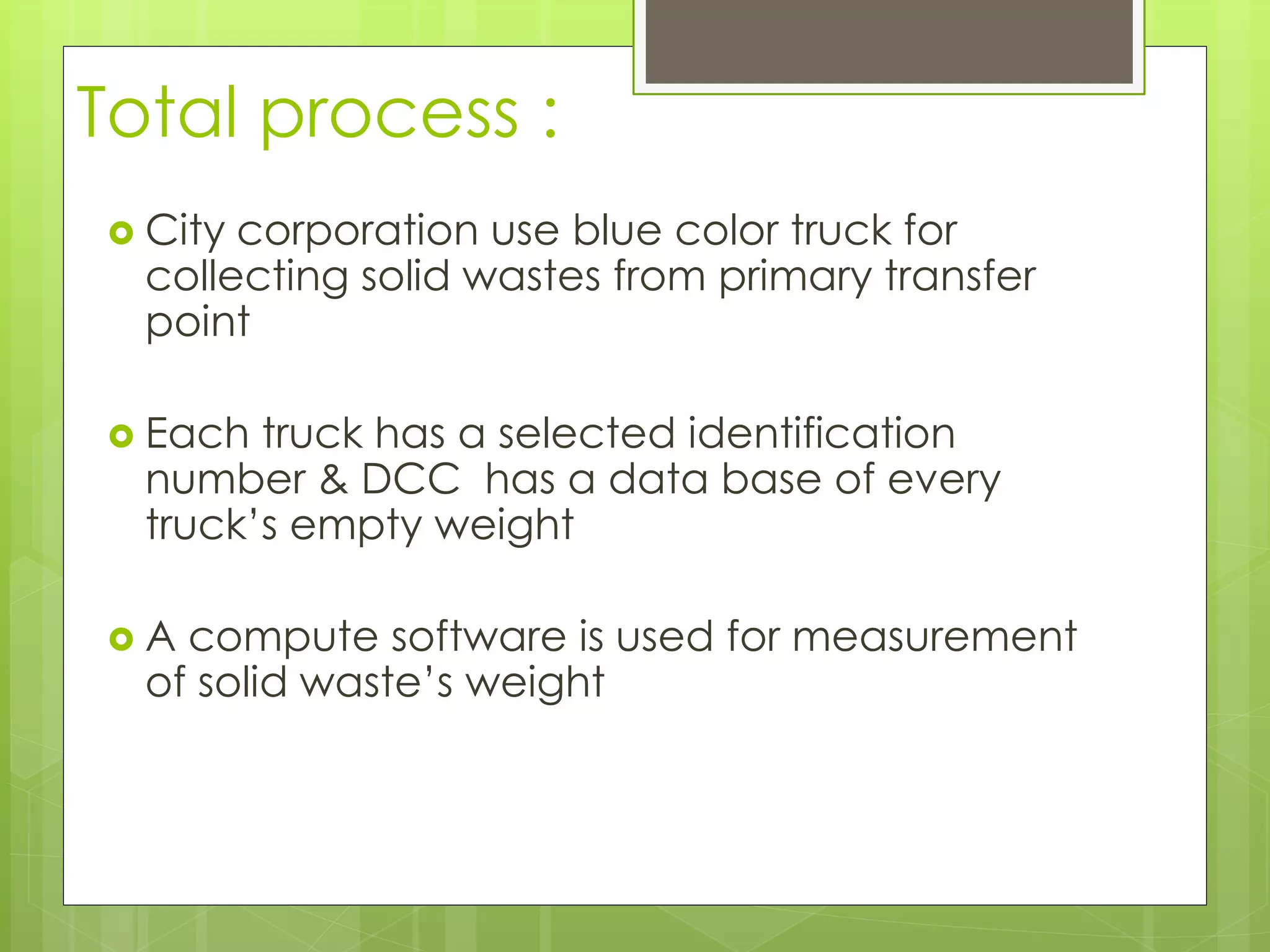
Total process :
 City corporation use blue color truck for
collecting solid wastes from primary transfer
point
 Each truck has a selected identification
number & DCC has a data base of every
truck’s empty weight
 A compute software is used for measurement
of solid waste’s weight
 DCC dump wastes in a
selected place in every
3 months phase
 After dumping the
wastes a soil layer has
provided
 Wastes are compacted
by mechanical
compactor
Recycling :
 There is no recycling process or plan in
Matuali site
 In 2015 DCC will start recycling of solid
waste like plastic,glass,timber etc
 Govt. has plan to produce 50 Mega watt
electricity from this site
Examples of energy contents
in different substrates
Substrates KWh/Ton
Cow dung 140
Manure from pipe 180
Manure from poultry 450
Gras 810
Wastes,fruit,vegetables 950
House hold food waste 1300
Food waste restaurant 1300
Waste from slaughter 2000
Pure
carbohydrates/sugar
3900
Proteins 4900
Fat 8500
Conclusion:
Ultimate disposal of urban solid waste is done crudely in open
dumps, lowlands or water bodies in an unsanitary manner. As a
result, the surrounding environment of the dumpsites is barely
hygienic. The increasing demand for landfill is also a big problem
for the authority to find suitable lands for dumping wastes. At
current waste generation rate the total land required per year
with existing collection efficiency and 100% collection efficiency
will be 141 acres and 273 acres respectively with a depth of 4
meters. Composting the organic portion of the waste can reduce
this high demand for landfill site since around 74% of the total
waste is organic. It is estimated that composting 50% and 74% of
the total generated waste with 100% collection efficiency the
area required for landfill will be reduced to 157 acres and 99
acres respectively per year with 4 meters of depth. Thus
composting can reduce a significant amount of landfill load. The
remaining inorganic portions can be recycled; thereby reducing
the expenditure to be incurred on landfill to a minimal.
THANK YOUPrepared by :
MD. MOSFIQUR RAHMAN
ID: 11.02.03.093

Solid Waste Management of Dhaka City Corporation

  • 1.
  • 2.
    Our Focus:  Toanalysis the generation and characteristic of solid waste in Dhaka city & Use of updated technologies  To discuss about source of solid waste  To discuss the management system
  • 3.
    Introduction  Dhaka isone of the most heavily occupied cities in the world. For this reason there are huge environmental problems. Waste is widespread problem of Dhaka city.  At this moment we are concerned and have to make sure the proper utilization of waste and we have to recycle all types of waste. Recycle is the intellectual salutation of urban waste problem. Because of, if we can recycle our waste we will also financially get benefits.
  • 4.
    Details of WasteGeneration Waste composition Bangladesh (Dhaka) %( By weight) Food and vegetable 70 Paper product 4 Plastic 5 Metals 0.13 Glass and ceramics 0.25 Wood 0.16 Green waste 11 Moisture 5 Other 65 Source: Ahmed, M.F. & Rahman, M.M. 2000
  • 5.
    Past, Present &Future Growth Rate Comparison of Waste Year Population(t otal) Urban population( %) Waste rate kg/c/day Total waste tones/day 1991 20872204 20.15 0.49 98735 2001 28808477 23.39 0.5 11695 2004 32765152 25.08 0.5 16382 2025 78440000 40 0.6 47064 Source: ADBI and ADB 2000 & Zurbrugg 2002
  • 6.
    Classification of Wastes: sourceTypes of solid wastes residential Food waste, paper,cardboard,tin,glass,household waste,textiles,leathers etc. commercial Paper,cardboard,plastic,wood,foodwaste,flass,metal,specialwa stes hazardous waste etc. Construction & demplition Wood, steel, concrete etc. municipal Commercial waste, park waste, special types of waste, wash besin debris etc. industrial Industrial process waste , scrap materials, non industrial material (food waste, rubbish, ashes, special wastes, hazardous wastes) agricultural Spoiled food waste, agricultural wastes, rubbish, hazardous wastes etc. Tanning waste Surface acid, chromium, ammonium sulphate, calcium etc.
  • 7.
  • 8.
  • 9.
  • 10.
    Collection System ofwastes: There are two types of collection system : 1. Conventional based 2. Community based  In some residential areas like Kalabagan, Dhanmondi, Banani, Gulshan, Baridhara and Uttara, ‘house to house’ waste collection service has been organized by some private initiatives. Rickshaw vans are used for collection of waste from houses and conveying to municipal containers (Yousuf 1996, Kazi 1999, Salam 2000)
  • 11.
    Convential Based collection System: Final disposal DCCtruck Nearestroadside bin House holder transporting House hold wastes
  • 12.
    Community Based collection system: Final disposal DCCtruck Primary transport point Primary collector Media vehicle House hold waste
  • 13.
    DCC Management:  Dhakacity corporation (DCC) are mainly maintaining this responsibility.DCC separated it’s area into 10 zones for supervising of solid waste production.  The total solid waste management involves 3 departments namely conservancy, transport and mechanical engineering  DCC conservancy department currently holds 370 trucks and container carriers, 4,920 bin/container and 300 handcarts per day  It is supported by 7,156 cleaners/ sweepers and 190 supervising officers and only 1 officer to supervise transports, for all desired activities
  • 14.
    Total waste generationand its distribution by source Data source Solid waste generati on Tons/da y Residenti al (%) Commer cial (%) Industrial (%) Hospital (%) Street (%) MMI 1991a 1300 46.8 17.3 12.9 0.5 22.6 PAS 1997a 3000- 5000 46.7 20.17 26.7 6.70 -- RSWC 1998a 1200- 1600 47.0 17 13.5 0.5 22 BCAS 1998b 2398 81.9 13.9 2.31 1.87 -- DCC 1999 3500 49.0 21 24.0 6 --
  • 15.
    Final Disposal /Dumping: Thereare six dumping sites of DCC have been abandoned: 1.Khulshi 2.Amin bazar 3.Gabtoli 4.Lalbag shosan ghat 5.Mugdhapara 6.Jatrabari  At present DCC selected two new sites for dumping 1.Matuali 2.Amin bazar  88% wastes are dumped in Matuali site.This site started from 2006
  • 16.
    Dumping process anddetails of Matuali site:  In previous time this site has only 50 acres but now it’s area is about 100 acers  In early days it’s height was 5 meter but now it’s height is 18 meter  JICA and DCC founded this site
  • 17.
    Total process : City corporation use blue color truck for collecting solid wastes from primary transfer point  Each truck has a selected identification number & DCC has a data base of every truck’s empty weight  A compute software is used for measurement of solid waste’s weight
  • 19.
     DCC dumpwastes in a selected place in every 3 months phase  After dumping the wastes a soil layer has provided  Wastes are compacted by mechanical compactor
  • 20.
    Recycling :  Thereis no recycling process or plan in Matuali site  In 2015 DCC will start recycling of solid waste like plastic,glass,timber etc  Govt. has plan to produce 50 Mega watt electricity from this site
  • 21.
    Examples of energycontents in different substrates Substrates KWh/Ton Cow dung 140 Manure from pipe 180 Manure from poultry 450 Gras 810 Wastes,fruit,vegetables 950 House hold food waste 1300 Food waste restaurant 1300 Waste from slaughter 2000 Pure carbohydrates/sugar 3900 Proteins 4900 Fat 8500
  • 22.
    Conclusion: Ultimate disposal ofurban solid waste is done crudely in open dumps, lowlands or water bodies in an unsanitary manner. As a result, the surrounding environment of the dumpsites is barely hygienic. The increasing demand for landfill is also a big problem for the authority to find suitable lands for dumping wastes. At current waste generation rate the total land required per year with existing collection efficiency and 100% collection efficiency will be 141 acres and 273 acres respectively with a depth of 4 meters. Composting the organic portion of the waste can reduce this high demand for landfill site since around 74% of the total waste is organic. It is estimated that composting 50% and 74% of the total generated waste with 100% collection efficiency the area required for landfill will be reduced to 157 acres and 99 acres respectively per year with 4 meters of depth. Thus composting can reduce a significant amount of landfill load. The remaining inorganic portions can be recycled; thereby reducing the expenditure to be incurred on landfill to a minimal.
  • 23.
    THANK YOUPrepared by: MD. MOSFIQUR RAHMAN ID: 11.02.03.093