SOLID WASTE MANAGEMENT,
CHANDIGARH
BY SURDEEP MAHANTA
INTRODUCTION
• An average of 370 tons/day of solid waste is generated in Chandigarh
municipal corporation area.
• The budget allocated for the financial year 2013-2014 to the
Chandigarh municipal corporation for management of solid waste
generated was INR 5737.49 crores (US$9 million) which was
insufficient.
• Chandigarh is the first city in India developed in a planned manner
which has helped in developing a comparatively better solid waste
management in comparison to other Indian cities.
• About 80% of total SWM budget is allocated for salary of sweepers and
rag pickers and only about 7-8% is allocated for collection purposes.
• The collection efficiency is about 70% from registered households and
20% from the slums and surrounding villages.
• Chandigarh is the only planned city in India with a population of
1.05 million in the year 2011 (Chandigarh master plan, 2013).
• For effective and proper management of the city it has been divided
into 1 district, 1 sub district, 6 towns, 1 statutory town, 5 census
towns and 5 villages.
MUNICIPAL SOLID WASTE
• Municipal Solid Waste is composed of refuse and trash
 Refuse- Rubbish and Garbage
 Trash- heavy and bulky waste materials that require special handling
• The municipal solid waste from Chandigarh city comprises of plastics
and polythene (7%), clothes (4%), paper (6%),
wood/organic/vegetables (52%), glass (1%), Inerts (21%),
rubber/leather (0.8%) and miscellaneous waste(3%) (CPCB, 2010).
• . The densities of solid waste in Chandigarh 550 kg/m3(Personal
communication with Chandigarh Municipal Corporation).
• Chemical properties of waste indicate that it contains high moisture
content (60%) and calorific value (800-1000 Kcal/Kg).
• Heavy metals like lead, cadmium, copper and nickel were present in
solid waste samples (Chandigarh Municipal Corporation, 2013).
• The major sources of municipal solid waste in Chandigarh municipal
corporation area are residential area, commercial areas, offices and
institutions.
• Chandigarh generates approximately 370 tons/ day i.e., 0.39kg/cap-d
of waste daily.
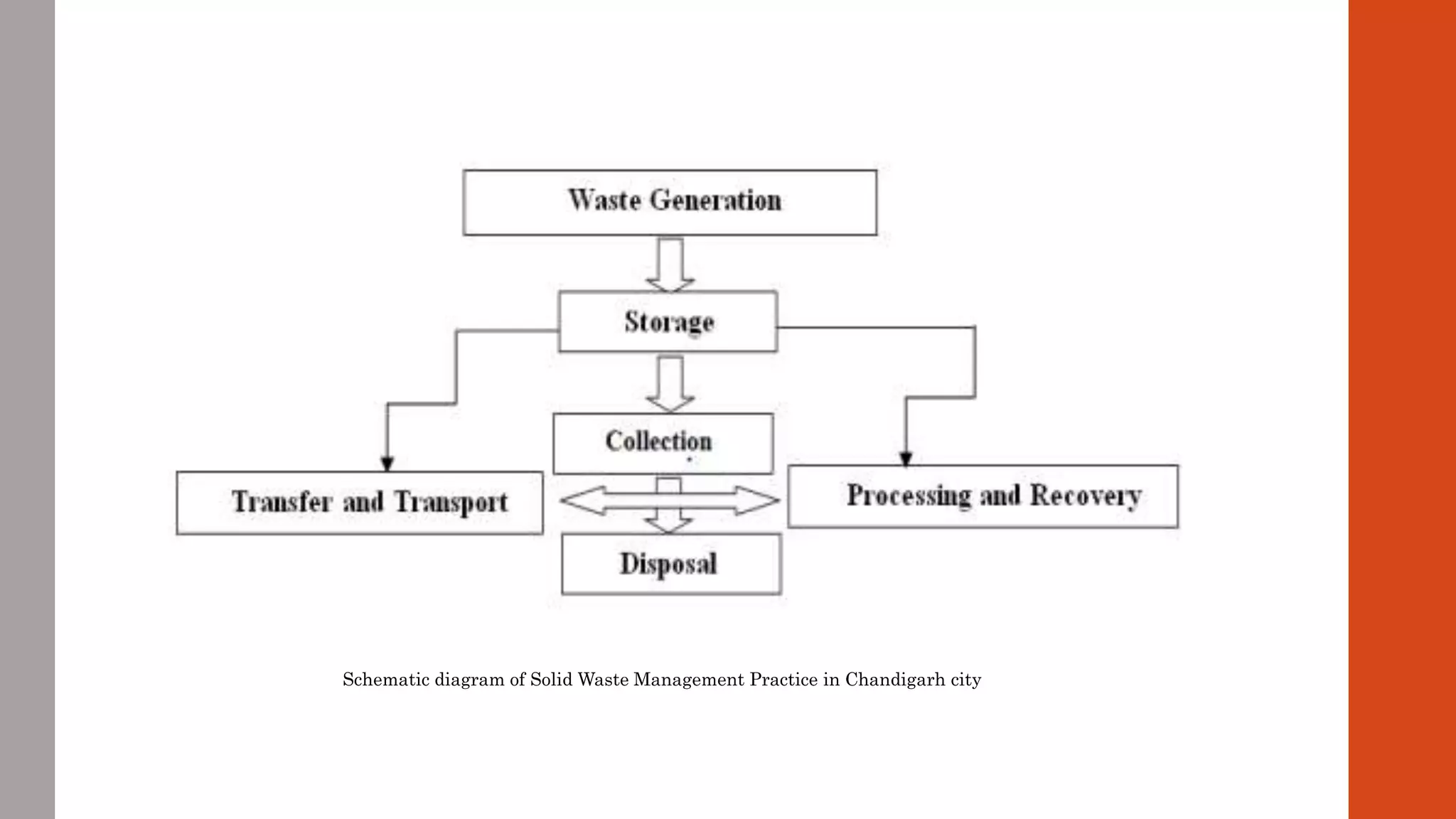
Schematic diagram of Solid Waste Management Practice in Chandigarh city
COLLECTION AND STORAGE OF
SOLID WASTE
• Generally common bins are provided for collection of decomposable and
non-decomposable waste.
• In Chandigarh due to climatic factors like high temperature, humidity
and also due to high organic composition in the solid waste, the
collection of the solid waste is done regularly as the waste gets
decomposed rapidly (Chandigarh development report, 2011).
• Different collection methods include
 house-to-house collection of the waste by using handcarts or tricycles
 collection of roadside waste by street sweeping.
 The remaining uncollected waste is often dumped on available vacant land
An overall collection of 90% has been achieved in Chandigarh with collection
efficiency of 60-70% for the registered households and 20% for the slums and
surrounding villages
• Once the waste has been collected they are unloaded at the
community based Sehaj Safai Kendra’s into the containers, from
where these containers are loaded on the vehicles (trucks, trolleys,
tractors etc.) used for transporting the waste to final disposal site.
• The Sehaj Safai Kendra acts as a primary collection point wherein
the wastes are segregated.
PRIMARY COLLECTION OF
MUNICIPAL SOLID WASTE
• Every day roads are swept and waste is collected at a particular time slot
starting from morning 6 AM to 4 PM.
• Sweepers are provided with the handcarts or tricycles, scrappers and brooms to
clean the roads and lanes properly, to clean the open drains, to collect the waste
and load it into the carts provided and then transfer them to the primary
collection points called the Sehaj Safai Kendra’s which are situated in different
sectors.
• The handcarts on an average have a capacity of 2-3 m3 .
• Roads are first swept before proceeding for collection of household wastes.
• The waste is collected by sweepers going from house-to-house and collecting the
waste which the residents have collected in the dustbins.
• This house-to-house collection is done in all the residential sectors and covers
about 70-80% of the registered households (Personal communication with
Chandigarh Municipal Corporation).
Handcarts and containers for used for Solid Waste collection in Chandigarh City
STORAGE OF SOLID WASTE
• Chandigarh Municipal Corporation have set up various community
Sehaj Safai Kendra’s in 35 out 56 sectors where the waste after
collection is stored primarily before getting transported to the
disposal site.
• For those sectors which do not have Sehaj Safai Kendra, wastes are
collected and stored in Sehaj Safai Kendra of adjoining sectors.
• These constructed buildings are provided with boundary wall also act
as segregation platform with drinking and toilet facilities, storage
and a room for rag pickers to take rest.
• Segregation of waste take places here as some items are picked up by
the sweepers.
Safai Kendra before
segregation of the waste.
Safai Kendra after
segregation of the waste.
• Waste is brought to these community Sehaj Safai Kendra’s with the
help of handcarts during primary collection and is emptied in storage
containers.
• Segregation of waste is carried out by rag pickers and sweepers in
informal way in these Kendra’s .
• Trucks or dumpers can also enter these Sehaj Safai Kendra’s and
pick up the waste from these storage sites to the disposal site.
SECONDARY COLLECTION OF
MUNICIPAL SOLID WASTE
• After the waste has been transported the community bins or the
Sehaj Safai Kendra’s are cleaned and treated with the sprays so as to
avoid any contamination or spread of disease.
• 112 conservancy vehicles for transporting and collecting the
municipal solid waste
• These vehicles include tractors trolleys (22), dumper placers (53),
refuse collector compactors (4), open trucks (3), three wheelers (6),
front-end loaders (4) and tractor trolleys for horticulture wastes (20).
• The capacity of these vehicles varies from 2-4 tonnes.
Collection and transportation of waste
• The collection routes followed by the drivers of these vehicles are very haphazard and collection time
depend upon the daily traffic causing excessive travel times for collection and dumping of wastes.
• Further, the loading of these wastes is also not done competently which leads to spilling of the waste
on roads which are either recollected or remain scattered on roads.
REFUSE DERIVED FUEL FROM THE
COLLECTED MUNICIPAL SOLID WASTE
• Chandigarh city there exists an agreement between government and
private company functioning under the name of Green Tech Fuel
Processing Plant.
• The company is responsible for complete processing of the municipal
solid waste and it derives the refused fuel from it.
• It has no role in collection and transportation of the waste.
• The refuse-derived fuel (RDF) obtained from the plant has calorific
value of 3100 Kcal/Kg and moisture content less than 15% .
• The plant has a processing capacity about 500 tons of garbage daily
• The major drawback the plant experiences is that the refuse derived
fuel so generated is not getting appropriate buyers thereby incurring
heavy financial losses.
Processing of
Solid Waste at
Refused Derived
Fuel Plant in
Chandigarh
FINAL DISPOSAL OF MUNICIPAL
SOLID WASTE IN CHANDIGARH
• There is only one designated dump yard consisting of 45.11 acres of
land which is situated in sector 38 near Dadu Majra labor colony .
• More than 90% of the total waste generated in the Chandigarh
Municipal Corporation area is disposed off at this disposal site
• Dumping: Dumping is the major and final step of municipal solid
waste management. Everyday around 280-300 tonnes of waste is
disposed off at the dumping site
• The Main constituents of the solution are actinomycetes (Photo
Synthetic Bacteria) and yeast. A 1000L spray solution contains 20L
EM solution with 30L Molasses and the rest is water
Flow sheet of processing solid waste at refused derived fuel
plant in Chandigarh
• Levelling: For levelling of the waste, bulldozers or heavy vehicles are
used to compact the waste. After compaction, oil and grease is
sprayed on the compacted area.
• It is then covered with the construction and demolition waste of
about 2 feet deep. At present about 20-25 feet deep disposal site is
piled with m.unicipal solid waste
EXISTING PROBLEMS IN THE PRESENT
SOLID WASTE MANAGEMENT
• Littering by residents after collection
• Poor Conditions of Collection Containers and Areas around them
• Distribution of Labour and Resources
• Poor Working Conditions
• Inadequate Maintenance and Replacement of worn-out collection
vehicles

Solid waste management, chandigarh

  • 1.
  • 2.
    INTRODUCTION • An averageof 370 tons/day of solid waste is generated in Chandigarh municipal corporation area. • The budget allocated for the financial year 2013-2014 to the Chandigarh municipal corporation for management of solid waste generated was INR 5737.49 crores (US$9 million) which was insufficient. • Chandigarh is the first city in India developed in a planned manner which has helped in developing a comparatively better solid waste management in comparison to other Indian cities. • About 80% of total SWM budget is allocated for salary of sweepers and rag pickers and only about 7-8% is allocated for collection purposes. • The collection efficiency is about 70% from registered households and 20% from the slums and surrounding villages.
  • 3.
    • Chandigarh isthe only planned city in India with a population of 1.05 million in the year 2011 (Chandigarh master plan, 2013). • For effective and proper management of the city it has been divided into 1 district, 1 sub district, 6 towns, 1 statutory town, 5 census towns and 5 villages.
  • 4.
    MUNICIPAL SOLID WASTE •Municipal Solid Waste is composed of refuse and trash  Refuse- Rubbish and Garbage  Trash- heavy and bulky waste materials that require special handling • The municipal solid waste from Chandigarh city comprises of plastics and polythene (7%), clothes (4%), paper (6%), wood/organic/vegetables (52%), glass (1%), Inerts (21%), rubber/leather (0.8%) and miscellaneous waste(3%) (CPCB, 2010). • . The densities of solid waste in Chandigarh 550 kg/m3(Personal communication with Chandigarh Municipal Corporation). • Chemical properties of waste indicate that it contains high moisture content (60%) and calorific value (800-1000 Kcal/Kg). • Heavy metals like lead, cadmium, copper and nickel were present in solid waste samples (Chandigarh Municipal Corporation, 2013).
  • 5.
    • The majorsources of municipal solid waste in Chandigarh municipal corporation area are residential area, commercial areas, offices and institutions. • Chandigarh generates approximately 370 tons/ day i.e., 0.39kg/cap-d of waste daily.
  • 6.
    Schematic diagram ofSolid Waste Management Practice in Chandigarh city
  • 7.
    COLLECTION AND STORAGEOF SOLID WASTE • Generally common bins are provided for collection of decomposable and non-decomposable waste. • In Chandigarh due to climatic factors like high temperature, humidity and also due to high organic composition in the solid waste, the collection of the solid waste is done regularly as the waste gets decomposed rapidly (Chandigarh development report, 2011). • Different collection methods include  house-to-house collection of the waste by using handcarts or tricycles  collection of roadside waste by street sweeping.  The remaining uncollected waste is often dumped on available vacant land An overall collection of 90% has been achieved in Chandigarh with collection efficiency of 60-70% for the registered households and 20% for the slums and surrounding villages
  • 8.
    • Once thewaste has been collected they are unloaded at the community based Sehaj Safai Kendra’s into the containers, from where these containers are loaded on the vehicles (trucks, trolleys, tractors etc.) used for transporting the waste to final disposal site. • The Sehaj Safai Kendra acts as a primary collection point wherein the wastes are segregated.
  • 9.
    PRIMARY COLLECTION OF MUNICIPALSOLID WASTE • Every day roads are swept and waste is collected at a particular time slot starting from morning 6 AM to 4 PM. • Sweepers are provided with the handcarts or tricycles, scrappers and brooms to clean the roads and lanes properly, to clean the open drains, to collect the waste and load it into the carts provided and then transfer them to the primary collection points called the Sehaj Safai Kendra’s which are situated in different sectors. • The handcarts on an average have a capacity of 2-3 m3 . • Roads are first swept before proceeding for collection of household wastes. • The waste is collected by sweepers going from house-to-house and collecting the waste which the residents have collected in the dustbins. • This house-to-house collection is done in all the residential sectors and covers about 70-80% of the registered households (Personal communication with Chandigarh Municipal Corporation).
  • 10.
    Handcarts and containersfor used for Solid Waste collection in Chandigarh City
  • 11.
    STORAGE OF SOLIDWASTE • Chandigarh Municipal Corporation have set up various community Sehaj Safai Kendra’s in 35 out 56 sectors where the waste after collection is stored primarily before getting transported to the disposal site. • For those sectors which do not have Sehaj Safai Kendra, wastes are collected and stored in Sehaj Safai Kendra of adjoining sectors. • These constructed buildings are provided with boundary wall also act as segregation platform with drinking and toilet facilities, storage and a room for rag pickers to take rest. • Segregation of waste take places here as some items are picked up by the sweepers.
  • 12.
    Safai Kendra before segregationof the waste. Safai Kendra after segregation of the waste.
  • 13.
    • Waste isbrought to these community Sehaj Safai Kendra’s with the help of handcarts during primary collection and is emptied in storage containers. • Segregation of waste is carried out by rag pickers and sweepers in informal way in these Kendra’s . • Trucks or dumpers can also enter these Sehaj Safai Kendra’s and pick up the waste from these storage sites to the disposal site.
  • 14.
    SECONDARY COLLECTION OF MUNICIPALSOLID WASTE • After the waste has been transported the community bins or the Sehaj Safai Kendra’s are cleaned and treated with the sprays so as to avoid any contamination or spread of disease. • 112 conservancy vehicles for transporting and collecting the municipal solid waste • These vehicles include tractors trolleys (22), dumper placers (53), refuse collector compactors (4), open trucks (3), three wheelers (6), front-end loaders (4) and tractor trolleys for horticulture wastes (20). • The capacity of these vehicles varies from 2-4 tonnes.
  • 15.
    Collection and transportationof waste • The collection routes followed by the drivers of these vehicles are very haphazard and collection time depend upon the daily traffic causing excessive travel times for collection and dumping of wastes. • Further, the loading of these wastes is also not done competently which leads to spilling of the waste on roads which are either recollected or remain scattered on roads.
  • 16.
    REFUSE DERIVED FUELFROM THE COLLECTED MUNICIPAL SOLID WASTE • Chandigarh city there exists an agreement between government and private company functioning under the name of Green Tech Fuel Processing Plant. • The company is responsible for complete processing of the municipal solid waste and it derives the refused fuel from it. • It has no role in collection and transportation of the waste. • The refuse-derived fuel (RDF) obtained from the plant has calorific value of 3100 Kcal/Kg and moisture content less than 15% . • The plant has a processing capacity about 500 tons of garbage daily • The major drawback the plant experiences is that the refuse derived fuel so generated is not getting appropriate buyers thereby incurring heavy financial losses.
  • 17.
    Processing of Solid Wasteat Refused Derived Fuel Plant in Chandigarh
  • 18.
    FINAL DISPOSAL OFMUNICIPAL SOLID WASTE IN CHANDIGARH • There is only one designated dump yard consisting of 45.11 acres of land which is situated in sector 38 near Dadu Majra labor colony . • More than 90% of the total waste generated in the Chandigarh Municipal Corporation area is disposed off at this disposal site • Dumping: Dumping is the major and final step of municipal solid waste management. Everyday around 280-300 tonnes of waste is disposed off at the dumping site • The Main constituents of the solution are actinomycetes (Photo Synthetic Bacteria) and yeast. A 1000L spray solution contains 20L EM solution with 30L Molasses and the rest is water
  • 19.
    Flow sheet ofprocessing solid waste at refused derived fuel plant in Chandigarh
  • 20.
    • Levelling: Forlevelling of the waste, bulldozers or heavy vehicles are used to compact the waste. After compaction, oil and grease is sprayed on the compacted area. • It is then covered with the construction and demolition waste of about 2 feet deep. At present about 20-25 feet deep disposal site is piled with m.unicipal solid waste
  • 21.
    EXISTING PROBLEMS INTHE PRESENT SOLID WASTE MANAGEMENT • Littering by residents after collection • Poor Conditions of Collection Containers and Areas around them • Distribution of Labour and Resources • Poor Working Conditions • Inadequate Maintenance and Replacement of worn-out collection vehicles