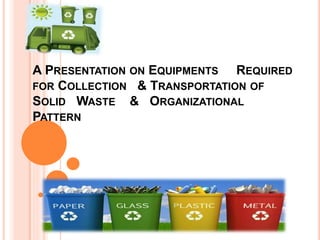
A PRESENTATION ON EQUIPMENTS REQUIRED
FOR COLLECTION & TRANSPORTATION OF
SOLID WASTE & ORGANIZATIONAL
PATTERN
PRESENTED BY
Sanket Subhash Hasabe
Santosh Madhukar Kharat
Ajay Namdev Bandgar
Dheeraj Dhondiram Deshmukh
T.Y.Civil
EQUIPMENTS FOR
WASTE COLLECTION
 Litter Bin
 Broom
 Shovels
 Handcarts
 Mechanical Road Sweeper
 Community Bins
LITTER BIN
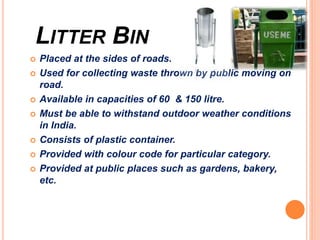
 Placed at the sides of roads.
 Used for collecting waste thrown by public moving on
road.
 Available in capacities of 60 & 150 litre.
 Must be able to withstand outdoor weather conditions
in India.
 Consists of plastic container.
 Provided with colour code for particular category.
 Provided at public places such as gardens, bakery,
etc.
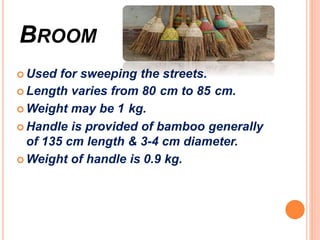
BROOM
 Used for sweeping the streets.
 Length varies from 80 cm to 85 cm.
 Weight may be 1 kg.
 Handle is provided of bamboo generally
of 135 cm length & 3-4 cm diameter.
 Weight of handle is 0.9 kg.
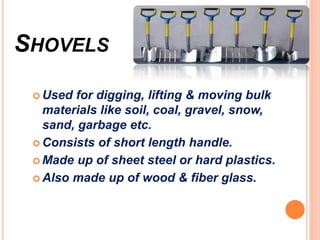
SHOVELS
 Used for digging, lifting & moving bulk
materials like soil, coal, gravel, snow,
sand, garbage etc.
 Consists of short length handle.
 Made up of sheet steel or hard plastics.
 Also made up of wood & fiber glass.
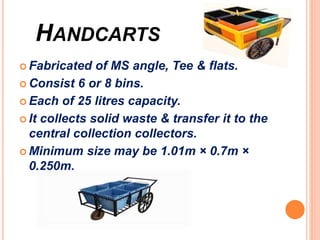
HANDCARTS
 Fabricated of MS angle, Tee & flats.
 Consist 6 or 8 bins.
 Each of 25 litres capacity.
 It collects solid waste & transfer it to the
central collection collectors.
 Minimum size may be 1.01m × 0.7m ×
0.250m.
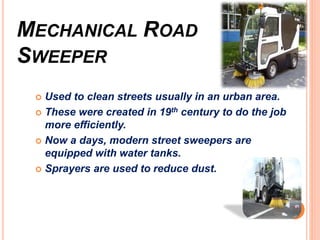
MECHANICAL ROAD
SWEEPER
 Used to clean streets usually in an urban area.
 These were created in 19th century to do the job
more efficiently.
 Now a days, modern street sweepers are
equipped with water tanks.
 Sprayers are used to reduce dust.
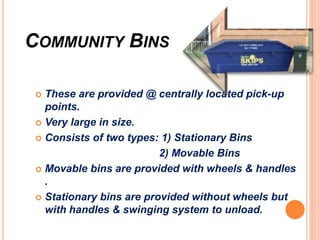
COMMUNITY BINS
 These are provided @ centrally located pick-up
points.
 Very large in size.
 Consists of two types: 1) Stationary Bins
2) Movable Bins
 Movable bins are provided with wheels & handles
.
 Stationary bins are provided without wheels but
with handles & swinging system to unload.
TRANSPORTATION VEHICLES
FOR SOLID WASTE
 Animal Cart
 Auto Vehicles
 Tractors & Trailers
 Trucks
 Dumper
 Compactor Vehicle
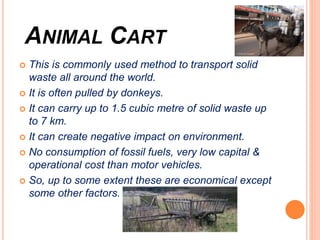
ANIMAL CART
 This is commonly used method to transport solid
waste all around the world.
 It is often pulled by donkeys.
 It can carry up to 1.5 cubic metre of solid waste up
to 7 km.
 It can create negative impact on environment.
 No consumption of fossil fuels, very low capital &
operational cost than motor vehicles.
 So, up to some extent these are economical except
some other factors.
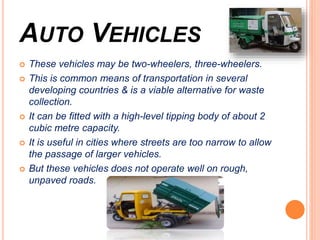
AUTO VEHICLES
 These vehicles may be two-wheelers, three-wheelers.
 This is common means of transportation in several
developing countries & is a viable alternative for waste
collection.
 It can be fitted with a high-level tipping body of about 2
cubic metre capacity.
 It is useful in cities where streets are too narrow to allow
the passage of larger vehicles.
 But these vehicles does not operate well on rough,
unpaved roads.
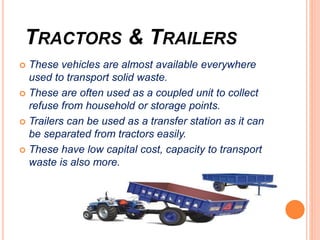
TRACTORS & TRAILERS
 These vehicles are almost available everywhere
used to transport solid waste.
 These are often used as a coupled unit to collect
refuse from household or storage points.
 Trailers can be used as a transfer station as it can
be separated from tractors easily.
 These have low capital cost, capacity to transport
waste is also more.
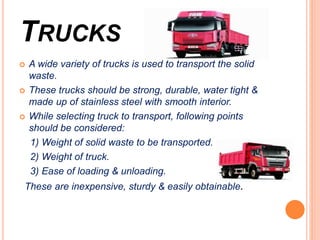
TRUCKS
 A wide variety of trucks is used to transport the solid
waste.
 These trucks should be strong, durable, water tight &
made up of stainless steel with smooth interior.
 While selecting truck to transport, following points
should be considered:
1) Weight of solid waste to be transported.
2) Weight of truck.
3) Ease of loading & unloading.
These are inexpensive, sturdy & easily obtainable.
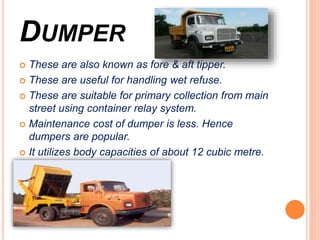
DUMPER
 These are also known as fore & aft tipper.
 These are useful for handling wet refuse.
 These are suitable for primary collection from main
street using container relay system.
 Maintenance cost of dumper is less. Hence
dumpers are popular.
 It utilizes body capacities of about 12 cubic metre.
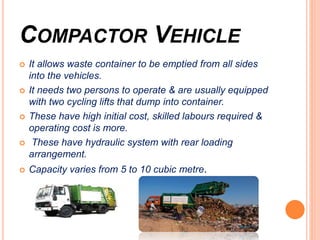
COMPACTOR VEHICLE
 It allows waste container to be emptied from all sides
into the vehicles.
 It needs two persons to operate & are usually equipped
with two cycling lifts that dump into container.
 These have high initial cost, skilled labours required &
operating cost is more.
 These have hydraulic system with rear loading
arrangement.
 Capacity varies from 5 to 10 cubic metre.
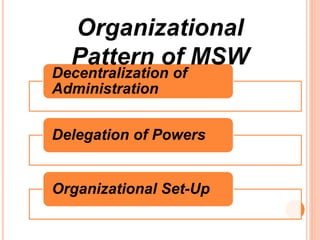
Decentralization of
Administration
Delegation of Powers
Organizational Set-Up
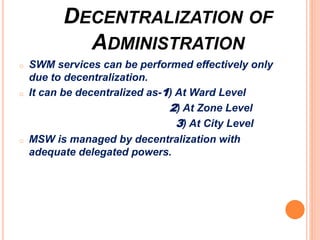
DECENTRALIZATION OF
ADMINISTRATION
o SWM services can be performed effectively only
due to decentralization.
o It can be decentralized as-1) At Ward Level
2) At Zone Level
3) At City Level
o MSW is managed by decentralization with
adequate delegated powers.
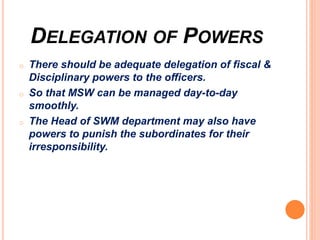
DELEGATION OF POWERS
o There should be adequate delegation of fiscal &
Disciplinary powers to the officers.
o So that MSW can be managed day-to-day
smoothly.
o The Head of SWM department may also have
powers to punish the subordinates for their
irresponsibility.
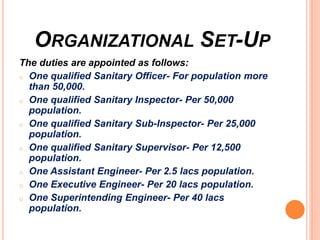
ORGANIZATIONAL SET-UP
The duties are appointed as follows:
o One qualified Sanitary Officer- For population more
than 50,000.
o One qualified Sanitary Inspector- Per 50,000
population.
o One qualified Sanitary Sub-Inspector- Per 25,000
population.
o One qualified Sanitary Supervisor- Per 12,500
population.
o One Assistant Engineer- Per 2.5 lacs population.
o One Executive Engineer- Per 20 lacs population.
o One Superintending Engineer- Per 40 lacs
population.
Solid waste management

Solid waste management

  • 1.
    A PRESENTATION ONEQUIPMENTS REQUIRED FOR COLLECTION & TRANSPORTATION OF SOLID WASTE & ORGANIZATIONAL PATTERN
  • 2.
    PRESENTED BY Sanket SubhashHasabe Santosh Madhukar Kharat Ajay Namdev Bandgar Dheeraj Dhondiram Deshmukh T.Y.Civil
  • 3.
    EQUIPMENTS FOR WASTE COLLECTION Litter Bin  Broom  Shovels  Handcarts  Mechanical Road Sweeper  Community Bins
  • 4.
    LITTER BIN  Placedat the sides of roads.  Used for collecting waste thrown by public moving on road.  Available in capacities of 60 & 150 litre.  Must be able to withstand outdoor weather conditions in India.  Consists of plastic container.  Provided with colour code for particular category.  Provided at public places such as gardens, bakery, etc.
  • 5.
    BROOM  Used forsweeping the streets.  Length varies from 80 cm to 85 cm.  Weight may be 1 kg.  Handle is provided of bamboo generally of 135 cm length & 3-4 cm diameter.  Weight of handle is 0.9 kg.
  • 6.
    SHOVELS  Used fordigging, lifting & moving bulk materials like soil, coal, gravel, snow, sand, garbage etc.  Consists of short length handle.  Made up of sheet steel or hard plastics.  Also made up of wood & fiber glass.
  • 7.
    HANDCARTS  Fabricated ofMS angle, Tee & flats.  Consist 6 or 8 bins.  Each of 25 litres capacity.  It collects solid waste & transfer it to the central collection collectors.  Minimum size may be 1.01m × 0.7m × 0.250m.
  • 8.
    MECHANICAL ROAD SWEEPER  Usedto clean streets usually in an urban area.  These were created in 19th century to do the job more efficiently.  Now a days, modern street sweepers are equipped with water tanks.  Sprayers are used to reduce dust.
  • 9.
    COMMUNITY BINS  Theseare provided @ centrally located pick-up points.  Very large in size.  Consists of two types: 1) Stationary Bins 2) Movable Bins  Movable bins are provided with wheels & handles .  Stationary bins are provided without wheels but with handles & swinging system to unload.
  • 10.
    TRANSPORTATION VEHICLES FOR SOLIDWASTE  Animal Cart  Auto Vehicles  Tractors & Trailers  Trucks  Dumper  Compactor Vehicle
  • 11.
    ANIMAL CART  Thisis commonly used method to transport solid waste all around the world.  It is often pulled by donkeys.  It can carry up to 1.5 cubic metre of solid waste up to 7 km.  It can create negative impact on environment.  No consumption of fossil fuels, very low capital & operational cost than motor vehicles.  So, up to some extent these are economical except some other factors.
  • 12.
    AUTO VEHICLES  Thesevehicles may be two-wheelers, three-wheelers.  This is common means of transportation in several developing countries & is a viable alternative for waste collection.  It can be fitted with a high-level tipping body of about 2 cubic metre capacity.  It is useful in cities where streets are too narrow to allow the passage of larger vehicles.  But these vehicles does not operate well on rough, unpaved roads.
  • 13.
    TRACTORS & TRAILERS These vehicles are almost available everywhere used to transport solid waste.  These are often used as a coupled unit to collect refuse from household or storage points.  Trailers can be used as a transfer station as it can be separated from tractors easily.  These have low capital cost, capacity to transport waste is also more.
  • 14.
    TRUCKS  A widevariety of trucks is used to transport the solid waste.  These trucks should be strong, durable, water tight & made up of stainless steel with smooth interior.  While selecting truck to transport, following points should be considered: 1) Weight of solid waste to be transported. 2) Weight of truck. 3) Ease of loading & unloading. These are inexpensive, sturdy & easily obtainable.
  • 15.
    DUMPER  These arealso known as fore & aft tipper.  These are useful for handling wet refuse.  These are suitable for primary collection from main street using container relay system.  Maintenance cost of dumper is less. Hence dumpers are popular.  It utilizes body capacities of about 12 cubic metre.
  • 16.
    COMPACTOR VEHICLE  Itallows waste container to be emptied from all sides into the vehicles.  It needs two persons to operate & are usually equipped with two cycling lifts that dump into container.  These have high initial cost, skilled labours required & operating cost is more.  These have hydraulic system with rear loading arrangement.  Capacity varies from 5 to 10 cubic metre.
  • 17.
  • 18.
    DECENTRALIZATION OF ADMINISTRATION o SWMservices can be performed effectively only due to decentralization. o It can be decentralized as-1) At Ward Level 2) At Zone Level 3) At City Level o MSW is managed by decentralization with adequate delegated powers.
  • 19.
    DELEGATION OF POWERS oThere should be adequate delegation of fiscal & Disciplinary powers to the officers. o So that MSW can be managed day-to-day smoothly. o The Head of SWM department may also have powers to punish the subordinates for their irresponsibility.
  • 20.
    ORGANIZATIONAL SET-UP The dutiesare appointed as follows: o One qualified Sanitary Officer- For population more than 50,000. o One qualified Sanitary Inspector- Per 50,000 population. o One qualified Sanitary Sub-Inspector- Per 25,000 population. o One qualified Sanitary Supervisor- Per 12,500 population. o One Assistant Engineer- Per 2.5 lacs population. o One Executive Engineer- Per 20 lacs population. o One Superintending Engineer- Per 40 lacs population.