Industrial waste
management
Awad Albalwi
Contents
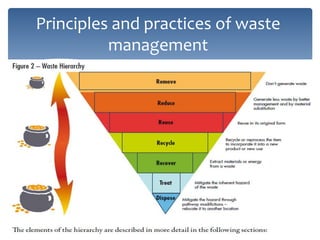
Principles and practices of waste management
Remove and Reduce
Reduction
1- Introduction
Reuse
Recycling/recovery
Residue Treatment
Disposal
Study design
 It is estimated that more than 3 billion tons of waste are
generated in Europe every year, and hazardous waste
generally makes up about 1% of all waste in Europe [1];
 nevertheless, hazardous waste presents a serous risk to the
ecosystem and human health if not managed and treated
safely.
introduction
Principles and practices of waste
management
Remove and Reduce
is known as ‘reduction at source’. Source reduction occurs prior to reuse, recycling,
treatment, or disposal. Source reduction may be achieved through equipment or
technology modifications,
process or procedure modifications, reformulation or redesign of products, substitution
of raw materials, and improvements in housekeeping, maintenance, training or inventory
control.
TYPES OF SOURCE REDUCTION
Source reduction can result from any activity that reduces the amount of a material need
ed and therefore used to make products. Some specific examples of source reduction pr
actices are:
•
Redesigning products to use fewer materials (e.g., lightweighting, material substitution).
• Reusing products and materials (e.g., a refillable water bottle). ‫المنتج‬ ‫استخدام‬ ‫اعادة‬/‫المواد‬
• Extending the useful lifespan of products. ‫تطويل‬/‫عمر‬ ‫تمديد‬‫المنتجات‬.
• Avoiding using materials in the first place (e.g., reducing junk mail).
‫األول‬ ‫المقام‬ ‫في‬ ‫المواد‬ ‫استخدام‬ ‫تجنب‬
Reduction
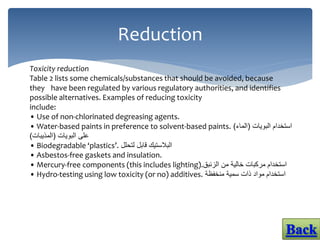
Toxicity reduction
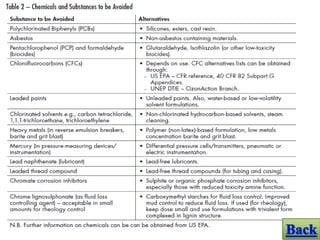
Table 2 lists some chemicals/substances that should be avoided, because
they have been regulated by various regulatory authorities, and identifies
possible alternatives. Examples of reducing toxicity
include:
• Use of non-chlorinated degreasing agents.
• Water-based paints in preference to solvent-based paints. ‫استخدام‬‫البويات‬(‫الماء‬)
‫على‬‫البويات‬(‫المذيبات‬)
• Biodegradable ‘plastics’. ‫لتحلل‬ ‫قابل‬ ‫البالستيك‬
• Asbestos-free gaskets and insulation.
• Mercury-free components (this includes lighting).‫الزئبق‬ ‫من‬ ‫خالية‬ ‫مركبات‬ ‫استخدام‬
• Hydro-testing using low toxicity (or no) additives. ‫سمية‬ ‫ذات‬ ‫مواد‬ ‫استخدام‬‫منخفظة‬
Reuse
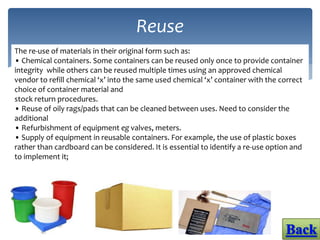
The re-use of materials in their original form such as:
• Chemical containers. Some containers can be reused only once to provide container
integrity while others can be reused multiple times using an approved chemical
vendor to refill chemical ‘x’ into the same used chemical ‘x’ container with the correct
choice of container material and
stock return procedures.
• Reuse of oily rags/pads that can be cleaned between uses. Need to consider the
additional
• Refurbishment of equipment eg valves, meters.
• Supply of equipment in reusable containers. For example, the use of plastic boxes
rather than cardboard can be considered. It is essential to identify a re-use option and
to implement it;
Recycling/recovery
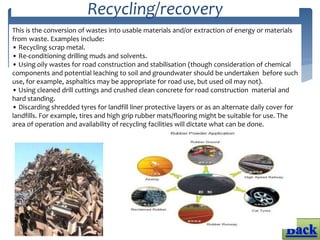
This is the conversion of wastes into usable materials and/or extraction of energy or materials
from waste. Examples include:
• Recycling scrap metal.
• Re-conditioning drilling muds and solvents.
• Using oily wastes for road construction and stabilisation (though consideration of chemical
components and potential leaching to soil and groundwater should be undertaken before such
use, for example, asphaltics may be appropriate for road use, but used oil may not).
• Using cleaned drill cuttings and crushed clean concrete for road construction material and
hard standing.
• Discarding shredded tyres for landfill liner protective layers or as an alternate daily cover for
landfills. For example, tires and high grip rubber mats/flooring might be suitable for use. The
area of operation and availability of recycling facilities will dictate what can be done.
Residue Treatment
Residue Treatment
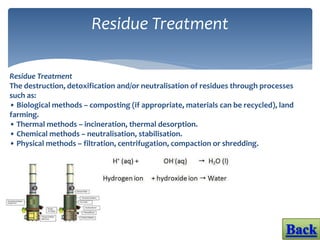
The destruction, detoxification and/or neutralisation of residues through processes
such as:
• Biological methods – composting (if appropriate, materials can be recycled), land
farming.
• Thermal methods – incineration, thermal desorption.
• Chemical methods – neutralisation, stabilisation.
• Physical methods – filtration, centrifugation, compaction or shredding.
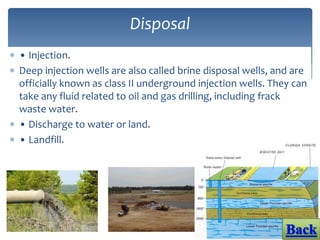
 • Injection.
 Deep injection wells are also called brine disposal wells, and are
officially known as class II underground injection wells. They can
take any fluid related to oil and gas drilling, including frack
waste water.
 • Discharge to water or land.
 • Landfill.
Disposal
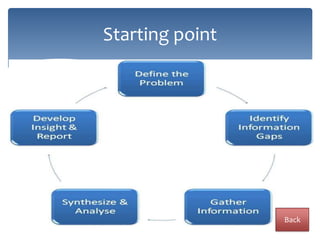
Information Collection
[Form] DATA COLLECTION
Analysing
Evaluation
Solution setting
Applying
Starting point
Study design
The
aim?
End
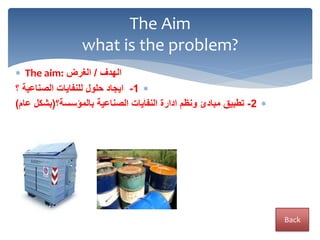
 The aim: ‫الهدف‬/‫الغرض‬
1-‫؟‬ ‫الصناعية‬ ‫للنفايات‬ ‫حلول‬ ‫ايجاد‬
2-‫بالمؤسسة؟‬ ‫الصناعية‬ ‫النفايات‬ ‫ادارة‬ ‫ونظم‬ ‫مبادئ‬ ‫تطبيق‬(‫ع‬ ‫بشكل‬‫ام‬)
The Aim
what is the problem?
Back
Starting point
Back
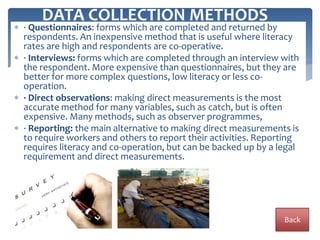
 · Questionnaires: forms which are completed and returned by
respondents. An inexpensive method that is useful where literacy
rates are high and respondents are co-operative.
 · Interviews: forms which are completed through an interview with
the respondent. More expensive than questionnaires, but they are
better for more complex questions, low literacy or less co-
operation.
 · Direct observations: making direct measurements is the most
accurate method for many variables, such as catch, but is often
expensive. Many methods, such as observer programmes,
 · Reporting: the main alternative to making direct measurements is
to require workers and others to report their activities. Reporting
requires literacy and co-operation, but can be backed up by a legal
requirement and direct measurements.
DATA COLLECTION METHODS
Back
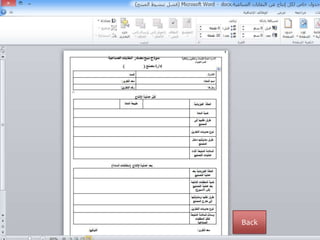
DATA COLLECTION Form
Back
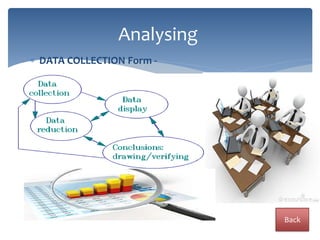
 DATA COLLECTION Form -
Analysing
Back
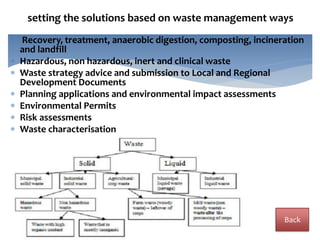
 Recovery, treatment, anaerobic digestion, composting, incineration
and landfill
 Hazardous, non hazardous, inert and clinical waste
 Waste strategy advice and submission to Local and Regional
Development Documents
 Planning applications and environmental impact assessments
 Environmental Permits
 Risk assessments
 Waste characterisation
• isation
setting the solutions based on waste management ways
Back
Thank you

Industrial waste management

  • 1.
  • 2.
    Contents Principles and practicesof waste management Remove and Reduce Reduction 1- Introduction Reuse Recycling/recovery Residue Treatment Disposal Study design
  • 3.
     It isestimated that more than 3 billion tons of waste are generated in Europe every year, and hazardous waste generally makes up about 1% of all waste in Europe [1];  nevertheless, hazardous waste presents a serous risk to the ecosystem and human health if not managed and treated safely. introduction
  • 4.
    Principles and practicesof waste management
  • 5.
    Remove and Reduce isknown as ‘reduction at source’. Source reduction occurs prior to reuse, recycling, treatment, or disposal. Source reduction may be achieved through equipment or technology modifications, process or procedure modifications, reformulation or redesign of products, substitution of raw materials, and improvements in housekeeping, maintenance, training or inventory control. TYPES OF SOURCE REDUCTION Source reduction can result from any activity that reduces the amount of a material need ed and therefore used to make products. Some specific examples of source reduction pr actices are: • Redesigning products to use fewer materials (e.g., lightweighting, material substitution). • Reusing products and materials (e.g., a refillable water bottle). ‫المنتج‬ ‫استخدام‬ ‫اعادة‬/‫المواد‬ • Extending the useful lifespan of products. ‫تطويل‬/‫عمر‬ ‫تمديد‬‫المنتجات‬. • Avoiding using materials in the first place (e.g., reducing junk mail). ‫األول‬ ‫المقام‬ ‫في‬ ‫المواد‬ ‫استخدام‬ ‫تجنب‬
  • 6.
    Reduction Toxicity reduction Table 2lists some chemicals/substances that should be avoided, because they have been regulated by various regulatory authorities, and identifies possible alternatives. Examples of reducing toxicity include: • Use of non-chlorinated degreasing agents. • Water-based paints in preference to solvent-based paints. ‫استخدام‬‫البويات‬(‫الماء‬) ‫على‬‫البويات‬(‫المذيبات‬) • Biodegradable ‘plastics’. ‫لتحلل‬ ‫قابل‬ ‫البالستيك‬ • Asbestos-free gaskets and insulation. • Mercury-free components (this includes lighting).‫الزئبق‬ ‫من‬ ‫خالية‬ ‫مركبات‬ ‫استخدام‬ • Hydro-testing using low toxicity (or no) additives. ‫سمية‬ ‫ذات‬ ‫مواد‬ ‫استخدام‬‫منخفظة‬
  • 8.
    Reuse The re-use ofmaterials in their original form such as: • Chemical containers. Some containers can be reused only once to provide container integrity while others can be reused multiple times using an approved chemical vendor to refill chemical ‘x’ into the same used chemical ‘x’ container with the correct choice of container material and stock return procedures. • Reuse of oily rags/pads that can be cleaned between uses. Need to consider the additional • Refurbishment of equipment eg valves, meters. • Supply of equipment in reusable containers. For example, the use of plastic boxes rather than cardboard can be considered. It is essential to identify a re-use option and to implement it;
  • 9.
    Recycling/recovery This is theconversion of wastes into usable materials and/or extraction of energy or materials from waste. Examples include: • Recycling scrap metal. • Re-conditioning drilling muds and solvents. • Using oily wastes for road construction and stabilisation (though consideration of chemical components and potential leaching to soil and groundwater should be undertaken before such use, for example, asphaltics may be appropriate for road use, but used oil may not). • Using cleaned drill cuttings and crushed clean concrete for road construction material and hard standing. • Discarding shredded tyres for landfill liner protective layers or as an alternate daily cover for landfills. For example, tires and high grip rubber mats/flooring might be suitable for use. The area of operation and availability of recycling facilities will dictate what can be done.
  • 10.
    Residue Treatment Residue Treatment Thedestruction, detoxification and/or neutralisation of residues through processes such as: • Biological methods – composting (if appropriate, materials can be recycled), land farming. • Thermal methods – incineration, thermal desorption. • Chemical methods – neutralisation, stabilisation. • Physical methods – filtration, centrifugation, compaction or shredding.
  • 11.
     • Injection. Deep injection wells are also called brine disposal wells, and are officially known as class II underground injection wells. They can take any fluid related to oil and gas drilling, including frack waste water.  • Discharge to water or land.  • Landfill. Disposal
  • 12.
    Information Collection [Form] DATACOLLECTION Analysing Evaluation Solution setting Applying Starting point Study design The aim? End
  • 13.
     The aim:‫الهدف‬/‫الغرض‬ 1-‫؟‬ ‫الصناعية‬ ‫للنفايات‬ ‫حلول‬ ‫ايجاد‬ 2-‫بالمؤسسة؟‬ ‫الصناعية‬ ‫النفايات‬ ‫ادارة‬ ‫ونظم‬ ‫مبادئ‬ ‫تطبيق‬(‫ع‬ ‫بشكل‬‫ام‬) The Aim what is the problem? Back
  • 14.
  • 15.
     · Questionnaires:forms which are completed and returned by respondents. An inexpensive method that is useful where literacy rates are high and respondents are co-operative.  · Interviews: forms which are completed through an interview with the respondent. More expensive than questionnaires, but they are better for more complex questions, low literacy or less co- operation.  · Direct observations: making direct measurements is the most accurate method for many variables, such as catch, but is often expensive. Many methods, such as observer programmes,  · Reporting: the main alternative to making direct measurements is to require workers and others to report their activities. Reporting requires literacy and co-operation, but can be backed up by a legal requirement and direct measurements. DATA COLLECTION METHODS Back
  • 16.
  • 17.
     DATA COLLECTIONForm - Analysing Back
  • 18.
     Recovery, treatment,anaerobic digestion, composting, incineration and landfill  Hazardous, non hazardous, inert and clinical waste  Waste strategy advice and submission to Local and Regional Development Documents  Planning applications and environmental impact assessments  Environmental Permits  Risk assessments  Waste characterisation • isation setting the solutions based on waste management ways Back
  • 19.