Municipal Solid Waste
Management in
Developing Countries
By: Qazi Maaz Arshad
11906424
School of Computer Science and Engineering
Lovely Professional University, Phagwara
Overview
 Introduction
 Classification of Wastes
 MSWM (Municipal Solid Waste Management)
 Factors Affecting MSWM
 Scenario of MSWM in India
 Global Scenario of MSWM
 Conclusion
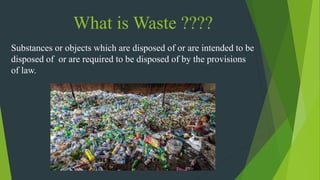
What is Waste ????
Substances or objects which are disposed of or are intended to be
disposed of or are required to be disposed of by the provisions
of law.
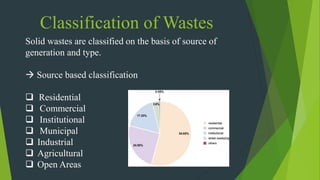
Classification of Wastes
Solid wastes are classified on the basis of source of
generation and type.
 Source based classification
 Residential
 Commercial
 Institutional
 Municipal
 Industrial
 Agricultural
 Open Areas
 Classification of Wastes Based on Type
 Garbage
 Ashes and Residues
 Combustible and Non-Combustible Wastes
 Bulky Wastes
 Street Wastes
 Biodegradable and Non-Biodegradable Wastes
 Dead Animals
 Abandoned Vehicles
 Construction and Demolition Wastes
 Farm Wastes
 Hazardous Wastes
 Sewage Wastes
Municipal Solid Waste
Management
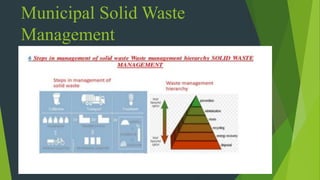
Steps in Management of Municipal Solid Waste
 Waste Generation
 Waste Storage and On-site handling
 Collection
 Transfer and Transport
 Processing
 Recovery and Recycling
 Waste Disposal
Solid waste management is defined as the discipline
associated with control of generation, storage, collection,
transport or transfer, processing and disposal of solid
wastes materials in a way that best addresses the public
health, conservation, economics, aesthetic, engineering and
other environmental considerations.
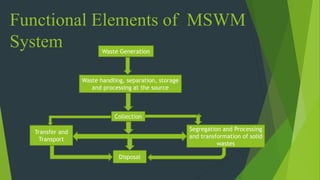
Functional Elements of MSWM
System Waste Generation
Waste handling, separation, storage
and processing at the source
Collection
Transfer and
Transport
Segregation and Processing
and transformation of solid
wastes
Disposal
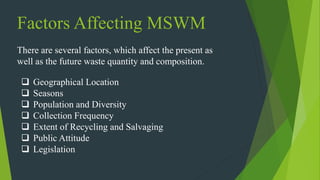
Factors Affecting MSWM
There are several factors, which affect the present as
well as the future waste quantity and composition.
 Geographical Location
 Seasons
 Population and Diversity
 Collection Frequency
 Extent of Recycling and Salvaging
 Public Attitude
 Legislation
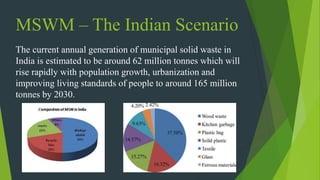
MSWM – The Indian Scenario
The current annual generation of municipal solid waste in
India is estimated to be around 62 million tonnes which will
rise rapidly with population growth, urbanization and
improving living standards of people to around 165 million
tonnes by 2030.
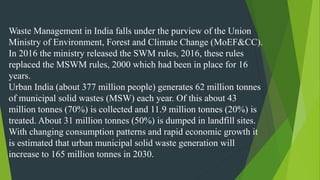
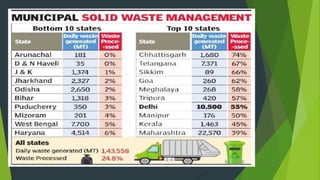
Waste Management in India falls under the purview of the Union
Ministry of Environment, Forest and Climate Change (MoEF&CC).
In 2016 the ministry released the SWM rules, 2016, these rules
replaced the MSWM rules, 2000 which had been in place for 16
years.
Urban India (about 377 million people) generates 62 million tonnes
of municipal solid wastes (MSW) each year. Of this about 43
million tonnes (70%) is collected and 11.9 million tonnes (20%) is
treated. About 31 million tonnes (50%) is dumped in landfill sites.
With changing consumption patterns and rapid economic growth it
is estimated that urban municipal solid waste generation will
increase to 165 million tonnes in 2030.
A typical waste management system in India
includes the following system: [There are (approx.)
4000 urban local bodies in India.]
• Waste generation and storage
• Segregation, reuse and recycling at the household level
• Primary waste collection and transport to a transfer station or
community bin
• Street sweeping and cleaning of public places
• Management of transfer station or community bin
• Secondary collection and transport to the waste disposal site
• Waste disposal in landfills
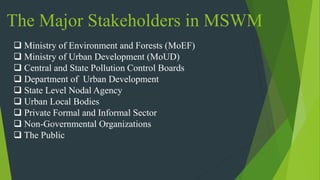
The Major Stakeholders in MSWM
 Ministry of Environment and Forests (MoEF)
 Ministry of Urban Development (MoUD)
 Central and State Pollution Control Boards
 Department of Urban Development
 State Level Nodal Agency
 Urban Local Bodies
 Private Formal and Informal Sector
 Non-Governmental Organizations
 The Public
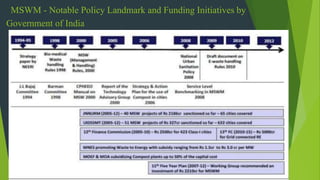
MSWM - Notable Policy Landmark and Funding Initiatives by
Government of India
Scenario of MSWM in Developed,
Developing and Least Developed
Countries
Although having different perspectives, waste management is
one of the key issues to be addressed both by developed and
developing countries for achieving a sustainable implementation
of the various human activities worldwide.
Developed countries produce more waste per capita because they
have higher levels of consumption. There are higher proportions
of plastics, metals, and paper in the MSW stream and there are
higher labour costs.
As countries continue developing, there is a reduction in biological
solid wastes and ash. Per capita waste generation in OECD
countries has increased by 14% since 1990, and 35% since
1980. Waste generation generally grows at a rate slightly lower than
GDP in these countries. Developed countries consume more than
60% of the world industrial raw materials and only comprise 22%
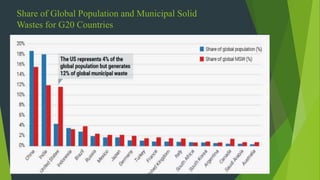
of the world's population. As a nation, Americans generate more
waste than any other nation in the world with 4.5 pounds (2.0 kg) of
municipal solid waste (MSW) per person per day, fifty five percent
of which is contributed as residential garbage.
Developing nations produce lower levels of waste per capita with a
higher proportion of organic material in the MSW stream. If
measured by weight, organic (biodegradable) residue constitutes at
least 50% of waste in developing countries.
Share of Global Population and Municipal Solid
Wastes for G20 Countries
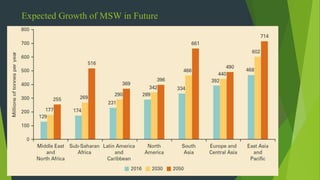
Expected Growth of MSW in Future
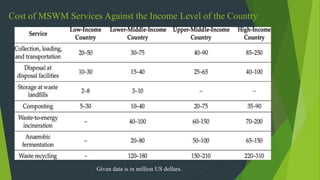
Cost of MSWM Services Against the Income Level of the Country
Given data is in million US dollars.
Conclusion
With an exponentially increasing population, it is even more
important to be considerate about how well individuals take care
of the planet. Land is limited, resources are limited, and the health
of the planet can only be hurt to a limited extent. As more and
more waste is generated yearly, it is evident that this increasing
trend is unacceptable in the long run. Landfills and recycling can
only temporarily mitigate the immediate consequences of this
large waste production. However, if the problem of municipal
solid waste is to be truly addressed, the root of the issue must be
looked at first. If less waste is generated in the first place, the
challenge of finding environmentally feasible ways of disposing
of waste will be much easier.
Thank You

Municipal Solid Waste Management in Developing Countries

  • 1.
    Municipal Solid Waste Managementin Developing Countries By: Qazi Maaz Arshad 11906424 School of Computer Science and Engineering Lovely Professional University, Phagwara
  • 2.
    Overview  Introduction  Classificationof Wastes  MSWM (Municipal Solid Waste Management)  Factors Affecting MSWM  Scenario of MSWM in India  Global Scenario of MSWM  Conclusion
  • 3.
    What is Waste???? Substances or objects which are disposed of or are intended to be disposed of or are required to be disposed of by the provisions of law.
  • 4.
    Classification of Wastes Solidwastes are classified on the basis of source of generation and type.  Source based classification  Residential  Commercial  Institutional  Municipal  Industrial  Agricultural  Open Areas
  • 5.
     Classification ofWastes Based on Type  Garbage  Ashes and Residues  Combustible and Non-Combustible Wastes  Bulky Wastes  Street Wastes  Biodegradable and Non-Biodegradable Wastes  Dead Animals  Abandoned Vehicles  Construction and Demolition Wastes  Farm Wastes  Hazardous Wastes  Sewage Wastes
  • 6.
  • 7.
    Steps in Managementof Municipal Solid Waste  Waste Generation  Waste Storage and On-site handling  Collection  Transfer and Transport  Processing  Recovery and Recycling  Waste Disposal Solid waste management is defined as the discipline associated with control of generation, storage, collection, transport or transfer, processing and disposal of solid wastes materials in a way that best addresses the public health, conservation, economics, aesthetic, engineering and other environmental considerations.
  • 8.
    Functional Elements ofMSWM System Waste Generation Waste handling, separation, storage and processing at the source Collection Transfer and Transport Segregation and Processing and transformation of solid wastes Disposal
  • 9.
    Factors Affecting MSWM Thereare several factors, which affect the present as well as the future waste quantity and composition.  Geographical Location  Seasons  Population and Diversity  Collection Frequency  Extent of Recycling and Salvaging  Public Attitude  Legislation
  • 10.
    MSWM – TheIndian Scenario The current annual generation of municipal solid waste in India is estimated to be around 62 million tonnes which will rise rapidly with population growth, urbanization and improving living standards of people to around 165 million tonnes by 2030.
  • 11.
    Waste Management inIndia falls under the purview of the Union Ministry of Environment, Forest and Climate Change (MoEF&CC). In 2016 the ministry released the SWM rules, 2016, these rules replaced the MSWM rules, 2000 which had been in place for 16 years. Urban India (about 377 million people) generates 62 million tonnes of municipal solid wastes (MSW) each year. Of this about 43 million tonnes (70%) is collected and 11.9 million tonnes (20%) is treated. About 31 million tonnes (50%) is dumped in landfill sites. With changing consumption patterns and rapid economic growth it is estimated that urban municipal solid waste generation will increase to 165 million tonnes in 2030.
  • 12.
    A typical wastemanagement system in India includes the following system: [There are (approx.) 4000 urban local bodies in India.] • Waste generation and storage • Segregation, reuse and recycling at the household level • Primary waste collection and transport to a transfer station or community bin • Street sweeping and cleaning of public places • Management of transfer station or community bin • Secondary collection and transport to the waste disposal site • Waste disposal in landfills
  • 13.
    The Major Stakeholdersin MSWM  Ministry of Environment and Forests (MoEF)  Ministry of Urban Development (MoUD)  Central and State Pollution Control Boards  Department of Urban Development  State Level Nodal Agency  Urban Local Bodies  Private Formal and Informal Sector  Non-Governmental Organizations  The Public
  • 15.
    MSWM - NotablePolicy Landmark and Funding Initiatives by Government of India
  • 16.
    Scenario of MSWMin Developed, Developing and Least Developed Countries Although having different perspectives, waste management is one of the key issues to be addressed both by developed and developing countries for achieving a sustainable implementation of the various human activities worldwide. Developed countries produce more waste per capita because they have higher levels of consumption. There are higher proportions of plastics, metals, and paper in the MSW stream and there are higher labour costs.
  • 17.
    As countries continuedeveloping, there is a reduction in biological solid wastes and ash. Per capita waste generation in OECD countries has increased by 14% since 1990, and 35% since 1980. Waste generation generally grows at a rate slightly lower than GDP in these countries. Developed countries consume more than 60% of the world industrial raw materials and only comprise 22% of the world's population. As a nation, Americans generate more waste than any other nation in the world with 4.5 pounds (2.0 kg) of municipal solid waste (MSW) per person per day, fifty five percent of which is contributed as residential garbage. Developing nations produce lower levels of waste per capita with a higher proportion of organic material in the MSW stream. If measured by weight, organic (biodegradable) residue constitutes at least 50% of waste in developing countries.
  • 18.
    Share of GlobalPopulation and Municipal Solid Wastes for G20 Countries
  • 19.
    Expected Growth ofMSW in Future
  • 20.
    Cost of MSWMServices Against the Income Level of the Country Given data is in million US dollars.
  • 21.
    Conclusion With an exponentiallyincreasing population, it is even more important to be considerate about how well individuals take care of the planet. Land is limited, resources are limited, and the health of the planet can only be hurt to a limited extent. As more and more waste is generated yearly, it is evident that this increasing trend is unacceptable in the long run. Landfills and recycling can only temporarily mitigate the immediate consequences of this large waste production. However, if the problem of municipal solid waste is to be truly addressed, the root of the issue must be looked at first. If less waste is generated in the first place, the challenge of finding environmentally feasible ways of disposing of waste will be much easier.
  • 22.