TOOL KIT ON
E-WASTE MANAGEMENT
RULES 2016
Ministry of Environment, Forest &
Climate Change, Govt. of India
Ministry of Housing & Urban Affairs
Govt. of India
CAPACITY BUILDING PROGRAMME ON
IMPLEMENTATION OF WASTE MANAGEMENT
RULES, 2016
National Productivity Council
Central Pollution Control Board
TOOLKIT ON
E-WASTE MANAGEMENT
RULES, 2016
Risks
Associated
With E-Waste
Salient
Features of
E-Waste
Rules 2016
Details of
Extended
Producer
Responsibility
Toolkit For
Manufactures,
Producers,
Dealers,
Refurbishers
bulk consumers
Your Guide For
Safe & Scien fic Management of
E-Waste
st
1 Edi on
June, 2019
Preface
Na onal Produc vity Council (NPC) is pleased to present to you the 'Toolkit on E-
Waste Management Rules 2016'.This toolkit has been cra ed specially for all the
stakeholders involved in the genera on, collec on, storage, transporta on &
treatmentofewaste.
The toolkit has seventeen sec ons with toolkits for manufacturer, producer,
collec on centres, transporta on, dealers, refurbisher, consumer or bulk consumer,
dismantler, recycler, reduc on in the use of hazardous substances (ROHS) in the
manufacture of electrical and electronic equipment and their components or
consumables or parts or spares, producer responsibility organiza on (PRO),
miscellaneousstakeholders.
The toolkit has been brought together by a team of good technocrats and
environmentalists from various regulatory authori es in the country. It has been
carefullyreviewedbyexperts.
This toolkit is to ensure safe and scien fic management of e waste for all the ci zens
everywhereatall mes.
NPC would welcome any sugges ons and feedback on this publica on so that 'The
Toolkit'becomesatrustedcompanionandpartofallstakeholders.
K.D.Bhardawaj
RegionalDirector,Delhi
Na onalProduc vityCouncil
Compiled & Edited by:
Na onal Produc vity Council
Note: 1.Allpicturesusedinthetoolkitarefromvarioussources,whichhavebeendulyreferredto.
2.Thispublica onispurelyforeduca onpurposeandnotforcommercialpurpose.
TABLE OF CONTENTS
1. INTRODUCTION & BACKGROUND 1
2. DEFINITION OF E-WASTE 4
3. RISKS ASSOCIATED WITH E-WASTE 6
4. AMOUNT & COMPOSITION OF E-WASTE & NEED FOR MANAGEMENT 10
5. SALIENT FEATURES OF E-WASTE RULES 2016 14
6. TOOLKIT FOR MANUFACTURER 18
7. TOOLKIT FOR PRODUCERS 20
8. TOOLKIT FOR COLLECTION CENTRES 27
9. TOOLKIT FOR TRANSPORTATION 29
10. TOOLKIT FOR DEALER 33
11. TOOLKIT FOR REFURBISHER 34
12. TOOL KIT FOR CONSUMER or BULK CONSUMER 37
13. TOOLKIT FOR DISMANTLER 39
14. TOOLKIT FOR RECYCLER 43
15. TOOLKIT FOR REDUCTION IN THE USE OF HAZARDOUS
SUBSTANCES (RoHS) IN THE MANUFACTURE OF ELECTRICAL AND
ELECTRONIC EQUIPMENT AND THEIR COMPONENTS OR
CONSUMABLES OR PARTS OR SPARES 51
16. TOOLKIT FOR PRODUCER RESPONSIBILITY ORGANIZATION (PRO) 52
17. TOOLKIT FOR MISCELLANEOUS STAKEHOLDERS 54
REFERENCES 57
ANNEXURE – 1: IMPORTANT DEFINITIONS 58
ANNEXURE – 2: SCHEDULE - II 60
ANNEXURE – 3: APPLICATION FORMS 63
ANNEXURE – 4: SELF DECLARATION FORM (as per E-waste
Management Rules, 2016) 77
ANNEXURE – 5: TECHNICAL DOCUMENTS FOR RoHS (EN 50581 of EU) 79
List of Tables
3.1 Hazardous Chemicals Contained in Some E- waste 6
4.1 Important metals used for electric and electronic equipment (based on demand
in 2006) 11
5.1 EEE as Per Schedule 16
5.2 Targets as per Schedule III 17
5.3 Responsibili es of Major Stakeholders for Collec on, Transporta on and Disposal
of E-waste 17
9.1 Local Authority Collec on Facili es Per Popula on in 2003 31
14.1 Input/ Output and unit opera ons for third level treatment of WEEE/E-waste 50
List of Figures
1.1 Breakup of IT Hardware 4 1
1.2 Trend of PC Sales in India 5 2
3.1 Evidences of air, water and soil pollu on and Occupa onal, Health and Safety
Hazards 8
3.2 CO2 emissions of primary metal produc on calculated using the EcoInvent 2.0
database 9
4.1 Material Content of Mobile Phones 10
4.2 Conceptual Material Flow Chain 12
4.3 Material Flow Chain in Developing Country 12
5.1 Conceptual EPR Applica on Material Flow Chain in Indian Context 15
5.2 Conceptual EPR Flow Chain in Indian Context 15
9.1 WEEE/E-waste Collec on Bins / Cage 32
9.2 Examples of WEEE/E-waste Collec on System (impermeable surface
& weatherproof covering) at a collec on facility 32
14.1 Simplified Flow Diagram for the Recycling of WEEE/E-waste 48
14.2 Simplified Flow Diagram for second Level WEEE/E-waste treatment 49
14.3 CRT Dismantling Opera on Procedure 49
14.4 Conceptual CFL/FL Waste Treatment Scheme and Process Flow 50
1. INTRODUCTION & BACKGROUND
1.1 Introduc on
Rapid growth in waste genera on is a major by product of increasing consump on. As per
the World Bank (2012) es mates, by 2025, 4.3 billion urban residents will generate 2.2
billion tones per year of municipal solid waste. Over the years, the nature and composi on
of waste has undergone significant changes due to changed consump on and consumer
behavior. As a result, diverse waste streams are emerging crea ng problems for na onal
and local government for their sustainable management. Since waste management has a
strong bearing on environment, and public health, the adverse impacts of improper waste
management are very serious and well documented. As per UNU-IAS es mates the total
amount of WEEE/E-waste generated in the world in 2014 was 41.8 million metric tonnes
(Mt). It has been forecasted to increase to 50 Mt by 2018. This E-waste is comprised of 1.0
Mt of lamps, 6.3 Mt of screens, 3.0 Mt of small IT (such as mobile phones, pocket
calculators, personal computers, printers, etc.), 12.8 Mt of small equipment (such as
vacuum cleaners, microwaves, toasters, electric shavers, video cameras, etc.), 11.8 Mt of
large equipment (such as washing machines, clothes dryers, dishwashers, electric stoves,
photovoltaic panels, etc.) and 7.0 Mt of cooling and freezing equipment (temperature
exchangeequipment).Onesuchemergingwastestreamiselectronicwaste(E-waste).
1.2 E-wasteScenarioinIndia
The growing amount of E-waste is not only an environmental issue but also a source of
precious metals & rare earth elements. About 15.5% of the total E-waste generated is
ge ng scien fically recycled. Since the last two decades, many na onal governments in
Europe and other developed countries have made con nuous efforts for E-waste
management.
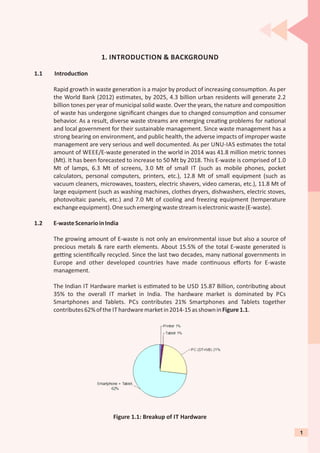
The Indian IT Hardware market is es mated to be USD 15.87 Billion, contribu ng about
35% to the overall IT market in India. The hardware market is dominated by PCs
Smartphones and Tablets. PCs contributes 21% Smartphones and Tablets together
contributes62%ofthe IT hardwaremarketin2014-15asshowninFigure1.1.
Figure 1.1: Breakup of IT Hardware
1
Figure 1.2 indicates that PC sales stood at 10.61 million in 2014-15, 1.23 million less than
that of previous year. Even though notebooks have de-grown by 15% over last year,
notebooks contribute 55% of overall PC sales. The smartphones sales in India grew 33% in
2014-15 to reach 69.67 million units, compared to a growth of 244% during 2013-14. Tablet
sales in India grew only by about 4% to reach 3.48 million units in 2014-15 as compared to a
growth of 76% during 2013-14. The average printer sales for last 5 years is around 3.0
million. The server market during 2014 has grown by 30% over the 2013-14 and posted
salesof1.82million.Serversgrowingconsistentlyforthelast5years.
Figure 1.2: Trend of PC Sales in India
TheconsumerelectronicsmarketinIndiaisoneofthelargestintheworldandisan cipated
to grow at a compound annual growth rate (CAGR) of 66.1% from US$ 31.6 billion in 2015
to US$ 400 billion in 2020. Some key factors behind this growth in the electronics market
are - rising disposable income, changing lifestyles, and easier access to credit. Television
industry is going to propel this growth. By 2020, the television industry in India is expected
to expand to US$ 16.8 billion from US$ 9.4 billion in 2016. Further, by 2020 demand of
telecom equipment in India is expected to rise to US$ 30 billion from US$ 20 billion in FY
16E.
The increasing growth trends of the IT & consumer electronics market in India indicate that
“end of life” electronic equipment will a major waste stream in the future. As per
CPCB/MoEF es mates, India generated 1,46,000 metric tones of E-waste from six items,
which were projected to exceed 8,00,000 metric tones by 2012. A report of UNU predicted
that 1.7 million metric tons of E-waste will be generated by 2014. Currently there are
registered 178 E-waste dismantling / recycling units with an installed capacity of 438086
metric tons in India. This waste stream needs to be addressed in future. In this regard, E-
waste(Management&Handling)Ruleshavebeenno fiedin2016&havebecomeeffec ve
since 1st October, 2016. These are extended producer responsibility (EPR) based rules
wherein targets for collec on have been fixed. Further, producers are given major
responsibility to address this waste stream & seek EPR authoriza on. Currently 112
producershavereceived EPR authoriza onfrom CPCB.
2
1.3 Objec vesofDevelopingToolkit
The major objec ve for developing toolkit is to assist the relevant stakeholders to
understand assist the relevant stakeholders to understand & implement their roles &
responsibili es for achieving not only regulatory compliance but also addressing E-waste
management. This toolkit will also serves both as reference material for training of trainers
aswellasreadyreckonertothetargetaudience.
1.4 FormatoftheToolkit
This Toolkit has been compiled in sixteen sec ons. Sec on 1 gives introduc on &
background; Sec on 2 describes defini on of E-waste; Sec on 3 describes risks associated
with E-waste; Sec on 4 describes amount & composi on of E-waste & need for
management; Sec on 5 describes salient features of E-waste Rules 2016; Sec on 6
describes toolkit for manufacturer; Sec on 7 describes toolkit for producers; Sec on 8
describes toolkit for collec on centres; Sec on 9 describes toolkit for transporta on;
Sec on 10 describes toolkit for dealers; Sec on 11 describes toolkit for refurbisher;
Sec on 12 describes toolkit consumer or bulk consumer; Sec on 13 describes toolkit for
dismantler; Sec on 14 describes toolkit for recycler; Sec on 15 describes toolkit for RoHS
andSec on16describestoolkitformiscellaneousstakeholders.Thetoolkitwillenablethe
user / stakeholder to read, understand and implement the simplified version of
regula on relevant to them. This simplifica on has been done based on defini on,
iden fica on of responsibili es, do's & don't infrastructure requirements & regulatory
checklist.Further,interna onalbestprac ceshavebeenincludedtogiveafairideatothe
audienceaboutprac calaspectsofimplementa on.
3
2. DEFINITION OF E-WASTE
2.0 Defini onasPerE-wasteRules
Defini on:'e-waste'meanselectricalandelectronicequipment,wholeorinpartdiscarded
as waste by the consumer or bulk consumer as well as rejects from manufacturing,
refurbishmentandrepairprocesses;
Defini on: 'end-of-life' of the product means the me when the product is intended to be
discardedbytheuser;
2.1 WEEE /E-wasteDefini onandClassifica on(Interna onal)
AS per Step Ini a ve, WEEE/E-waste is a term used to cover all items of electrical and
electronic equipment (EEE) and its parts that have been discarded by its owner as waste
without the intent of re-use. It is also referred to as WEEE (Waste Electrical and Electronic
Equipment), electronic waste or E-scrap in different regions. WEEE/E-waste includes a
wide range of products, almost any household or business item with circuit or electrical
components with power or ba ery supply. WEEE / E-waste can be classified into following
categories.
Ÿ Temperature exchange equipment: Also more commonly referred to as, cooling and
freezing equipment. Typical equipment is refrigerators, freezers, air condi oners, heat
pumps.
Ÿ Screens, monitors: Typical equipment comprises televisions, monitors, laptops,
notebooks,andtablets.
Ÿ Lamps: Typical equipment comprises straight fluorescent lamps, compact fluorescent
lamps,fluorescentlamps,highintensitydischargelamps,and LED lamps.
Ÿ Large equipment: Typical equipment comprises washing machines, clothes dryers,
dish washing machines, electric stoves, large prin ng machines, copying equipment
andphotovoltaicpanels.
Ÿ Small equipment: Typical equipment comprises vacuum cleaners, microwaves,
ven la on equipment, toasters, electric ke les, electric shavers, scales, calculators,
radio sets, video cameras, electrical and electronic toys, small electrical and electronic
tools,smallmedicaldevices,smallmonitoringandcontrolinstruments).
Ÿ Small IT and telecommunica on equipment: Typical equipment comprises mobile
phones, GPS,pocketcalculators,routers,personalcomputers,printers,telephones).
These categories have been defined as per ease of WEEE/E-waste streams requiring
specific collec on, treatment & disposal mechanism. Further, defini on & classifica on
differs from country to country. Examples of defini on & classifica on as per European
Unionisgivenbelow.
4
EuropeanUnion
Defini on as per EU direc ve with status of its transposi on and varia on in major EU
countries is described in Annexure 1 followed by WEEE/E-waste's reference in Basel
Conven on. WEEE Direc ve (EU, 2002a) describes WEEE/E-waste as “Electrical or
electronic equipment, which is waste including all components, subassemblies and
consumables,whicharepartoftheproductatthe meofdiscarding.”
Direc ve 75/442/EEC, Ar cle 1(a) defines “waste” as “any substance or object which the
holder disposes of or is required to dispose of pursuant to the provisions of na onal law in
force.”
'Electrical and electronic equipment' or 'EEE' means equipment which is dependent on
electrical currents or electromagne c fields in order to work properly and equipment for
the genera on, transfer and measurement of such current and fields falling under the
categories set out in Annex IA to Direc ve 2002/96/EC (WEEE) and designed for use with a
voltage ra ng not exceeding 1000 volts for alterna ng current and 1500 volts for direct
current.
Annex IA
CategoriesofelectricalandelectronicequipmentcoveredbythisDirec ve.
1. Largehouseholdappliances
2. Smallhouseholdappliances
3. IT andtelecommunica onsequipment
4. Consumerequipment
5. Ligh ngequipment
6. Electrical and electronic tools (with the excep on of large-scale sta onary industrial
tools)
7. Toys,leisureandsportsequipment
8. Medicaldevices(withtheexcep onofallimplantedandinfectedproducts)
9. Monitoringandcontrolinstruments
10. Automa cdispensers
5
3. RISKS ASSOCIATED WITH E-WASTE
3.0 HazardousNatureofE-waste
E-waste is poten ally hazardous waste due to unscien fic handling, treatment,
incinera on and dumping. A list of E-waste components containing hazardous substances
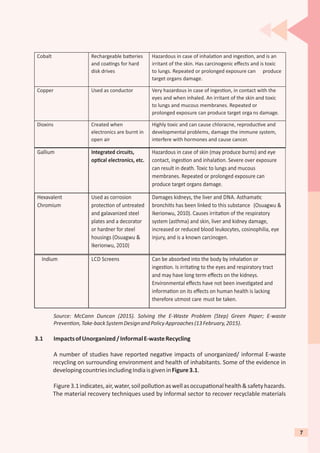
as per Interna onal Labour Organiza on (ILO) is presented in Table 3.1. The list indicates
that thesecomponents should betreatedscien ficallyand should not end up ina landfillor
anincineratorormixedwithothertypesofwaste.
Table 3.1: Hazardous Chemicals Contained in Some E-waste
Chemical
Source in Electronic
Products
Health Concerns
An mony CRTs, Printed Circuit
Boards, etc.
Very hazardous in event of inges on, hazardous in event
of skin of eye contact, and inhala on. Causes damage to
the blood, kidneys, lungs, nervous system, liver and
mucous membranes.
Arsenic Used to make
transistors
Soluble inorganic arsenic in acutely toxic and intake of
inorganic arsenic over a long period can lead to chronic
arsenic poisoning. Effects, which can take years to
develop, include skin lesions, peripheral neuropathy,
gastro-intes nal symptoms, diabetes, renal system
effects, cardiovascular disease and cancer.
Barium Front Panel of CRTs Short term exposure causes muscle weakness and
damage to heart, liver and spleen. It also produces brain
swelling a er short exposure.
Beryllium Motherboards of
computers
Carcinogenic (causing lung cnacer), and inhala on of
fumes and dust can cause chronic beryllium disease or
beryllicosis and skin diseases such as warts.
Cadmium Chip resistors and
semiconductors
Has toxic, irreversible effects on human health and
accumulates in kidney and liver (Op. cit.). Has toxic
effects on the kidney, the skeletal system and the
respiratory system, and is classified as a human
carcinogen.
Chloro-
Fluorocarbons
(CFCs)
In older fridges and
coolers
Found to destroy the ozone layer and is a potent
greenhouse gas. Direct exposure can cause
unconsciousness, shortness of breath and irregular
heartbeat. Can also cause confusion, drowsiness,
coughing, sore throat, difficulty in breathing and eye
redness and pain. Direct skin contact with some types of
CFCs can cause frostbite or dry skin.
6
Source: McCann Duncan (2015). Solving the E-Waste Problem (Step) Green Paper; E-waste
Preven on,Take-backSystemDesignandPolicyApproaches(13February,2015).
3.1 ImpactsofUnorganized/InformalE-wasteRecycling
A number of studies have reported nega ve impacts of unorganized/ informal E-waste
recycling on surrounding environment and health of inhabitants. Some of the evidence in
developingcountriesincludingIndiaisgiveninFigure3.1.
Figure3.1indicates,air,water,soilpollu onaswellasoccupa onalhealth&safetyhazards.
The material recovery techniques used by informal sector to recover recyclable materials
Cobalt Rechargeable ba eries
and coa ngs for hard
disk drives
Hazardous in case of inhala on and inges on, and is an
irritant of the skin. Has carcinogenic effects and is toxic
to lungs. Repeated or prolonged exposure can produce
target organs damage.
Copper Used as conductor Very hazardous in case of inges on, in contact with the
eyes and when inhaled. An irritant of the skin and toxic
to lungs and mucous membranes. Repeated or
prolonged exposure can produce target orga ns damage.
Dioxins Created when
electronics are burnt in
open air
Highly toxic and can cause chloracne, reproduc ve and
developmental problems, damage the immune system,
interfere with hormones and cause cancer.
Gallium Integrated circuits,
op cal electronics, etc.
Hazardous in case of skin (may produce burns) and eye
contact, inges on and inhala on. Severe over exposure
can result in death. Toxic to lungs and mucous
membranes. Repeated or prolonged exposure can
produce target organs damage.
Hexavalent
Chromium
Used as corrosion
protec on of untreated
and galavanized steel
plates and a decorator
or hardner for steel
housings (Osuagwu &
Ikerionwu, 2010)
Damages kidneys, the liver and DNA. Asthama c
bronchi s has been linked to this substance (Osuagwu &
Ikerionwu, 2010). Causes irrita on of the respiratory
system (asthma) and skin, liver and kidney damage,
increased or reduced blood leukocytes, cosinophilia, eye
injury, and is a known carcinogen.
Indium LCD Screens Can be absorbed into the body by inhala on or
inges on. Is irrita ng to the eyes and respiratory tract
and may have long term effects on the kidneys.
Environmental effects have not been inves gated and
informa on on its effects on human health is lacking
therefore utmost care must be taken.
7
o en cause pollu on e.g., open-air burning of cables to recover the copper wire from PVC
coa ng. It has serious impacts on the health of the informal workers because of
hydrochloric acid produced, which causes acute respiratory problems. Other examples
include precious metal leaching using cyanide process, breaking & disposal of mercury
containinglampsetc.
Figure3.1:Evidencesofair,waterandsoilpollu onandOccupa onal,HealthandSafetyHazards
Source: Compendium of Technologies for the Recovery of Materials from WEEE/E-Waste Final
Report UNEP / IETC.JainAmit(20thApril,2017).
3.2 EnvironmentalHealth&Socio-economicImpactofPrimaryProduc onVs
SecondaryProduc onofMetalsfrom WEEE/E-waste
The environmental impact/footprint of the primary metal produc on has been reported to
be significant, since they are mined from ores in which their concentra on is low. Some of
the impacts include large amount of land required for mining, genera on of waste water
and emissions of sulfur-dioxide (SO2), CO2 and energy consump on. Figure 3.2 indicates
CO2emissionsfromprimaryproduc onofmetals.
8
Figure 3.2: CO2 emissions of primary metal produc on calculated using the EcoInvent 2.0 database
Source: Schluep Mathias, Hagelueken Chris an, Ruediger Kuehr, Magalini Federico, Maurer Claudia,
Meskers Chris na, Mueller Esther, Wang Feng (2009). Sustainable Innova on and Technology Transfer
Industrial Sector Studies; Recycling – From E-Waste to Resources; UNEP / STEP Solving the E-waste
Problem, Page No. 10
Recovery of metals from secondary sources like WEEE/E-waste require small amount of
landandgenerateafrac onofgaseousemissionsandwastewater.
9
4. AMOUNT & COMPOSITION OF E-WASTE & NEED FOR MANAGEMENT
4.1 Amount&IComposi onofE-waste
E-waste may consist of 60 different elements, which are valuable as well as hazardous and
non-hazardous in nature. Since electrical and electronic equipments are major consumers
of precious metals, they create huge global demand. E-waste may contain up to 60
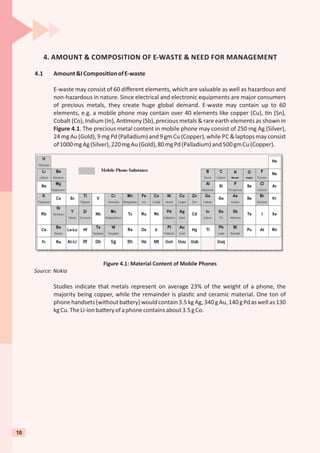
elements, e.g. a mobile phone may contain over 40 elements like copper (Cu), n (Sn),
Cobalt (Co), Indium (In), An mony (Sb), precious metals & rare earth elements as shown in
Figure 4.1. The precious metal content in mobile phone may consist of 250 mg Ag (Silver),
24 mg Au (Gold), 9 mg Pd (Palladium) and 9 gm Cu (Copper), while PC & laptops may consist
of1000mgAg(Silver),220mgAu(Gold),80mgPd(Palladium)and500gmCu(Copper).
Figure 4.1: Material Content of Mobile Phones
Source: Nokia
Studies indicate that metals represent on average 23% of the weight of a phone, the
majority being copper, while the remainder is plas c and ceramic material. One ton of
phone handsets (without ba ery)would contain3.5kgAg,340gAu,140gPd as wellas 130
kgCu.TheLi-ionba eryofaphonecontainsabout3.5gCo.
10
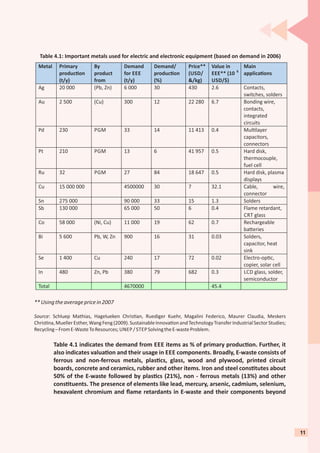
Table 4.1: Important metals used for electric and electronic equipment (based on demand in 2006)
**Usingtheaveragepricein2007
Source: Schluep Mathias, Hagelueken Chris an, Ruediger Kuehr, Magalini Federico, Maurer Claudia, Meskers
Chris na,MuellerEsther,WangFeng(2009).SustainableInnova onandTechnologyTransferIndustrialSectorStudies;
Recycling–FromE-WasteToResources; UNEP / STEP SolvingtheE-wasteProblem.
Table 4.1 indicates the demand from EEE items as % of primary produc on. Further, it
also indicates valua on and their usage in EEE components. Broadly, E-waste consists of
ferrous and non-ferrous metals, plas cs, glass, wood and plywood, printed circuit
boards, concrete and ceramics, rubber and other items. Iron and steel cons tutes about
50% of the E-waste followed by plas cs (21%), non - ferrous metals (13%) and other
cons tuents. The presence of elements like lead, mercury, arsenic, cadmium, selenium,
hexavalent chromium and flame retardants in E-waste and their components beyond
Metal Primary
produc on
(t/y)
By
product
from
Demand
for EEE
(t/y)
Demand/
produc on
(%)
Price**
(USD/
&/kg)
Value in
EEE** (10 6
USD/$)
Main
applica ons
Ag 20 000 (Pb, Zn) 6 000 30 430 2.6 Contacts,
switches, solders
Au 2 500 (Cu) 300 12 22 280 6.7 Bonding wire,
contacts,
integrated
circuits
Pd 230 PGM 33 14 11 413 0.4 Mul layer
capacitors,
connectors
Pt 210 PGM 13 6 41 957 0.5 Hard disk,
thermocouple,
fuel cell
Ru 32 PGM 27 84 18 647 0.5 Hard disk, plasma
displays
Cu 15 000 000 4500000 30 7 32.1 Cable, wire,
connector
Sn 275 000 90 000 33 15 1.3 Solders
Sb 130 000 65 000 50 6 0.4 Flame retardant,
CRT glass
Co 58 000 (Ni, Cu) 11 000 19 62 0.7 Rechargeable
ba eries
Bi 5 600 Pb, W, Zn 900 16 31 0.03 Solders,
capacitor, heat
sink
Se 1 400 Cu 240 17 72 0.02 Electro-op c,
copier, solar cell
In 480 Zn, Pb 380 79 682 0.3 LCD glass, solder,
semiconductor
Total 4670000 45.4
11
threshold quan es render them hazardous in nature. These items of economic value
canberecovereddependingontherecycling/recoverytechnologies.
4.2 NeedforE-wasteManagement
Since E-waste consists of items of economic value and poses environmental & health risks,
it needs to be managed in an environmentally sound manner. The main challenge is to
manage the material flow chain shown conceptually in Figure 4.2 & in developing country
context(India)showninFigure4.3.
Figure 4.2: Conceptual Material Flow Chain
Source: United Na ons Environment Programme Interna onal Environmental Technology / Asian Ins tute of
Technology Regional Resource Centre for Asia and the Pacific Centre Compendium of Technologies for the Recovery of
Materialsfrom WEEE/E-WasteFinalReportp
Figure 4.3: Material Flow Chain in Developing Country
Source: United Na ons Environment Programme Interna onal Environmental Technology / Asian Ins tute of
Technology Regional Resource Centre for Asia and the Pacific Centre Compendium of Technologies for the Recovery of
Materialsfrom WEEE/E-WasteFinalReport
Figure4.3indicatesdominanceofinformalsectorinE-wasterecyclinginIndia.
12
4.3 ExtendedProducerResponsibility(EPR)
Globally, E-waste management is carried out based on the principles of extended producer
responsibility (EPR) Principle. EPR term was coined in 1990, where extended means more
thanbefore,producersignifiesshi ofresponsibilityfrom“MunicipalitytoBusiness”.
Theresponsibilitymeansresponsibilityforphysical&financialmanagementofE-waste.
Conceptual Features under EPR include:
Ÿ Environmentally Sound Management of Waste
Ÿ Physical Responsibility
Ÿ Financial Responsibility
Ÿ Informa on Responsibility
Ÿ Product design shi (mee ng ROHS, ease of dismantling/recycling, resource
efficiency)
Major Enabling Factors to Implement EPR include:
Ÿ Defining Targets & planning (short & long term) to achieve
Ÿ Clear demarca on of Responsibility (Physical/ Financial/Regulatory)
Ÿ Infrastructure to implement responsibility e.g. crea on of a backbone to integrate
stakeholders for enabling viable “take back” system
Ÿ Financial management
Ÿ Monitoring and Audi ng
Ÿ Consumer / Producer / Regulator's Acceptability
Steps to Implementa on of EPR (Each Stakeholder along the chain)
Step 1: Iden fy, quan fy & monitor upstream & downstream flow
Step 2: Carry out: Input & Output Analysis both current & historical (number/ weight)
Step 3: Quan fy, prepare database & monitor upstream & downstream flow
Step 4: Map regulatory requirements Vs. upstream & downstream flow
Step 5: Refer guidelines to assess requirements for EPR planning
Step 6: Prepare strategic EPR plan for implementa on i.e. Individual/ collec ve/ both or
some other mechanism
Step 7: Submit (if applicable) & implement the plan
E-waste (Management & Handling) Rules, 2016 have been formulated based on the
principles of Extended Producers Responsibility (EPR).
13
5. SALIENT FEATURES OF E-WASTE RULES 2016
5.1 Major Features
Government of India in supersession of E-waste (Management and Handling) Rules, 2011
has no fied the E-waste (Management) Rules, 2016 vide G.S.R. 338(E) dated 23.03.2016
whichwillbeeffec vefrom01-10-2016.
1. These rules are applicable to every producer, consumer or bulk consumer, collec on
centre, dismantler and recycler of e-waste involved in the manufacture, sale, purchase
and processing of electrical and electronic equipment or components specified in
schedule–IoftheseRules.
2. Two categories of electrical and electronic equipment namely (i) IT and
Telecommunica on Equipment and (ii.) Consumer Electricals and Electronics such as
TVs, Washing Machines, Refrigerators Air Condi oners including fluorescent and other
mercury containing lamps are covered under these Rules. The main feature, of these
rules,isExtendedProducerResponsibility(EPR).
3. Target based approach for implementa on of EPR has been adopted in the E-Waste
(Management) Rules, 2016, which s pulate phase wise collec on target to producers
for the collec on of e-waste, either in number or weight, which shall be 30% of the
es matedquan tyofwastegenera onduringfirsttwoyearofimplementa onofrules
10%during2017-18,20%during2018-19followedby40%during30%duringthirdyear,
40% during fourth year, 50% during fi h, 60% during sixth year and 70% during seventh
yearonwards.
Rulesareapplicableto:
Ÿ Used lead acid ba eries as covered under the Ba eries (Management and Handling)
Rules,2001madeundertheAct.
Ÿ Micro enterprises as defined in the Micro, Small and Medium Enterprises Development
Act,2006(27of2006);and
Ÿ Radioac ve wastes as covered under the provisions of the Atomic Energy Act, 1962 (33
of1962)andrulesmadethereunder.
5.2 Applica onofRules
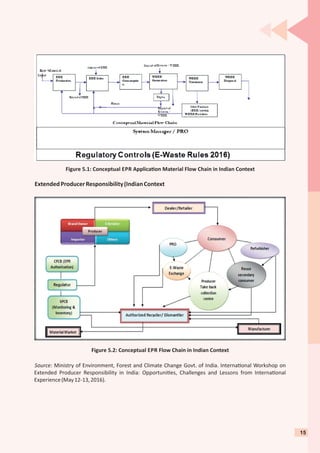
Conceptual EPR applica on to material flow chain in Indian context is shown in Figure 5.1,
while EPR flow chart in Indian context is shown in Figure 5.2. Applica on to EEE items is
given in Table 5.1, responsibili es of stakeholders in Table 5.2 and major compliance /
monitoring/repor nginTable5.3.
14
Figure 5.1: Conceptual EPR Applica on Material Flow Chain in Indian Context
ExtendedProducerResponsibility(IndianContext
Figure 5.2: Conceptual EPR Flow Chain in Indian Context
Source: Ministry of Environment, Forest and Climate Change Govt. of India. Interna onal Workshop on
Extended Producer Responsibility in India: Opportuni es, Challenges and Lessons from Interna onal
Experience(May12-13,2016).
15
Table 5.1: EEE as Per Schedule I
Source:E-waste(Management)Rules,2016
Sr.
No.
Categories of Electrical and Electronic
EEE
Code
Average
Life
i. Informa on Technology and Telecommunica on Equipment
Centralized Data Processing ITEW1
Mainframe 10 Years
Minicomputer 5 Years
Personal Compu ng: Personal Computers
(Central Processing Unit with Input and Output Devices)
ITEW2 6 Years
Personal Compu ng: Laptop
Computers (Central Processing Unit with Input and Output Devices)
ITEW3 5 Years
Personal Compu ng: Notebook Computers ITEW4 5 Years
Personal Compu ng: Notepad Computers ITEW5 5 Years
Printers Including Cartridges ITEW6 10 Years
Copying Equipment ITEW7 8 Years
Electrical and Electronic Typewriters ITEW8 5 Years
User Terminals and Systems ITEW9 6 Years
Facsimile ITEW10 10 Years
Telex ITEW11 5 Years
Telephones ITEW12 9 Years
Pay Telephones ITEW13 9 Years
Cordless Telephones ITEW14 9 Years
Cellular Telephones ITEW15
Feature Phones 7 Years
Smart Phones 5 Years
Answering Systems ITEW16 5 Years
ii. Consumer Electrical and Electronics
Television sets (including sets based on (Liquid Crystal Display and Light
Emi ng Diode Technology)
CEEW1 9 Years
Refrigerator CEEW2 10 Years
Washing Machine CEEW3 9 Years
Air-condi oners excluding centralized air condi oning plants CEEW4 10 Years
Fluorescent and other Mercury Containing Lamps CEEW5 2 Years
16
Table 5.2: Responsibili es of Major Stakeholders for Collec on, Transporta on and Disposal of E-
waste
Source: IRGSSA
Table 5.3: Compliance / Monitoring / Repor ng
Source: IRGSSA
17
Responsibilities
Producer
Consumer
Bulk
Consumer
Refurbisher
s
Dismantler
Recycler/
Reprocessor
Collection Manufacturing √
End of Life √
Take-back Individual √
Collectively √
Transportation to Producer √ √
Collection Centre √ √ √
Dismantlers/ Recyclers √ √ √ √ √
TSDF* Facility √ √ √
Financing √
Registration √ √ √ √
Filing of Annual Returns √ √ √ √ √
Return of Annual Inventory Handled √ √ √ √ √
Stakeholder
EPR Authorization
Record
Maintain
Annual
Return
Renewal
Form – 1 Form – 2 Form – 3 Form – 4
Manufacturer Ö 1 (a)
SPCB
Ö
(SPCB)
Ö
(SPCB)
Producer Ö
(CPCB)
Ö
(CPCB)
Ö
(CPCB)
Collection Centre Ö
(CPCB /
SPCB)
Refurbisher Ö 1 (a)
SPCB
Ö
(SPCB)
Ö
(SPCB)
Bulk Consumer Ö
(SPCB)
Ö
(SPCB)
Dismantler Ö
(SPCB)
Ö
(SPCB)
Ö
(SPCB)
Recycler Ö
(CPCB /
SPCB)
Ö
(SPCB)
Ö
(SPCB)
6. TOOLKIT FOR MANUFACTURER
6.1 Defini on
'manufacturer' means a person or an en ty or a company as defined in the Companies Act,
2013 (18 of 2013) or a factory as defined in the Factories Act, 1948 (63 of 1948) or Small and
Medium Enterprises as defined in Micro, Small and Medium Enterprises Development Act,
2006 (27 of 2006), which has facili es for manufacture of electrical and electronic
equipment;
6.2 Responsibili es of Manufacturer
Who Responsibility DO ’ s Don’ts
1. Person
2. En ty
3. Company as
defined in the
companies Act,
2013
4. Factory as
defined in the
Factory Act,
1948
5. Micro, Small &
Medium
Enterprises
Development
Act, 2006
(1) collect e-waste generated during
the manufacture of any electrical
and electronic equipment and
channelize it for recycling or
disposal;
(2) apply for an authorisa on in
Form 1 (a) from the concerned
State Pollu on Control Board,
which shall give the
authorisa on in accordance with
Form 1 (bb);
(3) ensure that no damage is caused
to the environment during
storage and transporta on of e -
waste;
(4) maintain records of the e -waste
generated, ha ndled and
disposed in Form-2 a;
(5) file annual returns in Form -3, to
the concerned State Pollu on
Control Board on or before the
30th day of June following the
financial year to which that
return relates.
(1) Carry out safe
opera ons in
the authorized
place only.
(2) Make records
available for
scru ny by the
concerned SPCB.
(3) Take all steps to
comply with the
condi ons
specified in the
authoriza on.
18
6.3 Regulatory Checklist
6.4 Procedure for Authoriza on (Manufacturer)
1. Form 1 a E-waste Rules
2. Form 1 bb E-waste Rules
3. Form 2 E-waste Rules
4. Form 3 E-waste Rules
5. Authoriza on (if applicable) Hazardous Waste Rules
19
Refurbisher
To apply within
90 days from
the date of
enforcement.
Application
SPCB
Requirements:
1. Form 1(a)
2. Authorization for
Hazardous Waste
under Hazardous
Wastes (Management
Handling &
Transboundary
Movement) Rules 2008
1. Form 1bb (120 days)
2. Validity for 5 Years
Power to:
1. Refuse
EPR Authorization
Renewal (After
5 Years)
Form 7
Appeal (30 days)
7. TOOLKIT FOR PRODUCERS
7.1 Defini on
'producer' means any person who, irrespec ve of the selling technique used such as
dealer,retailer,e-retailer,etc.;
(i) manufactures and offers to sell electrical and electronic equipment and their
componentsorconsumablesorpartsorsparesunderitsownbrand;
or
(ii) offers to sell under its own brand, assembled electrical and electronic equipment and
their components or consumables or parts or spares produced by other manufacturers
orsuppliers;or
(iii) offers to sell imported electrical and electronic equipment and their components or
consumablesorpartsorspares;
7.2 Responsibili esofProducer
20
Who Func ons
Responsibili es
Any Person:
1. Manufacturers
offers to sell
EEE own brand
2. Offers to sell
EEE under its
brand
3. Offers to sell
imported EEE &
their
components or
consumables,
parts or spares
Selling (1) implemen ng the Extended Producers Responsibility (EPR)
with the following frameworks, namely:
-
(a) collec on and channelisa on of e-waste generated from the
‘end-of-life’ of their products or ‘end-of-life’ products with same
electrical and electronic equipment code and historical waste
available as per Schedule I in line with the targets prescribed in
Schedule III in Extended Producer Responsibility- Authorisa on;
(b) channelisa on of e-waste including those from their service
centres to authorised dismantler or recycler or to TSDF as per
EPR authoriza on.
(c) EPR Authorisa on should comprise of: general scheme for
collec on of waste Electrical and Electronic Equipment from the
Electrical and Electronic Equipment placed on the market earlier,
such as through dealer, collec on centres, Producer Responsibility
Organisa on, through buy-back arrangement, exchange scheme,
Deposit R efund System, etc. whether directly or through any
authorised agency and channelising the items so collected to
authorised recyclers;
7.3 DO's& DON'Ts&InfrastructureRequirement
For disposal in Treatment, Storage and Disposal Facility, a pre-treatment is necessary to
immobilizethemercuryandreducethevolumeofwastetobedisposedoff;
DO’s Don’ts
· A producer can implement its EPR either through take-
back system or by se ng up collec on centres or both for
channeliza on of E- waste / end of life products to
authorized dismantlers / recyclers.
· The producers are required to have arrangements with
authorized dismantlers / recyclers either individually or
collec vely or through a Producer Responsibility
Organiza on (PRO) or E -waste Exchange System as spelt in
their EPR Plan which is approved / authorized by Central
Pollu on Control Board (CPCB).
· providing contact detail s such as address, e-mail address,
toll-free telephone numbers or helpline numbers to
· Opera on without Extended
Producer Responsibility -
Authorisa on by any
producer, as defined in this
rule, shall be considered as
causing damage to the
environment.
21
(d) the producer shall opt to implement Extended Producer
Responsibility individually or collec vely. In individual produ cer
responsibility, producer may set up his own collec on centre or
implement take back system or both to meet Extended Producer
Responsibility. In collec ve system, producers may e -up as a
member with a Producer Responsibility Organisa on or with e-
waste exchange or both. It shall be mandatory upon on the
individual producer in every case to seek Extended Producer
Responsibility - Authorisa on from Central Pollu on Control
Board in accordance with the Form -1 and the procedure laid
down in sub-rule (1) of rule 13;
(2) the import of electrical and electronic equipment shall be
allowed only to producers having Extended Producer
Responsibility authorisa on;
(3) maintaining records in Form-2 of the e -waste handled and
make such records available for scru ny by the Central Pollu on
consumer(s) or bulk consumer(s) through their website
and product user documenta on so as to facilitate return
of end-of-life electrical and electronic equipment;
· creating awareness through media, publica ons,
adver sements, posters, or by any other means of
communica on and product user documenta on
accompanying the equipment, with regard to –
(i) informa on on address, e-mail address, toll- free
telephone numbers or helpline numbers and web
site;
(ii) informa on on hazardous cons tuents as specified
in sub-rule 1 of rule 16 in electrical and electronic
equipment;
(iii) informa on on hazards of improper handling,
disposal, accidental breakage, damage or improper
recycling of e-waste;
(iv) instruc ons for handling and disposal of the
equipment a er its use, along with the Do’s and
Don’ts;
(v) affixing a visible, legible and indelible symbol given
below on the products or product user
documenta on to prevent e -waste from being
dropped in garbage bins containing waste des ned
for disposal;
(vi) means and mechanism available for their
consumers to return e-waste for recycling
including the details of Deposit Refund Scheme, if
applicable;
· to provide informa on on the implementa on of Deposit
Refund Scheme to ensure collec on of end-of-life products
and their channelisa on to authorised dismantlers or
recyclers, if such scheme is included in the Extended
7.4 Contentof EPR Plan
The EPR Plan requires es ma ng the quan ty of E-waste generated from their end-of-life
products, outlining a scheme for collec on and channeliza on of their end-of-life products
or products with same EEE code to authorized dismantlers/recyclers, es mated budget for
implemen ng EPR, outline the scheme of crea ng awareness, declara on on ROHS
compliance.
Es ma onofE-wasteGenera on:thegenera onofE-wastefromendoflifeproducts.
22
E-waste genera on (weight or number) in the financial year 'x – y' – Sales in the financial
year'(x-z)–(y-z)'
Where,'x–y'=financialyearinwhichgenera onises mated,and
Z=averagelifespanof EEE (ExamplesaregivenatAnnexure–1)
Averagelifeofthe EEE tobeusedintheaboveformulaisgivenbelow.
Es ma on of Target for Collec on: The target for collec on of E-waste shall be based on
es mated genera on calculated for each EEE code for a specific financial year as specified
above.
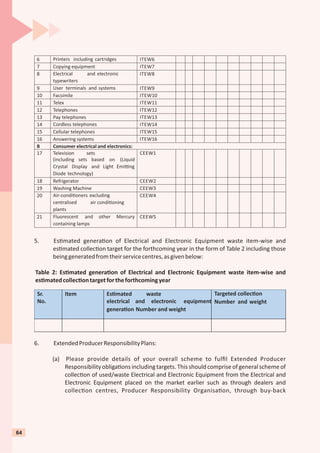
Sr. No. Categories of Electrical and Electronic EEE Code
i. Informa on Technology and Telecommunica on Equipment
Centralized Data Processing ITEW1
Mainframe
Minicomputer
Personal Compu ng: Personal Computers ITEW2
(Central Processing Unit with Input and Output Devices)
Personal Compu ng: Laptop ITEW3
Computers (Central Processing Unit with Input and Output
Devices)
Personal Compu ng: Notebook Computers ITEW4
Personal Compu ng: Notepad Computers ITEW5
Printers Including Cartridges ITEW6
Copying Equipment ITEW7
Electrical and Electronic Typewriters ITEW8
User Terminals and Systems ITEW9
Facsimile ITEW10
Telex ITEW11
Telephones ITEW12
Pay Telephones ITEW13
Cordless Telephones ITEW14
Cellular Telephones ITEW15
Feature Phones
Smart Phones
Answering Systems ITEW16
ii. Consumer Electrical and Electronics
Television sets (including sets based on (Liquid Crystal
Display and Light Emi ng Diode Technology)
CEEW1
Refrigerator CEEW2
Washing Machine CEEW3
Air-condi oners excluding centralized air condi oning
plants
CEEW4
Fluorescent and other Mercury Containing Lamps CEEW5
23
E-wasteTarget
Source:MinistryofEnvironment,ForestandClimateChange,No fica on,NewDelhi22ndMarch2018
Extended Producer Responsibility targets for producers, who have started sales opera ons
recently, i.e. number of years of sales opera ons is less than average life of their products
men onedbelow.
Source:MinistryofEnvironment,ForestandClimateChange,No fica on,NewDelhi22ndMarch2018
7.5 DetailsofExtendedProducerResponsibility
Ÿ etails of scheme / incen ve for returning of E-waste by consumers / bulk consumers
whether through dealers or buy-back arrangement or take-back systems or exchange
schemeforchanneliza onofE-waste.
Ÿ Ifproducerisop ngtomanageits EPR responsibilitythrough PRO,thendetailsof PRO's
organiza onal structure and system of collec on and channeliza on to the authorized
dismantlers/recyclersofE-waste.
Ÿ IfE-wasteexchangeispartofchanneliza onthenthedetailsthereof,
Ÿ If producer is op ng for 'deposit refund scheme' (DRS) or exchange scheme for
24
Sr. No. Year E-waste Collection Target (Weight
(i) 2017-18 10% of the quantity of waste generation as indicated in Extended
Producer Responsibility Plan
(ii) 2018-19 20% of quantity of waste generation as indicated in Extended Producer
Responsibility Plan
(iii) 2019-20 30% of the quantity of waste generation as indicated in Extended
Producer Responsibility Plan
(iv) 2020-21 40% of the quantity of waste generation as indicated in Extended
Producer Responsibility Plan
(v) 2021-22 50% of the quantity of waste generation as indicated in Extended
Producer Responsibility Plan
(vi) 2022-23 60% of the quantity of waste generation as indicated in Extended
Producer Responsibility Plan
(vii) 2023 onwards 70% of the quantity of waste generation as indicated in Extended
Producer Responsibility Plan
Sr. No. Year E-waste Collection Target (Weight
(i) 2018-19 5% of the sales figure of financial year 2016
-17
(ii) 2019-20 5% of the sales figure of financial year 2017
-18
(iii) 2020-21 10% of the sales figure of financial year 2018
-19
(iv) 2021-22 10% of the sales figure of financial year 2019
-20
(v) 2022-23 15% of the sales figure of financial year 2020
-21
(vi) 2023-24 15% of the sales figure of financial year 2021
-22
(vii) 2024-25 20% of the sales figure of financial year 2022
-23
(viii) 2025 onwards 20% of the sales figure of the year preceding the previous year
collec on and channeliza on of E-waste, then the details of mode of refund of the
deposited amount taken from the consumer or bulk consumer at the me of sale has to
be specified along with interest that becomes due at the prevalent rate for the period of
thedepositatthe meoftake-backoftheend-of-lifeproducts.
Ÿ Producers of item code: CEEW5 (fluorescent and other mercury containing lamp) may
provide list of waste deposi on centre or collec on points financed by them obliga on
under rule 17 (1) of the Solid Waste Management Rules 2016 for channelizing such
wastestorecyclersor TSDFs.
Collec onandStoragePlan:Informa onpertainingtocollec onandstorage
Channeliza on Plan: Details of Collec on Centres, Dismantlers & Recyclers & TSDF:
Producers shall specify details of their own collec ons centres or the collec on centres
withwhichtheyhaveagreement.
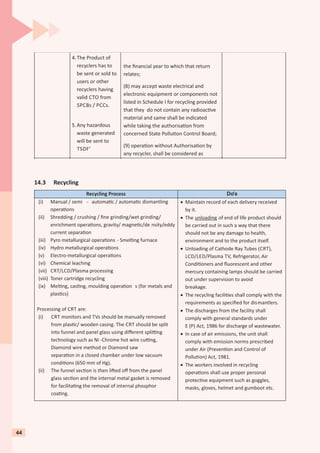
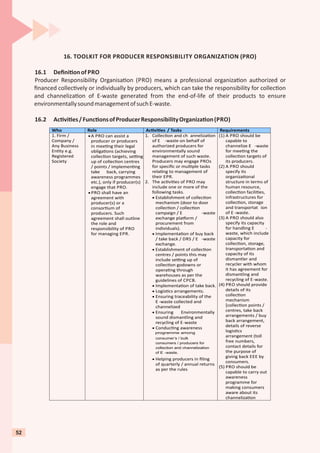
7.6 RegulatoryChecklist
7.7 ProcedureforAuthoriza on(Producer)
1. Form 1 E-waste Rules
2. Form 1 (aa) E-waste Rules
3. Form 2 E-waste Rules
4. Form 3 E-waste Rules
25
Producer
To apply within
90 days from
the date of
enforcement of
these rules.
Application
CPCB
*Requirements:
1. Form 1
2. EPR Plan
3. Copy of the permission from the
relevant ministries / Department
for selling product
4. Copies of agreement with
dealers, collection centre,
recyclers, TSDF etc.
5. DGFT License / permission if
required.
6. Self declaration for ROHS
1. Form 1(aa) (120 days)
Power to:
1. Authorize
2. Refuse
3. Cancel
4. Suspend
Renewal (merit
case to case)
SPCB
(Monitoring)
1. Target Quantity to be collected based on EPR
Plan (based on average life & EEE placed in
previous year)
2. Validity for 5 Years
Form 7
Appeal (30 days)
1. Documents related to EPR plan as envisaged in sections 2.1.
2. Details of proposed awareness programmes and allied initiatives.
3. Copies of agreement document with dealers, collection centres, dismantlers, recyclers, treatment, storage and disposal facilities (TSDFs) etc.
4. Self-declaration for compliance of RoHS as per the format.
5. The technical documents (supplier declaration description of product, document for materials, parts, and / or sub-assemblies and analytical test result) as an evidence that
the reduction of hazardous substance (RoHS) provisions are complied by the product based on standard EN 501581 of EU.
6. Copy of the permissions / licences from the relevant ministry / department for marketing various products or for doing the business are: (i) Tin details (ii) Pan details (iii)
Incorporation certificate (iv) Copy IEC in case of importers
7. Copy of authorization issued by the SPCBs / PCCs earlier under E-waste (Management & Handling) Rules, 2011 in case of those producers who are operating in the
country prior to 01-10-2016.
7.8 EPR Planning(Individual)
7.9 EPR Planning(PRO)
26
Collec on Point / bins
Collec on Centre
Collec on
Centre
Dealers / Retailer
Producer
Dismantlers / Recyclers
Take Back System -
(Accessible to any ci zen
located anywhere in country)
Deposit Refund Scheme
PUBLICIZE DETAILS OF
COLLECTION SYSTEM
Source: IRGSSA
Consumers
Collection Point / bins
Collection Centre
Collection Centre
Dealers / Retailer
Producer
Dismantlers
/ Recyclers
Formal
/ Informal Sectors
Formal / Informal Sectors
Take-Back System (Accessible to any citizen
located anywhere in country)
Deposit Refund Scheme
PUBLICIZE DETAILS OF
COLLECTION SYSTEM
PRO / E-waste Exchange
Source: IRGSSA
Consumers
Formal / Informal Sectors
8. TOOLKIT FOR COLLECTION CENTRES
8.1 Defini on
'collec on centre' means a centre or a collec on point or both established by producer
individually or as associa on jointly to collect e-waste for channelising the e-waste to
recycler and play such role as indicated in the authorisa on for Extended Producer
Responsibility granted to the producer and having facili es as per the guidelines of Central
Pollu on Control Board, including the collec on centre established by the dismantler or
refurbisher or recycler which should be a part of their authorisa on issued by the State
Pollu onControlBoardwherethefacilityexists;
8.2 Responsibili esofCollec onCentre
8.3 Func ons& DO'sforCollec onCentres
Who Responsibili es
1. Registered Producer/s
2. Authorized Refurbishers
3. Authorized Dismantlers
4. Authorized Recyclers
5. Dealers / Retailers
6. Others / PRO on behalf of
1 to 5 (Provided all are
men oned in EPR Plan of
Producers)
1. Collect E-waste on behalf of producer or dismantler or recycler or
refurbisher including those arising from orphaned products;
2. The collec on centres established by producer can also collect E -
waste on behalf of dismantler, refurbisher and recycler including
those arising from orphaned products.
3. Ensure that the facili es are in accordance with the standards or
guidelines issued by CPCB;
4. Ensure that the E -waste collected by them is stored in a secured
manner ll it is sent to authorized dismantler or recycler;
5. Ensure that no damage is caused to the environment during
storage and transporta on of E-waste;
6. Maintain records in Form-2 of the E-waste handled;
Func ons Do ’ s
1. Loading
2. Transporta on
3. Unloading
4. Storage
· Loading, transporta on, and unloading & storage of end of life
product should be carried out so that there is no damage to health,
environment and to the product itself.
· Refrigerator, Air Condi oners and fluorescent and other mercury
containing lamps should be given adequate a en on to avoid
breakage.
· Cathode Ray Tubes (CRT), LCD / LED / Plasma TV and fluorescent and
other mercury containing lamps should be stored either in containers
or stored in stable manner to avoid damage or breakage.
· Collec on Centre should store E-waste product category wise.
· Collec on Centre should maintain the records of E -waste collected
and account the same to respec ve producers.
· Spills involving broken fluorescent lamps, oils spills should first be
contained to prevent spread of the material to other areas. (use dry
sand, proprietary booms / absorbent pads, stabilizing chemicals etc.
for subsequent transfer of hazardous waste to TSDFs).
· Make records available to CPCB / SPCB.
27
8.4 InfrastructureRequirements
Collec on Infrastructure
1. Collec on Centre should have weighing equipment for weighing & record keeping.
2. The storage capacity of any collec on centre should commensurate with volume of opera ons
(weight & numbers) and category of E-waste.
3. Space needed for storage of different category of E -waste are: Mainframe, Minicomputer, Personal
Compu ng: Personal Computers (Central Processing Unit with input and output devices), Laptop
Computers (Central Processing Unit with input and output devices), Notebook Computers, Notepad
Computers & Printers including cartridges (ITEW1 to ITEW6) – 4.0m3/tonne; Monitors (CRT) –
5.0m3/tonne; Copying equipment, Electrical and electronic typewriters, User terminals and systems
& Facsimile ( ITEW7 to ITEW10) – 5.0 m3/tonne; Telex, Telephones, Pay telephones & Cordless
telephones ( ITEW11 to ITEW14) – 3.0 m3/tonne; Cellular telephones, Feature phones & Sm art
phones ( ITEW15) – 1.0 m3/tonne; Answering systems ( ITEW16) – 3.0 m3/tonne; Television sets
(including sets based on (Liquid Crystal Display and Light Emi ng Diode technology) (CEEW1)– 6.5
m3/tonne; Refrigerator (CEEW2)– 10.0 m3/tonne; Washing Machine (CEEW3)– 7.5 m3/tonne; Air-
condi oners excluding centralized air condi oning plants (CEEW4) – 6.0 m3/tonne & Fluorescent
and other Mercury containing lamps (CEEW5)– 1.0 m3/tonne
4. Adequate facili es for managing leakage of compressor oils, coolant/refrigerant gases such as
CFCs/HCFCs and mercury from end of life fluorescent and other mercury containing lamp etc.
5. Covered shed / spaces have to be used for storage of E -waste.
6. Collec on Centre should necessarily have adequate fire-figh ng arrangement, escape route for
emergency exit.
7. Storage capacity for 180 days commensurate with volume (weight & number) of E -waste.
28
9. TOOLKIT FOR TRANSPORTATION
9.1 Defini on
'transporter' means a person or company or en ty engaged in the off-site transporta on of
e-waste by air, rail, road or water carrying a manifest system issued by the person or
company or en ty who has handed over the e-waste to the transporter, giving the origin,
des na onandquan tyofthee-wastebeingtransported;
9.2 Responsibili es Related to Transporta on
Who Func ons Responsibility Sender Do’s
1. Person
2. Company
Off site
transportat
ion of e-
waste by
air, rail,
road or
water.
The
responsibility
of safe
transporta on
of E-waste shall
be with the
sender of E-
waste
Manufacturer Iden fy transporter or make arrangements
for a transpor ng E-waste.
Producer Transporta on in such a manner that health
& environmental consequences of hazards
associated are minimum.
Recycler Transport of E -waste should be carr ied out
as per the manifest system
Dismantler The transporter will be required to carry a
document (three copies) as per form 6 of
the rules provided by the sender.
Bulk
Consumer
Fluorescent and other mercury containing
lamps may be transported to TSDF where no
recyclers of CFL are available.
Refurbisher The manufacturers and recyclers while
transpor ng waste generated des ned for
final disposal to a TSDF will follow the
provisions under Hazardous and Other
Wastes (Management and Transbou ndary
Movement) Rules, 2016.
Collec on
Centre
Accident
Repor ng
Where an accident occurs at the facility
processing E-waste or during transporta on
of E-waste.
· the producer
· refurbisher
· transporter
· dismantler
· recycler
Shall report immedia tely to the concerned
State Pollu on Control Board about the
accident through telephone and e-mail.
29
9.3 Infrastructure Requirement
9.4 Collec on, Storage & Transporta on Planning of E-waste (Geographical Context)
9.5 Interna onal Best Prac ces for Collec on & Transporta on of E-waste
9.5.1 Logis cs / Collec on Channels
There are three primary channels of WEEE/E-waste collec on. These channels are:
1. Municipal sites / Municipal Collec on & Storage
2. In store retailer take-back & storage
3. Producer take-back & storage
All the three channels address “Business to Consumer” (B2C) and “Business to Business”
(B2B) WEEE/E-waste collec on.
1. Modes of transporta on with manifest system.
Legend Collec on Point / Bins Sub Collec on Point Collec on Centre
30
Residential RWA
Commercial Retail
Residential RWA
Residential
Educational
Office Complexes
Educational
&
Research Institution
Authorized
Dismantler /
Recycler
TSDF
CFL / FL
Source: IRGSSA
9.5.2 Guiding Principles (Design Specifica ons of WEEE/E- waste Collec on Points)
(i) Layout of Collec on Point/ Storage Area
1. Collec on point/ storage area should be easily accessible i.e the
iden fica on of their loca on is very important.
2. Area of the collec on point/ storage should be able to accommodate
separated/ sorted WEEE/ E-waste with respect to size.
3. Collec on point/ storage area should have impermeable surface with
sealed drainage system.
4. Weatherproofing of collec on point/ storage area.
(ii) Area of Collec on Point/ Storage Facility
Area of collec on point and storage facility is an important feature for fixing
up layout of storage area.
Some of the examples of the collc on bins / cages & collec on system is
shown in Figure 9.1 & Figure 9.3.
9.5.3 Number of Collec on Point/ Storage Facility
Collec on target defines the number of collec on points. The number of WEEE/
E-waste collec on points will vary from country to country. An example of local
collec on facili es per popula on in some European countries.
Table 9.1: Local Authority Collec on Facili es Per Popula on in 2003
Source: EPA Ireland 2003, Waste Electrical and Electronic Equipment (WEEE) Collec on trials in Ireland.
Authors: Wilkinson, S. and Duffy, N. Environmental Protec on Agency, Wexford, Ireland
Country Popula on (million) Local Authority C ollec on
Facili es
Ra on (facili es /
person)
The Netherlands 16.0 600 1/27 000
Sweden 8.8 600 1/15 000
Norway 4.5 400 1/11 000
31
Figure 9.1: WEEE/E-waste Collec on Bins / Cages
Source: UNEP E-waste Manual 2 & 3
Figure 9.2: Examples of WEEE/E-waste Collec on System (impermeable surface & weatherproof
covering) at a collec on facility
Source: UNEP E-waste Manual 2 & 3
32
Source www.sens.ch
Source Waste Electrical and Electronic Equiment (WEEE)
Pilot Scheme Report. www.ehsni.gov.uk
Source Waste Electrical and Electronic Equiment (WEEE)
Pilot Scheme Report. www.ehsni.gov.uk
Source : EIRetur. www.elretur.no
Different Types of Bins used by SENS in Switzerland
Cages
Weatherproof covering
Impermeable Surface
Impermeable Surface
Weatherproof Covering
10. TOOLKIT FOR DEALER
10.1 Defini on
'dealer' means any individual or firm that buys or receives electrical and electronic
equipment as listed in Schedule I of these rules and their components or consumables or
partsorsparesfromproducersforsale;
10.2 Responsibili esofDealers
10.3 DO's&InfrastructureRequirement
10.4 RegulatoryChecklist
NIL
Who Func ons Responsibili es
(1) Individual
(2) Firm /
Company /
Business en ty
Buying & receiving
EEE, their components
or consumables.
(1) in the ca se the dealer has been given the
responsibility of collec on on behalf of the
producer, the dealer shall collect the e-waste by
providing the consumer a box, bin or a
demarcated area to deposit e-waste , or through
take back system and send the e -waste so
collected to collec on centre or dismantler or
recycler as designated by producer;
(2) the dealer or retailer or e -retailer shall refund the
amount as per take back system or Deposit
Refund Scheme of the producer to the depositor
of e-waste;
(3) every dealer shall ensure that the e-waste thus
generated is safely transported to authorised
dismantlers or recyclers;
(4) ensure that no damage is caused to the
environment during storage and transporta on of
e-waste.
DO’s Infrastructure Requirement
(1) Provide environmentally sound storage &
transporta on of E-waste to collec on centre,
dismantler / recycler.
(2) Maintain account of refund as per deposit
refund scheme or take back system.
1. Provide box, bin or a demarcated area to
deposit e-waste.
33
11. TOOLKIT FOR REFURBISHER
11.1 Defini on
'refurbisher' for the purpose of these rules, means any company or undertaking registered
under the Factories Act, 1948 or the Companies Act, 1956 or both or district industries
centreengagedinrefurbishmentofusedelectricalandelectronicequipment;
'refurbishment' means repairing of used electrical and electronic equipment as listed in
Schedule I for extending its working life for its originally intended use and selling the same
inthemarketorreturningtoowner;
11.2 Responsibili esofRefurbishers
Who Func ons Responsibili es Essen al Requirements
1. Company
2. Undertaking
registered
under the
Factories
Act, 1948 or
the
Companies
Act, 1956.
3. District
Industries
Centre,
engaged in
refurbishme
nt of used
electrical
and
electronic
equipment.
1. Repairing of used
electrical and
electronic
equipment.
2. Should not be
any damage to
health and
environment.
1. collect e-waste generated
during refurbishing
2. Channelise the waste to
authorized dismantler or
recycler through its
collec on centre;
3. Apply for one me
authoriza on
4. ensure that no damage is
caused to the
environment during
storage and
transporta on of e-waste;
5. ensure that the
refurbishing process do
not h ave any adverse
effect on the health and
the environment;
6. ensure that the e -waste
thus generated is safely
transported to authorized
collec on centres or
dismantlers or recyclers;
7. file annual returns in
Form-3 to the concerned
SPCB, on or before the
30th day of June
following the financial
year to which that return
relates;
8. maintain records of the e -
waste handled in Form-2.
1. A refurbisher has to
obtain consent to
establish under the Water
(Preven on and Control of
Pollu on) Act, 1974, (25 of
1974).
2. the Air (Preven on and
Control of Pollu on) Act,
1981 (21 of 1981) from
the concerned State
Pollu on Control Board /
Pollu on control
Commi ee.
3. A refurbisher has to
obtain cer ficate of
registra on and proof of
installed capacity from
District Industries Centre
or any other government
agency authorized in this
regard;
4. A refurbisher has to
obtain one - me
authoriza on from
concerned SPCB.
34
11.3 DO's, DON'Ts&InfrastructureRequirement
11.4 RegulatoryChecklist
DO’s Don’ts Infrastructure Requirement
· Any e-waste generated during
refurbishment should be
collected separately and sent
to collec on centre
/authorised recycler.
· In case of refurbisher not
having own collec on centre,
the e - waste may be
channelized to an authorised
recycler.
· If refurbisher opts to sell
refurbished EEE then he is
required to seek EPR
authorisa on from CPCB.
The refurbisher shall
not sell any
refurbished EEE
without having
EPR authoriza on.
· The premise for refurbishing should have:
(i) Water proof roofing and impermeable
surfaces
(ii) As a general rule a refurbisher of
capacity of 1 Ton per day shall require a
minimum of 150 square meters’ area for
refurbishing, temporary storage of e waste
generated and space for refurbished EEE.
· The refurbishing area should be ven lated
and have proper dust control equipment.
De-dus ng system over refurbishment
tables should be provided
· System to manage leakage of coolant /
refrigerant gases and compressor oils from
used electrical and electronic equipment
during refurbishing opera ons.
1. Form 1 a E-waste Rules
2. Form 1 bb E-waste Rules
3. Form 2 E-waste Rules
4. Form 3 E-waste Rules
5. Consent to Establish & Operate Water Act
6. Consent to Establish & Operate Air Act
7. Cer ficate of Registra on DIC / Any Other
8. Proof of Installed Capacity DIC / Any Other
35
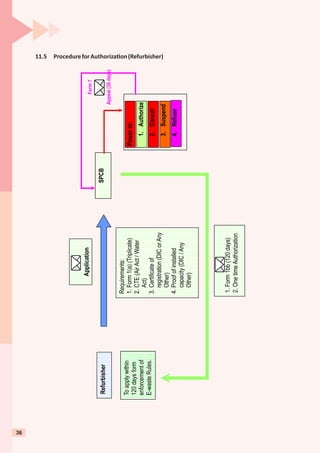
11.5 ProcedureforAuthoriza on(Refurbisher)
36
Refurbisher
To
apply
within
120
days
form
enforcement
of
E-waste
Rules.
Application
SPCB
Requirements:
1.
Form
1(a)
(Triplicate)
2.
CTE
(Air
Act
/
Water
Act)
3.
Certificate
of
registration
(DIC
or
Any
Other)
4.
Proof
of
installed
capacity
(DIC
/
Any
Other)
1.
Form
1bb
(120
days)
2.
One
time
Authorization
Power
to:
1.
Authorize
2.
Cancel
3.
Suspend
4.
Refuse
Form
7
Appeal
(30
days)
12. TOOL KIT FOR CONSUMER or BULK CONSUMER
12.1 Defini on
'consumer' means any person using electrical and electronic equipment excluding the bulk
consumers;
'bulk consumer' means bulk users of electrical and electronic equipment such as Central
Government or State Government Departments, public sector undertakings, banks,
educa onal ins tu ons, mul na onal organisa ons, interna onal agencies, partnership
and public or private companies that are registered under the Factories Act, 1948 (63 of
1948) and the Companies Act, 2013 (18 of 2013) and health care facili es which have
turnoverofmorethanonecroreorhavemorethantwentyemployees;
12.2 Responsibili esofConsumerorBulkConsumer
employees;
Who Responsibility DO’s Don’ts
Consumer: Any
person using
electrical &
electronic
equipment
Bulk Consumer:
1. Central
Government
2. State
Government
3. Departments,
Public Sector
undertakings,
4. Banks,
5. Educa onal
ins tu ons,
6. Mul na onal
organiza ons,
7. Interna onal
agencies,
8. Partnership and
public or
private
companies
registered
under the
Factories Act,
1948 (63 of
1948) and
Companies Act,
2013 (18 of
2013)
9. Health care
facili es which
have turnover
of more than
one crore or
have more than
twenty
(1) Ensure that e -waste generated
by them is channelized through:
- collec on centre
- dealer of authorized producer
- dismantler
- recycler
- through the designated take
back servic e provider of the
producer to authorised
dismantler or recycler;
(2) bulk consumers shall maintain
records of e -waste generated by
them in Form-2.
(3) Ensure that e - waste are not
admixed with e- waste containing
radioac ve material as covered
under the pro visions of the Atomic
Energy Act, 1962 (33 of 1962) and
rules made there under;
(4) bulk consumers shall file annual
returns in Form -3, to the
concerned State Pollu on Control
Board on or before the 30th day of
June following the financial year to
which that return relates.
(5) In case of the bulk consumer
with mul ple offices in a State, one
annual return combining
informa on from all the offices
shall be filed to the concerned
State Pollu on Control Board on or
before the 30th day of June
following t he financial year to
which that return relates
· The end of life intact
fluorescent and other
mercury containing lamp
may be stored either in
the same boxes in which
new lamps are brought
or other boxes of similar
size.
· They should be sorted
upright.
· The due precau on may
be taken while packing
more than one used
lamp, so as not to cause
the possibility of
breakage during the
storage and
transpira on.
· Bulk consumers should
ensure that used lamps
are not disposed in the
municipal bin but
handed over (in a
properly packed form)
to take back system /
collec on and
channeliza on system of
producer or to a
collec on centre of an
authorised recycler who
is part of producer
channeliza on system.
The consumer
should not
throw e -waste
in municipal
bins.
37
12.3 InfrastructureRequirement
· The bulk consumers must create special type of disposal bins (suitable for the purpose) at
sitefordeposi ngtheendoflifeintactfluorescentandothermercurycontaininglamponly.
12.4 Regulatory Checklist
1. Form 2 E-waste Rules
38
13. TOOLKIT FOR DISMANTLER
13.1 Defini on
'dismantler' means any person or organiza on engaged in dismantling of used electrical
and electronic equipment into their components and having facili es as per the guidelines
of Central Pollu on Control Board and having authorisa on from concerned State
Pollu onControlBoard;
13.2 Responsibili esofDismantler
Who Func ons Responsibili es Essen al Requirements
1. Any Person
2. Organiza on
3. Registered
Society
4. Designated
Agency
5. Company
6. Associa on
1. Dismantling of
e-waste into
their
components
2. May set up
their collec on
centre (details
shall be
entered in their
authoriza on &
shall not
require
separate
authoriza on).
(1) ensure that the facility and
dismantling processes are in accordance
with the standards or guidelines
prescribed by Central Pollu on Control
Board from me to me;
(2) obtain authorisa on from the
concerned State Pollu on Control Board;
(3) ensure that no damage is caused to
the health & environment during
storage, transporta on and dismantling
process of e-waste;
(4) ensure that dismantled e- waste are
segregated and sent to the authorized
recycling facili es for recovery of
materials;
(5) ensure that non-recyclable or non -
recoverable components are sent to
authorized treatment storage and
disposal facili es;
(6) maintain record of e-waste collected,
dismantled and sent to authorized
recycler in Form-2;
(7) file a return in Form-3, to the
concerned State Pollu on Control Board,
on or before 30th day of June following
the financial year to which that return
relates;
·Connected to either
Producers or PRO or
e-waste exchange or
take back system or
authorized recycler.
·Obtain both consent
to establish and
operate from SPCBs /
PCCs under the Water
(Preven on and
Control of Pollu on)
Act, 1974 and the Air
(Preven on and
Control of Pollu on)
Act, 1981
·Obtain authorisa on
from SPCBs/PCCs
under E -Waste
(Management) Rules,
2016, if fresh or post
expiry of authoriza on
under the Hazardous
Wastes (Management,
Handling and
Transboundary
Movements) Rules,
2008, and the E -waste
(Management &
Handling) Rules, 2011.
39
13.3 Dismantling DO's& DON'Ts
Dismantling
(8) not process any e -waste for recovery
or refining of materials, unless he is
authorized as a recycler for refining and
recovery of materials;
(9) Opera on without Authorisa on by
any dismant ler, shall be considered as
causing damage to the environment.
Dismantling Process DO
DO
’
’
s
s
Don’ts
1. Essen ally a manual
opera on for
segrega ng various
components/ parts
and sending them
to respec ve users/
recyclers.
2. Directly usable
components to be
sent to an
authorized
refurbisher.
3. The other parts can
be sent to recyclers
having valid CTO /
authorized e -waste
recyclers .
4. Perform the
following
opera ons (i) De -
dus ng (ii) Manual
dismantling
5. Opera on shall
comprise of
physical separa on
and segrega on
a er opening the
electrical and
· Maintain record of each delivery received by it.
· The unloading of e -waste/end of life products
should be carried out in such a way that there
should not be any damage to health,
environment and to the product itself.
· Unloading of Cathode Ray Tubes (CRT), LCD / LED
/ Plasma TV, refrigerator, air condi oners and
fluorescent and other mercury containing lamps
should be carried out under supervision to avoid
breakage.
· Dismantler may use screwdrivers, wrenches,
pliers, wire cu ers, tongs and hammers etc. for
dismantling.
· The dismantled components should be sent to
authorised e-waste recyclers or recyclers having
valid consent to operate (CTO).
· Manual dismantling opera ons should be carried
out over the dismantling table with space de -
dus ng system as per the factories Act.
· Collec on boxes should be placed near
dismantling tab le for keeping the dismantled
components.
· The workers should use proper personal
protec ve equipment such as goggles, masks,
gloves, helmet and gumboot etc.
· (i) Ba eries (ii) Printed Circuit Boards (PCBs) of
EEE (iii) Toner cartridges (iv) Plas c (v) External
Electrical Cables components must be removed
· Shall not carry out
shredding / crushing /
fine grinding/wet
grinding/ enrichment
opera ons and gravity/
magne c/density/eddy
current separa on of
prin ng circuit board or
the components a ached
with the circuit board.
· Shall not be permi ed for
dismantling of
fluorescent and other
mercury containing
lamps, CRT / LCD / Plasma
TV.
· Shall not be permi ed for
chemical leaching or
hea ng process or
mel ng the material.
40
electronic
equipment into the
component by
manual opera ons.
from end of life products and stored in a safe
manner for transporta on to recyclers.
· Dismantled and segregated plas c from e- waste
shall only be given to registered plas c recyclers
having registra on under Plas c Waste
(Management) Rules, 2016.
· In case of dismantling refrigerators and air
condi oners, only skilled manpower having
required tools and personal protec ve
equipment (PPEs) must be deployed to manually
separate compressors.
DO ’ s
1. Adequate facili es for managing leakage of compressor oils, co olant/refrigerant gases such as
CFCs/HCFCs and mercury from end of life fluorescent and other mercury containing lamp etc.
2. Spills involving broken Fluorescent lamps, Oils spills should first be contained to prevent spread of
the material to other areas (use of dry sand, proprietary booms / absorbent pads, stabilizing
chemicals etc. for subsequent transfer to hazardous waste TSDFs).
3. The premise for dismantling opera on should have: a) Water proof roofing and impermeable
surfaces. b) Storage space for dissembled spare parts.
4. Separate containers for storage of ba eries, capacitors containing PCBs (Polychlorinated biphenyls)
or PCTs (Polychlorinated terphenyls)
5. Prior to dismantling the compressors, adequate facili es should be provided for collec on of
coolant/refrigerant gases and compressor oil.
6. During the volume/size reduc on of dismantled steel/aluminium/plas c parts, the dismantlers
should have arrangement for dust and noise controls. These opera ons should be under acous c
enclosure for noise reduc on.
7. Volume/Size reduc on may be carried out a er dismantling opera ons for the parts like
steel/aluminium/plas c, for ease of transporta on.
8. The de dus ng system should consist of suc on hoods over dismantling table connected with a
cyclone, bag filter and ven ng through a chimney of three-meter height above roof level.
9. Should have weigh bridge and other appropriate weighing equipment for Weighing
10. Should have facili es for destroying or permanently dele ng data stored in the memory of end of
life products (Hard Disk, Telephones, Mobile phones) either through hammering or through
data eraser.
11. Space for storage of electrical and electronic equipment up to 180 days, for process of dismantling
and volume reduc on and space for storage of dismantl ed and segregated material and free space
for movement and office/ administra on and other u li es (Layout Requirement).
12. A minimum of 300 square meter area for a dismantling capacity of 1T/day is required for storage of
raw material, segregated material, dismantling opera ons and office/ administra on & other
u li es.
41
13.4 InfrastructureRequirement
13.5 RegulatoryChecklist
1. Form 4 E-waste Rules
2. Form 2 (Record Keeping) E-waste Rules
3. Form 3 (Return Filing) E-waste Rules
4. Consent to Establish & Operate Water Act
5. Consent to Establish & Operate Air Act
6. Cer ficate of Registra on DIC / Any Other
7. Proof of Installed Capacity DIC / Any Other
8. If renewal the cer ficate of compliance SPCB
42
14. TOOLKIT FOR RECYCLER
14.1 Defini on
'recycler' means any person who is engaged in recycling and reprocessing of waste
electricalandelectronicequipmentorassembliesortheircomponentsandhavingfacili es
aselaboratedintheguidelinesofCentralPollu onControlBoard;
14.2 Responsibili esofRecycler
Who Functions Responsibili es Essen al Requirement
(1)
Dismantling
along with
recovery
opera on.
(2) Any
person who
is engaged in
recycling
and
reprocessing
of e-waste
or
assemblies
or their
components.
1.Recycling and
reprocessing of e-
waste.
2.May set up the ir
collec on
centres, (details
of which shall be
entered in their
authoriza on &
shall not require
separate
authoriza on).
3.Obtain raw
material such as
waste electrical
and electronic
assemblies or
components or
used components
from producers /
PRO / e-waste
exchange /
dismantlers and
consumers / bulk
consumers.
(1) shall ensure that the facility and
recycling processes are in accordance
with the standards or guidelines
prescribed by the Central Pollu on
Control Board from me to me;
(2) obtain authorisa on from concerned
State Pollu on Control Board;
(3) ensure that no damage is caused to
the health & environment during storage,
transporta on, dismantling / recycling of
e-waste;
(4) ensure that the frac ons or material
not recycled in its facility is sent to the
respec ve authorised recyclers;
(5) ensure that residue generated during
recycling process is disposed of in an
authorised treatment storage disposal
facility;
(6) maintain record of e-waste
collected, dismantled, recycled
and sent to authorized recycler in
Form-2;
(7) file annual returns in Form-3, to the
concerned State Pollu on Control Board
as the case may be, on or before 30th
day of June following
·A recycler should be
part of producer’s e-
waste channelisa on
system.
·A recycler has to obtain
consent to establish &
operate from
SPCBs/PCCs under the
Water (Preven on and
Control of Pollu on)
Act, 1974 and the Air
(Preven on and Control
of Pollu on) Act, 1981
·A recycler has to obtain
authorisa on from
SPCBs / PCCs under E-
Waste (Management)
Rules, 2016, if fresh or
post expiry of
authoriza on under the
provisions of the
Hazardous Wastes
(Management, Handling
and Transboundary
Movements) Rules,
·2008, and the E-waste
(Management &
Handling) Rules, 2011.
43
14.3 Recycling
4.The Product of
recyclers has to
be sent or sold to
users or other
recyclers having
valid CTO from
SPCBs / PCCs.
5.Any hazardous
waste generated
will be sent to
TSDF’
the financial year to which that return
relates;
(8) may accept waste electrical and
electronic equipment or components not
listed in Schedule I for recycling provided
that they do not contain any radioac ve
material and same shall be indicated
while taking the authorisa on from
concerned State Pollu on Control Board;
(9) opera on without Authorisa on by
any recycler, shall be considered as
Recycling Process Do’s
(i) Manual / semi - automa c / automa c dismantling
opera ons
(ii) Shredding / crushing / fine grinding/wet grinding/
enrichment opera ons, gravity/ magne c/de nsity/eddy
current separa on
(iii) Pyro metallurgical opera ons - Smel ng furnace
(iv) Hydro metallurgical opera ons
(v) Electro-metallurgical opera ons
(vi) Chemical leaching
(vii) CRT/LCD/Plasma processing
(viii) Toner cartridge recycling
(ix) Mel ng, cas ng, moulding opera on s (for metals and
plas cs)
Processing of CRT are:
(i) CRT monitors and TVs should be manually removed
from plas c/ wooden casing. The CRT should be split
into funnel and panel glass using different spli ng
technology such as Ni -Chrome hot wire cu ng,
Diamond wire method or Diamond saw
separa on in a closed chamber under low vacuum
condi ons (650 mm of Hg).
(ii) The funnel sec on is then li ed off from the panel
glass sec on and the internal metal gasket is removed
for facilita ng the removal of internal phosphor
coa ng.
· Maintain record of each delivery received
by it.
· The unloading of end of life product should
be carried out in such a way that there
should not be any damage to health,
environment and to the product itself.
· Unloading of Cathode Ray Tubes (CRT),
LCD/LED/Plasma TV, Refrigerator, Air
Condi oners and fluorescent and other
mercury containing lamps should be carried
out under supervision to avoid
breakage.
· The recycling facili es shall comply with the
requirements as specified for dismantlers.
· The discharges from the facility shall
comply with general standards under
E (P) Act, 1986 for discharge of wastewater.
· In case of air emissions, the unit shall
comply with emission norms prescribed
under Air (Preven on and Control of
Pollu on) Act, 1981.
· The workers involved in recycling
opera ons shall use proper personal
protec ve equipment such as goggles,
masks, gloves, helmet and gumboot etc.
44
14.4 InfrastructureRequirement
1. Forfluorescentandothermercurycontaininglamprecycling,theunitshallhaveatleast
followingsystems:
(i) Mechanicalfeedingsystem.
(ii) Mercuryspillcollec onsystem.
(iii) Lamp Crushing System, under vacuum, for separa on of mercury-contaminated
phosphor powder & mercury vapors from other crushed components, so as not to
causereleaseofanypollutant,includingmercuryvapor.
(iv) System for segrega on of mercury vapour from the phosphor powder through a
dis lla onsystemforsepara on&recoveryofmercury.
(v) Air pollu on control system (APCS) which shall include HEPA (High Efficiency
(iii) The internal phosphor coa ng from the inner side of
panel glass is removed by using an abrasive wire brush
with suc on arrangement under low pressure as given
above at (i). The extracted air is cleaned through high
efficiency bag-filter system and collected in appropriate
labelled containers and then disposed at an authorised
TSDF.
(iv) Manual shredding, cu ng, and segrega on opera ons
for CRTs should be carried out in low vacuum (650 mm
of Hg) chambers where the dust is extracted through
cyclones, bag filters, ID fan and a suitable chimney.
(v) Segregated CRTs can also be shredded in
mechanical/automa c shredding machines connected
with dust control systems. The mixed shredded glass is
separated into leaded glass and glass cullet using
electro-magne c field or by density separa on.
The LCD / Plasma TV should be dismantled piece by piece,
star ng:
Ÿ The removal of the plas c backing shell,
Ÿ Printed circuit boards,
Ÿ Aluminium or steel frame,
Ÿ Screen,
Ÿ PET plas cs,
Ÿ LCD Panel and backlight.
Ÿ The metal frame, wire, other metallic material plas c
backing cabinet may be sent to recyclers with valid CTO.
Ÿ Printed Circuit Board and LCD panel may be recycled or in
case recycling facility is not available then sent to
respec ve authorized recycling facility.
· Adequate facili es for onsite collec on and
storage of bag filter residues, floor cleaning
dust and other hazardous material shall be
provided and sent to secure landfill by
obtaining membership of TSDF.
· The CRT / LCD / Plasma TV should be
processed only at a recycler’s facility.
· For recycling of CRT monitor and TVs care
should be taken to contain release of
harmful substances.
45
Par culate Arrestor) filter system or ac vated carbon filter system or any other
equivalent efficient system for separa on/ removal of mercury vapor from mercury
contaminatedphosphorpowder'
(vi) Arrangementfordisposalofmercurycontaminatedfilterpadsto TSDF.
(vii)On line mercury monitoring system, to have check on emission of mercury, which
hastobeincompliancetotheconsentednorms.
2. For LCD and Plasma TV a recycler should have sealed vacuum dismantling pla orm for
dismantlingof LCD /Plasmapanels.
3. In case of furnace, a minimum stack height of 30 meter shall be installed depending on
emissionrateof SO2.
4. Noise control arrangement for equipment like crusher, grinder and shredder needs to
beprovided.
5. Fume hoods to be connected with bag dust collectors followed wet (chemical)
scrubbers and carbon filters shall be installed for control of fugi ve emissions from
furnacesorreactor.
6. De dus ng equipment such as suc on hood shall be installed where manual
dismantlingiscarriedout.
7. A recycling facility shall install adequate wastewater treatment facili es for process
wastewater and air pollu on control equipment (off gas treatment,
wet/alkaline/packed bed scrubber and carbon filters) depending on type of opera ons
undertaken.
8. A recycler should have facili es for destroying or permanently dele ng data stored in
the memory of end of life products (Hard Disk, Telephones, Mobile phones) either
throughshreddingorgrindingorthroughdataeraser.
9. A recycler should have weigh bridge and other appropriate weighing equipment for
weighing.
10. A recycler of capacity of 1 Ton per day shall require a minimum of 500 square meters
area.
11. Authorisa on to recyclers may be preferred if they have minimum opera onal capacity
of5 MT/daywithanareaofabout2500squaremeter.
14.5 RegulatoryChecklist
1. Form 4 E-waste Rules
2. Form 2 (Record Keeping) E-waste Rules
3. Form 3 (Return Filing) E-waste Rules
4. Consent to Establish & Operate Water Act
5. Consent to Establish & Operate Air Act
6. Cer ficate of Registra on DIC / Any Other
7. Proof of Installed Capacity DIC / Any Other
8. If renewal the cer ficate of compliance SPCB
46
14.6 ProcedureforAuthoriza on(Dismantler/Recycler)
47
Dismantler
/
Recycler
To
apply
within
120
days
form
the
date
of
enforcement
of
these
Rules.
Application
SPCB
Requirements:
1.
Form
4
(Triplicate)
2.
CTE
(Air
Act
/
Wa
ter
Act)
3.
Certificate
of
registration
(DIC
or
Any
Other)
4.
Proof
of
installed
capacity
(DIC
/
Any
Other)
5.
If
renewal
then
certificate
of
compliance
(Effluent
Standards,
Emissions,
Hazardous
Waste)
(120
days)
Power
to:
1.
Authorize
2.
Cancel
3.
Suspend
4.
Refuse
Renewal
Form
7
Appeal
(30
days)
14.7 Interna onalBestPrac cesforDismantlingandRecyclingofE-waste
Figure 14.1: Simplified Flow Diagram for the Recycling of WEEE/E-waste
Source: Compendium of Technologies for the Recovery of Materials from WEEE/E-Waste Final Report.
Jain Amit (20th April, 2017).
WEEE/E-waste (ICT, TV, Refrigerators
/ Air conditioners / CFL / Bulbs)
Test / Sort
Decontamination
Disassembly
Size Reduction
Separation by
Materials /
Components
Recycling /
Recovery of valuable
materials (precious
metals / Rare Earth
Elements)
Disposal (Landfill /
Incineration / Storage)
Resale / Reuse
Product (if
func onal)
Resale / Reuse
Parts
Disposal (Landfill /
Incinera on /
Storage)
Cathode Ray Tubes
/LCD/CFLs/Bulbs
Further
Treatment
Material /
Component Usage
First Level
WEEE / E-
waste
Treatment
Second Level
WEEE / E-
waste
Treatment
Third Level
WEEE / E-
waste
Treatment
48
Figure 14.2: Simplified Flow Diagram for second Level WEEE/E-waste treatment
Source:CompendiumofTechnologiesfortheRecoveryofMaterialsfrom WEEE/E-WasteFinal
Report.JainAmit(20thApril,2017).
Figure 14.3: CRT Dismantling Opera on Procedure
Source: Compendium of Technologies for the Recovery of Materials from WEEE/E-Waste Final Report. Jain
Amit(20thApril,2017
Input (WEEE/E
-waste Fractions)
Sale / Reuse of components
Hazardous Materials
CRTs
Further treatment /
Disposal
Further treatment
Ferrous metals melting / smelting
Nonferrous metals melting / smelting
Plastics Treatment
Landfill / Incinerator
Disposal
Density Separation
Eddy Current Separation
Magnetic Separation
Vibrating Screen
Size Reduction
Sorting
Downstream Vendors
CRT Monitors / Televisions
CRT
Separation
Wire Cutting
Cone/PCB/Copper etc.
Plastic Case
Front
Panel + Phosphor Funnel + Interface Glass
Phosphor Removed by Vaccum
Phosphor Front Panel
TSDF
Crushing
Front Panel Glass Panel Dust Fines
49
Table 14.1: Input/ Output and unit opera ons for third level treatment of WEEE/E-waste
Source: UNEP Manual,E-wasteVolume II:E-wasteManagementManual,
h p://www.unep.or.jp/ietc/publica ons/spc/ewastemanual_vol2.pdf,(Accessedon14July,2016)
Figure 14.4: Conceptual CFL/FL Waste Treatment Scheme and Process Flow
Source: Compendium of Technologies for the Recovery of Materials from WEEE/E-Waste Final Report. Jain
Amit(20thApril,2017).
Input/ WEEEResidues
Unit Opera on/ Disposal/ Recycling
Technique
Output
Sorted Plas c Recycling Plas c Product
Plas c Mixture Energy Recovery/ Incinera on Energy Recovery
Plas c Mixture with Flame
Retardants ( FR)
Incinera on Energy Recovery
Lead Smelting Secondary Lead Smelter Lead
Ferrous metal scrap Secondary steel/ iron recycling Iron
Non Ferrous metal Scrap Secondary copper and aluminum
smelting
Copper/ Aluminum
Precious Metals Au/ Ag separa on (refining) Gold/ Silver/ Platinum
and Palladium
Ba eries (Lead Acid/
NiMHand LiION)
Lead recovery and smel ng
Remelting and separa on
Lead
CFC Recovery/ Reuse and
Incinera on
CFC/ Energy recovery
Oil Recovery/ Reuse and
Incinera on
Oil recovery/ energy
Capacitors Incinera on Energy recovery
Mercury Separa on and Distilla on Mercury
Glass Remel ng Glass
2nd Level
Treatment
(Crushing
Solid Waste
Mercury
Metals Metals Plastics Glass
Mercury
Treatment
Distillation Metal
E-waste
Recyclers
Plastic
Recyclers
Glass
Recyclers
Solid
Waste
Mercury
Rare Earths Oxides
Lamps Powder
Sulfuric acid Leaching
Filtration
RE precipitation
Filtration
Calcination
Solid
1
st
Level
Treatment
2
nd
Level
Treatment
3
rd
Level
Treatment
Input CFL / FL
2nd Level
Treatment
(Crushing
Solid Waste
Mercury
Metals Metals Plastics Glass
Mercury
Treatment
Distillation
Secondary E-
Mercury
Rare Earths Oxides
Water Leaching
Filtration
RE precipitation
Filtration
Calcination
Rare earths oxides
Rare earths oxalates
Oxalic acid
Solid
Wastewater
1
st
Level
Treatment
2
nd
Level
Treatment
3
rd
Level
Treatment
50
15. TOOLKIT FOR REDUCTION IN THE USE OF HAZARDOUS SUBSTANCES (RoHS) IN THE
MANUFACTURE OF ELECTRICAL AND ELECTRONIC EQUIPMENT AND THEIR
COMPONENTS OR CONSUMABLES OR PARTS OR SPARES
RoHS: Every producer of electrical and electronic equipment and their components or
consumablesorpartsorspareslistedinScheduleIshallensure:
Ÿ newElectricalandElectronicEquipmentandtheircomponentsorconsumablesorparts
or spares do not contain Lead, Mercury, Cadmium, Hexavalent Chromium,
polybrominated biphenyls and polybrominated diphenyl ethers beyond a maximum
concentra on value of 0.1% by weight in homogenous materials for lead, mercury,
hexavalentchromium,polybrominatedbiphenylsandpolybrominateddiphenylethers
Ÿ 0.01%byweightinhomogenousmaterialsforcadmium.
Exclusions
Ÿ Components or consumables or parts or spares required for the electrical and
electronicequipmentplacedinthemarketpriorto1stMay,2014providedReduc onof
HazardousSubstancescompliantpartsandsparesarenotavailable.
Ÿ The applica ons listed in Schedule II shall be exempted from provisions of sub-rule (1)
ofrule16.
Ÿ Manufacture and supply of electrical and electronic equipment used for defence and
othersimilarstrategicapplica onsshallbeexcludedfromprovisionsRoHS.
Producers CPCB
(1) Every producer of applica ons listed in Schedule II shall
ensure that the limits of hazardous substances as given in
Schedule II are to be complied.
(2) Every producer shall provide the detailed informa on on
the cons tuents of the equipment and their components
or consumables or parts or spares along with a
declara on of conformance to the provisions in the
product user documenta on.
(3) Imports or placement in the market for new electrical and
electronic equipment shall be permi ed only for those
which are compliant to provisions of RoHS.
(4) Every producer while seeking EPR – Authorisa on will
provide informa on on the compliance of the provisions.
This informa on shall be in terms of self-declara on.
(5) If the product does not comply with RoHS provisions, the
Producers shall take correc ve measures to bring the
product into compliance
(6) Withdraw or recall the product from the market, within a
reasonable period as per the guidelines of the Central
Pollu on Control Board.
(1) Central Pollu on Control Board shall conduct
random sampling of electrical and electronic
equipment placed on the market to monitor
and verify the compliance of RoHS
provisions.
(2) The cost for sample and tes ng shall be
borne by the Producer.
(3) Random sampling shall be as per the
guidelines of Central Pollu on Control Board.
(1) Central Pollu on Control Board shall publish
the methods for sampling and analysis of
Hazardous Substances to the it ems listed in
Schedule I and II.
(2) Also enlist the labs for this purpose.
51
52
16. TOOLKIT FOR PRODUCER RESPONSIBILITY ORGANIZATION (PRO)
16.1 Defini onof PRO
Producer Responsibility Organisa on (PRO) means a professional organiza on authorized or
financed collec vely or individually by producers, which can take the responsibility for collec on
and channeliza on of E-waste generated from the end-of-life of their products to ensure
environmentallysoundmanagementofsuchE-waste.
16.2 Ac vi es/Func onsofProducerResponsibilityOrganiza on(PRO)
Who Role Ac vi es / Tasks Requirements
1. Firm /
Company /
Any Business
En ty e.g.
Registered
Society
· A PRO can assist a
producer or producers
in mee ng their legal
obliga ons (achieving
collec on targets, se ng
up of collec on centres
/ points / implemen ng
take back, carrying
awareness programmes
etc.), only if producer(s)
engage that PRO.
· PRO shall have an
agreement with
producer(s) or a
consor um of
producers. Such
agreement shall outline
the role and
responsibility of PRO
for managing EPR.
1. Collec on and ch anneliza on
of E -waste on behalf of
authorized producers for
environmentally sound
management of such waste.
Producers may engage PROs
for specific or mul ple tasks
rela ng to management of
their EPR.
2. The ac vi es of PRO may
include one or more of the
following tasks.
· Establishment of collec on
mechanism (door to door
collec on / collec on
campaign / E -waste
exchange pla orm /
procurement from
individuals).
· Implementa on of buy back
/ take back / DRS / E -waste
exchange.
· Establishment of collec on
centres / points this may
include se ng up of
collec on godowns or
opera ng through
warehouses as per the
guidelines of CPCB.
· Implementa on of take back.
· Logis cs arrangements.
· Ensuring traceability of the
E -waste collected and
channelized
· Ensuring Environmentally
sound dismantling and
recycling of E-waste
· Conduc ng awareness
programme among
consumer’s / bulk
consumers / producers for
collection and channelization
of E -waste.
· Helping producers in filing
of quarterly / annual returns
as per the rules
(1) A PRO should be
capable to
channelize E -waste
for mee ng the
collec on targets of
its producers.
(2) A PRO should
specify its
organiza onal
structure in terms of
human resource,
collec on facili es,
infrastructures for
collec on, storage
and transportat ion
of E -waste.
(3) A PRO should also
specify its capacity
for handling E -
waste, which include
capacity for
collec on, storage,
transporta on and
capacity of its
dismantler and
recycler with whom
it has agreement for
dismantling and
recycling of E-waste.
(4) PRO should provide
details of its
collec on
mechanism
[collec on points /
centres, take back
arrangements / buy
back arrangement,
details of reverse
logis cs
arrangement (toll
free numbers,
contact details for
the purpose of
giving back EEE by
consumers.
(5) PRO should be
capable to carry out
awareness
programme for
making consumers
aware about its
channeliza on
53
16.3 ProcedureforRegistra on(PRO)
PRO
Application
CPCB
Registration
(60
days)
Power
to:
1.
Refuse
2.
Cancel
Renewal
After
5
Years
SPCB
Feedback
(25
Days)
(25
days
in
case
of
shortcoming)
Procedure
for
Registration
1.
A
PRO
shall
apply
for
registration
to
Central
Pollution
Control
Board
in
the
form
given
at
Annexure
–
I.
2.
On
receipt
of
the
application
complete
in
all
respect,
CPCB
will
carry
out
evaluation
for
its
capability
and
capacity
to
handle
E
-waste
collection,
storage,
transportation,
dismantling
recycling
and
its
capacity
for
carrying
out
awareness
programme
for
channelization
of
E
-
waste.
3.
On
being
satisfied
of
its
capability
and
capacity,
CPCB
shall
grant
registration
to
the
PRO
within
60
days
of
receipt
of
completed
application.
177 TOOLKIT FOR MISCELLANEOUS STAKEHOLDERS
17.1CentralPollu onControlBoard,Delhi
17.2 StatePollu onControlBoardsorCommi eesofUnionTerritories
AUTHORITY DO’s
i. Grant and Renewal of EPR- Authorisa on and monitoring of its compliance.
ii. Maintain informa on on EPR- Authorisa on on its web site.
iii. Set and revise targets for collec on of e-waste.
iv. Coordina on with State Pollu on Control Boards
v. Prepara on of Guidelines for Environmentally Sound Management of e-waste.
vi. Conduct random check for ascertaining compliance of the e-waste rules
vii. iden fica on of such importers or producers who have not applied for EPR
authorisa on or are not complying with RoHS provision.
viii. Seek the help of customs department or any other agency of the Government of
India.
ix. Conduct random inspec on of dismantler or recycler or refurbisher.
x. Documenta on, compila on of data on e-waste and uploading on websites of
Central Pollu on Control Board
xi. Ac ons against viola on of these rules.
xii. Conduc ng training programmes.
xiii. Submit Annual Report to the MoEF&CC by 30
th
December every year.
xiv. Enforcement of provisions regarding RoHS in manufacture of EEE.
xv. Interac on with IT industry for reducing hazardous substances.
xvi. Set and revise targets for compliance to the RoHS.
xvii. Any other func on delegated by the MoEF&CC.
Authority DOs
SPCB / PCC i. Inventorisa on of e-waste.
ii. Grant and renewal of authorisa on to manufacturers, dismantlers, recyclers and
refurbishers.
iii. Monitoring and compliance of EPR - Authorisa on as directed by CPCB and
that of dismantlers, recyclers and refurbishers authorisa on.
iv. Conduct random inspec on of dismantler or recycler or refurbisher.
v. Maintain online informa on regarding authorisa on granted to manufacturers,
dismantlers, recyclers and refurbishers.
vi. Implementa on of programmes to encourage environmentally sound
recycling.
vii. Ac on against viola ons of these rules.
viii. Any other func on delegated by the Ministry under these rules.
54
17.3 UrbanLocalBodies(MunicipalCommi eeorCouncilorCorpora on)
17.4 Port Authority Under Indian Ports Act, 1908 (15 of 1908) and Customs Authority Under
theCustomsAct,1962(52of1962)
17.5 StateGovernment
Authority DO’s
Urban Local
Bodies
(i) To ensure that e-waste if found to be mixed with Municipal Solid Waste is
properly segregated, collected and is 1uthorized1 to 1uthorized dismantler or
recycler.
(ii) To ensure that e-waste pertaining to orphan products is collected and
1uthorized1 to 1uthorized dismantler or recycler.
Authority DO’s
Port authority (i) Verify the EPR - Authorisa on.
(ii) Inform Central Pollu on Control Board of any illegal traffic for necessary ac on.
(iii) Take ac on against importer for viola ons under the Indian Ports Act,
1908/Customs Act, 1962.
Authority DO’s
State Government (1) Department of Industry / Other Department: to ensure earmarking or alloca on of
industrial space or shed for e -waste dismantling and recycling in the exis ng and
upcoming industrial park, estate and industrial clusters;
(2) Department of Labour / Other Department:
a. ensure recogni on and registra on of workers involved in dismantling and
recycling;
b. assist forma on of groups of such workers to facilitate se ng up dismantling
facili es;
c. undertake industrial skill development ac vi es for the workers involved in
dismantling and recycling;
d. undertake annual monitoring
e. Ensure safety & health of workers involved in dismantling and recycling;
(3) Prepare integrated plan for effec ve implementa on of these provisions, and to
submit annual report to MoEF&CC.
55
17.6 Others
Facility
Transportation
1. Producer
2. Refurbisher
3. Transporter
4. Dismantler
E-mail
SPCB
Accident Reporting
Liability (Who) Type
1. Manufacturer
2. Producer
3. Importer
4. Transporter
5. Refurbisher
6. Dismantler
7. Recycler
1. Damage to the environment
2. Third Part
Viola on by (Who) Type
1. Manufacturer
2. Producer
3. Importer
4. Transporter
5. Refurbisher
6. Dismantler
7. Recycler
Financial levied by SPCB a er approval
from CPCB.
56
REFERENCES
1. Balde, C.P., Wang, F., Kuehr, Huishman, J. (2015). The Global E-waste Monitor, quan ty
flowsandresources.
2. Compendium of Technologies for the Recovery of Materials from WEEE/E-Waste Final
Report UNEP / IETC.JainAmit(20thApril,2017).
3. E-waste (Management & Handling) Rules, 2016, Government of India Ministry of
Environment,ForestandClimateChange,NewDelhi,the23rdMarch,2016
4. Hoornweg Daniel and Bhada-Tata Perinaz (2012). What a waste? A Global Review of Solid
WasteManagement
5. Implementa on Guidelines for E-Waste (Management) Rules 2016, Central Pollu on
ControlBoard(CPCB)Delhi
6. ITOPS Report2015,April2014–March2015,for MAIT preparedby IMRB
7. McCann Duncan (2015). Solving the E-Waste Problem (Step) Green Paper; E-waste
Preven on,Take-backSystemDesignandPolicyApproaches(13February,2015).
8. MinistryofEnvironment,ForestandClimateChangeGovt.ofIndia.Interna onalWorkshop
on Extended Producer Responsibility in India: Opportuni es, Challenges and Lessons from
Interna onalExperience(May12-13,2016).
9. Schluep Mathias, Hagelueken Chris an, Ruediger Kuehr, Magalini Federico, Maurer
Claudia, Meskers Chris na, Mueller Esther, Wang Feng (2009). Sustainable Innova on and
Technology Transfer Industrial Sector Studies; Recycling – From E-Waste To Resources;
UNEP / STEP SolvingtheE-wasteProblem,PageNo.10
10. UNEP Manual,E-wasteVolume II:E-wasteManagementManual,
11. UNEP Manual,E-wasteVolume III:E-wasteTakeBackSystem
12. www.ibef.org/industry/chemicals-presenta on
57
ANNEXURE – 1: IMPORTANT DEFINITIONS
Defini on: 'authorisa on' means permission for genera on, handling, collec on, recep on,
storage, transporta on, refurbishing, dismantling, recycling, treatment and disposal of e-waste,
grantedtomanufacturer,dismantler,refurbisherandrecycler;
Defini on: 'component' means one of the parts of a sub-assembly or assembly of which a
manufactured product is made up and into which it may be resolved and includes an accessory or
a achmenttoanothercomponent;
Defini on: 'consumables' means an item, which par cipates in or is required for a manufacturing
processorforfunc oningoftheelectricalandelectronicequipmentandmayormaynotformpart
of end-product. Items, which are substan ally or totally consumed during a manufacturing
process,shallbedeemedtobeconsumables;
Defini on: 'channelisa on' means to direct the path for movement of e-wastes from collec on
onwards to authorised dismantler or recycler. In case of fluorescent and other mercury containing
lamps, where recyclers are not available, this means path for movement from collec on centre to
Treatment,StorageandDisposalFacility;
Defini on:'disposal'meansanyopera onwhichdoesnotleadtorecycling,recoveryor
reuse and includes physico-chemical or biological treatment, incinera on and deposi on in
securedlandfill;
Defini on: 'environmentally sound management of e-waste' means taking all steps required to
ensure that e-waste is managed in a manner which shall protect health and environment against
anyadverseeffects,whichmayresultfromsuche-waste;
Defini on: 'electrical and electronic equipment' means equipment which are dependent on
electriccurrentorelectro-magne cfieldinordertobecomefunc onal;
Defini on: 'facility' means any loca on wherein the process incidental to the collec on,
58
recep on, storage, segrega on, refurbishing, dismantling, recycling, treatment and disposal of e-
wastearecarriedout;
Defini on: 'historical e-waste' means e-waste generated from electrical and electronic
equipmentasspecifiedinScheduleI,whichwasavailableonthedatefromwhichtheserulescome
intoforce;
Defini on: 'orphaned products’means non-branded or assembled electrical and electronic
equipment as specified in Schedule I or those produced by a company, which has closed its
opera ons;
Defini on: 'part' means an element of a sub-assembly or assembly not normally useful by
itself, and not amenable to further disassembly for maintenance purposes. A part may be a
component, spare or an accessory;
Defini on: "spares” means a part or a sub-assembly or assembly for subs tu on which is
ready to replace an iden cal or similar part or sub-assembly or assembly including a component
or an accessory;
59
ANNEXURE – 2: SCHEDULE - II
Schedule II from E-waste Rules
Applica ons,
whichare exemptedfromtherequirements
of sub-rule(1)of rule16
Substance
1 Mercury in single capped (compact) fluorescent lamps not exceeding (per burner):
1(a) For general ligh ng purposes <30 W : 2.5 mg
1(b) For general lighting purposes ≥ 30 W and <50 W : 3.5mg
1(c) For general ligh ng purposes ≥ 50 W and <150 W : 5mg
1(d) For general ligh ng purposes ≥150 W : 15 mg
1(e) For general ligh ng purposes with circular or square structural shape and tube diameter ≤17 mm :
7mg
1(f) For specialpurposes:5mg
2(a) Mercury in double-capped linear fluorescent lamps for general ligh ng purposes not
exceeding (per lamp):
2(a)(1) Tri-band phosphor with normal life me and a tube diameter < 9mm (e.g. T2): 4mg
2(a)(2) Tri-band phosphor with normal life me and a tube diameter ≥ 9 mm and
≤ 17 mm (e.g.T5): 3 mg
2(a)(3) Tri- band phosphor with normal life me and a tube diameter >17 mm and
≤ 28 mm(e.g. T8): 3.5 mg
2(a)(4) Tri-band phosphor with normal life me and a tube diameter >28 mm (e.g. T 12):3.5 mg
2(a)(5) Tri-band phosphor with long life me (≥25000h):5mg
2(b) Mercury in other fluorescent lamps not exceeding(perlamp):
2(b)(1) Linear halophosphatelamps with tube >28 mm (e.g. T 10 and T12):10 mg
2(b)(2) Non-linear halophosphatelamps(all diameters):15mg
2(b)(3) Non-linear tri-band phosphor lamps with tube diameter>17 mm(e.g.T9): 15 mg
2(b)(4) Lamps for other general ligh ng and special purposes (e.g. induc on lamps):15mg
3 Mercury in cold cathode fluorescent lamps and external electrode fluorescent lamps (CCFLand
EEFL)forspecialpurposes not exceeding (per lamp):
3(a) Short length(< 500 mm):3.5mg
3(b) Medium length(>500 mm and<1500 mm): 5mg
3(c) Long length(>1500mm): 13mg
4(a) Mercury in other low pressure discharge lamps (per lamp): 15mg
4(b) Mercury in High Pressure Sodium(vapour) lamps for general ligh ng purposes not exceeding
(per burner)in lamps with improved colour rendering index Ra>60:
4(b)-I P ≤155 W : 30 mg
4(b)-II 155 W < P <405 W : 40 mg
4(b)-III P >405 W: 40 mg
4(c) Mercury in other High Pressure Sodium(vapour)lampsfor general ligh ng purposes not
exceeding (per burner):
4(c)-I P<155 W:25mg
4(c)-II 155 W < P < 405 W:30 mg
4(c)-III P >405 W:40 mg
4(d) Mercury in High Pressure Mercury (vapour) lamps (HPMV)
4(e) Mercury in metal halide lamps (MH)
4(f) Mercury in other discharge lamps for special purposes not specifically men onedin this
Schedule
60
5(a) Lead in glass of cathode ray tubes
5(b) Lead in glass of fluorescent tubes not exceeding 0.2% by weight
6(a) Lead as an alloyingelement in steel for machiningpurposes and in galvanized steel containing up to
0.35% lead by weight
6(b) Lead as an alloying element in aluminium containing up to 0.4% lead by weight
6(c) Copper alloy containingup to 4% lead by weight
7(a) Lead in high mel ng temperature type solders (i.e. lead-based alloys containing 85% by
weight or more lead)
7(b) Lead in solders for servers, storage and storage array systems, network infrastructure
equipment for switching, signalling, transmission, and network management for
telecommunica ons
7(c)-I Electrical and electronic components containing lead in a glass or ceramic other than dielectric
ceramic in capacitors, e.g. piezoelectronic devices, or in a glass or ceramic matrix compound.
7(c)-II Lead in dielectric ceramic in capacitors for a rated voltage of 125 V AC or 250 V DCor higher
7(c)-III Lead in dielectric ceramic in capacitors for a rated voltage of less than 125 V ACor 250 V DC
8(a) Cadmium and its compoundsin one shot pellet type thermal cut-offs
8(b) Cadmium and its compoundsin electrical contracts
9 Hexavalent chromium as an an corrosionagent of the carbon steel cooling
system in absorp on refrigerators up to 0.75% by weight in the cooling solu on
9(b) Lead in bearing shells and bushes for refrigerant-containing compressors for hea ng,
ven la on, air condi oningand refrigera on (HVACR) applica on.
11(a) Lead used in C-press compliant pin connector systems
11(b) Lead used in other than C-press compliant pin connector systems
12 Lead as a coa ng material for the thermal conduc onmodule C- ring
13(a) Lead in white glassesused for op cal applica ons
13(b) Cadmium and lead in filter glasses and glasses used for reflectance standards.
14 Lead in solders consis ng of more than two elements for the connec on between the pins
and the package of microprocessorswith a lead content of more than 80% and less than 85% by
weight
15 Lead in solders to complete a viable electrical connec on between semiconductordie
and carrier within integrated circuitflip chip packages.
16 Lead in linear incandescentlamps with silicate coated tubes
17 Lead halide as radiant agent in high intensity discharge (HID) lamps used for professional
reprographyapplica ons.
18(a) Lead as ac vator in the fluorescent powder (1% lead by weight or less) of discharge lamps
when used as specialty lamps for diazoprin ng reprography, lithography, insect traps,
photochemical and curing processes containing phosphorssuch as SMS((Sr, Ba)2Mg Si2O7:Pb)
18(b) Lead as ac vator in the fluorescent powder (1% lead by weight or less) of discharge lamps when
used as sun tanning lamps containing phosphors such as BSP(Ba Si2O5:Pb)
19 Lead with PbBiSn-Hg and PblnSn-Hg in specific composi ons as main amalgam and with
PbSn-Hg as auxiliary amalgam in very compact energy saving lamps (ESL)
20 Lead oxide in glass used for bonding front and rear substrates of flat fluorescent lamps
used for LiquidCrystal Displays (LCDs)
61
21 Lead and cadmium in prin ng inks for the applica on of enamels on glasses,such as
borosilicate and soda lime glasses
23 Lead in finishes of fine pitch components other than connectors with a pitch of
0.65 mm and less
24 Lead in solders for the soldering to machined through hole discoidal and planar array ceramic
mul layer capacitors
25 Lead oxide in surface conduc on electron emi er displays (SED)used in structuralelements,
notably in the seal frit and frit ring.
26 Lead oxide in the glass envelopeof black light blue lamps
27 Lead alloys as solder for transducers used in high-powered (designated to operate for several
hours at acous c power levels of 125 dB SPL and above) loudspeakers
29 Lead bound in crystal glass
30 Cadmium alloys as electrical/mechanical solder joints to electrical conductors located directly on
the voice coil in transducers used in high-powered loudspeakers with sound pressure levels of
100 dB(A)and more
31 Lead in soldering materials in mercury free flat fluorescent lamps (which e.g. are used
for liquid crystal displays, design or industrial ligh ng)
32 Lead oxide in seal frit used for making window assemblies for Argon and Krypton laser tubes
33 Lead in solders for the soldering of thin copper wires of 100 µm diameter and less in power
transformers
34 Lead in cermet-based trimmer poten ometerelements
36 Mercury used as a cathode spu ering inhibitor in DC plasma displays with a content up to 30 mg
per display
37 Lead in the pla ng layer of high voltage diodes on the basis of a zinc borate glass body
38 Cadmium and cadmium oxide in thick film pastes used on aluminium bonded berylliumoxide
39 Cadmium in colour conver ng II-VI LEDs (<10 µg Cd per mm2of light- emi ng area) for use
in solid state illumina onor display systems.
62
ANNEXURE – 3: APPLICATION FORMS
FORM-1
[See Rules 5(1) (g), 13(1) (i), 13(1) (vi)]
Applicable to producers seeking Extended Producer Responsibility - Authorisa on
The applica on form should contain the following informa on:
Table 1: Details of Electrical and Electronic Equipment placed on the market in previous years -
Codewise
1. Name and full address along with telephone
numbers, e-mail and other contact details of
Producer (It should be the place from where sale
in en re country is being managed)
:
2. Name of the Authorised Person and full address
with e-mail, telephone and fax number
:
3. Name, address and contact details of Producer
Responsibility Organisa on, if any with full
address, e-mail, telephone and fax number, if
engaged for implemen ng the Extended Producer
Responsibility
:
4. Details of electrical and electronic equipment
placed on market year-wise during previous 10
years in the form of Table 1 as given below:
:
Sr.
No.
Electrical and Electronic
Equipment Item
Electrical and
Electronic
Equipment
Code
Quan ty, number and weight placed on
market (year-wise)
A Informa on technology and telecommunica on equipment:
1 Centralised data processing:
Mainframes, Minicomputers
ITEW1
2 Personal Compu ng: Personal
Computers (Central Processing
Unit with input and output
devices)
ITEW2
3 Personal Compu ng: Laptop
Computers (Central Processing
Unit with input and output devices)
ITEW3
4 Personal
Compu ng: Notebook
Computers
ITEW4
5 Personal Compu ng: Notepad
Computers
ITEW5
63
5. Es mated genera on of Electrical and Electronic Equipment waste item-wise and
es mated collec on target for the forthcoming year in the form of Table 2 including those
beinggeneratedfromtheirservicecentres,asgivenbelow:
Table 2: Es mated genera on of Electrical and Electronic Equipment waste item-wise and
es matedcollec ontargetfortheforthcomingyear
6. ExtendedProducerResponsibilityPlans:
(a) Please provide details of your overall scheme to fulfil Extended Producer
Responsibility obliga ons including targets. This should comprise of general scheme of
collec on of used/waste Electrical and Electronic Equipment from the Electrical and
Electronic Equipment placed on the market earlier such as through dealers and
collec on centres, Producer Responsibility Organisa on, through buy-back
6 Printers ITEW6
7 Copying equipment ITEW7
8 Electrical and electronic
typewriters
ITEW8
9 User terminals and systems ITEW9
10 Facsimile ITEW10
11 Telex ITEW11
12 Telephones ITEW12
13 Pay telephones ITEW13
14 Cordless telephones ITEW14
15 Cellular telephones ITEW15
16 Answering systems ITEW16
B Consumer electrical and electronics:
17 Television sets
(including sets based on (Liquid
Crystal Display and Light Emi ng
Diode technology)
CEEW1
18 Refrigerator CEEW2
19 Washing Machine CEEW3
20 Air-condi oners excluding
centralised air condi oning
plants
CEEW4
21 Fluorescent and other Mercury
containing lamps
CEEW5
including cartridges
Sr.
No.
Item Es mated waste
electrical and electronic equipment
genera on Number and weight
Targeted collec on
Number and weight
64
arrangement, exchange scheme, Deposit Refund Scheme, etc. whether directly or
through any authorised agency and channelising the items so collected to authorised
recyclers.
(b) Provide the list with addresses along with agreement copies with dealers, collec on
centres,recyclers,Treatment,StorageandDisposalFacility,etc.underyourscheme.
7. Es mated budget for Extended Producer Responsibility and allied ini a ves to create
consumerawareness.
8. Detailsofproposedawarenessprogrammes.
9. DetailsforReduc onofHazardousSubstancescompliance(tobefilledifapplicable):
(a) Whether the Electrical and Electronic Equipment placed on market complies with the
rule 16 (1) limits with respect to lead, mercury, cadmium, hexavalent chromium,
polybrominatedbiphenylsandpolybrominateddiphenylethers;
(b) Provide the technical documents (Supplier declara ons, Materials
declara ons/Analy cal reports) as evidence that the Reduc on of Hazardous
Substances (RoHS) provisions are complied by the product based on standard EN
50581of EU;
(c) Documents required:
i. Extended Producer Responsibility plan;
ii. Copy of the permission from the relevant Ministry/Department for selling their
product;
iii. Copies of agreement with dealers, collec on centre, recyclers, Treatment,
Storage and Disposal Facility, etc.;
iv. Copy of Directorate General of Foreign Trade license/permission as pplicable;
v. Self-declara on regarding Reduc on of Hazardous Substances provision;
vi. Any other document as required
(Authorised signature)
Place: __________
Date: __________
65
FORM 1(a)
[See rules 4(2), 8 (2), 13(2) (ii), 13(2) (vi) and 13(4) (I)]
APPLICATION FOR OBTAINING AUTHORISATION FOR GENERATION OR STORAGE
OR TREATMENT OR DISPOSAL OF E-WASTE BY MANUFACTURER OR
REFURBISHER*
From:....................................
....................................
To
TheMemberSecretary,
.................Pollu onControlBoardor………………Pollu onControlCommi ee
........................................................
........................................................
Sir,
I / We hereby apply for authorisa on/renewal of authorisa on under rule 13(2) (i) to 13(2) (viii)
and/or 13 (4) (i) of the E-Waste (Management) Rules, 2016 for collec on/storage/ transporta on/
treatment/refurbishing/disposalofe-wastes.
ForOfficeUseOnly
CodeNo.:
Whether the unit is situated in a cri cally polluted area as iden fied by Ministry of Environment
andForests(yes/no);
TobefilledinbyApplicant
1. Nameandfulladdress:
2. Contact Person with designa on and contact details such as telephone Nos, Fax. No. and E-
mail:
3. Authorisa onrequiredfor(Please ckmarkappropriateac vity/ies*)
i. Genera onduringmanufacturingorrefurbishing* o
ii. Treatment,ifany o
iii. Collec on,Transporta on,Storage o
iv. Refurbishing o
66
4. E-wastedetails:
(a) Totalquan tye-wastegeneratedin MT/A
(b) Quan tyrefurbished(applicabletorefurbisher)
(c) Quan tysentforrecycling
(d) Quan tysentfordisposal
5. Details of Facili es for storage/handling/treatment/refurbishing:
6. In case of renewal of authorisa on previous authorisa on no. and date and details of
annual returns:
Place : __________ Signature ______________
(Name_________________)
Date : __________
Designa on: ___________
Note:-
(1) * The authorisa on for e-waste may be obtained along with authorisa on for hazardous
waste under the Hazardous Wastes (Management, Handling and Transboundary
Movement) Rules, 2008, if applicable.
(2) Wherever necessary, use addi onal sheets to give requisite and necessary details.
67
FORM 1 (aa)
[See rules 5 (6) and 13(1)(ii)]
FORMAT OF EXTENDED PRODUCER RESPONSIBILITY - AUTHORISATION
[Extended Producer Responsibility Authorisa on for Producer of the Electrical & Electronic
Equipment]
Ref: Your applica on for Grant of Extended Producer Responsibility - Authorisa on for following
Electrical&ElectronicEquipmentunderE-Waste(Management)Rules,2016
1 NumberofAuthorisa on:
Date:
2. M/s. ------------------- is hereby granted Extended Producer Responsibility - Authorisa on
basedon:
(a) overallExtendedProducerResponsibilityplan
(b) proposedtargetforcollec onofe-waste
3. The Authorisa on shall be valid for a period of ___ years from date of issue with following
condi ons:
(i) you shall strictly follow the approved Extended Producer Responsibility plan, a copy of
whichisenclosedherewith;
(ii) you shall ensure that collec on mechanism or centre are set up or designated as per
the details given in the Extended Producer Responsibility plan. Informa on on
collec onmechanism/centreincludingthestate-wisesetupshouldbeprovided;
(iii) you shall ensure that all the collected e-waste is channelised to authorized dismantler
or recycler designated as per the details. Informa on on authorized dismantler or
recyclerdesignatedstate-wiseshouldbeprovided;
(iv) youshallmaintainrecords,inForm-2oftheseRules,ofe-wasteandmakesuchrecords
availableforscru nybyCentralPollu onControlBoard;
(v) you shall file annual returns in Form-3 to the Central Pollu on Control Board on or
before30thdayofJunefollowingthefinancialyeartowhichthatreturnsrelates;
(vi) GeneralTerms&Condi onsoftheAuthorisa on:
68
a. Theauthorisa onshallcomplywithprovisionsoftheEnvironment(Protec on)Act,
1986andtheRulesmadethereunder;
b. The authorisa on or its renewal shall be produced for inspec on at the request of an
officerauthorisedbytheCentralPollu onControlBoard;
c. Any change in the approved Extended Producer Responsibility plan should be informed
to Central Pollu on Control Board on which decision shall be communicated by Central
Pollu onControlBoardwithinsixtydays;
d. It is the duty of the authorised person to take prior permission of the concerned State
Pollu onControlBoardsandCentralPollu onControlBoardtoclosedownthefacility;
e. An applica on for the renewal of authorisa on shall be made as laid down in sub-rule
(vi)ofruleof13(1)theE-Waste(Management)Rules,2016;
f. The Board reserves right to cancel/amend/revoke the authorisa on at any me as per
thePolicyoftheBoardorGovernment.
Authorized signatory
(with designa on)
To,
ConcernedProducer
Copyto:
1. MemberSecretary,ConcernedState.
2. In-charge,concernedZonalOffice,CentralPollu onControlBoard.
69
FORM 1(bb)
[See rules 4(2), 8(2)(a), 13(2) (iii) and 13(4)(ii)]
FORMAT FOR GRANTING AUTHORISATION FOR GENERATION OR STORAGE OR
TREATMENT OR REFURBISHING OR DISPOSAL OF E-WASTE BY MANUFACTURER OR
REFURBISHER
Ref:Yourapplica onforGrantofAuthorisa on
1. (a)Authorisa onno.................and(b)dateofissue………………………….
2. .……..….…………………of……………………………isherebygrantedanauthorisa onforgenera on,
storage, treatment, disposal of e-waste on the premises situated
at…………………………………………forthefollowing:
a. quan tyofe-waste;
b. natureofe-waste.
3. Theauthorisa onshallbevalidforaperiodfrom………to…………
4. The e-waste men oned above shall be treated/ disposed off in a manner ............ at
..............
5. The authorisa on is subject to the condi ons stated below and such condi ons as may be
specified in the rules for the me being in force under the Environment (Protec on) Act,
1986.
Signature-------------------------
Designa on----------------------Date:--------------------
Termsandcondi onsofauthorisa on
1. The authorisa on shall comply with the provisions of the Environment (Protec on) Act,
1986,andtherulesmadethereunder.
2. Theauthorisa onoritsrenewalshallbeproducedforinspec onattherequestofanofficer
authorizedbytheconcernedStatePollu onControlBoard.
3. Any unauthorized change in personnel, equipment as working condi ons as men oned in
theapplica onbythepersonauthorizedshallcons tuteabreachofhisauthorisa on.
4. It is the duty of the authorized person to take prior permission of the concerned State
Pollu onControlBoardtoclosedowntheopera ons.
5. An applica on for the renewal of an authorisa on shall be made as laid down in sub-rule
(vi)ofrule13(2).
70
FORM-2
[See rules 4(4), 5(4), 6(5), 8(7), 9(2), 10(7), 11(8), 13 (1) (xi), 13(2)(v), 13(3)(vii) and 13 (4)(v)]
FORM FOR MAINTAINING RECORDS OF E-WASTE HANDLED OR GENERATED
Generated Quan ty in Metric Tonnes (MT) per year
Note:-
(1) *Strikeoffwhicheverisnotapplicable
(2) Provideanyotherinforma onass pulatedinthecondi onstotheauthoriser
(3) **Forproducersthisinforma onhastobeprovidedstate-wise
1. Name & Address: Producer or Manufacturer or
Refurbisher or Dismantler or Recycler or Bulk
Consumer*
2. Date of Issue of Extended Producer
Responsibility Authorisa on*/ Authorisa on*
3. Validity of Extended Producer
Responsibility Authorisa on*/ Authorisa on*
4. Types & Quan ty of e- waste handled or
generated**
Category Quan ty
Item Descrip on
5. Types & Quan ty of e-waste stored Category Quan ty
Item Descrip on
6. Types & Quan ty of e-waste sent to collec on
centre
authorized by producer/ dismantler/recycler /
refurbisher or authorized dismantler/recycler or
refurbisher**
Category Quan ty
Item Descrip on
7. Types & Quan ty of e-waste transported* Category Quan ty
Quan ty
Name, address and contact details of the
des na on
8. Types & Quan ty of e-waste refurbished* Category Quan ty
Item Descrip on
Name, address and contact details of the
des na on of refurbished materials
9. Types & Quan ty of e-waste dismantled* Category Quan ty
Item Descrip on
Name, address and contact details of the
des na on
10. Types & Quan ty of e-waste recycled* Category Quan ty
Types & Quan ty of materials recovered Item Descrip on
Quan ty
Name, address and contact details of the
des na on
11. Types & Quan ty of e- waste sent to recyclers
by dismantlers
Category Quan ty
Item Descrip on
Name, address and contact details of the
des na on
12. Types & Quan ty of other waste sent to
respec ve recyclers by dismantlers/recyclers of
e-waste
Category Quan ty
Item Descrip on
Name, address and contact details of the
des na on
13. Types & Quan ty of e-waste treated & disposed Category Quan ty
Item Descrip on
71
FORM-3
[See rules 4(5), 5(5), 8(6), 9(4), 10(8), 11(9), 13 (1) (xi), 13(2)(v), 13(3)(vii) and 13(4)(v)]
FORM FOR FILING ANNUAL RETURNS
[To be submi ed by producer or manufacturer or refurbisher or dismantler or recycler by 30th day
ofJunefollowingthefinancialyeartowhichthatreturnrelates].
Quan ty in Metric Tonnes (MT) and numbers
Place_________________
Date__________________ Signatureoftheauthorisedperson
Note:-
(1) *Strikeoffwhicheverisnotapplicable
(2) Provideanyotherinforma onass pulatedinthecondi onstotheauthoriser
(3) In case filing on behalf of mul ple regional offices, Bulk Consumers and Producers need to
addextrarowsto1&3(A)withrespecttoeachoffice.
1 Name and address of the producer or manufacturer
or refurbisher or dismantler or recycler
2 Name of the authorised person and complete
address with telephone and fax numbers and e-mail
address
3 Total quan ty of e-waste collected or channelised to
recyclers or dismantlers for processing during the
year for each category of electrical and electronic
equipment listed in the Schedule I (A ach list) by
PRODUCERS
Details of the above TYPE QUANTITY No.
3(A)* BULKCONSUMERS:Quan ty of e- waste
3(B)* REFURBISHERS:
Quan ty of e-waste:
3(C)* DISMANTLERS:
i Quan ty of e-waste processed (Code wise);
i.. Details of materials or components recovered
and sold;
ii. . Quan ty of e-waste sent to recycler;
iii. . Residual quan ty of e-waste sent to
Treatment, Storage and Disposal Facility.
3(D)* RECYCLERS:
i. Quan ty of e-waste processed (Code wise);
ii. Details of materials recovered and sold in the
market;
iii. Details of residue sent to Treatment, Storage and
Disposal Facility.
4 Name and full address of the des na on with
respect to 3(A)-3(D) above
5 Type and quan ty of materials segregated or
recovered from e -waste of different codes as
applicable to 3(A)-3(D)
Type Quan ty
72
FORM-4
[See rules 13(3)(i) and 13(3)(vi)]
APPLICATION FORM FOR AUTHORISATION OF FACILITIES POSSESSING
ENVIRONMENTALLY SOUND MANAGEMENT PRACTICE FOR DISMANTLING OR
RECYCLING OF E-WASTE
(To be submi ed in triplicate)
II.Incaseofrenewalofauthorisa on,previousregistra onorauthorisa onno.anddate
I hereby declare that the above statements or informa on are true and correct to the best of my
knowledgeandbelief.
Signature
Place:______________Name:________________________
Date:______________Designa on:________________________
1. Name and Address of the unit
2. Contact person with designa on, Tel./Fax
3. Date of Commissioning
4. No.of workers (including contract labour)
5. Consents Validity Water (Preven on and Control of
Pollu on) Act, 1974; Valid up to
Air (Preven on and Control of
Pollu on) Act, 1981; Valid up to
6. Validity of current authorisa on if any e-waste (Management & Handling)
Rules, 2011; Valid up to
7. Dismantling or Recycling Process Please a ach complete details
8. Installed capacity in MT/year Products Installed capacity
(MTA)
9. E-waste processed during last three years Year Product Quan ty
10. Waste Management:
a. Waste genera on in processing e-waste Please provide details material
wise
b. Provide details of disposal of residue. Please provide details
c. Name of Treatment Storage and Disposal
Facility u lized for
11. Details of e-waste proposed to be procured from re-
processing
Please provide details
12. Occupa onal safety and health aspects Please provide details
13. Details of Facili es for dismantling both manual as
well as mechanised:
14. Copy of agreement with Collec on Centre
15. Copy agreement with Producer
16. Details of storage for dismantled e-waste
17. Copy of agreement with Recycler
18. Details of Facili es for Recycling
19. Copy of agreement with Collec on Centre
20. Copy agreement with Producer
21. Details of storage for raw materials and
recovered materials
73
FORM-5
[See rule 18 (1)]
FORM FOR ANNUAL REPORT TO BE SUBMITTED BY THE STATE POLLUTION CONTROL
BOARD TO THE CENTRAL POLLUTION CONTROL BOARD
To,
TheChairman,
CentralPollu onControlBoard,
(MinistryofEnvironmentAndForests)
GovernmentOfIndia,'PariveshBhawan',EastArjunNagar,
Delhi-1100032
Place:_________________
Date:________________
Chairman or the Member Secretary
State Pollu on Control Board
1. Number of authorised manufacturer, refurbisher,
collec on centre, dismantler and recycler for
management of e-waste in the State or Union
territory under these rules
:
2. Categories of waste collected along with their
quan es on a monthly average basis:
: Please a ach as Annexure-I
3. A Summary Statement code-wise of e-waste
collected
: Please a ach as Annexure-II
4. Details of material recovered from recycling of e-
waste
:
5. Quan ty of CFL received at Treatment,
Storage and Disposal Facility
:
6. The above report is for the period from ……………to .............…………………
74
FORM-6
[See rule 19]
E-WASTE MANIFEST
Note:-
1. Sender’s name and mailing address (including
Phone No.):
2. Sender’s authorisa on No, if applicable.:
3. Manifest Document No.:
4. Transporter’s name and address: (including Phone
No.)
5. Type of vehicle: (Truck
Vehicle)
or Tanker or Special
6. Transporter/s registra on No.:
7. Vehicle registra on No.:
8. Receiver’s name & address:
9. Receiver’s authorisa on No, if applicable:
10. Descrip on of E-Waste (Item, Weight/
Numbers):
11. Name and stamp of Sender* (Manufacturer or Producer or Bulk Consumer or Collec on
Centre or Refurbisher or Dismantler):
Signature: Month Day Year
12. Transporter acknowledgement of receipt of E-
Wastes
Name and
Year
stamp: Signature: Month Day
13. Receiver* (Collec on Centre or Refurbisher or Dismantler or Recycler) cer fica on
of receipt of E-waste
Name and
Year
stamp: Signature: Month Day
Copy number with
colour code (1)
Purpose (2)
Copy 1 (Yellow) To be retained by the sender a er taking signature on it from the
transporter and other three copies will be carried by transporter.
Copy 2 (Pink) To be retained by the receiver a er signature of the transporter.
Copy 3 (Orange) To be retained by the transporter a er taking signature of the
receiver.
Copy 4 (Green) To be returned by the receiver with his/her signature to the sender
75
FORM 7
[See rule 22]
APPLICATION FOR FILING APPEAL
AGAINST THE ORDER PASSED BY CENTRAL POLLUTION CONTROL
BOARD/STATE POLLUTION CONTROL BOARD
1. Nameandaddressofthepersonmakingtheappeal:
2. Number, date of order and address of the authority : (cer fied copy of the to which passed
theorder,againstwhichappealisorderbea ached)
3. Groundonwhichtheappealisbeingmade:
4. Reliefsoughtfor:
5. List of enclosures other than the order referred in point 2 against which the appeal is being
filed.:
Signature………………….
Nameandaddress………….
Place:
Date:
________________________________________________________________
Bishwanath Sinha
Joint Secretary to Government of India
(F No. 12-6/2013-HSMD)
76
ANNEXURE – 4: SELF DECLARATION FORM (as per E-waste Management Rules,
2016)
Date:
Self-Declara on Form
(As per E-Waste (Management) Rules, 2016)
ProducerDetails:
Self-Declara on for Compliance of
Reduc on in the use of Hazardous Substances (RoHS)
(As per E-Waste (Management) Rules, 2016)
We being the Producer as per E-Waste (Management) Rules, 2016, hereby declare that all the EEE,
being offered for sale in the country by our company and covered in the Schedule – I of the E-Waste
(Management) Rules, 2016 and listed at enclosure – A comply with the sub rule (1) of the Rule16 of
theabovesaidRule.
Authorizing Signatory
(Name/Signature/Seal)
Date:
Enclosed:EnclosureA
S.No. Required Informa on Details
1. Company Name
with Complete Address from where business/sale
in the en re country is being managed:
2. Name of Authorised Person
Email:
Telephone:
Fax:
Mobile Number:
Complete Postal Address:
3. Brand name (if any):
77
Enclosure – A
**Add addi onal rows for products and models
Authorizing Signatory
(Name/Signature/Seal)
Date:
S.
No.
Product
Category &
Code* (as
per
Schedule I
of
E-Waste
(M)
Rules, 2016
Product
name**
Model
No.**
Weight of
Product
(kgs) or
Numbers
Date of
placing
on
market
(In case of
import,
date of
entry in
the
country)
Complianc
e
with RoHS
Yes/No/
Par al
RoHS
Informa on
provided on
product
informa on
booklet
Yes/No
In case Product
is imported
from other
country, name
of the country
where product
is manufactured
78
ANNEXURE – 5: TECHNICAL DOCUMENTS FOR RoHS (EN 50581 of EU)
1. General descrip on of the product
2. Documents for materials, parts and/or sub-assemblies
3. Supplier declara ons (covering specific material, part and/or sub-assembly, or a specific
range of materials, part and/or sub-assemblies) and/or contractual agreement, such as:
(I) Supplier declara ons, confirming that the restricted substance content of the
material, part, or sub-assembly is within the permi ed levels and iden fying any
exemp ons that have been applied
(ii) Signed contracts confirming that the producer's specifica on for the maximum
content of restricted substances in a material, part, or sub-assembly is fulfilled.
4. Material Declara ons:
(i) Material declara ons providing informa on on specific substance content and
iden fying any exemp ons that have been applied.
and/or
5. Analy cal test results:
(i) Analy cal test results using the methods described or referenced in EN 62321
79
80
Contribu on by:
ShriAmitJain,ManagingDirector, IRG SystemsSouthAsiaPvt.Ltd,NewDelhi
CentralPollu onControlBoard(CPCB)Team
Shri B. Vinod Babu, Scien st-E & Nodal Officer (Waste Management), Central Pollu on Control
Board,NewDelhi
Na onalProduc vityCouncil(NPC)Team
Ms.Nikita,AssistantDirectorandShriVijayKumarNehra,AssistantDirector
National Productivity Council
5-6, Institutional Area, Lodhi Road
New Delhi - 110003
www.npcindia.gov.in

E-Waste Management Rules.pdf

  • 1.
    TOOL KIT ON E-WASTEMANAGEMENT RULES 2016 Ministry of Environment, Forest & Climate Change, Govt. of India Ministry of Housing & Urban Affairs Govt. of India CAPACITY BUILDING PROGRAMME ON IMPLEMENTATION OF WASTE MANAGEMENT RULES, 2016 National Productivity Council Central Pollution Control Board
  • 2.
    TOOLKIT ON E-WASTE MANAGEMENT RULES,2016 Risks Associated With E-Waste Salient Features of E-Waste Rules 2016 Details of Extended Producer Responsibility Toolkit For Manufactures, Producers, Dealers, Refurbishers bulk consumers Your Guide For Safe & Scien fic Management of E-Waste st 1 Edi on June, 2019
  • 3.
    Preface Na onal Producvity Council (NPC) is pleased to present to you the 'Toolkit on E- Waste Management Rules 2016'.This toolkit has been cra ed specially for all the stakeholders involved in the genera on, collec on, storage, transporta on & treatmentofewaste. The toolkit has seventeen sec ons with toolkits for manufacturer, producer, collec on centres, transporta on, dealers, refurbisher, consumer or bulk consumer, dismantler, recycler, reduc on in the use of hazardous substances (ROHS) in the manufacture of electrical and electronic equipment and their components or consumables or parts or spares, producer responsibility organiza on (PRO), miscellaneousstakeholders. The toolkit has been brought together by a team of good technocrats and environmentalists from various regulatory authori es in the country. It has been carefullyreviewedbyexperts. This toolkit is to ensure safe and scien fic management of e waste for all the ci zens everywhereatall mes. NPC would welcome any sugges ons and feedback on this publica on so that 'The Toolkit'becomesatrustedcompanionandpartofallstakeholders. K.D.Bhardawaj RegionalDirector,Delhi Na onalProduc vityCouncil
  • 4.
    Compiled & Editedby: Na onal Produc vity Council Note: 1.Allpicturesusedinthetoolkitarefromvarioussources,whichhavebeendulyreferredto. 2.Thispublica onispurelyforeduca onpurposeandnotforcommercialpurpose.
  • 5.
    TABLE OF CONTENTS 1.INTRODUCTION & BACKGROUND 1 2. DEFINITION OF E-WASTE 4 3. RISKS ASSOCIATED WITH E-WASTE 6 4. AMOUNT & COMPOSITION OF E-WASTE & NEED FOR MANAGEMENT 10 5. SALIENT FEATURES OF E-WASTE RULES 2016 14 6. TOOLKIT FOR MANUFACTURER 18 7. TOOLKIT FOR PRODUCERS 20 8. TOOLKIT FOR COLLECTION CENTRES 27 9. TOOLKIT FOR TRANSPORTATION 29 10. TOOLKIT FOR DEALER 33 11. TOOLKIT FOR REFURBISHER 34 12. TOOL KIT FOR CONSUMER or BULK CONSUMER 37 13. TOOLKIT FOR DISMANTLER 39 14. TOOLKIT FOR RECYCLER 43 15. TOOLKIT FOR REDUCTION IN THE USE OF HAZARDOUS SUBSTANCES (RoHS) IN THE MANUFACTURE OF ELECTRICAL AND ELECTRONIC EQUIPMENT AND THEIR COMPONENTS OR CONSUMABLES OR PARTS OR SPARES 51 16. TOOLKIT FOR PRODUCER RESPONSIBILITY ORGANIZATION (PRO) 52 17. TOOLKIT FOR MISCELLANEOUS STAKEHOLDERS 54 REFERENCES 57 ANNEXURE – 1: IMPORTANT DEFINITIONS 58 ANNEXURE – 2: SCHEDULE - II 60 ANNEXURE – 3: APPLICATION FORMS 63 ANNEXURE – 4: SELF DECLARATION FORM (as per E-waste Management Rules, 2016) 77 ANNEXURE – 5: TECHNICAL DOCUMENTS FOR RoHS (EN 50581 of EU) 79
  • 6.
    List of Tables 3.1Hazardous Chemicals Contained in Some E- waste 6 4.1 Important metals used for electric and electronic equipment (based on demand in 2006) 11 5.1 EEE as Per Schedule 16 5.2 Targets as per Schedule III 17 5.3 Responsibili es of Major Stakeholders for Collec on, Transporta on and Disposal of E-waste 17 9.1 Local Authority Collec on Facili es Per Popula on in 2003 31 14.1 Input/ Output and unit opera ons for third level treatment of WEEE/E-waste 50 List of Figures 1.1 Breakup of IT Hardware 4 1 1.2 Trend of PC Sales in India 5 2 3.1 Evidences of air, water and soil pollu on and Occupa onal, Health and Safety Hazards 8 3.2 CO2 emissions of primary metal produc on calculated using the EcoInvent 2.0 database 9 4.1 Material Content of Mobile Phones 10 4.2 Conceptual Material Flow Chain 12 4.3 Material Flow Chain in Developing Country 12 5.1 Conceptual EPR Applica on Material Flow Chain in Indian Context 15 5.2 Conceptual EPR Flow Chain in Indian Context 15 9.1 WEEE/E-waste Collec on Bins / Cage 32 9.2 Examples of WEEE/E-waste Collec on System (impermeable surface & weatherproof covering) at a collec on facility 32 14.1 Simplified Flow Diagram for the Recycling of WEEE/E-waste 48 14.2 Simplified Flow Diagram for second Level WEEE/E-waste treatment 49 14.3 CRT Dismantling Opera on Procedure 49 14.4 Conceptual CFL/FL Waste Treatment Scheme and Process Flow 50
  • 7.
    1. INTRODUCTION &BACKGROUND 1.1 Introduc on Rapid growth in waste genera on is a major by product of increasing consump on. As per the World Bank (2012) es mates, by 2025, 4.3 billion urban residents will generate 2.2 billion tones per year of municipal solid waste. Over the years, the nature and composi on of waste has undergone significant changes due to changed consump on and consumer behavior. As a result, diverse waste streams are emerging crea ng problems for na onal and local government for their sustainable management. Since waste management has a strong bearing on environment, and public health, the adverse impacts of improper waste management are very serious and well documented. As per UNU-IAS es mates the total amount of WEEE/E-waste generated in the world in 2014 was 41.8 million metric tonnes (Mt). It has been forecasted to increase to 50 Mt by 2018. This E-waste is comprised of 1.0 Mt of lamps, 6.3 Mt of screens, 3.0 Mt of small IT (such as mobile phones, pocket calculators, personal computers, printers, etc.), 12.8 Mt of small equipment (such as vacuum cleaners, microwaves, toasters, electric shavers, video cameras, etc.), 11.8 Mt of large equipment (such as washing machines, clothes dryers, dishwashers, electric stoves, photovoltaic panels, etc.) and 7.0 Mt of cooling and freezing equipment (temperature exchangeequipment).Onesuchemergingwastestreamiselectronicwaste(E-waste). 1.2 E-wasteScenarioinIndia The growing amount of E-waste is not only an environmental issue but also a source of precious metals & rare earth elements. About 15.5% of the total E-waste generated is ge ng scien fically recycled. Since the last two decades, many na onal governments in Europe and other developed countries have made con nuous efforts for E-waste management. The Indian IT Hardware market is es mated to be USD 15.87 Billion, contribu ng about 35% to the overall IT market in India. The hardware market is dominated by PCs Smartphones and Tablets. PCs contributes 21% Smartphones and Tablets together contributes62%ofthe IT hardwaremarketin2014-15asshowninFigure1.1. Figure 1.1: Breakup of IT Hardware 1
  • 8.
    Figure 1.2 indicatesthat PC sales stood at 10.61 million in 2014-15, 1.23 million less than that of previous year. Even though notebooks have de-grown by 15% over last year, notebooks contribute 55% of overall PC sales. The smartphones sales in India grew 33% in 2014-15 to reach 69.67 million units, compared to a growth of 244% during 2013-14. Tablet sales in India grew only by about 4% to reach 3.48 million units in 2014-15 as compared to a growth of 76% during 2013-14. The average printer sales for last 5 years is around 3.0 million. The server market during 2014 has grown by 30% over the 2013-14 and posted salesof1.82million.Serversgrowingconsistentlyforthelast5years. Figure 1.2: Trend of PC Sales in India TheconsumerelectronicsmarketinIndiaisoneofthelargestintheworldandisan cipated to grow at a compound annual growth rate (CAGR) of 66.1% from US$ 31.6 billion in 2015 to US$ 400 billion in 2020. Some key factors behind this growth in the electronics market are - rising disposable income, changing lifestyles, and easier access to credit. Television industry is going to propel this growth. By 2020, the television industry in India is expected to expand to US$ 16.8 billion from US$ 9.4 billion in 2016. Further, by 2020 demand of telecom equipment in India is expected to rise to US$ 30 billion from US$ 20 billion in FY 16E. The increasing growth trends of the IT & consumer electronics market in India indicate that “end of life” electronic equipment will a major waste stream in the future. As per CPCB/MoEF es mates, India generated 1,46,000 metric tones of E-waste from six items, which were projected to exceed 8,00,000 metric tones by 2012. A report of UNU predicted that 1.7 million metric tons of E-waste will be generated by 2014. Currently there are registered 178 E-waste dismantling / recycling units with an installed capacity of 438086 metric tons in India. This waste stream needs to be addressed in future. In this regard, E- waste(Management&Handling)Ruleshavebeenno fiedin2016&havebecomeeffec ve since 1st October, 2016. These are extended producer responsibility (EPR) based rules wherein targets for collec on have been fixed. Further, producers are given major responsibility to address this waste stream & seek EPR authoriza on. Currently 112 producershavereceived EPR authoriza onfrom CPCB. 2
  • 9.
    1.3 Objec vesofDevelopingToolkit Themajor objec ve for developing toolkit is to assist the relevant stakeholders to understand assist the relevant stakeholders to understand & implement their roles & responsibili es for achieving not only regulatory compliance but also addressing E-waste management. This toolkit will also serves both as reference material for training of trainers aswellasreadyreckonertothetargetaudience. 1.4 FormatoftheToolkit This Toolkit has been compiled in sixteen sec ons. Sec on 1 gives introduc on & background; Sec on 2 describes defini on of E-waste; Sec on 3 describes risks associated with E-waste; Sec on 4 describes amount & composi on of E-waste & need for management; Sec on 5 describes salient features of E-waste Rules 2016; Sec on 6 describes toolkit for manufacturer; Sec on 7 describes toolkit for producers; Sec on 8 describes toolkit for collec on centres; Sec on 9 describes toolkit for transporta on; Sec on 10 describes toolkit for dealers; Sec on 11 describes toolkit for refurbisher; Sec on 12 describes toolkit consumer or bulk consumer; Sec on 13 describes toolkit for dismantler; Sec on 14 describes toolkit for recycler; Sec on 15 describes toolkit for RoHS andSec on16describestoolkitformiscellaneousstakeholders.Thetoolkitwillenablethe user / stakeholder to read, understand and implement the simplified version of regula on relevant to them. This simplifica on has been done based on defini on, iden fica on of responsibili es, do's & don't infrastructure requirements & regulatory checklist.Further,interna onalbestprac ceshavebeenincludedtogiveafairideatothe audienceaboutprac calaspectsofimplementa on. 3
  • 10.
    2. DEFINITION OFE-WASTE 2.0 Defini onasPerE-wasteRules Defini on:'e-waste'meanselectricalandelectronicequipment,wholeorinpartdiscarded as waste by the consumer or bulk consumer as well as rejects from manufacturing, refurbishmentandrepairprocesses; Defini on: 'end-of-life' of the product means the me when the product is intended to be discardedbytheuser; 2.1 WEEE /E-wasteDefini onandClassifica on(Interna onal) AS per Step Ini a ve, WEEE/E-waste is a term used to cover all items of electrical and electronic equipment (EEE) and its parts that have been discarded by its owner as waste without the intent of re-use. It is also referred to as WEEE (Waste Electrical and Electronic Equipment), electronic waste or E-scrap in different regions. WEEE/E-waste includes a wide range of products, almost any household or business item with circuit or electrical components with power or ba ery supply. WEEE / E-waste can be classified into following categories. Ÿ Temperature exchange equipment: Also more commonly referred to as, cooling and freezing equipment. Typical equipment is refrigerators, freezers, air condi oners, heat pumps. Ÿ Screens, monitors: Typical equipment comprises televisions, monitors, laptops, notebooks,andtablets. Ÿ Lamps: Typical equipment comprises straight fluorescent lamps, compact fluorescent lamps,fluorescentlamps,highintensitydischargelamps,and LED lamps. Ÿ Large equipment: Typical equipment comprises washing machines, clothes dryers, dish washing machines, electric stoves, large prin ng machines, copying equipment andphotovoltaicpanels. Ÿ Small equipment: Typical equipment comprises vacuum cleaners, microwaves, ven la on equipment, toasters, electric ke les, electric shavers, scales, calculators, radio sets, video cameras, electrical and electronic toys, small electrical and electronic tools,smallmedicaldevices,smallmonitoringandcontrolinstruments). Ÿ Small IT and telecommunica on equipment: Typical equipment comprises mobile phones, GPS,pocketcalculators,routers,personalcomputers,printers,telephones). These categories have been defined as per ease of WEEE/E-waste streams requiring specific collec on, treatment & disposal mechanism. Further, defini on & classifica on differs from country to country. Examples of defini on & classifica on as per European Unionisgivenbelow. 4
  • 11.
    EuropeanUnion Defini on asper EU direc ve with status of its transposi on and varia on in major EU countries is described in Annexure 1 followed by WEEE/E-waste's reference in Basel Conven on. WEEE Direc ve (EU, 2002a) describes WEEE/E-waste as “Electrical or electronic equipment, which is waste including all components, subassemblies and consumables,whicharepartoftheproductatthe meofdiscarding.” Direc ve 75/442/EEC, Ar cle 1(a) defines “waste” as “any substance or object which the holder disposes of or is required to dispose of pursuant to the provisions of na onal law in force.” 'Electrical and electronic equipment' or 'EEE' means equipment which is dependent on electrical currents or electromagne c fields in order to work properly and equipment for the genera on, transfer and measurement of such current and fields falling under the categories set out in Annex IA to Direc ve 2002/96/EC (WEEE) and designed for use with a voltage ra ng not exceeding 1000 volts for alterna ng current and 1500 volts for direct current. Annex IA CategoriesofelectricalandelectronicequipmentcoveredbythisDirec ve. 1. Largehouseholdappliances 2. Smallhouseholdappliances 3. IT andtelecommunica onsequipment 4. Consumerequipment 5. Ligh ngequipment 6. Electrical and electronic tools (with the excep on of large-scale sta onary industrial tools) 7. Toys,leisureandsportsequipment 8. Medicaldevices(withtheexcep onofallimplantedandinfectedproducts) 9. Monitoringandcontrolinstruments 10. Automa cdispensers 5
  • 12.
    3. RISKS ASSOCIATEDWITH E-WASTE 3.0 HazardousNatureofE-waste E-waste is poten ally hazardous waste due to unscien fic handling, treatment, incinera on and dumping. A list of E-waste components containing hazardous substances as per Interna onal Labour Organiza on (ILO) is presented in Table 3.1. The list indicates that thesecomponents should betreatedscien ficallyand should not end up ina landfillor anincineratorormixedwithothertypesofwaste. Table 3.1: Hazardous Chemicals Contained in Some E-waste Chemical Source in Electronic Products Health Concerns An mony CRTs, Printed Circuit Boards, etc. Very hazardous in event of inges on, hazardous in event of skin of eye contact, and inhala on. Causes damage to the blood, kidneys, lungs, nervous system, liver and mucous membranes. Arsenic Used to make transistors Soluble inorganic arsenic in acutely toxic and intake of inorganic arsenic over a long period can lead to chronic arsenic poisoning. Effects, which can take years to develop, include skin lesions, peripheral neuropathy, gastro-intes nal symptoms, diabetes, renal system effects, cardiovascular disease and cancer. Barium Front Panel of CRTs Short term exposure causes muscle weakness and damage to heart, liver and spleen. It also produces brain swelling a er short exposure. Beryllium Motherboards of computers Carcinogenic (causing lung cnacer), and inhala on of fumes and dust can cause chronic beryllium disease or beryllicosis and skin diseases such as warts. Cadmium Chip resistors and semiconductors Has toxic, irreversible effects on human health and accumulates in kidney and liver (Op. cit.). Has toxic effects on the kidney, the skeletal system and the respiratory system, and is classified as a human carcinogen. Chloro- Fluorocarbons (CFCs) In older fridges and coolers Found to destroy the ozone layer and is a potent greenhouse gas. Direct exposure can cause unconsciousness, shortness of breath and irregular heartbeat. Can also cause confusion, drowsiness, coughing, sore throat, difficulty in breathing and eye redness and pain. Direct skin contact with some types of CFCs can cause frostbite or dry skin. 6
  • 13.
    Source: McCann Duncan(2015). Solving the E-Waste Problem (Step) Green Paper; E-waste Preven on,Take-backSystemDesignandPolicyApproaches(13February,2015). 3.1 ImpactsofUnorganized/InformalE-wasteRecycling A number of studies have reported nega ve impacts of unorganized/ informal E-waste recycling on surrounding environment and health of inhabitants. Some of the evidence in developingcountriesincludingIndiaisgiveninFigure3.1. Figure3.1indicates,air,water,soilpollu onaswellasoccupa onalhealth&safetyhazards. The material recovery techniques used by informal sector to recover recyclable materials Cobalt Rechargeable ba eries and coa ngs for hard disk drives Hazardous in case of inhala on and inges on, and is an irritant of the skin. Has carcinogenic effects and is toxic to lungs. Repeated or prolonged exposure can produce target organs damage. Copper Used as conductor Very hazardous in case of inges on, in contact with the eyes and when inhaled. An irritant of the skin and toxic to lungs and mucous membranes. Repeated or prolonged exposure can produce target orga ns damage. Dioxins Created when electronics are burnt in open air Highly toxic and can cause chloracne, reproduc ve and developmental problems, damage the immune system, interfere with hormones and cause cancer. Gallium Integrated circuits, op cal electronics, etc. Hazardous in case of skin (may produce burns) and eye contact, inges on and inhala on. Severe over exposure can result in death. Toxic to lungs and mucous membranes. Repeated or prolonged exposure can produce target organs damage. Hexavalent Chromium Used as corrosion protec on of untreated and galavanized steel plates and a decorator or hardner for steel housings (Osuagwu & Ikerionwu, 2010) Damages kidneys, the liver and DNA. Asthama c bronchi s has been linked to this substance (Osuagwu & Ikerionwu, 2010). Causes irrita on of the respiratory system (asthma) and skin, liver and kidney damage, increased or reduced blood leukocytes, cosinophilia, eye injury, and is a known carcinogen. Indium LCD Screens Can be absorbed into the body by inhala on or inges on. Is irrita ng to the eyes and respiratory tract and may have long term effects on the kidneys. Environmental effects have not been inves gated and informa on on its effects on human health is lacking therefore utmost care must be taken. 7
  • 14.
    o en causepollu on e.g., open-air burning of cables to recover the copper wire from PVC coa ng. It has serious impacts on the health of the informal workers because of hydrochloric acid produced, which causes acute respiratory problems. Other examples include precious metal leaching using cyanide process, breaking & disposal of mercury containinglampsetc. Figure3.1:Evidencesofair,waterandsoilpollu onandOccupa onal,HealthandSafetyHazards Source: Compendium of Technologies for the Recovery of Materials from WEEE/E-Waste Final Report UNEP / IETC.JainAmit(20thApril,2017). 3.2 EnvironmentalHealth&Socio-economicImpactofPrimaryProduc onVs SecondaryProduc onofMetalsfrom WEEE/E-waste The environmental impact/footprint of the primary metal produc on has been reported to be significant, since they are mined from ores in which their concentra on is low. Some of the impacts include large amount of land required for mining, genera on of waste water and emissions of sulfur-dioxide (SO2), CO2 and energy consump on. Figure 3.2 indicates CO2emissionsfromprimaryproduc onofmetals. 8
  • 15.
    Figure 3.2: CO2emissions of primary metal produc on calculated using the EcoInvent 2.0 database Source: Schluep Mathias, Hagelueken Chris an, Ruediger Kuehr, Magalini Federico, Maurer Claudia, Meskers Chris na, Mueller Esther, Wang Feng (2009). Sustainable Innova on and Technology Transfer Industrial Sector Studies; Recycling – From E-Waste to Resources; UNEP / STEP Solving the E-waste Problem, Page No. 10 Recovery of metals from secondary sources like WEEE/E-waste require small amount of landandgenerateafrac onofgaseousemissionsandwastewater. 9
  • 16.
    4. AMOUNT &COMPOSITION OF E-WASTE & NEED FOR MANAGEMENT 4.1 Amount&IComposi onofE-waste E-waste may consist of 60 different elements, which are valuable as well as hazardous and non-hazardous in nature. Since electrical and electronic equipments are major consumers of precious metals, they create huge global demand. E-waste may contain up to 60 elements, e.g. a mobile phone may contain over 40 elements like copper (Cu), n (Sn), Cobalt (Co), Indium (In), An mony (Sb), precious metals & rare earth elements as shown in Figure 4.1. The precious metal content in mobile phone may consist of 250 mg Ag (Silver), 24 mg Au (Gold), 9 mg Pd (Palladium) and 9 gm Cu (Copper), while PC & laptops may consist of1000mgAg(Silver),220mgAu(Gold),80mgPd(Palladium)and500gmCu(Copper). Figure 4.1: Material Content of Mobile Phones Source: Nokia Studies indicate that metals represent on average 23% of the weight of a phone, the majority being copper, while the remainder is plas c and ceramic material. One ton of phone handsets (without ba ery)would contain3.5kgAg,340gAu,140gPd as wellas 130 kgCu.TheLi-ionba eryofaphonecontainsabout3.5gCo. 10
  • 17.
    Table 4.1: Importantmetals used for electric and electronic equipment (based on demand in 2006) **Usingtheaveragepricein2007 Source: Schluep Mathias, Hagelueken Chris an, Ruediger Kuehr, Magalini Federico, Maurer Claudia, Meskers Chris na,MuellerEsther,WangFeng(2009).SustainableInnova onandTechnologyTransferIndustrialSectorStudies; Recycling–FromE-WasteToResources; UNEP / STEP SolvingtheE-wasteProblem. Table 4.1 indicates the demand from EEE items as % of primary produc on. Further, it also indicates valua on and their usage in EEE components. Broadly, E-waste consists of ferrous and non-ferrous metals, plas cs, glass, wood and plywood, printed circuit boards, concrete and ceramics, rubber and other items. Iron and steel cons tutes about 50% of the E-waste followed by plas cs (21%), non - ferrous metals (13%) and other cons tuents. The presence of elements like lead, mercury, arsenic, cadmium, selenium, hexavalent chromium and flame retardants in E-waste and their components beyond Metal Primary produc on (t/y) By product from Demand for EEE (t/y) Demand/ produc on (%) Price** (USD/ &/kg) Value in EEE** (10 6 USD/$) Main applica ons Ag 20 000 (Pb, Zn) 6 000 30 430 2.6 Contacts, switches, solders Au 2 500 (Cu) 300 12 22 280 6.7 Bonding wire, contacts, integrated circuits Pd 230 PGM 33 14 11 413 0.4 Mul layer capacitors, connectors Pt 210 PGM 13 6 41 957 0.5 Hard disk, thermocouple, fuel cell Ru 32 PGM 27 84 18 647 0.5 Hard disk, plasma displays Cu 15 000 000 4500000 30 7 32.1 Cable, wire, connector Sn 275 000 90 000 33 15 1.3 Solders Sb 130 000 65 000 50 6 0.4 Flame retardant, CRT glass Co 58 000 (Ni, Cu) 11 000 19 62 0.7 Rechargeable ba eries Bi 5 600 Pb, W, Zn 900 16 31 0.03 Solders, capacitor, heat sink Se 1 400 Cu 240 17 72 0.02 Electro-op c, copier, solar cell In 480 Zn, Pb 380 79 682 0.3 LCD glass, solder, semiconductor Total 4670000 45.4 11
  • 18.
    threshold quan esrender them hazardous in nature. These items of economic value canberecovereddependingontherecycling/recoverytechnologies. 4.2 NeedforE-wasteManagement Since E-waste consists of items of economic value and poses environmental & health risks, it needs to be managed in an environmentally sound manner. The main challenge is to manage the material flow chain shown conceptually in Figure 4.2 & in developing country context(India)showninFigure4.3. Figure 4.2: Conceptual Material Flow Chain Source: United Na ons Environment Programme Interna onal Environmental Technology / Asian Ins tute of Technology Regional Resource Centre for Asia and the Pacific Centre Compendium of Technologies for the Recovery of Materialsfrom WEEE/E-WasteFinalReportp Figure 4.3: Material Flow Chain in Developing Country Source: United Na ons Environment Programme Interna onal Environmental Technology / Asian Ins tute of Technology Regional Resource Centre for Asia and the Pacific Centre Compendium of Technologies for the Recovery of Materialsfrom WEEE/E-WasteFinalReport Figure4.3indicatesdominanceofinformalsectorinE-wasterecyclinginIndia. 12
  • 19.
    4.3 ExtendedProducerResponsibility(EPR) Globally, E-wastemanagement is carried out based on the principles of extended producer responsibility (EPR) Principle. EPR term was coined in 1990, where extended means more thanbefore,producersignifiesshi ofresponsibilityfrom“MunicipalitytoBusiness”. Theresponsibilitymeansresponsibilityforphysical&financialmanagementofE-waste. Conceptual Features under EPR include: Ÿ Environmentally Sound Management of Waste Ÿ Physical Responsibility Ÿ Financial Responsibility Ÿ Informa on Responsibility Ÿ Product design shi (mee ng ROHS, ease of dismantling/recycling, resource efficiency) Major Enabling Factors to Implement EPR include: Ÿ Defining Targets & planning (short & long term) to achieve Ÿ Clear demarca on of Responsibility (Physical/ Financial/Regulatory) Ÿ Infrastructure to implement responsibility e.g. crea on of a backbone to integrate stakeholders for enabling viable “take back” system Ÿ Financial management Ÿ Monitoring and Audi ng Ÿ Consumer / Producer / Regulator's Acceptability Steps to Implementa on of EPR (Each Stakeholder along the chain) Step 1: Iden fy, quan fy & monitor upstream & downstream flow Step 2: Carry out: Input & Output Analysis both current & historical (number/ weight) Step 3: Quan fy, prepare database & monitor upstream & downstream flow Step 4: Map regulatory requirements Vs. upstream & downstream flow Step 5: Refer guidelines to assess requirements for EPR planning Step 6: Prepare strategic EPR plan for implementa on i.e. Individual/ collec ve/ both or some other mechanism Step 7: Submit (if applicable) & implement the plan E-waste (Management & Handling) Rules, 2016 have been formulated based on the principles of Extended Producers Responsibility (EPR). 13
  • 20.
    5. SALIENT FEATURESOF E-WASTE RULES 2016 5.1 Major Features Government of India in supersession of E-waste (Management and Handling) Rules, 2011 has no fied the E-waste (Management) Rules, 2016 vide G.S.R. 338(E) dated 23.03.2016 whichwillbeeffec vefrom01-10-2016. 1. These rules are applicable to every producer, consumer or bulk consumer, collec on centre, dismantler and recycler of e-waste involved in the manufacture, sale, purchase and processing of electrical and electronic equipment or components specified in schedule–IoftheseRules. 2. Two categories of electrical and electronic equipment namely (i) IT and Telecommunica on Equipment and (ii.) Consumer Electricals and Electronics such as TVs, Washing Machines, Refrigerators Air Condi oners including fluorescent and other mercury containing lamps are covered under these Rules. The main feature, of these rules,isExtendedProducerResponsibility(EPR). 3. Target based approach for implementa on of EPR has been adopted in the E-Waste (Management) Rules, 2016, which s pulate phase wise collec on target to producers for the collec on of e-waste, either in number or weight, which shall be 30% of the es matedquan tyofwastegenera onduringfirsttwoyearofimplementa onofrules 10%during2017-18,20%during2018-19followedby40%during30%duringthirdyear, 40% during fourth year, 50% during fi h, 60% during sixth year and 70% during seventh yearonwards. Rulesareapplicableto: Ÿ Used lead acid ba eries as covered under the Ba eries (Management and Handling) Rules,2001madeundertheAct. Ÿ Micro enterprises as defined in the Micro, Small and Medium Enterprises Development Act,2006(27of2006);and Ÿ Radioac ve wastes as covered under the provisions of the Atomic Energy Act, 1962 (33 of1962)andrulesmadethereunder. 5.2 Applica onofRules Conceptual EPR applica on to material flow chain in Indian context is shown in Figure 5.1, while EPR flow chart in Indian context is shown in Figure 5.2. Applica on to EEE items is given in Table 5.1, responsibili es of stakeholders in Table 5.2 and major compliance / monitoring/repor nginTable5.3. 14
  • 21.
    Figure 5.1: ConceptualEPR Applica on Material Flow Chain in Indian Context ExtendedProducerResponsibility(IndianContext Figure 5.2: Conceptual EPR Flow Chain in Indian Context Source: Ministry of Environment, Forest and Climate Change Govt. of India. Interna onal Workshop on Extended Producer Responsibility in India: Opportuni es, Challenges and Lessons from Interna onal Experience(May12-13,2016). 15
  • 22.
    Table 5.1: EEEas Per Schedule I Source:E-waste(Management)Rules,2016 Sr. No. Categories of Electrical and Electronic EEE Code Average Life i. Informa on Technology and Telecommunica on Equipment Centralized Data Processing ITEW1 Mainframe 10 Years Minicomputer 5 Years Personal Compu ng: Personal Computers (Central Processing Unit with Input and Output Devices) ITEW2 6 Years Personal Compu ng: Laptop Computers (Central Processing Unit with Input and Output Devices) ITEW3 5 Years Personal Compu ng: Notebook Computers ITEW4 5 Years Personal Compu ng: Notepad Computers ITEW5 5 Years Printers Including Cartridges ITEW6 10 Years Copying Equipment ITEW7 8 Years Electrical and Electronic Typewriters ITEW8 5 Years User Terminals and Systems ITEW9 6 Years Facsimile ITEW10 10 Years Telex ITEW11 5 Years Telephones ITEW12 9 Years Pay Telephones ITEW13 9 Years Cordless Telephones ITEW14 9 Years Cellular Telephones ITEW15 Feature Phones 7 Years Smart Phones 5 Years Answering Systems ITEW16 5 Years ii. Consumer Electrical and Electronics Television sets (including sets based on (Liquid Crystal Display and Light Emi ng Diode Technology) CEEW1 9 Years Refrigerator CEEW2 10 Years Washing Machine CEEW3 9 Years Air-condi oners excluding centralized air condi oning plants CEEW4 10 Years Fluorescent and other Mercury Containing Lamps CEEW5 2 Years 16
  • 23.
    Table 5.2: Responsibilies of Major Stakeholders for Collec on, Transporta on and Disposal of E- waste Source: IRGSSA Table 5.3: Compliance / Monitoring / Repor ng Source: IRGSSA 17 Responsibilities Producer Consumer Bulk Consumer Refurbisher s Dismantler Recycler/ Reprocessor Collection Manufacturing √ End of Life √ Take-back Individual √ Collectively √ Transportation to Producer √ √ Collection Centre √ √ √ Dismantlers/ Recyclers √ √ √ √ √ TSDF* Facility √ √ √ Financing √ Registration √ √ √ √ Filing of Annual Returns √ √ √ √ √ Return of Annual Inventory Handled √ √ √ √ √ Stakeholder EPR Authorization Record Maintain Annual Return Renewal Form – 1 Form – 2 Form – 3 Form – 4 Manufacturer Ö 1 (a) SPCB Ö (SPCB) Ö (SPCB) Producer Ö (CPCB) Ö (CPCB) Ö (CPCB) Collection Centre Ö (CPCB / SPCB) Refurbisher Ö 1 (a) SPCB Ö (SPCB) Ö (SPCB) Bulk Consumer Ö (SPCB) Ö (SPCB) Dismantler Ö (SPCB) Ö (SPCB) Ö (SPCB) Recycler Ö (CPCB / SPCB) Ö (SPCB) Ö (SPCB)
  • 24.
    6. TOOLKIT FORMANUFACTURER 6.1 Defini on 'manufacturer' means a person or an en ty or a company as defined in the Companies Act, 2013 (18 of 2013) or a factory as defined in the Factories Act, 1948 (63 of 1948) or Small and Medium Enterprises as defined in Micro, Small and Medium Enterprises Development Act, 2006 (27 of 2006), which has facili es for manufacture of electrical and electronic equipment; 6.2 Responsibili es of Manufacturer Who Responsibility DO ’ s Don’ts 1. Person 2. En ty 3. Company as defined in the companies Act, 2013 4. Factory as defined in the Factory Act, 1948 5. Micro, Small & Medium Enterprises Development Act, 2006 (1) collect e-waste generated during the manufacture of any electrical and electronic equipment and channelize it for recycling or disposal; (2) apply for an authorisa on in Form 1 (a) from the concerned State Pollu on Control Board, which shall give the authorisa on in accordance with Form 1 (bb); (3) ensure that no damage is caused to the environment during storage and transporta on of e - waste; (4) maintain records of the e -waste generated, ha ndled and disposed in Form-2 a; (5) file annual returns in Form -3, to the concerned State Pollu on Control Board on or before the 30th day of June following the financial year to which that return relates. (1) Carry out safe opera ons in the authorized place only. (2) Make records available for scru ny by the concerned SPCB. (3) Take all steps to comply with the condi ons specified in the authoriza on. 18
  • 25.
    6.3 Regulatory Checklist 6.4Procedure for Authoriza on (Manufacturer) 1. Form 1 a E-waste Rules 2. Form 1 bb E-waste Rules 3. Form 2 E-waste Rules 4. Form 3 E-waste Rules 5. Authoriza on (if applicable) Hazardous Waste Rules 19 Refurbisher To apply within 90 days from the date of enforcement. Application SPCB Requirements: 1. Form 1(a) 2. Authorization for Hazardous Waste under Hazardous Wastes (Management Handling & Transboundary Movement) Rules 2008 1. Form 1bb (120 days) 2. Validity for 5 Years Power to: 1. Refuse EPR Authorization Renewal (After 5 Years) Form 7 Appeal (30 days)
  • 26.
    7. TOOLKIT FORPRODUCERS 7.1 Defini on 'producer' means any person who, irrespec ve of the selling technique used such as dealer,retailer,e-retailer,etc.; (i) manufactures and offers to sell electrical and electronic equipment and their componentsorconsumablesorpartsorsparesunderitsownbrand; or (ii) offers to sell under its own brand, assembled electrical and electronic equipment and their components or consumables or parts or spares produced by other manufacturers orsuppliers;or (iii) offers to sell imported electrical and electronic equipment and their components or consumablesorpartsorspares; 7.2 Responsibili esofProducer 20 Who Func ons Responsibili es Any Person: 1. Manufacturers offers to sell EEE own brand 2. Offers to sell EEE under its brand 3. Offers to sell imported EEE & their components or consumables, parts or spares Selling (1) implemen ng the Extended Producers Responsibility (EPR) with the following frameworks, namely: - (a) collec on and channelisa on of e-waste generated from the ‘end-of-life’ of their products or ‘end-of-life’ products with same electrical and electronic equipment code and historical waste available as per Schedule I in line with the targets prescribed in Schedule III in Extended Producer Responsibility- Authorisa on; (b) channelisa on of e-waste including those from their service centres to authorised dismantler or recycler or to TSDF as per EPR authoriza on. (c) EPR Authorisa on should comprise of: general scheme for collec on of waste Electrical and Electronic Equipment from the Electrical and Electronic Equipment placed on the market earlier, such as through dealer, collec on centres, Producer Responsibility Organisa on, through buy-back arrangement, exchange scheme, Deposit R efund System, etc. whether directly or through any authorised agency and channelising the items so collected to authorised recyclers;
  • 27.
    7.3 DO's& DON'Ts&InfrastructureRequirement Fordisposal in Treatment, Storage and Disposal Facility, a pre-treatment is necessary to immobilizethemercuryandreducethevolumeofwastetobedisposedoff; DO’s Don’ts · A producer can implement its EPR either through take- back system or by se ng up collec on centres or both for channeliza on of E- waste / end of life products to authorized dismantlers / recyclers. · The producers are required to have arrangements with authorized dismantlers / recyclers either individually or collec vely or through a Producer Responsibility Organiza on (PRO) or E -waste Exchange System as spelt in their EPR Plan which is approved / authorized by Central Pollu on Control Board (CPCB). · providing contact detail s such as address, e-mail address, toll-free telephone numbers or helpline numbers to · Opera on without Extended Producer Responsibility - Authorisa on by any producer, as defined in this rule, shall be considered as causing damage to the environment. 21 (d) the producer shall opt to implement Extended Producer Responsibility individually or collec vely. In individual produ cer responsibility, producer may set up his own collec on centre or implement take back system or both to meet Extended Producer Responsibility. In collec ve system, producers may e -up as a member with a Producer Responsibility Organisa on or with e- waste exchange or both. It shall be mandatory upon on the individual producer in every case to seek Extended Producer Responsibility - Authorisa on from Central Pollu on Control Board in accordance with the Form -1 and the procedure laid down in sub-rule (1) of rule 13; (2) the import of electrical and electronic equipment shall be allowed only to producers having Extended Producer Responsibility authorisa on; (3) maintaining records in Form-2 of the e -waste handled and make such records available for scru ny by the Central Pollu on
  • 28.
    consumer(s) or bulkconsumer(s) through their website and product user documenta on so as to facilitate return of end-of-life electrical and electronic equipment; · creating awareness through media, publica ons, adver sements, posters, or by any other means of communica on and product user documenta on accompanying the equipment, with regard to – (i) informa on on address, e-mail address, toll- free telephone numbers or helpline numbers and web site; (ii) informa on on hazardous cons tuents as specified in sub-rule 1 of rule 16 in electrical and electronic equipment; (iii) informa on on hazards of improper handling, disposal, accidental breakage, damage or improper recycling of e-waste; (iv) instruc ons for handling and disposal of the equipment a er its use, along with the Do’s and Don’ts; (v) affixing a visible, legible and indelible symbol given below on the products or product user documenta on to prevent e -waste from being dropped in garbage bins containing waste des ned for disposal; (vi) means and mechanism available for their consumers to return e-waste for recycling including the details of Deposit Refund Scheme, if applicable; · to provide informa on on the implementa on of Deposit Refund Scheme to ensure collec on of end-of-life products and their channelisa on to authorised dismantlers or recyclers, if such scheme is included in the Extended 7.4 Contentof EPR Plan The EPR Plan requires es ma ng the quan ty of E-waste generated from their end-of-life products, outlining a scheme for collec on and channeliza on of their end-of-life products or products with same EEE code to authorized dismantlers/recyclers, es mated budget for implemen ng EPR, outline the scheme of crea ng awareness, declara on on ROHS compliance. Es ma onofE-wasteGenera on:thegenera onofE-wastefromendoflifeproducts. 22
  • 29.
    E-waste genera on(weight or number) in the financial year 'x – y' – Sales in the financial year'(x-z)–(y-z)' Where,'x–y'=financialyearinwhichgenera onises mated,and Z=averagelifespanof EEE (ExamplesaregivenatAnnexure–1) Averagelifeofthe EEE tobeusedintheaboveformulaisgivenbelow. Es ma on of Target for Collec on: The target for collec on of E-waste shall be based on es mated genera on calculated for each EEE code for a specific financial year as specified above. Sr. No. Categories of Electrical and Electronic EEE Code i. Informa on Technology and Telecommunica on Equipment Centralized Data Processing ITEW1 Mainframe Minicomputer Personal Compu ng: Personal Computers ITEW2 (Central Processing Unit with Input and Output Devices) Personal Compu ng: Laptop ITEW3 Computers (Central Processing Unit with Input and Output Devices) Personal Compu ng: Notebook Computers ITEW4 Personal Compu ng: Notepad Computers ITEW5 Printers Including Cartridges ITEW6 Copying Equipment ITEW7 Electrical and Electronic Typewriters ITEW8 User Terminals and Systems ITEW9 Facsimile ITEW10 Telex ITEW11 Telephones ITEW12 Pay Telephones ITEW13 Cordless Telephones ITEW14 Cellular Telephones ITEW15 Feature Phones Smart Phones Answering Systems ITEW16 ii. Consumer Electrical and Electronics Television sets (including sets based on (Liquid Crystal Display and Light Emi ng Diode Technology) CEEW1 Refrigerator CEEW2 Washing Machine CEEW3 Air-condi oners excluding centralized air condi oning plants CEEW4 Fluorescent and other Mercury Containing Lamps CEEW5 23
  • 30.
    E-wasteTarget Source:MinistryofEnvironment,ForestandClimateChange,No fica on,NewDelhi22ndMarch2018 ExtendedProducer Responsibility targets for producers, who have started sales opera ons recently, i.e. number of years of sales opera ons is less than average life of their products men onedbelow. Source:MinistryofEnvironment,ForestandClimateChange,No fica on,NewDelhi22ndMarch2018 7.5 DetailsofExtendedProducerResponsibility Ÿ etails of scheme / incen ve for returning of E-waste by consumers / bulk consumers whether through dealers or buy-back arrangement or take-back systems or exchange schemeforchanneliza onofE-waste. Ÿ Ifproducerisop ngtomanageits EPR responsibilitythrough PRO,thendetailsof PRO's organiza onal structure and system of collec on and channeliza on to the authorized dismantlers/recyclersofE-waste. Ÿ IfE-wasteexchangeispartofchanneliza onthenthedetailsthereof, Ÿ If producer is op ng for 'deposit refund scheme' (DRS) or exchange scheme for 24 Sr. No. Year E-waste Collection Target (Weight (i) 2017-18 10% of the quantity of waste generation as indicated in Extended Producer Responsibility Plan (ii) 2018-19 20% of quantity of waste generation as indicated in Extended Producer Responsibility Plan (iii) 2019-20 30% of the quantity of waste generation as indicated in Extended Producer Responsibility Plan (iv) 2020-21 40% of the quantity of waste generation as indicated in Extended Producer Responsibility Plan (v) 2021-22 50% of the quantity of waste generation as indicated in Extended Producer Responsibility Plan (vi) 2022-23 60% of the quantity of waste generation as indicated in Extended Producer Responsibility Plan (vii) 2023 onwards 70% of the quantity of waste generation as indicated in Extended Producer Responsibility Plan Sr. No. Year E-waste Collection Target (Weight (i) 2018-19 5% of the sales figure of financial year 2016 -17 (ii) 2019-20 5% of the sales figure of financial year 2017 -18 (iii) 2020-21 10% of the sales figure of financial year 2018 -19 (iv) 2021-22 10% of the sales figure of financial year 2019 -20 (v) 2022-23 15% of the sales figure of financial year 2020 -21 (vi) 2023-24 15% of the sales figure of financial year 2021 -22 (vii) 2024-25 20% of the sales figure of financial year 2022 -23 (viii) 2025 onwards 20% of the sales figure of the year preceding the previous year
  • 31.
    collec on andchanneliza on of E-waste, then the details of mode of refund of the deposited amount taken from the consumer or bulk consumer at the me of sale has to be specified along with interest that becomes due at the prevalent rate for the period of thedepositatthe meoftake-backoftheend-of-lifeproducts. Ÿ Producers of item code: CEEW5 (fluorescent and other mercury containing lamp) may provide list of waste deposi on centre or collec on points financed by them obliga on under rule 17 (1) of the Solid Waste Management Rules 2016 for channelizing such wastestorecyclersor TSDFs. Collec onandStoragePlan:Informa onpertainingtocollec onandstorage Channeliza on Plan: Details of Collec on Centres, Dismantlers & Recyclers & TSDF: Producers shall specify details of their own collec ons centres or the collec on centres withwhichtheyhaveagreement. 7.6 RegulatoryChecklist 7.7 ProcedureforAuthoriza on(Producer) 1. Form 1 E-waste Rules 2. Form 1 (aa) E-waste Rules 3. Form 2 E-waste Rules 4. Form 3 E-waste Rules 25 Producer To apply within 90 days from the date of enforcement of these rules. Application CPCB *Requirements: 1. Form 1 2. EPR Plan 3. Copy of the permission from the relevant ministries / Department for selling product 4. Copies of agreement with dealers, collection centre, recyclers, TSDF etc. 5. DGFT License / permission if required. 6. Self declaration for ROHS 1. Form 1(aa) (120 days) Power to: 1. Authorize 2. Refuse 3. Cancel 4. Suspend Renewal (merit case to case) SPCB (Monitoring) 1. Target Quantity to be collected based on EPR Plan (based on average life & EEE placed in previous year) 2. Validity for 5 Years Form 7 Appeal (30 days) 1. Documents related to EPR plan as envisaged in sections 2.1. 2. Details of proposed awareness programmes and allied initiatives. 3. Copies of agreement document with dealers, collection centres, dismantlers, recyclers, treatment, storage and disposal facilities (TSDFs) etc. 4. Self-declaration for compliance of RoHS as per the format. 5. The technical documents (supplier declaration description of product, document for materials, parts, and / or sub-assemblies and analytical test result) as an evidence that the reduction of hazardous substance (RoHS) provisions are complied by the product based on standard EN 501581 of EU. 6. Copy of the permissions / licences from the relevant ministry / department for marketing various products or for doing the business are: (i) Tin details (ii) Pan details (iii) Incorporation certificate (iv) Copy IEC in case of importers 7. Copy of authorization issued by the SPCBs / PCCs earlier under E-waste (Management & Handling) Rules, 2011 in case of those producers who are operating in the country prior to 01-10-2016.
  • 32.
    7.8 EPR Planning(Individual) 7.9EPR Planning(PRO) 26 Collec on Point / bins Collec on Centre Collec on Centre Dealers / Retailer Producer Dismantlers / Recyclers Take Back System - (Accessible to any ci zen located anywhere in country) Deposit Refund Scheme PUBLICIZE DETAILS OF COLLECTION SYSTEM Source: IRGSSA Consumers Collection Point / bins Collection Centre Collection Centre Dealers / Retailer Producer Dismantlers / Recyclers Formal / Informal Sectors Formal / Informal Sectors Take-Back System (Accessible to any citizen located anywhere in country) Deposit Refund Scheme PUBLICIZE DETAILS OF COLLECTION SYSTEM PRO / E-waste Exchange Source: IRGSSA Consumers Formal / Informal Sectors Formal / Informal Sectors
  • 33.
    8. TOOLKIT FORCOLLECTION CENTRES 8.1 Defini on 'collec on centre' means a centre or a collec on point or both established by producer individually or as associa on jointly to collect e-waste for channelising the e-waste to recycler and play such role as indicated in the authorisa on for Extended Producer Responsibility granted to the producer and having facili es as per the guidelines of Central Pollu on Control Board, including the collec on centre established by the dismantler or refurbisher or recycler which should be a part of their authorisa on issued by the State Pollu onControlBoardwherethefacilityexists; 8.2 Responsibili esofCollec onCentre 8.3 Func ons& DO'sforCollec onCentres Who Responsibili es 1. Registered Producer/s 2. Authorized Refurbishers 3. Authorized Dismantlers 4. Authorized Recyclers 5. Dealers / Retailers 6. Others / PRO on behalf of 1 to 5 (Provided all are men oned in EPR Plan of Producers) 1. Collect E-waste on behalf of producer or dismantler or recycler or refurbisher including those arising from orphaned products; 2. The collec on centres established by producer can also collect E - waste on behalf of dismantler, refurbisher and recycler including those arising from orphaned products. 3. Ensure that the facili es are in accordance with the standards or guidelines issued by CPCB; 4. Ensure that the E -waste collected by them is stored in a secured manner ll it is sent to authorized dismantler or recycler; 5. Ensure that no damage is caused to the environment during storage and transporta on of E-waste; 6. Maintain records in Form-2 of the E-waste handled; Func ons Do ’ s 1. Loading 2. Transporta on 3. Unloading 4. Storage · Loading, transporta on, and unloading & storage of end of life product should be carried out so that there is no damage to health, environment and to the product itself. · Refrigerator, Air Condi oners and fluorescent and other mercury containing lamps should be given adequate a en on to avoid breakage. · Cathode Ray Tubes (CRT), LCD / LED / Plasma TV and fluorescent and other mercury containing lamps should be stored either in containers or stored in stable manner to avoid damage or breakage. · Collec on Centre should store E-waste product category wise. · Collec on Centre should maintain the records of E -waste collected and account the same to respec ve producers. · Spills involving broken fluorescent lamps, oils spills should first be contained to prevent spread of the material to other areas. (use dry sand, proprietary booms / absorbent pads, stabilizing chemicals etc. for subsequent transfer of hazardous waste to TSDFs). · Make records available to CPCB / SPCB. 27
  • 34.
    8.4 InfrastructureRequirements Collec onInfrastructure 1. Collec on Centre should have weighing equipment for weighing & record keeping. 2. The storage capacity of any collec on centre should commensurate with volume of opera ons (weight & numbers) and category of E-waste. 3. Space needed for storage of different category of E -waste are: Mainframe, Minicomputer, Personal Compu ng: Personal Computers (Central Processing Unit with input and output devices), Laptop Computers (Central Processing Unit with input and output devices), Notebook Computers, Notepad Computers & Printers including cartridges (ITEW1 to ITEW6) – 4.0m3/tonne; Monitors (CRT) – 5.0m3/tonne; Copying equipment, Electrical and electronic typewriters, User terminals and systems & Facsimile ( ITEW7 to ITEW10) – 5.0 m3/tonne; Telex, Telephones, Pay telephones & Cordless telephones ( ITEW11 to ITEW14) – 3.0 m3/tonne; Cellular telephones, Feature phones & Sm art phones ( ITEW15) – 1.0 m3/tonne; Answering systems ( ITEW16) – 3.0 m3/tonne; Television sets (including sets based on (Liquid Crystal Display and Light Emi ng Diode technology) (CEEW1)– 6.5 m3/tonne; Refrigerator (CEEW2)– 10.0 m3/tonne; Washing Machine (CEEW3)– 7.5 m3/tonne; Air- condi oners excluding centralized air condi oning plants (CEEW4) – 6.0 m3/tonne & Fluorescent and other Mercury containing lamps (CEEW5)– 1.0 m3/tonne 4. Adequate facili es for managing leakage of compressor oils, coolant/refrigerant gases such as CFCs/HCFCs and mercury from end of life fluorescent and other mercury containing lamp etc. 5. Covered shed / spaces have to be used for storage of E -waste. 6. Collec on Centre should necessarily have adequate fire-figh ng arrangement, escape route for emergency exit. 7. Storage capacity for 180 days commensurate with volume (weight & number) of E -waste. 28
  • 35.
    9. TOOLKIT FORTRANSPORTATION 9.1 Defini on 'transporter' means a person or company or en ty engaged in the off-site transporta on of e-waste by air, rail, road or water carrying a manifest system issued by the person or company or en ty who has handed over the e-waste to the transporter, giving the origin, des na onandquan tyofthee-wastebeingtransported; 9.2 Responsibili es Related to Transporta on Who Func ons Responsibility Sender Do’s 1. Person 2. Company Off site transportat ion of e- waste by air, rail, road or water. The responsibility of safe transporta on of E-waste shall be with the sender of E- waste Manufacturer Iden fy transporter or make arrangements for a transpor ng E-waste. Producer Transporta on in such a manner that health & environmental consequences of hazards associated are minimum. Recycler Transport of E -waste should be carr ied out as per the manifest system Dismantler The transporter will be required to carry a document (three copies) as per form 6 of the rules provided by the sender. Bulk Consumer Fluorescent and other mercury containing lamps may be transported to TSDF where no recyclers of CFL are available. Refurbisher The manufacturers and recyclers while transpor ng waste generated des ned for final disposal to a TSDF will follow the provisions under Hazardous and Other Wastes (Management and Transbou ndary Movement) Rules, 2016. Collec on Centre Accident Repor ng Where an accident occurs at the facility processing E-waste or during transporta on of E-waste. · the producer · refurbisher · transporter · dismantler · recycler Shall report immedia tely to the concerned State Pollu on Control Board about the accident through telephone and e-mail. 29
  • 36.
    9.3 Infrastructure Requirement 9.4Collec on, Storage & Transporta on Planning of E-waste (Geographical Context) 9.5 Interna onal Best Prac ces for Collec on & Transporta on of E-waste 9.5.1 Logis cs / Collec on Channels There are three primary channels of WEEE/E-waste collec on. These channels are: 1. Municipal sites / Municipal Collec on & Storage 2. In store retailer take-back & storage 3. Producer take-back & storage All the three channels address “Business to Consumer” (B2C) and “Business to Business” (B2B) WEEE/E-waste collec on. 1. Modes of transporta on with manifest system. Legend Collec on Point / Bins Sub Collec on Point Collec on Centre 30 Residential RWA Commercial Retail Residential RWA Residential Educational Office Complexes Educational & Research Institution Authorized Dismantler / Recycler TSDF CFL / FL Source: IRGSSA
  • 37.
    9.5.2 Guiding Principles(Design Specifica ons of WEEE/E- waste Collec on Points) (i) Layout of Collec on Point/ Storage Area 1. Collec on point/ storage area should be easily accessible i.e the iden fica on of their loca on is very important. 2. Area of the collec on point/ storage should be able to accommodate separated/ sorted WEEE/ E-waste with respect to size. 3. Collec on point/ storage area should have impermeable surface with sealed drainage system. 4. Weatherproofing of collec on point/ storage area. (ii) Area of Collec on Point/ Storage Facility Area of collec on point and storage facility is an important feature for fixing up layout of storage area. Some of the examples of the collc on bins / cages & collec on system is shown in Figure 9.1 & Figure 9.3. 9.5.3 Number of Collec on Point/ Storage Facility Collec on target defines the number of collec on points. The number of WEEE/ E-waste collec on points will vary from country to country. An example of local collec on facili es per popula on in some European countries. Table 9.1: Local Authority Collec on Facili es Per Popula on in 2003 Source: EPA Ireland 2003, Waste Electrical and Electronic Equipment (WEEE) Collec on trials in Ireland. Authors: Wilkinson, S. and Duffy, N. Environmental Protec on Agency, Wexford, Ireland Country Popula on (million) Local Authority C ollec on Facili es Ra on (facili es / person) The Netherlands 16.0 600 1/27 000 Sweden 8.8 600 1/15 000 Norway 4.5 400 1/11 000 31
  • 38.
    Figure 9.1: WEEE/E-wasteCollec on Bins / Cages Source: UNEP E-waste Manual 2 & 3 Figure 9.2: Examples of WEEE/E-waste Collec on System (impermeable surface & weatherproof covering) at a collec on facility Source: UNEP E-waste Manual 2 & 3 32 Source www.sens.ch Source Waste Electrical and Electronic Equiment (WEEE) Pilot Scheme Report. www.ehsni.gov.uk Source Waste Electrical and Electronic Equiment (WEEE) Pilot Scheme Report. www.ehsni.gov.uk Source : EIRetur. www.elretur.no Different Types of Bins used by SENS in Switzerland Cages Weatherproof covering Impermeable Surface Impermeable Surface Weatherproof Covering
  • 39.
    10. TOOLKIT FORDEALER 10.1 Defini on 'dealer' means any individual or firm that buys or receives electrical and electronic equipment as listed in Schedule I of these rules and their components or consumables or partsorsparesfromproducersforsale; 10.2 Responsibili esofDealers 10.3 DO's&InfrastructureRequirement 10.4 RegulatoryChecklist NIL Who Func ons Responsibili es (1) Individual (2) Firm / Company / Business en ty Buying & receiving EEE, their components or consumables. (1) in the ca se the dealer has been given the responsibility of collec on on behalf of the producer, the dealer shall collect the e-waste by providing the consumer a box, bin or a demarcated area to deposit e-waste , or through take back system and send the e -waste so collected to collec on centre or dismantler or recycler as designated by producer; (2) the dealer or retailer or e -retailer shall refund the amount as per take back system or Deposit Refund Scheme of the producer to the depositor of e-waste; (3) every dealer shall ensure that the e-waste thus generated is safely transported to authorised dismantlers or recyclers; (4) ensure that no damage is caused to the environment during storage and transporta on of e-waste. DO’s Infrastructure Requirement (1) Provide environmentally sound storage & transporta on of E-waste to collec on centre, dismantler / recycler. (2) Maintain account of refund as per deposit refund scheme or take back system. 1. Provide box, bin or a demarcated area to deposit e-waste. 33
  • 40.
    11. TOOLKIT FORREFURBISHER 11.1 Defini on 'refurbisher' for the purpose of these rules, means any company or undertaking registered under the Factories Act, 1948 or the Companies Act, 1956 or both or district industries centreengagedinrefurbishmentofusedelectricalandelectronicequipment; 'refurbishment' means repairing of used electrical and electronic equipment as listed in Schedule I for extending its working life for its originally intended use and selling the same inthemarketorreturningtoowner; 11.2 Responsibili esofRefurbishers Who Func ons Responsibili es Essen al Requirements 1. Company 2. Undertaking registered under the Factories Act, 1948 or the Companies Act, 1956. 3. District Industries Centre, engaged in refurbishme nt of used electrical and electronic equipment. 1. Repairing of used electrical and electronic equipment. 2. Should not be any damage to health and environment. 1. collect e-waste generated during refurbishing 2. Channelise the waste to authorized dismantler or recycler through its collec on centre; 3. Apply for one me authoriza on 4. ensure that no damage is caused to the environment during storage and transporta on of e-waste; 5. ensure that the refurbishing process do not h ave any adverse effect on the health and the environment; 6. ensure that the e -waste thus generated is safely transported to authorized collec on centres or dismantlers or recyclers; 7. file annual returns in Form-3 to the concerned SPCB, on or before the 30th day of June following the financial year to which that return relates; 8. maintain records of the e - waste handled in Form-2. 1. A refurbisher has to obtain consent to establish under the Water (Preven on and Control of Pollu on) Act, 1974, (25 of 1974). 2. the Air (Preven on and Control of Pollu on) Act, 1981 (21 of 1981) from the concerned State Pollu on Control Board / Pollu on control Commi ee. 3. A refurbisher has to obtain cer ficate of registra on and proof of installed capacity from District Industries Centre or any other government agency authorized in this regard; 4. A refurbisher has to obtain one - me authoriza on from concerned SPCB. 34
  • 41.
    11.3 DO's, DON'Ts&InfrastructureRequirement 11.4RegulatoryChecklist DO’s Don’ts Infrastructure Requirement · Any e-waste generated during refurbishment should be collected separately and sent to collec on centre /authorised recycler. · In case of refurbisher not having own collec on centre, the e - waste may be channelized to an authorised recycler. · If refurbisher opts to sell refurbished EEE then he is required to seek EPR authorisa on from CPCB. The refurbisher shall not sell any refurbished EEE without having EPR authoriza on. · The premise for refurbishing should have: (i) Water proof roofing and impermeable surfaces (ii) As a general rule a refurbisher of capacity of 1 Ton per day shall require a minimum of 150 square meters’ area for refurbishing, temporary storage of e waste generated and space for refurbished EEE. · The refurbishing area should be ven lated and have proper dust control equipment. De-dus ng system over refurbishment tables should be provided · System to manage leakage of coolant / refrigerant gases and compressor oils from used electrical and electronic equipment during refurbishing opera ons. 1. Form 1 a E-waste Rules 2. Form 1 bb E-waste Rules 3. Form 2 E-waste Rules 4. Form 3 E-waste Rules 5. Consent to Establish & Operate Water Act 6. Consent to Establish & Operate Air Act 7. Cer ficate of Registra on DIC / Any Other 8. Proof of Installed Capacity DIC / Any Other 35
  • 42.
  • 43.
    12. TOOL KITFOR CONSUMER or BULK CONSUMER 12.1 Defini on 'consumer' means any person using electrical and electronic equipment excluding the bulk consumers; 'bulk consumer' means bulk users of electrical and electronic equipment such as Central Government or State Government Departments, public sector undertakings, banks, educa onal ins tu ons, mul na onal organisa ons, interna onal agencies, partnership and public or private companies that are registered under the Factories Act, 1948 (63 of 1948) and the Companies Act, 2013 (18 of 2013) and health care facili es which have turnoverofmorethanonecroreorhavemorethantwentyemployees; 12.2 Responsibili esofConsumerorBulkConsumer employees; Who Responsibility DO’s Don’ts Consumer: Any person using electrical & electronic equipment Bulk Consumer: 1. Central Government 2. State Government 3. Departments, Public Sector undertakings, 4. Banks, 5. Educa onal ins tu ons, 6. Mul na onal organiza ons, 7. Interna onal agencies, 8. Partnership and public or private companies registered under the Factories Act, 1948 (63 of 1948) and Companies Act, 2013 (18 of 2013) 9. Health care facili es which have turnover of more than one crore or have more than twenty (1) Ensure that e -waste generated by them is channelized through: - collec on centre - dealer of authorized producer - dismantler - recycler - through the designated take back servic e provider of the producer to authorised dismantler or recycler; (2) bulk consumers shall maintain records of e -waste generated by them in Form-2. (3) Ensure that e - waste are not admixed with e- waste containing radioac ve material as covered under the pro visions of the Atomic Energy Act, 1962 (33 of 1962) and rules made there under; (4) bulk consumers shall file annual returns in Form -3, to the concerned State Pollu on Control Board on or before the 30th day of June following the financial year to which that return relates. (5) In case of the bulk consumer with mul ple offices in a State, one annual return combining informa on from all the offices shall be filed to the concerned State Pollu on Control Board on or before the 30th day of June following t he financial year to which that return relates · The end of life intact fluorescent and other mercury containing lamp may be stored either in the same boxes in which new lamps are brought or other boxes of similar size. · They should be sorted upright. · The due precau on may be taken while packing more than one used lamp, so as not to cause the possibility of breakage during the storage and transpira on. · Bulk consumers should ensure that used lamps are not disposed in the municipal bin but handed over (in a properly packed form) to take back system / collec on and channeliza on system of producer or to a collec on centre of an authorised recycler who is part of producer channeliza on system. The consumer should not throw e -waste in municipal bins. 37
  • 44.
    12.3 InfrastructureRequirement · Thebulk consumers must create special type of disposal bins (suitable for the purpose) at sitefordeposi ngtheendoflifeintactfluorescentandothermercurycontaininglamponly. 12.4 Regulatory Checklist 1. Form 2 E-waste Rules 38
  • 45.
    13. TOOLKIT FORDISMANTLER 13.1 Defini on 'dismantler' means any person or organiza on engaged in dismantling of used electrical and electronic equipment into their components and having facili es as per the guidelines of Central Pollu on Control Board and having authorisa on from concerned State Pollu onControlBoard; 13.2 Responsibili esofDismantler Who Func ons Responsibili es Essen al Requirements 1. Any Person 2. Organiza on 3. Registered Society 4. Designated Agency 5. Company 6. Associa on 1. Dismantling of e-waste into their components 2. May set up their collec on centre (details shall be entered in their authoriza on & shall not require separate authoriza on). (1) ensure that the facility and dismantling processes are in accordance with the standards or guidelines prescribed by Central Pollu on Control Board from me to me; (2) obtain authorisa on from the concerned State Pollu on Control Board; (3) ensure that no damage is caused to the health & environment during storage, transporta on and dismantling process of e-waste; (4) ensure that dismantled e- waste are segregated and sent to the authorized recycling facili es for recovery of materials; (5) ensure that non-recyclable or non - recoverable components are sent to authorized treatment storage and disposal facili es; (6) maintain record of e-waste collected, dismantled and sent to authorized recycler in Form-2; (7) file a return in Form-3, to the concerned State Pollu on Control Board, on or before 30th day of June following the financial year to which that return relates; ·Connected to either Producers or PRO or e-waste exchange or take back system or authorized recycler. ·Obtain both consent to establish and operate from SPCBs / PCCs under the Water (Preven on and Control of Pollu on) Act, 1974 and the Air (Preven on and Control of Pollu on) Act, 1981 ·Obtain authorisa on from SPCBs/PCCs under E -Waste (Management) Rules, 2016, if fresh or post expiry of authoriza on under the Hazardous Wastes (Management, Handling and Transboundary Movements) Rules, 2008, and the E -waste (Management & Handling) Rules, 2011. 39
  • 46.
    13.3 Dismantling DO's&DON'Ts Dismantling (8) not process any e -waste for recovery or refining of materials, unless he is authorized as a recycler for refining and recovery of materials; (9) Opera on without Authorisa on by any dismant ler, shall be considered as causing damage to the environment. Dismantling Process DO DO ’ ’ s s Don’ts 1. Essen ally a manual opera on for segrega ng various components/ parts and sending them to respec ve users/ recyclers. 2. Directly usable components to be sent to an authorized refurbisher. 3. The other parts can be sent to recyclers having valid CTO / authorized e -waste recyclers . 4. Perform the following opera ons (i) De - dus ng (ii) Manual dismantling 5. Opera on shall comprise of physical separa on and segrega on a er opening the electrical and · Maintain record of each delivery received by it. · The unloading of e -waste/end of life products should be carried out in such a way that there should not be any damage to health, environment and to the product itself. · Unloading of Cathode Ray Tubes (CRT), LCD / LED / Plasma TV, refrigerator, air condi oners and fluorescent and other mercury containing lamps should be carried out under supervision to avoid breakage. · Dismantler may use screwdrivers, wrenches, pliers, wire cu ers, tongs and hammers etc. for dismantling. · The dismantled components should be sent to authorised e-waste recyclers or recyclers having valid consent to operate (CTO). · Manual dismantling opera ons should be carried out over the dismantling table with space de - dus ng system as per the factories Act. · Collec on boxes should be placed near dismantling tab le for keeping the dismantled components. · The workers should use proper personal protec ve equipment such as goggles, masks, gloves, helmet and gumboot etc. · (i) Ba eries (ii) Printed Circuit Boards (PCBs) of EEE (iii) Toner cartridges (iv) Plas c (v) External Electrical Cables components must be removed · Shall not carry out shredding / crushing / fine grinding/wet grinding/ enrichment opera ons and gravity/ magne c/density/eddy current separa on of prin ng circuit board or the components a ached with the circuit board. · Shall not be permi ed for dismantling of fluorescent and other mercury containing lamps, CRT / LCD / Plasma TV. · Shall not be permi ed for chemical leaching or hea ng process or mel ng the material. 40
  • 47.
    electronic equipment into the componentby manual opera ons. from end of life products and stored in a safe manner for transporta on to recyclers. · Dismantled and segregated plas c from e- waste shall only be given to registered plas c recyclers having registra on under Plas c Waste (Management) Rules, 2016. · In case of dismantling refrigerators and air condi oners, only skilled manpower having required tools and personal protec ve equipment (PPEs) must be deployed to manually separate compressors. DO ’ s 1. Adequate facili es for managing leakage of compressor oils, co olant/refrigerant gases such as CFCs/HCFCs and mercury from end of life fluorescent and other mercury containing lamp etc. 2. Spills involving broken Fluorescent lamps, Oils spills should first be contained to prevent spread of the material to other areas (use of dry sand, proprietary booms / absorbent pads, stabilizing chemicals etc. for subsequent transfer to hazardous waste TSDFs). 3. The premise for dismantling opera on should have: a) Water proof roofing and impermeable surfaces. b) Storage space for dissembled spare parts. 4. Separate containers for storage of ba eries, capacitors containing PCBs (Polychlorinated biphenyls) or PCTs (Polychlorinated terphenyls) 5. Prior to dismantling the compressors, adequate facili es should be provided for collec on of coolant/refrigerant gases and compressor oil. 6. During the volume/size reduc on of dismantled steel/aluminium/plas c parts, the dismantlers should have arrangement for dust and noise controls. These opera ons should be under acous c enclosure for noise reduc on. 7. Volume/Size reduc on may be carried out a er dismantling opera ons for the parts like steel/aluminium/plas c, for ease of transporta on. 8. The de dus ng system should consist of suc on hoods over dismantling table connected with a cyclone, bag filter and ven ng through a chimney of three-meter height above roof level. 9. Should have weigh bridge and other appropriate weighing equipment for Weighing 10. Should have facili es for destroying or permanently dele ng data stored in the memory of end of life products (Hard Disk, Telephones, Mobile phones) either through hammering or through data eraser. 11. Space for storage of electrical and electronic equipment up to 180 days, for process of dismantling and volume reduc on and space for storage of dismantl ed and segregated material and free space for movement and office/ administra on and other u li es (Layout Requirement). 12. A minimum of 300 square meter area for a dismantling capacity of 1T/day is required for storage of raw material, segregated material, dismantling opera ons and office/ administra on & other u li es. 41 13.4 InfrastructureRequirement
  • 48.
    13.5 RegulatoryChecklist 1. Form4 E-waste Rules 2. Form 2 (Record Keeping) E-waste Rules 3. Form 3 (Return Filing) E-waste Rules 4. Consent to Establish & Operate Water Act 5. Consent to Establish & Operate Air Act 6. Cer ficate of Registra on DIC / Any Other 7. Proof of Installed Capacity DIC / Any Other 8. If renewal the cer ficate of compliance SPCB 42
  • 49.
    14. TOOLKIT FORRECYCLER 14.1 Defini on 'recycler' means any person who is engaged in recycling and reprocessing of waste electricalandelectronicequipmentorassembliesortheircomponentsandhavingfacili es aselaboratedintheguidelinesofCentralPollu onControlBoard; 14.2 Responsibili esofRecycler Who Functions Responsibili es Essen al Requirement (1) Dismantling along with recovery opera on. (2) Any person who is engaged in recycling and reprocessing of e-waste or assemblies or their components. 1.Recycling and reprocessing of e- waste. 2.May set up the ir collec on centres, (details of which shall be entered in their authoriza on & shall not require separate authoriza on). 3.Obtain raw material such as waste electrical and electronic assemblies or components or used components from producers / PRO / e-waste exchange / dismantlers and consumers / bulk consumers. (1) shall ensure that the facility and recycling processes are in accordance with the standards or guidelines prescribed by the Central Pollu on Control Board from me to me; (2) obtain authorisa on from concerned State Pollu on Control Board; (3) ensure that no damage is caused to the health & environment during storage, transporta on, dismantling / recycling of e-waste; (4) ensure that the frac ons or material not recycled in its facility is sent to the respec ve authorised recyclers; (5) ensure that residue generated during recycling process is disposed of in an authorised treatment storage disposal facility; (6) maintain record of e-waste collected, dismantled, recycled and sent to authorized recycler in Form-2; (7) file annual returns in Form-3, to the concerned State Pollu on Control Board as the case may be, on or before 30th day of June following ·A recycler should be part of producer’s e- waste channelisa on system. ·A recycler has to obtain consent to establish & operate from SPCBs/PCCs under the Water (Preven on and Control of Pollu on) Act, 1974 and the Air (Preven on and Control of Pollu on) Act, 1981 ·A recycler has to obtain authorisa on from SPCBs / PCCs under E- Waste (Management) Rules, 2016, if fresh or post expiry of authoriza on under the provisions of the Hazardous Wastes (Management, Handling and Transboundary Movements) Rules, ·2008, and the E-waste (Management & Handling) Rules, 2011. 43
  • 50.
    14.3 Recycling 4.The Productof recyclers has to be sent or sold to users or other recyclers having valid CTO from SPCBs / PCCs. 5.Any hazardous waste generated will be sent to TSDF’ the financial year to which that return relates; (8) may accept waste electrical and electronic equipment or components not listed in Schedule I for recycling provided that they do not contain any radioac ve material and same shall be indicated while taking the authorisa on from concerned State Pollu on Control Board; (9) opera on without Authorisa on by any recycler, shall be considered as Recycling Process Do’s (i) Manual / semi - automa c / automa c dismantling opera ons (ii) Shredding / crushing / fine grinding/wet grinding/ enrichment opera ons, gravity/ magne c/de nsity/eddy current separa on (iii) Pyro metallurgical opera ons - Smel ng furnace (iv) Hydro metallurgical opera ons (v) Electro-metallurgical opera ons (vi) Chemical leaching (vii) CRT/LCD/Plasma processing (viii) Toner cartridge recycling (ix) Mel ng, cas ng, moulding opera on s (for metals and plas cs) Processing of CRT are: (i) CRT monitors and TVs should be manually removed from plas c/ wooden casing. The CRT should be split into funnel and panel glass using different spli ng technology such as Ni -Chrome hot wire cu ng, Diamond wire method or Diamond saw separa on in a closed chamber under low vacuum condi ons (650 mm of Hg). (ii) The funnel sec on is then li ed off from the panel glass sec on and the internal metal gasket is removed for facilita ng the removal of internal phosphor coa ng. · Maintain record of each delivery received by it. · The unloading of end of life product should be carried out in such a way that there should not be any damage to health, environment and to the product itself. · Unloading of Cathode Ray Tubes (CRT), LCD/LED/Plasma TV, Refrigerator, Air Condi oners and fluorescent and other mercury containing lamps should be carried out under supervision to avoid breakage. · The recycling facili es shall comply with the requirements as specified for dismantlers. · The discharges from the facility shall comply with general standards under E (P) Act, 1986 for discharge of wastewater. · In case of air emissions, the unit shall comply with emission norms prescribed under Air (Preven on and Control of Pollu on) Act, 1981. · The workers involved in recycling opera ons shall use proper personal protec ve equipment such as goggles, masks, gloves, helmet and gumboot etc. 44
  • 51.
    14.4 InfrastructureRequirement 1. Forfluorescentandothermercurycontaininglamprecycling,theunitshallhaveatleast followingsystems: (i)Mechanicalfeedingsystem. (ii) Mercuryspillcollec onsystem. (iii) Lamp Crushing System, under vacuum, for separa on of mercury-contaminated phosphor powder & mercury vapors from other crushed components, so as not to causereleaseofanypollutant,includingmercuryvapor. (iv) System for segrega on of mercury vapour from the phosphor powder through a dis lla onsystemforsepara on&recoveryofmercury. (v) Air pollu on control system (APCS) which shall include HEPA (High Efficiency (iii) The internal phosphor coa ng from the inner side of panel glass is removed by using an abrasive wire brush with suc on arrangement under low pressure as given above at (i). The extracted air is cleaned through high efficiency bag-filter system and collected in appropriate labelled containers and then disposed at an authorised TSDF. (iv) Manual shredding, cu ng, and segrega on opera ons for CRTs should be carried out in low vacuum (650 mm of Hg) chambers where the dust is extracted through cyclones, bag filters, ID fan and a suitable chimney. (v) Segregated CRTs can also be shredded in mechanical/automa c shredding machines connected with dust control systems. The mixed shredded glass is separated into leaded glass and glass cullet using electro-magne c field or by density separa on. The LCD / Plasma TV should be dismantled piece by piece, star ng: Ÿ The removal of the plas c backing shell, Ÿ Printed circuit boards, Ÿ Aluminium or steel frame, Ÿ Screen, Ÿ PET plas cs, Ÿ LCD Panel and backlight. Ÿ The metal frame, wire, other metallic material plas c backing cabinet may be sent to recyclers with valid CTO. Ÿ Printed Circuit Board and LCD panel may be recycled or in case recycling facility is not available then sent to respec ve authorized recycling facility. · Adequate facili es for onsite collec on and storage of bag filter residues, floor cleaning dust and other hazardous material shall be provided and sent to secure landfill by obtaining membership of TSDF. · The CRT / LCD / Plasma TV should be processed only at a recycler’s facility. · For recycling of CRT monitor and TVs care should be taken to contain release of harmful substances. 45
  • 52.
    Par culate Arrestor)filter system or ac vated carbon filter system or any other equivalent efficient system for separa on/ removal of mercury vapor from mercury contaminatedphosphorpowder' (vi) Arrangementfordisposalofmercurycontaminatedfilterpadsto TSDF. (vii)On line mercury monitoring system, to have check on emission of mercury, which hastobeincompliancetotheconsentednorms. 2. For LCD and Plasma TV a recycler should have sealed vacuum dismantling pla orm for dismantlingof LCD /Plasmapanels. 3. In case of furnace, a minimum stack height of 30 meter shall be installed depending on emissionrateof SO2. 4. Noise control arrangement for equipment like crusher, grinder and shredder needs to beprovided. 5. Fume hoods to be connected with bag dust collectors followed wet (chemical) scrubbers and carbon filters shall be installed for control of fugi ve emissions from furnacesorreactor. 6. De dus ng equipment such as suc on hood shall be installed where manual dismantlingiscarriedout. 7. A recycling facility shall install adequate wastewater treatment facili es for process wastewater and air pollu on control equipment (off gas treatment, wet/alkaline/packed bed scrubber and carbon filters) depending on type of opera ons undertaken. 8. A recycler should have facili es for destroying or permanently dele ng data stored in the memory of end of life products (Hard Disk, Telephones, Mobile phones) either throughshreddingorgrindingorthroughdataeraser. 9. A recycler should have weigh bridge and other appropriate weighing equipment for weighing. 10. A recycler of capacity of 1 Ton per day shall require a minimum of 500 square meters area. 11. Authorisa on to recyclers may be preferred if they have minimum opera onal capacity of5 MT/daywithanareaofabout2500squaremeter. 14.5 RegulatoryChecklist 1. Form 4 E-waste Rules 2. Form 2 (Record Keeping) E-waste Rules 3. Form 3 (Return Filing) E-waste Rules 4. Consent to Establish & Operate Water Act 5. Consent to Establish & Operate Air Act 6. Cer ficate of Registra on DIC / Any Other 7. Proof of Installed Capacity DIC / Any Other 8. If renewal the cer ficate of compliance SPCB 46
  • 53.
  • 54.
    14.7 Interna onalBestPraccesforDismantlingandRecyclingofE-waste Figure 14.1: Simplified Flow Diagram for the Recycling of WEEE/E-waste Source: Compendium of Technologies for the Recovery of Materials from WEEE/E-Waste Final Report. Jain Amit (20th April, 2017). WEEE/E-waste (ICT, TV, Refrigerators / Air conditioners / CFL / Bulbs) Test / Sort Decontamination Disassembly Size Reduction Separation by Materials / Components Recycling / Recovery of valuable materials (precious metals / Rare Earth Elements) Disposal (Landfill / Incineration / Storage) Resale / Reuse Product (if func onal) Resale / Reuse Parts Disposal (Landfill / Incinera on / Storage) Cathode Ray Tubes /LCD/CFLs/Bulbs Further Treatment Material / Component Usage First Level WEEE / E- waste Treatment Second Level WEEE / E- waste Treatment Third Level WEEE / E- waste Treatment 48
  • 55.
    Figure 14.2: SimplifiedFlow Diagram for second Level WEEE/E-waste treatment Source:CompendiumofTechnologiesfortheRecoveryofMaterialsfrom WEEE/E-WasteFinal Report.JainAmit(20thApril,2017). Figure 14.3: CRT Dismantling Opera on Procedure Source: Compendium of Technologies for the Recovery of Materials from WEEE/E-Waste Final Report. Jain Amit(20thApril,2017 Input (WEEE/E -waste Fractions) Sale / Reuse of components Hazardous Materials CRTs Further treatment / Disposal Further treatment Ferrous metals melting / smelting Nonferrous metals melting / smelting Plastics Treatment Landfill / Incinerator Disposal Density Separation Eddy Current Separation Magnetic Separation Vibrating Screen Size Reduction Sorting Downstream Vendors CRT Monitors / Televisions CRT Separation Wire Cutting Cone/PCB/Copper etc. Plastic Case Front Panel + Phosphor Funnel + Interface Glass Phosphor Removed by Vaccum Phosphor Front Panel TSDF Crushing Front Panel Glass Panel Dust Fines 49
  • 56.
    Table 14.1: Input/Output and unit opera ons for third level treatment of WEEE/E-waste Source: UNEP Manual,E-wasteVolume II:E-wasteManagementManual, h p://www.unep.or.jp/ietc/publica ons/spc/ewastemanual_vol2.pdf,(Accessedon14July,2016) Figure 14.4: Conceptual CFL/FL Waste Treatment Scheme and Process Flow Source: Compendium of Technologies for the Recovery of Materials from WEEE/E-Waste Final Report. Jain Amit(20thApril,2017). Input/ WEEEResidues Unit Opera on/ Disposal/ Recycling Technique Output Sorted Plas c Recycling Plas c Product Plas c Mixture Energy Recovery/ Incinera on Energy Recovery Plas c Mixture with Flame Retardants ( FR) Incinera on Energy Recovery Lead Smelting Secondary Lead Smelter Lead Ferrous metal scrap Secondary steel/ iron recycling Iron Non Ferrous metal Scrap Secondary copper and aluminum smelting Copper/ Aluminum Precious Metals Au/ Ag separa on (refining) Gold/ Silver/ Platinum and Palladium Ba eries (Lead Acid/ NiMHand LiION) Lead recovery and smel ng Remelting and separa on Lead CFC Recovery/ Reuse and Incinera on CFC/ Energy recovery Oil Recovery/ Reuse and Incinera on Oil recovery/ energy Capacitors Incinera on Energy recovery Mercury Separa on and Distilla on Mercury Glass Remel ng Glass 2nd Level Treatment (Crushing Solid Waste Mercury Metals Metals Plastics Glass Mercury Treatment Distillation Metal E-waste Recyclers Plastic Recyclers Glass Recyclers Solid Waste Mercury Rare Earths Oxides Lamps Powder Sulfuric acid Leaching Filtration RE precipitation Filtration Calcination Solid 1 st Level Treatment 2 nd Level Treatment 3 rd Level Treatment Input CFL / FL 2nd Level Treatment (Crushing Solid Waste Mercury Metals Metals Plastics Glass Mercury Treatment Distillation Secondary E- Mercury Rare Earths Oxides Water Leaching Filtration RE precipitation Filtration Calcination Rare earths oxides Rare earths oxalates Oxalic acid Solid Wastewater 1 st Level Treatment 2 nd Level Treatment 3 rd Level Treatment 50
  • 57.
    15. TOOLKIT FORREDUCTION IN THE USE OF HAZARDOUS SUBSTANCES (RoHS) IN THE MANUFACTURE OF ELECTRICAL AND ELECTRONIC EQUIPMENT AND THEIR COMPONENTS OR CONSUMABLES OR PARTS OR SPARES RoHS: Every producer of electrical and electronic equipment and their components or consumablesorpartsorspareslistedinScheduleIshallensure: Ÿ newElectricalandElectronicEquipmentandtheircomponentsorconsumablesorparts or spares do not contain Lead, Mercury, Cadmium, Hexavalent Chromium, polybrominated biphenyls and polybrominated diphenyl ethers beyond a maximum concentra on value of 0.1% by weight in homogenous materials for lead, mercury, hexavalentchromium,polybrominatedbiphenylsandpolybrominateddiphenylethers Ÿ 0.01%byweightinhomogenousmaterialsforcadmium. Exclusions Ÿ Components or consumables or parts or spares required for the electrical and electronicequipmentplacedinthemarketpriorto1stMay,2014providedReduc onof HazardousSubstancescompliantpartsandsparesarenotavailable. Ÿ The applica ons listed in Schedule II shall be exempted from provisions of sub-rule (1) ofrule16. Ÿ Manufacture and supply of electrical and electronic equipment used for defence and othersimilarstrategicapplica onsshallbeexcludedfromprovisionsRoHS. Producers CPCB (1) Every producer of applica ons listed in Schedule II shall ensure that the limits of hazardous substances as given in Schedule II are to be complied. (2) Every producer shall provide the detailed informa on on the cons tuents of the equipment and their components or consumables or parts or spares along with a declara on of conformance to the provisions in the product user documenta on. (3) Imports or placement in the market for new electrical and electronic equipment shall be permi ed only for those which are compliant to provisions of RoHS. (4) Every producer while seeking EPR – Authorisa on will provide informa on on the compliance of the provisions. This informa on shall be in terms of self-declara on. (5) If the product does not comply with RoHS provisions, the Producers shall take correc ve measures to bring the product into compliance (6) Withdraw or recall the product from the market, within a reasonable period as per the guidelines of the Central Pollu on Control Board. (1) Central Pollu on Control Board shall conduct random sampling of electrical and electronic equipment placed on the market to monitor and verify the compliance of RoHS provisions. (2) The cost for sample and tes ng shall be borne by the Producer. (3) Random sampling shall be as per the guidelines of Central Pollu on Control Board. (1) Central Pollu on Control Board shall publish the methods for sampling and analysis of Hazardous Substances to the it ems listed in Schedule I and II. (2) Also enlist the labs for this purpose. 51
  • 58.
    52 16. TOOLKIT FORPRODUCER RESPONSIBILITY ORGANIZATION (PRO) 16.1 Defini onof PRO Producer Responsibility Organisa on (PRO) means a professional organiza on authorized or financed collec vely or individually by producers, which can take the responsibility for collec on and channeliza on of E-waste generated from the end-of-life of their products to ensure environmentallysoundmanagementofsuchE-waste. 16.2 Ac vi es/Func onsofProducerResponsibilityOrganiza on(PRO) Who Role Ac vi es / Tasks Requirements 1. Firm / Company / Any Business En ty e.g. Registered Society · A PRO can assist a producer or producers in mee ng their legal obliga ons (achieving collec on targets, se ng up of collec on centres / points / implemen ng take back, carrying awareness programmes etc.), only if producer(s) engage that PRO. · PRO shall have an agreement with producer(s) or a consor um of producers. Such agreement shall outline the role and responsibility of PRO for managing EPR. 1. Collec on and ch anneliza on of E -waste on behalf of authorized producers for environmentally sound management of such waste. Producers may engage PROs for specific or mul ple tasks rela ng to management of their EPR. 2. The ac vi es of PRO may include one or more of the following tasks. · Establishment of collec on mechanism (door to door collec on / collec on campaign / E -waste exchange pla orm / procurement from individuals). · Implementa on of buy back / take back / DRS / E -waste exchange. · Establishment of collec on centres / points this may include se ng up of collec on godowns or opera ng through warehouses as per the guidelines of CPCB. · Implementa on of take back. · Logis cs arrangements. · Ensuring traceability of the E -waste collected and channelized · Ensuring Environmentally sound dismantling and recycling of E-waste · Conduc ng awareness programme among consumer’s / bulk consumers / producers for collection and channelization of E -waste. · Helping producers in filing of quarterly / annual returns as per the rules (1) A PRO should be capable to channelize E -waste for mee ng the collec on targets of its producers. (2) A PRO should specify its organiza onal structure in terms of human resource, collec on facili es, infrastructures for collec on, storage and transportat ion of E -waste. (3) A PRO should also specify its capacity for handling E - waste, which include capacity for collec on, storage, transporta on and capacity of its dismantler and recycler with whom it has agreement for dismantling and recycling of E-waste. (4) PRO should provide details of its collec on mechanism [collec on points / centres, take back arrangements / buy back arrangement, details of reverse logis cs arrangement (toll free numbers, contact details for the purpose of giving back EEE by consumers. (5) PRO should be capable to carry out awareness programme for making consumers aware about its channeliza on
  • 59.
  • 60.
    177 TOOLKIT FORMISCELLANEOUS STAKEHOLDERS 17.1CentralPollu onControlBoard,Delhi 17.2 StatePollu onControlBoardsorCommi eesofUnionTerritories AUTHORITY DO’s i. Grant and Renewal of EPR- Authorisa on and monitoring of its compliance. ii. Maintain informa on on EPR- Authorisa on on its web site. iii. Set and revise targets for collec on of e-waste. iv. Coordina on with State Pollu on Control Boards v. Prepara on of Guidelines for Environmentally Sound Management of e-waste. vi. Conduct random check for ascertaining compliance of the e-waste rules vii. iden fica on of such importers or producers who have not applied for EPR authorisa on or are not complying with RoHS provision. viii. Seek the help of customs department or any other agency of the Government of India. ix. Conduct random inspec on of dismantler or recycler or refurbisher. x. Documenta on, compila on of data on e-waste and uploading on websites of Central Pollu on Control Board xi. Ac ons against viola on of these rules. xii. Conduc ng training programmes. xiii. Submit Annual Report to the MoEF&CC by 30 th December every year. xiv. Enforcement of provisions regarding RoHS in manufacture of EEE. xv. Interac on with IT industry for reducing hazardous substances. xvi. Set and revise targets for compliance to the RoHS. xvii. Any other func on delegated by the MoEF&CC. Authority DOs SPCB / PCC i. Inventorisa on of e-waste. ii. Grant and renewal of authorisa on to manufacturers, dismantlers, recyclers and refurbishers. iii. Monitoring and compliance of EPR - Authorisa on as directed by CPCB and that of dismantlers, recyclers and refurbishers authorisa on. iv. Conduct random inspec on of dismantler or recycler or refurbisher. v. Maintain online informa on regarding authorisa on granted to manufacturers, dismantlers, recyclers and refurbishers. vi. Implementa on of programmes to encourage environmentally sound recycling. vii. Ac on against viola ons of these rules. viii. Any other func on delegated by the Ministry under these rules. 54
  • 61.
    17.3 UrbanLocalBodies(MunicipalCommi eeorCouncilorCorporaon) 17.4 Port Authority Under Indian Ports Act, 1908 (15 of 1908) and Customs Authority Under theCustomsAct,1962(52of1962) 17.5 StateGovernment Authority DO’s Urban Local Bodies (i) To ensure that e-waste if found to be mixed with Municipal Solid Waste is properly segregated, collected and is 1uthorized1 to 1uthorized dismantler or recycler. (ii) To ensure that e-waste pertaining to orphan products is collected and 1uthorized1 to 1uthorized dismantler or recycler. Authority DO’s Port authority (i) Verify the EPR - Authorisa on. (ii) Inform Central Pollu on Control Board of any illegal traffic for necessary ac on. (iii) Take ac on against importer for viola ons under the Indian Ports Act, 1908/Customs Act, 1962. Authority DO’s State Government (1) Department of Industry / Other Department: to ensure earmarking or alloca on of industrial space or shed for e -waste dismantling and recycling in the exis ng and upcoming industrial park, estate and industrial clusters; (2) Department of Labour / Other Department: a. ensure recogni on and registra on of workers involved in dismantling and recycling; b. assist forma on of groups of such workers to facilitate se ng up dismantling facili es; c. undertake industrial skill development ac vi es for the workers involved in dismantling and recycling; d. undertake annual monitoring e. Ensure safety & health of workers involved in dismantling and recycling; (3) Prepare integrated plan for effec ve implementa on of these provisions, and to submit annual report to MoEF&CC. 55
  • 62.
    17.6 Others Facility Transportation 1. Producer 2.Refurbisher 3. Transporter 4. Dismantler E-mail SPCB Accident Reporting Liability (Who) Type 1. Manufacturer 2. Producer 3. Importer 4. Transporter 5. Refurbisher 6. Dismantler 7. Recycler 1. Damage to the environment 2. Third Part Viola on by (Who) Type 1. Manufacturer 2. Producer 3. Importer 4. Transporter 5. Refurbisher 6. Dismantler 7. Recycler Financial levied by SPCB a er approval from CPCB. 56
  • 63.
    REFERENCES 1. Balde, C.P.,Wang, F., Kuehr, Huishman, J. (2015). The Global E-waste Monitor, quan ty flowsandresources. 2. Compendium of Technologies for the Recovery of Materials from WEEE/E-Waste Final Report UNEP / IETC.JainAmit(20thApril,2017). 3. E-waste (Management & Handling) Rules, 2016, Government of India Ministry of Environment,ForestandClimateChange,NewDelhi,the23rdMarch,2016 4. Hoornweg Daniel and Bhada-Tata Perinaz (2012). What a waste? A Global Review of Solid WasteManagement 5. Implementa on Guidelines for E-Waste (Management) Rules 2016, Central Pollu on ControlBoard(CPCB)Delhi 6. ITOPS Report2015,April2014–March2015,for MAIT preparedby IMRB 7. McCann Duncan (2015). Solving the E-Waste Problem (Step) Green Paper; E-waste Preven on,Take-backSystemDesignandPolicyApproaches(13February,2015). 8. MinistryofEnvironment,ForestandClimateChangeGovt.ofIndia.Interna onalWorkshop on Extended Producer Responsibility in India: Opportuni es, Challenges and Lessons from Interna onalExperience(May12-13,2016). 9. Schluep Mathias, Hagelueken Chris an, Ruediger Kuehr, Magalini Federico, Maurer Claudia, Meskers Chris na, Mueller Esther, Wang Feng (2009). Sustainable Innova on and Technology Transfer Industrial Sector Studies; Recycling – From E-Waste To Resources; UNEP / STEP SolvingtheE-wasteProblem,PageNo.10 10. UNEP Manual,E-wasteVolume II:E-wasteManagementManual, 11. UNEP Manual,E-wasteVolume III:E-wasteTakeBackSystem 12. www.ibef.org/industry/chemicals-presenta on 57
  • 64.
    ANNEXURE – 1:IMPORTANT DEFINITIONS Defini on: 'authorisa on' means permission for genera on, handling, collec on, recep on, storage, transporta on, refurbishing, dismantling, recycling, treatment and disposal of e-waste, grantedtomanufacturer,dismantler,refurbisherandrecycler; Defini on: 'component' means one of the parts of a sub-assembly or assembly of which a manufactured product is made up and into which it may be resolved and includes an accessory or a achmenttoanothercomponent; Defini on: 'consumables' means an item, which par cipates in or is required for a manufacturing processorforfunc oningoftheelectricalandelectronicequipmentandmayormaynotformpart of end-product. Items, which are substan ally or totally consumed during a manufacturing process,shallbedeemedtobeconsumables; Defini on: 'channelisa on' means to direct the path for movement of e-wastes from collec on onwards to authorised dismantler or recycler. In case of fluorescent and other mercury containing lamps, where recyclers are not available, this means path for movement from collec on centre to Treatment,StorageandDisposalFacility; Defini on:'disposal'meansanyopera onwhichdoesnotleadtorecycling,recoveryor reuse and includes physico-chemical or biological treatment, incinera on and deposi on in securedlandfill; Defini on: 'environmentally sound management of e-waste' means taking all steps required to ensure that e-waste is managed in a manner which shall protect health and environment against anyadverseeffects,whichmayresultfromsuche-waste; Defini on: 'electrical and electronic equipment' means equipment which are dependent on electriccurrentorelectro-magne cfieldinordertobecomefunc onal; Defini on: 'facility' means any loca on wherein the process incidental to the collec on, 58
  • 65.
    recep on, storage,segrega on, refurbishing, dismantling, recycling, treatment and disposal of e- wastearecarriedout; Defini on: 'historical e-waste' means e-waste generated from electrical and electronic equipmentasspecifiedinScheduleI,whichwasavailableonthedatefromwhichtheserulescome intoforce; Defini on: 'orphaned products’means non-branded or assembled electrical and electronic equipment as specified in Schedule I or those produced by a company, which has closed its opera ons; Defini on: 'part' means an element of a sub-assembly or assembly not normally useful by itself, and not amenable to further disassembly for maintenance purposes. A part may be a component, spare or an accessory; Defini on: "spares” means a part or a sub-assembly or assembly for subs tu on which is ready to replace an iden cal or similar part or sub-assembly or assembly including a component or an accessory; 59
  • 66.
    ANNEXURE – 2:SCHEDULE - II Schedule II from E-waste Rules Applica ons, whichare exemptedfromtherequirements of sub-rule(1)of rule16 Substance 1 Mercury in single capped (compact) fluorescent lamps not exceeding (per burner): 1(a) For general ligh ng purposes <30 W : 2.5 mg 1(b) For general lighting purposes ≥ 30 W and <50 W : 3.5mg 1(c) For general ligh ng purposes ≥ 50 W and <150 W : 5mg 1(d) For general ligh ng purposes ≥150 W : 15 mg 1(e) For general ligh ng purposes with circular or square structural shape and tube diameter ≤17 mm : 7mg 1(f) For specialpurposes:5mg 2(a) Mercury in double-capped linear fluorescent lamps for general ligh ng purposes not exceeding (per lamp): 2(a)(1) Tri-band phosphor with normal life me and a tube diameter < 9mm (e.g. T2): 4mg 2(a)(2) Tri-band phosphor with normal life me and a tube diameter ≥ 9 mm and ≤ 17 mm (e.g.T5): 3 mg 2(a)(3) Tri- band phosphor with normal life me and a tube diameter >17 mm and ≤ 28 mm(e.g. T8): 3.5 mg 2(a)(4) Tri-band phosphor with normal life me and a tube diameter >28 mm (e.g. T 12):3.5 mg 2(a)(5) Tri-band phosphor with long life me (≥25000h):5mg 2(b) Mercury in other fluorescent lamps not exceeding(perlamp): 2(b)(1) Linear halophosphatelamps with tube >28 mm (e.g. T 10 and T12):10 mg 2(b)(2) Non-linear halophosphatelamps(all diameters):15mg 2(b)(3) Non-linear tri-band phosphor lamps with tube diameter>17 mm(e.g.T9): 15 mg 2(b)(4) Lamps for other general ligh ng and special purposes (e.g. induc on lamps):15mg 3 Mercury in cold cathode fluorescent lamps and external electrode fluorescent lamps (CCFLand EEFL)forspecialpurposes not exceeding (per lamp): 3(a) Short length(< 500 mm):3.5mg 3(b) Medium length(>500 mm and<1500 mm): 5mg 3(c) Long length(>1500mm): 13mg 4(a) Mercury in other low pressure discharge lamps (per lamp): 15mg 4(b) Mercury in High Pressure Sodium(vapour) lamps for general ligh ng purposes not exceeding (per burner)in lamps with improved colour rendering index Ra>60: 4(b)-I P ≤155 W : 30 mg 4(b)-II 155 W < P <405 W : 40 mg 4(b)-III P >405 W: 40 mg 4(c) Mercury in other High Pressure Sodium(vapour)lampsfor general ligh ng purposes not exceeding (per burner): 4(c)-I P<155 W:25mg 4(c)-II 155 W < P < 405 W:30 mg 4(c)-III P >405 W:40 mg 4(d) Mercury in High Pressure Mercury (vapour) lamps (HPMV) 4(e) Mercury in metal halide lamps (MH) 4(f) Mercury in other discharge lamps for special purposes not specifically men onedin this Schedule 60
  • 67.
    5(a) Lead inglass of cathode ray tubes 5(b) Lead in glass of fluorescent tubes not exceeding 0.2% by weight 6(a) Lead as an alloyingelement in steel for machiningpurposes and in galvanized steel containing up to 0.35% lead by weight 6(b) Lead as an alloying element in aluminium containing up to 0.4% lead by weight 6(c) Copper alloy containingup to 4% lead by weight 7(a) Lead in high mel ng temperature type solders (i.e. lead-based alloys containing 85% by weight or more lead) 7(b) Lead in solders for servers, storage and storage array systems, network infrastructure equipment for switching, signalling, transmission, and network management for telecommunica ons 7(c)-I Electrical and electronic components containing lead in a glass or ceramic other than dielectric ceramic in capacitors, e.g. piezoelectronic devices, or in a glass or ceramic matrix compound. 7(c)-II Lead in dielectric ceramic in capacitors for a rated voltage of 125 V AC or 250 V DCor higher 7(c)-III Lead in dielectric ceramic in capacitors for a rated voltage of less than 125 V ACor 250 V DC 8(a) Cadmium and its compoundsin one shot pellet type thermal cut-offs 8(b) Cadmium and its compoundsin electrical contracts 9 Hexavalent chromium as an an corrosionagent of the carbon steel cooling system in absorp on refrigerators up to 0.75% by weight in the cooling solu on 9(b) Lead in bearing shells and bushes for refrigerant-containing compressors for hea ng, ven la on, air condi oningand refrigera on (HVACR) applica on. 11(a) Lead used in C-press compliant pin connector systems 11(b) Lead used in other than C-press compliant pin connector systems 12 Lead as a coa ng material for the thermal conduc onmodule C- ring 13(a) Lead in white glassesused for op cal applica ons 13(b) Cadmium and lead in filter glasses and glasses used for reflectance standards. 14 Lead in solders consis ng of more than two elements for the connec on between the pins and the package of microprocessorswith a lead content of more than 80% and less than 85% by weight 15 Lead in solders to complete a viable electrical connec on between semiconductordie and carrier within integrated circuitflip chip packages. 16 Lead in linear incandescentlamps with silicate coated tubes 17 Lead halide as radiant agent in high intensity discharge (HID) lamps used for professional reprographyapplica ons. 18(a) Lead as ac vator in the fluorescent powder (1% lead by weight or less) of discharge lamps when used as specialty lamps for diazoprin ng reprography, lithography, insect traps, photochemical and curing processes containing phosphorssuch as SMS((Sr, Ba)2Mg Si2O7:Pb) 18(b) Lead as ac vator in the fluorescent powder (1% lead by weight or less) of discharge lamps when used as sun tanning lamps containing phosphors such as BSP(Ba Si2O5:Pb) 19 Lead with PbBiSn-Hg and PblnSn-Hg in specific composi ons as main amalgam and with PbSn-Hg as auxiliary amalgam in very compact energy saving lamps (ESL) 20 Lead oxide in glass used for bonding front and rear substrates of flat fluorescent lamps used for LiquidCrystal Displays (LCDs) 61
  • 68.
    21 Lead andcadmium in prin ng inks for the applica on of enamels on glasses,such as borosilicate and soda lime glasses 23 Lead in finishes of fine pitch components other than connectors with a pitch of 0.65 mm and less 24 Lead in solders for the soldering to machined through hole discoidal and planar array ceramic mul layer capacitors 25 Lead oxide in surface conduc on electron emi er displays (SED)used in structuralelements, notably in the seal frit and frit ring. 26 Lead oxide in the glass envelopeof black light blue lamps 27 Lead alloys as solder for transducers used in high-powered (designated to operate for several hours at acous c power levels of 125 dB SPL and above) loudspeakers 29 Lead bound in crystal glass 30 Cadmium alloys as electrical/mechanical solder joints to electrical conductors located directly on the voice coil in transducers used in high-powered loudspeakers with sound pressure levels of 100 dB(A)and more 31 Lead in soldering materials in mercury free flat fluorescent lamps (which e.g. are used for liquid crystal displays, design or industrial ligh ng) 32 Lead oxide in seal frit used for making window assemblies for Argon and Krypton laser tubes 33 Lead in solders for the soldering of thin copper wires of 100 µm diameter and less in power transformers 34 Lead in cermet-based trimmer poten ometerelements 36 Mercury used as a cathode spu ering inhibitor in DC plasma displays with a content up to 30 mg per display 37 Lead in the pla ng layer of high voltage diodes on the basis of a zinc borate glass body 38 Cadmium and cadmium oxide in thick film pastes used on aluminium bonded berylliumoxide 39 Cadmium in colour conver ng II-VI LEDs (<10 µg Cd per mm2of light- emi ng area) for use in solid state illumina onor display systems. 62
  • 69.
    ANNEXURE – 3:APPLICATION FORMS FORM-1 [See Rules 5(1) (g), 13(1) (i), 13(1) (vi)] Applicable to producers seeking Extended Producer Responsibility - Authorisa on The applica on form should contain the following informa on: Table 1: Details of Electrical and Electronic Equipment placed on the market in previous years - Codewise 1. Name and full address along with telephone numbers, e-mail and other contact details of Producer (It should be the place from where sale in en re country is being managed) : 2. Name of the Authorised Person and full address with e-mail, telephone and fax number : 3. Name, address and contact details of Producer Responsibility Organisa on, if any with full address, e-mail, telephone and fax number, if engaged for implemen ng the Extended Producer Responsibility : 4. Details of electrical and electronic equipment placed on market year-wise during previous 10 years in the form of Table 1 as given below: : Sr. No. Electrical and Electronic Equipment Item Electrical and Electronic Equipment Code Quan ty, number and weight placed on market (year-wise) A Informa on technology and telecommunica on equipment: 1 Centralised data processing: Mainframes, Minicomputers ITEW1 2 Personal Compu ng: Personal Computers (Central Processing Unit with input and output devices) ITEW2 3 Personal Compu ng: Laptop Computers (Central Processing Unit with input and output devices) ITEW3 4 Personal Compu ng: Notebook Computers ITEW4 5 Personal Compu ng: Notepad Computers ITEW5 63
  • 70.
    5. Es matedgenera on of Electrical and Electronic Equipment waste item-wise and es mated collec on target for the forthcoming year in the form of Table 2 including those beinggeneratedfromtheirservicecentres,asgivenbelow: Table 2: Es mated genera on of Electrical and Electronic Equipment waste item-wise and es matedcollec ontargetfortheforthcomingyear 6. ExtendedProducerResponsibilityPlans: (a) Please provide details of your overall scheme to fulfil Extended Producer Responsibility obliga ons including targets. This should comprise of general scheme of collec on of used/waste Electrical and Electronic Equipment from the Electrical and Electronic Equipment placed on the market earlier such as through dealers and collec on centres, Producer Responsibility Organisa on, through buy-back 6 Printers ITEW6 7 Copying equipment ITEW7 8 Electrical and electronic typewriters ITEW8 9 User terminals and systems ITEW9 10 Facsimile ITEW10 11 Telex ITEW11 12 Telephones ITEW12 13 Pay telephones ITEW13 14 Cordless telephones ITEW14 15 Cellular telephones ITEW15 16 Answering systems ITEW16 B Consumer electrical and electronics: 17 Television sets (including sets based on (Liquid Crystal Display and Light Emi ng Diode technology) CEEW1 18 Refrigerator CEEW2 19 Washing Machine CEEW3 20 Air-condi oners excluding centralised air condi oning plants CEEW4 21 Fluorescent and other Mercury containing lamps CEEW5 including cartridges Sr. No. Item Es mated waste electrical and electronic equipment genera on Number and weight Targeted collec on Number and weight 64
  • 71.
    arrangement, exchange scheme,Deposit Refund Scheme, etc. whether directly or through any authorised agency and channelising the items so collected to authorised recyclers. (b) Provide the list with addresses along with agreement copies with dealers, collec on centres,recyclers,Treatment,StorageandDisposalFacility,etc.underyourscheme. 7. Es mated budget for Extended Producer Responsibility and allied ini a ves to create consumerawareness. 8. Detailsofproposedawarenessprogrammes. 9. DetailsforReduc onofHazardousSubstancescompliance(tobefilledifapplicable): (a) Whether the Electrical and Electronic Equipment placed on market complies with the rule 16 (1) limits with respect to lead, mercury, cadmium, hexavalent chromium, polybrominatedbiphenylsandpolybrominateddiphenylethers; (b) Provide the technical documents (Supplier declara ons, Materials declara ons/Analy cal reports) as evidence that the Reduc on of Hazardous Substances (RoHS) provisions are complied by the product based on standard EN 50581of EU; (c) Documents required: i. Extended Producer Responsibility plan; ii. Copy of the permission from the relevant Ministry/Department for selling their product; iii. Copies of agreement with dealers, collec on centre, recyclers, Treatment, Storage and Disposal Facility, etc.; iv. Copy of Directorate General of Foreign Trade license/permission as pplicable; v. Self-declara on regarding Reduc on of Hazardous Substances provision; vi. Any other document as required (Authorised signature) Place: __________ Date: __________ 65
  • 72.
    FORM 1(a) [See rules4(2), 8 (2), 13(2) (ii), 13(2) (vi) and 13(4) (I)] APPLICATION FOR OBTAINING AUTHORISATION FOR GENERATION OR STORAGE OR TREATMENT OR DISPOSAL OF E-WASTE BY MANUFACTURER OR REFURBISHER* From:.................................... .................................... To TheMemberSecretary, .................Pollu onControlBoardor………………Pollu onControlCommi ee ........................................................ ........................................................ Sir, I / We hereby apply for authorisa on/renewal of authorisa on under rule 13(2) (i) to 13(2) (viii) and/or 13 (4) (i) of the E-Waste (Management) Rules, 2016 for collec on/storage/ transporta on/ treatment/refurbishing/disposalofe-wastes. ForOfficeUseOnly CodeNo.: Whether the unit is situated in a cri cally polluted area as iden fied by Ministry of Environment andForests(yes/no); TobefilledinbyApplicant 1. Nameandfulladdress: 2. Contact Person with designa on and contact details such as telephone Nos, Fax. No. and E- mail: 3. Authorisa onrequiredfor(Please ckmarkappropriateac vity/ies*) i. Genera onduringmanufacturingorrefurbishing* o ii. Treatment,ifany o iii. Collec on,Transporta on,Storage o iv. Refurbishing o 66
  • 73.
    4. E-wastedetails: (a) Totalquantye-wastegeneratedin MT/A (b) Quan tyrefurbished(applicabletorefurbisher) (c) Quan tysentforrecycling (d) Quan tysentfordisposal 5. Details of Facili es for storage/handling/treatment/refurbishing: 6. In case of renewal of authorisa on previous authorisa on no. and date and details of annual returns: Place : __________ Signature ______________ (Name_________________) Date : __________ Designa on: ___________ Note:- (1) * The authorisa on for e-waste may be obtained along with authorisa on for hazardous waste under the Hazardous Wastes (Management, Handling and Transboundary Movement) Rules, 2008, if applicable. (2) Wherever necessary, use addi onal sheets to give requisite and necessary details. 67
  • 74.
    FORM 1 (aa) [Seerules 5 (6) and 13(1)(ii)] FORMAT OF EXTENDED PRODUCER RESPONSIBILITY - AUTHORISATION [Extended Producer Responsibility Authorisa on for Producer of the Electrical & Electronic Equipment] Ref: Your applica on for Grant of Extended Producer Responsibility - Authorisa on for following Electrical&ElectronicEquipmentunderE-Waste(Management)Rules,2016 1 NumberofAuthorisa on: Date: 2. M/s. ------------------- is hereby granted Extended Producer Responsibility - Authorisa on basedon: (a) overallExtendedProducerResponsibilityplan (b) proposedtargetforcollec onofe-waste 3. The Authorisa on shall be valid for a period of ___ years from date of issue with following condi ons: (i) you shall strictly follow the approved Extended Producer Responsibility plan, a copy of whichisenclosedherewith; (ii) you shall ensure that collec on mechanism or centre are set up or designated as per the details given in the Extended Producer Responsibility plan. Informa on on collec onmechanism/centreincludingthestate-wisesetupshouldbeprovided; (iii) you shall ensure that all the collected e-waste is channelised to authorized dismantler or recycler designated as per the details. Informa on on authorized dismantler or recyclerdesignatedstate-wiseshouldbeprovided; (iv) youshallmaintainrecords,inForm-2oftheseRules,ofe-wasteandmakesuchrecords availableforscru nybyCentralPollu onControlBoard; (v) you shall file annual returns in Form-3 to the Central Pollu on Control Board on or before30thdayofJunefollowingthefinancialyeartowhichthatreturnsrelates; (vi) GeneralTerms&Condi onsoftheAuthorisa on: 68
  • 75.
    a. Theauthorisa onshallcomplywithprovisionsoftheEnvironment(Protecon)Act, 1986andtheRulesmadethereunder; b. The authorisa on or its renewal shall be produced for inspec on at the request of an officerauthorisedbytheCentralPollu onControlBoard; c. Any change in the approved Extended Producer Responsibility plan should be informed to Central Pollu on Control Board on which decision shall be communicated by Central Pollu onControlBoardwithinsixtydays; d. It is the duty of the authorised person to take prior permission of the concerned State Pollu onControlBoardsandCentralPollu onControlBoardtoclosedownthefacility; e. An applica on for the renewal of authorisa on shall be made as laid down in sub-rule (vi)ofruleof13(1)theE-Waste(Management)Rules,2016; f. The Board reserves right to cancel/amend/revoke the authorisa on at any me as per thePolicyoftheBoardorGovernment. Authorized signatory (with designa on) To, ConcernedProducer Copyto: 1. MemberSecretary,ConcernedState. 2. In-charge,concernedZonalOffice,CentralPollu onControlBoard. 69
  • 76.
    FORM 1(bb) [See rules4(2), 8(2)(a), 13(2) (iii) and 13(4)(ii)] FORMAT FOR GRANTING AUTHORISATION FOR GENERATION OR STORAGE OR TREATMENT OR REFURBISHING OR DISPOSAL OF E-WASTE BY MANUFACTURER OR REFURBISHER Ref:Yourapplica onforGrantofAuthorisa on 1. (a)Authorisa onno.................and(b)dateofissue…………………………. 2. .……..….…………………of……………………………isherebygrantedanauthorisa onforgenera on, storage, treatment, disposal of e-waste on the premises situated at…………………………………………forthefollowing: a. quan tyofe-waste; b. natureofe-waste. 3. Theauthorisa onshallbevalidforaperiodfrom………to………… 4. The e-waste men oned above shall be treated/ disposed off in a manner ............ at .............. 5. The authorisa on is subject to the condi ons stated below and such condi ons as may be specified in the rules for the me being in force under the Environment (Protec on) Act, 1986. Signature------------------------- Designa on----------------------Date:-------------------- Termsandcondi onsofauthorisa on 1. The authorisa on shall comply with the provisions of the Environment (Protec on) Act, 1986,andtherulesmadethereunder. 2. Theauthorisa onoritsrenewalshallbeproducedforinspec onattherequestofanofficer authorizedbytheconcernedStatePollu onControlBoard. 3. Any unauthorized change in personnel, equipment as working condi ons as men oned in theapplica onbythepersonauthorizedshallcons tuteabreachofhisauthorisa on. 4. It is the duty of the authorized person to take prior permission of the concerned State Pollu onControlBoardtoclosedowntheopera ons. 5. An applica on for the renewal of an authorisa on shall be made as laid down in sub-rule (vi)ofrule13(2). 70
  • 77.
    FORM-2 [See rules 4(4),5(4), 6(5), 8(7), 9(2), 10(7), 11(8), 13 (1) (xi), 13(2)(v), 13(3)(vii) and 13 (4)(v)] FORM FOR MAINTAINING RECORDS OF E-WASTE HANDLED OR GENERATED Generated Quan ty in Metric Tonnes (MT) per year Note:- (1) *Strikeoffwhicheverisnotapplicable (2) Provideanyotherinforma onass pulatedinthecondi onstotheauthoriser (3) **Forproducersthisinforma onhastobeprovidedstate-wise 1. Name & Address: Producer or Manufacturer or Refurbisher or Dismantler or Recycler or Bulk Consumer* 2. Date of Issue of Extended Producer Responsibility Authorisa on*/ Authorisa on* 3. Validity of Extended Producer Responsibility Authorisa on*/ Authorisa on* 4. Types & Quan ty of e- waste handled or generated** Category Quan ty Item Descrip on 5. Types & Quan ty of e-waste stored Category Quan ty Item Descrip on 6. Types & Quan ty of e-waste sent to collec on centre authorized by producer/ dismantler/recycler / refurbisher or authorized dismantler/recycler or refurbisher** Category Quan ty Item Descrip on 7. Types & Quan ty of e-waste transported* Category Quan ty Quan ty Name, address and contact details of the des na on 8. Types & Quan ty of e-waste refurbished* Category Quan ty Item Descrip on Name, address and contact details of the des na on of refurbished materials 9. Types & Quan ty of e-waste dismantled* Category Quan ty Item Descrip on Name, address and contact details of the des na on 10. Types & Quan ty of e-waste recycled* Category Quan ty Types & Quan ty of materials recovered Item Descrip on Quan ty Name, address and contact details of the des na on 11. Types & Quan ty of e- waste sent to recyclers by dismantlers Category Quan ty Item Descrip on Name, address and contact details of the des na on 12. Types & Quan ty of other waste sent to respec ve recyclers by dismantlers/recyclers of e-waste Category Quan ty Item Descrip on Name, address and contact details of the des na on 13. Types & Quan ty of e-waste treated & disposed Category Quan ty Item Descrip on 71
  • 78.
    FORM-3 [See rules 4(5),5(5), 8(6), 9(4), 10(8), 11(9), 13 (1) (xi), 13(2)(v), 13(3)(vii) and 13(4)(v)] FORM FOR FILING ANNUAL RETURNS [To be submi ed by producer or manufacturer or refurbisher or dismantler or recycler by 30th day ofJunefollowingthefinancialyeartowhichthatreturnrelates]. Quan ty in Metric Tonnes (MT) and numbers Place_________________ Date__________________ Signatureoftheauthorisedperson Note:- (1) *Strikeoffwhicheverisnotapplicable (2) Provideanyotherinforma onass pulatedinthecondi onstotheauthoriser (3) In case filing on behalf of mul ple regional offices, Bulk Consumers and Producers need to addextrarowsto1&3(A)withrespecttoeachoffice. 1 Name and address of the producer or manufacturer or refurbisher or dismantler or recycler 2 Name of the authorised person and complete address with telephone and fax numbers and e-mail address 3 Total quan ty of e-waste collected or channelised to recyclers or dismantlers for processing during the year for each category of electrical and electronic equipment listed in the Schedule I (A ach list) by PRODUCERS Details of the above TYPE QUANTITY No. 3(A)* BULKCONSUMERS:Quan ty of e- waste 3(B)* REFURBISHERS: Quan ty of e-waste: 3(C)* DISMANTLERS: i Quan ty of e-waste processed (Code wise); i.. Details of materials or components recovered and sold; ii. . Quan ty of e-waste sent to recycler; iii. . Residual quan ty of e-waste sent to Treatment, Storage and Disposal Facility. 3(D)* RECYCLERS: i. Quan ty of e-waste processed (Code wise); ii. Details of materials recovered and sold in the market; iii. Details of residue sent to Treatment, Storage and Disposal Facility. 4 Name and full address of the des na on with respect to 3(A)-3(D) above 5 Type and quan ty of materials segregated or recovered from e -waste of different codes as applicable to 3(A)-3(D) Type Quan ty 72
  • 79.
    FORM-4 [See rules 13(3)(i)and 13(3)(vi)] APPLICATION FORM FOR AUTHORISATION OF FACILITIES POSSESSING ENVIRONMENTALLY SOUND MANAGEMENT PRACTICE FOR DISMANTLING OR RECYCLING OF E-WASTE (To be submi ed in triplicate) II.Incaseofrenewalofauthorisa on,previousregistra onorauthorisa onno.anddate I hereby declare that the above statements or informa on are true and correct to the best of my knowledgeandbelief. Signature Place:______________Name:________________________ Date:______________Designa on:________________________ 1. Name and Address of the unit 2. Contact person with designa on, Tel./Fax 3. Date of Commissioning 4. No.of workers (including contract labour) 5. Consents Validity Water (Preven on and Control of Pollu on) Act, 1974; Valid up to Air (Preven on and Control of Pollu on) Act, 1981; Valid up to 6. Validity of current authorisa on if any e-waste (Management & Handling) Rules, 2011; Valid up to 7. Dismantling or Recycling Process Please a ach complete details 8. Installed capacity in MT/year Products Installed capacity (MTA) 9. E-waste processed during last three years Year Product Quan ty 10. Waste Management: a. Waste genera on in processing e-waste Please provide details material wise b. Provide details of disposal of residue. Please provide details c. Name of Treatment Storage and Disposal Facility u lized for 11. Details of e-waste proposed to be procured from re- processing Please provide details 12. Occupa onal safety and health aspects Please provide details 13. Details of Facili es for dismantling both manual as well as mechanised: 14. Copy of agreement with Collec on Centre 15. Copy agreement with Producer 16. Details of storage for dismantled e-waste 17. Copy of agreement with Recycler 18. Details of Facili es for Recycling 19. Copy of agreement with Collec on Centre 20. Copy agreement with Producer 21. Details of storage for raw materials and recovered materials 73
  • 80.
    FORM-5 [See rule 18(1)] FORM FOR ANNUAL REPORT TO BE SUBMITTED BY THE STATE POLLUTION CONTROL BOARD TO THE CENTRAL POLLUTION CONTROL BOARD To, TheChairman, CentralPollu onControlBoard, (MinistryofEnvironmentAndForests) GovernmentOfIndia,'PariveshBhawan',EastArjunNagar, Delhi-1100032 Place:_________________ Date:________________ Chairman or the Member Secretary State Pollu on Control Board 1. Number of authorised manufacturer, refurbisher, collec on centre, dismantler and recycler for management of e-waste in the State or Union territory under these rules : 2. Categories of waste collected along with their quan es on a monthly average basis: : Please a ach as Annexure-I 3. A Summary Statement code-wise of e-waste collected : Please a ach as Annexure-II 4. Details of material recovered from recycling of e- waste : 5. Quan ty of CFL received at Treatment, Storage and Disposal Facility : 6. The above report is for the period from ……………to .............………………… 74
  • 81.
    FORM-6 [See rule 19] E-WASTEMANIFEST Note:- 1. Sender’s name and mailing address (including Phone No.): 2. Sender’s authorisa on No, if applicable.: 3. Manifest Document No.: 4. Transporter’s name and address: (including Phone No.) 5. Type of vehicle: (Truck Vehicle) or Tanker or Special 6. Transporter/s registra on No.: 7. Vehicle registra on No.: 8. Receiver’s name & address: 9. Receiver’s authorisa on No, if applicable: 10. Descrip on of E-Waste (Item, Weight/ Numbers): 11. Name and stamp of Sender* (Manufacturer or Producer or Bulk Consumer or Collec on Centre or Refurbisher or Dismantler): Signature: Month Day Year 12. Transporter acknowledgement of receipt of E- Wastes Name and Year stamp: Signature: Month Day 13. Receiver* (Collec on Centre or Refurbisher or Dismantler or Recycler) cer fica on of receipt of E-waste Name and Year stamp: Signature: Month Day Copy number with colour code (1) Purpose (2) Copy 1 (Yellow) To be retained by the sender a er taking signature on it from the transporter and other three copies will be carried by transporter. Copy 2 (Pink) To be retained by the receiver a er signature of the transporter. Copy 3 (Orange) To be retained by the transporter a er taking signature of the receiver. Copy 4 (Green) To be returned by the receiver with his/her signature to the sender 75
  • 82.
    FORM 7 [See rule22] APPLICATION FOR FILING APPEAL AGAINST THE ORDER PASSED BY CENTRAL POLLUTION CONTROL BOARD/STATE POLLUTION CONTROL BOARD 1. Nameandaddressofthepersonmakingtheappeal: 2. Number, date of order and address of the authority : (cer fied copy of the to which passed theorder,againstwhichappealisorderbea ached) 3. Groundonwhichtheappealisbeingmade: 4. Reliefsoughtfor: 5. List of enclosures other than the order referred in point 2 against which the appeal is being filed.: Signature…………………. Nameandaddress…………. Place: Date: ________________________________________________________________ Bishwanath Sinha Joint Secretary to Government of India (F No. 12-6/2013-HSMD) 76
  • 83.
    ANNEXURE – 4:SELF DECLARATION FORM (as per E-waste Management Rules, 2016) Date: Self-Declara on Form (As per E-Waste (Management) Rules, 2016) ProducerDetails: Self-Declara on for Compliance of Reduc on in the use of Hazardous Substances (RoHS) (As per E-Waste (Management) Rules, 2016) We being the Producer as per E-Waste (Management) Rules, 2016, hereby declare that all the EEE, being offered for sale in the country by our company and covered in the Schedule – I of the E-Waste (Management) Rules, 2016 and listed at enclosure – A comply with the sub rule (1) of the Rule16 of theabovesaidRule. Authorizing Signatory (Name/Signature/Seal) Date: Enclosed:EnclosureA S.No. Required Informa on Details 1. Company Name with Complete Address from where business/sale in the en re country is being managed: 2. Name of Authorised Person Email: Telephone: Fax: Mobile Number: Complete Postal Address: 3. Brand name (if any): 77
  • 84.
    Enclosure – A **Addaddi onal rows for products and models Authorizing Signatory (Name/Signature/Seal) Date: S. No. Product Category & Code* (as per Schedule I of E-Waste (M) Rules, 2016 Product name** Model No.** Weight of Product (kgs) or Numbers Date of placing on market (In case of import, date of entry in the country) Complianc e with RoHS Yes/No/ Par al RoHS Informa on provided on product informa on booklet Yes/No In case Product is imported from other country, name of the country where product is manufactured 78
  • 85.
    ANNEXURE – 5:TECHNICAL DOCUMENTS FOR RoHS (EN 50581 of EU) 1. General descrip on of the product 2. Documents for materials, parts and/or sub-assemblies 3. Supplier declara ons (covering specific material, part and/or sub-assembly, or a specific range of materials, part and/or sub-assemblies) and/or contractual agreement, such as: (I) Supplier declara ons, confirming that the restricted substance content of the material, part, or sub-assembly is within the permi ed levels and iden fying any exemp ons that have been applied (ii) Signed contracts confirming that the producer's specifica on for the maximum content of restricted substances in a material, part, or sub-assembly is fulfilled. 4. Material Declara ons: (i) Material declara ons providing informa on on specific substance content and iden fying any exemp ons that have been applied. and/or 5. Analy cal test results: (i) Analy cal test results using the methods described or referenced in EN 62321 79
  • 86.
    80 Contribu on by: ShriAmitJain,ManagingDirector,IRG SystemsSouthAsiaPvt.Ltd,NewDelhi CentralPollu onControlBoard(CPCB)Team Shri B. Vinod Babu, Scien st-E & Nodal Officer (Waste Management), Central Pollu on Control Board,NewDelhi Na onalProduc vityCouncil(NPC)Team Ms.Nikita,AssistantDirectorandShriVijayKumarNehra,AssistantDirector
  • 88.
    National Productivity Council 5-6,Institutional Area, Lodhi Road New Delhi - 110003 www.npcindia.gov.in