SOLID WASTE
MANAGEMENT
1
ANAYAT ALI
B.TECH CIVIL
1221600013
A Presentation on:
Presented By:
Department of Civil Engineering
IIMT College of Engineering, Greater Noida
Objective Of Solid Waste
Management
The objective of solid wastes
management is to control,
collect, process, dispose off
solid wastes in an
economical way consistent
with the public health
protection.
Classification of Solid
Waste
E-Wastes
Industrial
wastes
Bio-medical wastes
Agricultural wastes
Municipal Solid wastes
Classification of Solid Waste
 Municipal Solid wastes: Solid wastes that include household
garbage, rubbish, construction & packaging materials, etc. and are
managed by any municipality.
 Bio-medical wastes: Solid or liquid wastes including containers,
products generated during diagnosis, treatment & research activities
of medical sciences.
 Industrial wastes: Liquid and solid wastes that are generated by
manufacturing & processing units of various industries like chemical,
petroleum, coal, metal gas, paper etc.
 Agricultural wastes: Wastes generated from farming activities.
These substances are mostly biodegradable.
 E-wastes: Electronic wastes generated from any modern
establishments. They may be described as discarded electrical or
electronic devices. Some electronic scrap components, such as
wires, circuits, mobile, computers etc.
E-Wastes Agricultural wastes
Bio-medical wastes Industrial wastes
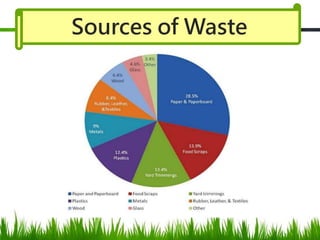
Sources of Waste
 7.2 million tonnes of hazardous waste.
 One Sq. km of additional landfill is needed
area every-year.
 Rs 1600 crore for treatment & disposal of
these wastes.
 In addition to this industries discharge
about 150 million tonnes of high volume
low hazard waste every year, which is
mostly dumped on open low lying land
areas.
Solid Waste in India
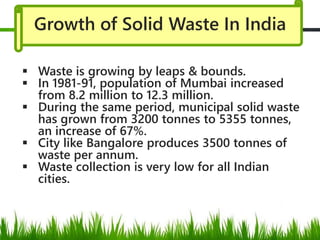
 Waste is growing by leaps & bounds.
 In 1981-91, population of Mumbai increased
from 8.2 million to 12.3 million.
 During the same period, municipal solid waste
has grown from 3200 tonnes to 5355 tonnes,
an increase of 67%.
 City like Bangalore produces 3500 tonnes of
waste per annum.
 Waste collection is very low for all Indian
cities.
Growth of Solid Waste In India
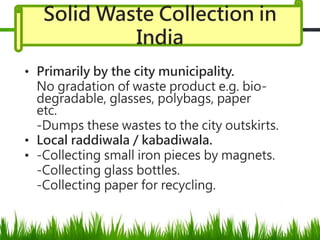
• Primarily by the city municipality.
No gradation of waste product e.g. bio-
degradable, glasses, polybags, paper
etc.
-Dumps these wastes to the city outskirts.
• Local raddiwala / kabadiwala.
• -Collecting small iron pieces by magnets.
-Collecting glass bottles.
-Collecting paper for recycling.
Solid Waste Collection in
India
 In Mumbai (2005) clogged the sewage
line due to large no. of plastic bags.
 Blast in the Bhusan Steel factory at Noida,
caused due to imported scrap from Iran.
 Reduction in the number of migratory
birds due to consumption of
contaminated foods.
 Animals dying on streets due to
consumption of plastic bags, which
blocks the food movement in their
stomach .
How solid waste affected us in
recent years.
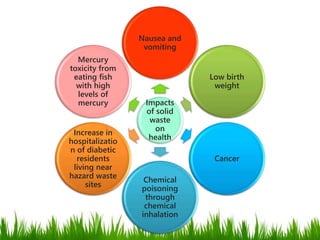
Impacts
of solid
waste
on
health
Nausea and
vomiting
Low birth
weight
Cancer
Chemical
poisoning
through
chemical
inhalation
Increase in
hospitalizatio
n of diabetic
residents
living near
hazard waste
sites
Mercury
toxicity from
eating fish
with high
levels of
mercury
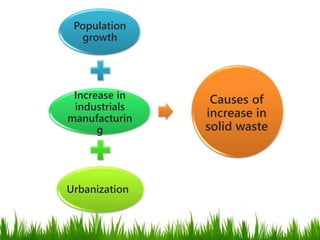
Population
growth
Increase in
industrials
manufacturin
g
Urbanization
Causes of
increase in
solid waste
Understand The Various Kinds
of MSW Disposal Methods Such
as Land Filling, Incineration and
Organic MSW Composting.
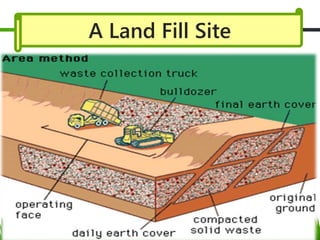
• It is the most traditional method of waste
disposal.
• Waste is directly dumped into quarries, mining
voids or borrow pits.
• Disposed waste is compacted and covered with
soil.
• It is generally used for domestic waste.
Land Filling
A Land Fill Site
LAND REQUIRED FOR DISPOSAL OF
MSW
EMMISION OF METHANE FROM
LANDFILL
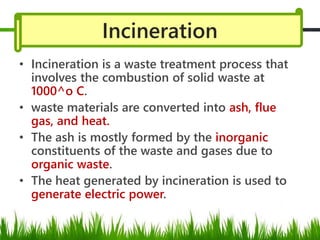
• Incineration is a waste treatment process that
involves the combustion of solid waste at
1000^o C.
• waste materials are converted into ash, flue
gas, and heat.
• The ash is mostly formed by the inorganic
constituents of the waste and gases due to
organic waste.
• The heat generated by incineration is used to
generate electric power.
Incineration
Incineration
How can we make a change
Know 3R’s Concept and Justify
Aspects and Issues related to
recycling and composting of
municipal solid waste
(MSW).
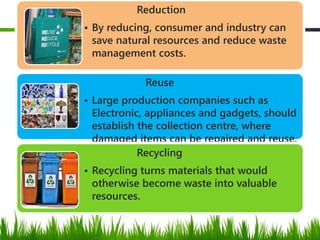
Reduction
• By reducing, consumer and industry can
save natural resources and reduce waste
management costs.
Reuse
• Large production companies such as
Electronic, appliances and gadgets, should
establish the collection centre, where
damaged items can be repaired and reuse.
Recycling
• Recycling turns materials that would
otherwise become waste into valuable
resources.
Thank You..

Solid Waste Management

  • 1.
    SOLID WASTE MANAGEMENT 1 ANAYAT ALI B.TECHCIVIL 1221600013 A Presentation on: Presented By: Department of Civil Engineering IIMT College of Engineering, Greater Noida
  • 4.
    Objective Of SolidWaste Management The objective of solid wastes management is to control, collect, process, dispose off solid wastes in an economical way consistent with the public health protection.
  • 5.
    Classification of Solid Waste E-Wastes Industrial wastes Bio-medicalwastes Agricultural wastes Municipal Solid wastes
  • 6.
    Classification of SolidWaste  Municipal Solid wastes: Solid wastes that include household garbage, rubbish, construction & packaging materials, etc. and are managed by any municipality.  Bio-medical wastes: Solid or liquid wastes including containers, products generated during diagnosis, treatment & research activities of medical sciences.  Industrial wastes: Liquid and solid wastes that are generated by manufacturing & processing units of various industries like chemical, petroleum, coal, metal gas, paper etc.  Agricultural wastes: Wastes generated from farming activities. These substances are mostly biodegradable.  E-wastes: Electronic wastes generated from any modern establishments. They may be described as discarded electrical or electronic devices. Some electronic scrap components, such as wires, circuits, mobile, computers etc.
  • 7.
  • 8.
  • 10.
     7.2 milliontonnes of hazardous waste.  One Sq. km of additional landfill is needed area every-year.  Rs 1600 crore for treatment & disposal of these wastes.  In addition to this industries discharge about 150 million tonnes of high volume low hazard waste every year, which is mostly dumped on open low lying land areas. Solid Waste in India
  • 11.
     Waste isgrowing by leaps & bounds.  In 1981-91, population of Mumbai increased from 8.2 million to 12.3 million.  During the same period, municipal solid waste has grown from 3200 tonnes to 5355 tonnes, an increase of 67%.  City like Bangalore produces 3500 tonnes of waste per annum.  Waste collection is very low for all Indian cities. Growth of Solid Waste In India
  • 12.
    • Primarily bythe city municipality. No gradation of waste product e.g. bio- degradable, glasses, polybags, paper etc. -Dumps these wastes to the city outskirts. • Local raddiwala / kabadiwala. • -Collecting small iron pieces by magnets. -Collecting glass bottles. -Collecting paper for recycling. Solid Waste Collection in India
  • 13.
     In Mumbai(2005) clogged the sewage line due to large no. of plastic bags.  Blast in the Bhusan Steel factory at Noida, caused due to imported scrap from Iran.  Reduction in the number of migratory birds due to consumption of contaminated foods.  Animals dying on streets due to consumption of plastic bags, which blocks the food movement in their stomach . How solid waste affected us in recent years.
  • 14.
    Impacts of solid waste on health Nausea and vomiting Lowbirth weight Cancer Chemical poisoning through chemical inhalation Increase in hospitalizatio n of diabetic residents living near hazard waste sites Mercury toxicity from eating fish with high levels of mercury
  • 15.
  • 16.
    Understand The VariousKinds of MSW Disposal Methods Such as Land Filling, Incineration and Organic MSW Composting.
  • 17.
    • It isthe most traditional method of waste disposal. • Waste is directly dumped into quarries, mining voids or borrow pits. • Disposed waste is compacted and covered with soil. • It is generally used for domestic waste. Land Filling
  • 18.
  • 19.
    LAND REQUIRED FORDISPOSAL OF MSW EMMISION OF METHANE FROM LANDFILL
  • 20.
    • Incineration isa waste treatment process that involves the combustion of solid waste at 1000^o C. • waste materials are converted into ash, flue gas, and heat. • The ash is mostly formed by the inorganic constituents of the waste and gases due to organic waste. • The heat generated by incineration is used to generate electric power. Incineration
  • 21.
  • 22.
    How can wemake a change Know 3R’s Concept and Justify Aspects and Issues related to recycling and composting of municipal solid waste (MSW).
  • 23.
    Reduction • By reducing,consumer and industry can save natural resources and reduce waste management costs. Reuse • Large production companies such as Electronic, appliances and gadgets, should establish the collection centre, where damaged items can be repaired and reuse. Recycling • Recycling turns materials that would otherwise become waste into valuable resources.
  • 25.