Solid Waste Management
1LT Patrick McPartland, E.I.T
484th Forward Engineer Support Team-Advanced
TERMINAL LEARNING OBJECTIVE
• Action: Recognize both military and civilian Solid Waste
treatment methods.
• Conditions: In a office environment, given the civilian and
military reference material (see reference slide)
• Standards: Develop an understanding of water treatment
process, and military treatment capabilities
484th Forward Engineer Support Team-Advanced
SAFETY, RISK, AND ENVIRONMENTAL
CONCERNS
• Safety Requirements: No major safety requirements.
• Risk Assessment Level: Low
• Environmental Considerations: No major environmental
484th Forward Engineer Support Team-Advanced
OUTLINE
• Introduction to Municipal Solid Waste (MSW)
• Understanding the process of generation and handing of MSW
• Understand MSW collection Activities
• SWEAT-MSO
484th Forward Engineer Support Team-Advanced
INTRODUCTION: WHAT IS SOLD WASTE
• Solid waste are not liquid or gaseous.
• Solid waste are all discarded solid materials from municipal, industrial, and
agricultural activities.
• Solid waste is material such as household garbage, food wastes, yard
wastes, and construction debris.
484th Forward Engineer Support Team-Advanced
OBJECTIVE OF SOLID WASTE
MANAGEMENT
The Objective of solid waste management is to control, collect, process,
dispose of solid wastes in an economical and safe manner consistent with the
public health protection.
484th Forward Engineer Support Team-Advanced
MUNICIPAL SOLID WASTE (MSW)
• Municipal solid waste (MSW) is a waste type consisting of everday items
that are discarded by the public.
• All waste, resulting from population, residential and non residential
buildings, as well as vehicles.
• MSW is commonly known as: trash, garbage, refuse or rubbish
484th Forward Engineer Support Team-Advanced
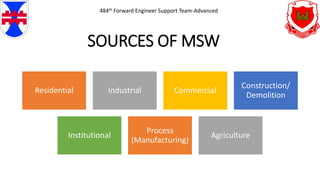
SOURCES OF MSW
Residential Industrial Commercial
Construction/
Demolition
Institutional
Process
(Manufacturing)
Agriculture
484th Forward Engineer Support Team-Advanced
ELEMENTS OF MSW MANAGEMENT
Waste generation
Waste handling,
sorting, storage, and
processing at the
source
Collection
Separation,
processing, and
transformation of
solid wastes
Transfer and
transport
Energy generation Disposal
484th Forward Engineer Support Team-Advanced
STRATEGIES FOR EFFECTIVE AND
ENVIRONMENTAL FRIENDLY MSW
MANAGEMENT
• The four R’s
• Reduce- Minimize waste generation. By
reducing, consumer and industry can save
natural resources and reduce waste
management costs/
• Reuse- Maximize the reuse of a product.
Damaged items can be repaired and reused.
• Recovery- Energy or material can be
recovered from waste that are not reused or
recycled.
• Recycle- Maximize the recycling of a
product. Turns materials into different
resources
484th Forward Engineer Support Team-Advanced
Prevention
Minimization
Reuse
Recycling
Energy Recovery
Disposal
Most Preferred
Least Preferred
UNDERSTANDING THE
CHARACTERISTICS OF MSW
Municipal Solid Waste
Physical Characteristic
Moisture content: increases the
weight of solid waste, in turn
the cost of collection &
transportation will increase
Density: Used to assess volume
of transportation & sixe of
disposal facility
Chemical Characteristic
Is essential in understanding
the behavior of waste all
through the waste
management system and also
in selecting and determining
the efficiency of any treatment
process
484th Forward Engineer Support Team-Advanced
CHECK ON LEARNING
• What are the Four R’s.
484th Forward Engineer Support Team-Advanced
Reduce
Reuse
Recover
Recycle
• What does MSW stand for?
Municipal Solid Waste
Understanding the process of
generation and handing of MSW
484th Forward Engineer Support Team-Advanced
WASTE GENERATION
Waste generation include activities in which
material identified as no longer being of
value and are either thrown away or
gathered together for disposal
484th Forward Engineer Support Team-Advanced
COLLECTION
Elements of collection, includes not only the
gathering of solid waste and recyclable
materials, but also the transport of these
materials after collection, to the location
where the collection vehicle is emptied
484th Forward Engineer Support Team-Advanced
HANDLING AND SEPARATING MSW
• Waste handling and separation involves
activities associated with waste
management until the waste is placed in
storage containers for collection
• Handling also includes the movement of
loaded containers to the point of
collection. Separating different types of
waste components is an important step in
the handling and storage of solid waste at
the source.
484th Forward Engineer Support Team-Advanced
CHECKS ON LEARNING
• What does MSW collection involve?
484th Forward Engineer Support Team-Advanced
Elements of collection, includes not only the gathering of solid waste
and recyclable materials, but also the transport of these materials after
collection, to the location where the collection vehicle is emptied
Understand Municipal Solid Waste
Collection Activities
484th Forward Engineer Support Team-Advanced
COLLECTION ACTIVITIES
• The most common collection services are
curb/alley and set-out, set-back pickup
• The collection services provided to large
apartment buildings, residential
complexes, commercial and industrial
activates typically is centered around the
use of large movable and stationary
containers (dumpster) and large stationary
compactors.
484th Forward Engineer Support Team-Advanced
CURB OR ALLEY PICKUP
• The quickest and most economical
point of collection
• Often uses standard container
that has been designed by city
council
• Cost is often wrapped up in taxes
or paid for as a services.
484th Forward Engineer Support Team-Advanced
SET-OUT, SET-BACK PICKUP
• Collectors have to enter property.
• Set out crew carries full container from resident storage location to
curb/alley before collection vehicle arrives.
• Set back crew return the container to storage area.
484th Forward Engineer Support Team-Advanced
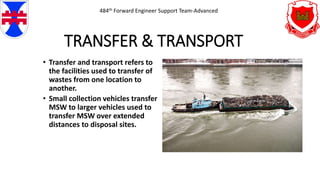
TRANSFER & TRANSPORT
• Transfer and transport refers to
the facilities used to transfer of
wastes from one location to
another.
• Small collection vehicles transfer
MSW to larger vehicles used to
transfer MSW over extended
distances to disposal sites.
484th Forward Engineer Support Team-Advanced
CHECK ON LEARNING
• What are the four types of collection activities.
484th Forward Engineer Support Team-Advanced
Curb or Alley Pickup
Set-out, Set-back Pickup
Transfer & Transport
Understand the Various Kinds of MSW
Disposal Methods Such as Landfilling,
Incineration and Organic MSW Composting
484th Forward Engineer Support Team-Advanced
LAND FILLING
• The controlled disposal of solid waste on the upper layer of the
earth, in a manner that minimizes environmental hazards.
• Important technical aspects in the implementation of sanitary
landfills include:
• Site selection
• Movement and control of gases and leachate
484th Forward Engineer Support Team-Advanced
LANDFILL SITE SELECTION
484th Forward Engineer Support Team-Advanced
• Can be considered the most critical design step.
• Must be a balance of minimizing haul distance and maximizing
distances from housing, inhabited buildings and other
undesirables location
• Historic wind information should be considered
• Site access
• Other considerations:
• Surface and sub surface water conditions
• Soil permeability
• 100-year flood plains
• Recharge zones of sole source aquifers
• Airports/airfields (birds)
• Geologically unstable areas (Karst)
LANDFILL
484th Forward Engineer Support Team-Advanced
MOVEMENT AND CONTROL OF GASES
AND LEACHATE
484th Forward Engineer Support Team-Advanced
• Leachate- any liquid which touches MSW.
• Minimizing working face of landfill will limit the amount of leachate that
needs to be collected.
• Chemical and biological characteristics of leachate vary on the types of
MSW in landfill.
• Requirements for controlling and moving leachate are based on federal
and state laws and regulation.
• Leachate collection
• Fundamental approach is to first confine leachate within limits of landfill and
then to collect and dispose of it safely.
• For collection techniques to be successful an impermeable soil (clay) or artificial
liner must be in place.
• Movement is often promoted by gravity through layers of sand and/or gravel
underlain with perforated pipes which carry leachate to collection points
GAS VENT
484th Forward Engineer Support Team-Advanced
INCINERATION
• The process of burning waste in
large furnaces at high temperature
is known as incineration.
• It is used to dispose of solid, liquid,
and gaseous waste. Incineration
facilities generally do not require as
much area as landfills.
• At the end of the process all that is
left behind is ash, which can be
landfilled.
• Not a similar method to burn pits.
484th Forward Engineer Support Team-Advanced
Eco waste Solutions- ECO-
Mobile a containerized
incinerator
BURN PITS
• A Burn pit is an area devoted to open-air
combustion of trash.
• Modern waste contains significant
amounts of plastic and other material
which may emit toxic aerial compounds
and particulates when burned.
• Often jet fuel is used to accelerate the fire.
• Burn pits were adopted as temporary
measure, however they have remained
open long after alternative methods of
disposal such as incineration were
available.
• Often related to multiple types of health
issues do to improper disposal.
484th Forward Engineer Support Team-Advanced
COMPOSTING
• Compost is the product resulting from the controlled
biological decomposition of organic material
• The starting material for composting are commonly
referred to a feed stock
• Two types of composting
• Aerobic composting (preferred)
• Anaerobic composting
484th Forward Engineer Support Team-Advanced
FACTORS THAT INFLUENCE AEROBIC
COMPOSTING PROCESS
• Particle size 25 to 75 mm for optimum chemical reaction
to occur.
• Moisture content should be in the range of 50-60%.
• Optimum temperature is within 50-70°C.
• PH between 6.5-7.5. Must not exceed 8.5.
• Mixing process to prevent dehydration on the surface of
the compost
484th Forward Engineer Support Team-Advanced
CHECK ON LEARNING
• What are the preffered types of MSW disposal method.
484th Forward Engineer Support Team-Advanced
Landfill
Incineration
Composting
• Is a burn pit a permanent disposal method?
NO
• Should a landfill not be constructed near an airfield?
No, landfills should not be constructed within
10,000 ft or more depending on local regulations
of an airfield due to risk of bird aircraft collision.
Trash in SWEAT-MSO
484th Forward Engineer Support Team-Advanced
TRASH
• Factors that an inspectors should ask or draw from observations.
• Is there a system in place for removing waste?
• What hazardous waste streams are being generated that may have
detrimental impacts on health and the environment?
• What is the ultimate disposal system for trash?
• Inspectors need to consider the infrastructure linkage when
assessing the trash section as it correlates directly to the sewage
(Leachate).
• Proper trash disposal will often relate to increase in health
conditions.
484th Forward Engineer Support Team-Advanced
TRASH
Formal trash collection
system is operational. Trash
is in a central area that does
not present a health hazard.
No Trash build up in public
facilities such as roads.
Formal trash collection
system exists, but is limited.
Unknown central trash
collection area. Limited trash
in public facilities.
No formal trash collection
system. Central trash area
presents a possible health
hazard. Public facilities have
no means to remove trash.
No Trash collection. Trash is
consolidated in an area that
present a health hazard.
Public facilities have excess
trash.
484th Forward Engineer Support Team-Advanced

Solid waste management

  • 1.
    Solid Waste Management 1LTPatrick McPartland, E.I.T 484th Forward Engineer Support Team-Advanced
  • 2.
    TERMINAL LEARNING OBJECTIVE •Action: Recognize both military and civilian Solid Waste treatment methods. • Conditions: In a office environment, given the civilian and military reference material (see reference slide) • Standards: Develop an understanding of water treatment process, and military treatment capabilities 484th Forward Engineer Support Team-Advanced
  • 3.
    SAFETY, RISK, ANDENVIRONMENTAL CONCERNS • Safety Requirements: No major safety requirements. • Risk Assessment Level: Low • Environmental Considerations: No major environmental 484th Forward Engineer Support Team-Advanced
  • 4.
    OUTLINE • Introduction toMunicipal Solid Waste (MSW) • Understanding the process of generation and handing of MSW • Understand MSW collection Activities • SWEAT-MSO 484th Forward Engineer Support Team-Advanced
  • 5.
    INTRODUCTION: WHAT ISSOLD WASTE • Solid waste are not liquid or gaseous. • Solid waste are all discarded solid materials from municipal, industrial, and agricultural activities. • Solid waste is material such as household garbage, food wastes, yard wastes, and construction debris. 484th Forward Engineer Support Team-Advanced
  • 6.
    OBJECTIVE OF SOLIDWASTE MANAGEMENT The Objective of solid waste management is to control, collect, process, dispose of solid wastes in an economical and safe manner consistent with the public health protection. 484th Forward Engineer Support Team-Advanced
  • 7.
    MUNICIPAL SOLID WASTE(MSW) • Municipal solid waste (MSW) is a waste type consisting of everday items that are discarded by the public. • All waste, resulting from population, residential and non residential buildings, as well as vehicles. • MSW is commonly known as: trash, garbage, refuse or rubbish 484th Forward Engineer Support Team-Advanced
  • 8.
    SOURCES OF MSW ResidentialIndustrial Commercial Construction/ Demolition Institutional Process (Manufacturing) Agriculture 484th Forward Engineer Support Team-Advanced
  • 9.
    ELEMENTS OF MSWMANAGEMENT Waste generation Waste handling, sorting, storage, and processing at the source Collection Separation, processing, and transformation of solid wastes Transfer and transport Energy generation Disposal 484th Forward Engineer Support Team-Advanced
  • 10.
    STRATEGIES FOR EFFECTIVEAND ENVIRONMENTAL FRIENDLY MSW MANAGEMENT • The four R’s • Reduce- Minimize waste generation. By reducing, consumer and industry can save natural resources and reduce waste management costs/ • Reuse- Maximize the reuse of a product. Damaged items can be repaired and reused. • Recovery- Energy or material can be recovered from waste that are not reused or recycled. • Recycle- Maximize the recycling of a product. Turns materials into different resources 484th Forward Engineer Support Team-Advanced Prevention Minimization Reuse Recycling Energy Recovery Disposal Most Preferred Least Preferred
  • 11.
    UNDERSTANDING THE CHARACTERISTICS OFMSW Municipal Solid Waste Physical Characteristic Moisture content: increases the weight of solid waste, in turn the cost of collection & transportation will increase Density: Used to assess volume of transportation & sixe of disposal facility Chemical Characteristic Is essential in understanding the behavior of waste all through the waste management system and also in selecting and determining the efficiency of any treatment process 484th Forward Engineer Support Team-Advanced
  • 12.
    CHECK ON LEARNING •What are the Four R’s. 484th Forward Engineer Support Team-Advanced Reduce Reuse Recover Recycle • What does MSW stand for? Municipal Solid Waste
  • 13.
    Understanding the processof generation and handing of MSW 484th Forward Engineer Support Team-Advanced
  • 14.
    WASTE GENERATION Waste generationinclude activities in which material identified as no longer being of value and are either thrown away or gathered together for disposal 484th Forward Engineer Support Team-Advanced
  • 15.
    COLLECTION Elements of collection,includes not only the gathering of solid waste and recyclable materials, but also the transport of these materials after collection, to the location where the collection vehicle is emptied 484th Forward Engineer Support Team-Advanced
  • 16.
    HANDLING AND SEPARATINGMSW • Waste handling and separation involves activities associated with waste management until the waste is placed in storage containers for collection • Handling also includes the movement of loaded containers to the point of collection. Separating different types of waste components is an important step in the handling and storage of solid waste at the source. 484th Forward Engineer Support Team-Advanced
  • 17.
    CHECKS ON LEARNING •What does MSW collection involve? 484th Forward Engineer Support Team-Advanced Elements of collection, includes not only the gathering of solid waste and recyclable materials, but also the transport of these materials after collection, to the location where the collection vehicle is emptied
  • 18.
    Understand Municipal SolidWaste Collection Activities 484th Forward Engineer Support Team-Advanced
  • 19.
    COLLECTION ACTIVITIES • Themost common collection services are curb/alley and set-out, set-back pickup • The collection services provided to large apartment buildings, residential complexes, commercial and industrial activates typically is centered around the use of large movable and stationary containers (dumpster) and large stationary compactors. 484th Forward Engineer Support Team-Advanced
  • 20.
    CURB OR ALLEYPICKUP • The quickest and most economical point of collection • Often uses standard container that has been designed by city council • Cost is often wrapped up in taxes or paid for as a services. 484th Forward Engineer Support Team-Advanced
  • 21.
    SET-OUT, SET-BACK PICKUP •Collectors have to enter property. • Set out crew carries full container from resident storage location to curb/alley before collection vehicle arrives. • Set back crew return the container to storage area. 484th Forward Engineer Support Team-Advanced
  • 22.
    TRANSFER & TRANSPORT •Transfer and transport refers to the facilities used to transfer of wastes from one location to another. • Small collection vehicles transfer MSW to larger vehicles used to transfer MSW over extended distances to disposal sites. 484th Forward Engineer Support Team-Advanced
  • 23.
    CHECK ON LEARNING •What are the four types of collection activities. 484th Forward Engineer Support Team-Advanced Curb or Alley Pickup Set-out, Set-back Pickup Transfer & Transport
  • 24.
    Understand the VariousKinds of MSW Disposal Methods Such as Landfilling, Incineration and Organic MSW Composting 484th Forward Engineer Support Team-Advanced
  • 25.
    LAND FILLING • Thecontrolled disposal of solid waste on the upper layer of the earth, in a manner that minimizes environmental hazards. • Important technical aspects in the implementation of sanitary landfills include: • Site selection • Movement and control of gases and leachate 484th Forward Engineer Support Team-Advanced
  • 26.
    LANDFILL SITE SELECTION 484thForward Engineer Support Team-Advanced • Can be considered the most critical design step. • Must be a balance of minimizing haul distance and maximizing distances from housing, inhabited buildings and other undesirables location • Historic wind information should be considered • Site access • Other considerations: • Surface and sub surface water conditions • Soil permeability • 100-year flood plains • Recharge zones of sole source aquifers • Airports/airfields (birds) • Geologically unstable areas (Karst)
  • 27.
    LANDFILL 484th Forward EngineerSupport Team-Advanced
  • 28.
    MOVEMENT AND CONTROLOF GASES AND LEACHATE 484th Forward Engineer Support Team-Advanced • Leachate- any liquid which touches MSW. • Minimizing working face of landfill will limit the amount of leachate that needs to be collected. • Chemical and biological characteristics of leachate vary on the types of MSW in landfill. • Requirements for controlling and moving leachate are based on federal and state laws and regulation. • Leachate collection • Fundamental approach is to first confine leachate within limits of landfill and then to collect and dispose of it safely. • For collection techniques to be successful an impermeable soil (clay) or artificial liner must be in place. • Movement is often promoted by gravity through layers of sand and/or gravel underlain with perforated pipes which carry leachate to collection points
  • 29.
    GAS VENT 484th ForwardEngineer Support Team-Advanced
  • 30.
    INCINERATION • The processof burning waste in large furnaces at high temperature is known as incineration. • It is used to dispose of solid, liquid, and gaseous waste. Incineration facilities generally do not require as much area as landfills. • At the end of the process all that is left behind is ash, which can be landfilled. • Not a similar method to burn pits. 484th Forward Engineer Support Team-Advanced Eco waste Solutions- ECO- Mobile a containerized incinerator
  • 31.
    BURN PITS • ABurn pit is an area devoted to open-air combustion of trash. • Modern waste contains significant amounts of plastic and other material which may emit toxic aerial compounds and particulates when burned. • Often jet fuel is used to accelerate the fire. • Burn pits were adopted as temporary measure, however they have remained open long after alternative methods of disposal such as incineration were available. • Often related to multiple types of health issues do to improper disposal. 484th Forward Engineer Support Team-Advanced
  • 32.
    COMPOSTING • Compost isthe product resulting from the controlled biological decomposition of organic material • The starting material for composting are commonly referred to a feed stock • Two types of composting • Aerobic composting (preferred) • Anaerobic composting 484th Forward Engineer Support Team-Advanced
  • 33.
    FACTORS THAT INFLUENCEAEROBIC COMPOSTING PROCESS • Particle size 25 to 75 mm for optimum chemical reaction to occur. • Moisture content should be in the range of 50-60%. • Optimum temperature is within 50-70°C. • PH between 6.5-7.5. Must not exceed 8.5. • Mixing process to prevent dehydration on the surface of the compost 484th Forward Engineer Support Team-Advanced
  • 34.
    CHECK ON LEARNING •What are the preffered types of MSW disposal method. 484th Forward Engineer Support Team-Advanced Landfill Incineration Composting • Is a burn pit a permanent disposal method? NO • Should a landfill not be constructed near an airfield? No, landfills should not be constructed within 10,000 ft or more depending on local regulations of an airfield due to risk of bird aircraft collision.
  • 35.
    Trash in SWEAT-MSO 484thForward Engineer Support Team-Advanced
  • 36.
    TRASH • Factors thatan inspectors should ask or draw from observations. • Is there a system in place for removing waste? • What hazardous waste streams are being generated that may have detrimental impacts on health and the environment? • What is the ultimate disposal system for trash? • Inspectors need to consider the infrastructure linkage when assessing the trash section as it correlates directly to the sewage (Leachate). • Proper trash disposal will often relate to increase in health conditions. 484th Forward Engineer Support Team-Advanced
  • 37.
    TRASH Formal trash collection systemis operational. Trash is in a central area that does not present a health hazard. No Trash build up in public facilities such as roads. Formal trash collection system exists, but is limited. Unknown central trash collection area. Limited trash in public facilities. No formal trash collection system. Central trash area presents a possible health hazard. Public facilities have no means to remove trash. No Trash collection. Trash is consolidated in an area that present a health hazard. Public facilities have excess trash. 484th Forward Engineer Support Team-Advanced