Downloaded 77 times


![WHY DESALINATION ?
97.5 % ocean water not drinkable, 2%
frozen fresh water, 0.5 % available fresh
water.
By 2030,2/3rd of the world population will
be suffering from water shortages
[HSBC optimized Global water
index,2008 ]
The Worlds Wate3% Fresh Water
World Water Resources
Salt Water
Fresh Water](https://image.slidesharecdn.com/presentation1-160613000318/85/Solar-Disalination-4-320.jpg)
![WHY DESALINATION ?
• Fresh water Reserves
500 to 1000 ppm salinity; fresh water constitutes only 3%-5% of
the world’s water [ADA, 2002].
• Rapidly Diminishing Accessible Freshwater Reserves
The high rate of population growth and climate change
presents increased need for freshwater, and in the next
decades many further areas of the world are expected also to
require substantial use of desalination](https://image.slidesharecdn.com/presentation1-160613000318/85/Solar-Disalination-5-320.jpg)
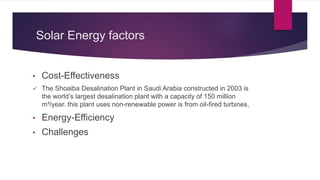
![Solar Energy Technologies
• Solar photovoltaic (PV) systems
which collect solar power and transform this energy into electrical
power ([Chaabane, 2013]).
• Solar Concentrating Systems
which collect solar power and transfer this to heat energy (perhaps the
most extensive surveys on solar thermal systems is [NREL, 2003],](https://image.slidesharecdn.com/presentation1-160613000318/85/Solar-Disalination-6-320.jpg)
![Desalination Technologies
The multi-stage flash(MSF) process
• The multiple-effect boiling(MEB)process
• The vapour compression(VC)process]
• Reverse osmosis(RO)
• Electrodialysis(ED)](https://image.slidesharecdn.com/presentation1-160613000318/85/Solar-Disalination-8-320.jpg)

![References
[AbKadir, 2010] AbKadir MZA, Rafeeu Y, Adam NM. Prospective scenarios for the
full solar energy development in Malaysia. Renewable and Sustainable Energy
Reviews 2010;14:3023–31.
[Al-Sahlawi, 1999] Al-Sahlawi MA. Sea water desalination in Saudia Arabia:
economic review and demand projection. Elsever Desalination 1999;123:143–7.
Renewable and Sustainable Energy Reviews, (2015). DOI:
10.1016/j.rser.2015.03.065
Seawater desalination is described in [Al-sofi, 2011]](https://image.slidesharecdn.com/presentation1-160613000318/85/Solar-Disalination-10-320.jpg)

This document discusses solar desalination, including suitable solar technologies like photovoltaic and concentrating solar systems. It also covers various desalination techniques like multi-stage flash, multiple-effect boiling, vapor compression, and reverse osmosis. While desalination provides a solution to water scarcity issues given limited freshwater reserves, solar energy coupled with desalination faces technical challenges but offers promising prospects for powering water needs in remote areas without access to traditional energy sources.


