Instrumentation
& Measurements
Engr. Taimoor Muzaffar Gondal
taimoor.muzaffar@superior.edu.pk
Faculty of Engineering & Technology
The Superior University Lahore
Spring-2022
Lecture-04
4/6/2022 LECTURE 04 1
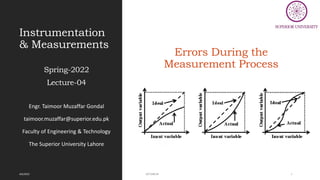
Errors During the
Measurement Process
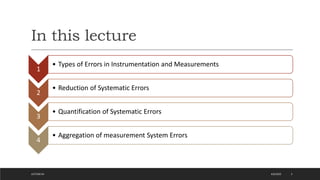
In this lecture
1
• Types of Errors in Instrumentation and Measurements
2
• Reduction of Systematic Errors
3
• Quantification of Systematic Errors
4
• Aggregation of measurement System Errors
4/6/2022
LECTURE 04 2
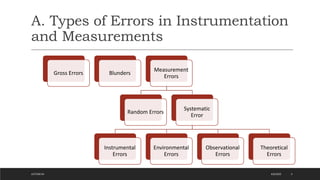
A. Types of Errors in Instrumentation
and Measurements
4/6/2022
LECTURE 04 3
Gross Errors Blunders
Measurement
Errors
Random Errors
Systematic
Error
Instrumental
Errors
Environmental
Errors
Observational
Errors
Theoretical
Errors
1. Gross Errors
Gross errors are caused by mistake in using instruments or meters, calculating
measurement and recording data results.
The best example of these errors is a person or operator reading pressure gage 1.01N/m2
as 1.10N/m2.
This may be the reason for gross errors in the reported data, and such errors may end up
in calculation of the final results, thus deviating results.
4/6/2022
LECTURE 04 4
2. Blunders
Blunders are final source of errors, and these errors are caused by faulty recording or due
to a wrong value while recording a measurement or misreading a scale or forgetting a digit
while reading a scale.
These blunders should stick out like sore thumbs if one person checks the work of another
person. It should not be comprised in the analysis of data.
4/6/2022
LECTURE 04 5
3. Measurement Errors
The measurement error is the result of the variation of a measurement of the true value.
Measurement error consists of a random error and systematic error.
The best example of the measurement error is, if electronic scales are loaded with 1kg
standard weight and the reading is 10002 grams, then
The measurement error is = (1002 grams-1000 grams) = 2 grams
4/6/2022
LECTURE 04 6
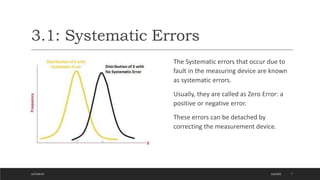
3.1: Systematic Errors
The Systematic errors that occur due to
fault in the measuring device are known
as systematic errors.
Usually, they are called as Zero Error: a
positive or negative error.
These errors can be detached by
correcting the measurement device.
4/6/2022
LECTURE 04 7
3.1.1. Instrumental Errors
Instrumental errors occur due to wrong construction of the measuring instruments.
These errors may occur due to hysteresis or friction.
These types of errors include loading effect and misuse of the instruments.
In order to reduce the gross errors in measurement, different correction factors must be
applied and in the extreme condition instrument must be recalibrated carefully.
4/6/2022
LECTURE 04 8
3.1.2. Environmental Errors
The environmental errors occur due to some external conditions of the instrument.
External conditions mainly include pressure, temperature, humidity or due to magnetic
fields.
In order to reduce the environmental errors
Try to maintain the humidity and temperature constant in the laboratory by making
some arrangements.
Ensure that there shall not be any external electrostatic or magnetic field around the
instrument.
4/6/2022
LECTURE 04 9
3.1.3. Observational Errors
4/6/2022
LECTURE 04 10
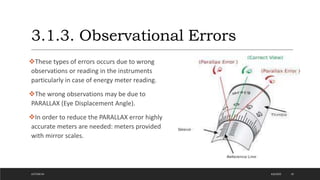
These types of errors occurs due to wrong
observations or reading in the instruments
particularly in case of energy meter reading.
The wrong observations may be due to
PARALLAX (Eye Displacement Angle).
In order to reduce the PARALLAX error highly
accurate meters are needed: meters provided
with mirror scales.
3.1.4. Theoretical Errors
Theoretical errors are caused by simplification of the model system.
For example, a theory states that the temperature of the system surrounding will not
change the readings taken when it does.
Then this factor will begin a source of error in measurement.
4/6/2022
LECTURE 04 11
3.2. Random Errors
Random errors are caused by the sudden change in experimental conditions and noise and
tiredness in the working persons.
These errors are either positive or negative.
An example of the random errors is during changes in humidity, unexpected change in
temperature and fluctuation in voltage. These errors may be reduced by taking the average
of many readings.
4/6/2022
LECTURE 04 12
Errors in Electrical Circuits
4/6/2022
LECTURE 04 13
Example:
4/6/2022
LECTURE 04 14
B. Reduction
of systematic
errors
4/6/2022 LECTURE 04 15
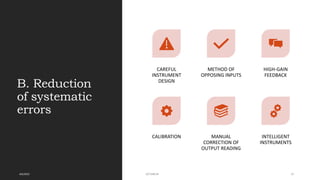
CAREFUL
INSTRUMENT
DESIGN
METHOD OF
OPPOSING INPUTS
HIGH-GAIN
FEEDBACK
CALIBRATION MANUAL
CORRECTION OF
OUTPUT READING
INTELLIGENT
INSTRUMENTS
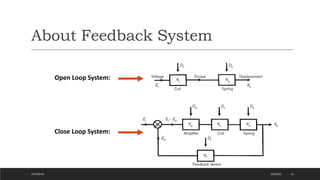
About Feedback System
4/6/2022
LECTURE 04 16
Open Loop System:
Close Loop System:
C. Quantification of systematic
errors
Unfortunately, it is not always possible to quantify exact values of a systematic error,
particularly if measurements are subject to unpredictable environmental conditions.
The usual course of action is to assume mid-point environmental conditions and specify
the maximum measurement error as +x% or –x% of the output reading to allow for the
maximum expected deviation in environmental conditions away from this mid-point.
Data sheets supplied by instrument manufacturers usually quantify systematic errors in
this way.
4/6/2022
LECTURE 04 17
D. More on Random errors
Random errors in measurements are caused by unpredictable variations in the
measurement system.
Therefore, random errors can largely be eliminated by calculating the average of several
repeated measurements.
The degree of confidence in the calculated mean/median values can be quantified by
calculating the standard deviation or variance of the data
4/6/2022
LECTURE 04 18
D.1: Statistical analysis of measurements
subject to random errors
Mean and median
values
Standard deviation and
variance
4/6/2022
LECTURE 04 19
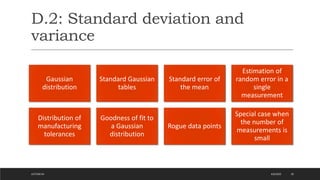
D.2: Standard deviation and
variance
4/6/2022
LECTURE 04 20
Gaussian
distribution
Standard Gaussian
tables
Standard error of
the mean
Estimation of
random error in a
single
measurement
Distribution of
manufacturing
tolerances
Goodness of fit to
a Gaussian
distribution
Rogue data points
Special case when
the number of
measurements is
small
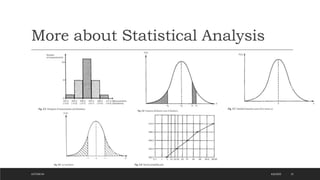
More about Statistical Analysis
4/6/2022
LECTURE 04 21
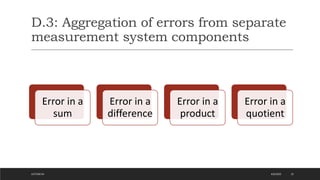
D.3: Aggregation of errors from separate
measurement system components
4/6/2022
LECTURE 04 22
Error in a
sum
Error in a
difference
Error in a
product
Error in a
quotient
End of Lecture-04
4/6/2022
LECTURE 04 23

Lecture 04: Errors During the Measurement Process

  • 1.
    Instrumentation & Measurements Engr. TaimoorMuzaffar Gondal taimoor.muzaffar@superior.edu.pk Faculty of Engineering & Technology The Superior University Lahore Spring-2022 Lecture-04 4/6/2022 LECTURE 04 1 Errors During the Measurement Process
  • 2.
    In this lecture 1 •Types of Errors in Instrumentation and Measurements 2 • Reduction of Systematic Errors 3 • Quantification of Systematic Errors 4 • Aggregation of measurement System Errors 4/6/2022 LECTURE 04 2
  • 3.
    A. Types ofErrors in Instrumentation and Measurements 4/6/2022 LECTURE 04 3 Gross Errors Blunders Measurement Errors Random Errors Systematic Error Instrumental Errors Environmental Errors Observational Errors Theoretical Errors
  • 4.
    1. Gross Errors Grosserrors are caused by mistake in using instruments or meters, calculating measurement and recording data results. The best example of these errors is a person or operator reading pressure gage 1.01N/m2 as 1.10N/m2. This may be the reason for gross errors in the reported data, and such errors may end up in calculation of the final results, thus deviating results. 4/6/2022 LECTURE 04 4
  • 5.
    2. Blunders Blunders arefinal source of errors, and these errors are caused by faulty recording or due to a wrong value while recording a measurement or misreading a scale or forgetting a digit while reading a scale. These blunders should stick out like sore thumbs if one person checks the work of another person. It should not be comprised in the analysis of data. 4/6/2022 LECTURE 04 5
  • 6.
    3. Measurement Errors Themeasurement error is the result of the variation of a measurement of the true value. Measurement error consists of a random error and systematic error. The best example of the measurement error is, if electronic scales are loaded with 1kg standard weight and the reading is 10002 grams, then The measurement error is = (1002 grams-1000 grams) = 2 grams 4/6/2022 LECTURE 04 6
  • 7.
    3.1: Systematic Errors TheSystematic errors that occur due to fault in the measuring device are known as systematic errors. Usually, they are called as Zero Error: a positive or negative error. These errors can be detached by correcting the measurement device. 4/6/2022 LECTURE 04 7
  • 8.
    3.1.1. Instrumental Errors Instrumentalerrors occur due to wrong construction of the measuring instruments. These errors may occur due to hysteresis or friction. These types of errors include loading effect and misuse of the instruments. In order to reduce the gross errors in measurement, different correction factors must be applied and in the extreme condition instrument must be recalibrated carefully. 4/6/2022 LECTURE 04 8
  • 9.
    3.1.2. Environmental Errors Theenvironmental errors occur due to some external conditions of the instrument. External conditions mainly include pressure, temperature, humidity or due to magnetic fields. In order to reduce the environmental errors Try to maintain the humidity and temperature constant in the laboratory by making some arrangements. Ensure that there shall not be any external electrostatic or magnetic field around the instrument. 4/6/2022 LECTURE 04 9
  • 10.
    3.1.3. Observational Errors 4/6/2022 LECTURE04 10 These types of errors occurs due to wrong observations or reading in the instruments particularly in case of energy meter reading. The wrong observations may be due to PARALLAX (Eye Displacement Angle). In order to reduce the PARALLAX error highly accurate meters are needed: meters provided with mirror scales.
  • 11.
    3.1.4. Theoretical Errors Theoreticalerrors are caused by simplification of the model system. For example, a theory states that the temperature of the system surrounding will not change the readings taken when it does. Then this factor will begin a source of error in measurement. 4/6/2022 LECTURE 04 11
  • 12.
    3.2. Random Errors Randomerrors are caused by the sudden change in experimental conditions and noise and tiredness in the working persons. These errors are either positive or negative. An example of the random errors is during changes in humidity, unexpected change in temperature and fluctuation in voltage. These errors may be reduced by taking the average of many readings. 4/6/2022 LECTURE 04 12
  • 13.
    Errors in ElectricalCircuits 4/6/2022 LECTURE 04 13
  • 14.
  • 15.
    B. Reduction of systematic errors 4/6/2022LECTURE 04 15 CAREFUL INSTRUMENT DESIGN METHOD OF OPPOSING INPUTS HIGH-GAIN FEEDBACK CALIBRATION MANUAL CORRECTION OF OUTPUT READING INTELLIGENT INSTRUMENTS
  • 16.
    About Feedback System 4/6/2022 LECTURE04 16 Open Loop System: Close Loop System:
  • 17.
    C. Quantification ofsystematic errors Unfortunately, it is not always possible to quantify exact values of a systematic error, particularly if measurements are subject to unpredictable environmental conditions. The usual course of action is to assume mid-point environmental conditions and specify the maximum measurement error as +x% or –x% of the output reading to allow for the maximum expected deviation in environmental conditions away from this mid-point. Data sheets supplied by instrument manufacturers usually quantify systematic errors in this way. 4/6/2022 LECTURE 04 17
  • 18.
    D. More onRandom errors Random errors in measurements are caused by unpredictable variations in the measurement system. Therefore, random errors can largely be eliminated by calculating the average of several repeated measurements. The degree of confidence in the calculated mean/median values can be quantified by calculating the standard deviation or variance of the data 4/6/2022 LECTURE 04 18
  • 19.
    D.1: Statistical analysisof measurements subject to random errors Mean and median values Standard deviation and variance 4/6/2022 LECTURE 04 19
  • 20.
    D.2: Standard deviationand variance 4/6/2022 LECTURE 04 20 Gaussian distribution Standard Gaussian tables Standard error of the mean Estimation of random error in a single measurement Distribution of manufacturing tolerances Goodness of fit to a Gaussian distribution Rogue data points Special case when the number of measurements is small
  • 21.
    More about StatisticalAnalysis 4/6/2022 LECTURE 04 21
  • 22.
    D.3: Aggregation oferrors from separate measurement system components 4/6/2022 LECTURE 04 22 Error in a sum Error in a difference Error in a product Error in a quotient
  • 23.