Duration: 60 min DPT Medical Physics Lecture 08
Low, Medium & High
Frequency Current
Instructor:
Engr. Taimoor Muzaffar Gondal
taimoor.muzaffar@superior.edu.pk
Lecture 08
Duration: 60 min DPT Medical Physics Lecture 08
Classification of Currents
On the basis of direction of flow of current
Alternating current: flow in both direction
Direct current: flow in one direction
On the basis of frequency
Low frequency: range of 50 to 100 Hz e.g. IDC, Faradic, galvanic, sinusoidal, TENS
Medium frequency: range of 100 to 4000 e.g. interferential currents
High frequency currents: frequency more than 1MHz e.g. SWD, MWD, UST
On the basis of voltage
Low voltage currents: less than100 Volt
High voltage currents: greater than 100 volt
Duration: 60 min DPT Medical Physics Lecture 08
Classification of Currents
On the basis of voltage
Low voltage currents: less than100 Volt
High voltage currents: greater than 100 volt
On the basis of amperage
Low amperage currents: 1 to30 mAmp e.g.- high TENS
High amperage currents: 500 to2000 mAmp
On the basis of amperage
Low amperage currents: 1 to30 mAmp e.g.- high TENS
High amperage currents: 500 to2000 mAmp
Duration: 60 min DPT Medical Physics Lecture 08
Low Frequency Current:
 An alternating current having a frequency of 0 to 1000hz.
Action of Low Frequency Current
 Stimulation of nerve and muscle
 To produce muscle contraction and relaxation
Duration: 60 min DPT Medical Physics Lecture 08
Types of Low Frequency Current
There are four types of low frequency current.
 Faradic current
 Galvanic current
 Sinusoidal current
 Dynamic current
Duration: 60 min DPT Medical Physics Lecture 08
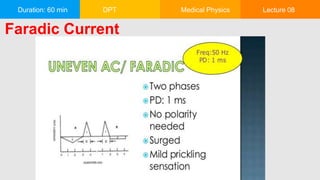
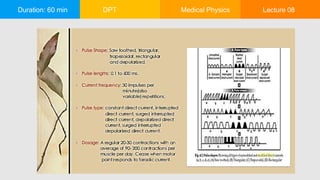
Faradic Current
Duration: 60 min DPT Medical Physics Lecture 08
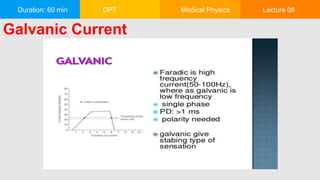
Galvanic Current
Duration: 60 min DPT Medical Physics Lecture 08
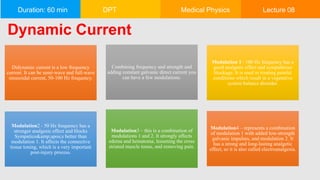
Dynamic Current
Didynamic current is a low frequency
current. It can be semi-wave and full-wave
sinusoidal current, 50-100 Hz frequency.
Combining frequency and strength and
adding constant galvanic direct current you
can have a few modulations.
Modulation 1– 100 Hz frequency has a
good analgetic effect and sympathicus
blockage. It is used in treating painful
conditions which result in a vegetative
system balance disorder.
Modulation2 - 50 Hz frequency has a
stronger analgesic effect and blocks
Sympatico's better than
modulation 1. It affects the connective
tissue toning, which is a very important
post-injury process.
Modulation3 – this is a combination of
modulations 1 and 2. It strongly affects
edema and hematoma, lessening the cross
striated muscle tonus, and removing pain.
Modulation4 – represents a combination
of modulation 1 with added low-strength
galvanic impulses, and modulation 2. It
has a strong and long-lasting analgetic
effect, so it is also called electroanalgesia.
Duration: 60 min DPT Medical Physics Lecture 08
Therapeutic uses of Low Frequency
Current Bursitis
 Arthritis
 Relaxation of Muscular spasm
 Increase arrythmia
 Reduction of pain
 Prevention of deep vein thrombosis
 Range of motion
 Pain control
 Nerve stimulation
 Decrease swelling
 Muscle contraction
 Circulatory disorders
 Soft tissue injuries
 Joint disorders
Duration: 60 min DPT Medical Physics Lecture 08
Effects of Low Frequency Current
 Inflammation
 Skin lesions and dermatological disorders
 Cardiac pacemakers
 Infection
 Thrombosis
 Active TB or cancer
 Nerve sensitivity
Duration: 60 min DPT Medical Physics Lecture 08
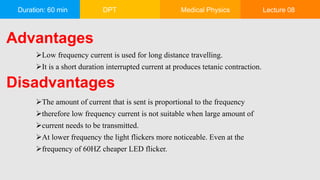
Advantages
Low frequency current is used for long distance travelling.
It is a short duration interrupted current at produces tetanic contraction.
The amount of current that is sent is proportional to the frequency
therefore low frequency current is not suitable when large amount of
current needs to be transmitted.
At lower frequency the light flickers more noticeable. Even at the
frequency of 60HZ cheaper LED flicker.
Disadvantages
Duration: 60 min DPT Medical Physics Lecture 08
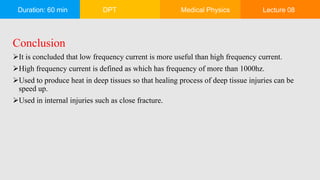
Conclusion
It is concluded that low frequency current is more useful than high frequency current.
High frequency current is defined as which has frequency of more than 1000hz.
Used to produce heat in deep tissues so that healing process of deep tissue injuries can be
speed up.
Used in internal injuries such as close fracture.
Duration: 60 min DPT Medical Physics Lecture 08
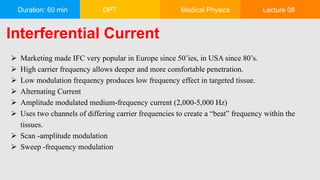
Interferential Current
 Marketing made IFC very popular in Europe since 50’ies, in USA since 80’s.
 High carrier frequency allows deeper and more comfortable penetration.
 Low modulation frequency produces low frequency effect in targeted tissue.
 Alternating Current
 Amplitude modulated medium-frequency current (2,000-5,000 Hz)
 Uses two channels of differing carrier frequencies to create a “beat” frequency within the
tissues.
 Scan -amplitude modulation
 Sweep -frequency modulation
Duration: 60 min DPT Medical Physics Lecture 08
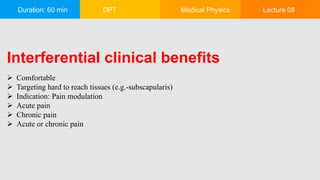
Interferential clinical benefits
 Comfortable
 Targeting hard to reach tissues (e.g.-subscapularis)
 Indication: Pain modulation
 Acute pain
 Chronic pain
 Acute or chronic pain
Duration: 60 min DPT Medical Physics Lecture 08
High Frequency
This treatment can be applied directly or indirectly
 to the skin and can be used to heal, stimulate or sanitise the skin.
 The machine uses a high frequency current that alternates over 100,000 cycles per second.
 The output of the machine is a high frequency, alternating/oscillating current of
 250,000 Hz at a high voltage and low current flow.
 A high frequency machine will have an on/off switch and an intensity control.
Duration: 60 min DPT Medical Physics Lecture 08
Direct High Frequency
The glass electrode is placed directly onto the skin or over a layer of gauze and is applied
using slow circular motions. The current passes through the electrode and is dispersed into
the skin.
Indirect High Frequency
During an indirect high frequency treatment, the client holds the electrode in their hands. The
therapist then uses their hands to apply the massage to the client’s skin, which causes the
current to transfer from the client’s skin to the therapist’s hands.
Duration: 60 min DPT Medical Physics Lecture 08
Types of Electrode
 Mushroom electrode
 Flattened dome electrode
 Horseshoe electrode
 Roller electrode
 Fulgurator
 Saturator
Duration: 60 min DPT Medical Physics Lecture 08
End of Lecture 08
For any kind of queries and questions you are advised to
write at
taimoor.muzaffar@superior.edu.pk
Or visit my office during consulting hours
This lectures can also be downloaded from
https://www.slideshare.net/Taimoor_Gondal

Low, Medium and High Frequency Current

  • 1.
    Duration: 60 minDPT Medical Physics Lecture 08 Low, Medium & High Frequency Current Instructor: Engr. Taimoor Muzaffar Gondal taimoor.muzaffar@superior.edu.pk Lecture 08
  • 2.
    Duration: 60 minDPT Medical Physics Lecture 08 Classification of Currents On the basis of direction of flow of current Alternating current: flow in both direction Direct current: flow in one direction On the basis of frequency Low frequency: range of 50 to 100 Hz e.g. IDC, Faradic, galvanic, sinusoidal, TENS Medium frequency: range of 100 to 4000 e.g. interferential currents High frequency currents: frequency more than 1MHz e.g. SWD, MWD, UST On the basis of voltage Low voltage currents: less than100 Volt High voltage currents: greater than 100 volt
  • 3.
    Duration: 60 minDPT Medical Physics Lecture 08 Classification of Currents On the basis of voltage Low voltage currents: less than100 Volt High voltage currents: greater than 100 volt On the basis of amperage Low amperage currents: 1 to30 mAmp e.g.- high TENS High amperage currents: 500 to2000 mAmp On the basis of amperage Low amperage currents: 1 to30 mAmp e.g.- high TENS High amperage currents: 500 to2000 mAmp
  • 4.
    Duration: 60 minDPT Medical Physics Lecture 08 Low Frequency Current:  An alternating current having a frequency of 0 to 1000hz. Action of Low Frequency Current  Stimulation of nerve and muscle  To produce muscle contraction and relaxation
  • 5.
    Duration: 60 minDPT Medical Physics Lecture 08 Types of Low Frequency Current There are four types of low frequency current.  Faradic current  Galvanic current  Sinusoidal current  Dynamic current
  • 6.
    Duration: 60 minDPT Medical Physics Lecture 08 Faradic Current
  • 7.
    Duration: 60 minDPT Medical Physics Lecture 08 Galvanic Current
  • 8.
    Duration: 60 minDPT Medical Physics Lecture 08
  • 9.
    Duration: 60 minDPT Medical Physics Lecture 08 Dynamic Current Didynamic current is a low frequency current. It can be semi-wave and full-wave sinusoidal current, 50-100 Hz frequency. Combining frequency and strength and adding constant galvanic direct current you can have a few modulations. Modulation 1– 100 Hz frequency has a good analgetic effect and sympathicus blockage. It is used in treating painful conditions which result in a vegetative system balance disorder. Modulation2 - 50 Hz frequency has a stronger analgesic effect and blocks Sympatico's better than modulation 1. It affects the connective tissue toning, which is a very important post-injury process. Modulation3 – this is a combination of modulations 1 and 2. It strongly affects edema and hematoma, lessening the cross striated muscle tonus, and removing pain. Modulation4 – represents a combination of modulation 1 with added low-strength galvanic impulses, and modulation 2. It has a strong and long-lasting analgetic effect, so it is also called electroanalgesia.
  • 10.
    Duration: 60 minDPT Medical Physics Lecture 08 Therapeutic uses of Low Frequency Current Bursitis  Arthritis  Relaxation of Muscular spasm  Increase arrythmia  Reduction of pain  Prevention of deep vein thrombosis  Range of motion  Pain control  Nerve stimulation  Decrease swelling  Muscle contraction  Circulatory disorders  Soft tissue injuries  Joint disorders
  • 11.
    Duration: 60 minDPT Medical Physics Lecture 08 Effects of Low Frequency Current  Inflammation  Skin lesions and dermatological disorders  Cardiac pacemakers  Infection  Thrombosis  Active TB or cancer  Nerve sensitivity
  • 12.
    Duration: 60 minDPT Medical Physics Lecture 08 Advantages Low frequency current is used for long distance travelling. It is a short duration interrupted current at produces tetanic contraction. The amount of current that is sent is proportional to the frequency therefore low frequency current is not suitable when large amount of current needs to be transmitted. At lower frequency the light flickers more noticeable. Even at the frequency of 60HZ cheaper LED flicker. Disadvantages
  • 13.
    Duration: 60 minDPT Medical Physics Lecture 08 Conclusion It is concluded that low frequency current is more useful than high frequency current. High frequency current is defined as which has frequency of more than 1000hz. Used to produce heat in deep tissues so that healing process of deep tissue injuries can be speed up. Used in internal injuries such as close fracture.
  • 14.
    Duration: 60 minDPT Medical Physics Lecture 08 Interferential Current  Marketing made IFC very popular in Europe since 50’ies, in USA since 80’s.  High carrier frequency allows deeper and more comfortable penetration.  Low modulation frequency produces low frequency effect in targeted tissue.  Alternating Current  Amplitude modulated medium-frequency current (2,000-5,000 Hz)  Uses two channels of differing carrier frequencies to create a “beat” frequency within the tissues.  Scan -amplitude modulation  Sweep -frequency modulation
  • 15.
    Duration: 60 minDPT Medical Physics Lecture 08 Interferential clinical benefits  Comfortable  Targeting hard to reach tissues (e.g.-subscapularis)  Indication: Pain modulation  Acute pain  Chronic pain  Acute or chronic pain
  • 16.
    Duration: 60 minDPT Medical Physics Lecture 08 High Frequency This treatment can be applied directly or indirectly  to the skin and can be used to heal, stimulate or sanitise the skin.  The machine uses a high frequency current that alternates over 100,000 cycles per second.  The output of the machine is a high frequency, alternating/oscillating current of  250,000 Hz at a high voltage and low current flow.  A high frequency machine will have an on/off switch and an intensity control.
  • 17.
    Duration: 60 minDPT Medical Physics Lecture 08 Direct High Frequency The glass electrode is placed directly onto the skin or over a layer of gauze and is applied using slow circular motions. The current passes through the electrode and is dispersed into the skin. Indirect High Frequency During an indirect high frequency treatment, the client holds the electrode in their hands. The therapist then uses their hands to apply the massage to the client’s skin, which causes the current to transfer from the client’s skin to the therapist’s hands.
  • 18.
    Duration: 60 minDPT Medical Physics Lecture 08 Types of Electrode  Mushroom electrode  Flattened dome electrode  Horseshoe electrode  Roller electrode  Fulgurator  Saturator
  • 19.
    Duration: 60 minDPT Medical Physics Lecture 08 End of Lecture 08 For any kind of queries and questions you are advised to write at taimoor.muzaffar@superior.edu.pk Or visit my office during consulting hours This lectures can also be downloaded from https://www.slideshare.net/Taimoor_Gondal