GREEN ENERGY
Presented by:
Sanaan Umar Khan
Sanaan Zia
Ibrahim
Ziaullah
Department of Industrial Engineering
University of Engineering and Technology Peshawar
1.0 Contents
 Introduction
 Why Green Energy
 Types of Green Energy
 Hydro
 Solar
 Wind
 Biofuel
 Tidal
 Wave energy
 Hydrogen
 Geo-Thermal
 Conclusion.
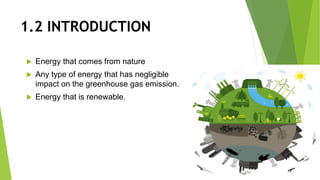
1.2 INTRODUCTION
 Energy that comes from nature
 Any type of energy that has negligible
impact on the greenhouse gas emission.
 Energy that is renewable.
1.3 WHY GREEN ENERGY
 Fossil fuel is limited
 Fossil fuel creates great amount of greenhouse gases
 Except coal the other options are expensive
 Green energy is natural and renewable
 Its free because its natural
 It does not produce harmful gases.
1.4 TYPES OF GREEN ENERGY
(HYDRO)
 The biggest source of renewable energy
used around the world
 Almost 21% of world energy is produced
by this (2000)
 Build on special sites
 Water storage needs lots of area so people
and environment can be affected.
CONTINUE ……
(SOLAR)
 232 GW produced through solar (2015)
 There are two ways energy is produced through solar
Thermal:
sunlight is concentrated at one place to make steam.
Photovoltaic:
special panels used that turns light
into electricity. Substance used are
gallium arsenide, crystalline silicon
and amorphous silicon
CONTINUE……
(WIND)
 Second most popular source of green power.
 17,500 MW worldwide (2000)
 Can be installed only in specific areas (windy areas)
 Are complicated to design ( aerodynamics)
 two types of wind turbine.
Vertical axis: spins on wind
From every direction.
Horizontal axis: spins on
Only one direction.
CONTINUE……
(BIO-FUEL)
 Plant matter, trees, grasses,
agricultural crops or other
biological materials.
 When the rots or decomposes
they release burnable gases.
 14,000 MW of annual
worldwide generation
capacity.
 The U.S. is the largest
biomass generator in the
world with 7,000 MW.
CONTINUE……
(TIDAL)
 Tides caused by moon in ocean are
used to drive underwater blades .
 Tides are more predictive than solar
and wind. Happens twice a day
 Huge potential because of the ocean
is waste.
 A tidal barrage power station in
France has 240 MW of capacity; its
typical output is 0.5 terawatt-hour
per year.
CONTINUE…
(WAVE)
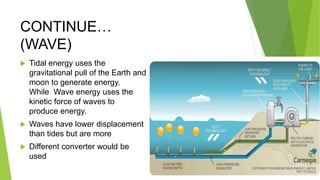
 Tidal energy uses the
gravitational pull of the Earth and
moon to generate energy.
While Wave energy uses the
kinetic force of waves to
produce energy.
 Waves have lower displacement
than tides but are more
 Different converter would be
used
CONTINUE…..
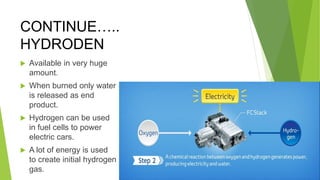
HYDRODEN
 Available in very huge
amount.
 When burned only water
is released as end
product.
 Hydrogen can be used
in fuel cells to power
electric cars.
 A lot of energy is used
to create initial hydrogen
gas.
CONTINUE…..
(GEO-THERMAL)
 Heat at the core of the
earth exploited to
produce electricity
through steam.
 7,974 MW generated
worldwide (1999).
 Needs specific areas to
made like places with
natural hot springs.
(Chitral).
1.5 CONCLUSION
 As the concerns about the
availability & environmental impacts
of fossil fuels become more wide
spread, the interest on
environmentally benign renewable
energy technologies will surely take
center stage among engineers &
policymakers
1.6 REFRENCES
 Wikipedia
 Cosia.ca
 Bp.com global corporate energy
 Britannica.com
Green energy technical writing

Green energy technical writing

  • 1.
    GREEN ENERGY Presented by: SanaanUmar Khan Sanaan Zia Ibrahim Ziaullah Department of Industrial Engineering University of Engineering and Technology Peshawar
  • 2.
    1.0 Contents  Introduction Why Green Energy  Types of Green Energy  Hydro  Solar  Wind  Biofuel  Tidal  Wave energy  Hydrogen  Geo-Thermal  Conclusion.
  • 3.
    1.2 INTRODUCTION  Energythat comes from nature  Any type of energy that has negligible impact on the greenhouse gas emission.  Energy that is renewable.
  • 4.
    1.3 WHY GREENENERGY  Fossil fuel is limited  Fossil fuel creates great amount of greenhouse gases  Except coal the other options are expensive  Green energy is natural and renewable  Its free because its natural  It does not produce harmful gases.
  • 5.
    1.4 TYPES OFGREEN ENERGY (HYDRO)  The biggest source of renewable energy used around the world  Almost 21% of world energy is produced by this (2000)  Build on special sites  Water storage needs lots of area so people and environment can be affected.
  • 6.
    CONTINUE …… (SOLAR)  232GW produced through solar (2015)  There are two ways energy is produced through solar Thermal: sunlight is concentrated at one place to make steam. Photovoltaic: special panels used that turns light into electricity. Substance used are gallium arsenide, crystalline silicon and amorphous silicon
  • 7.
    CONTINUE…… (WIND)  Second mostpopular source of green power.  17,500 MW worldwide (2000)  Can be installed only in specific areas (windy areas)  Are complicated to design ( aerodynamics)  two types of wind turbine. Vertical axis: spins on wind From every direction. Horizontal axis: spins on Only one direction.
  • 8.
    CONTINUE…… (BIO-FUEL)  Plant matter,trees, grasses, agricultural crops or other biological materials.  When the rots or decomposes they release burnable gases.  14,000 MW of annual worldwide generation capacity.  The U.S. is the largest biomass generator in the world with 7,000 MW.
  • 9.
    CONTINUE…… (TIDAL)  Tides causedby moon in ocean are used to drive underwater blades .  Tides are more predictive than solar and wind. Happens twice a day  Huge potential because of the ocean is waste.  A tidal barrage power station in France has 240 MW of capacity; its typical output is 0.5 terawatt-hour per year.
  • 10.
    CONTINUE… (WAVE)  Tidal energyuses the gravitational pull of the Earth and moon to generate energy. While Wave energy uses the kinetic force of waves to produce energy.  Waves have lower displacement than tides but are more  Different converter would be used
  • 11.
    CONTINUE….. HYDRODEN  Available invery huge amount.  When burned only water is released as end product.  Hydrogen can be used in fuel cells to power electric cars.  A lot of energy is used to create initial hydrogen gas.
  • 12.
    CONTINUE….. (GEO-THERMAL)  Heat atthe core of the earth exploited to produce electricity through steam.  7,974 MW generated worldwide (1999).  Needs specific areas to made like places with natural hot springs. (Chitral).
  • 13.
    1.5 CONCLUSION  Asthe concerns about the availability & environmental impacts of fossil fuels become more wide spread, the interest on environmentally benign renewable energy technologies will surely take center stage among engineers & policymakers
  • 14.
    1.6 REFRENCES  Wikipedia Cosia.ca  Bp.com global corporate energy  Britannica.com