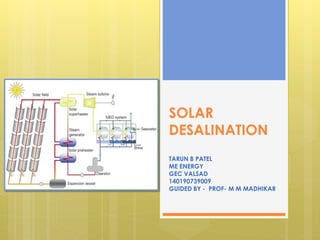



SOLAR
DESALINATION
TARUN B PATEL
ME ENERGY
GEC VALSAD
140190739009
GUIDED BY - PROF- M M MADHIKAR
contents
 INTRODUCTION
 CONVENTIONAL DESALINATION
TECHNOLOGIES
 SOLAR DESALINATION
 SOLAR TECHNOLOGIES
 DIRECT SOLAR DESALINATION
 IN DIRECT SOLAR DESALINATION
 INTRODUCTION
 Desalination involves any process in
which dissolved minerals are removed
from saline or brackish water.
 challenges for the world in the future
 shortage of energy
 shortage of fresh water
 Conventional Desalination
Technologies
 large-scale,
 technology intensive suitable for the energy rich and
economically advanced regions.
 cause environmental hazard( fossil-fuel driven)
 problem of brine disposal
 Desalination processes.
 Phase-change processes
 Multi-stage flash (MSF)
 Multiple effect distillation (MED)
 Vapor compression (VC)
 Membrane processes
 Reverse osmosis (RO)
 Electrodialysis (ED)
Conclusions of Conventional
Desalination System
 the process efficiency is drastically
reduced
 the required size of a condenser or other
drying units will be large
 require detailed design of some special
equipment
 Solar desalination
 Solar desalination is a technique to desalinate water
using solar energy.
 Direct
 use solar energy to produce distillate directly in
the solar collector
 Requires large land areas and has a relatively
low productivity
 Indirect
 combining conventional desalination
techniques
 small-scale production due to its relatively low
cost and simplicity
 Solar technologies
 Different solar energy collectors used in order to
convert solar energy to thermal energy
 In most of them, a fluid is heated by the solar
radiation as it circulates along the solar collector
through an absorber pipe.
 This heat transfer fluid is usually water or synthetic
oil.
 The fluid heated at the solar collector field may be
either stored at an insulated tank or used to heat
another thermal storage medium.
 The solar collector may be a static or sun tracking
device.
Conti…
 The solar collectors suitable for seawater
distillation.
Salinity-gradient solar ponds
Flat-plate collector
Evacuated tube collector
Parabolic trough collector
 Direct solar desalination
 suited for small production systems(solar still)
 regions where the freshwater demand is less
than 200 m3/day
 The simple solar still of the basin type is the
oldest method
 improvements in its design have been made
to increase its efficiency
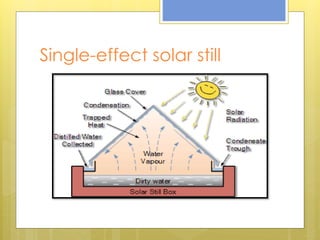
Single-effect solar still
Modifications using passive
methods
 Basin stills
 Wick stills
 Diffusion stills
 Solar still greenhouse combination
 Multiple-effect basin stills
 Externally heated (active) solar stills
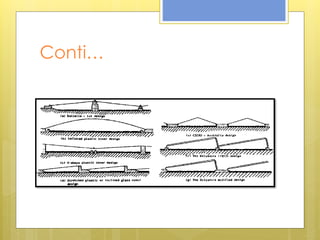
Basin stills
 The operating performance of a simple
basin type passive still can be augmented
by several techniques
Single slope vs. double slope basin stills
Still with cover cooling
Still with additional condenser
Still with black dye
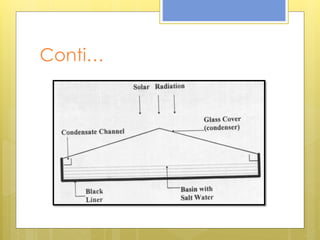
Conti…
Conti…
Wick stills
 the feed water flows slowly through a porous,
radiation-absorbing pad (the wick).
the wick can be tilted so that the feed
water presents a better angle to the sun
less feed water is in the still at any time
and so the water is heated more quickly
and to a higher temperature.
tilted wick type solar still increase in
productivity by 20–50%
Conti…
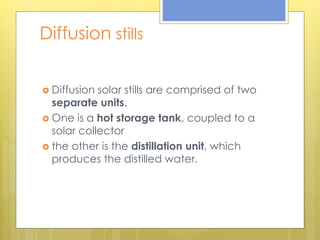
Diffusion stills
 Diffusion solar stills are comprised of two
separate units.
 One is a hot storage tank, coupled to a
solar collector
 the other is the distillation unit, which
produces the distilled water.
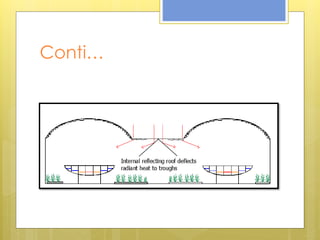
Solar still greenhouse
combination
 Integrated design of greenhouses
combined with solar stills represents an
interesting possibility for the development
of small-scale cultivation in places where
only saline water or brackish water is
available
Conti…
Multiple-effect basin stills
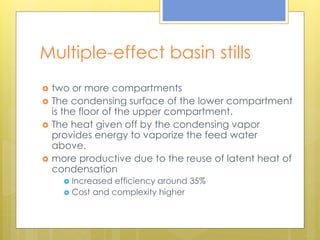
 two or more compartments
 The condensing surface of the lower compartment
is the floor of the upper compartment.
 The heat given off by the condensing vapor
provides energy to vaporize the feed water
above.
 more productive due to the reuse of latent heat of
condensation
 Increased efficiency around 35%
 Cost and complexity higher
Externally heated (active)
solar stills
 The temperature of saline water in the
basin can be increased through
additional (external heating).
 For this purpose the still is integrated with
 solar heater
 solar concentrator
 waste heat recovery system.
 natural circulation (Thermosyphon) or
forced circulation (pump).
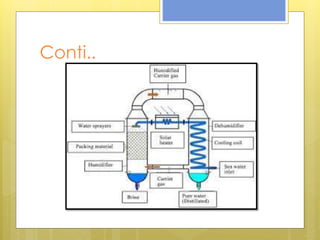
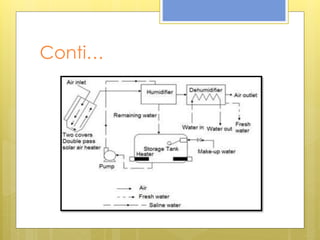
 Water desalination with
humidification–dehumidification (HD)
 the still performance is negatively affected
by the direct contact between the collector
and the saline water
 Cause corrosion and scaling in the still
 reduce the thermal efficiency
 In HDD air is used as a working fluid, which
eliminates this problem.
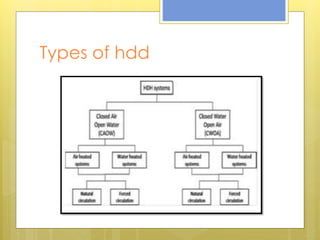
Types of hdd
Conti..
Conti…
Conti…
 operates on the principle of mass diffusion
 utilizes dry air to evaporate saline water,
thus humidifying the air.
 low pressure,low temperature desalination
 can operate off of waste heat
 Indirect solar desalination
 Multi-stage flash process
 Multiple-effect distillation
 Freezing
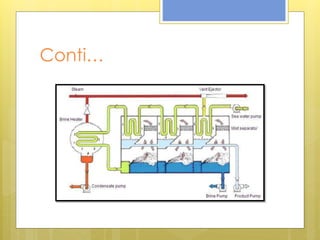
Multi-stage flash process
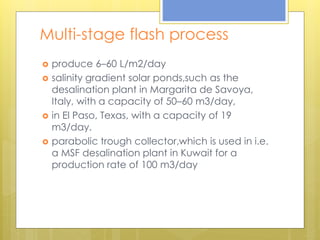
 produce 6–60 L/m2/day
 salinity gradient solar ponds,such as the
desalination plant in Margarita de Savoya,
Italy, with a capacity of 50–60 m3/day,
 in El Paso, Texas, with a capacity of 19
m3/day.
 parabolic trough collector,which is used in i.e.
a MSF desalination plant in Kuwait for a
production rate of 100 m3/day
Conti…
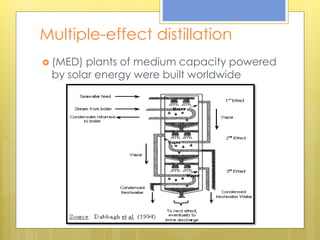
Multiple-effect distillation
 (MED) plants of medium capacity powered
by solar energy were built worldwide
Freezing
 demonstration projects have been built to
date.
 lower theoretical energy requirement
 Minimal potential for corrosion
 little scaling or precipitation.
 handling ice and water mixtures that are
mechanically complex to move and process
 Vacuum freezing vapor compression
 vacuum-freezing ejector-absorption
 refrigeration freezing
 secondary refrigerant.
Summary
 Solar energy coupled to desalination
offers a promising prospect for covering
the fundamental needs of power and
water in remote regions
 Solar desalination processes direct and
indirect collection systems.
References
 Y.B.Karhe, Dr. P.V.Walke, A Solar Desalination System Using
Humidification-Dehumidification Process- A Review of
Recent Research, International Journal of Modern
Engineering Research (IJMER) Vol.3, Issue.2, March-April.
2013 pp-962-969
 Hazim Mohameed Qiblawey*, Fawzi Banat, Solar thermal
desalination technologies, Desalination 220 (2008) 633–644
 Pascale Compaina, Solar Energy for Water desalination,
Procedia Engineering 46 ( 2012 ) 220 – 227
Thank you

Solar desalination

  • 1.
    SOLAR DESALINATION TARUN B PATEL MEENERGY GEC VALSAD 140190739009 GUIDED BY - PROF- M M MADHIKAR
  • 2.
    contents  INTRODUCTION  CONVENTIONALDESALINATION TECHNOLOGIES  SOLAR DESALINATION  SOLAR TECHNOLOGIES  DIRECT SOLAR DESALINATION  IN DIRECT SOLAR DESALINATION
  • 3.
     INTRODUCTION  Desalinationinvolves any process in which dissolved minerals are removed from saline or brackish water.  challenges for the world in the future  shortage of energy  shortage of fresh water
  • 4.
     Conventional Desalination Technologies large-scale,  technology intensive suitable for the energy rich and economically advanced regions.  cause environmental hazard( fossil-fuel driven)  problem of brine disposal  Desalination processes.  Phase-change processes  Multi-stage flash (MSF)  Multiple effect distillation (MED)  Vapor compression (VC)  Membrane processes  Reverse osmosis (RO)  Electrodialysis (ED)
  • 5.
    Conclusions of Conventional DesalinationSystem  the process efficiency is drastically reduced  the required size of a condenser or other drying units will be large  require detailed design of some special equipment
  • 6.
     Solar desalination Solar desalination is a technique to desalinate water using solar energy.  Direct  use solar energy to produce distillate directly in the solar collector  Requires large land areas and has a relatively low productivity  Indirect  combining conventional desalination techniques  small-scale production due to its relatively low cost and simplicity
  • 7.
     Solar technologies Different solar energy collectors used in order to convert solar energy to thermal energy  In most of them, a fluid is heated by the solar radiation as it circulates along the solar collector through an absorber pipe.  This heat transfer fluid is usually water or synthetic oil.  The fluid heated at the solar collector field may be either stored at an insulated tank or used to heat another thermal storage medium.  The solar collector may be a static or sun tracking device.
  • 8.
    Conti…  The solarcollectors suitable for seawater distillation. Salinity-gradient solar ponds Flat-plate collector Evacuated tube collector Parabolic trough collector
  • 9.
     Direct solardesalination  suited for small production systems(solar still)  regions where the freshwater demand is less than 200 m3/day  The simple solar still of the basin type is the oldest method  improvements in its design have been made to increase its efficiency
  • 10.
  • 11.
    Modifications using passive methods Basin stills  Wick stills  Diffusion stills  Solar still greenhouse combination  Multiple-effect basin stills  Externally heated (active) solar stills
  • 12.
    Basin stills  Theoperating performance of a simple basin type passive still can be augmented by several techniques Single slope vs. double slope basin stills Still with cover cooling Still with additional condenser Still with black dye
  • 13.
  • 14.
  • 15.
    Wick stills  thefeed water flows slowly through a porous, radiation-absorbing pad (the wick). the wick can be tilted so that the feed water presents a better angle to the sun less feed water is in the still at any time and so the water is heated more quickly and to a higher temperature. tilted wick type solar still increase in productivity by 20–50%
  • 16.
  • 17.
    Diffusion stills  Diffusionsolar stills are comprised of two separate units.  One is a hot storage tank, coupled to a solar collector  the other is the distillation unit, which produces the distilled water.
  • 18.
    Solar still greenhouse combination Integrated design of greenhouses combined with solar stills represents an interesting possibility for the development of small-scale cultivation in places where only saline water or brackish water is available
  • 19.
  • 20.
    Multiple-effect basin stills two or more compartments  The condensing surface of the lower compartment is the floor of the upper compartment.  The heat given off by the condensing vapor provides energy to vaporize the feed water above.  more productive due to the reuse of latent heat of condensation  Increased efficiency around 35%  Cost and complexity higher
  • 21.
    Externally heated (active) solarstills  The temperature of saline water in the basin can be increased through additional (external heating).  For this purpose the still is integrated with  solar heater  solar concentrator  waste heat recovery system.  natural circulation (Thermosyphon) or forced circulation (pump).
  • 22.
     Water desalinationwith humidification–dehumidification (HD)  the still performance is negatively affected by the direct contact between the collector and the saline water  Cause corrosion and scaling in the still  reduce the thermal efficiency  In HDD air is used as a working fluid, which eliminates this problem.
  • 23.
  • 24.
  • 25.
  • 26.
    Conti…  operates onthe principle of mass diffusion  utilizes dry air to evaporate saline water, thus humidifying the air.  low pressure,low temperature desalination  can operate off of waste heat
  • 27.
     Indirect solardesalination  Multi-stage flash process  Multiple-effect distillation  Freezing
  • 28.
    Multi-stage flash process produce 6–60 L/m2/day  salinity gradient solar ponds,such as the desalination plant in Margarita de Savoya, Italy, with a capacity of 50–60 m3/day,  in El Paso, Texas, with a capacity of 19 m3/day.  parabolic trough collector,which is used in i.e. a MSF desalination plant in Kuwait for a production rate of 100 m3/day
  • 29.
  • 30.
    Multiple-effect distillation  (MED)plants of medium capacity powered by solar energy were built worldwide
  • 31.
    Freezing  demonstration projectshave been built to date.  lower theoretical energy requirement  Minimal potential for corrosion  little scaling or precipitation.  handling ice and water mixtures that are mechanically complex to move and process  Vacuum freezing vapor compression  vacuum-freezing ejector-absorption  refrigeration freezing  secondary refrigerant.
  • 32.
    Summary  Solar energycoupled to desalination offers a promising prospect for covering the fundamental needs of power and water in remote regions  Solar desalination processes direct and indirect collection systems.
  • 33.
    References  Y.B.Karhe, Dr.P.V.Walke, A Solar Desalination System Using Humidification-Dehumidification Process- A Review of Recent Research, International Journal of Modern Engineering Research (IJMER) Vol.3, Issue.2, March-April. 2013 pp-962-969  Hazim Mohameed Qiblawey*, Fawzi Banat, Solar thermal desalination technologies, Desalination 220 (2008) 633–644  Pascale Compaina, Solar Energy for Water desalination, Procedia Engineering 46 ( 2012 ) 220 – 227
  • 34.

Editor's Notes

  • #3 Desalination is one of mankind’s earliest forms of water treatment, and it is still a popular treatment solution throughout the world today. In nature, solar desalination produces rain when solar radiation is absorbed by the sea and causes water to evaporate. The evaporated water rises above the surface and is moved by the wind. Once this vapor . cools down to its dew point, condensation occurs, and the freshwater comes down as rain. This basic process is responsible for the hydrologic cycle. This same principle is used in all man-made distillation systems using alternative sources of heating and cooling.
  • #4 Desalination uses a large amount of energy to remove a portion of pure water from a salt water source. Salt water (feed water) is fed into the process, and the result is one output stream of pure water and another of wastewater with a high salt concentration.
  • #5 It has been estimated by Kalogirou [23] that the production of 1000 m3 per day of freshwater requires 10,000 tons of oil per year. Large commercial desalination plants using fossil fuel are in use in a number of oil-rich countries to supplement the traditional sources of water supply. People in many other areas of the world have neither the money nor oil resources to allow them to develop on a similar manner. Problems relevant to the use of fossil fuels, in part, could be resolved by considering possible utilization of renewable resources such as solar, biomass, wind, or geothermal energy. It often happens that the geographical areas where water is needed are well gifted with renewable energy sources (RES). Thus, the obvious way is to combine those renewable energy sources to a desalination plant, in order to provide water resources as required. The World Health Organization estimates that over a billion people lack access to purified drinking water and the vast majority of these people are living in rural areas where the low population density and remote locations make it very difficult to install the traditional clean water solutions.
  • #7 Solar energy can directly or indirectly be harnessed for desalination. Collection systems that use solar energy to produce distillate directly in the solar collector are called direct collection systems whereas systems that combine solar energy collection systems with conventional desalination systems are called indirect systems. In indirect systems, solar energy is used either to generate the heat required for desalination and/or to generate electricity that is used to provide the required electric power for conventional desalination plants such as multi-effect (ME), multi-stage flash (MSF) or reverse osmosis (RO) systems
  • #11 A solar still is a simple device which can be used to convert saline, brackish water into drinking water. Solar stills use exactly the same processes which in nature generate rainfall, namely evaporation and condensation Its function is very simple; basically a transparent cover encloses a pan of saline water. The latter traps solar energy within the enclosure. This heats up the water causing evaporation and condensation on the inner face of the sloping transparent cover. This distilled water is generally potable; the quality of the distillate is very high because all the salts, inorganic and organic components and microbes are left behind in the bath. In order to evaporate 1 kg of water at a temperature of 30°C about 2.4 × 10⁶ J is required. single-effect solar stills have an efficiency of about 30–40% Material selection for solar stills is very important. The cover can be either glass or plastic.Glass is considered to be best for most long-term applications, whereas a plastic One of the main setbacks for this type of desalination plant is the low thermal efficiency and productivity. This could be improved by various passive and active methods.
  • #12 The solar still integrated with a heater or solar concentrator panel is generally referred to as an active solar distillation while others are referred to as passive stills. Passive solar distillation is an attractive process for saline water desalination in that the process can be self-operating, of simple construction and relatively maintenance free. These advantages of simple passive solar stills however,are offset by the low amounts of freshwater produced, approximately 2 L/m2 for the simple basin type solar still [41] and for the need for regular flushing of accumulated salts [24].
  • #13 Single slope still gave better performance than a double slope still under cold climatic conditions while the opposite is true under summer climaticConditions Increasing the temperature difference between the basin (heat source) and the cover (heat sink) lead to increase the water evaporation rate [20]. In stills with cover cooling, cooling water or saline solution is fed in the gap of a double glass cover to maximize the temperature difference. The cost, as such,is increased. adding a passive condenser in the shaded region of a single slopped still increases the still efficiency by 45%. Injecting black dye in the seawater increases the distillate yield
  • #15 The operating performance of a simple basin type passive still can be augmented by several techniques such as
  • #25 The HD process is based on the fact that air can be mixed with significant quantities of vapor. The vapor carrying capability of air increases with temperature, i.e. 1 kg of dry air can carry 0.5 kg of vapor and about 670 kcal when its temperature increases from 30 to 80°C. Freshwater is produced by condensing out the water vapor, which results in dehumidification of the air. The Humidification-Dehumidification (HDH) process presents a very interesting solution for small units (hotels, rural regions, light industry, etc.), especially when new materials are used. The process is very convenient in cases where heat is available at low temperature at an attractive cost
  • #27 The HD process is based on the fact that air can be mixed with significant quantities of vapor.The vapor carrying capability of air increases with temperature, i.e. 1 kg of dry air can carry 0.5 kg of vapor and about 670 kcal when its temperature increases from 30 to 80°C.
  • #29 Several medium scale plants for MSF desalination using solar energy have recently been implemented.
  • #31 It was a tower with series of flat trays for effects and used a flat plate solar collector with oil as a heating medium for thermal energy. Oil is circulated by natural convection between the solar collector and the first effect. The vapor from the first stage condenses at the bottom wall of the second stage, releasing its latent heat. The condensed water moves through a channel to be collected outside the unit
  • #32 proposed method for desalination for several decades, only The concept is appealing in theory because the minimum thermodynamic energy required for freezing is less than for evaporation since the latent heat of fusion of water is 6.01 kJ/mole while the latent heat of vaporization at 100°C is 40.66 kJ/mole.