Duration: 60 min DPT Medical Physics Lecture 01
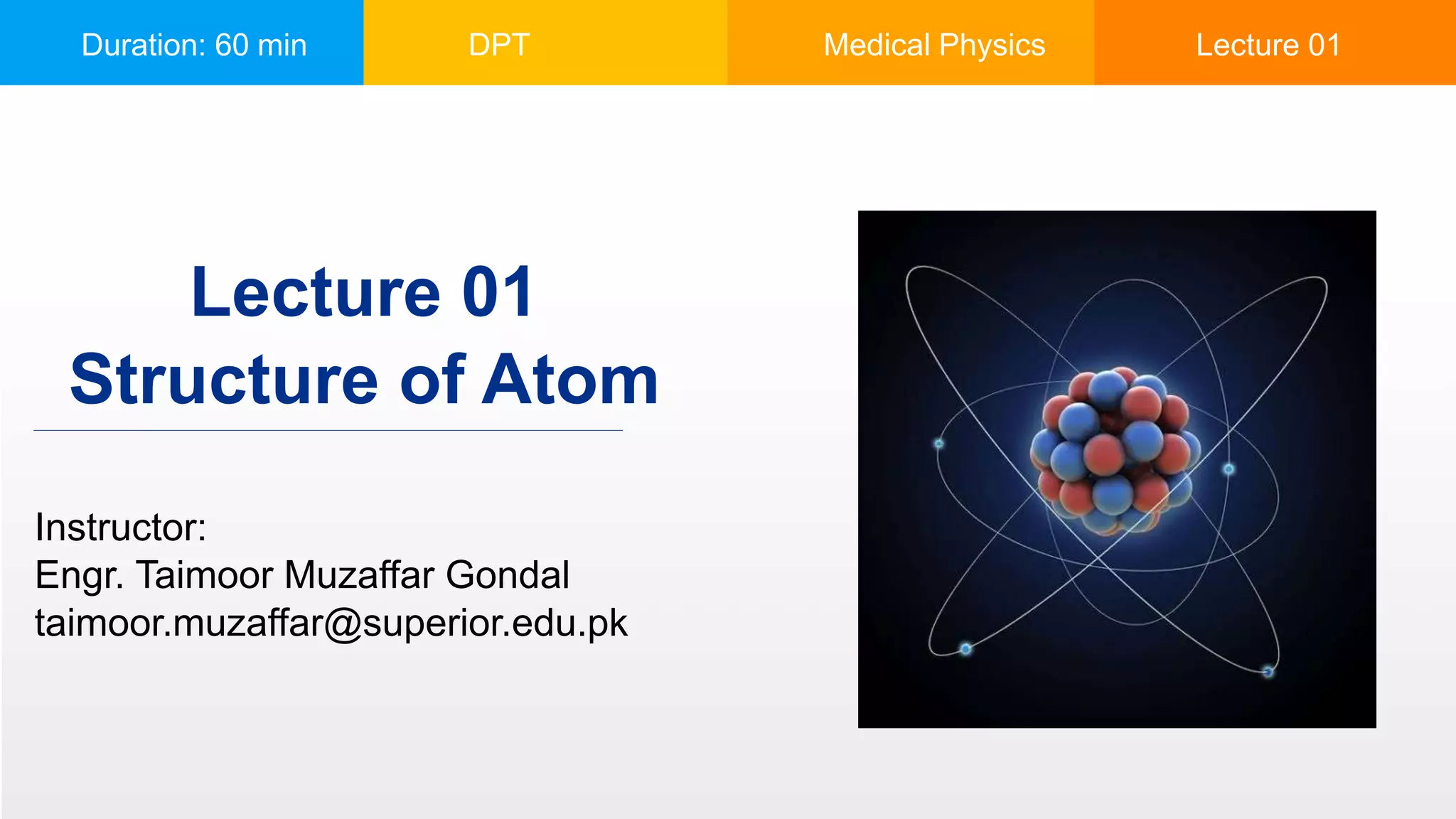
Structure of Atom
Instructor:
Engr. Taimoor Muzaffar Gondal
taimoor.muzaffar@superior.edu.pk
Lecture 01
Duration: 60 min DPT Medical Physics Lecture 01
Physics
• Fundamental Science
• Concerned with the fundamental principles of the Universe
• Foundation of other physical sciences
• Has simplicity of fundamental concepts
Divided into six major areas:
• Classical Mechanics
• Relativity
• Thermodynamics
• Electromagnetism
• Optics
• Quantum Mechanics
Duration: 60 min DPT Medical Physics Lecture 01
Medical Physics
• Medical Physics is defined as the application of physics to the needs of
medicine
Aims of the Medical physics
• Application of the concepts and methods of physics to understanding the
function of human body in health and disease
Duration: 60 min DPT Medical Physics Lecture 01
Application of physics in medicine
Medical physics Techniques are used for
i. Diagnostic:
• Stethoscope
• Manometer (blood pressure)
• Sphygmomanometer
• Electrocardiograph(ECG),
• X- Ray,
• Electroencephalograph(EEG), Electromyography (EMG)
thyroid function using I¹³¹
Duration: 60 min DPT Medical Physics Lecture 01
Application of physics in medicine
i. Diagnostic:
• Thyroid function using I¹³¹
• Computer tomography (CT scan ),
• Ultrasound, tuning Fork,
• Magnetic Resonance Imaging (MRI),
• Flow meter, Spirometer to study the function lungs,
• Audiometer,
• Optics, Laser, Gamma camera to study the function of kidney, liver, and
lungs
Duration: 60 min DPT Medical Physics Lecture 01
Application of physics in medicine
• ii. Therapy
• Radiotherapy
• Cobalt sixty( Co sixty )
• High voltage
• Ultrasound
• infrared
• Radio frequency
• Heating
• Laser
iii. Patient monitoring
ECG, spirometer, blood pressure, and thermometer.
Duration: 60 min DPT Medical Physics Lecture 01
Atomic Structure
All matter is composed of atoms.
Understanding the structure of atoms is critical to understanding the
properties of matter
Duration: 60 min DPT Medical Physics Lecture 01
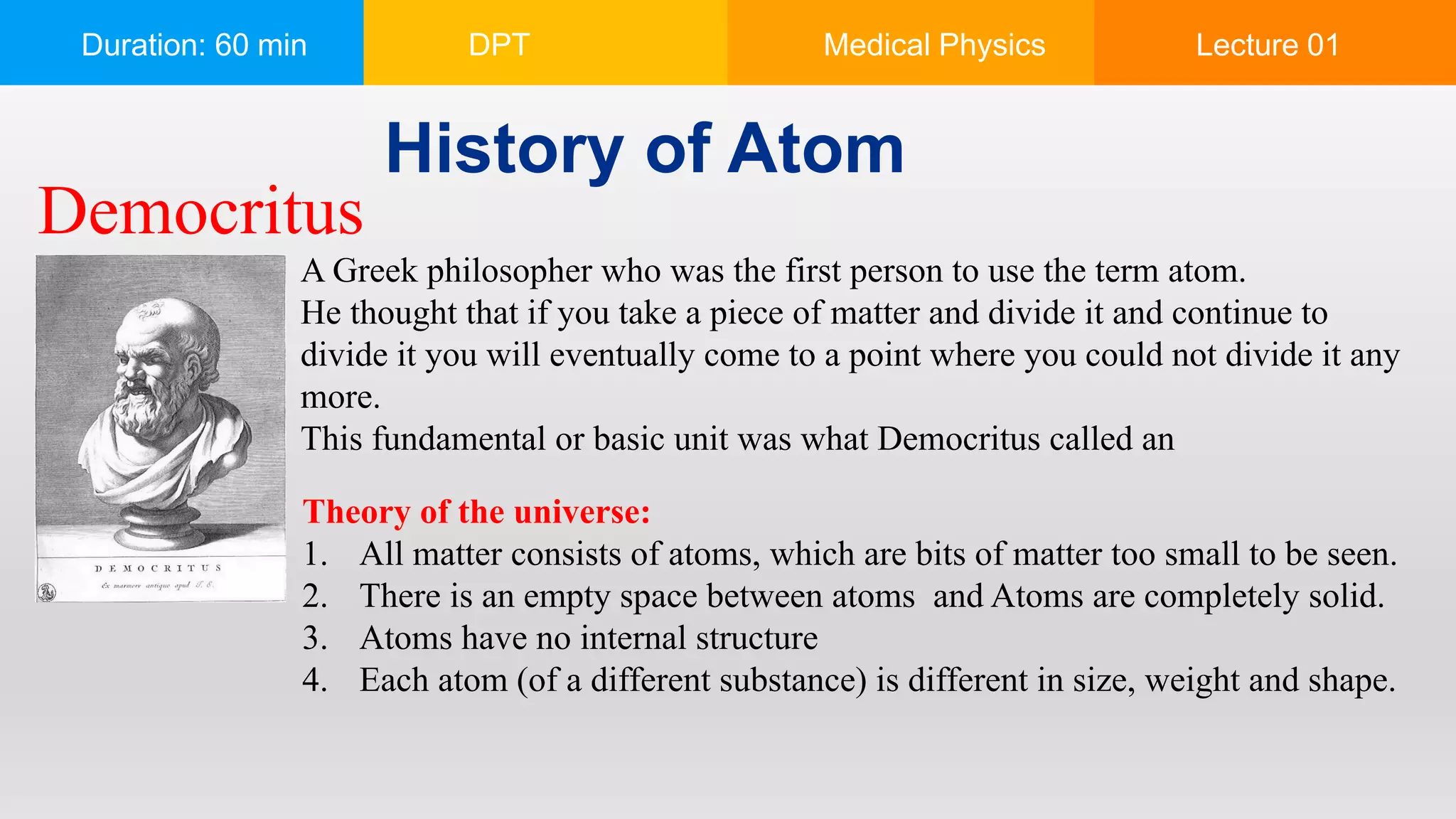
History of Atom
A Greek philosopher who was the first person to use the term atom.
He thought that if you take a piece of matter and divide it and continue to
divide it you will eventually come to a point where you could not divide it any
more.
This fundamental or basic unit was what Democritus called an
Theory of the universe:
1. All matter consists of atoms, which are bits of matter too small to be seen.
2. There is an empty space between atoms and Atoms are completely solid.
3. Atoms have no internal structure
4. Each atom (of a different substance) is different in size, weight and shape.
Democritus
Duration: 60 min DPT Medical Physics Lecture 01
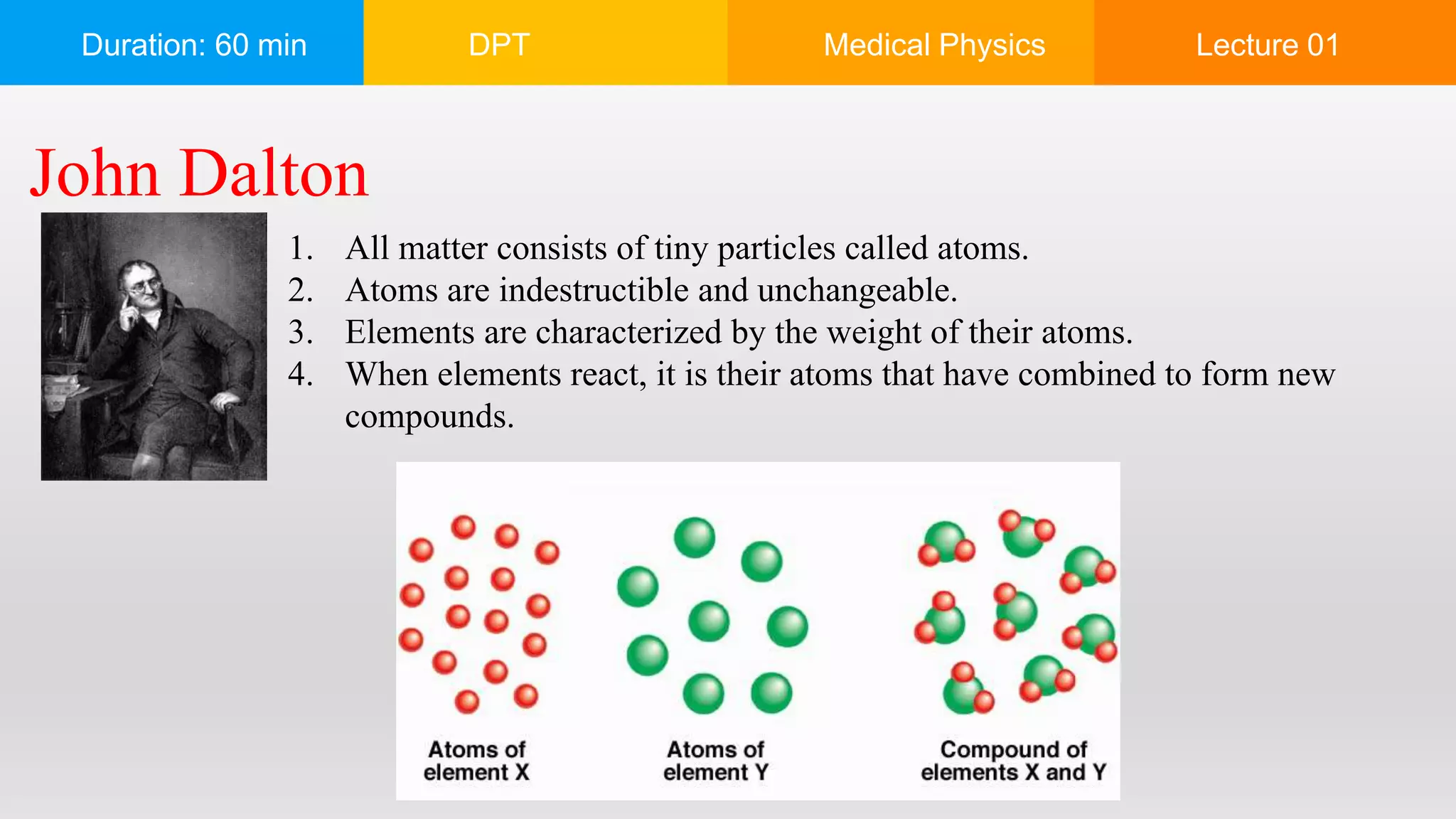
1. All matter consists of tiny particles called atoms.
2. Atoms are indestructible and unchangeable.
3. Elements are characterized by the weight of their atoms.
4. When elements react, it is their atoms that have combined to form new
compounds.
John Dalton
Duration: 60 min DPT Medical Physics Lecture 01
J.J. Thomson
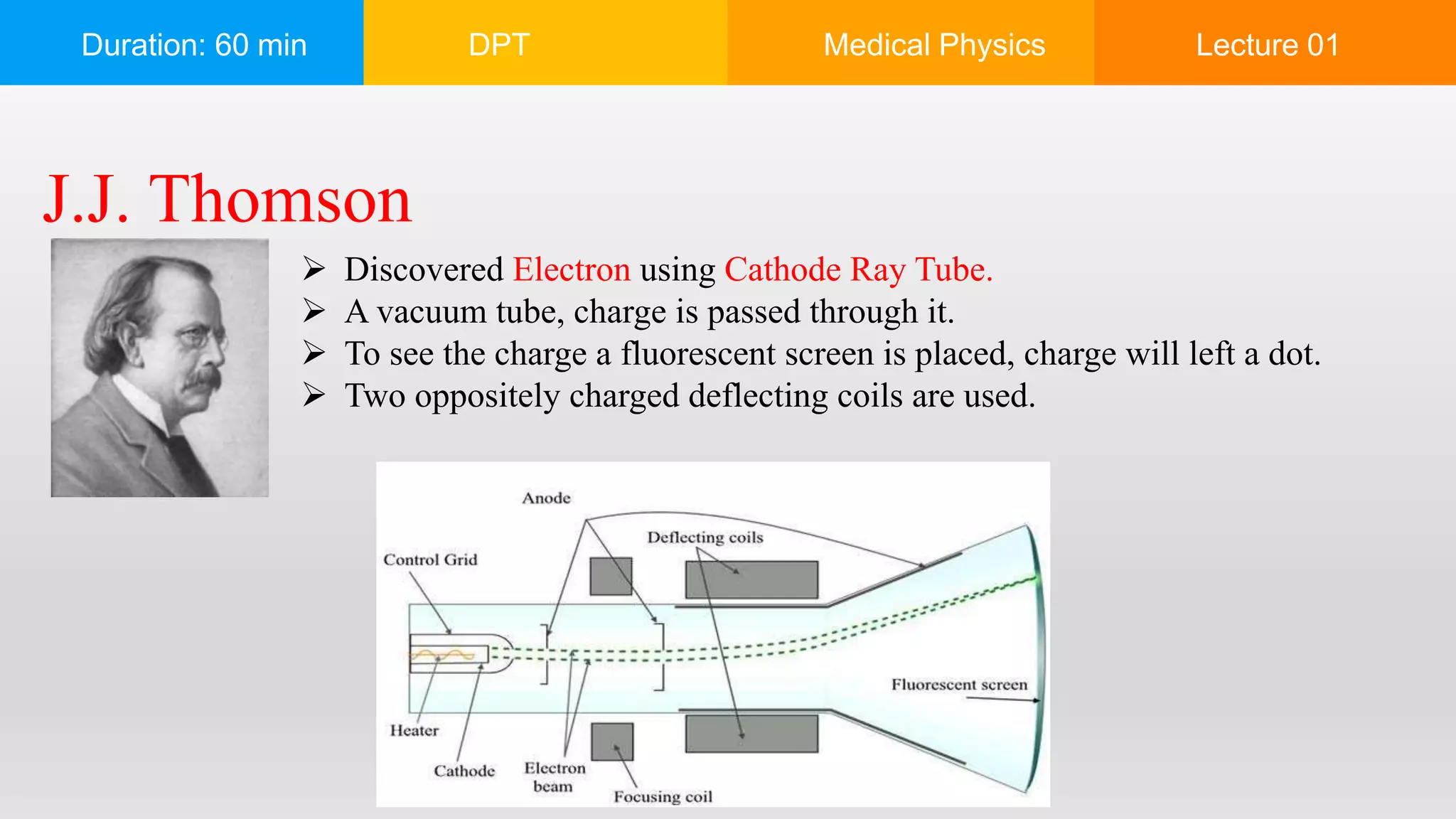
 Discovered Electron using Cathode Ray Tube.
 A vacuum tube, charge is passed through it.
 To see the charge a fluorescent screen is placed, charge will left a dot.
 Two oppositely charged deflecting coils are used.
Duration: 60 min DPT Medical Physics Lecture 01
 This beam will always travel straight if not interfered
 he deflection coils each have a specific charge. One is positive and the other
is negative.
 Thomson showed (as in the diagram above) that the charge would deflect
away from the negative coil.
 He then stated that this charge was thus a negative charge
 He did not predict the movement of these electrons.
 He predicted the mass of Electron and earned Nobel Prize in Physics.
Contd.
Duration: 60 min DPT Medical Physics Lecture 01
Ernest Rutherford
Gold Foil Experiment:
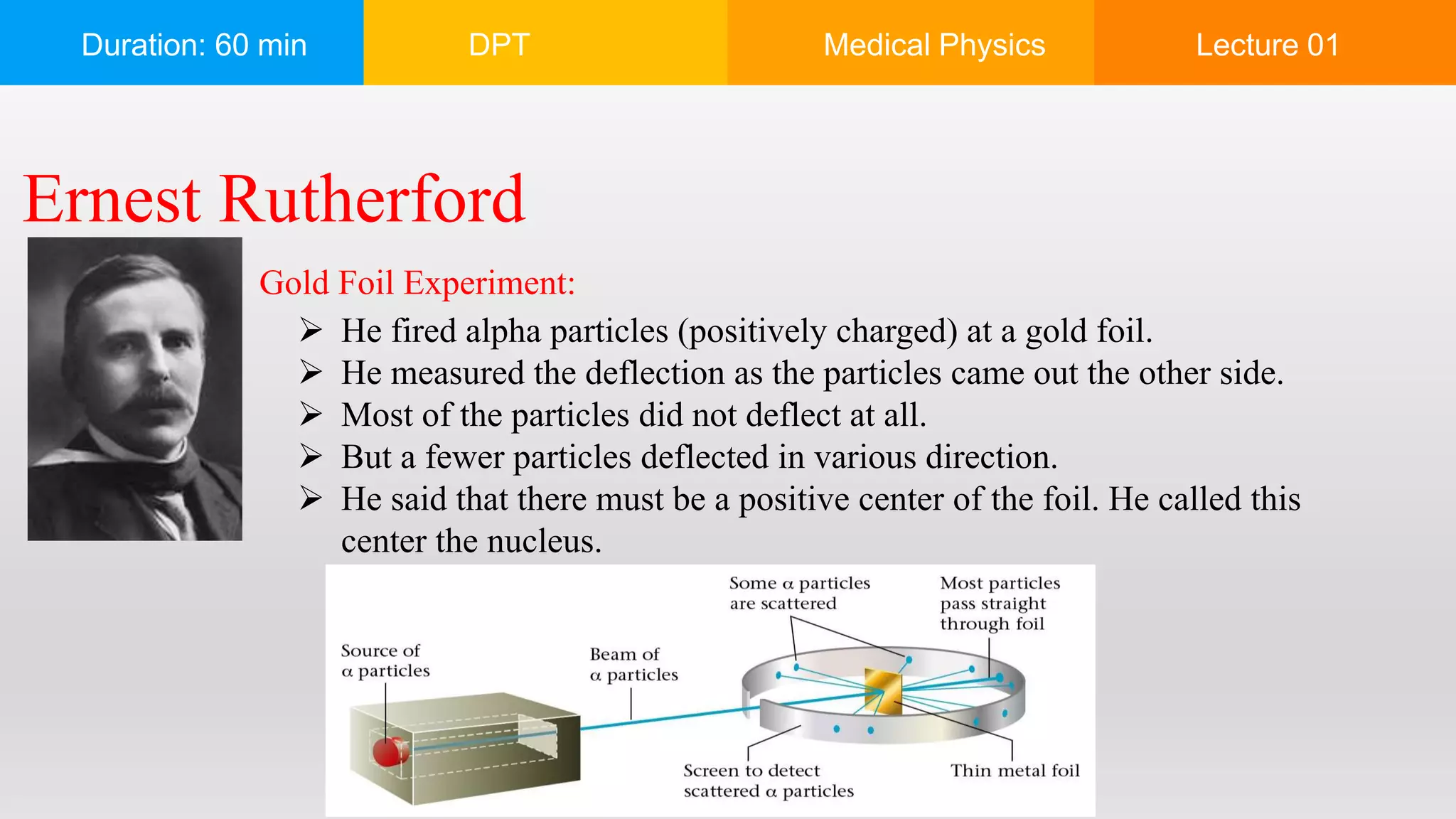
 He fired alpha particles (positively charged) at a gold foil.
 He measured the deflection as the particles came out the other side.
 Most of the particles did not deflect at all.
 But a fewer particles deflected in various direction.
 He said that there must be a positive center of the foil. He called this
center the nucleus.
Duration: 60 min DPT Medical Physics Lecture 01
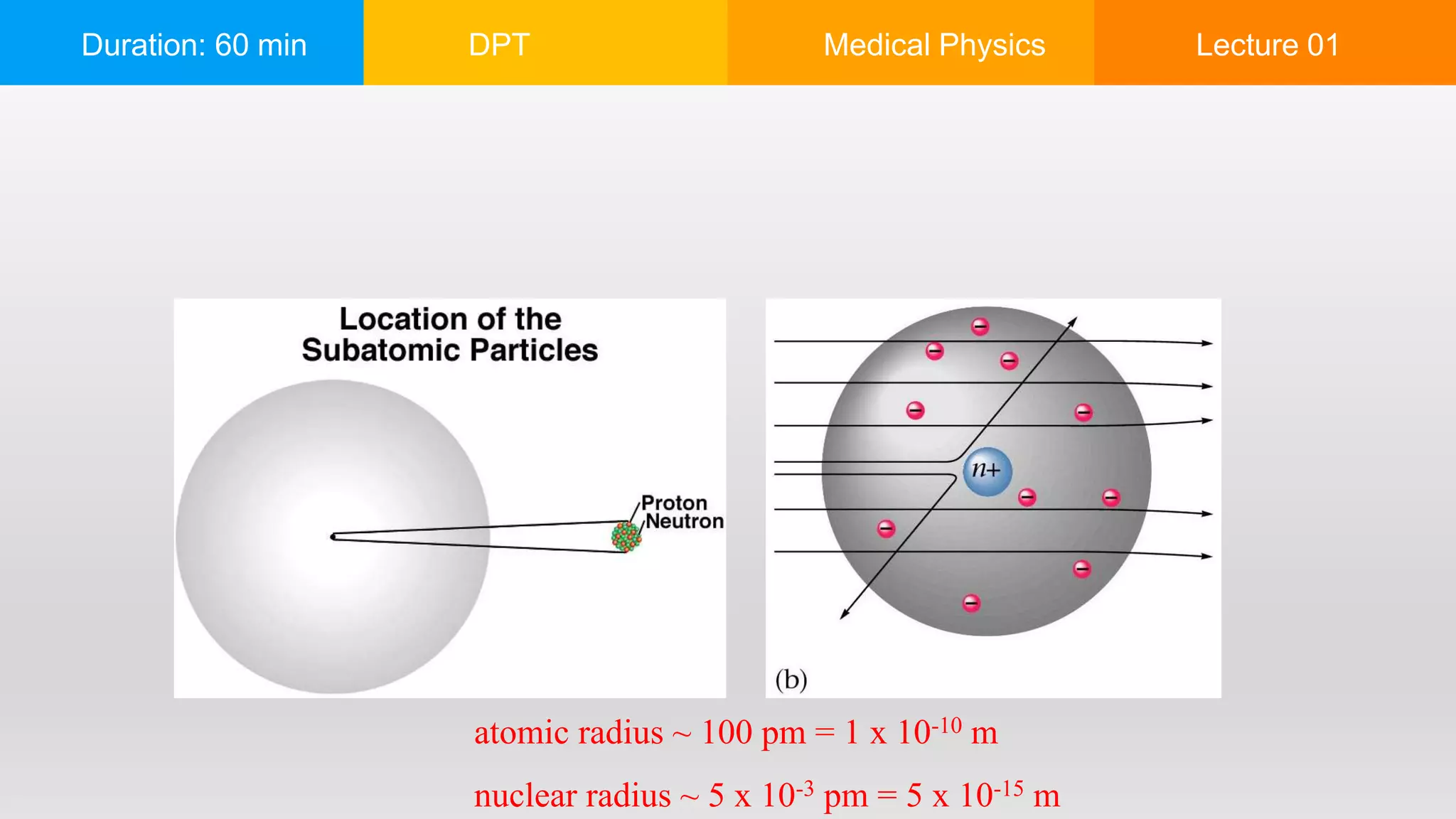
atomic radius ~ 100 pm = 1 x 10⁻¹⁰ m
nuclear radius ~ 5 x 10⁻³ pm = 5 x 10-15 m
Duration: 60 min DPT Medical Physics Lecture 01
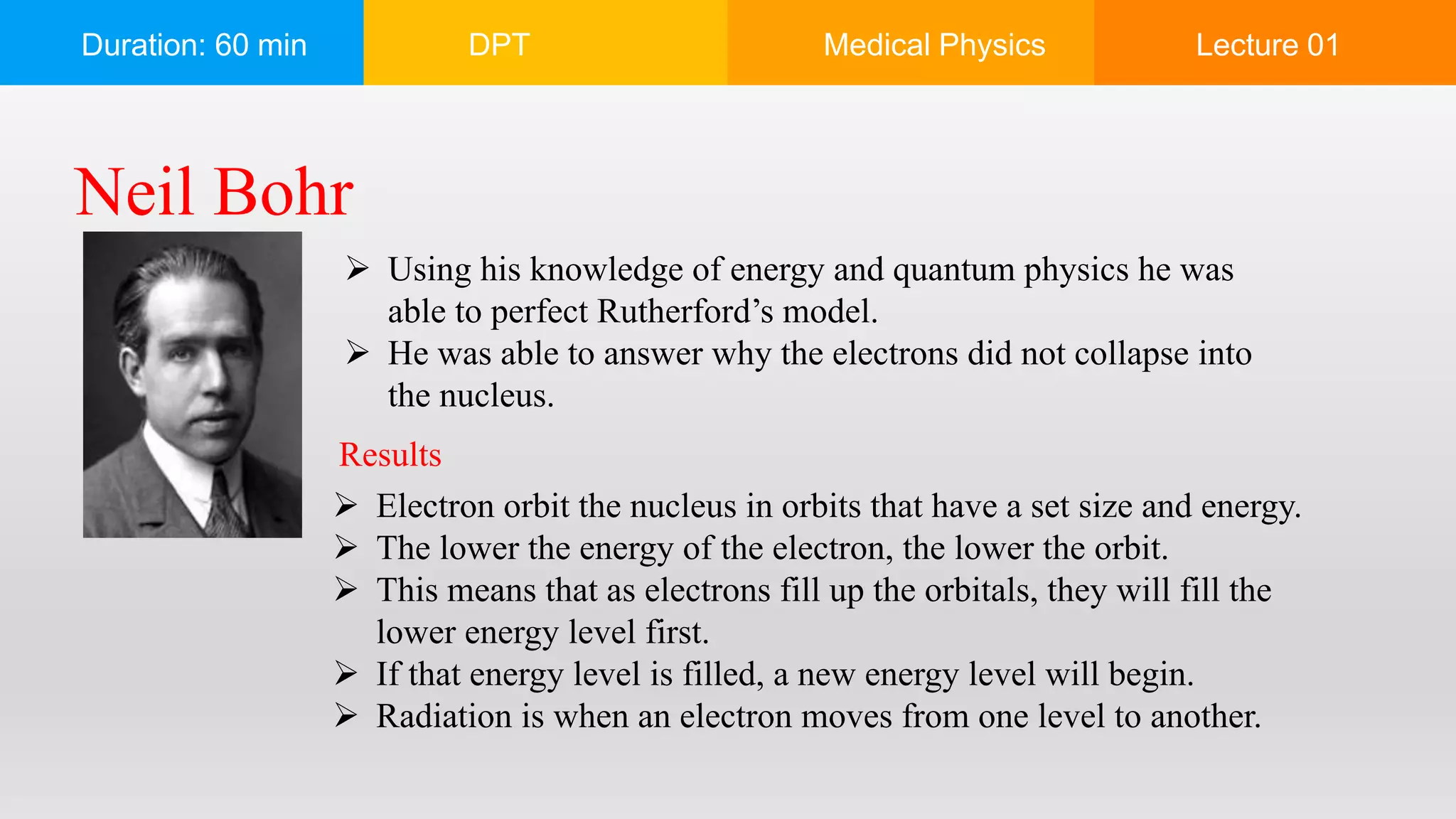
Neil Bohr
 Using his knowledge of energy and quantum physics he was
able to perfect Rutherford’s model.
 He was able to answer why the electrons did not collapse into
the nucleus.
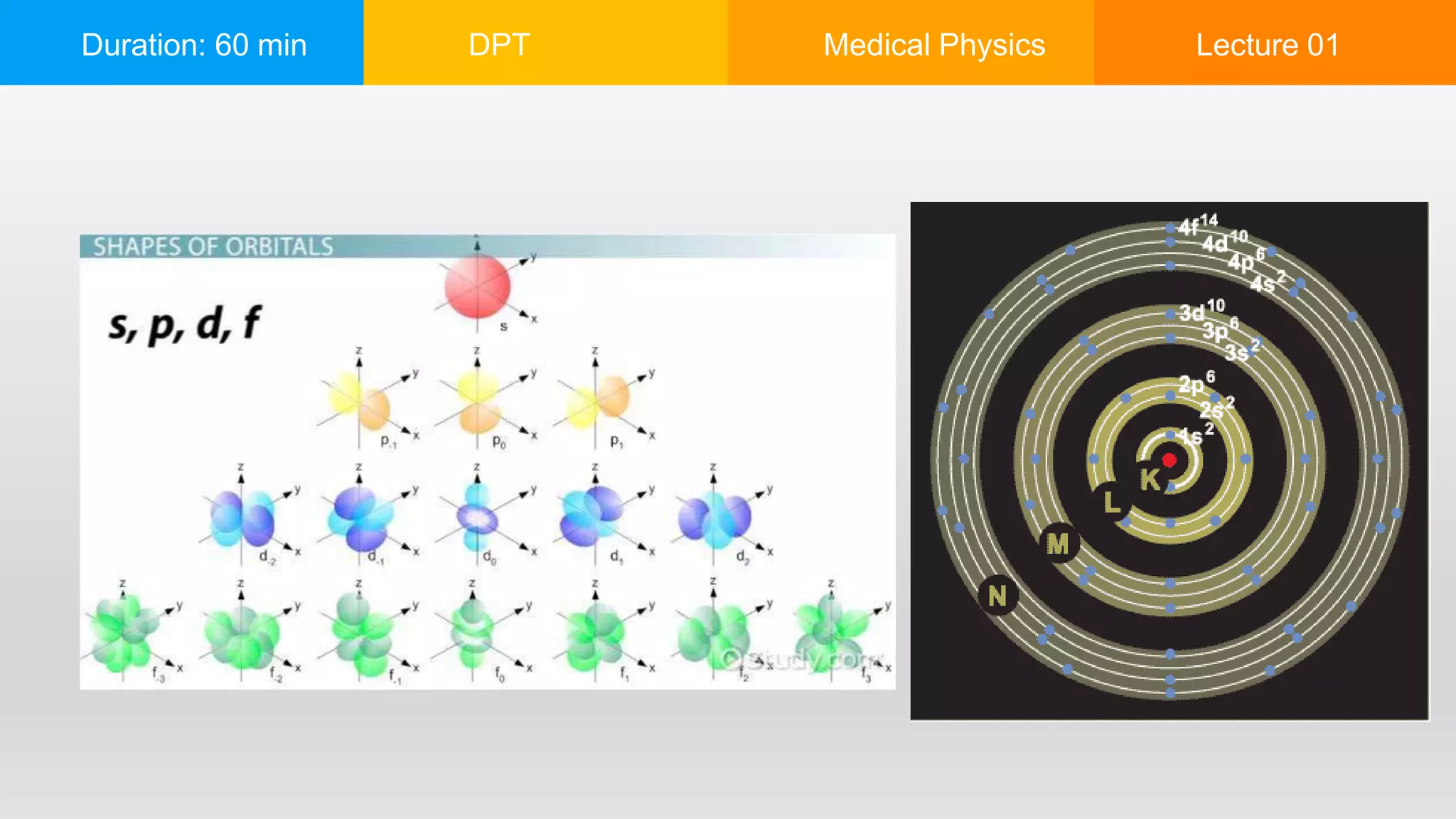
 Electron orbit the nucleus in orbits that have a set size and energy.
 The lower the energy of the electron, the lower the orbit.
 This means that as electrons fill up the orbitals, they will fill the
lower energy level first.
 If that energy level is filled, a new energy level will begin.
 Radiation is when an electron moves from one level to another.
Results
Duration: 60 min DPT Medical Physics Lecture 01
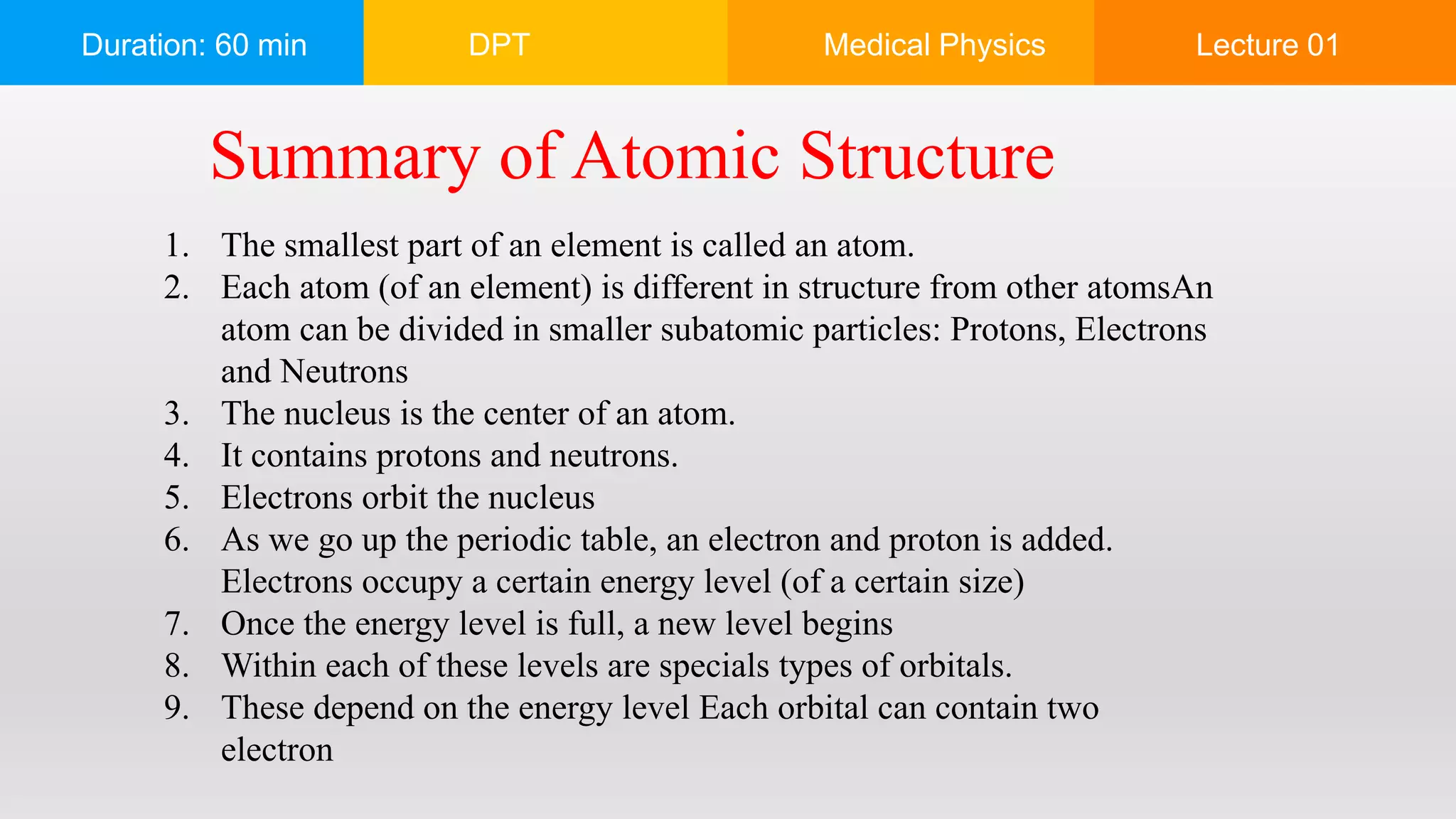
1. The smallest part of an element is called an atom.
2. Each atom (of an element) is different in structure from other atomsAn
atom can be divided in smaller subatomic particles: Protons, Electrons
and Neutrons
3. The nucleus is the center of an atom.
4. It contains protons and neutrons.
5. Electrons orbit the nucleus
6. As we go up the periodic table, an electron and proton is added.
Electrons occupy a certain energy level (of a certain size)
7. Once the energy level is full, a new level begins
8. Within each of these levels are specials types of orbitals.
9. These depend on the energy level Each orbital can contain two
electron
Summary of Atomic Structure
Duration: 60 min DPT Medical Physics Lecture 01
Conductors, Insulators and Semiconductor
The stability of the electrons in the outer ring determines whether a material made
from this element is a conductor, insulator, or semiconductor.
 Elements whose electrons are unstable and can easily move from one atom to
another make good conductors.
 Elements whose electrons are stable and can not easily move from one atom to
another make good insulators.
 Any elements that are not considered conductors or insulators are categorized
as semiconductors.
Duration: 60 min DPT Medical Physics Lecture 01
When an element’s outer electron ring is incomplete or not full, its electrons
can move more freely from one atom to another atom.
Elements whose electrons can move more freely make good conductors.
In general, most metals make good conductors because they only have one or
two electrons in their outer band.
Silver and gold are the best conductors. Copper is the second best conductor.
Most wiring uses copper wire because it is a good conductor and is less
expensive than the other metals.
Conductors
Duration: 60 min DPT Medical Physics Lecture 01
• When an element’s outer ring is complete, or full, its electrons can not
easily move from one atom to another atom.
• Elements whose electrons can not move freely make good insulators.
• Examples of good insulators are glass, plastic, rubber, paper, or air.
Most wiring uses plastic as an insulator.
• Plastics are polymers or long chains of atoms bonded to one another.
Viewing the atomic structure of plastics is far beyond the scope of this
class (If you are interested in such topics, you may want to take AP
Chemistry.).
• Neon and argon, both gases, are good insulators and are often used in
light bulbs.
Insulators
Duration: 60 min DPT Medical Physics Lecture 01
• When an element’s outer ring is neither complete nor incomplete, the
element is considered to be a semiconductor.
• Examples of good semiconductor materials are
• Carbon (used to make resistors)
• Silicon (used to make transistors)
Semi Conductors
Duration: 60 min DPT Medical Physics Lecture 01
• When an element’s outer ring is complete, or full, its electrons can not
easily move from one atom to another atom.
• Elements whose electrons can not move freely make good insulators.
• Examples of good insulators are glass, plastic, rubber, paper, or air.
Most wiring uses plastic as an insulator.
• Plastics are polymers or long chains of atoms bonded to one another.
Viewing the atomic structure of plastics is far beyond the scope of this
class (If you are interested in such topics, you may want to take AP
Chemistry.).
• Neon and argon, both gases, are good insulators and are often used in
light bulbs.
Insulators
Duration: 60 min DPT Medical Physics Lecture 01
End of Lecture 01
For any kind of queries and questions you are advised to
write at
taimoor.muzaffar@superior.edu.pk
Or visit my office during consulting hours
This lectures can also be downloaded from
https://www.slideshare.net/Taimoor_Gondal

Updated Lecture 01- History of Atom

  • 1.
    Duration: 60 minDPT Medical Physics Lecture 01 Structure of Atom Instructor: Engr. Taimoor Muzaffar Gondal taimoor.muzaffar@superior.edu.pk Lecture 01
  • 2.
    Duration: 60 minDPT Medical Physics Lecture 01 Physics • Fundamental Science • Concerned with the fundamental principles of the Universe • Foundation of other physical sciences • Has simplicity of fundamental concepts Divided into six major areas: • Classical Mechanics • Relativity • Thermodynamics • Electromagnetism • Optics • Quantum Mechanics
  • 3.
    Duration: 60 minDPT Medical Physics Lecture 01 Medical Physics • Medical Physics is defined as the application of physics to the needs of medicine Aims of the Medical physics • Application of the concepts and methods of physics to understanding the function of human body in health and disease
  • 4.
    Duration: 60 minDPT Medical Physics Lecture 01 Application of physics in medicine Medical physics Techniques are used for i. Diagnostic: • Stethoscope • Manometer (blood pressure) • Sphygmomanometer • Electrocardiograph(ECG), • X- Ray, • Electroencephalograph(EEG), Electromyography (EMG) thyroid function using I¹³¹
  • 5.
    Duration: 60 minDPT Medical Physics Lecture 01 Application of physics in medicine i. Diagnostic: • Thyroid function using I¹³¹ • Computer tomography (CT scan ), • Ultrasound, tuning Fork, • Magnetic Resonance Imaging (MRI), • Flow meter, Spirometer to study the function lungs, • Audiometer, • Optics, Laser, Gamma camera to study the function of kidney, liver, and lungs
  • 6.
    Duration: 60 minDPT Medical Physics Lecture 01 Application of physics in medicine • ii. Therapy • Radiotherapy • Cobalt sixty( Co sixty ) • High voltage • Ultrasound • infrared • Radio frequency • Heating • Laser iii. Patient monitoring ECG, spirometer, blood pressure, and thermometer.
  • 7.
    Duration: 60 minDPT Medical Physics Lecture 01 Atomic Structure All matter is composed of atoms. Understanding the structure of atoms is critical to understanding the properties of matter
  • 8.
    Duration: 60 minDPT Medical Physics Lecture 01 History of Atom A Greek philosopher who was the first person to use the term atom. He thought that if you take a piece of matter and divide it and continue to divide it you will eventually come to a point where you could not divide it any more. This fundamental or basic unit was what Democritus called an Theory of the universe: 1. All matter consists of atoms, which are bits of matter too small to be seen. 2. There is an empty space between atoms and Atoms are completely solid. 3. Atoms have no internal structure 4. Each atom (of a different substance) is different in size, weight and shape. Democritus
  • 9.
    Duration: 60 minDPT Medical Physics Lecture 01 1. All matter consists of tiny particles called atoms. 2. Atoms are indestructible and unchangeable. 3. Elements are characterized by the weight of their atoms. 4. When elements react, it is their atoms that have combined to form new compounds. John Dalton
  • 10.
    Duration: 60 minDPT Medical Physics Lecture 01 J.J. Thomson  Discovered Electron using Cathode Ray Tube.  A vacuum tube, charge is passed through it.  To see the charge a fluorescent screen is placed, charge will left a dot.  Two oppositely charged deflecting coils are used.
  • 11.
    Duration: 60 minDPT Medical Physics Lecture 01  This beam will always travel straight if not interfered  he deflection coils each have a specific charge. One is positive and the other is negative.  Thomson showed (as in the diagram above) that the charge would deflect away from the negative coil.  He then stated that this charge was thus a negative charge  He did not predict the movement of these electrons.  He predicted the mass of Electron and earned Nobel Prize in Physics. Contd.
  • 12.
    Duration: 60 minDPT Medical Physics Lecture 01 Ernest Rutherford Gold Foil Experiment:  He fired alpha particles (positively charged) at a gold foil.  He measured the deflection as the particles came out the other side.  Most of the particles did not deflect at all.  But a fewer particles deflected in various direction.  He said that there must be a positive center of the foil. He called this center the nucleus.
  • 13.
    Duration: 60 minDPT Medical Physics Lecture 01 atomic radius ~ 100 pm = 1 x 10⁻¹⁰ m nuclear radius ~ 5 x 10⁻³ pm = 5 x 10-15 m
  • 14.
    Duration: 60 minDPT Medical Physics Lecture 01 Neil Bohr  Using his knowledge of energy and quantum physics he was able to perfect Rutherford’s model.  He was able to answer why the electrons did not collapse into the nucleus.  Electron orbit the nucleus in orbits that have a set size and energy.  The lower the energy of the electron, the lower the orbit.  This means that as electrons fill up the orbitals, they will fill the lower energy level first.  If that energy level is filled, a new energy level will begin.  Radiation is when an electron moves from one level to another. Results
  • 15.
    Duration: 60 minDPT Medical Physics Lecture 01
  • 16.
    Duration: 60 minDPT Medical Physics Lecture 01 1. The smallest part of an element is called an atom. 2. Each atom (of an element) is different in structure from other atomsAn atom can be divided in smaller subatomic particles: Protons, Electrons and Neutrons 3. The nucleus is the center of an atom. 4. It contains protons and neutrons. 5. Electrons orbit the nucleus 6. As we go up the periodic table, an electron and proton is added. Electrons occupy a certain energy level (of a certain size) 7. Once the energy level is full, a new level begins 8. Within each of these levels are specials types of orbitals. 9. These depend on the energy level Each orbital can contain two electron Summary of Atomic Structure
  • 17.
    Duration: 60 minDPT Medical Physics Lecture 01 Conductors, Insulators and Semiconductor The stability of the electrons in the outer ring determines whether a material made from this element is a conductor, insulator, or semiconductor.  Elements whose electrons are unstable and can easily move from one atom to another make good conductors.  Elements whose electrons are stable and can not easily move from one atom to another make good insulators.  Any elements that are not considered conductors or insulators are categorized as semiconductors.
  • 18.
    Duration: 60 minDPT Medical Physics Lecture 01 When an element’s outer electron ring is incomplete or not full, its electrons can move more freely from one atom to another atom. Elements whose electrons can move more freely make good conductors. In general, most metals make good conductors because they only have one or two electrons in their outer band. Silver and gold are the best conductors. Copper is the second best conductor. Most wiring uses copper wire because it is a good conductor and is less expensive than the other metals. Conductors
  • 19.
    Duration: 60 minDPT Medical Physics Lecture 01 • When an element’s outer ring is complete, or full, its electrons can not easily move from one atom to another atom. • Elements whose electrons can not move freely make good insulators. • Examples of good insulators are glass, plastic, rubber, paper, or air. Most wiring uses plastic as an insulator. • Plastics are polymers or long chains of atoms bonded to one another. Viewing the atomic structure of plastics is far beyond the scope of this class (If you are interested in such topics, you may want to take AP Chemistry.). • Neon and argon, both gases, are good insulators and are often used in light bulbs. Insulators
  • 20.
    Duration: 60 minDPT Medical Physics Lecture 01 • When an element’s outer ring is neither complete nor incomplete, the element is considered to be a semiconductor. • Examples of good semiconductor materials are • Carbon (used to make resistors) • Silicon (used to make transistors) Semi Conductors
  • 21.
    Duration: 60 minDPT Medical Physics Lecture 01 • When an element’s outer ring is complete, or full, its electrons can not easily move from one atom to another atom. • Elements whose electrons can not move freely make good insulators. • Examples of good insulators are glass, plastic, rubber, paper, or air. Most wiring uses plastic as an insulator. • Plastics are polymers or long chains of atoms bonded to one another. Viewing the atomic structure of plastics is far beyond the scope of this class (If you are interested in such topics, you may want to take AP Chemistry.). • Neon and argon, both gases, are good insulators and are often used in light bulbs. Insulators
  • 22.
    Duration: 60 minDPT Medical Physics Lecture 01 End of Lecture 01 For any kind of queries and questions you are advised to write at taimoor.muzaffar@superior.edu.pk Or visit my office during consulting hours This lectures can also be downloaded from https://www.slideshare.net/Taimoor_Gondal