Solar Atmospheres
Topics Chromosphere Corona Solar Wind Solar Magnetism Transition Zone and the Corona
Chromosphere ->emits very little light of its own. Can not be seen directly it is  pinkish blue due to H alpha emission lines. Can be seen at eclipses -> spicules- solar storms emitted leave atmosphere around 100km/h  and hit high above the photosphere. Near the edges of super granules Why? Magnetic field constructive interference
Corona and transition zone Corona- also seen only on eclipses when the moons angular size blocks the photosphere spectra changes from absorption to emission upper chromospheres temps are way hotter than photosphere corona is still hotter transition zone yields high temps, why is not clear.
Solar Wind escaping solar particles (protons and electrons) @500km/ hr what’s happening? *query, sun is constantly evaporating and losing mass- the high temps replenish the sun from below about 1million tons shed per second, less than .1 % since formation of the sun
Solar Magnetism sun spots have a magnetic profile 1000X greater than surrounding area flows from s- n pole of spot, Polarity reversed on southern hemisphere occur in pairs with opposite polarities. Light emitted by charged particles Solar magnetic field warped by equator (differentially rotates) and eventually wraps it and the result is a prominence
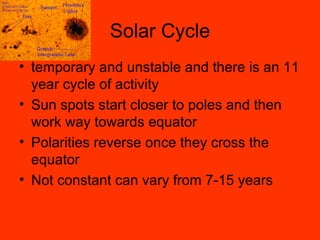
Solar Cycle temporary and unstable and there is an 11 year cycle of activity Sun spots start closer to poles and then work way towards equator Polarities reverse once they cross the equator  Not constant can vary from 7-15 years
Corona and the Solar Cycle corona heated by solar surface activity this injects large amounts of energy into the atmosphere fueled by small scale magnetic loops linked in time to the solar cycle

Solar atmospheres

  • 1.
  • 2.
    Topics Chromosphere CoronaSolar Wind Solar Magnetism Transition Zone and the Corona
  • 3.
    Chromosphere ->emits verylittle light of its own. Can not be seen directly it is pinkish blue due to H alpha emission lines. Can be seen at eclipses -> spicules- solar storms emitted leave atmosphere around 100km/h and hit high above the photosphere. Near the edges of super granules Why? Magnetic field constructive interference
  • 4.
    Corona and transitionzone Corona- also seen only on eclipses when the moons angular size blocks the photosphere spectra changes from absorption to emission upper chromospheres temps are way hotter than photosphere corona is still hotter transition zone yields high temps, why is not clear.
  • 5.
    Solar Wind escapingsolar particles (protons and electrons) @500km/ hr what’s happening? *query, sun is constantly evaporating and losing mass- the high temps replenish the sun from below about 1million tons shed per second, less than .1 % since formation of the sun
  • 6.
    Solar Magnetism sunspots have a magnetic profile 1000X greater than surrounding area flows from s- n pole of spot, Polarity reversed on southern hemisphere occur in pairs with opposite polarities. Light emitted by charged particles Solar magnetic field warped by equator (differentially rotates) and eventually wraps it and the result is a prominence
  • 7.
    Solar Cycle temporaryand unstable and there is an 11 year cycle of activity Sun spots start closer to poles and then work way towards equator Polarities reverse once they cross the equator Not constant can vary from 7-15 years
  • 8.
    Corona and theSolar Cycle corona heated by solar surface activity this injects large amounts of energy into the atmosphere fueled by small scale magnetic loops linked in time to the solar cycle