Vector Atom Model
Vector Atom Model
• Concept of Spatial quantisation
• Spinning of electron
Spatial Quantisation
• According to quantum theory, direction or
orientation of orbits in space should be
quantised in addition to the magnitude
• To specify the orientation of electron orbit in
space, a fixed reference axis is needed
• Reference line is chosen as the direction of
external magnetic field applied to the atom
• Projections of the quantised orbits on the field
direction must be quantised
• The direction of electron is restricted by quantum
mechanics is called space quantisation
• The axis of orbit may point only in a few
preferred directions. These directions are
determined by the direction of any external force
that may be acting on the atom like magnetic field
• Thus according to quantum theory both
magnitude and direction of the orbits are
quantised. The introduction of such a space
quantisation make the orbits vector quantities
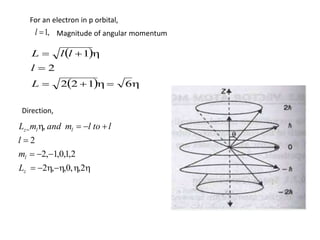
For an electron in p orbital,
,1l Magnitude of angular momentum
 
  

6122
2
1



L
l
llL
Direction,


2,,0,,2
2,1,0,1,2
2
,




z
l
llz
L
m
l
ltolmandmL
Spinning of electron
• Concept was introduced by Uhlenbeck and
Goudsmith in 1926
• Electron spins about its own axis and it also
moves around the nucleus of the atom
• Like the spinning of planet
• According to quantum theory,spin of electron
also should be quantised
• A new quantum number called spin quantum
number is introduced
• Orbital and spin motion are considered as
quantised vectors
• Atom model based on these quantised vectors
is called vector atom model
Spin endows electron with a spin angular
momentum and spin magnetic moment
Total angular momentum is the vector sum of
orbital angular momentum and spin angular
momentum
Total magnetic moment of the atom is the vector
sum of orbital and spin magnetic moments
s

Vector atom model

  • 1.
  • 2.
    Vector Atom Model •Concept of Spatial quantisation • Spinning of electron
  • 3.
    Spatial Quantisation • Accordingto quantum theory, direction or orientation of orbits in space should be quantised in addition to the magnitude • To specify the orientation of electron orbit in space, a fixed reference axis is needed • Reference line is chosen as the direction of external magnetic field applied to the atom • Projections of the quantised orbits on the field direction must be quantised
  • 4.
    • The directionof electron is restricted by quantum mechanics is called space quantisation • The axis of orbit may point only in a few preferred directions. These directions are determined by the direction of any external force that may be acting on the atom like magnetic field • Thus according to quantum theory both magnitude and direction of the orbits are quantised. The introduction of such a space quantisation make the orbits vector quantities
  • 5.
    For an electronin p orbital, ,1l Magnitude of angular momentum       6122 2 1    L l llL Direction,   2,,0,,2 2,1,0,1,2 2 ,     z l llz L m l ltolmandmL
  • 6.
    Spinning of electron •Concept was introduced by Uhlenbeck and Goudsmith in 1926 • Electron spins about its own axis and it also moves around the nucleus of the atom • Like the spinning of planet • According to quantum theory,spin of electron also should be quantised • A new quantum number called spin quantum number is introduced
  • 7.
    • Orbital andspin motion are considered as quantised vectors • Atom model based on these quantised vectors is called vector atom model Spin endows electron with a spin angular momentum and spin magnetic moment Total angular momentum is the vector sum of orbital angular momentum and spin angular momentum Total magnetic moment of the atom is the vector sum of orbital and spin magnetic moments s