By Aaron, Laria, and Nicholas
How do they work?
 Infrared telescopes by seeing infrared light and
  detecting what is around it by the heat that stars and
  celestial objects radiate.
 All objects radiate some heat unless they are at
  absolute zero. Depending on the telescope or used
  device it becomes different colors at certain intervals.
  For example black is the coldest and white is the
  hottest.
Why to we use infrared telescopes?
 Infrared radiation is heat. It is radiation in
  electromagnet that is at longer wavelengths then light
  we usually see with our naked eye. We can’t see it but
  we can feel it, for example on a sunny day.
 Infrared astronomy allows astronauts and
  astrophysicists the ability to measure the temperature
  of planetary bodies and stars and whatnot.
What do infrared telescopes need
to function properly?
 Infrared telescopes must be built to minimize the
  amount of heat generated by the telescope itself.
 Since infrared telescopes emit a ton of heat, they need
  to be shielded from the heat by people containing
  them (or at least the ground-based telescopes) by
  containing them in liquid nitrogen.
 Infrared telescopes need electricity to function at all.
 Infrared light reciever
Pros and Cons:
Pros                        Cons
 We can see how warm        Infrared telescopes need to be
  celestial objects are.      in a cold place if not
 Would be used to detect     artificially chilled.
  foreign life forms.        Produces a lot of heat on its
 Smaller than other          own because of the heat
  telescopes.                 making the image inaccurate.
                             Infrared telescopes are hard
                              to use on land because of the
                              heat in the atmosphere
                              blocking a clear viewing.
Examples of Infrared Telescopes
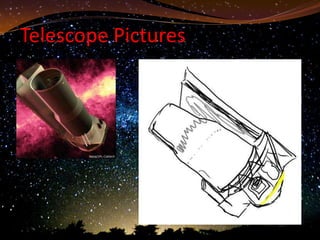
 The Spitzer Space Telescope was the fourth and final
  of the NASA Great Observatories program.
 There are two observatories on Mauna Kea, Hawaii.
  They are at an altitude of 4205 meters.
 Kuiper Airborne Observatory, which operated from
  1974 to 1995.
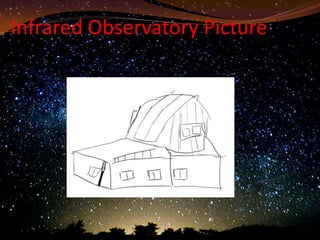
Infrared Observatory Picture
Telescope Pictures
Bibliography
 Brasil, C. (n.d.). Chavals. Retrieved 1 24, 2013, from Flickr:
    http://www.flickr.com/photos/chavals/3656263494/sizes/l/in/photostream/
   Farlex. (n.d.). Infrared Telescope. Retrieved 1 28, 2013, from The Free
    Dictionary: http://www.thefreedictionary.com/infrared+telescope
   Massey, D. R. (n.d.). Glorious Orion: UKIRT Helps Reveal Chaotic and
    Overcrowded Stellar Nursery. Retrieved 1 29, 2013, from Outreach Jach Hawaii:
    http://outreach.jach.hawaii.edu/pressroom/2009_orion/
   NASA. (n.d.). PIA04267: SIRTF and the Milky Way, an Artist's Concept.
    Retrieved 1 29, 2013, from Nasa.gov:
    http://www.nasa.gov/multimedia/imagegallery/image_feature_27_prt.htm
   Ogilvie, P. (n.d.). How Does an Infrared Telescope Work? Retrieved 1 28, 2013,
    from eHow: http://www.ehow.com/how-does_4926827_infrared-telescope-
    work.html
   The Tarantula Nebula. (n.d.). Retrieved 1 25, 2013, from Spitzer.CalTech.edu:
    http://www.spitzer.caltech.edu/images/1121-ssc2004-01a-The-Tarantula-Nebula
   Wikipedia. (n.d.). Spitzer Space Telescope. Retrieved 1 28, 2013, from
    Wikipedia: http://en.wikipedia.org/wiki/Spitzer_Space_Telescope
Credits
Laria: Telescope artistry, researcher, PowerPoint editor
Nicholas: PowerPoint designer, researcher
Aaron: Researcher, Bibliography, Telescope observatory
artist

Finished infrared telescope project power point

  • 1.
    By Aaron, Laria,and Nicholas
  • 2.
    How do theywork?  Infrared telescopes by seeing infrared light and detecting what is around it by the heat that stars and celestial objects radiate.  All objects radiate some heat unless they are at absolute zero. Depending on the telescope or used device it becomes different colors at certain intervals. For example black is the coldest and white is the hottest.
  • 3.
    Why to weuse infrared telescopes?  Infrared radiation is heat. It is radiation in electromagnet that is at longer wavelengths then light we usually see with our naked eye. We can’t see it but we can feel it, for example on a sunny day.  Infrared astronomy allows astronauts and astrophysicists the ability to measure the temperature of planetary bodies and stars and whatnot.
  • 4.
    What do infraredtelescopes need to function properly?  Infrared telescopes must be built to minimize the amount of heat generated by the telescope itself.  Since infrared telescopes emit a ton of heat, they need to be shielded from the heat by people containing them (or at least the ground-based telescopes) by containing them in liquid nitrogen.  Infrared telescopes need electricity to function at all.  Infrared light reciever
  • 5.
    Pros and Cons: Pros Cons  We can see how warm  Infrared telescopes need to be celestial objects are. in a cold place if not  Would be used to detect artificially chilled. foreign life forms.  Produces a lot of heat on its  Smaller than other own because of the heat telescopes. making the image inaccurate.  Infrared telescopes are hard to use on land because of the heat in the atmosphere blocking a clear viewing.
  • 6.
    Examples of InfraredTelescopes  The Spitzer Space Telescope was the fourth and final of the NASA Great Observatories program.  There are two observatories on Mauna Kea, Hawaii. They are at an altitude of 4205 meters.  Kuiper Airborne Observatory, which operated from 1974 to 1995.
  • 7.
  • 8.
  • 9.
    Bibliography  Brasil, C.(n.d.). Chavals. Retrieved 1 24, 2013, from Flickr: http://www.flickr.com/photos/chavals/3656263494/sizes/l/in/photostream/  Farlex. (n.d.). Infrared Telescope. Retrieved 1 28, 2013, from The Free Dictionary: http://www.thefreedictionary.com/infrared+telescope  Massey, D. R. (n.d.). Glorious Orion: UKIRT Helps Reveal Chaotic and Overcrowded Stellar Nursery. Retrieved 1 29, 2013, from Outreach Jach Hawaii: http://outreach.jach.hawaii.edu/pressroom/2009_orion/  NASA. (n.d.). PIA04267: SIRTF and the Milky Way, an Artist's Concept. Retrieved 1 29, 2013, from Nasa.gov: http://www.nasa.gov/multimedia/imagegallery/image_feature_27_prt.htm  Ogilvie, P. (n.d.). How Does an Infrared Telescope Work? Retrieved 1 28, 2013, from eHow: http://www.ehow.com/how-does_4926827_infrared-telescope- work.html  The Tarantula Nebula. (n.d.). Retrieved 1 25, 2013, from Spitzer.CalTech.edu: http://www.spitzer.caltech.edu/images/1121-ssc2004-01a-The-Tarantula-Nebula  Wikipedia. (n.d.). Spitzer Space Telescope. Retrieved 1 28, 2013, from Wikipedia: http://en.wikipedia.org/wiki/Spitzer_Space_Telescope
  • 10.
    Credits Laria: Telescope artistry,researcher, PowerPoint editor Nicholas: PowerPoint designer, researcher Aaron: Researcher, Bibliography, Telescope observatory artist