Introduction to Stars
 A. The Sun
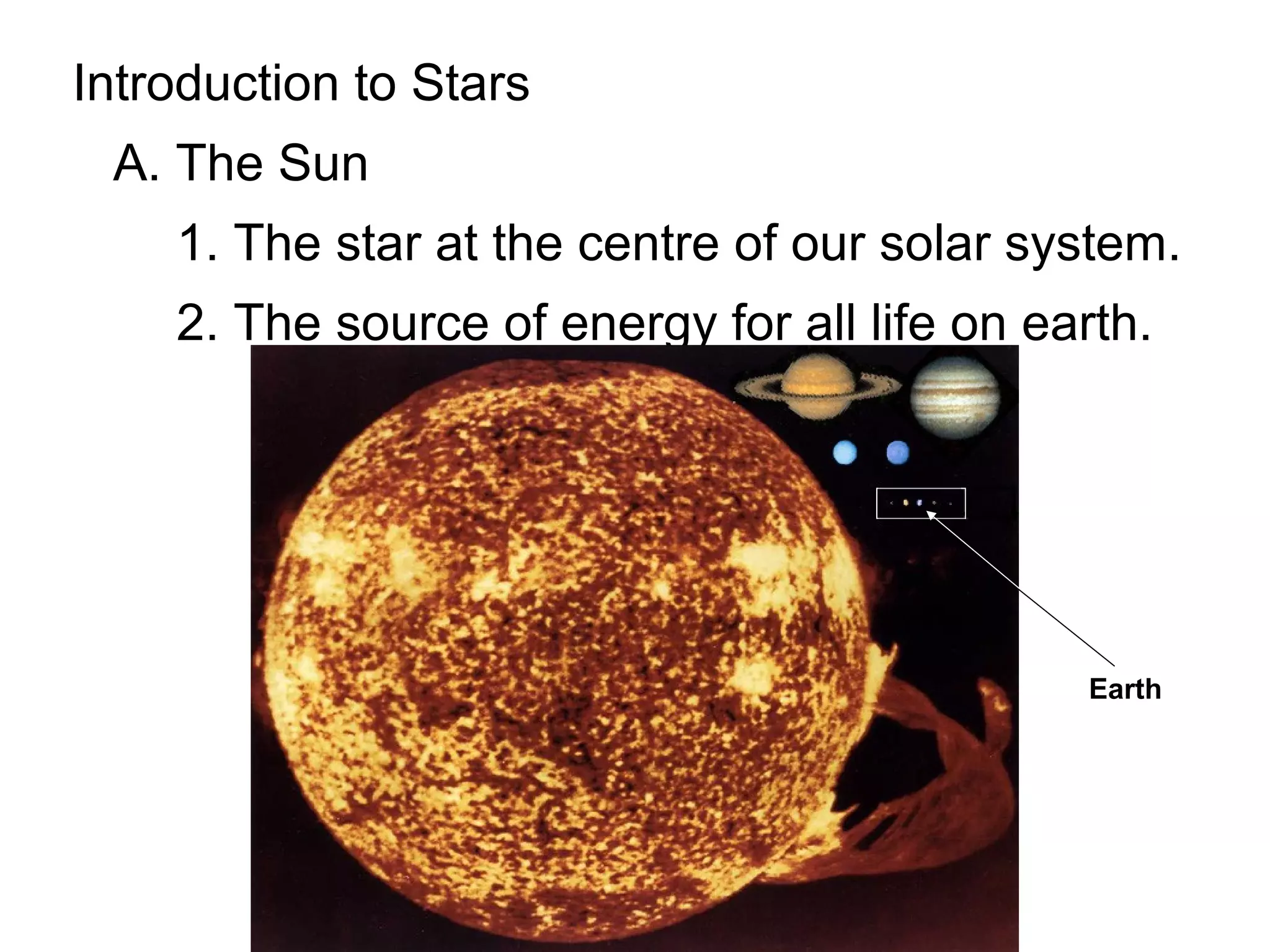
    1. The star at the centre of our solar system.
    2. The source of energy for all life on earth.


                                              Earth
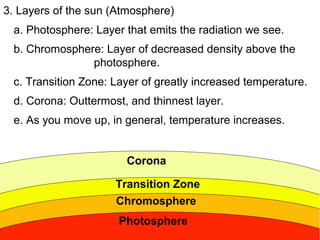
3. Layers of the sun (Atmosphere)
 a. Photosphere: Layer that emits the radiation we see.
 b. Chromosphere: Layer of decreased density above the
               photosphere.
 c. Transition Zone: Layer of greatly increased temperature.
 d. Corona: Outtermost, and thinnest layer.
 e. As you move up, in general, temperature increases.


                       Corona

                     Transition Zone
                     Chromosphere
                      Photosphere
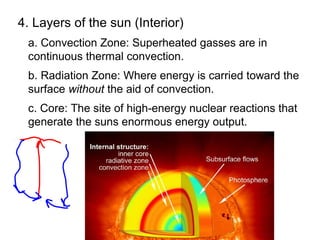
4. Layers of the sun (Interior)
 a. Convection Zone: Superheated gasses are in
 continuous thermal convection.
 b. Radiation Zone: Where energy is carried toward the
 surface without the aid of convection.
 c. Core: The site of high-energy nuclear reactions that
 generate the suns enormous energy output.
5. Solar Wind:
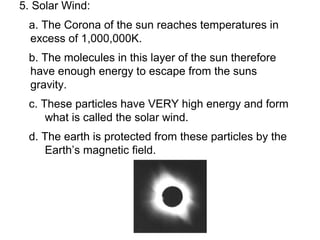
 a. The Corona of the sun reaches temperatures in
 excess of 1,000,000K.
 b. The molecules in this layer of the sun therefore
 have enough energy to escape from the suns
 gravity.
 c. These particles have VERY high energy and form
     what is called the solar wind.
 d. The earth is protected from these particles by the
    Earth’s magnetic field.
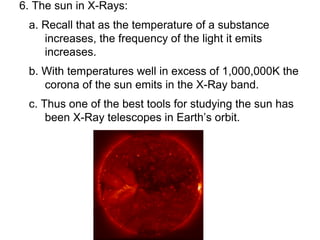
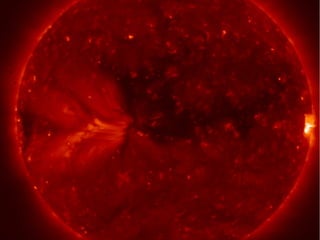
6. The sun in X-Rays:
 a. Recall that as the temperature of a substance
    increases, the frequency of the light it emits
    increases.
 b. With temperatures well in excess of 1,000,000K the
    corona of the sun emits in the X-Ray band.
 c. Thus one of the best tools for studying the sun has
     been X-Ray telescopes in Earth’s orbit.
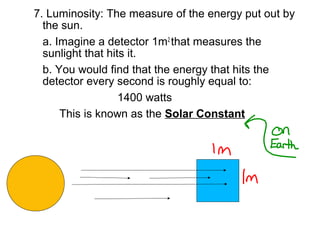
7. Luminosity: The measure of the energy put out by
  the sun.
  a. Imagine a detector 1m2 that measures the
  sunlight that hits it.
  b. You would find that the energy that hits the
  detector every second is roughly equal to:
                   1400 watts
      This is known as the Solar Constant
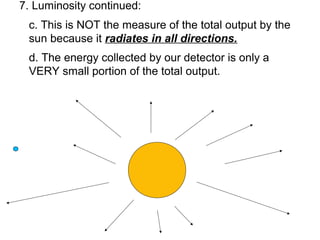
7. Luminosity continued:
 c. This is NOT the measure of the total output by the
 sun because it radiates in all directions.
 d. The energy collected by our detector is only a
 VERY small portion of the total output.
7. Luminosity continued:
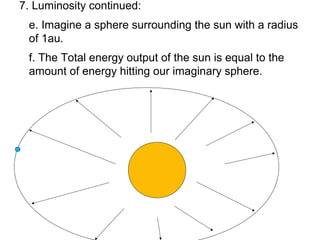
 e. Imagine a sphere surrounding the sun with a radius
 of 1au.
 f. The Total energy output of the sun is equal to the
 amount of energy hitting our imaginary sphere.
6. Luminosity continued:
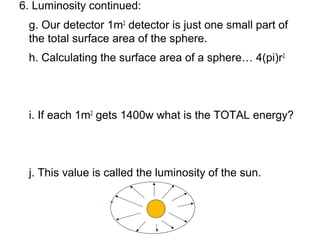
 g. Our detector 1m2 detector is just one small part of
 the total surface area of the sphere.
 h. Calculating the surface area of a sphere… 4(pi)r 2


 i. If each 1m2 gets 1400w what is the TOTAL energy?


 j. This value is called the luminosity of the sun.
7. Luminosity continued:
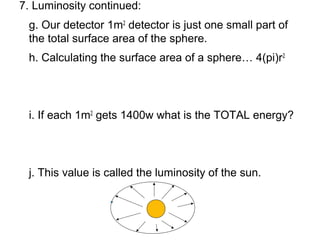
 g. Our detector 1m2 detector is just one small part of
 the total surface area of the sphere.
 h. Calculating the surface area of a sphere… 4(pi)r 2


 i. If each 1m2 gets 1400w what is the TOTAL energy?


 j. This value is called the luminosity of the sun.
Introduction to Stars
 A. The Sun
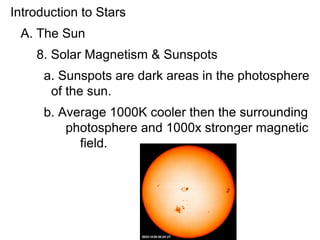
    8. Solar Magnetism & Sunspots
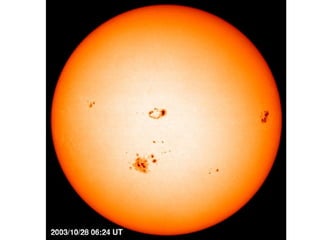
      a. Sunspots are dark areas in the photosphere
       of the sun.
      b. Average 1000K cooler then the surrounding
          photosphere and 1000x stronger magnetic
            field.
8. Solar Magnetism & Sunspots
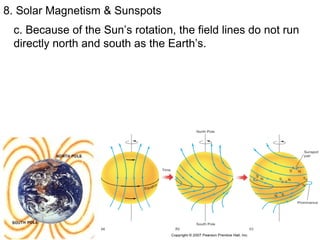
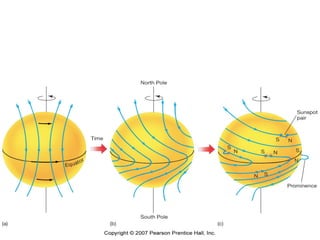
 c. Because of the Sun’s rotation, the field lines do not run
 directly north and south as the Earth’s.
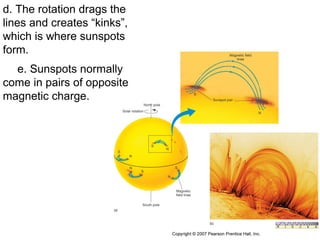
d. The rotation drags the
lines and creates “kinks”,
which is where sunspots
form.
  e. Sunspots normally
come in pairs of opposite
magnetic charge.
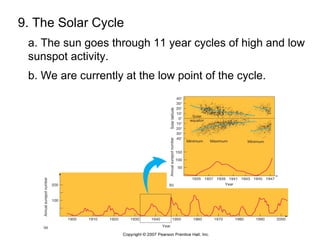
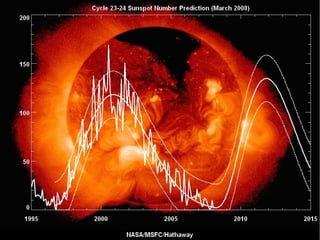
9. The Solar Cycle
 a. The sun goes through 11 year cycles of high and low
 sunspot activity.
 b. We are currently at the low point of the cycle.
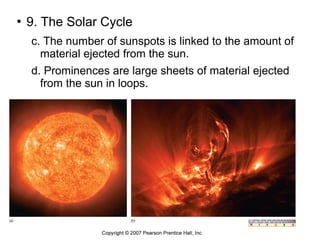
   9. The Solar Cycle
    c. The number of sunspots is linked to the amount of
      material ejected from the sun.
    d. Prominences are large sheets of material ejected
      from the sun in loops.
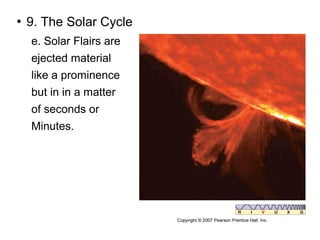
   9. The Solar Cycle
    e. Solar Flairs are
    ejected material
    like a prominence
    but in in a matter
    of seconds or
    Minutes.

Properties of the sun

  • 1.
    Introduction to Stars A. The Sun 1. The star at the centre of our solar system. 2. The source of energy for all life on earth. Earth
  • 2.
    3. Layers ofthe sun (Atmosphere) a. Photosphere: Layer that emits the radiation we see. b. Chromosphere: Layer of decreased density above the photosphere. c. Transition Zone: Layer of greatly increased temperature. d. Corona: Outtermost, and thinnest layer. e. As you move up, in general, temperature increases. Corona Transition Zone Chromosphere Photosphere
  • 3.
    4. Layers ofthe sun (Interior) a. Convection Zone: Superheated gasses are in continuous thermal convection. b. Radiation Zone: Where energy is carried toward the surface without the aid of convection. c. Core: The site of high-energy nuclear reactions that generate the suns enormous energy output.
  • 4.
    5. Solar Wind: a. The Corona of the sun reaches temperatures in excess of 1,000,000K. b. The molecules in this layer of the sun therefore have enough energy to escape from the suns gravity. c. These particles have VERY high energy and form what is called the solar wind. d. The earth is protected from these particles by the Earth’s magnetic field.
  • 5.
    6. The sunin X-Rays: a. Recall that as the temperature of a substance increases, the frequency of the light it emits increases. b. With temperatures well in excess of 1,000,000K the corona of the sun emits in the X-Ray band. c. Thus one of the best tools for studying the sun has been X-Ray telescopes in Earth’s orbit.
  • 7.
    7. Luminosity: Themeasure of the energy put out by the sun. a. Imagine a detector 1m2 that measures the sunlight that hits it. b. You would find that the energy that hits the detector every second is roughly equal to: 1400 watts This is known as the Solar Constant
  • 8.
    7. Luminosity continued: c. This is NOT the measure of the total output by the sun because it radiates in all directions. d. The energy collected by our detector is only a VERY small portion of the total output.
  • 9.
    7. Luminosity continued: e. Imagine a sphere surrounding the sun with a radius of 1au. f. The Total energy output of the sun is equal to the amount of energy hitting our imaginary sphere.
  • 10.
    6. Luminosity continued: g. Our detector 1m2 detector is just one small part of the total surface area of the sphere. h. Calculating the surface area of a sphere… 4(pi)r 2 i. If each 1m2 gets 1400w what is the TOTAL energy? j. This value is called the luminosity of the sun.
  • 11.
    7. Luminosity continued: g. Our detector 1m2 detector is just one small part of the total surface area of the sphere. h. Calculating the surface area of a sphere… 4(pi)r 2 i. If each 1m2 gets 1400w what is the TOTAL energy? j. This value is called the luminosity of the sun.
  • 12.
    Introduction to Stars A. The Sun 8. Solar Magnetism & Sunspots a. Sunspots are dark areas in the photosphere of the sun. b. Average 1000K cooler then the surrounding photosphere and 1000x stronger magnetic field.
  • 14.
    8. Solar Magnetism& Sunspots c. Because of the Sun’s rotation, the field lines do not run directly north and south as the Earth’s.
  • 16.
    d. The rotationdrags the lines and creates “kinks”, which is where sunspots form. e. Sunspots normally come in pairs of opposite magnetic charge.
  • 17.
    9. The SolarCycle a. The sun goes through 11 year cycles of high and low sunspot activity. b. We are currently at the low point of the cycle.
  • 19.
    9. The Solar Cycle c. The number of sunspots is linked to the amount of material ejected from the sun. d. Prominences are large sheets of material ejected from the sun in loops.
  • 20.
    9. The Solar Cycle e. Solar Flairs are ejected material like a prominence but in in a matter of seconds or Minutes.