


SOIL
Submitted By:
ANJALI AWASTHI
M.Sc Forensic Science
4th Sem
Introduction:
• Soil is a common form of physical evidence found at the scene of crime such
as hit-and- run Accidents, rapes and burglaries.
• Soil from the crime scene may be picked up by an automobile(tyres) thus can
be a probable link between automobile and the crime.
• It is a naturally occurring material which usually contains clay, rocks, coal,
plant material and other debris in addition to its mineral constituents.
• Soil is heterogenous in nature and varies widely from place to place due to the
effects of wind, water, living organisms, mining and agriculture.
• Thus, soil from different places will have different individual characteristics.
• Forensic examination of soil is not only concerned with analysis of naturally
occurring rocks, objects such as glass, paint chips, brick fragments.
• A number of physical and chemical methods have been used for identification of
source correspondence as well as for comparison of two soils.
• Soil science has two branches study- Edaphology and Pedology.
• Edaphology is totally concerned with influence of soil on living beings.
• Pedology is the formation, morphology and classification of soil in their natural
environment.
Method of Examination
• Microscopic Examination- In this we observe the colour of the soil as such and after
drying in incubator at 105̊C.
Observing the nature, size and shape.
Sorting out the foreign elements as paper pieces, leaves, seed, glass fragments, animal
and wood matters etc.
• Sample Preparation- Set of sieves (ranging in size from ASTM) in motor driven sieve
shaker.
Method- Arranging the set of sieves in numerical order with smallest number (largest
mesh size) at top and largest number (smallest mesh size) at the bottom
Place the sieve on the shaker and pour the soil sample on the top sieve.
Further, placing the cover on the upper sieve, fasten the binding straps. Switching on
the shaker and allow the shake to operate for at least 5 minutes.
Removing the sieve cover and separate the sieves. Collecting the soil retained in each sieve
separately and marked them.
• Removal of Blood from Blood-stained Soil-
Method- We prepare saline water of about 0.95% i.e. dissolve 50mg of NaCl in 100ml of
distilled water.
Pour the blood stained soil sample in saline water and stir for separation of blood.
After few hours, decant the water and wash with distilled water. Drying the sample in hot
oven or on hot plate at 105̊C and keep it in Desiccator.
Observation- with the help of Stereo- Microscope.
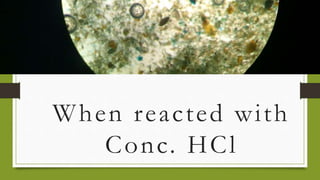
The soil that is dried in the incubator is analysed by checking the presence of insoluble
carbonate and the presence of soluble Iron present in the Questioned and Sample soil.
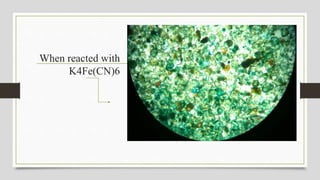
If there is appearance of bubble arising then for confirmation we add 2-3 drops of
freshly prepared solution of Potassium Ferrocyanide. On addition Bluish-green color
marks the presence of Soluble Iron in the soil.
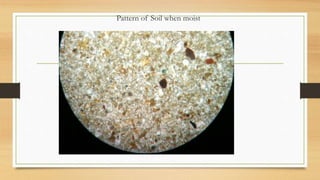
Pattern of Soil when moist
When reacted with
Conc. HCl
When reacted with
K4Fe(CN)6
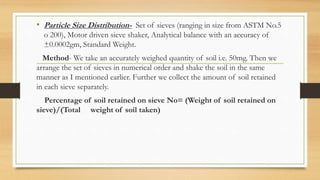
• Particle Size Distribution- Set of sieves (ranging in size from ASTM No.5
o 200), Motor driven sieve shaker, Analytical balance with an accuracy of
±0.0002gm, Standard Weight.
Method- We take an accurately weighed quantity of soil i.e. 50mg. Then we
arrange the set of sieves in numerical order and shake the soil in the same
manner as I mentioned earlier. Further we collect the amount of soil retained
in each sieve separately.
Percentage of soil retained on sieve No= (Weight of soil retained on
sieve)/(Total weight of soil taken)
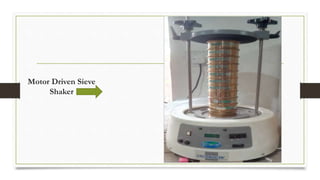
Motor Driven Sieve
Shaker
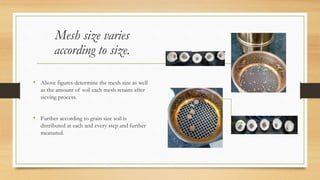
Mesh size varies
according to size.
• Above figures determine the mesh size as well
as the amount of soil each mesh retains after
sieving process.
• Further according to grain size soil is
distributed at each and every step and further
measured.
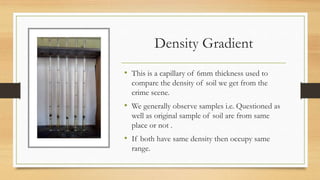
Density Gradient
• This is a capillary of 6mm thickness used to
compare the density of soil we get from the
crime scene.
• We generally observe samples i.e. Questioned as
well as original sample of soil are from same
place or not .
• If both have same density then occupy same
range.
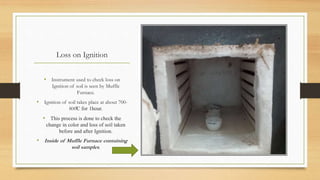
Loss on Ignition
• Instrument used to check loss on
Ignition of soil is seen by Muffle
Furnace.
• Ignition of soil takes place at about 700-
800̊C for 1hour.
• This process is done to check the
change in color and loss of soil taken
before and after Ignition.
• Inside of Muffle Furnace containing
soil samples.
Instrumental Analysis
• Neutron Activation Analysis
• X-ray Emission Spectrographic Analysis
• Analysis of Organic comparison
• Mineralogical Classification
• Diffraction Thermal Analysis
• Comparison of Micro-organism Content.
Forensic Significance
Soil ppt

Soil ppt

  • 1.
  • 2.
    Introduction: • Soil isa common form of physical evidence found at the scene of crime such as hit-and- run Accidents, rapes and burglaries. • Soil from the crime scene may be picked up by an automobile(tyres) thus can be a probable link between automobile and the crime. • It is a naturally occurring material which usually contains clay, rocks, coal, plant material and other debris in addition to its mineral constituents. • Soil is heterogenous in nature and varies widely from place to place due to the effects of wind, water, living organisms, mining and agriculture. • Thus, soil from different places will have different individual characteristics.
  • 3.
    • Forensic examinationof soil is not only concerned with analysis of naturally occurring rocks, objects such as glass, paint chips, brick fragments. • A number of physical and chemical methods have been used for identification of source correspondence as well as for comparison of two soils. • Soil science has two branches study- Edaphology and Pedology. • Edaphology is totally concerned with influence of soil on living beings. • Pedology is the formation, morphology and classification of soil in their natural environment.
  • 4.
    Method of Examination •Microscopic Examination- In this we observe the colour of the soil as such and after drying in incubator at 105̊C. Observing the nature, size and shape. Sorting out the foreign elements as paper pieces, leaves, seed, glass fragments, animal and wood matters etc. • Sample Preparation- Set of sieves (ranging in size from ASTM) in motor driven sieve shaker. Method- Arranging the set of sieves in numerical order with smallest number (largest mesh size) at top and largest number (smallest mesh size) at the bottom Place the sieve on the shaker and pour the soil sample on the top sieve. Further, placing the cover on the upper sieve, fasten the binding straps. Switching on the shaker and allow the shake to operate for at least 5 minutes.
  • 5.
    Removing the sievecover and separate the sieves. Collecting the soil retained in each sieve separately and marked them. • Removal of Blood from Blood-stained Soil- Method- We prepare saline water of about 0.95% i.e. dissolve 50mg of NaCl in 100ml of distilled water. Pour the blood stained soil sample in saline water and stir for separation of blood. After few hours, decant the water and wash with distilled water. Drying the sample in hot oven or on hot plate at 105̊C and keep it in Desiccator. Observation- with the help of Stereo- Microscope. The soil that is dried in the incubator is analysed by checking the presence of insoluble carbonate and the presence of soluble Iron present in the Questioned and Sample soil. If there is appearance of bubble arising then for confirmation we add 2-3 drops of freshly prepared solution of Potassium Ferrocyanide. On addition Bluish-green color marks the presence of Soluble Iron in the soil.
  • 6.
    Pattern of Soilwhen moist
  • 7.
  • 8.
  • 9.
    • Particle SizeDistribution- Set of sieves (ranging in size from ASTM No.5 o 200), Motor driven sieve shaker, Analytical balance with an accuracy of ±0.0002gm, Standard Weight. Method- We take an accurately weighed quantity of soil i.e. 50mg. Then we arrange the set of sieves in numerical order and shake the soil in the same manner as I mentioned earlier. Further we collect the amount of soil retained in each sieve separately. Percentage of soil retained on sieve No= (Weight of soil retained on sieve)/(Total weight of soil taken)
  • 10.
  • 11.
    Mesh size varies accordingto size. • Above figures determine the mesh size as well as the amount of soil each mesh retains after sieving process. • Further according to grain size soil is distributed at each and every step and further measured.
  • 12.
    Density Gradient • Thisis a capillary of 6mm thickness used to compare the density of soil we get from the crime scene. • We generally observe samples i.e. Questioned as well as original sample of soil are from same place or not . • If both have same density then occupy same range.
  • 13.
    Loss on Ignition •Instrument used to check loss on Ignition of soil is seen by Muffle Furnace. • Ignition of soil takes place at about 700- 800̊C for 1hour. • This process is done to check the change in color and loss of soil taken before and after Ignition. • Inside of Muffle Furnace containing soil samples.
  • 14.
    Instrumental Analysis • NeutronActivation Analysis • X-ray Emission Spectrographic Analysis • Analysis of Organic comparison • Mineralogical Classification • Diffraction Thermal Analysis • Comparison of Micro-organism Content.
  • 15.