Warm Up – Page 26 What are the  5 characteristics of a mineral? Copy down today’s EQ and date on page 27. Turn in your syllabus (only the bottom portion) Have your notebook open to your vocab homework
How do we identify minerals? Mineral Identification Lab
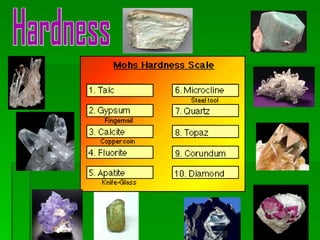
Minerals are identified by their Hardness  – a  mineral  can  scratch  any mineral  softer  than itself but will be  scratched  by a mineral  harder  than itself  Mohs  Hardness Scale – ranks minerals from  softest  to hardest on a scale of one to ten.  Talc  is the softest known mineral, and  diamond  is the hardest known mineral.
Hardness
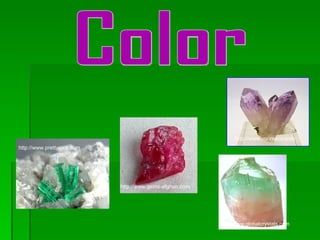
Minerals are identified by their Color – some  minerals  are always the same  color  (sulfur is always yellow,  malachite  is always green and azurite is always  blue ); most minerals come in a  variety  of colors
Color http://www.minresco.com http://www.gems-afghan.com http://www.globalcrystals.com http://www.prettyrock.com
Minerals are identified by their Streak  – the color of a mineral’s  powder;  the color of a mineral’s streak does not  change  like the color of the mineral may
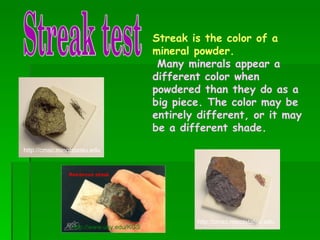
Streak test http://www.uky.edu/KGS Streak is the color of a mineral powder. Many minerals appear a different color when powdered than they do as a big piece. The color may be entirely different, or it may be a different shade.   http://cmsc.minotstateu.edu http://cmsc.minotstateu.edu
Minerals are identified by their Luster – how a mineral  reflects  light from its  surface ; some ways to describe luster are  shiny,  earthy,  metallic,  waxy, and  pearly
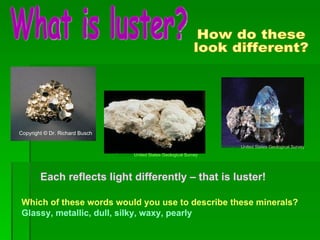
What is luster? Copyright © Dr. Richard Busch   How do these look different? Courtesy  United States Geological Survey   Courtesy  United States Geological Survey   Each reflects light differently – that is luster! Which of these words would you use to describe these minerals? Glassy, metallic, dull, silky, waxy, pearly
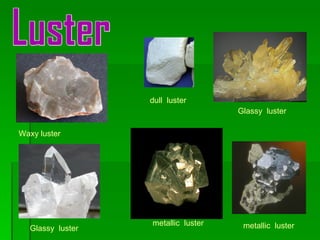
Luster Waxy luster Glassy  luster dull  luster metallic  luster metallic  luster Glassy  luster
Minerals are identified by their Density  – all minerals have a  characteristic  density; no matter the size of the sample, its density will  remain  the  same
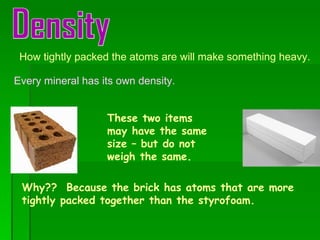
Density How tightly packed the atoms are will make something heavy. Every mineral has its own density. These two items may have the same size – but do not weigh the same. Why??  Because the brick has atoms that are more tightly packed together than the styrofoam.
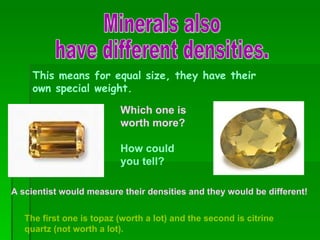
Minerals also  have different densities. This means for equal size, they have their own special weight. http://www.palagems.com Which one is worth more? How could you tell? The first one is topaz (worth a lot) and the second is citrine quartz (not worth a lot). A scientist would measure their densities and they would be different!
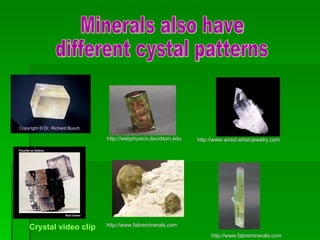
Minerals also have different cystal patterns Copyright © Dr. Richard Busch   http://www.wired-artist-jewelry.com http://webphysics.davidson.edu http://www.fabreminerals.com http://www.fabreminerals.com Crystal video clip
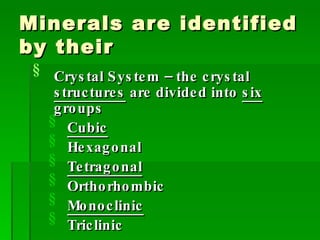
Minerals are identified by their Crystal System – the crystal  structures  are divided into  six  groups Cubic Hexagonal Tetragonal Orthorhombic Monoclinic Triclinic
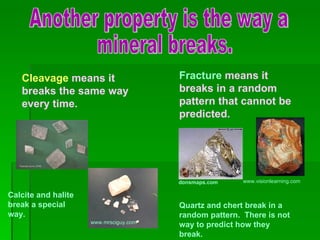
Another property is the way a mineral breaks. Cleavage  means it breaks the same way every time. Fracture  means it breaks in a random pattern that cannot be predicted. www.mrsciguy.com  Calcite and halite break a special way. donsmaps.com  www.visionlearning.com  Quartz and chert break in a random pattern.  There is not way to predict how they break.
Minerals are identified by their Cleavage and  fracture  – the way a mineral  breaks  apart helps us identify it Cleavage  – splits  apart  along  flat  surface Fracture – breaks apart in an  irregular  way
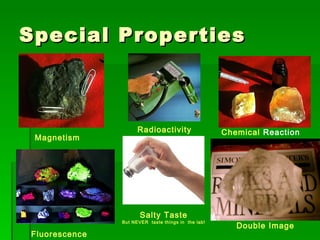
Minerals are identified by their Special  Properties  – some minerals are identified by their special properties Fluorescence  – minerals that glow under ultraviolet light Magnetism Radioactive Chemically Reactive Electrical  Properties
Special Properties Magnetism Radioactivity Chemical  Reaction Fluorescence Salty Taste But NEVER  taste things in  the lab! Double Image
Warm Up – Page 26 What are the 8 ways we can identify minerals?
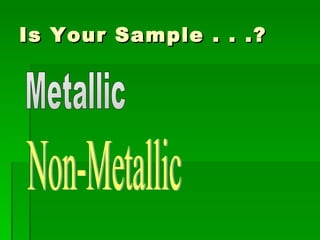
Is Your Sample . . .? Metallic Non-Metallic
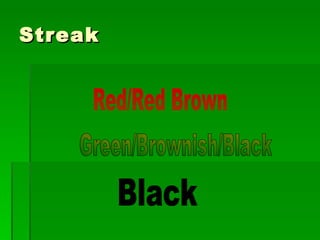
Streak Red/Red Brown Green/Brownish/Black Black
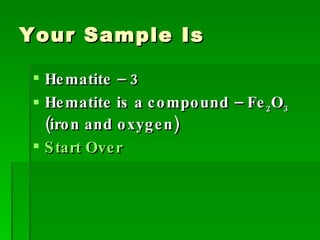
Your Sample Is Hematite – 3 Hematite is a compound – Fe 2 O 3  (iron and oxygen) Start Over
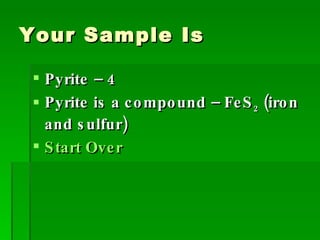
Your Sample Is Pyrite – 4 Pyrite is a compound – FeS 2  (iron and sulfur) Start Over
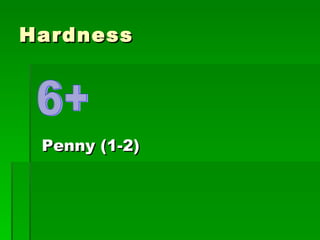
Hardness 6+ Penny (1-2)
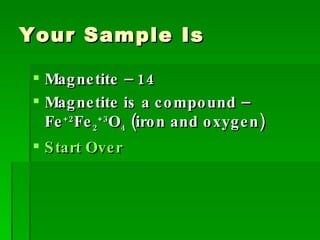
Your Sample Is Magnetite – 14  Magnetite is a compound – Fe +2 Fe 2 +3 O 4  (iron and oxygen) Start Over
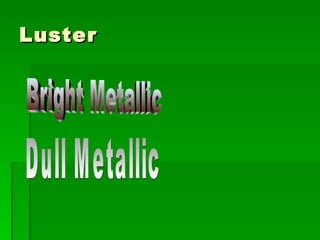
Luster Bright Metallic Dull Metallic
Your Sample Is Galena (7) Galena is a compound – PbS (lead and sulfur) Start Over
Your Sample Is Graphite – 9 Graphite is an element – C (carbon) Start Over
Color Yellow Other
Your Sample Is Sulfur – 8 Sulfur is an element - S Start Over
Hardness Fingernail Penny 6+
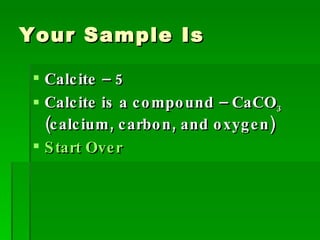
Your Sample Is Calcite – 5 Calcite is a compound – CaCO 3  (calcium, carbon, and oxygen) Start Over
Luster Glassy Pearly
Color Colorless/White Brownish
Your Sample Is Halite – 15 Halite is a compound – NaCl (Sodium and Chloride – salt) Start Over
Your Sample Is Muscavite Mica – 2 Muscavite Mica is a compound – KAl 2 (Si 3 AlO 10 )(OH,F) 2  (Potassium, Aluminum, Silicon, Oxygen, Hydrogen, and Fluorine) Start Over
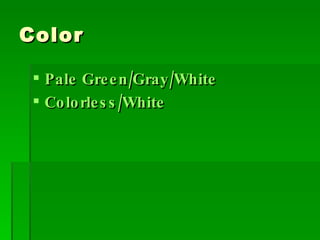
Color Pale Green/Gray/White Colorless/White
Your Sample Is Talc – 13 Talc is a compound – Mg 9 Si 4 O 10 (OH) 4  (magnesium, silicon, oxygen, hydrogen) Start Over
Your Sample Is Gypsum – 12 Gypsum is a compound – CaSO 4 *2H 2 O (Calcium, Sulfur, Oxygen, Hydride) Start Over
Luster Glassy Pearly
Your Sample Is Microcline Feldspar Microcline Feldspar is a compound – KAlSi 3 O 8  (Potassium, Aluminum, Silicon, and Oxygen) Start Over
Your Sample Is Quartz Color – Clear/colorless – Rock Quartz – 10 Color – Pink – Rose Quartz – 6 Quartz is a compound – SiO 2  (Silicon and Oxygen) Start Over
Conclusion – Page 26 Out activity What was the easiest mineral property to identify? What was the hardest mineral property to identify? What did you learn from this lab? Write a haiku about minerals. A haiku is a three line poem with 7 syllables in the first line, 5 in the second, and 7 in the third. It does not rhyme.

Mineral Identification Lab

  • 1.
    Warm Up –Page 26 What are the 5 characteristics of a mineral? Copy down today’s EQ and date on page 27. Turn in your syllabus (only the bottom portion) Have your notebook open to your vocab homework
  • 2.
    How do weidentify minerals? Mineral Identification Lab
  • 3.
    Minerals are identifiedby their Hardness – a mineral can scratch any mineral softer than itself but will be scratched by a mineral harder than itself Mohs Hardness Scale – ranks minerals from softest to hardest on a scale of one to ten. Talc is the softest known mineral, and diamond is the hardest known mineral.
  • 4.
  • 5.
    Minerals are identifiedby their Color – some minerals are always the same color (sulfur is always yellow, malachite is always green and azurite is always blue ); most minerals come in a variety of colors
  • 6.
    Color http://www.minresco.com http://www.gems-afghan.comhttp://www.globalcrystals.com http://www.prettyrock.com
  • 7.
    Minerals are identifiedby their Streak – the color of a mineral’s powder; the color of a mineral’s streak does not change like the color of the mineral may
  • 8.
    Streak test http://www.uky.edu/KGSStreak is the color of a mineral powder. Many minerals appear a different color when powdered than they do as a big piece. The color may be entirely different, or it may be a different shade. http://cmsc.minotstateu.edu http://cmsc.minotstateu.edu
  • 9.
    Minerals are identifiedby their Luster – how a mineral reflects light from its surface ; some ways to describe luster are shiny, earthy, metallic, waxy, and pearly
  • 10.
    What is luster?Copyright © Dr. Richard Busch How do these look different? Courtesy United States Geological Survey Courtesy United States Geological Survey Each reflects light differently – that is luster! Which of these words would you use to describe these minerals? Glassy, metallic, dull, silky, waxy, pearly
  • 11.
    Luster Waxy lusterGlassy luster dull luster metallic luster metallic luster Glassy luster
  • 12.
    Minerals are identifiedby their Density – all minerals have a characteristic density; no matter the size of the sample, its density will remain the same
  • 13.
    Density How tightlypacked the atoms are will make something heavy. Every mineral has its own density. These two items may have the same size – but do not weigh the same. Why?? Because the brick has atoms that are more tightly packed together than the styrofoam.
  • 14.
    Minerals also have different densities. This means for equal size, they have their own special weight. http://www.palagems.com Which one is worth more? How could you tell? The first one is topaz (worth a lot) and the second is citrine quartz (not worth a lot). A scientist would measure their densities and they would be different!
  • 15.
    Minerals also havedifferent cystal patterns Copyright © Dr. Richard Busch http://www.wired-artist-jewelry.com http://webphysics.davidson.edu http://www.fabreminerals.com http://www.fabreminerals.com Crystal video clip
  • 16.
    Minerals are identifiedby their Crystal System – the crystal structures are divided into six groups Cubic Hexagonal Tetragonal Orthorhombic Monoclinic Triclinic
  • 17.
    Another property isthe way a mineral breaks. Cleavage means it breaks the same way every time. Fracture means it breaks in a random pattern that cannot be predicted. www.mrsciguy.com Calcite and halite break a special way. donsmaps.com www.visionlearning.com Quartz and chert break in a random pattern. There is not way to predict how they break.
  • 18.
    Minerals are identifiedby their Cleavage and fracture – the way a mineral breaks apart helps us identify it Cleavage – splits apart along flat surface Fracture – breaks apart in an irregular way
  • 19.
    Minerals are identifiedby their Special Properties – some minerals are identified by their special properties Fluorescence – minerals that glow under ultraviolet light Magnetism Radioactive Chemically Reactive Electrical Properties
  • 20.
    Special Properties MagnetismRadioactivity Chemical Reaction Fluorescence Salty Taste But NEVER taste things in the lab! Double Image
  • 21.
    Warm Up –Page 26 What are the 8 ways we can identify minerals?
  • 22.
    Is Your Sample. . .? Metallic Non-Metallic
  • 23.
    Streak Red/Red BrownGreen/Brownish/Black Black
  • 24.
    Your Sample IsHematite – 3 Hematite is a compound – Fe 2 O 3 (iron and oxygen) Start Over
  • 25.
    Your Sample IsPyrite – 4 Pyrite is a compound – FeS 2 (iron and sulfur) Start Over
  • 26.
  • 27.
    Your Sample IsMagnetite – 14 Magnetite is a compound – Fe +2 Fe 2 +3 O 4 (iron and oxygen) Start Over
  • 28.
  • 29.
    Your Sample IsGalena (7) Galena is a compound – PbS (lead and sulfur) Start Over
  • 30.
    Your Sample IsGraphite – 9 Graphite is an element – C (carbon) Start Over
  • 31.
  • 32.
    Your Sample IsSulfur – 8 Sulfur is an element - S Start Over
  • 33.
  • 34.
    Your Sample IsCalcite – 5 Calcite is a compound – CaCO 3 (calcium, carbon, and oxygen) Start Over
  • 35.
  • 36.
  • 37.
    Your Sample IsHalite – 15 Halite is a compound – NaCl (Sodium and Chloride – salt) Start Over
  • 38.
    Your Sample IsMuscavite Mica – 2 Muscavite Mica is a compound – KAl 2 (Si 3 AlO 10 )(OH,F) 2 (Potassium, Aluminum, Silicon, Oxygen, Hydrogen, and Fluorine) Start Over
  • 39.
  • 40.
    Your Sample IsTalc – 13 Talc is a compound – Mg 9 Si 4 O 10 (OH) 4 (magnesium, silicon, oxygen, hydrogen) Start Over
  • 41.
    Your Sample IsGypsum – 12 Gypsum is a compound – CaSO 4 *2H 2 O (Calcium, Sulfur, Oxygen, Hydride) Start Over
  • 42.
  • 43.
    Your Sample IsMicrocline Feldspar Microcline Feldspar is a compound – KAlSi 3 O 8 (Potassium, Aluminum, Silicon, and Oxygen) Start Over
  • 44.
    Your Sample IsQuartz Color – Clear/colorless – Rock Quartz – 10 Color – Pink – Rose Quartz – 6 Quartz is a compound – SiO 2 (Silicon and Oxygen) Start Over
  • 45.
    Conclusion – Page26 Out activity What was the easiest mineral property to identify? What was the hardest mineral property to identify? What did you learn from this lab? Write a haiku about minerals. A haiku is a three line poem with 7 syllables in the first line, 5 in the second, and 7 in the third. It does not rhyme.

Editor's Notes

  • #7 Emerald, ruby, amethyst, watermelon tourmaline