PRESENTED BY-
ANJALI VISHWAKARMA
ROLL NO.-Y19242503
PRESENTED TO-
DR. NAVJOT KAUR
CONTENT
 Glass definition
 Types of glass
 General properties of glass
 Scope of glass examination
 Types of cracks and fractures in glass sample and their
interpretation
 Forensic examination of glass samples.
scopes
 Glass, as a physical clue, is frequently encountered in
various crimes such as burglary, road accidents, murder,
sexual assaults, shooting incidents, arson and vandalism.
 The chips of broken glass window may be lodged in
suspect’s shoes or garments during the act of
burglary/crime, particles of headlight glass found at the
crime scene make offer clues that confirm the identity of
a suspected vehicle, glass may also be found on the
clothing of an alleged assailant, where a bottle is used as
a weapon.
 Whenever there is violence, bottles, window pane
glass, mirrors, eye glasses and other glass objects can
be accidently scattered and fragments of these can also
adhere to the criminal's clothing or shoes.
 Thus, glass forms one evidentiary materials in many
criminal investigations
Glass
glass is technically defined as
‘’The inorganic product of fusion which has cooled to a
rigid condition without crystallizing.’’
In contrast to crystalline solids which have an ordered
internal arrangement of atoms ,the internal structure of
glass consists of a network of atoms lacking long-range
symmetry; This condition is referred to as the vitreous,
or glassy, state.
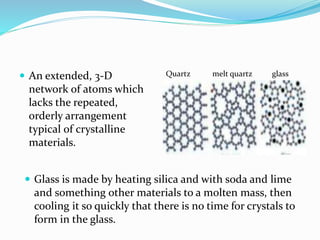
 An extended, 3-D
network of atoms which
lacks the repeated,
orderly arrangement
typical of crystalline
materials.
Quartz melt quartz glass
 Glass is made by heating silica and with soda and lime
and something other materials to a molten mass, then
cooling it so quickly that there is no time for crystals to
form in the glass.
 Even though glass is a liquid to us it appears solid it is
not viscous like other liquids, but it looks rigid.
 The viscosity is such a high value that the amorphous
material acts like a solid
CHEMICAL COMPOSITION OF
GLASS
 Glass is a hard and crystalline substance which is super
cooled liquid, tensile strength of glass depends upon
chemical bonding of glass mainly includes oxides of
various metals.
 They are-
1. Network forming oxides
2. Network loosing oxides
3. Stabilizing oxides
4. Intermediates oxides
NETWORK FORMING OXIDES
 Eg- SiO2, B2O3, As2O3, P2O5
 They are also called “formers”
 They form network of glass.
NETWORK LOOSING OXIDES
 Eg- Na2O, CaO, MgO, BaO, K2O, LiO2 etc.
 They decreases the melting point of glass.
 They are also called fluxes – “softeners”.
STABILISG OXIDES
 Eg.-CaO, BaO,MgO etc.
 They decreases rate of hydrolysis.
 They are also called “modifiers’’
INTERMEDIATES OXIDES
 Eg.-Al2o3, Sb2O3, PbO, ZnO, TiO2, BeO etc.
 They plays role of modifiers and formers.
TYPES OF GLASS
[A]. On the basis of manufacturing process:
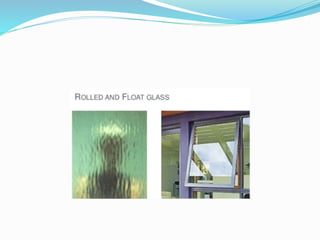
 Ordinary sheet glass
 Float glass (plate)
[B].On the basis of composition:
 Oxide glass
 Non oxide glass
[C].On the basis of market application
 Commercial the basic of market application :
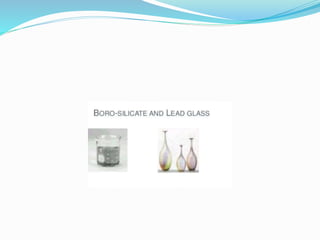
 Lead glass
 Borosilicate glass
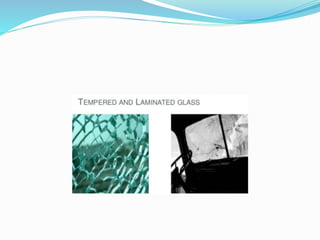
 Laminated glass
 Tempered glass
Collection preservation of glass
evidence
 Firstly photographed the glass piece found as a evidence on
soc.
 Fingerprints are generally found on glass surface. Cases in
which breaking of glass was done due to the result of struggle,
probability of finding latent fingerprints is more in the
surface of glass.
 Note done the presence of latent prints on the surface of glass
and also the inner and outer surface of glass. This is important
in the process of division and determination.
 For physical matching, it is necessary to collect the suspect
object or artical from which the glass piece belongs to.
 For packing, glass piece should always be wrapped in
cotton or cloth. Minute piece of glass should be packed
in pill box for edges, it should be sealed with wax or
modeling clay so they can not destroyed otherwise
contor matching is not possible.
 Detail should be refer after packing.
PHYSICAL AND CHEMICAL
MATCHING
CHEMICAL MATCHING-Laboratory examination of glass
is based on comparison.
 PRELIMINARY EXAMINATION- Matching should be
done of glass piece with its belong parts on the
parameters of color, thickness, design, curvature, color
comparison also done in uv light.
 COMPARISON OF DENSITY-Density of glass is 2.1-8.1
gm cm3 whereas optical and crystal glass having their
density much more in comparison to normal glass
 FREE FLOATATION MOTHOD
 UV LIGHT METHOD
 NEEDLE SHAPE MICROSCOPE
 DENSITY GRADIENT COLUMN METHOD
 COMPARISON OF REFRACTIVE INDEX
SOME SPECIAL TYPES OF GLASSS
 Glass fiber
 Vitreous silica
 Alumino-silicate glass
 Alkali-barium silicate glass
 Glass ceramics
 Technical glass
 Phosphate glass
 Optical glass
 Sealing glass
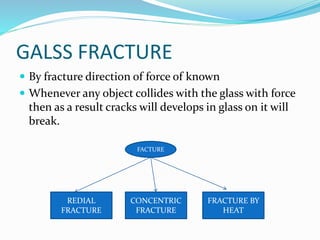
GALSS FRACTURE
 By fracture direction of force of known
 Whenever any object collides with the glass with force
then as a result cracks will develops in glass on it will
break.
FACTURE
REDIAL
FRACTURE
CONCENTRIC
FRACTURE
FRACTURE BY
HEAT
RADIAL FRACTURE
 When an object has been thrown through pane, a
fracture forming a pattern somewhat like a spider web
will be seen.
 The cracks will appear radiating outwards from the point
of impact making a star shaped fracture known as radial
fracture.
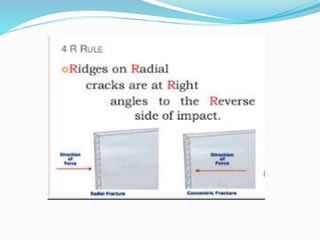
 The radial fracture originates on the surface opposite to
that on which force was applied.
 This type of fracture is always the first to appear on glass.
Radial and concentric
fracture
CONCENTRIC FRACTURE
 A series of broken circles originate on the surface, on
which force is applied around the point of impact.
 There are the secondary fracture as they always
appears after radial fractures.
Radial and concentric
fracture
FRACTURE BY HEAT
 Fractures caused by excessive heat will not show
regular radial and concentric fractures as the impact is
not on one spot but will be in v-shape.
 The fracture will be dispersed and the glass will break
into small fragment and fall on the side where the heat
was applied or caused.
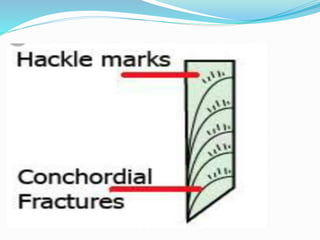
MARKS OF FRACTURES
 RIB MARKS
 HECKLE MARKS
RIB MARKS
 RIB MARKS-At radial fracture direction of the rib
marks is the stress marks on broken edges of glass that
are to one side of glass.
 For radial fractures (radiating form of centre), the
direction of the force is on the same side as the
tangential parts of rib marks.
 In this direction of collision was compressed and at
opposite side will expanded.
HECKLE MARKS
 They are found between rib marks. If the impact
occurred to the glass surface on the outside of the
house , then the heckle marks would be at right angles
to the glass surface on the inside of glass.
Forensic glass examination
 A forensic glass analysis is typically a comparison of two
more glass fragments in an attempt to determine if they
originated from different sources.
 These analysis requires the determination of class
characteristics that may associate objects with a group of
similar object.
 Only physically matching of two or more broken glass
fragments allows for their association with each other to
the exclusion of all other sources.
Refractive index:
(ND)
 The ratio of the velocity of light in a vacuum to the
velocity of light in a given medium
 ND (Water)- 1.333. i.e. light travels 1.333 time faster in
vacuum than in water
 An intensive property
 varies with temperature and the light frequency
performed less frequently than
refractive index determination
because
 The glass fragment must be scrupulously clean and
free of inclusions
 accurate density measurements require a sample that
is two or three mm in diameter.
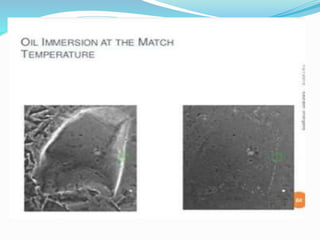
BACKE LINE METHOD (1892)
 When the objective of the microscope is raised, a
bright line moves into the direction of the material of
higher R.I.
 Once the line disappears or doesn't move, the
refractive index of oil can be measured by a
refractometer.
 the backe line is best observed with contrast
microscopy.
REFERENCE
 FORENSIC SCIENCE IN CRIME SCENE
INVESTIGATION(Third Edition) by B.S.NABAR
 Forensic interpretation of glass evidence by James
Michael Curran Tacha Natalie Hicks
 Slide share.net/mobile
 https://www.journals.uchicajo.edu/doi/abs/10.1086/62
6840?journalcode=jg
THANKYOU

Glass fracture

  • 1.
    PRESENTED BY- ANJALI VISHWAKARMA ROLLNO.-Y19242503 PRESENTED TO- DR. NAVJOT KAUR
  • 2.
    CONTENT  Glass definition Types of glass  General properties of glass  Scope of glass examination  Types of cracks and fractures in glass sample and their interpretation  Forensic examination of glass samples.
  • 3.
    scopes  Glass, asa physical clue, is frequently encountered in various crimes such as burglary, road accidents, murder, sexual assaults, shooting incidents, arson and vandalism.  The chips of broken glass window may be lodged in suspect’s shoes or garments during the act of burglary/crime, particles of headlight glass found at the crime scene make offer clues that confirm the identity of a suspected vehicle, glass may also be found on the clothing of an alleged assailant, where a bottle is used as a weapon.
  • 4.
     Whenever thereis violence, bottles, window pane glass, mirrors, eye glasses and other glass objects can be accidently scattered and fragments of these can also adhere to the criminal's clothing or shoes.  Thus, glass forms one evidentiary materials in many criminal investigations
  • 5.
    Glass glass is technicallydefined as ‘’The inorganic product of fusion which has cooled to a rigid condition without crystallizing.’’ In contrast to crystalline solids which have an ordered internal arrangement of atoms ,the internal structure of glass consists of a network of atoms lacking long-range symmetry; This condition is referred to as the vitreous, or glassy, state.
  • 6.
     An extended,3-D network of atoms which lacks the repeated, orderly arrangement typical of crystalline materials. Quartz melt quartz glass  Glass is made by heating silica and with soda and lime and something other materials to a molten mass, then cooling it so quickly that there is no time for crystals to form in the glass.
  • 7.
     Even thoughglass is a liquid to us it appears solid it is not viscous like other liquids, but it looks rigid.  The viscosity is such a high value that the amorphous material acts like a solid
  • 8.
    CHEMICAL COMPOSITION OF GLASS Glass is a hard and crystalline substance which is super cooled liquid, tensile strength of glass depends upon chemical bonding of glass mainly includes oxides of various metals.  They are- 1. Network forming oxides 2. Network loosing oxides 3. Stabilizing oxides 4. Intermediates oxides
  • 9.
    NETWORK FORMING OXIDES Eg- SiO2, B2O3, As2O3, P2O5  They are also called “formers”  They form network of glass.
  • 10.
    NETWORK LOOSING OXIDES Eg- Na2O, CaO, MgO, BaO, K2O, LiO2 etc.  They decreases the melting point of glass.  They are also called fluxes – “softeners”.
  • 11.
    STABILISG OXIDES  Eg.-CaO,BaO,MgO etc.  They decreases rate of hydrolysis.  They are also called “modifiers’’
  • 12.
    INTERMEDIATES OXIDES  Eg.-Al2o3,Sb2O3, PbO, ZnO, TiO2, BeO etc.  They plays role of modifiers and formers.
  • 13.
    TYPES OF GLASS [A].On the basis of manufacturing process:  Ordinary sheet glass  Float glass (plate) [B].On the basis of composition:  Oxide glass  Non oxide glass [C].On the basis of market application  Commercial the basic of market application :  Lead glass  Borosilicate glass  Laminated glass  Tempered glass
  • 14.
    Collection preservation ofglass evidence  Firstly photographed the glass piece found as a evidence on soc.  Fingerprints are generally found on glass surface. Cases in which breaking of glass was done due to the result of struggle, probability of finding latent fingerprints is more in the surface of glass.  Note done the presence of latent prints on the surface of glass and also the inner and outer surface of glass. This is important in the process of division and determination.  For physical matching, it is necessary to collect the suspect object or artical from which the glass piece belongs to.
  • 15.
     For packing,glass piece should always be wrapped in cotton or cloth. Minute piece of glass should be packed in pill box for edges, it should be sealed with wax or modeling clay so they can not destroyed otherwise contor matching is not possible.  Detail should be refer after packing.
  • 16.
    PHYSICAL AND CHEMICAL MATCHING CHEMICALMATCHING-Laboratory examination of glass is based on comparison.  PRELIMINARY EXAMINATION- Matching should be done of glass piece with its belong parts on the parameters of color, thickness, design, curvature, color comparison also done in uv light.  COMPARISON OF DENSITY-Density of glass is 2.1-8.1 gm cm3 whereas optical and crystal glass having their density much more in comparison to normal glass
  • 17.
     FREE FLOATATIONMOTHOD  UV LIGHT METHOD  NEEDLE SHAPE MICROSCOPE  DENSITY GRADIENT COLUMN METHOD  COMPARISON OF REFRACTIVE INDEX
  • 21.
    SOME SPECIAL TYPESOF GLASSS  Glass fiber  Vitreous silica  Alumino-silicate glass  Alkali-barium silicate glass  Glass ceramics  Technical glass  Phosphate glass  Optical glass  Sealing glass
  • 22.
    GALSS FRACTURE  Byfracture direction of force of known  Whenever any object collides with the glass with force then as a result cracks will develops in glass on it will break. FACTURE REDIAL FRACTURE CONCENTRIC FRACTURE FRACTURE BY HEAT
  • 23.
    RADIAL FRACTURE  Whenan object has been thrown through pane, a fracture forming a pattern somewhat like a spider web will be seen.  The cracks will appear radiating outwards from the point of impact making a star shaped fracture known as radial fracture.  The radial fracture originates on the surface opposite to that on which force was applied.  This type of fracture is always the first to appear on glass.
  • 24.
  • 25.
    CONCENTRIC FRACTURE  Aseries of broken circles originate on the surface, on which force is applied around the point of impact.  There are the secondary fracture as they always appears after radial fractures.
  • 26.
  • 27.
    FRACTURE BY HEAT Fractures caused by excessive heat will not show regular radial and concentric fractures as the impact is not on one spot but will be in v-shape.  The fracture will be dispersed and the glass will break into small fragment and fall on the side where the heat was applied or caused.
  • 28.
    MARKS OF FRACTURES RIB MARKS  HECKLE MARKS
  • 30.
    RIB MARKS  RIBMARKS-At radial fracture direction of the rib marks is the stress marks on broken edges of glass that are to one side of glass.  For radial fractures (radiating form of centre), the direction of the force is on the same side as the tangential parts of rib marks.  In this direction of collision was compressed and at opposite side will expanded.
  • 31.
    HECKLE MARKS  Theyare found between rib marks. If the impact occurred to the glass surface on the outside of the house , then the heckle marks would be at right angles to the glass surface on the inside of glass.
  • 33.
    Forensic glass examination A forensic glass analysis is typically a comparison of two more glass fragments in an attempt to determine if they originated from different sources.  These analysis requires the determination of class characteristics that may associate objects with a group of similar object.  Only physically matching of two or more broken glass fragments allows for their association with each other to the exclusion of all other sources.
  • 34.
    Refractive index: (ND)  Theratio of the velocity of light in a vacuum to the velocity of light in a given medium  ND (Water)- 1.333. i.e. light travels 1.333 time faster in vacuum than in water  An intensive property  varies with temperature and the light frequency
  • 35.
    performed less frequentlythan refractive index determination because  The glass fragment must be scrupulously clean and free of inclusions  accurate density measurements require a sample that is two or three mm in diameter.
  • 36.
    BACKE LINE METHOD(1892)  When the objective of the microscope is raised, a bright line moves into the direction of the material of higher R.I.  Once the line disappears or doesn't move, the refractive index of oil can be measured by a refractometer.  the backe line is best observed with contrast microscopy.
  • 38.
    REFERENCE  FORENSIC SCIENCEIN CRIME SCENE INVESTIGATION(Third Edition) by B.S.NABAR  Forensic interpretation of glass evidence by James Michael Curran Tacha Natalie Hicks  Slide share.net/mobile  https://www.journals.uchicajo.edu/doi/abs/10.1086/62 6840?journalcode=jg
  • 39.