Elements of Forensic Science Types of Evidence Related Services
Elements of Forensic Science Firearms and Toolmark Identification Forensic Psychiatry and Profiling Questioned Document Examination Criminal Law Careers in Law Enforcement Forensic Photography Personal Identification Crime Scene Processing
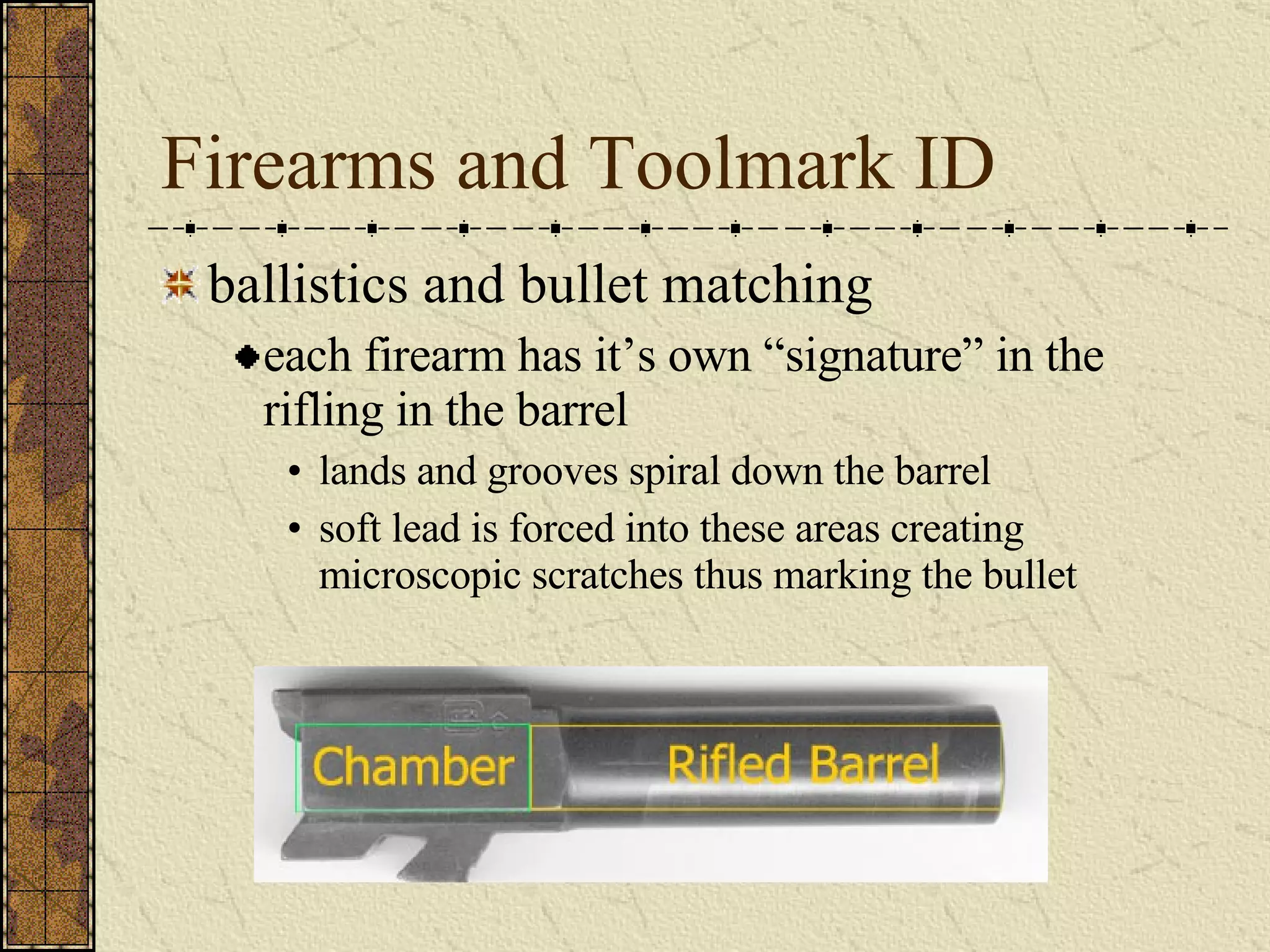
Firearms and Toolmark ID ballistics and bullet matching each firearm has it’s own “signature” in the rifling in the barrel lands and grooves spiral down the barrel soft lead is forced into these areas creating microscopic scratches thus marking the bullet
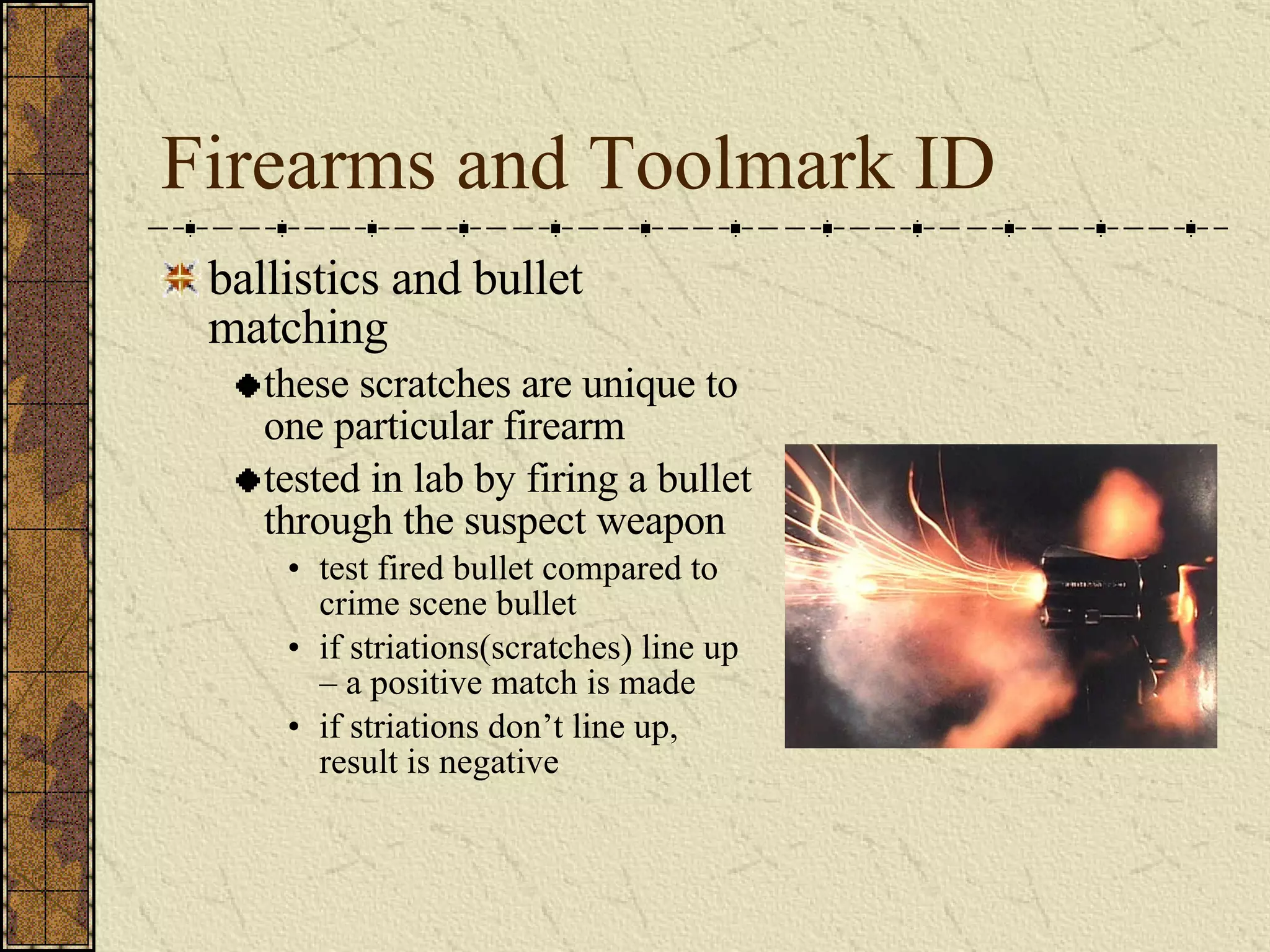
Firearms and Toolmark ID ballistics and bullet matching these scratches are unique to one particular firearm tested in lab by firing a bullet through the suspect weapon test fired bullet compared to crime scene bullet if striations(scratches) line up – a positive match is made if striations don’t line up, result is negative
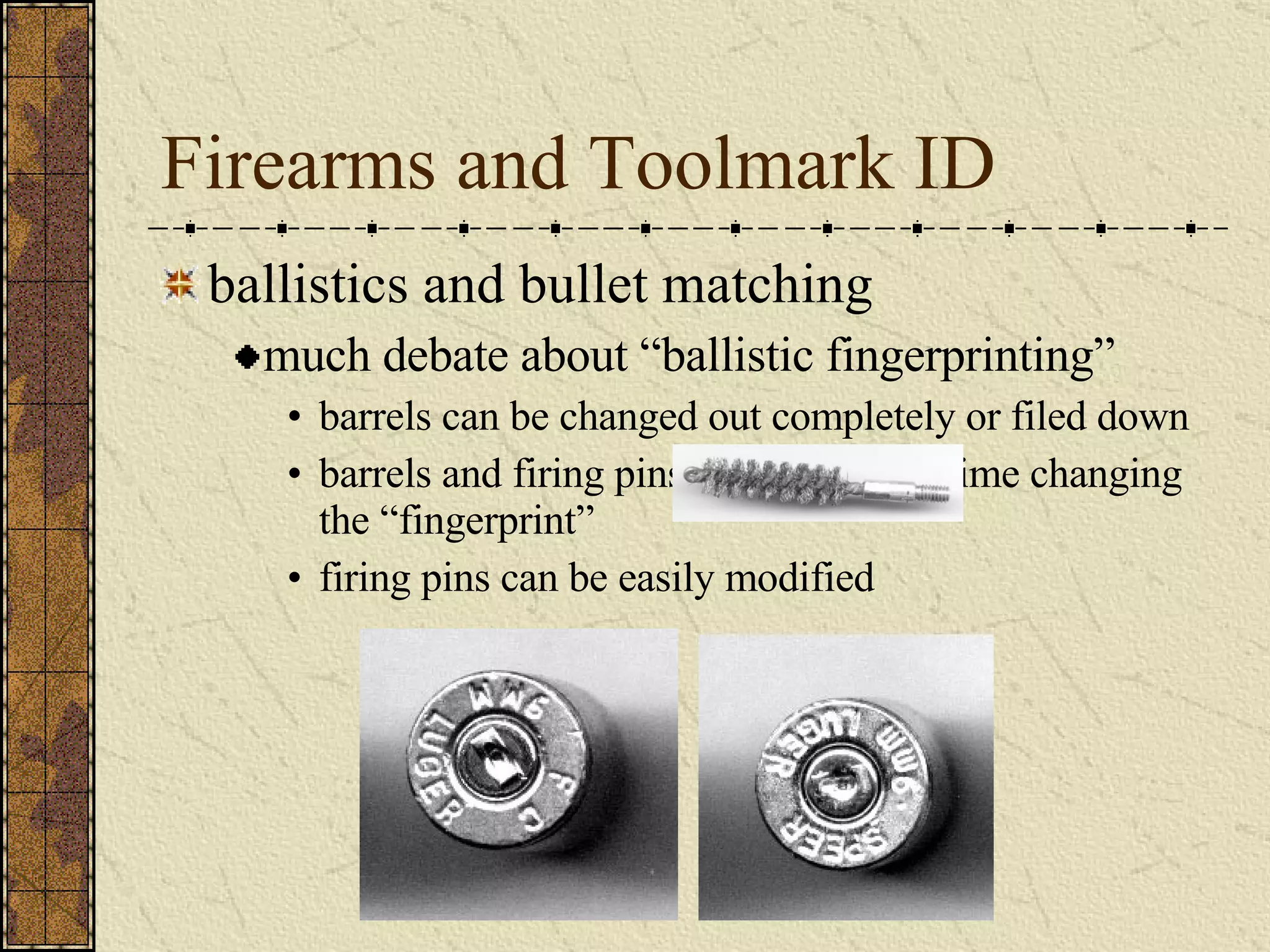
Firearms and Toolmark ID ballistics and bullet matching much debate about “ballistic fingerprinting” barrels can be changed out completely or filed down barrels and firing pins also wear with time changing the “fingerprint” firing pins can be easily modified
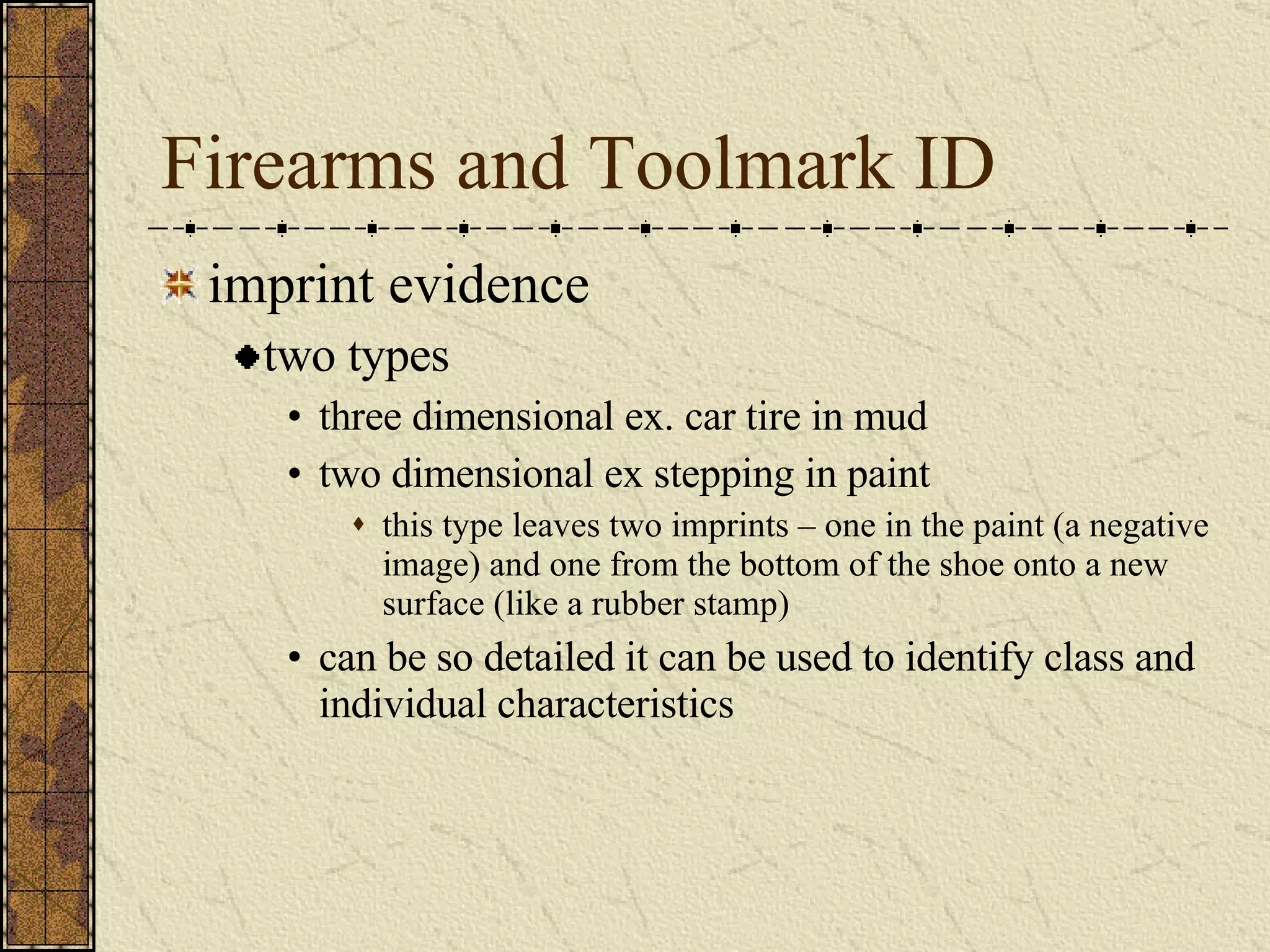
Firearms and Toolmark ID imprint evidence two types three dimensional ex. car tire in mud two dimensional ex stepping in paint this type leaves two imprints – one in the paint (a negative image) and one from the bottom of the shoe onto a new surface (like a rubber stamp)  can be so detailed it can be used to identify class and individual characteristics
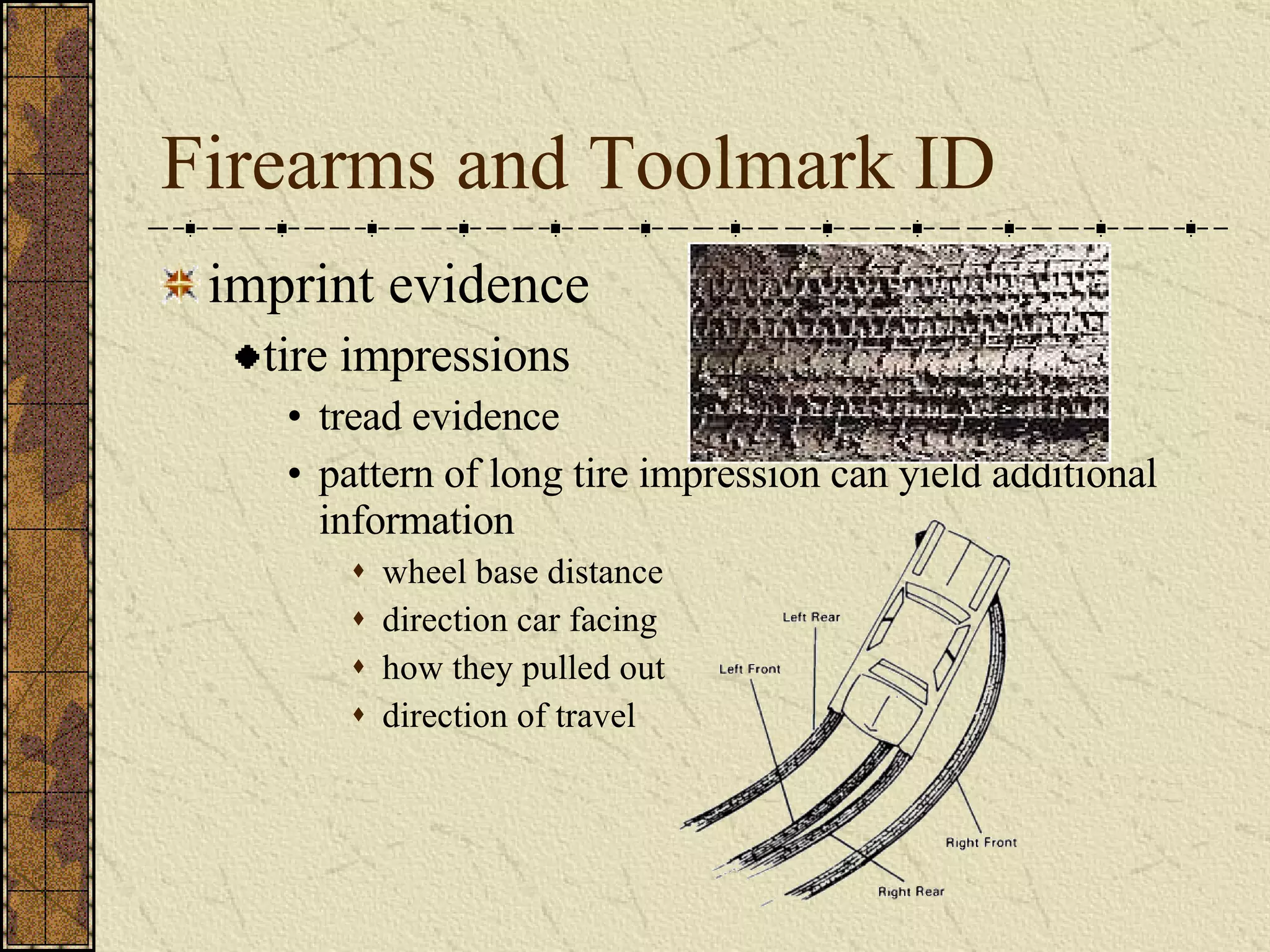
Firearms and Toolmark ID imprint evidence tire impressions tread evidence pattern of long tire impression can yield additional information wheel base distance direction car facing how they pulled out  direction of travel
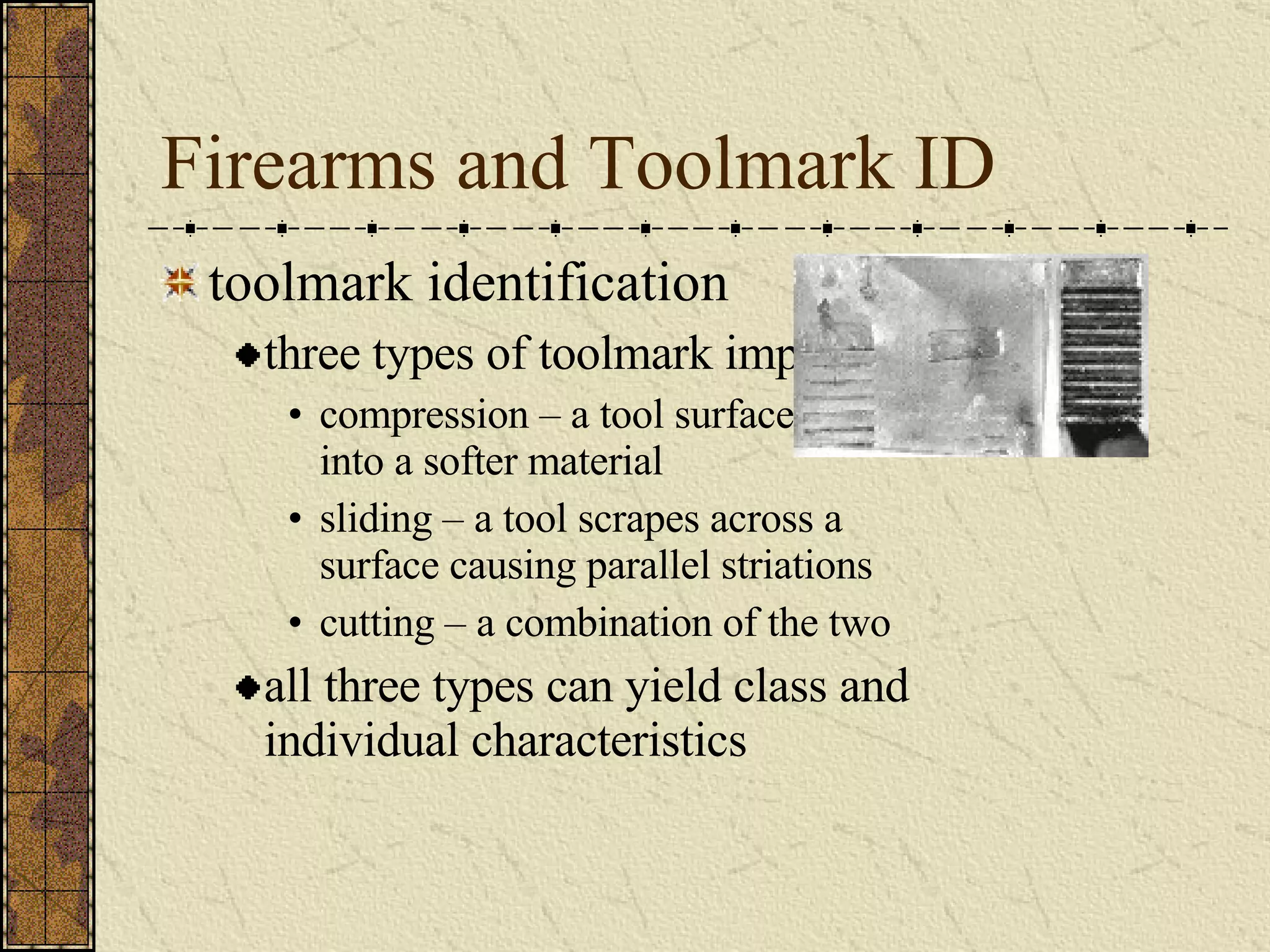
Firearms and Toolmark ID toolmark identification three types of toolmark impressions compression – a tool surface presses into a softer material sliding – a tool scrapes across a surface causing parallel striations cutting – a combination of the two all three types can yield class and individual characteristics
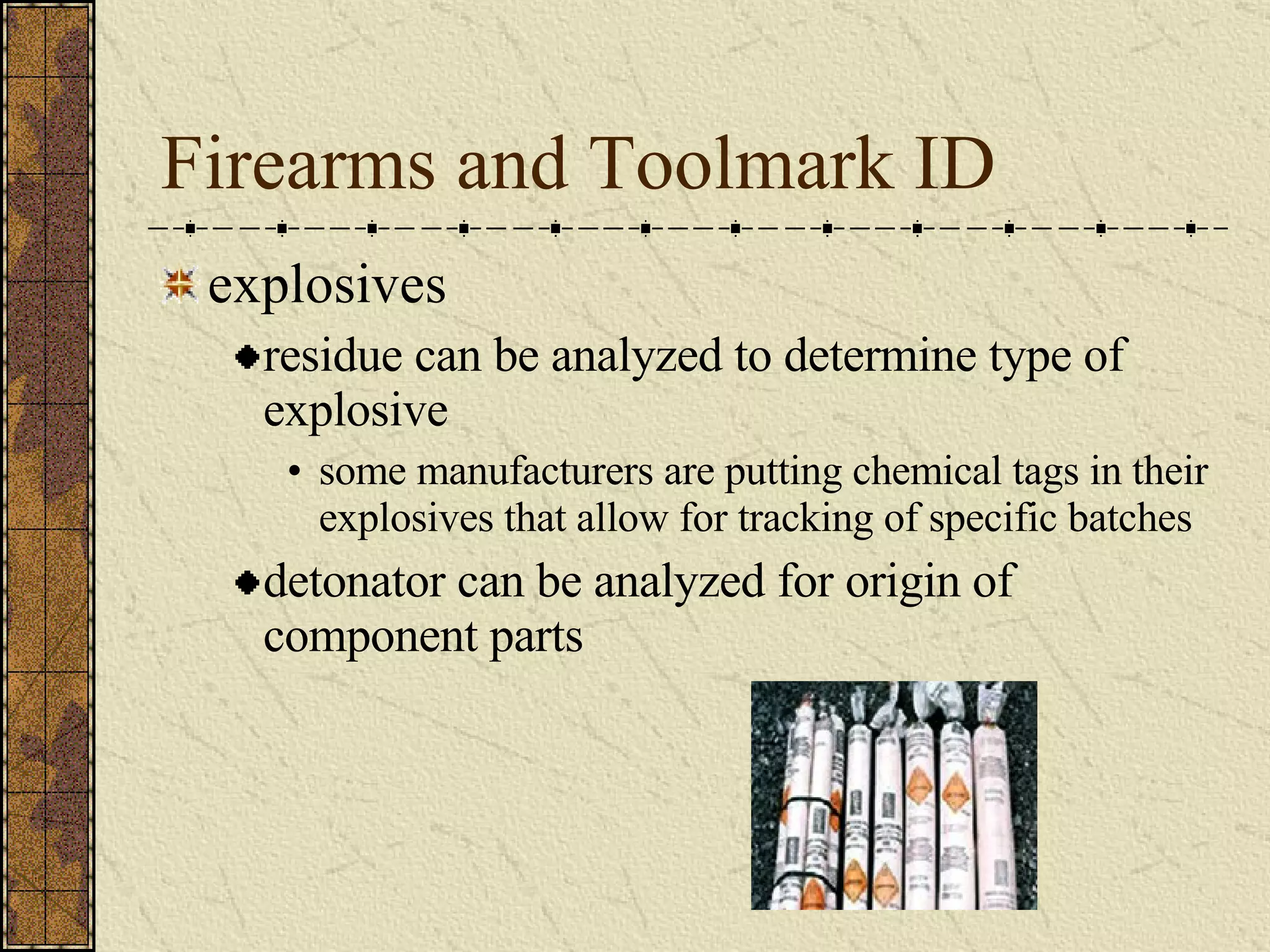
Firearms and Toolmark ID explosives residue can be analyzed to determine type of explosive some manufacturers are putting chemical tags in their explosives that allow for tracking of specific batches  detonator can be analyzed for origin of component parts
Forensic Psychiatry& Profiling forensic psychiatry serves to define what mental illness and disorder are what creates mental illness and disorder how they are diagnosed how they are treated
Forensic Psychiatry& Profiling forensic psychiatry mental illness – the individual does not function well because of emotional fluctuations or distorted point of view interpretation mental disorder – clinically significant behavior or psychological syndrome or pattern that is associated with present distress or disability or with a significantly increased risk of suffering death, pain or disability or loss of freedom
Forensic Psychiatry& Profiling forensic psychiatry issue of incompetency is fitness to stand trial must understand what is going on can help in their own defense three bases of incompetency emotional/psychological factors cognitive or intellectual factors physical factors competency evaluation must be done – cannot be refused
Forensic Psychiatry& Profiling forensic psychiatry issue of insanity applies to mental state of defendant at time at which the crime was committed defendant must concede guilt at time of insanity plea defendant must be competent to stand trial defendant must prove profound defect of mental ability – this must be directly related to the crime
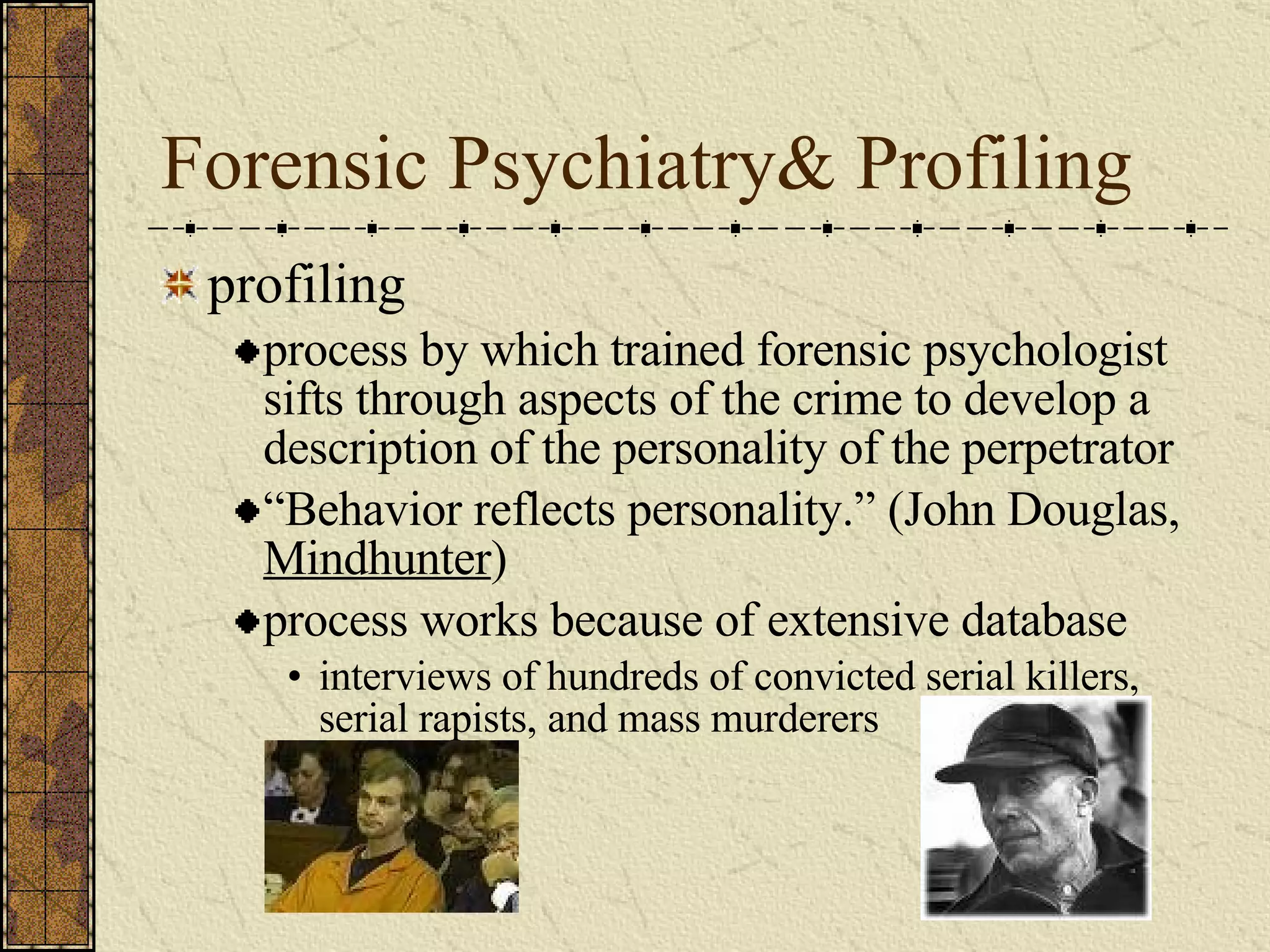
Forensic Psychiatry& Profiling profiling process by which trained forensic psychologist sifts through aspects of the crime to develop a description of the personality of the perpetrator “ Behavior reflects personality.” (John Douglas,  Mindhunter ) process works because of extensive database interviews of hundreds of convicted serial killers, serial rapists, and mass murderers
Forensic Psychiatry& Profiling profiling description can include age sex occupation behavioral disorders upbringing  marital status type of living quarters and general condition type of person the perpetrator lives with what type of car is driven any disability or difficulty in relating to others how the crime was committed
Forensic Psychiatry& Profiling profiling description can be used to focus investigation on particular suspects provide strategies on how to approach suspect during interrogation provide strategies on how to break him down on the witness stand at the trial Criminal Minds
Questioned Document Analysis handwriting analysis examination of design, shape and structure  determine authorship basic principle is that no two people will write the exact same thing in the exact same way
Questioned Document Analysis handwriting analysis  characteristics letter formations connectors upstrokes retraces down strokes spacing baseline curves size distortions hesitations flying stops
Questioned Document Analysis typewriting much like firearms, typewriters of the same make and model are pretty much the same daily wear and tear or parts of the machining process can cause “defects” or individual characteristics that translate to paper when the machine is used
Questioned Document Analysis photocopiers and laser printers in photocopier, original is placed on glass and exposed using reflected light to a drum that is covered with photosensitve material image of original exists on drum as invisible positive photoelectric charge negatively charged toner is drizzled on drum where it sticks to the positive image paper with a positive charge passes the drum causing the negatively charged toner to transfer to the paper which is then heat sealed with laser printer - image of the original held in memory of computer is written to the photosensitive drum using a laser
Questioned Document Analysis photocopiers and laser printers paper yields clues marks from belts, pinchers, rollers and gears can be matched like toolmarks toner can have unique chemical compositions how toner is placed and fused on paper (ie. clumps, blobs) marks on optics scratches or other marks on glass, lenses or mirrors will leave markings on the printed page that can be matched with the optic
Questioned Document Analysis forgery false making or altering of any writing with intent to defraud four types traced simulation freehand lifted
Questioned Document Analysis forgery traced can use overlays (like tracing paper) transmitted light (as with a light board) tracing indentations left in the page underneath the original  tracing patterns of dots that outline the writing to be forged
Questioned Document Analysis forgery simulation involves the copying of writing from a genuine article, trying to imitate the handwriting of the original freehand written with no knowledge of the appearance of the original just writing off the top of your head and passing it off as something else
Questioned Document Analysis forgery lifted tape is used to lift off a signature then place it on another document detection of forgeries freehand easiest to detect simulation easy to detect – style not as fluid, more hesitations than “comfortable” writing traced and lifted are easy to detect but identity of forger cannot be determined
Questioned Document Analysis counterfeit security measures U.S. currency easy to counterfeit! all paper currency after 1993 has microline printing, nylon security threads and a plastic security strip as of 2000, all paper currency was updated except the $1 bill
Questioned Document Analysis counterfeit security measures official documents (i.e. passport) background is printed with intricate pattern of polygons with a color shift in the ink green stars – reflective specks sealed in the paper blue “USA” stamp overlaps photo and background paper three red stars stamped over edge of photo whole page sealed with single sheet of adhesive plastic microline printing in lower right corner
Criminal Law serves to define offences under a codified system of laws and punishments where we define what crime is and how it goes about being prosecuted
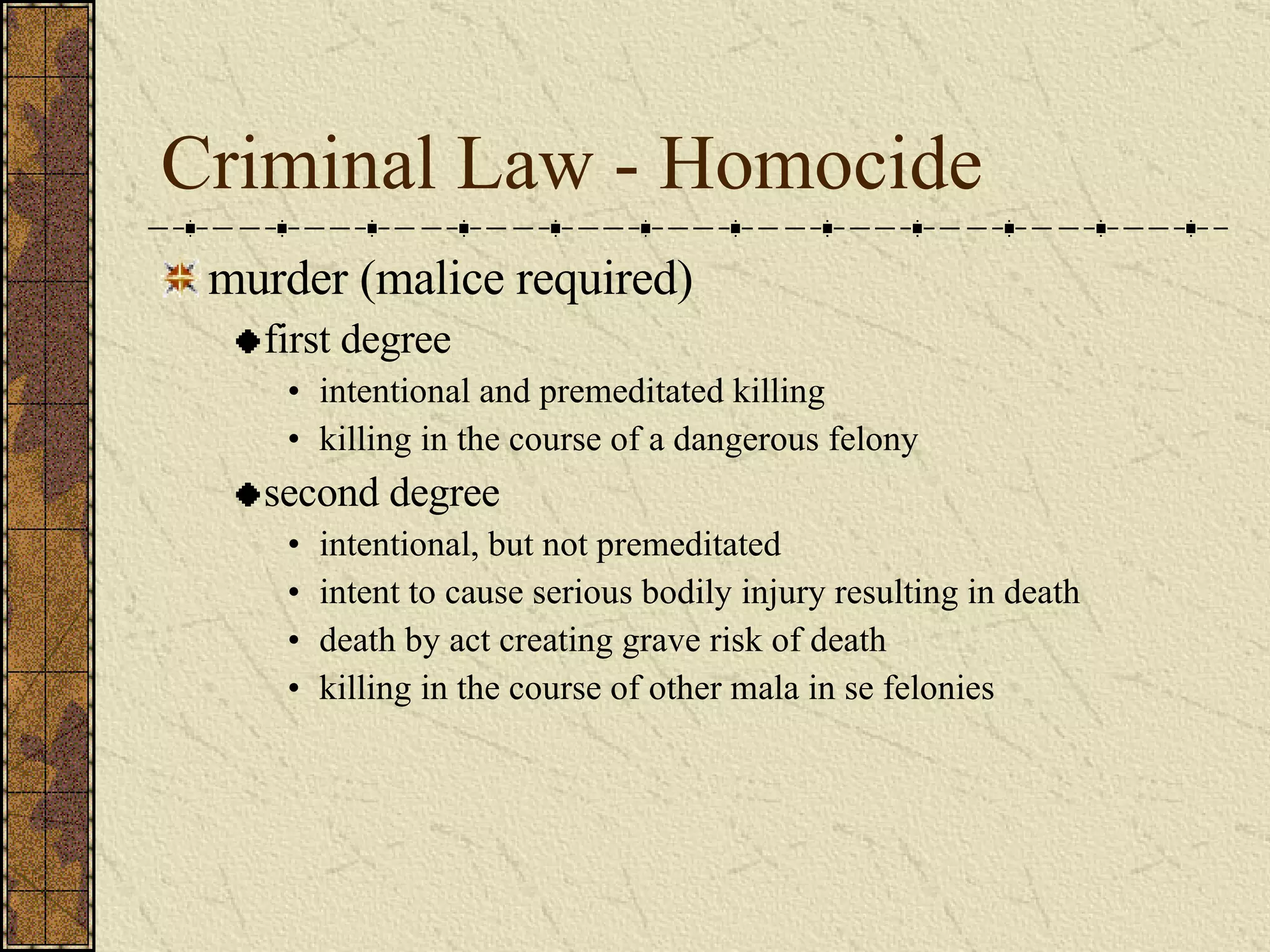
Criminal Law - Homocide murder (malice required) first degree intentional and premeditated killing killing in the course of a dangerous felony second degree intentional, but not premeditated intent to cause serious bodily injury resulting in death death by act creating grave risk of death killing in the course of other mala in se felonies
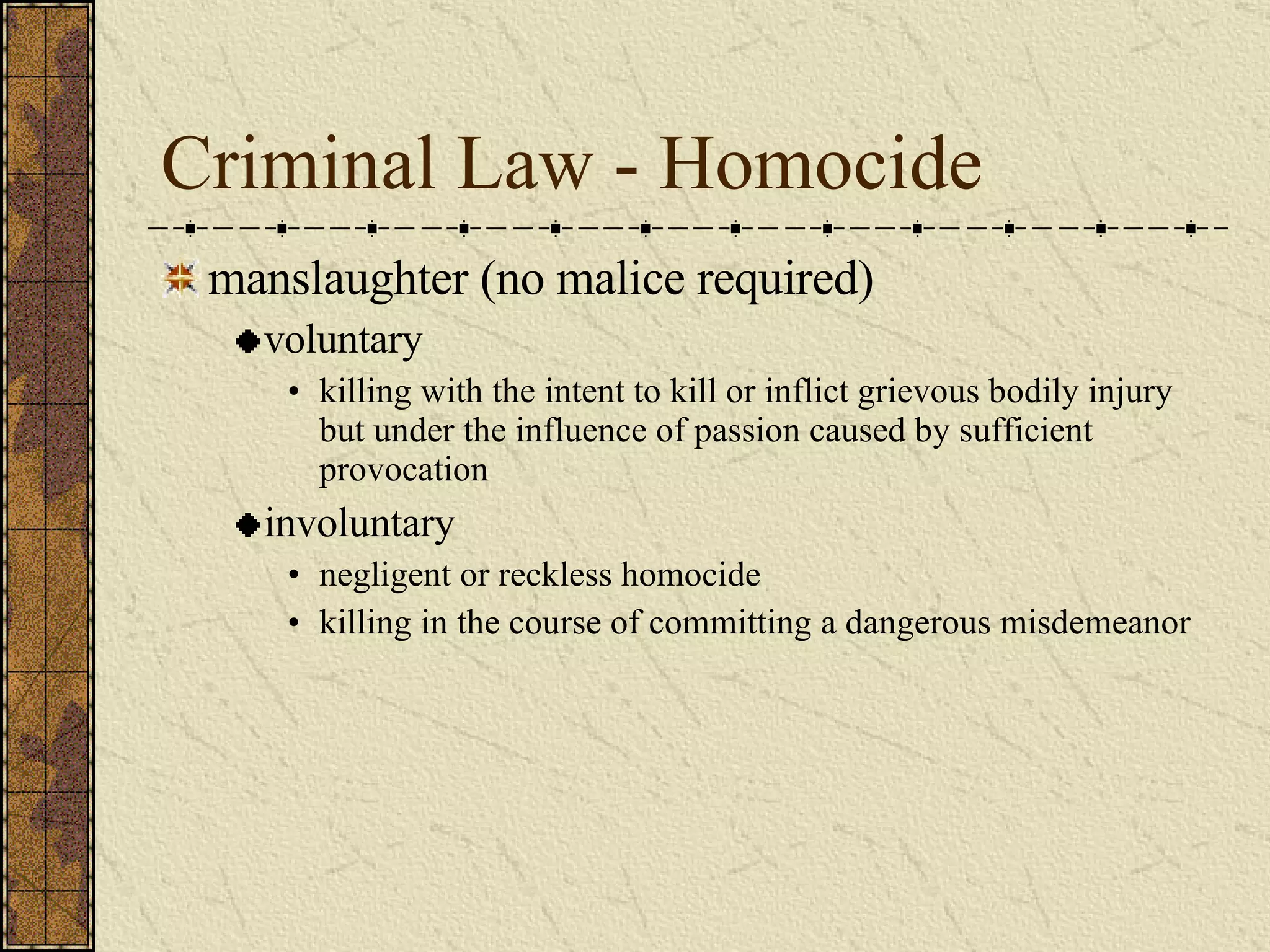
Criminal Law - Homocide manslaughter (no malice required) voluntary killing with the intent to kill or inflict grievous bodily injury but under the influence of passion caused by sufficient provocation involuntary negligent or reckless homocide killing in the course of committing a dangerous misdemeanor
Criminal Law - Homocide justifiable homocide self defense defense of others defense of property prevention of felonies arresting a felon
Criminal Law - Homocide accidental death duty of care involuntary manslaughter or negligence
Criminal Law –  Assault and Battery battery intentional or reckless touching of another without excuse or justification does not require significant blow that inflicts bodily injury
Criminal Law –  Assault and Battery assault an unlawful attempt, coupled with present ability, to commit a battery (such as a missed punch)
Criminal Law –  Assault and Battery aggravated assault and battery when battery inflicts a serious bodily injury or assault and battery involves the use of a deadly weapon assault with intent to rape
Criminal Law – Rape sexual intercourse by a male with a female, who is not his wife, achieved by force or threat of force against the will of the victim force can include drugs administered by the male OR inability of the victim to understand what is happening spousal “immunity” in some old laws has been done away with men don’t rape men – they sodomize women may be charged with rape as a accomplice, (this too is changing)
Criminal Law – Rape statutory rape involves sexual intercourse with a minor who is regarded by law as incapable of giving lawful consent to the act
Criminal Law – Conspiracy agreement between two or more people, beyond an undercover government agent, to commit an unlawful act, and some degree of intent ultimate act can be impossible to carry out everyone does not have to know everyone else involved all parties must have a common end acts of one are acts of all
Criminal Law – Conspiracy for conspiracy, one overt act in furtherance of the crime by any involved party gives liability if one abandons the conspiracy, he is still liable for the conspiracy, but not the resulting act “ overt act” need not be criminal in itself individuals are charged with conspiracy and the actual crime (i.e. murder), the two don’t merge
Criminal Law – Burglary at common law, breaking and entering into a dwelling during the night with intent to commit a felony modern code includes any building or similar structure day or night unlawful entry with or without a breaking people get robbed, not houses
Criminal Law – Larceny taking the property of another, with knowledge of their ownership, to deprive them permanently or infringe upon their rights in a substantial way petit vs. grand larceny varies in $$$ amount of property one cannot negligently steal
Criminal Law – Embezzlement persons who lawfully received possession of the property of another and then wrongfully convert that property to their own use real property can be embezzled does not require intent to permanently deprive
Criminal Law – False Pretenses applies to persons who induce others to transfer property to them by means of misrepresentation, which must be to a material past or present fact that the seller know to be false does not include “seller’s talk”
Criminal Law – Robbery a larceny with the stolen property taken from the victim in the presence of the victim and with the taking accomplished by means of force or threat of force crime against person and property Does pickpocketing constitute a robbery?
Criminal Law – Extortion threat of force or harm used to achieve some sort of benefit to the criminal truth can be used as leverage benefit does not have to be monetary “ blackmailing”
Criminal Law – Arson an intentional or reckless burning or explosion of a building owned by another person or, under limited circumstances, of a building owned by the actor
Criminal Law – Solicitation agreement to commit a crime hiring individual is just as liable as the actor merges into conspiracy
Criminal Law –  Aiding and Abetting involved prior to the crime, contributed to the act or induced the act, even if not involved in the act itself one who orders a crime shares the same liability as the actor
Careers in Law Enforcement federal law enforcement state agencies city agencies local agencies private sector
Careers in Law Enforcement types of jobs investigators, officers, troopers lab positions support positions (clerks, evidence technicians, surveillance operations, photographers) education necessary depends on job description and agency usually college degree to start specialization in a field might be required
Careers in Law Enforcement typical application process call agency’s personal department and ask for an application send in and get called for initial interview written exam – much like SAT’s background questionnaire and check panel interview physical fitness test (if in the field) polygraph test

Elements Of Forensic Science

  • 1.
    Elements of ForensicScience Types of Evidence Related Services
  • 2.
    Elements of ForensicScience Firearms and Toolmark Identification Forensic Psychiatry and Profiling Questioned Document Examination Criminal Law Careers in Law Enforcement Forensic Photography Personal Identification Crime Scene Processing
  • 3.
    Firearms and ToolmarkID ballistics and bullet matching each firearm has it’s own “signature” in the rifling in the barrel lands and grooves spiral down the barrel soft lead is forced into these areas creating microscopic scratches thus marking the bullet
  • 4.
    Firearms and ToolmarkID ballistics and bullet matching these scratches are unique to one particular firearm tested in lab by firing a bullet through the suspect weapon test fired bullet compared to crime scene bullet if striations(scratches) line up – a positive match is made if striations don’t line up, result is negative
  • 5.
    Firearms and ToolmarkID ballistics and bullet matching much debate about “ballistic fingerprinting” barrels can be changed out completely or filed down barrels and firing pins also wear with time changing the “fingerprint” firing pins can be easily modified
  • 6.
    Firearms and ToolmarkID imprint evidence two types three dimensional ex. car tire in mud two dimensional ex stepping in paint this type leaves two imprints – one in the paint (a negative image) and one from the bottom of the shoe onto a new surface (like a rubber stamp) can be so detailed it can be used to identify class and individual characteristics
  • 7.
    Firearms and ToolmarkID imprint evidence tire impressions tread evidence pattern of long tire impression can yield additional information wheel base distance direction car facing how they pulled out direction of travel
  • 8.
    Firearms and ToolmarkID toolmark identification three types of toolmark impressions compression – a tool surface presses into a softer material sliding – a tool scrapes across a surface causing parallel striations cutting – a combination of the two all three types can yield class and individual characteristics
  • 9.
    Firearms and ToolmarkID explosives residue can be analyzed to determine type of explosive some manufacturers are putting chemical tags in their explosives that allow for tracking of specific batches detonator can be analyzed for origin of component parts
  • 10.
    Forensic Psychiatry& Profilingforensic psychiatry serves to define what mental illness and disorder are what creates mental illness and disorder how they are diagnosed how they are treated
  • 11.
    Forensic Psychiatry& Profilingforensic psychiatry mental illness – the individual does not function well because of emotional fluctuations or distorted point of view interpretation mental disorder – clinically significant behavior or psychological syndrome or pattern that is associated with present distress or disability or with a significantly increased risk of suffering death, pain or disability or loss of freedom
  • 12.
    Forensic Psychiatry& Profilingforensic psychiatry issue of incompetency is fitness to stand trial must understand what is going on can help in their own defense three bases of incompetency emotional/psychological factors cognitive or intellectual factors physical factors competency evaluation must be done – cannot be refused
  • 13.
    Forensic Psychiatry& Profilingforensic psychiatry issue of insanity applies to mental state of defendant at time at which the crime was committed defendant must concede guilt at time of insanity plea defendant must be competent to stand trial defendant must prove profound defect of mental ability – this must be directly related to the crime
  • 14.
    Forensic Psychiatry& Profilingprofiling process by which trained forensic psychologist sifts through aspects of the crime to develop a description of the personality of the perpetrator “ Behavior reflects personality.” (John Douglas, Mindhunter ) process works because of extensive database interviews of hundreds of convicted serial killers, serial rapists, and mass murderers
  • 15.
    Forensic Psychiatry& Profilingprofiling description can include age sex occupation behavioral disorders upbringing marital status type of living quarters and general condition type of person the perpetrator lives with what type of car is driven any disability or difficulty in relating to others how the crime was committed
  • 16.
    Forensic Psychiatry& Profilingprofiling description can be used to focus investigation on particular suspects provide strategies on how to approach suspect during interrogation provide strategies on how to break him down on the witness stand at the trial Criminal Minds
  • 17.
    Questioned Document Analysishandwriting analysis examination of design, shape and structure determine authorship basic principle is that no two people will write the exact same thing in the exact same way
  • 18.
    Questioned Document Analysishandwriting analysis characteristics letter formations connectors upstrokes retraces down strokes spacing baseline curves size distortions hesitations flying stops
  • 19.
    Questioned Document Analysistypewriting much like firearms, typewriters of the same make and model are pretty much the same daily wear and tear or parts of the machining process can cause “defects” or individual characteristics that translate to paper when the machine is used
  • 20.
    Questioned Document Analysisphotocopiers and laser printers in photocopier, original is placed on glass and exposed using reflected light to a drum that is covered with photosensitve material image of original exists on drum as invisible positive photoelectric charge negatively charged toner is drizzled on drum where it sticks to the positive image paper with a positive charge passes the drum causing the negatively charged toner to transfer to the paper which is then heat sealed with laser printer - image of the original held in memory of computer is written to the photosensitive drum using a laser
  • 21.
    Questioned Document Analysisphotocopiers and laser printers paper yields clues marks from belts, pinchers, rollers and gears can be matched like toolmarks toner can have unique chemical compositions how toner is placed and fused on paper (ie. clumps, blobs) marks on optics scratches or other marks on glass, lenses or mirrors will leave markings on the printed page that can be matched with the optic
  • 22.
    Questioned Document Analysisforgery false making or altering of any writing with intent to defraud four types traced simulation freehand lifted
  • 23.
    Questioned Document Analysisforgery traced can use overlays (like tracing paper) transmitted light (as with a light board) tracing indentations left in the page underneath the original tracing patterns of dots that outline the writing to be forged
  • 24.
    Questioned Document Analysisforgery simulation involves the copying of writing from a genuine article, trying to imitate the handwriting of the original freehand written with no knowledge of the appearance of the original just writing off the top of your head and passing it off as something else
  • 25.
    Questioned Document Analysisforgery lifted tape is used to lift off a signature then place it on another document detection of forgeries freehand easiest to detect simulation easy to detect – style not as fluid, more hesitations than “comfortable” writing traced and lifted are easy to detect but identity of forger cannot be determined
  • 26.
    Questioned Document Analysiscounterfeit security measures U.S. currency easy to counterfeit! all paper currency after 1993 has microline printing, nylon security threads and a plastic security strip as of 2000, all paper currency was updated except the $1 bill
  • 27.
    Questioned Document Analysiscounterfeit security measures official documents (i.e. passport) background is printed with intricate pattern of polygons with a color shift in the ink green stars – reflective specks sealed in the paper blue “USA” stamp overlaps photo and background paper three red stars stamped over edge of photo whole page sealed with single sheet of adhesive plastic microline printing in lower right corner
  • 28.
    Criminal Law servesto define offences under a codified system of laws and punishments where we define what crime is and how it goes about being prosecuted
  • 29.
    Criminal Law -Homocide murder (malice required) first degree intentional and premeditated killing killing in the course of a dangerous felony second degree intentional, but not premeditated intent to cause serious bodily injury resulting in death death by act creating grave risk of death killing in the course of other mala in se felonies
  • 30.
    Criminal Law -Homocide manslaughter (no malice required) voluntary killing with the intent to kill or inflict grievous bodily injury but under the influence of passion caused by sufficient provocation involuntary negligent or reckless homocide killing in the course of committing a dangerous misdemeanor
  • 31.
    Criminal Law -Homocide justifiable homocide self defense defense of others defense of property prevention of felonies arresting a felon
  • 32.
    Criminal Law -Homocide accidental death duty of care involuntary manslaughter or negligence
  • 33.
    Criminal Law – Assault and Battery battery intentional or reckless touching of another without excuse or justification does not require significant blow that inflicts bodily injury
  • 34.
    Criminal Law – Assault and Battery assault an unlawful attempt, coupled with present ability, to commit a battery (such as a missed punch)
  • 35.
    Criminal Law – Assault and Battery aggravated assault and battery when battery inflicts a serious bodily injury or assault and battery involves the use of a deadly weapon assault with intent to rape
  • 36.
    Criminal Law –Rape sexual intercourse by a male with a female, who is not his wife, achieved by force or threat of force against the will of the victim force can include drugs administered by the male OR inability of the victim to understand what is happening spousal “immunity” in some old laws has been done away with men don’t rape men – they sodomize women may be charged with rape as a accomplice, (this too is changing)
  • 37.
    Criminal Law –Rape statutory rape involves sexual intercourse with a minor who is regarded by law as incapable of giving lawful consent to the act
  • 38.
    Criminal Law –Conspiracy agreement between two or more people, beyond an undercover government agent, to commit an unlawful act, and some degree of intent ultimate act can be impossible to carry out everyone does not have to know everyone else involved all parties must have a common end acts of one are acts of all
  • 39.
    Criminal Law –Conspiracy for conspiracy, one overt act in furtherance of the crime by any involved party gives liability if one abandons the conspiracy, he is still liable for the conspiracy, but not the resulting act “ overt act” need not be criminal in itself individuals are charged with conspiracy and the actual crime (i.e. murder), the two don’t merge
  • 40.
    Criminal Law –Burglary at common law, breaking and entering into a dwelling during the night with intent to commit a felony modern code includes any building or similar structure day or night unlawful entry with or without a breaking people get robbed, not houses
  • 41.
    Criminal Law –Larceny taking the property of another, with knowledge of their ownership, to deprive them permanently or infringe upon their rights in a substantial way petit vs. grand larceny varies in $$$ amount of property one cannot negligently steal
  • 42.
    Criminal Law –Embezzlement persons who lawfully received possession of the property of another and then wrongfully convert that property to their own use real property can be embezzled does not require intent to permanently deprive
  • 43.
    Criminal Law –False Pretenses applies to persons who induce others to transfer property to them by means of misrepresentation, which must be to a material past or present fact that the seller know to be false does not include “seller’s talk”
  • 44.
    Criminal Law –Robbery a larceny with the stolen property taken from the victim in the presence of the victim and with the taking accomplished by means of force or threat of force crime against person and property Does pickpocketing constitute a robbery?
  • 45.
    Criminal Law –Extortion threat of force or harm used to achieve some sort of benefit to the criminal truth can be used as leverage benefit does not have to be monetary “ blackmailing”
  • 46.
    Criminal Law –Arson an intentional or reckless burning or explosion of a building owned by another person or, under limited circumstances, of a building owned by the actor
  • 47.
    Criminal Law –Solicitation agreement to commit a crime hiring individual is just as liable as the actor merges into conspiracy
  • 48.
    Criminal Law – Aiding and Abetting involved prior to the crime, contributed to the act or induced the act, even if not involved in the act itself one who orders a crime shares the same liability as the actor
  • 49.
    Careers in LawEnforcement federal law enforcement state agencies city agencies local agencies private sector
  • 50.
    Careers in LawEnforcement types of jobs investigators, officers, troopers lab positions support positions (clerks, evidence technicians, surveillance operations, photographers) education necessary depends on job description and agency usually college degree to start specialization in a field might be required
  • 51.
    Careers in LawEnforcement typical application process call agency’s personal department and ask for an application send in and get called for initial interview written exam – much like SAT’s background questionnaire and check panel interview physical fitness test (if in the field) polygraph test