Ballistics Powders Weapons Projectiles
Powders
Fire of Discovery - powders dirt with sulfur in it will sizzle and pop with lit on fire Chinese added concentrated sulfur to charcoal by the 9 th  Century AD, potassium nitrate crystals (saltpeter) was added burn the mixture for sparkly effects Taoist monks played with these chemicals to create true fireworks
Fire of Discovery - powders 12 th  Century and on… realization that this mixture could make stuff fly armies of Sung Dynasty added grenades to arsenals fragmentations bombs created military rockets and bombs some filled with poisons some filled with oil to start fires upon impact
Refining Gunpowder for hand held guns, improvements needed because carbon, sulfur and saltpeter all had different weights saltpeter would drop and carbon rise to the top = misfire could load weapon right before firing time consuming difficult
Refining Gunpowder ingredients could be made to stick together by mixing gunpowder with brandy and letting the resulting paste dry into corns or “grains” waste of brandy so other items were used vinegar urine
Weapons
Early Firearms 1364 – First recorded use of firearm 1380 – hand guns known across Europe
Early Firearms at this point, guns were fired by holding a burning wick to a “touch hole” in the barrel igniting the powder one hand to aim, one to ignite, and a prop to hold the gun
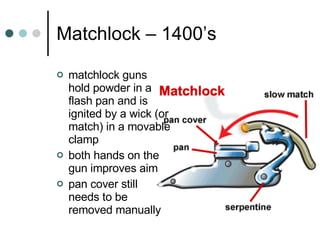
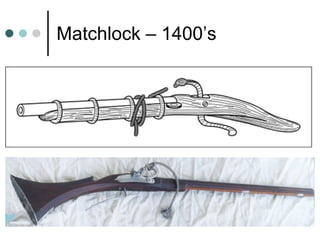
Matchlock – 1400’s matchlock guns hold powder in a flash pan and is ignited by a wick (or match) in a movable clamp both hands on the gun improves aim pan cover still needs to be removed manually
Matchlock – 1400’s
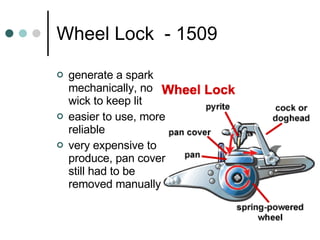
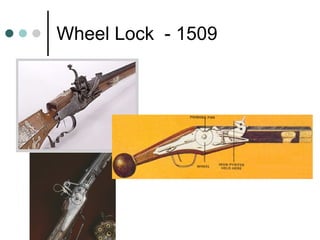
Wheel Lock  - 1509 generate a spark mechanically, no wick to keep lit easier to use, more reliable very expensive to produce, pan cover still had to be removed manually
Wheel Lock  - 1509
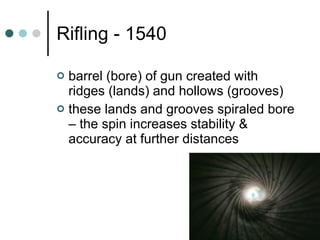
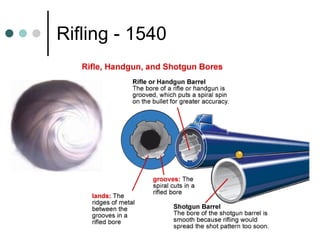
Rifling - 1540 barrel (bore) of gun created with ridges (lands) and hollows (grooves) these lands and grooves spiraled bore – the spin increases stability & accuracy at further distances
Rifling - 1540
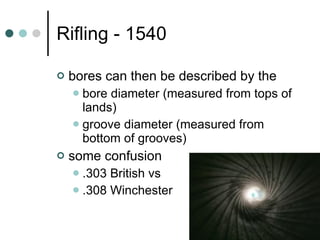
Rifling - 1540 bores can then be described by the bore diameter (measured from tops of lands) groove diameter (measured from bottom of grooves) some confusion .303 British vs .308 Winchester
Rifling - 1540 rifling also allows us to describe twist rates – the distance the bullet must travel to complete one full revolution 1:10 inches or 1:30 cm shorter distance means a “faster” twist length of projectile determines twist rate needed to stabilize it
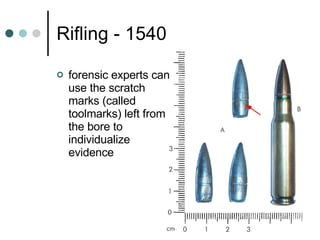
Rifling - 1540 forensic experts can use the scratch marks (called toolmarks) left from the bore to individualize evidence
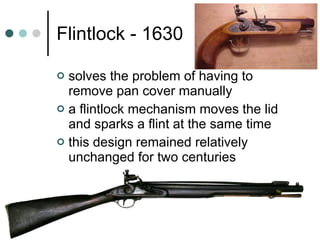
Flintlock - 1630 solves the problem of having to remove pan cover manually a flintlock mechanism moves the lid and sparks a flint at the same time this design remained relatively unchanged for two centuries
Percussion Caps - 1825 firing mechanism no longer uses flash pan, instead has a tube leading straight into the gun barrel the tube had an explosive cap on it that exploded when struck
Size Does Matter! Decimation of Target Fire Power
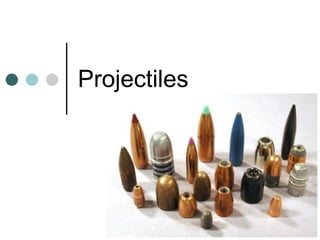
Projectiles
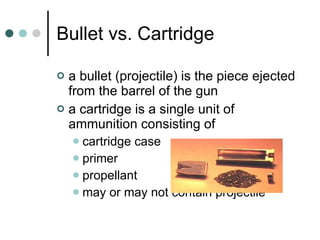
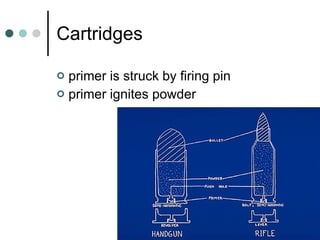
Bullet vs. Cartridge a bullet (projectile) is the piece ejected from the barrel of the gun a cartridge is a single unit of ammunition consisting of cartridge case primer propellant may or may not contain projectile
Cartridges primer is struck by firing pin primer ignites powder
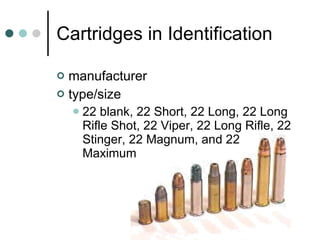
Cartridges in Identification manufacturer type/size 22 blank, 22 Short, 22 Long, 22 Long Rifle Shot, 22 Viper, 22 Long Rifle, 22 Stinger, 22 Magnum, and 22 Maximum
Bullets described by caliber diameter of bullet in hundredths of an inch bullet 30 hundredths of an inch (.30) is called a 30 caliber bullet this is an English derived system and used by manufacturers in the US in Europe, the metric system is used and a 30 caliber bullet would be called a 7.62mm bullet
Bullets balance between penetration and expansion is main idea of bullet construction too little penetration and internal organs not reached too much penetration and bullet can pass through target & energy is wasted down range hollow point demo
Bullets - Construction shape and material are key to identification bullets usu. made of  single metal alloy – non jacketed  layered combination of various materials (copper, lead, brass, bronze, steel, aluminum) – these are called jacketed bullets
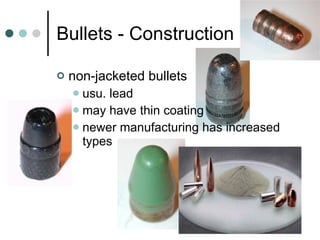
Bullets - Construction non-jacketed bullets usu. lead may have thin coating newer manufacturing has increased types
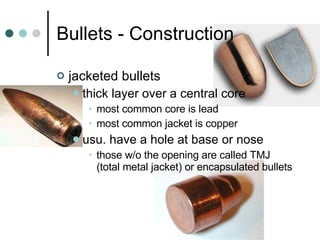
Bullets - Construction jacketed bullets thick layer over a central core most common core is lead most common jacket is copper usu. have a hole at base or nose those w/o the opening are called TMJ (total metal jacket) or encapsulated bullets
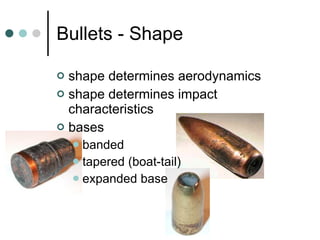
Bullets - Shape shape determines aerodynamics shape determines impact characteristics bases banded tapered (boat-tail) expanded base
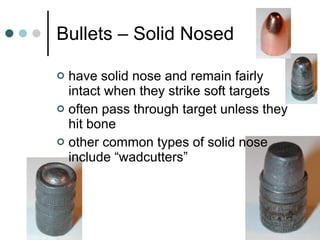
Bullets – Solid Nosed have solid nose and remain fairly intact when they strike soft targets often pass through target unless they hit bone other common types of solid nose include “wadcutters”
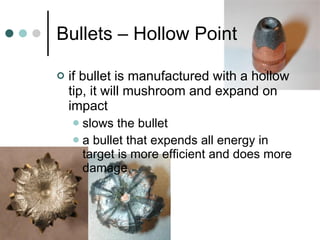
Bullets – Hollow Point if bullet is manufactured with a hollow tip, it will mushroom and expand on impact  slows the bullet a bullet that expends all energy in target is more efficient and does more damage
Bullets in Identification manufacturer construction shape  nose base materials jacketed vs. unjacketed weight  diameter
Class & Individual ID Class Characteristics rifling caliber Individual Characteristics breech marks firing pin impressions extractor marks ejector marks
Gun Shot Wounds  many determining factors distance weapon/caliber site of wound
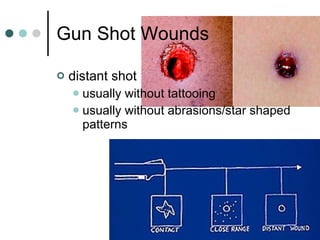
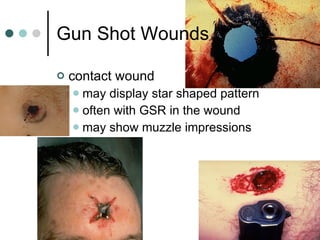
Gun Shot Wounds contact wound  may display star shaped pattern often with GSR in the wound may show muzzle impressions
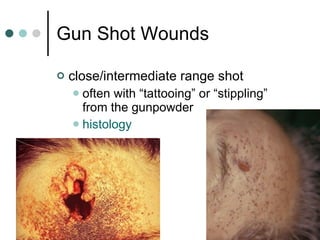
Gun Shot Wounds close/intermediate range shot often with “tattooing” or “stippling” from the gunpowder histology
Gun Shot Wounds distant shot usually without tattooing  usually without abrasions/star shaped patterns
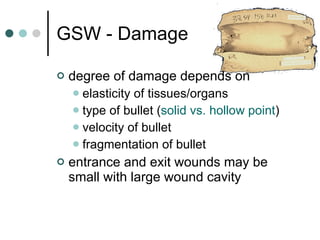
GSW - Damage degree of damage depends on  elasticity of tissues/organs type of bullet ( solid vs. hollow point ) velocity of bullet fragmentation of bullet entrance and exit wounds may be small with large wound cavity
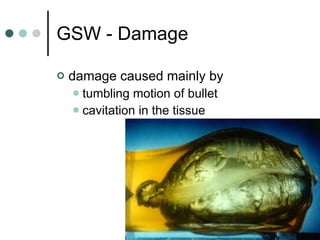
GSW - Damage damage caused mainly by tumbling motion of bullet cavitation in the tissue
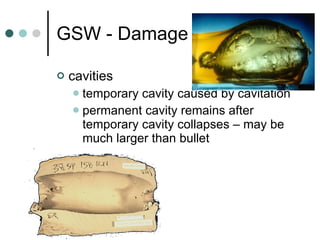
GSW - Damage cavities temporary cavity caused by cavitation permanent cavity remains after temporary cavity collapses – may be much larger than bullet
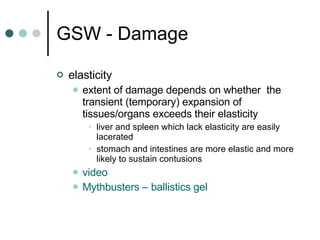
GSW - Damage elasticity extent of damage depends on whether  the transient (temporary) expansion of tissues/organs exceeds their elasticity liver and spleen which lack elasticity are easily lacerated stomach and intestines are more elastic and more likely to sustain contusions  video Mythbusters  – ballistics gel
lock, stock and barrel flash in the pan going off at half cock

Ballistics & Toolmark Analysis

  • 1.
  • 2.
  • 3.
    Fire of Discovery- powders dirt with sulfur in it will sizzle and pop with lit on fire Chinese added concentrated sulfur to charcoal by the 9 th Century AD, potassium nitrate crystals (saltpeter) was added burn the mixture for sparkly effects Taoist monks played with these chemicals to create true fireworks
  • 4.
    Fire of Discovery- powders 12 th Century and on… realization that this mixture could make stuff fly armies of Sung Dynasty added grenades to arsenals fragmentations bombs created military rockets and bombs some filled with poisons some filled with oil to start fires upon impact
  • 5.
    Refining Gunpowder forhand held guns, improvements needed because carbon, sulfur and saltpeter all had different weights saltpeter would drop and carbon rise to the top = misfire could load weapon right before firing time consuming difficult
  • 6.
    Refining Gunpowder ingredientscould be made to stick together by mixing gunpowder with brandy and letting the resulting paste dry into corns or “grains” waste of brandy so other items were used vinegar urine
  • 7.
  • 8.
    Early Firearms 1364– First recorded use of firearm 1380 – hand guns known across Europe
  • 9.
    Early Firearms atthis point, guns were fired by holding a burning wick to a “touch hole” in the barrel igniting the powder one hand to aim, one to ignite, and a prop to hold the gun
  • 10.
    Matchlock – 1400’smatchlock guns hold powder in a flash pan and is ignited by a wick (or match) in a movable clamp both hands on the gun improves aim pan cover still needs to be removed manually
  • 11.
  • 12.
    Wheel Lock - 1509 generate a spark mechanically, no wick to keep lit easier to use, more reliable very expensive to produce, pan cover still had to be removed manually
  • 13.
  • 14.
    Rifling - 1540barrel (bore) of gun created with ridges (lands) and hollows (grooves) these lands and grooves spiraled bore – the spin increases stability & accuracy at further distances
  • 15.
  • 16.
    Rifling - 1540bores can then be described by the bore diameter (measured from tops of lands) groove diameter (measured from bottom of grooves) some confusion .303 British vs .308 Winchester
  • 17.
    Rifling - 1540rifling also allows us to describe twist rates – the distance the bullet must travel to complete one full revolution 1:10 inches or 1:30 cm shorter distance means a “faster” twist length of projectile determines twist rate needed to stabilize it
  • 18.
    Rifling - 1540forensic experts can use the scratch marks (called toolmarks) left from the bore to individualize evidence
  • 19.
    Flintlock - 1630solves the problem of having to remove pan cover manually a flintlock mechanism moves the lid and sparks a flint at the same time this design remained relatively unchanged for two centuries
  • 20.
    Percussion Caps -1825 firing mechanism no longer uses flash pan, instead has a tube leading straight into the gun barrel the tube had an explosive cap on it that exploded when struck
  • 21.
    Size Does Matter!Decimation of Target Fire Power
  • 22.
  • 23.
    Bullet vs. Cartridgea bullet (projectile) is the piece ejected from the barrel of the gun a cartridge is a single unit of ammunition consisting of cartridge case primer propellant may or may not contain projectile
  • 24.
    Cartridges primer isstruck by firing pin primer ignites powder
  • 25.
    Cartridges in Identificationmanufacturer type/size 22 blank, 22 Short, 22 Long, 22 Long Rifle Shot, 22 Viper, 22 Long Rifle, 22 Stinger, 22 Magnum, and 22 Maximum
  • 26.
    Bullets described bycaliber diameter of bullet in hundredths of an inch bullet 30 hundredths of an inch (.30) is called a 30 caliber bullet this is an English derived system and used by manufacturers in the US in Europe, the metric system is used and a 30 caliber bullet would be called a 7.62mm bullet
  • 27.
    Bullets balance betweenpenetration and expansion is main idea of bullet construction too little penetration and internal organs not reached too much penetration and bullet can pass through target & energy is wasted down range hollow point demo
  • 28.
    Bullets - Constructionshape and material are key to identification bullets usu. made of single metal alloy – non jacketed layered combination of various materials (copper, lead, brass, bronze, steel, aluminum) – these are called jacketed bullets
  • 29.
    Bullets - Constructionnon-jacketed bullets usu. lead may have thin coating newer manufacturing has increased types
  • 30.
    Bullets - Constructionjacketed bullets thick layer over a central core most common core is lead most common jacket is copper usu. have a hole at base or nose those w/o the opening are called TMJ (total metal jacket) or encapsulated bullets
  • 31.
    Bullets - Shapeshape determines aerodynamics shape determines impact characteristics bases banded tapered (boat-tail) expanded base
  • 32.
    Bullets – SolidNosed have solid nose and remain fairly intact when they strike soft targets often pass through target unless they hit bone other common types of solid nose include “wadcutters”
  • 33.
    Bullets – HollowPoint if bullet is manufactured with a hollow tip, it will mushroom and expand on impact slows the bullet a bullet that expends all energy in target is more efficient and does more damage
  • 34.
    Bullets in Identificationmanufacturer construction shape nose base materials jacketed vs. unjacketed weight diameter
  • 35.
    Class & IndividualID Class Characteristics rifling caliber Individual Characteristics breech marks firing pin impressions extractor marks ejector marks
  • 36.
    Gun Shot Wounds many determining factors distance weapon/caliber site of wound
  • 37.
    Gun Shot Woundscontact wound may display star shaped pattern often with GSR in the wound may show muzzle impressions
  • 38.
    Gun Shot Woundsclose/intermediate range shot often with “tattooing” or “stippling” from the gunpowder histology
  • 39.
    Gun Shot Woundsdistant shot usually without tattooing usually without abrasions/star shaped patterns
  • 40.
    GSW - Damagedegree of damage depends on elasticity of tissues/organs type of bullet ( solid vs. hollow point ) velocity of bullet fragmentation of bullet entrance and exit wounds may be small with large wound cavity
  • 41.
    GSW - Damagedamage caused mainly by tumbling motion of bullet cavitation in the tissue
  • 42.
    GSW - Damagecavities temporary cavity caused by cavitation permanent cavity remains after temporary cavity collapses – may be much larger than bullet
  • 43.
    GSW - Damageelasticity extent of damage depends on whether the transient (temporary) expansion of tissues/organs exceeds their elasticity liver and spleen which lack elasticity are easily lacerated stomach and intestines are more elastic and more likely to sustain contusions video Mythbusters – ballistics gel
  • 44.
    lock, stock andbarrel flash in the pan going off at half cock