FORENSIC SCIENCE History & Scope
Forensic Science science occupies unique role in criminal justice system based on scientist’s ability to supply accurate and objective info that reflects the events that have occurred at a crime scene forensic science in broadest definition is application of science to law
FORENSIC SCIENCE is the application of science to the criminal and civil laws that are enforced by police agencies in a criminal justice system
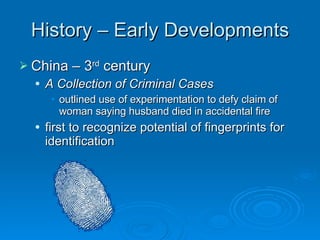
History – Early Developments China – 3 rd  century A Collection of Criminal Cases outlined use of experimentation to defy claim of woman saying husband died in accidental fire first to recognize potential of fingerprints for identification
Initial Scientific Developments between 1775 and 1806 many advances in detecting various poisons Mathieu Orfila (1814)  published first scientific treatise on detection of poisons and their effects on animals established forensic toxicology as a legitimate scientific endeavor  Orfila now recognized as “father of  forensic toxicology”
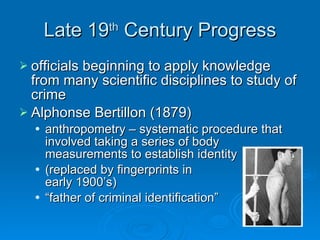
Late 19 th  Century Progress officials beginning to apply knowledge from many scientific disciplines to study of crime Alphonse Bertillon (1879) anthropometry – systematic procedure that involved taking a series of body measurements to establish identity (replaced by fingerprints in  early 1900’s) “father of criminal identification”
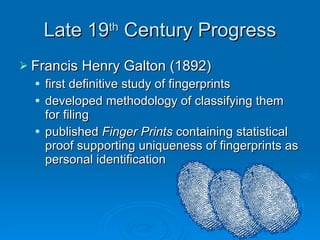
Late 19 th  Century Progress Francis Henry Galton (1892) first definitive study of fingerprints developed methodology of classifying them for filing published  Finger Prints  containing statistical proof supporting uniqueness of fingerprints as personal identification
Late 19 th  Century Progress Hans Gross (1893) studied and developed principles of criminal investigation Criminal Investigation   detailed assistance investigators could expect from fields of microscopy, chemistry, physics, mineralogy, zoology, botany, anthropometry, and fingerprinting
Late 19 th  Century Progress Sherlock Holmes although fictional, author Sir Arthur Conan Doyle had considerable influence on popularizing scientific crime detection methods first to apply serology, fingerprinting, firearms identification, and questioned document examination long before these were valued and accepted by real life criminal investigators
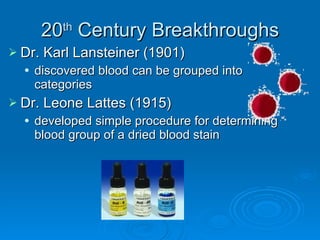
20 th  Century Breakthroughs Dr. Karl Lansteiner (1901) discovered blood can be grouped into categories Dr. Leone Lattes (1915) developed simple procedure for determining blood group of a dried blood stain
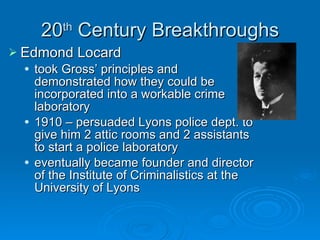
20 th  Century Breakthroughs Edmond Locard took Gross’ principles and demonstrated how they could be incorporated into a workable crime laboratory 1910 – persuaded Lyons police dept. to give him 2 attic rooms and 2 assistants to start a police laboratory eventually became founder and director of the Institute of Criminalistics at the University of Lyons
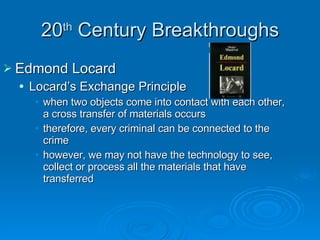
20 th  Century Breakthroughs Edmond Locard Locard’s Exchange Principle when two objects come into contact with each other, a cross transfer of materials occurs therefore, every criminal can be connected to the crime however, we may not have the technology to see, collect or process all the materials that have transferred
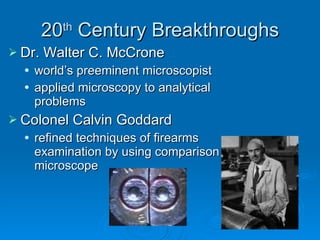
20 th  Century Breakthroughs Dr. Walter C. McCrone world’s preeminent microscopist applied microscopy to analytical problems Colonel Calvin Goddard refined techniques of firearms examination by using comparison microscope
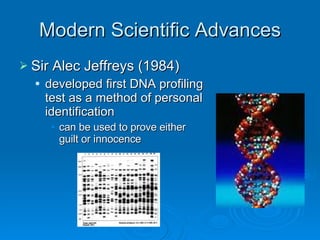
Modern Scientific Advances Sir Alec Jeffreys (1984) developed first DNA profiling test as a method of personal identification can be used to prove either guilt or innocence
Modern Scientific Advances Computerized Databases compare evidence at a scene to thousands of pieces of similar information used for fingerprints (AFIS), markings on bullets and shell casings, and DNA
Scope of Forensic Science Crime Laboratories vary by country usu. at least one dedicated facility offering forensic science services in US- many local, regional and state labs FBI runs a national lab in Virginia
Scope of Forensic Science basic units of a “full service” lab physical science - applies principles of chemistry, physics and geology to evidence biology – DNA, bloodstains, hair & fibers, botanical materials firearms – examines firearms and ammunition, clothing and other objects for gun shot residue document examination – handwriting, typewriting, paper, ink photography – examines and records the physical evidence, preps exhibits for courtrooms
Scope of Forensic Science additional services/units toxicology – examines body fluids and organs to determine presence or absence of drugs and poisons latent fingerprint – visualizes the “invisible” prints not seen by the naked eye, records polygraph – lie detector, staffed more by criminal investigator voiceprint analysis – uses spectrograph to create visual display from speech, used for identification crime scene investigation – evidence collection unit
Scope of Forensic Science specialized services/units forensic psychiatry – examines relationship between human behavior and legal proceedings forensic odontology – identify victims through dental evidence if body is left in unrecognizable state, bite mark analysis forensic engineering – concerned with failure analysis, accident reconstruction, causes and origins of fires and explosions forensic computer and digital analysis – identifying, collecting, preserving and examining info from digital devices

History And Scope

  • 1.
  • 2.
    Forensic Science scienceoccupies unique role in criminal justice system based on scientist’s ability to supply accurate and objective info that reflects the events that have occurred at a crime scene forensic science in broadest definition is application of science to law
  • 3.
    FORENSIC SCIENCE isthe application of science to the criminal and civil laws that are enforced by police agencies in a criminal justice system
  • 4.
    History – EarlyDevelopments China – 3 rd century A Collection of Criminal Cases outlined use of experimentation to defy claim of woman saying husband died in accidental fire first to recognize potential of fingerprints for identification
  • 5.
    Initial Scientific Developmentsbetween 1775 and 1806 many advances in detecting various poisons Mathieu Orfila (1814) published first scientific treatise on detection of poisons and their effects on animals established forensic toxicology as a legitimate scientific endeavor Orfila now recognized as “father of forensic toxicology”
  • 6.
    Late 19 th Century Progress officials beginning to apply knowledge from many scientific disciplines to study of crime Alphonse Bertillon (1879) anthropometry – systematic procedure that involved taking a series of body measurements to establish identity (replaced by fingerprints in early 1900’s) “father of criminal identification”
  • 7.
    Late 19 th Century Progress Francis Henry Galton (1892) first definitive study of fingerprints developed methodology of classifying them for filing published Finger Prints containing statistical proof supporting uniqueness of fingerprints as personal identification
  • 8.
    Late 19 th Century Progress Hans Gross (1893) studied and developed principles of criminal investigation Criminal Investigation detailed assistance investigators could expect from fields of microscopy, chemistry, physics, mineralogy, zoology, botany, anthropometry, and fingerprinting
  • 9.
    Late 19 th Century Progress Sherlock Holmes although fictional, author Sir Arthur Conan Doyle had considerable influence on popularizing scientific crime detection methods first to apply serology, fingerprinting, firearms identification, and questioned document examination long before these were valued and accepted by real life criminal investigators
  • 10.
    20 th Century Breakthroughs Dr. Karl Lansteiner (1901) discovered blood can be grouped into categories Dr. Leone Lattes (1915) developed simple procedure for determining blood group of a dried blood stain
  • 11.
    20 th Century Breakthroughs Edmond Locard took Gross’ principles and demonstrated how they could be incorporated into a workable crime laboratory 1910 – persuaded Lyons police dept. to give him 2 attic rooms and 2 assistants to start a police laboratory eventually became founder and director of the Institute of Criminalistics at the University of Lyons
  • 12.
    20 th Century Breakthroughs Edmond Locard Locard’s Exchange Principle when two objects come into contact with each other, a cross transfer of materials occurs therefore, every criminal can be connected to the crime however, we may not have the technology to see, collect or process all the materials that have transferred
  • 13.
    20 th Century Breakthroughs Dr. Walter C. McCrone world’s preeminent microscopist applied microscopy to analytical problems Colonel Calvin Goddard refined techniques of firearms examination by using comparison microscope
  • 14.
    Modern Scientific AdvancesSir Alec Jeffreys (1984) developed first DNA profiling test as a method of personal identification can be used to prove either guilt or innocence
  • 15.
    Modern Scientific AdvancesComputerized Databases compare evidence at a scene to thousands of pieces of similar information used for fingerprints (AFIS), markings on bullets and shell casings, and DNA
  • 16.
    Scope of ForensicScience Crime Laboratories vary by country usu. at least one dedicated facility offering forensic science services in US- many local, regional and state labs FBI runs a national lab in Virginia
  • 17.
    Scope of ForensicScience basic units of a “full service” lab physical science - applies principles of chemistry, physics and geology to evidence biology – DNA, bloodstains, hair & fibers, botanical materials firearms – examines firearms and ammunition, clothing and other objects for gun shot residue document examination – handwriting, typewriting, paper, ink photography – examines and records the physical evidence, preps exhibits for courtrooms
  • 18.
    Scope of ForensicScience additional services/units toxicology – examines body fluids and organs to determine presence or absence of drugs and poisons latent fingerprint – visualizes the “invisible” prints not seen by the naked eye, records polygraph – lie detector, staffed more by criminal investigator voiceprint analysis – uses spectrograph to create visual display from speech, used for identification crime scene investigation – evidence collection unit
  • 19.
    Scope of ForensicScience specialized services/units forensic psychiatry – examines relationship between human behavior and legal proceedings forensic odontology – identify victims through dental evidence if body is left in unrecognizable state, bite mark analysis forensic engineering – concerned with failure analysis, accident reconstruction, causes and origins of fires and explosions forensic computer and digital analysis – identifying, collecting, preserving and examining info from digital devices