FINGERPRINTING “dermatoglyphics”
History of Fingerprinting 1892 – Sir Francis Galton published that fingerprints are unique and invariable basis for modern fingerprinting science 1897 – Sir Edward Henry introduces the Galton-Henry classification system 1901 – 1910 widespread use of fingerprints begins
Basics of Fingerprints contact surfaces of hands and feet on humans and some other animals have a series of raised patterns called friction ridges identity, number and relative location of ridge characteristics individualize a fingerprint
Basics of Fingerprints friction ridges formed before birth between 6 th  and 13 th  week of development contain a single row of pores leading from sweat glands if finger is bruised or cut slightly, friction ridges not permanently altered or defaced serious injuries may form a permanent scar
Basics of Fingerprints prints are permanent for the life of the individual NO TWO PRINTS ARE IDENTICAL not even twins not even on the same person – you have 10 unique fingerprints
Transmission of Prints when a finger touches a surface, the perspiration and oils from the body are transferred to the surface imprints of fingerprints can be left in a soft surface a mark can be made by a substance like blood or paint on the finger
Patterns of Friction Ridges three general category patterns with variations among those groups arch loop whorl
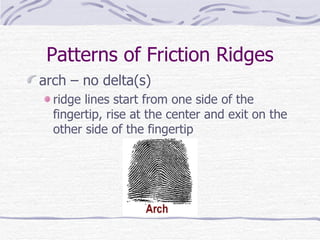
Patterns of Friction Ridges arch – no delta(s) ridge lines start from one side of the fingertip, rise at the center and exit on the other side of the fingertip
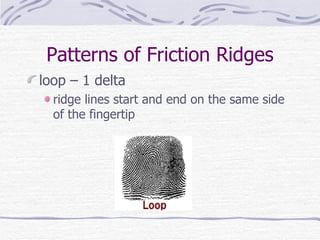
Patterns of Friction Ridges loop – 1 delta ridge lines start and end on the same side of the fingertip
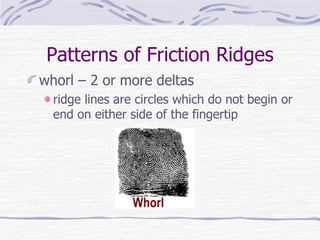
Patterns of Friction Ridges whorl – 2 or more deltas ridge lines are circles which do not begin or end on either side of the fingertip
arches plain arch – tends to flow across print tent arch – significant upthrust in print
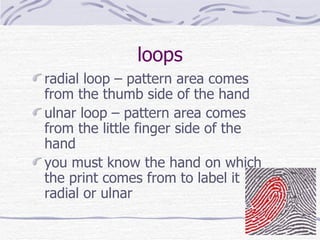
loops radial loop – pattern area comes from the thumb side of the hand ulnar loop – pattern area comes from the little finger side of the hand you must know the hand on which the print comes from to label it radial or ulnar
whorls plain – delta line cuts the inner pattern area central pocket – delta line doesn’t cut the inner area
whorls double – contain two core areas (and two deltas) accidental – contain more than 2 deltas
Friction Ridge Details - Typica patterns of ridges that differ from one individual to the next are called the ridge details called “typica” or “minutiae” experts usually require 10-12 points of similarity in typica to establish that one print matches another two main kinds of typica ending lines bifurcations (splitting lines)
Friction Ridge Details - Typica examples of specific typica ending ridge bifurcation/fork short ridge dot bridge
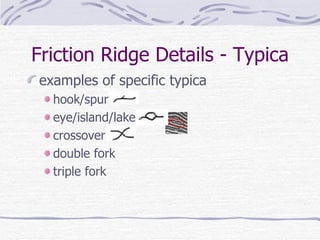
Friction Ridge Details - Typica examples of specific typica hook/spur eye/island/lake crossover double fork triple fork
Friction Ridge Details - Typica
Identifying a Print make a preliminary match by looking at the general pattern (arch, loop, whorl) on the unknown print, identify at least 10 typica  on the known print, attempt to find all 10 typica in the same relative positions as the ones on the unknown print if the typica correspond, the print is an identical match
Making Prints Visible dusting methods  use powders dusted over a surface powder sticks to oils and perspiration that were left on the surface light powders on dark surfaces dark powders on light
Making Prints Visible developing methods use chemicals to make prints visible on surfaces where powder may not work nin-hydrin bonds to and colors amino acids left behind – works well on paper  iodine vapors stick to fingerprint residue on surfaces like unpainted wood cyanoacrylate (super glue) vapors adhere to residue on surfaces like styrofoam, metal and plastic
Making Prints Visible developing methods use chemicals to make prints visible on surfaces where powder may not work fluorescence techniques
Collecting and Saving Prints dusted and developed prints should be photographed immediately most prints can be “lifted” with adhesive tape or ready made adhesive sheets to preserve them photographed or lifted prints can later be scanned into IAFIS
Fingerprint Data Banks 1924 – FBI Identification Division created and 750,000 prints were transferred there currently FBI possesses over 250 million sets of prints criminal prints –from individuals arrested or convicted of a crime civil prints – from government employees and applicants for federal jobs
Fingerprint Data Banks digital system has replaced the traditional fingerprint card  called IAFIS – Integrated Automated Fingerprint Identification System allows officers anywhere to take suspect’s prints on electronic pad or scan a lifted print in order to make a comparison

Fingerprinting

  • 1.
  • 2.
    History of Fingerprinting1892 – Sir Francis Galton published that fingerprints are unique and invariable basis for modern fingerprinting science 1897 – Sir Edward Henry introduces the Galton-Henry classification system 1901 – 1910 widespread use of fingerprints begins
  • 3.
    Basics of Fingerprintscontact surfaces of hands and feet on humans and some other animals have a series of raised patterns called friction ridges identity, number and relative location of ridge characteristics individualize a fingerprint
  • 4.
    Basics of Fingerprintsfriction ridges formed before birth between 6 th and 13 th week of development contain a single row of pores leading from sweat glands if finger is bruised or cut slightly, friction ridges not permanently altered or defaced serious injuries may form a permanent scar
  • 5.
    Basics of Fingerprintsprints are permanent for the life of the individual NO TWO PRINTS ARE IDENTICAL not even twins not even on the same person – you have 10 unique fingerprints
  • 6.
    Transmission of Printswhen a finger touches a surface, the perspiration and oils from the body are transferred to the surface imprints of fingerprints can be left in a soft surface a mark can be made by a substance like blood or paint on the finger
  • 7.
    Patterns of FrictionRidges three general category patterns with variations among those groups arch loop whorl
  • 8.
    Patterns of FrictionRidges arch – no delta(s) ridge lines start from one side of the fingertip, rise at the center and exit on the other side of the fingertip
  • 9.
    Patterns of FrictionRidges loop – 1 delta ridge lines start and end on the same side of the fingertip
  • 10.
    Patterns of FrictionRidges whorl – 2 or more deltas ridge lines are circles which do not begin or end on either side of the fingertip
  • 11.
    arches plain arch– tends to flow across print tent arch – significant upthrust in print
  • 12.
    loops radial loop– pattern area comes from the thumb side of the hand ulnar loop – pattern area comes from the little finger side of the hand you must know the hand on which the print comes from to label it radial or ulnar
  • 13.
    whorls plain –delta line cuts the inner pattern area central pocket – delta line doesn’t cut the inner area
  • 14.
    whorls double –contain two core areas (and two deltas) accidental – contain more than 2 deltas
  • 15.
    Friction Ridge Details- Typica patterns of ridges that differ from one individual to the next are called the ridge details called “typica” or “minutiae” experts usually require 10-12 points of similarity in typica to establish that one print matches another two main kinds of typica ending lines bifurcations (splitting lines)
  • 16.
    Friction Ridge Details- Typica examples of specific typica ending ridge bifurcation/fork short ridge dot bridge
  • 17.
    Friction Ridge Details- Typica examples of specific typica hook/spur eye/island/lake crossover double fork triple fork
  • 18.
  • 19.
  • 20.
  • 21.
    Identifying a Printmake a preliminary match by looking at the general pattern (arch, loop, whorl) on the unknown print, identify at least 10 typica on the known print, attempt to find all 10 typica in the same relative positions as the ones on the unknown print if the typica correspond, the print is an identical match
  • 22.
    Making Prints Visibledusting methods use powders dusted over a surface powder sticks to oils and perspiration that were left on the surface light powders on dark surfaces dark powders on light
  • 23.
    Making Prints Visibledeveloping methods use chemicals to make prints visible on surfaces where powder may not work nin-hydrin bonds to and colors amino acids left behind – works well on paper iodine vapors stick to fingerprint residue on surfaces like unpainted wood cyanoacrylate (super glue) vapors adhere to residue on surfaces like styrofoam, metal and plastic
  • 24.
    Making Prints Visibledeveloping methods use chemicals to make prints visible on surfaces where powder may not work fluorescence techniques
  • 25.
    Collecting and SavingPrints dusted and developed prints should be photographed immediately most prints can be “lifted” with adhesive tape or ready made adhesive sheets to preserve them photographed or lifted prints can later be scanned into IAFIS
  • 26.
    Fingerprint Data Banks1924 – FBI Identification Division created and 750,000 prints were transferred there currently FBI possesses over 250 million sets of prints criminal prints –from individuals arrested or convicted of a crime civil prints – from government employees and applicants for federal jobs
  • 27.
    Fingerprint Data Banksdigital system has replaced the traditional fingerprint card called IAFIS – Integrated Automated Fingerprint Identification System allows officers anywhere to take suspect’s prints on electronic pad or scan a lifted print in order to make a comparison