Gene Prediction Methods
NUSRAT. M. GULBARGA
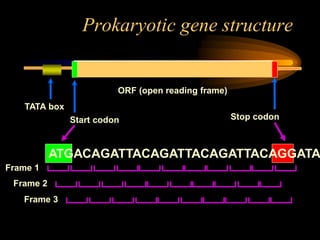
Prokaryotic gene structure
ORF (open reading frame)
Start codon Stop codon
TATA box
ATGACAGATTACAGATTACAGATTACAGGATA
Frame 1
Frame 2
Frame 3
Prokaryotes
• Advantages
– Simple gene structure
– Small genomes (0.5 to 10 million bp)
– No introns
– Genes are called Open Reading Frames (ORFs)
– High coding density (>90%)
• Disadvantages
– Some genes overlap (nested)
– Some genes are quite short (<60 bp)
Gene finding approaches
1) Rule-based (e.g, start & stop codons)
2) Content-based (e.g., codon bias, promoter
sites)
3) Similarity-based (e.g., orthologs)
4) Pattern-based (e.g., machine-learning)
5) Ab-initio methods (FFT)
Simple rule-based gene finding
• Look for putative start codon (ATG)
• Staying in same frame, scan in groups of three
until a stop codon is found
• If # of codons >=50, assume it’s a gene
• If # of codons <50, go back to last start codon,
increment by 1 & start again
• At end of chromosome, repeat process for reverse
complement
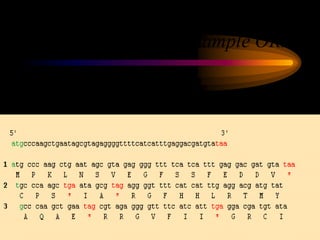
Example ORF
Content based gene prediction method
• RNA polymerase promoter site (-10, -30
site or TATA box)
• Shine-Dalgarno sequence (+10, Ribosome
Binding Site) to initiate protein translation
• Codon biases
• High GC content
Similarity-based gene finding
• Take all known genes from a related genome and
compare them to the query genome via BLAST
• Disadvantages:
– Orthologs/paralogs sometimes lose function and
become pseudogenes
– Not all genes will always be known in the comparison
genome (big circularity problem)
– The best species for comparison isn’t always obvious
• Summary: Similarity comparisons are good
supporting evidence for prediction validity
Machine Learning Techniques
Hidden Markov Model
ANN based method
Bayes Networks
Ab-initio Methods
• Fast Fourier Transform based methods
• Poor performance
• Able to identify new genes
• FTG method
• http://www.imtech.res.in/raghava/ftg/
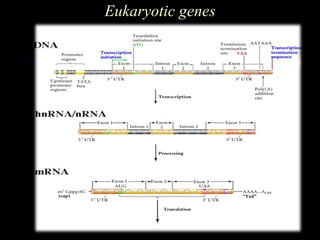
Eukaryotic genes
Eukaryotes
• Complex gene structure
• Large genomes (0.1 to 3 billion bases)
• Exons and Introns (interrupted)
• Low coding density (<30%)
– 3% in humans, 25% in Fugu, 60% in yeast
• Alternate splicing (40-60% of all genes)
• Considerable number of pseudogenes
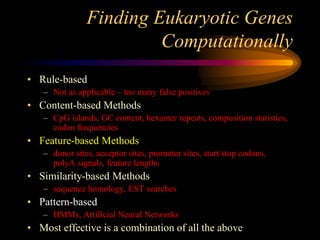
Finding Eukaryotic Genes
Computationally
• Rule-based
– Not as applicable – too many false positives
• Content-based Methods
– CpG islands, GC content, hexamer repeats, composition statistics,
codon frequencies
• Feature-based Methods
– donor sites, acceptor sites, promoter sites, start/stop codons,
polyA signals, feature lengths
• Similarity-based Methods
– sequence homology, EST searches
• Pattern-based
– HMMs, Artificial Neural Networks
• Most effective is a combination of all the above
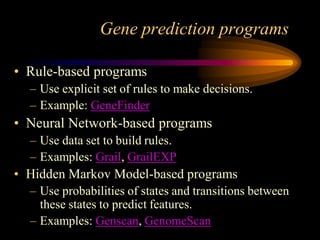
Gene prediction programs
• Rule-based programs
– Use explicit set of rules to make decisions.
– Example: GeneFinder
• Neural Network-based programs
– Use data set to build rules.
– Examples: Grail, GrailEXP
• Hidden Markov Model-based programs
– Use probabilities of states and transitions between
these states to predict features.
– Examples: Genscan, GenomeScan
Combined Methods
• GRAIL (http://compbio.ornl.gov/Grail-1.3/)
• FGENEH (http://www.bioscience.org/urllists/genefind.htm)
• HMMgene (http://www.cbs.dtu.dk/services/HMMgene/)
• GENSCAN(http://genes.mit.edu/GENSCAN.html)
• GenomeScan (http://genes.mit.edu/genomescan.html)
• Twinscan (http://ardor.wustl.edu/query.html)
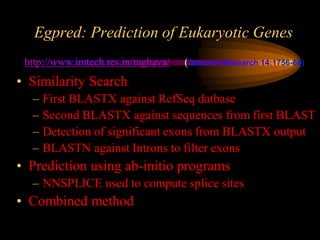
Egpred: Prediction of Eukaryotic Genes
• Similarity Search
– First BLASTX against RefSeq datbase
– Second BLASTX against sequences from first BLAST
– Detection of significant exons from BLASTX output
– BLASTN against Introns to filter exons
• Prediction using ab-initio programs
– NNSPLICE used to compute splice sites
• Combined method
http://www.imtech.res.in/raghava/ (Genome Research 14:1756-66)
Thank
you

Gene prediction method

  • 1.
  • 2.
    Prokaryotic gene structure ORF(open reading frame) Start codon Stop codon TATA box ATGACAGATTACAGATTACAGATTACAGGATA Frame 1 Frame 2 Frame 3
  • 3.
    Prokaryotes • Advantages – Simplegene structure – Small genomes (0.5 to 10 million bp) – No introns – Genes are called Open Reading Frames (ORFs) – High coding density (>90%) • Disadvantages – Some genes overlap (nested) – Some genes are quite short (<60 bp)
  • 4.
    Gene finding approaches 1)Rule-based (e.g, start & stop codons) 2) Content-based (e.g., codon bias, promoter sites) 3) Similarity-based (e.g., orthologs) 4) Pattern-based (e.g., machine-learning) 5) Ab-initio methods (FFT)
  • 5.
    Simple rule-based genefinding • Look for putative start codon (ATG) • Staying in same frame, scan in groups of three until a stop codon is found • If # of codons >=50, assume it’s a gene • If # of codons <50, go back to last start codon, increment by 1 & start again • At end of chromosome, repeat process for reverse complement
  • 6.
  • 7.
    Content based geneprediction method • RNA polymerase promoter site (-10, -30 site or TATA box) • Shine-Dalgarno sequence (+10, Ribosome Binding Site) to initiate protein translation • Codon biases • High GC content
  • 8.
    Similarity-based gene finding •Take all known genes from a related genome and compare them to the query genome via BLAST • Disadvantages: – Orthologs/paralogs sometimes lose function and become pseudogenes – Not all genes will always be known in the comparison genome (big circularity problem) – The best species for comparison isn’t always obvious • Summary: Similarity comparisons are good supporting evidence for prediction validity
  • 9.
    Machine Learning Techniques HiddenMarkov Model ANN based method Bayes Networks
  • 10.
    Ab-initio Methods • FastFourier Transform based methods • Poor performance • Able to identify new genes • FTG method • http://www.imtech.res.in/raghava/ftg/
  • 11.
  • 12.
    Eukaryotes • Complex genestructure • Large genomes (0.1 to 3 billion bases) • Exons and Introns (interrupted) • Low coding density (<30%) – 3% in humans, 25% in Fugu, 60% in yeast • Alternate splicing (40-60% of all genes) • Considerable number of pseudogenes
  • 13.
    Finding Eukaryotic Genes Computationally •Rule-based – Not as applicable – too many false positives • Content-based Methods – CpG islands, GC content, hexamer repeats, composition statistics, codon frequencies • Feature-based Methods – donor sites, acceptor sites, promoter sites, start/stop codons, polyA signals, feature lengths • Similarity-based Methods – sequence homology, EST searches • Pattern-based – HMMs, Artificial Neural Networks • Most effective is a combination of all the above
  • 14.
    Gene prediction programs •Rule-based programs – Use explicit set of rules to make decisions. – Example: GeneFinder • Neural Network-based programs – Use data set to build rules. – Examples: Grail, GrailEXP • Hidden Markov Model-based programs – Use probabilities of states and transitions between these states to predict features. – Examples: Genscan, GenomeScan
  • 15.
    Combined Methods • GRAIL(http://compbio.ornl.gov/Grail-1.3/) • FGENEH (http://www.bioscience.org/urllists/genefind.htm) • HMMgene (http://www.cbs.dtu.dk/services/HMMgene/) • GENSCAN(http://genes.mit.edu/GENSCAN.html) • GenomeScan (http://genes.mit.edu/genomescan.html) • Twinscan (http://ardor.wustl.edu/query.html)
  • 16.
    Egpred: Prediction ofEukaryotic Genes • Similarity Search – First BLASTX against RefSeq datbase – Second BLASTX against sequences from first BLAST – Detection of significant exons from BLASTX output – BLASTN against Introns to filter exons • Prediction using ab-initio programs – NNSPLICE used to compute splice sites • Combined method http://www.imtech.res.in/raghava/ (Genome Research 14:1756-66)
  • 17.