WATER
Introduction
Types of Water
Hardness of Water
Effect of Hard Water in Industry
Types of Hardness
CONTENTSCONTENTS
 Water is life.
 Water is required for animals, plants and
human.
 It is essential for all human activities
domestic, agricultural and industrial
use.
 Water plays important role in various
life processes in the human body.
 Pure water (H2O) is colorless, tasteless, and
odorless.
 It is composed of hydrogen and oxygen.
 Water molecule has tendency to form
intermolecular hydrogen bonding.
 It is polar in nature.
 To some degree, water can dissolve every
naturally occurring substance on the earth.
Because of this property, water has been
termed a "universal solvent.”
 pH of pure water is 7.
 The main sources of natural water are — (a) Rain
water (b) Surface water (flowing, still & sea water)
(c) Ground water (well, spring).
 The water consists of different impurities depending
upon the source.
 Rain water consists of atmospheric impurities,
surface water consists of dissolved, suspended,
colloidal and biological impurities.
 Ground water consists of mineral salts and has
medicinal value.
 Because water becomes contaminated by the
substances with which it comes into contact, it is
not available for use in its pure state.
 Water in industry has unique position. It is
used as coolant, solvent, washing agent,
steam generator, diluent etc.
 Water is used in generating power.
 Growing needs of water has initiated
interest in quality of water.
 Water quality required for domestic use as
well as for each industry has the
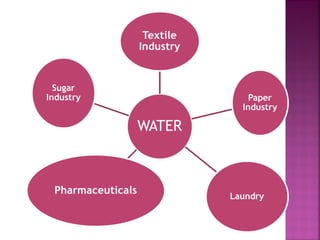
characteristics of its own. e.g. The quality
of water used in sugar industry is different
from the quality of water used in
pharmaceuticals or cosmetic industries.
Uses of Water
 Industry depends on water, much like agriculture
and domestic households depend on water.
Industries that produce metals, wood, paper,
chemicals, gasoline, oils, and most other products all
use water in some part of their production process.
 Industrial reliance on water makes it essential to
preserve water in every aspect possible and make
sure water pollution is kept at minimal levels.
 Industry is reliant on water for all levels of
production. It can be used as a raw material,
solvent, coolant, transport agent, and energy source.
 rain water falls on the surfaces
 Comes in contact with several
minerals, oxides, sulphates,
carbonates, bicarbonates, dissolved
gases etc.
 Due to contamination the
characteristics of water changes.
 Water impurities include suspended
solids and dissolved solids.
 Suspended solids are substances that are not
completely soluble in water and are present as
particles.
 These particles usually impart a visible turbidity to
the water.
 Calcium bicarbonate is a soluble salt. A solution of
calcium bicarbonate is clear.
 Some soluble minerals impart a color to the
solution. Soluble iron salts produce pale yellow or
green solutions; some copper salts form intensely
blue solutions.
 Although colored, these solutions are clear.
 Dissolved and suspended solids are
present in most surface waters.
 Seawater is very high in soluble sodium
chloride; suspended sand and silt make
it slightly cloudy.
 Due to dissolved salts the water
becomes hard
 Water becomes alkaline in nature.
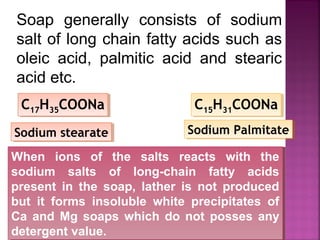
Soap generally consists of sodium
salt of long chain fatty acids such as
oleic acid, palmitic acid and stearic
acid etc.
C17H35COONaC17H35COONa
Sodium stearateSodium stearate
C15H31COONaC15H31COONa
Sodium PalmitateSodium Palmitate
When ions of the salts reacts with the
sodium salts of long-chain fatty acids
present in the soap, lather is not produced
but it forms insoluble white precipitates of
Ca and Mg soaps which do not posses any
detergent value.
When ions of the salts reacts with the
sodium salts of long-chain fatty acids
present in the soap, lather is not produced
but it forms insoluble white precipitates of
Ca and Mg soaps which do not posses any
detergent value.
 When hard water is treated with soap, hardness of
water does not allow soap to produce good amount
of lather (foam) until a sufficient amount of soap
has been added to precipitate out all hardness
causing ions. When whole of the hardness causing
ions are precipitated out, further addition of soap
produces lather.
 These ions do not pose any health threat, but they
can engage in reactions that leave insoluble mineral
deposits. These deposits can make hard water
unsuitable for many uses, and so a variety of means
have been developed to "soften" hard water;
 i.e. remove the calcium and magnesium ions.
 Water which immediately (easily) produces
good amount of lather (foam) with soap is
called soft water.
 Soft water is free from soluble salts of
Magnesium and Calcium such as CaCl2, MgCl2,
CaSO4, MgSO4, Ca(HCO3)2 and Mg(HCO3)2.
 Soft water does not react with soap and
hence does not produce insoluble curd like
precipitate of Ca and Mg stearate or
palmitate.
 Dissolved salts of calcium and magnesium
make the water hard.
 Water which does not easily produce
good amount of lather (foam) with soap is
called hard water.
 Hard water contains Calcium and
Magnesium soluble salts such as CaCI2,
MgCl2, CaSO4, MgSO4, Ca(HCO3)2 and
Mg(HCO3)2.
 It contains soluble salts of some heavy
metals like Fe, Mn, Al, etc.
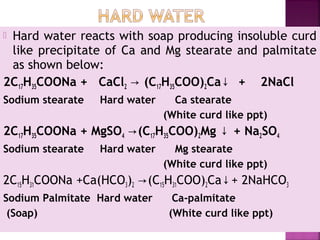
 Hard water reacts with soap producing insoluble curd
like precipitate of Ca and Mg stearate and palmitate
as shown below:
2C17H35COONa + CaCl2 (C→ 17H35COO)2Ca + 2NaCl↓
Sodium stearate Hard water Ca stearate
(White curd like ppt)
2C17H35COONa + MgSO4 (C→ 17H35COO)2Mg + Na↓ 2SO4
Sodium stearate Hard water Mg stearate
(White curd like ppt)
2C15H31COONa +Ca(HCO3)2 →(C15H31COO)2Ca↓+ 2NaHCO3
Sodium Palmitate Hard water Ca-palmitate
(Soap) (White curd like ppt)
 Drinking - Hardwater causes bad
effects on our digestive system.
Moreover, the possibility of
forming calciumoxalate crystals in
urinary tracks is increased.
 For cooking the boiling point of
water is increased because of
presence of salts. Hence more fuel
and time are required.
 WASHING - hardwater, when used for washing
purposes, does not producing lather freely with soap.
As a result cleansing quality of soap is decreased and
a lot of it is wasted. Hardwater reacts with
soap it produces sticky precipitates of
calcium and magnesium soaps. These
are insoluble formations.
 Bathing - hardwater does not form lather freely with
soap solution, but produces sticky scum on the bath-
tub and body. Thus, the cleansing quality of soap is
Bathing. Thus, the cleansing quality of soap is
depressed and a lot of is wasted.
 Textile Industry: In this industry water is used for
dyeing, bleaching and washing purpose.
(a) During washing if hard water is used, a lot of soap
gets wasted.
(b) During dyeing exact shades of colour are not
obtained with hard water.
(c) On white clothes Fe and Mn may form coloured
spots.
 Sugar Industry : Water used should be free from
sulphates, nitrates, bicarbonates etc. Otherwise it
causes problems in crystallisation of sugar and such
sugar may decompose on storage.
 Paper Industry : Water is used to make paper pulp.
Water must be free from Fe, Ca, Mg. These ions
affect the colour, smoothness and glossiness of the
paper.
 Dyeing Industry - The dissolved salts in hard water
may reacts with costly dyes forming precipitates.
 Pharmaceutical Industry - Hard water may cause
some undesirable products while preparation of
pharmaceutical products.
 Concrete Making - Water containing chlorides and
sulphates, if used for concrete making, affects the
hydration of cement and the final strength of the
hardened concrete.
 Laundry – Hard water, if used in laundry,
causes much of the soap used in washing to go
as waste Iron salts may even cause coloration
of the clothes.
 Bakeries : Water should not contain any
organic matter such as fungi or bacteria. These
affects yeast’s action and the quality of the
bakery product becomes inferior.
 Dairies : Contamination in diary product may
lead to toxic effect.
 Beaverage : Undesirable taste
 When hard water is boiled at home or in industries, it
leaves deposits of calcium and magnesium salts in
kettles, hot-water pipes, boilers and radiators.
 These deposits reduce the efficiency of boilers,
kettles and pipes and can cause blockages and even
bursting of the boilers.
 Mineral deposits are formed by ionic reactions
resulting in the formation of an insoluble precipitate.
For example, when hard water is heated, Ca2+
ions
react with bicarbonate (HCO3
-
) ions to form insoluble
calcium carbonate (CaCO3).
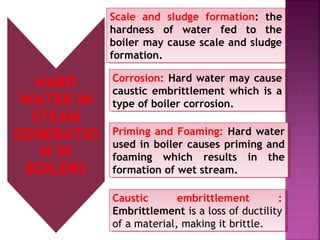
HARD
WATER IN
STEAM
GENERATIO
N IN
BOILERS
Scale and sludge formation: the
hardness of water fed to the
boiler may cause scale and sludge
formation.
Scale and sludge formation: the
hardness of water fed to the
boiler may cause scale and sludge
formation.
Corrosion: Hard water may cause
caustic embrittlement which is a
type of boiler corrosion.
Corrosion: Hard water may cause
caustic embrittlement which is a
type of boiler corrosion.
Priming and Foaming: Hard water
used in boiler causes priming and
foaming which results in the
formation of wet stream.
Priming and Foaming: Hard water
used in boiler causes priming and
foaming which results in the
formation of wet stream.
Caustic embrittlement :
Embrittlement is a loss of ductility
of a material, making it brittle.
Caustic embrittlement :
Embrittlement is a loss of ductility
of a material, making it brittle.
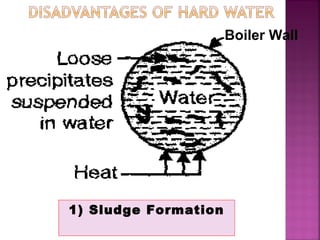
1) Sludge Formation
Boiler Wall
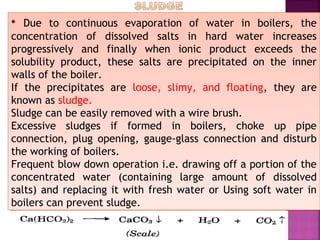
• Due to continuous evaporation of water in boilers, the
concentration of dissolved salts in hard water increases
progressively and finally when ionic product exceeds the
solubility product, these salts are precipitated on the inner
walls of the boiler.
If the precipitates are loose, slimy, and floating, they are
known as sludge.
Sludge can be easily removed with a wire brush.
Excessive sludges if formed in boilers, choke up pipe
connection, plug opening, gauge-glass connection and disturb
the working of boilers.
Frequent blow down operation i.e. drawing off a portion of the
concentrated water (containing large amount of dissolved
salts) and replacing it with fresh water or Using soft water in
boilers can prevent sludge.
• Due to continuous evaporation of water in boilers, the
concentration of dissolved salts in hard water increases
progressively and finally when ionic product exceeds the
solubility product, these salts are precipitated on the inner
walls of the boiler.
If the precipitates are loose, slimy, and floating, they are
known as sludge.
Sludge can be easily removed with a wire brush.
Excessive sludges if formed in boilers, choke up pipe
connection, plug opening, gauge-glass connection and disturb
the working of boilers.
Frequent blow down operation i.e. drawing off a portion of the
concentrated water (containing large amount of dissolved
salts) and replacing it with fresh water or Using soft water in
boilers can prevent sludge.
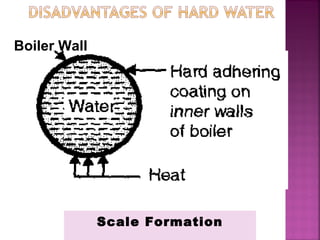
Scale Formation
Boiler Wall
•If the precipitated matter forms a
hard adhering coating inside the
boiler surface, they are called as
scales.
•Causes of scale formation
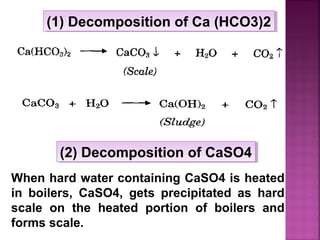
1. Decomposition of Ca (HCO3)2
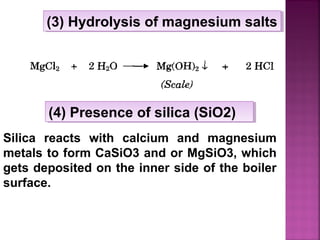
2. Deposition of CaSO4
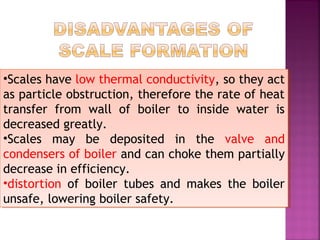
3. Hydrolysis of magnesium salts
4. Presence of silica (SiO2)
•If the precipitated matter forms a
hard adhering coating inside the
boiler surface, they are called as
scales.
•Causes of scale formation
1. Decomposition of Ca (HCO3)2
2. Deposition of CaSO4
3. Hydrolysis of magnesium salts
4. Presence of silica (SiO2)
 This precipitate, known as scale, coats the vessels in
which the water is heated, producing the mineral
deposits.
 This scale, coats the vessels in which the water is
heated, producing the mineral deposits.
 As these deposits build up, they reduce the efficiency
of heat transfer, so food may not cook as evenly or
quickly in pans with large scale deposits.
 Hard water can cause "Scaling" inside the pipes that
transport water . Therefore if we use hard water in
   turbines and heat exchangers, their pipes will be
corroded.
 Therefore water should be softened before using in
industries.
(1) Decomposition of Ca (HCO3)2(1) Decomposition of Ca (HCO3)2
When hard water containing CaSO4 is heated
in boilers, CaSO4, gets precipitated as hard
scale on the heated portion of boilers and
forms scale.
(2) Decomposition of CaSO4(2) Decomposition of CaSO4
(3) Hydrolysis of magnesium salts(3) Hydrolysis of magnesium salts
Silica reacts with calcium and magnesium
metals to form CaSiO3 and or MgSiO3, which
gets deposited on the inner side of the boiler
surface.
(4) Presence of silica (SiO2)(4) Presence of silica (SiO2)
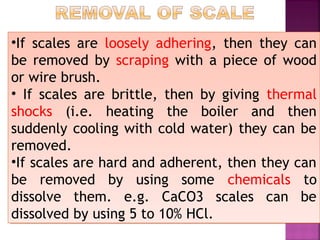
•Scales have low thermal conductivity, so they act
as particle obstruction, therefore the rate of heat
transfer from wall of boiler to inside water is
decreased greatly.
•Scales may be deposited in the valve and
condensers of boiler and can choke them partially
decrease in efficiency.
•distortion of boiler tubes and makes the boiler
unsafe, lowering boiler safety.
•Scales have low thermal conductivity, so they act
as particle obstruction, therefore the rate of heat
transfer from wall of boiler to inside water is
decreased greatly.
•Scales may be deposited in the valve and
condensers of boiler and can choke them partially
decrease in efficiency.
•distortion of boiler tubes and makes the boiler
unsafe, lowering boiler safety.
•If scales are loosely adhering, then they can
be removed by scraping with a piece of wood
or wire brush.
• If scales are brittle, then by giving thermal
shocks (i.e. heating the boiler and then
suddenly cooling with cold water) they can be
removed.
•If scales are hard and adherent, then they can
be removed by using some chemicals to
dissolve them. e.g. CaCO3 scales can be
dissolved by using 5 to 10% HCl.
•If scales are loosely adhering, then they can
be removed by scraping with a piece of wood
or wire brush.
• If scales are brittle, then by giving thermal
shocks (i.e. heating the boiler and then
suddenly cooling with cold water) they can be
removed.
•If scales are hard and adherent, then they can
be removed by using some chemicals to
dissolve them. e.g. CaCO3 scales can be
dissolved by using 5 to 10% HCl.
Colloidal conditioning
•In low pressure boilers, scale formation
can be avoided by adding organic
substances like kerosene, tanin, agar-
agar etc.
•These substances get coated over the
scale forming precipitates, thereby
yielding non-sticky and loose deposits
similar to sludge which can be removed
by blow down operation.
Colloidal conditioning
•In low pressure boilers, scale formation
can be avoided by adding organic
substances like kerosene, tanin, agar-
agar etc.
•These substances get coated over the
scale forming precipitates, thereby
yielding non-sticky and loose deposits
similar to sludge which can be removed
by blow down operation.
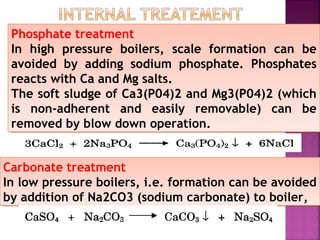
Phosphate treatment
In high pressure boilers, scale formation can be
avoided by adding sodium phosphate. Phosphates
reacts with Ca and Mg salts.
The soft sludge of Ca3(P04)2 and Mg3(P04)2 (which
is non-adherent and easily removable) can be
removed by blow down operation.
Phosphate treatment
In high pressure boilers, scale formation can be
avoided by adding sodium phosphate. Phosphates
reacts with Ca and Mg salts.
The soft sludge of Ca3(P04)2 and Mg3(P04)2 (which
is non-adherent and easily removable) can be
removed by blow down operation.
Carbonate treatment
In low pressure boilers, i.e. formation can be avoided
by addition of Na2CO3 (sodium carbonate) to boiler,
Carbonate treatment
In low pressure boilers, i.e. formation can be avoided
by addition of Na2CO3 (sodium carbonate) to boiler,
Treatment with sodium aluminate (NaAlO2)
When boiler water is treated with NaAIO2 in
solution, it gets hydrolysed to yield NaOH and
Al(OH)3
Treatment with sodium aluminate (NaAlO2)
When boiler water is treated with NaAIO2 in
solution, it gets hydrolysed to yield NaOH and
Al(OH)3
Calgon conditioning
Sodium hexametaphosphate Na2[Na4(PO3)6] is added
to boiler water. It prevents the scale formation by
forming soluble complex compound.
Calgon conditioning
Sodium hexametaphosphate Na2[Na4(PO3)6] is added
to boiler water. It prevents the scale formation by
forming soluble complex compound.
(Gelatinous precipitate
Electrical conditioning
o This is achieved by using sealed glass bulbs
containing mercury connected to a battery which are
set floating in the boiler.
o When water boils, due to high temperature
mercury bulbs emit electrical discharges which
prevent the precipitates to stick to the sides of boiler
and this prevents scale formation.
Electrical conditioning
o This is achieved by using sealed glass bulbs
containing mercury connected to a battery which are
set floating in the boiler.
o When water boils, due to high temperature
mercury bulbs emit electrical discharges which
prevent the precipitates to stick to the sides of boiler
and this prevents scale formation.
Radioactive conditioning
o Small tablets which contain radioactive salts are
placed inside the boiler water at few points.
o As water boils these tablets emit energy radiations
and thus prevent scale formation.
Radioactive conditioning
o Small tablets which contain radioactive salts are
placed inside the boiler water at few points.
o As water boils these tablets emit energy radiations
and thus prevent scale formation.
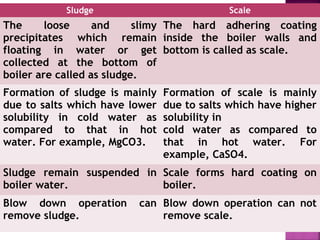
Sludge Scale
The loose and slimy
precipitates which remain
floating in water or get
collected at the bottom of
boiler are called as sludge.
The hard adhering coating
inside the boiler walls and
bottom is called as scale.
Formation of sludge is mainly
due to salts which have lower
solubility in cold water as
compared to that in hot
water. For example, MgCO3.
Formation of scale is mainly
due to salts which have higher
solubility in
cold water as compared to
that in hot water. For
example, CaSO4.
Sludge remain suspended in
boiler water.
Scale forms hard coating on
boiler.
Blow down operation can
remove sludge.
Blow down operation can not
remove scale.
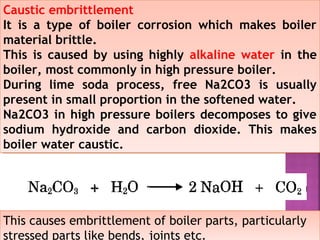
Caustic embrittlement
It is a type of boiler corrosion which makes boiler
material brittle.
This is caused by using highly alkaline water in the
boiler, most commonly in high pressure boiler.
During lime soda process, free Na2CO3 is usually
present in small proportion in the softened water.
Na2CO3 in high pressure boilers decomposes to give
sodium hydroxide and carbon dioxide. This makes
boiler water caustic.
Caustic embrittlement
It is a type of boiler corrosion which makes boiler
material brittle.
This is caused by using highly alkaline water in the
boiler, most commonly in high pressure boiler.
During lime soda process, free Na2CO3 is usually
present in small proportion in the softened water.
Na2CO3 in high pressure boilers decomposes to give
sodium hydroxide and carbon dioxide. This makes
boiler water caustic.
This causes embrittlement of boiler parts, particularlyThis causes embrittlement of boiler parts, particularly
stressed parts like bends, joints etc.
The water containing NaOH flows into the
minute hair-cracks, in the inner wall of
boiler, by capillary action.
Here, water evaporates and the
concentration of NaOH increases
progressively.
This caustic soda attacks the surrounding
areas, thereby dissolving iron of boiler
wall as sodium-ferroate.
This causes embrittlement of boiler wall
at a stressed parts like bends, joints, etc.
The water containing NaOH flows into the
minute hair-cracks, in the inner wall of
boiler, by capillary action.
Here, water evaporates and the
concentration of NaOH increases
progressively.
This caustic soda attacks the surrounding
areas, thereby dissolving iron of boiler
wall as sodium-ferroate.
This causes embrittlement of boiler wall
at a stressed parts like bends, joints, etc.
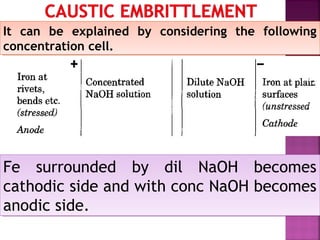
It can be explained by considering the following
concentration cell.
It can be explained by considering the following
concentration cell.
Fe surrounded by dil NaOH becomes
cathodic side and with conc NaOH becomes
anodic side.
Fe surrounded by dil NaOH becomes
cathodic side and with conc NaOH becomes
anodic side.
pH adjustment to 8 -9.
Sodium phosphte can be used instead
of Na carbonate.
pH adjustment to 8 -9.
Sodium phosphte can be used instead
of Na carbonate.
 Corrosion reactions cause the slow
dissolution of metals by water.
 Deposition reactions, which produce
scale on heat transfer surfaces,
represent a change in the solvency
power of water as its temperature is
varied.
 The control of corrosion and scale is a
major focus of water treatment
technology.
 More serious is the situation in which
industrial-sized water boilers become coated
with scale.
 The cost in heat-transfer efficiency can have
a dramatic effect on power bill.
Furthermore, scale can accumulate on the
inside of appliances, such as and pipes. As
scale builds up, water flow is impeded, and
hence appliance parts and pipes must be
replaced more often than if Ca2+
and Mg2+
ions
were not present in the water.
 Water is an Universal solvent.
 Although beneficial to mankind, the
solvency power of water can pose a major
threat to industrial equipment.
 Corrosion reactions cause the slow
dissolution of metals by water. Deposition
reactions, which produce scale on heat
transfer surfaces, represent a change in the
solvency power of water as its temperature
is varied.
 The control of corrosion and scale is a
major focus of water treatment technology.
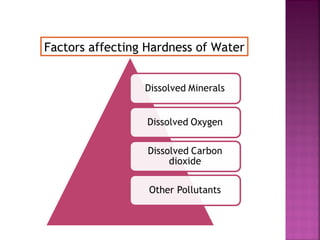
Factors affecting Hardness of Water
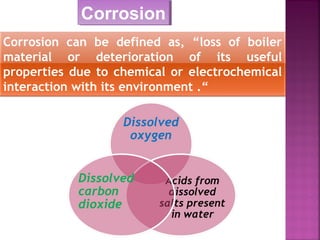
CorrosionCorrosion
Corrosion can be defined as, “loss of boiler
material or deterioration of its useful
properties due to chemical or electrochemical
interaction with its environment .“
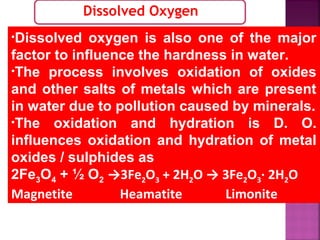
Dissolved Oxygen
•Dissolved oxygen is also one of the major
factor to influence the hardness in water.
•The process involves oxidation of oxides
and other salts of metals which are present
in water due to pollution caused by minerals.
•The oxidation and hydration is D. O.
influences oxidation and hydration of metal
oxides / sulphides as
2Fe3O4 + ½ O2 →3Fe2O3 + 2H2O → 3Fe2O3∙ 2H2O
Magnetite Heamatite Limonite
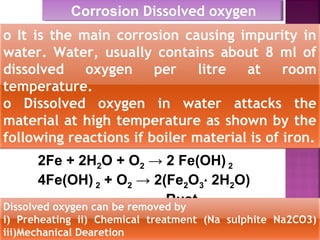
Corrosion Dissolved oxygenCorrosion Dissolved oxygen
o It is the main corrosion causing impurity in
water. Water, usually contains about 8 ml of
dissolved oxygen per litre at room
temperature.
o Dissolved oxygen in water attacks the
material at high temperature as shown by the
following reactions if boiler material is of iron.
2Fe + 2H2O + O2 → 2 Fe(OH) 2
4Fe(OH) 2 + O2 → 2(Fe2O3∙ 2H2O)
RustDissolved oxygen can be removed by
i) Preheating ii) Chemical treatment (Na sulphite Na2CO3)
iii)Mechanical Dearetion
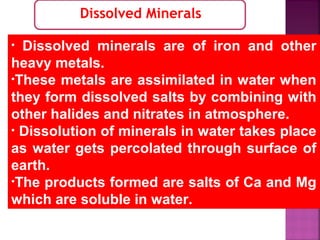
Dissolved Minerals
• Dissolved minerals are of iron and other
heavy metals.
•These metals are assimilated in water when
they form dissolved salts by combining with
other halides and nitrates in atmosphere.
• Dissolution of minerals in water takes place
as water gets percolated through surface of
earth.
•The products formed are salts of Ca and Mg
which are soluble in water.
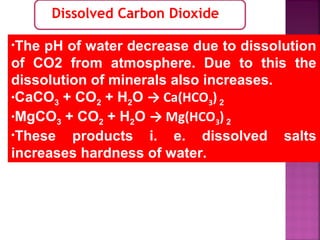
Dissolved Carbon Dioxide
•The pH of water decrease due to dissolution
of CO2 from atmosphere. Due to this the
dissolution of minerals also increases.
•CaCO3 + CO2 + H2O → Ca(HCO3) 2
•MgCO3 + CO2 + H2O → Mg(HCO3) 2
•These products i. e. dissolved salts
increases hardness of water.
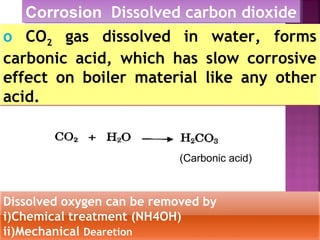
Corrosion Dissolved carbon dioxideCorrosion Dissolved carbon dioxide
o CO2 gas dissolved in water, forms
carbonic acid, which has slow corrosive
effect on boiler material like any other
acid.
(Carbonic acid)
Dissolved oxygen can be removed by
i)Chemical treatment (NH4OH)
ii)Mechanical Dearetion
Other Pollutants
•Acids such as carbonic
acid contributes hardness
•Other poolutants such as
industrial wastes,
radioactive decay
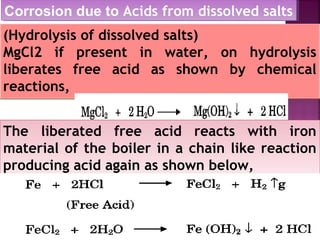
Corrosion due to Acids from dissolved saltsCorrosion due to Acids from dissolved salts
(Hydrolysis of dissolved salts)
MgCl2 if present in water, on hydrolysis
liberates free acid as shown by chemical
reactions,
The liberated free acid reacts with iron
material of the boiler in a chain like reaction
producing acid again as shown below,
The liberated free acid reacts with iron
material of the boiler in a chain like reaction
producing acid again as shown below,
 Other metals like Fe2+
, Mn2+
and Al3+
also react with
soap.
 In practice the hardness of a water sample is
usually taken as a measure of its Ca2+
and Mg2+
contents.
Types of hardnessTypes of hardness
TEMPORARY
HARDNESS
TEMPORARY
HARDNESS
PERMANENT
HARDNESS
PERMANENT
HARDNESS
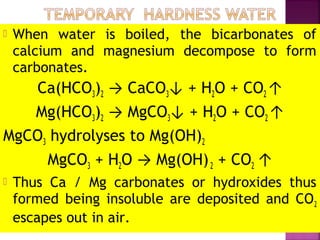
 When water is boiled, the bicarbonates of
calcium and magnesium decompose to form
carbonates.
Ca(HCO3)2 → CaCO3↓ + H2O + CO2 ↑
Mg(HCO3)2 → MgCO3↓ + H2O + CO2 ↑
MgCO3 hydrolyses to Mg(OH)2
MgCO3 + H2O → Mg(OH)2 + CO2 ↑
 Thus Ca / Mg carbonates or hydroxides thus
formed being insoluble are deposited and CO2
escapes out in air.
 It is defined as the hardness of water
caused by the bicarbonates of calcium,
magnesium and other hardness producing
metals.
 It can be removed by boiling the water.
 On boiling soluble Ca(HCO3)2 and Mg(HCO3)2
decompose into insoluble carbonates,
which is removed by filtration. Hardness
caused by bicarbonates of Ca and Mg also
is called ‘Alkaline Hardness”.
 Therefore when water is boiled, the
bicarbonates of calcium and magnesium
decompose to form carbonates.
 These are insoluble and collect on the
sides of the vessel as fur or scale.
 When calcium and magnesium
bicarbonates are removed from the
water, it becomes soft.
 It is also called as Non-carbonate or
Non-alkaline Hardness.
 Hardness caused by the sulphates,
nitrates and chlorides of calcium and
magnesium is called permanent
hardness.
 It is not destroyed on boiling.
 It requires special chemical treatment
for removal of hardness causing salts,
such as internal conditioning or
external treatment.
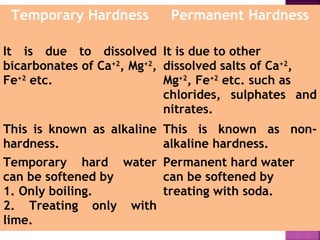
Temporary Hardness Permanent Hardness
It is due to dissolved
bicarbonates of Ca+2
, Mg+2
,
Fe+2
etc.
It is due to other
dissolved salts of Ca+2
,
Mg+2
, Fe+2
etc. such as
chlorides, sulphates and
nitrates.
This is known as alkaline
hardness.
This is known as non-
alkaline hardness.
Temporary hard water
can be softened by
1. Only boiling.
2. Treating only with
lime.
Permanent hard water
can be softened by
treating with soda.
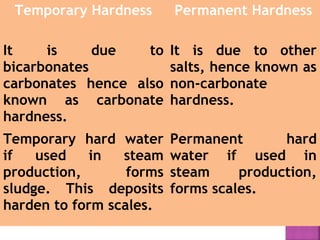
Temporary Hardness Permanent Hardness
It is due to
bicarbonates
carbonates hence also
known as carbonate
hardness.
It is due to other
salts, hence known as
non-carbonate
hardness.
Temporary hard water
if used in steam
production, forms
sludge. This deposits
harden to form scales.
Permanent hard
water if used in
steam production,
forms scales.
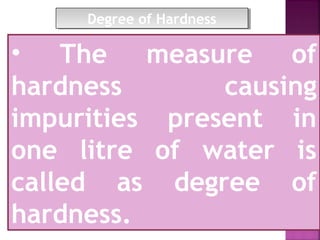
• The measure of
hardness causing
impurities present in
one litre of water is
called as degree of
hardness.
Degree of HardnessDegree of Hardness
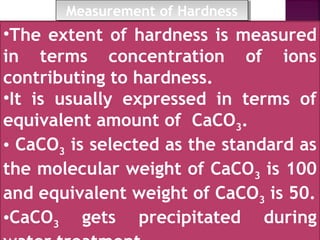
•The extent of hardness is measured
in terms concentration of ions
contributing to hardness.
•It is usually expressed in terms of
equivalent amount of CaCO3.
• CaCO3 is selected as the standard as
the molecular weight of CaCO3 is 100
and equivalent weight of CaCO3 is 50.
•CaCO3 gets precipitated during
Measurement of HardnessMeasurement of Hardness
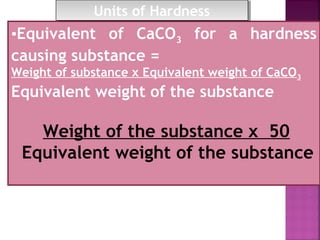
•Equivalent of CaCO3 for a hardness
causing substance =
Weight of substance x Equivalent weight of CaCO3
Equivalent weight of the substance
Weight of the substance x 50
Equivalent weight of the substance
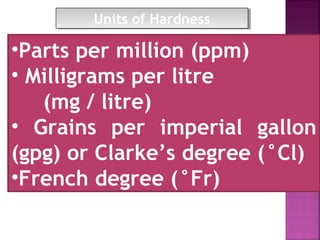
Units of HardnessUnits of Hardness
•Parts per million (ppm)
• Milligrams per litre
(mg / litre)
• Grains per imperial gallon
(gpg) or Clarke’s degree (°Cl)
•French degree (°Fr)
Units of HardnessUnits of Hardness
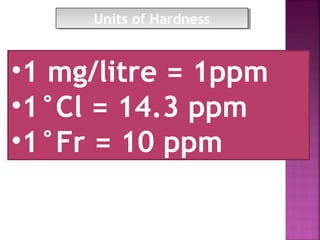
•1 mg/litre = 1ppm
•1°Cl = 14.3 ppm
•1°Fr = 10 ppm
Units of HardnessUnits of Hardness
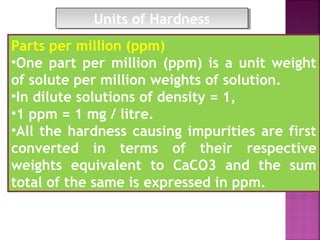
Parts per million (ppm)
•One part per million (ppm) is a unit weight
of solute per million weights of solution.
•In dilute solutions of density = 1,
•1 ppm = 1 mg / litre.
•All the hardness causing impurities are first
converted in terms of their respective
weights equivalent to CaCO3 and the sum
total of the same is expressed in ppm.
Units of HardnessUnits of Hardness
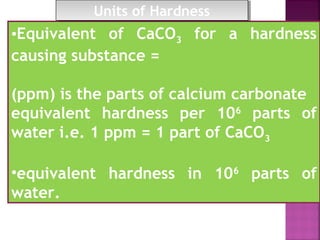
•Equivalent of CaCO3 for a hardness
causing substance =
(ppm) is the parts of calcium carbonate
equivalent hardness per 106
parts of
water i.e. 1 ppm = 1 part of CaCO3
•equivalent hardness in 106
parts of
water.
Units of HardnessUnits of Hardness
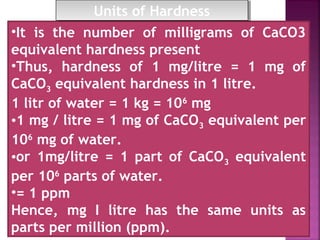
•It is the number of milligrams of CaCO3
equivalent hardness present
•Thus, hardness of 1 mg/litre = 1 mg of
CaCO3 equivalent hardness in 1 litre.
1 litr of water = 1 kg = 106
mg
•1 mg / litre = 1 mg of CaCO3 equivalent per
106
mg of water.
•or 1mg/litre = 1 part of CaCO3 equivalent
per 106
parts of water.
•= 1 ppm
Hence, mg I litre has the same units as
parts per million (ppm).
Units of HardnessUnits of Hardness
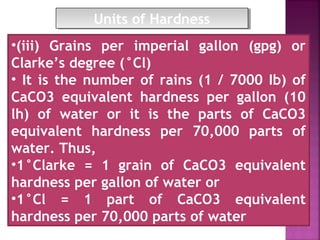
•(iii) Grains per imperial gallon (gpg) or
Clarke’s degree (°Cl)
• It is the number of rains (1 / 7000 Ib) of
CaCO3 equivalent hardness per gallon (10
lh) of water or it is the parts of CaCO3
equivalent hardness per 70,000 parts of
water. Thus,
•1°Clarke = 1 grain of CaCO3 equivalent
hardness per gallon of water or
•1°Cl = 1 part of CaCO3 equivalent
hardness per 70,000 parts of water
Units of HardnessUnits of Hardness
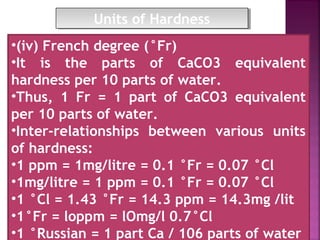
•(iv) French degree (°Fr)
•It is the parts of CaCO3 equivalent
hardness per 10 parts of water.
•Thus, 1 Fr = 1 part of CaCO3 equivalent
per 10 parts of water.
•Inter-relationships between various units
of hardness:
•1 ppm = 1mg/litre = 0.1 °Fr = 0.07 °Cl
•1mg/litre = 1 ppm = 0.1 °Fr = 0.07 °Cl
•1 °Cl = 1.43 °Fr = 14.3 ppm = 14.3mg /lit
•1°Fr = loppm = lOmg/l 0.7°Cl
•1 °Russian = 1 part Ca / 106 parts of water
Units of HardnessUnits of Hardness
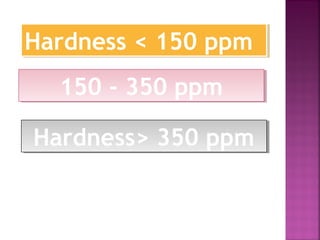
Hardness < 150 ppmHardness < 150 ppm
150 - 350 ppm150 - 350 ppm
Hardness> 350 ppmHardness> 350 ppm

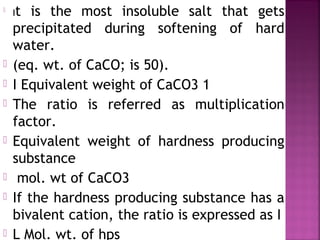
It is the most insoluble salt that gets
precipitated during softening of hard
water.
 (eq. wt. of CaCO; is 50).
 I Equivalent weight of CaCO3 1
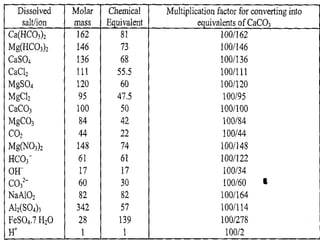
 The ratio is referred as multiplication
factor.
 Equivalent weight of hardness producing
substance
 mol. wt of CaCO3
 If the hardness producing substance has a
bivalent cation, the ratio is expressed as I
 L Mol. wt. of hps
 Insoluble Ca and Mg salts are removed
by filtration.
 Hardness caused by Chlorides and
Sulphates of Ca and Mg is called Non-
Alkaline Hardness.
 Degree of Hardness
 The net amount of hardness causing
impurities present in a finite volume
(usually one litre or i.e. one
 million ml) is called degree of
hardness. This is expressed in terms
of equivalents of CaCO3.
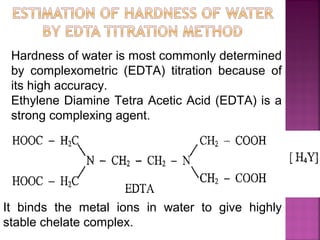
Hardness of water is most commonly determined
by complexometric (EDTA) titration because of
its high accuracy.
Ethylene Diamine Tetra Acetic Acid (EDTA) is a
strong complexing agent.
It binds the metal ions in water to give highly
stable chelate complex.
It is not very soluble in
water hence EDTA in the
form of its soluble
disodium salt (Na2H2y) is
generally used in
complexometric titrations.
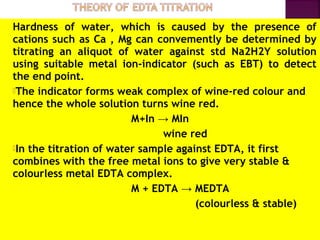
Hardness of water, which is caused by the presence of
cations such as Ca , Mg can convemently be determined by
titrating an aliquot of water against std Na2H2Y solution
using suitable metal ion-indicator (such as EBT) to detect
the end point.
The indicator forms weak complex of wine-red colour and
hence the whole solution turns wine red.
M+In → MIn
wine red
In the titration of water sample against EDTA, it first
combines with the free metal ions to give very stable &
colourless metal EDTA complex.
M + EDTA → MEDTA
(colourless & stable)
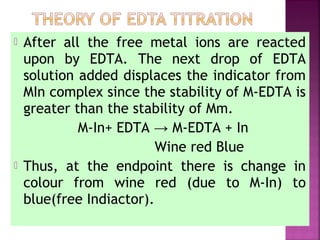
 After all the free metal ions are reacted
upon by EDTA. The next drop of EDTA
solution added displaces the indicator from
MIn complex since the stability of M-EDTA is
greater than the stability of Mm.
M-In+ EDTA → M-EDTA + In
Wine red Blue
 Thus, at the endpoint there is change in
colour from wine red (due to M-In) to
blue(free Indiactor).
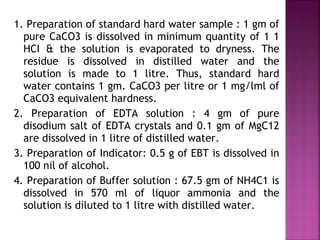
1. Preparation of standard hard water sample : 1 gm of
pure CaCO3 is dissolved in minimum quantity of 1 1
HCI & the solution is evaporated to dryness. The
residue is dissolved in distilled water and the
solution is made to 1 litre. Thus, standard hard
water contains 1 gm. CaCO3 per litre or 1 mg/lml of
CaCO3 equivalent hardness.
2. Preparation of EDTA solution : 4 gm of pure
disodium salt of EDTA crystals and 0.1 gm of MgC12
are dissolved in 1 litre of distilled water.
3. Preparation of Indicator: 0.5 g of EBT is dissolved in
100 nil of alcohol.
4. Preparation of Buffer solution : 67.5 gm of NH4C1 is
dissolved in 570 ml of liquor ammonia and the
solution is diluted to 1 litre with distilled water.
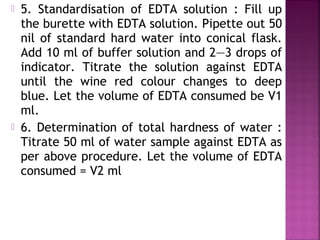
 5. Standardisation of EDTA solution : Fill up
the burette with EDTA solution. Pipette out 50
nil of standard hard water into conical flask.
Add 10 ml of buffer solution and 2—3 drops of
indicator. Titrate the solution against EDTA
until the wine red colour changes to deep
blue. Let the volume of EDTA consumed be V1
ml.
 6. Determination of total hardness of water :
Titrate 50 ml of water sample against EDTA as
per above procedure. Let the volume of EDTA
consumed = V2 ml
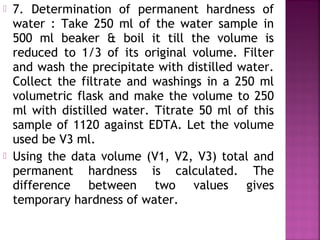
 7. Determination of permanent hardness of
water : Take 250 ml of the water sample in
500 ml beaker & boil it till the volume is
reduced to 1/3 of its original volume. Filter
and wash the precipitate with distilled water.
Collect the filtrate and washings in a 250 ml
volumetric flask and make the volume to 250
ml with distilled water. Titrate 50 ml of this
sample of 1120 against EDTA. Let the volume
used be V3 ml.
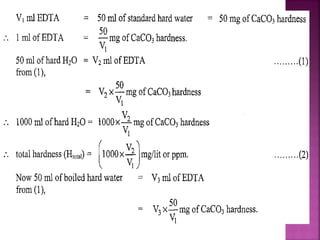
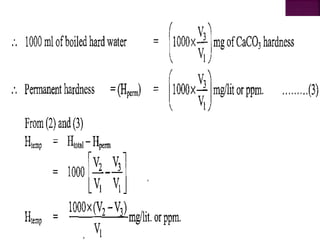
 Using the data volume (V1, V2, V3) total and
permanent hardness is calculated. The
difference between two values gives
temporary hardness of water.
Advantages of
EDTA Titration
Method
Advantages of
EDTA Titration
Method
Highly Accurate
Highly Convenient
Highly Rapid
Highly Accurate
Highly Convenient
Highly Rapid
 This is also known as softening of water.
 This process of removing hardness
producing salts, such as Mg(HCO3)2,
Cad2, MgCl2, CaSO4, MgSO4,
 Ca(HCO3)2 from hard water is known as
softening of water.
 This is done by following methods
1. Lime Soda process
2. Permutit or Zeolite process
3. Ion—Exchange process
4. Membrane Technology
 Principle - To convert all the soluble hardness
causing constituents into insoluble precipitates
by appropriate chemical treatments and then
removing them.
 In this process calculated amounts of Lime
[Ca(OH)2] and Soda (Na2CO3) are added
depending upon the concentration of
impurities.
 Reactions of lime with various chemicals in
hard water are as follows:
Lime and soda when added to hard water, the
soluble Ca & Mg impurities reacts with lime and
soda and are converted into the insoluble
precipitate. The Ca carbonate and Mg
hydroxide thus precipitated is filtered off.
Ca(OH)2 + Mg2+
→ Mg(OH)2 ↓+ Ca2+
(Lime)
The Ca produced is removed by addition of
soda and precipitate out as Ca carbonate.
Ca2+
+ Na2CO3 → CaCO3 ↓+ Na+
(Soda)
Lime removes temporary hardness completely.
Lime and soda when added to hard water, the
soluble Ca & Mg impurities reacts with lime and
soda and are converted into the insoluble
precipitate. The Ca carbonate and Mg
hydroxide thus precipitated is filtered off.
Ca(OH)2 + Mg2+
→ Mg(OH)2 ↓+ Ca2+
(Lime)
The Ca produced is removed by addition of
soda and precipitate out as Ca carbonate.
Ca2+
+ Na2CO3 → CaCO3 ↓+ Na+
(Soda)
Lime removes temporary hardness completely.
 The goal of all of these reactions is to change
the calcium and magnesium compounds in
water into calcium carbonate and magnesium
hydroxide. 
 These are the least soluble calcium and
magnesium compounds and thus will settle out
of the water at the lowest concentrations.
 In this process calculated amounts of Lime and
Soda are added depending upon the
concentration of impurities.
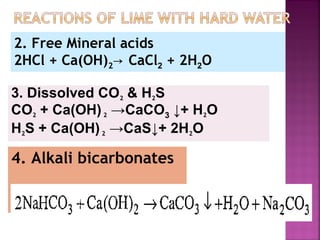
 Reactions of lime with various chemicals in
hard water are as follows.
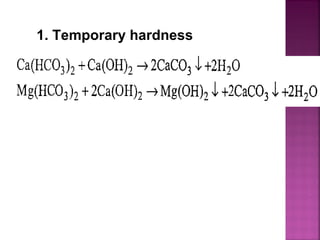
1. Temporary hardness
4. Alkali bicarbonates
2. Free Mineral acids
2HCl + Ca(OH)2 CaCl→ 2 + 2H2O
3. Dissolved CO2 & H2S
CO2 + Ca(OH)2 →CaCO3 ↓+ H2O
H2S + Ca(OH)2 →CaS↓+ 2H2O
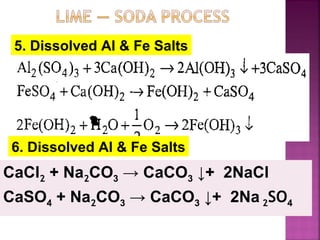
5. Dissolved Al & Fe Salts
CaCl2 + Na2CO3 → CaCO3 ↓+ 2NaCl
CaSO4 + Na2CO3 → CaCO3 ↓+ 2Na 2SO4
6. Dissolved Al & Fe Salts
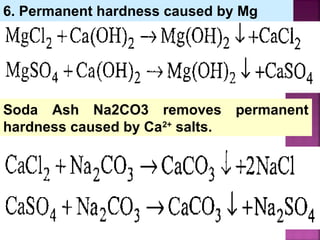
6. Permanent hardness caused by Mg
Salts
Soda Ash Na2CO3 removes permanent
hardness caused by Ca2+
salts.
Precipitates of CaCO3 & Mg(OH)2 are
removed by filtration.
It is seen from above reactions that lime
removes temporary hardness without
introducing any soluble salts into the water.
Since lime is cheap, it is economical to use
it for removing temporary hardness.
Both CaCO3 & Mg(OH)2 produced as per
the reactions given above are insoluble &
precipitate as sludge.
Addition of coagulant like alum helps in
faster settling of sludge which can then be
removed easily.
Water softened by this process
contains considerable quantities of
soluble salts like NaCI & Na2SO4
and hence can not be used in high
pressure boilers.
There are following types of lime
soda process
1. Batch process (Cold & hot)
2. Continuous process (Cold & hot)
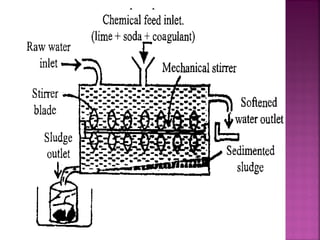
•This process is carried out in tanks provided with
mechanical stirrers for thorough mixing. Calculated
quantities of lime & soda are added to the water tank
& thoroughly mixed.
•The precipitates formed are very fine & hence
cannot be removed by filtration immediately. It takes
about 24 hours for settling.
•To hasten setting coagulants like sodium aluminate,
aluminium sulphate or alum have to be added. It
takes about 2 hrs to precipitate to settle down.
•The softened water from the top is drawn out using
pumps & passed through sand filters. The sludge
formed at the bottom is removed & cleaned with
water.
Batch Process
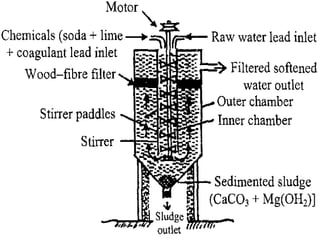
Calculated quantity of lime, soda &
coagulant are fed through the top into the
inner circular chamber with rotating shafts
having paddles. As the water flows down in
the vertical chamber there is thorough
mixing & due to the various chemical
reactions taking place in this process,
softening is achieved. The softened water
rises upwards through the outer coaxial
chamber. The solid sludge formed settles at
bottom water is filtered and flows out
continuously through the outlet at the top.
Sludge is removed from time to time.
2. Continuous Process
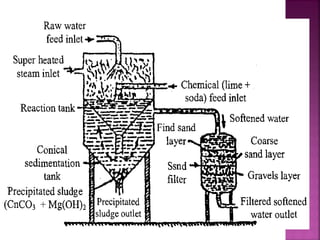
This process is operated at 90— 100°C.
A typical hot lime soda water softening unit is
shown in figure. This consists essentially of a
reaction cum settling tank and a filtering setup.
The filtering bed consists of sand, anthracite
coal, calcite or magnesite.
If a slight excess of chemicals are used, not only
the process is faster but also removal of
hardness is achieved but excessive chemicals
are carried through to the softened H2O and
hence decreases its quality.
2. Hot lime soda process
It has the following advantages.
1. The rate of reaction is increased,
softening is completed in 15
minutes.
2. Sludge settles faster and the
addition of coagulants is not
required.
3. Dissolved gases like CO2 are
expelled.
4. It reduces the viscosity of water
& increases the rate of filtration.
Hot lime soda process
Advantages of Lime Soda Process:
I. It is very economical.
2. The process increases pH value making water
alkaline which results in reduction rate of corrosion
of the boiler by acids.
3. Alongwith hardness causing salts, mineral acids
and other impurities are also removed.
4. Due to alkaline nature of water, amount of
pathogenic bacteria in water is considerably
reduced.
Disadvantages of Lime Soda Process:
1. The water softened by this process has residual
hardness upto 50 ppm.
2. Large amount of sludge formation causes problems
of disposal.
3. Skilled supervisor is required to control the
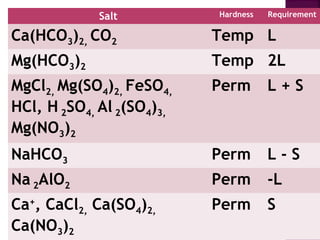
Salt Hardness Requirement
Ca(HCO3)2, CO2 Temp L
Mg(HCO3)2 Temp 2L
MgCl2, Mg(SO4)2, FeSO4,
HCl, H 2SO4, Al 2(SO4)3,
Mg(NO3)2
Perm L + S
NaHCO3 Perm L - S
Na 2AlO2 Perm -L
Ca+
, CaCl2, Ca(SO4)2,
Ca(NO3)2
Perm S
Formula
Permutit is the technical name given
to Sodium Zeolite [Na2Z]
Na2O ∙Al2O3 . xSiO2 . yH2O
where x = 2 to 10, y = 2 to 6
It is also called hydrated sodium
alumino silicates.
It is represented as Na2Z
where Z is zeolite.
Zeolite or Permutit Process
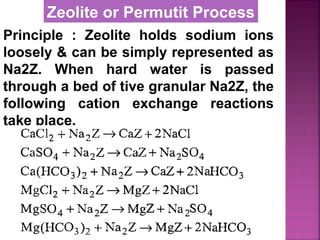
Principle : Zeolite holds sodium ions
loosely & can be simply represented as
Na2Z. When hard water is passed
through a bed of tive granular Na2Z, the
following cation exchange reactions
take place.
Zeolite or Permutit Process
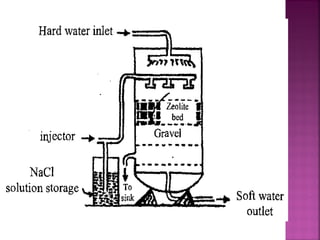
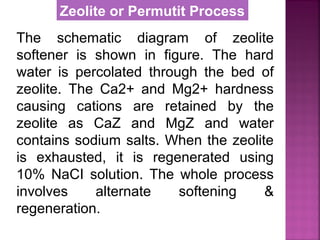
The schematic diagram of zeolite
softener is shown in figure. The hard
water is percolated through the bed of
zeolite. The Ca2+ and Mg2+ hardness
causing cations are retained by the
zeolite as CaZ and MgZ and water
contains sodium salts. When the zeolite
is exhausted, it is regenerated using
10% NaCI solution. The whole process
involves alternate softening &
regeneration.
Zeolite or Permutit Process
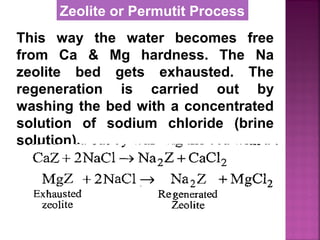
This way the water becomes free
from Ca & Mg hardness. The Na
zeolite bed gets exhausted. The
regeneration is carried out by
washing the bed with a concentrated
solution of sodium chloride (brine
solution).
Zeolite or Permutit Process
1. Residual hardness is upto 10 ppm.
2. The equipment used is compact and
occupies small space.
3. It requires less time for softening.
4. It does not require skilled operator.
5. No impurities are precipitated, hence
there is no danger of sludge formation in
water at a later stage.
Advantages of Zeolite or Permutit
Process
I. The turbidity in water if any should be removed
before passing through zeolite bed as it cloggs the
pones of zeolite bed.
2. If the watercontains Fe2+ and Mn2+ they get
converted to FeZ and MnZ which are very difficult to be
regenerated because of their high stability.
3. If mineral acids are present in H2O destroy the
zeolite bed and therefore they must be neutralised
before admitting to zeolite softener.
4. The treated water contains more sodium, salts than
in lime soda process.
5. When such soft water containing more amount of
NaFICO3 and Na2CO1 is used in high pressure boilers,
NaHCO3 decomposes producing CO2 which causes
‘Caustic embrittlement’.
Limitations of Zeolite or Permutit
Process
Ion — Exchange Resins
An ion-exchange resin or ion-exchange
polymer is an insoluble matrix (or support
structure) normally in the form of small (1–
2 mm diameter) beads, usually white or
yellowish, fabricated from an organic polymer
substrate. The material has highly developed
structure of pores on the surface of which are
sites with easily trapped and released ions. The
trapping of ions takes place only with
simultaneous releasing of other ions; thus the
process is called ion-exchange. There are
multiple different types of ion-exchange resin
which are fabricated to selectively prefer one
or several different types of ions.
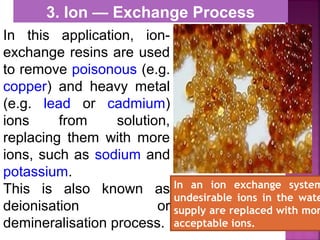
In this application, ion-
exchange resins are used
to remove poisonous (e.g.
copper) and heavy metal
(e.g. lead or cadmium)
ions from solution,
replacing them with more
ions, such as sodium and
potassium.
This is also known as
deionisation or
demineralisation process.
3. Ion — Exchange Process
In an ion exchange system
undesirable ions in the wate
supply are replaced with mor
acceptable ions.
3. Ion — Exchange Process
Few ion-exchange resins remove
chlorine or organic contaminants from
water - this is usually done by using an
activated charcoal filter mixed in with the
resin. There are some ion-exchange
resins that do remove organic ions, such
as MIEX (magnetic ion-exchange)
resins. Domestic water purification resin
is not usually recharged - the resin is
discarded when it can no longer be
used.
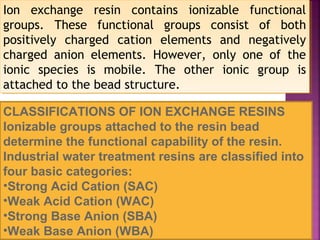
Ion exchange resin contains ionizable functional
groups. These functional groups consist of both
positively charged cation elements and negatively
charged anion elements. However, only one of the
ionic species is mobile. The other ionic group is
attached to the bead structure. 
Ion exchange resin contains ionizable functional
groups. These functional groups consist of both
positively charged cation elements and negatively
charged anion elements. However, only one of the
ionic species is mobile. The other ionic group is
attached to the bead structure. 
CLASSIFICATIONS OF ION EXCHANGE RESINS
Ionizable groups attached to the resin bead
determine the functional capability of the resin.
Industrial water treatment resins are classified into
four basic categories:
•Strong Acid Cation (SAC)
•Weak Acid Cation (WAC)
•Strong Base Anion (SBA)
•Weak Base Anion (WBA)
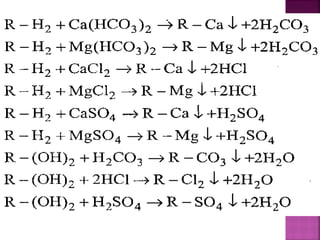
Cation exchange resins are resins which are capable
of exchanging H+
ions, with other cations.
They contain functional groups like — SO3H, —COOH,
—H etc. They are represented as R—H2.
Commercial cation exchanger is AMBERLITE IR — 120
Anion exchange resins are resins which are capable
of exchanging OH ions, with other anions.
They contain functional groups like — NH2 or —NH as
an integral part of the resin matrix.
When they are treated with dilute NaOH solution,
they act as an anion exchange resins and are
represented as R — (OH)2.
A commercial anion exchange is AMBERLITE [R400]
Cation exchange resins are resins which are capable
of exchanging H+
ions, with other cations.
They contain functional groups like — SO3H, —COOH,
—H etc. They are represented as R—H2.
Commercial cation exchanger is AMBERLITE IR — 120
Anion exchange resins are resins which are capable
of exchanging OH ions, with other anions.
They contain functional groups like — NH2 or —NH as
an integral part of the resin matrix.
When they are treated with dilute NaOH solution,
they act as an anion exchange resins and are
represented as R — (OH)2.
A commercial anion exchange is AMBERLITE [R400]
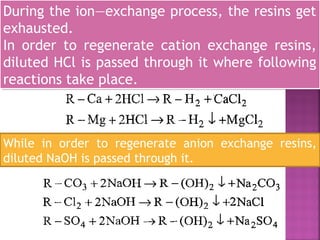
During the ion—exchange process, the resins get
exhausted.
In order to regenerate cation exchange resins,
diluted HCl is passed through it where following
reactions take place.
During the ion—exchange process, the resins get
exhausted.
In order to regenerate cation exchange resins,
diluted HCl is passed through it where following
reactions take place.
While in order to regenerate anion exchange resins,
diluted NaOH is passed through it.
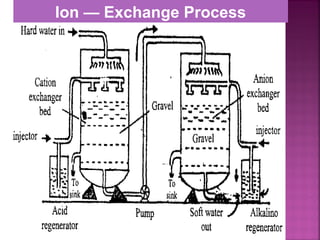
Ion — Exchange Process
The water to be treated passes through a bed of
the resin.
The hard water is first passes through the cation
exchange column when all the cations like Ca2+,
Mg2+ etc are removed (taken up by resin) & an
equivalent amount of H+
is released from resin to
water.
Subsequently, this water is passed through the
anion exchange column when all the anions like
Cl-
, SO4
2-
etc are removed (taken up by the resin)
and an equivalent amount of OH-
is released from
this column to water.
Ion — Exchange Process
The H+
and OH-
released
respectively from cation exchanger
and anion exchanger combine to
give water.
H+
+ OH-
→ H2OH+
+ OH-
→ H2O
Ion — Exchange Process
The "harder" the water, the more
hydrogen ions are released from the
resin and into the water.
The "harder" the water, the more
hydrogen ions are released from the
resin and into the water.
The ions in water can be reduced to
very low concentrations by exchange
with two different ion exchange resins
- one charged with hydrogen ions and
the other charged with hydroxyl ions.
The exchange results in the formation
of water.
Ion — Exchange Process
While the resins could be used in
series, efficiency is greatly enhanced
by mixing the resins together. As a
hydrogen ion or hydroxyl ion is
released, it helps drive the exchange
of a nearby site to get the ion for the
reaction to water. Using two resins of
opposite charge together is called
mixed-bed ion exchange.
Ion — Exchange Process
Water flowing out of the anion
exchange column is free from all
the cations and anions and
becomes ion free or deionised or
demineralised.
When capacities of cation and
anion exchangers to exchange H+
&
OH-
ions respectively are lost, they
are said to be exhausted.
Ion — Exchange Process
The affinity of an ion for a charged site
on the resin depends on the hydrated
radius of the ion. As this radius is
smaller for ions with greater charge,
the relative affinities depend on the
charge or valence as shown:
Single charged ion < ion with 2
charges < ion with 3 charges < multi
charged ion
Ion — Exchange Process
This is ideal for most practical
situations because we can prepare a
resin in the form of a monovalent ion
such as Na+
or H+
and exchange for
an ion such as Ca++
, Mg++
, or Fe+++
Ion — Exchange Process
The resin's capacity is gradually
exhausted and eventually it
contains only divalent ions,
Mg2+
and Ca2+
for cation
exchange resins, and SO4
2-
for
anion.
At this stage, the resin must be
regenerated.
Regeneration of Exchangers
These colunms are regenerated by respective
acid and alkali solutions as stated before.
The cation exchanger is regenerated by
diluted H2SO4 and then washed with
deionised water and washing (Containing
Ca2+
, Mg2+
and Cl-
, SO4
2-
ions) is passed to the
sink.
The anion exchanger is regenerated by
diluted NaOH and then washed with deionised
water & washing (containing Na and Cl-
, SO4
2-
ions) is passed to the sink.
The regenerated column is used again.
Regeneration of Exchangers
Very strong binding means that removal of that
ion for regeneration of the resin will be difficult.
The concentration required for the regenerating
ion and the cost will be less if a resin is selected
that is adequate for the task but does not hold
the ion too tightly.
Regeneration of Exchangers
R-Ca + 2HCl → 2 R- H + CaCl2
R-Ca + H2SO4 → 2R-H + CaSO4
Regeneration
Regeneration
1. The process can be used to soften highly
acidic or alkaline waters.
2. It produces water of very low hardness
(upto 2 ppm).
3. The water softened by this process is good
for high pressure boilers.
4. Deionized water is less expensive than
distilled water and is usually acceptable for
boilers and for industrial processes.
1. The process can be used to soften highly
acidic or alkaline waters.
2. It produces water of very low hardness
(upto 2 ppm).
3. The water softened by this process is good
for high pressure boilers.
4. Deionized water is less expensive than
distilled water and is usually acceptable for
boilers and for industrial processes.
Advantages of Ion-exchange processAdvantages of Ion-exchange process
Disadvantages of Ion-exchange processDisadvantages of Ion-exchange process
1. The equipment is costly and more
expensive chemicals are needed.
2. If water contains turbidity then the
output of the process is reduced.
1. The equipment is costly and more
expensive chemicals are needed.
2. If water contains turbidity then the
output of the process is reduced.
Deionised water has all its ions removed
but contains dissolved gases, organic
materials.
Distilled water is purest form of water.
All dissolved and suspended solids have
been removed.
Wastewater to be treated is of following
origin:
(i) Domestic
(ii) Industrial
For treatment of wastewater, membrane
technologies are becoming quite popular
because of simplicity & low energy
consumption.
The membrane technology includes
ultrafiltration, microfiltration,
nanofiltration etc.
Wastewater to be treated is of following
origin:
(i) Domestic
(ii) Industrial
For treatment of wastewater, membrane
technologies are becoming quite popular
because of simplicity & low energy
consumption.
The membrane technology includes
ultrafiltration, microfiltration,
nanofiltration etc.
Wastewater treatmentWastewater treatment
Membrane Filtration, means in
general mechanical separation
process used for separation of
gaseous or liquid streams using
membrane.
The membrane technology covers all
process engineering measures for
the transport of substances between
two fractions with the help of
permeable membranes.
Membrane FiltrationMembrane Filtration
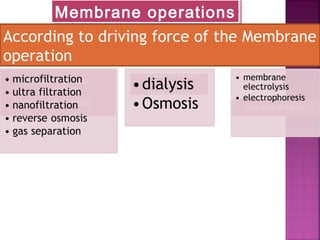
According to driving force of the Membrane
operation
Membrane operationsMembrane operations
Ultrafiltration is a type of membrane technical
filtration. It is commonly abbreviated to "UF."
UF has ability to purify, separate, and
concentrate target macromolecules in
continuous Process.
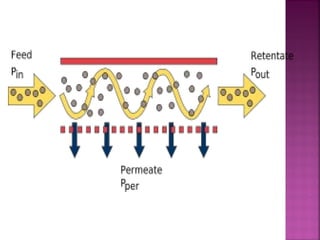
The solvent and other dissolved components
that pass through the membrane are known as
permeate. The components that do not pass
through are known as retentate.
Depending on the Molecular Weight Cut Off
(MWCO) of the membrane used,
macromolecules may be purified, separated, or
concentrated in either fraction.
Flux is amount of permeate produced per unit
Ultra filtrationUltra filtration
In many process and wastewater applications,
reduction of dissolved ions is not required but
efficient reduction of colloidal inorganic or organic
molecules is required.
Ultrafiltration (UF) membrane configurations and
system designs are similar to those used in the
single-stage RO process.
Because the large molecules removed by UF
exhibit negligible osmotic pressure, operating
pressures are usually much lower than in RO
systems.
MWCO is the smallest Mol wt species for which
membrane has more than 90% rejection.
Ultra filtrationUltra filtration
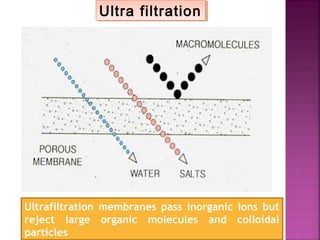
Ultrafiltration membranes pass inorganic ions but
reject large organic molecules and colloidal
particles
Ultra filtrationUltra filtration
Ultrafiltration is pressure driven and size
exclusion membrane process for removal
of particulate matter and micro-
organisms with diameter in excess of the
pore sizes of the membranes.
Pore size used is 0.002 to 0.1 microns,
MWCO 10,000 to 1,00,000 daltons
Operating pressure 200 to 700 kPa.
Flux 50 to 200 Gallons per foot per day.
Ultra filtrationUltra filtration
•Ultrafiltration is cross flow separation
process.
•The pressure is applied on the feed.
•The stream of that liquid which comes
through the membrane is called
permeate.
•The other liquid is called concentrate.
•Feed water flows through
semipermeable membrane depending
upon their MWCO.
Ultra filtrationUltra filtration
• UF will remove high molecular weight
substances, colloidal materials, organic
and inorganic polymeric molecules.
•Because high molecular weight species is
removed, osmotic pressure differential
across membrane is negligible.
• Low molecular weight organics and ions
such as sodium, calcium, are not
removed by UF membranes.
size exclusion based pressure driven
membrane separation process.
UP membranes have pore size in the range of
10 to 1000 A and are capable of retaining
species in the molecular weight range 500 to
500,000 Daltons.
Typical rejected species or constituents
include sugars, biomolecules, polymers,
colloidal particles and high molecular weight
organic substances depending upon their
molecular weight, molecular size and also
shape.
UltrafiltrationUltrafiltration
Membranes are classified according to their
molecular weight cut off (MWCO) which is usually
defined as the smallest molecular weight species
for which membranes have more than 90%
rejection.
Different available configuration of UP membranes
are:
(i) Flat membrane in plate and frame structure.
(ii) Tubular
(iii) Spiraly wound modules.
(iv) Hollow fibre type.
Ultrafiltration MembraneUltrafiltration Membrane
Amongst these spiral wound modules are most
commonly used through tubular type are of more
forgiving as far as pretreatment is concerned. These
four types of membrane configurations are studied
and tried in all the pressure driven membrane
processes. For waste treatment, mostly tubular or
spirally wound membrane configurations are in all
types of membrane treatment.
The membranes are used normally in spiral wound
type configuration and operate at low driving
pressures of 3 to 10 kg/cm2.
Ultrafiltration MembraneUltrafiltration Membrane
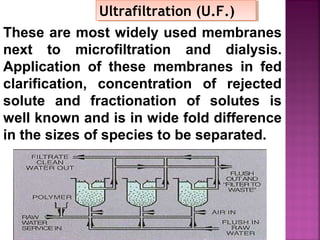
These are most widely used membranes
next to microfiltration and dialysis.
Application of these membranes in fed
clarification, concentration of rejected
solute and fractionation of solutes is
well known and is in wide fold difference
in the sizes of species to be separated.
Ultrafiltration (U.F.)Ultrafiltration (U.F.)
PRETREATMENTPRETREATMENT
Processes that rely on microporous membranes must
be protected from fouling. Membrane fouling causes a
loss of water production (flux), reduced permeate
quality, and increased trans-membrane pressure drop.
Membrane fouling is typically caused by precipitation
of inorganic salts, particulates of metal oxides,
colloidal silt, and the accumulation or growth of
microbiological organisms on the membrane surface.
These fouling problems can lead to serious damage
and necessitate more frequent replacement of
membranes.
SOLID REDUCTIONSOLID REDUCTION
Membrane feedwater should be relatively free from
colloidal particulates. The most common particulates
encountered in industrial membrane systems are silt,
iron oxides, and manganese oxides.
SCALE CONTROLSCALE CONTROL
Membrane processes produce a concentration
gradient of dissolved salts approaching the membrane
surfaces. The concentration at the membrane may
exceed the solubility limits of certain species. Calcium
carbonate (CaCO3) and calcium sulfate (CaSO4) are
typical precipitates formed. Silica, barium, and
strontium salts are also frequently identified in
membrane deposits. Because of their low solubility,
very low levels of feedwater barium or strontium can
cause membrane fouling.
MICROBIOLOGICAL SEPARATIONMICROBIOLOGICAL SEPARATION
Polyacrylamide membranes are resistant to
microbiological degradation; however, they are
susceptible to chemical oxidation. Therefore,
chlorination is not an acceptable treatment. If
inoculation occurs, microbiological fouling can
become a problem. Nonoxidizing antimicrobials and
biodispersants should be used if serious
microbiological fouling
Applications of UltrafiltrationApplications of Ultrafiltration
(i) Selective concentration of milk
constituents (fat and true proteins).
(ii) Concentration of fruit juices.
(iii) Separation clarification and selective
concentrations of liquid foods.
(iv) Clarification of sugar cane juice.
(v) Soyabean milk purification.
(vi) Removal of ligno compounds and liquid
imparting colour to the pulp and paper mill
wastewater. Depending upon the molecular
weight, high molecular weight organics are
economically separated from this waste
before biological treatment.
(vii)Pharmaceutical industry wastewater
containing complex organic molecules and their
dimers and trimers etc. having molecular weight
as high as 20,000 are removed by UP.
(viii)Textile industry wastewater which contains
dyes and other process chemical of organic
nature are separated using UP to reuse the water
or for disposal.
(ix) Pesticide industry wastewater which contains
complex, high molecular weight organics can be
selectively separated by choosing the membrane
of appropriate molecular weight cut off.
Applications of UltrafiltrationApplications of Ultrafiltration
(x) Leather and leather tanning industry waste is a
very tough effluent to treat. The volumes of water
required are also very large. UP can be applied after
proper pre-treatment. It gives the possible
application of UP along with other membrane
technologies like MF, ED, RO, Enzyme Membrane
Reactor or supported liquid membrane.
Advantages of UltrafiltrationAdvantages of Ultrafiltration
• UF effectively removes most
colloidal particles.
• fast process.
• low energy consumption.
•Low maintenance
• No use of chemicals.
•Long term operations are
possible.
• It requires minimal pretreatment
compared to RO.
Also called as
Hyperfiltration.
Membrane technology used
for separations.
Reverse Osmosis (RO)Reverse Osmosis (RO)
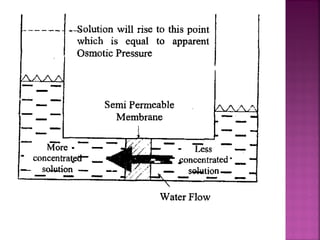
When more concentrated solution is separated by
a semi—permeable membrane from the less
concentrated solution, solution will rise in more
concentrated solution side. This happens due to
difference in osmotic pressures of two solutions.
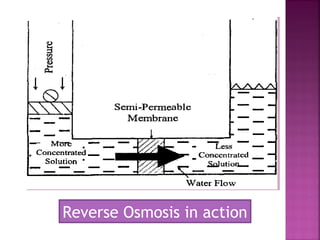
Now if by some means we are able to apply
externally a pressures equivalent to this
difference in pressures on more concentrated
solution, the flow of water will stop and systems
will be in equilibrium. Beyond this when the
pressure is further increased flowing in reverse
direction i.e. from concentrated solution side to
less concentrated solution side.
By selecting proper pore size and matrix of the
When more concentrated solution is separated by
a semi—permeable membrane from the less
concentrated solution, solution will rise in more
concentrated solution side. This happens due to
difference in osmotic pressures of two solutions.
Now if by some means we are able to apply
externally a pressures equivalent to this
difference in pressures on more concentrated
solution, the flow of water will stop and systems
will be in equilibrium. Beyond this when the
pressure is further increased flowing in reverse
direction i.e. from concentrated solution side to
less concentrated solution side.
By selecting proper pore size and matrix of the
OsmosisOsmosis
Reverse Osmosis in action
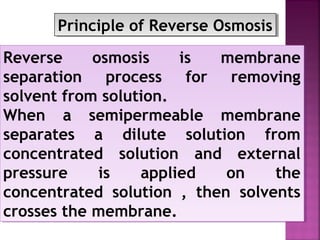
Reverse osmosis is membrane
separation process for removing
solvent from solution.
When a semipermeable membrane
separates a dilute solution from
concentrated solution and external
pressure is applied on the
concentrated solution , then solvents
crosses the membrane.
Reverse osmosis is membrane
separation process for removing
solvent from solution.
When a semipermeable membrane
separates a dilute solution from
concentrated solution and external
pressure is applied on the
concentrated solution , then solvents
crosses the membrane.
Principle of Reverse OsmosisPrinciple of Reverse Osmosis
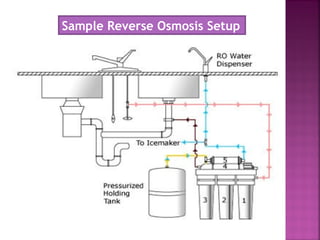
Sample Reverse Osmosis Setup
Reverse Osmosis system
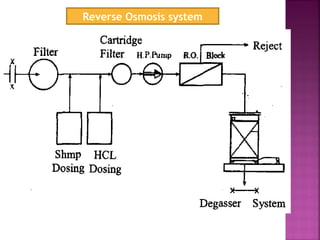
The solution is first filtered through a rough filter like sand
or active carbon or dual media filter etc. If the solution
contains (a) Calcium, magnesium salts, (b) Iron, (c)
Carbonates like calcium carbonate or magnesium carbonate
then acid dosing system and S.H.M.P. dosing systems are
introduced.
The pH adjusted solution is fine filtered through micro
cartridge filter (usually 5 to 10 micron size). The pretreated
water is then pumped into the RO bank with a help of high
pressure pump.
The membrane separates the pollutants in concentrated
form in the reject stream and pure water is collected as
permeate.
Since the membranes do not filter out (reject), the carbon—
dioxide generated by addition of acid in pretreatment, it is
physically removed in a degas ifier system as shown in fig(b).
The pressure range for RO systems varies from 10 kg/cm2 to
The solution is first filtered through a rough filter like sand
or active carbon or dual media filter etc. If the solution
contains (a) Calcium, magnesium salts, (b) Iron, (c)
Carbonates like calcium carbonate or magnesium carbonate
then acid dosing system and S.H.M.P. dosing systems are
introduced.
The pH adjusted solution is fine filtered through micro
cartridge filter (usually 5 to 10 micron size). The pretreated
water is then pumped into the RO bank with a help of high
pressure pump.
The membrane separates the pollutants in concentrated
form in the reject stream and pure water is collected as
permeate.
Since the membranes do not filter out (reject), the carbon—
dioxide generated by addition of acid in pretreatment, it is
physically removed in a degas ifier system as shown in fig(b).
The pressure range for RO systems varies from 10 kg/cm2 to
Reverse Osmosis system
RO membranes must be freely permeable to water,
highly impermeable to solutes.
Able to withstand high pressure.
Tolerant to wide ranges to of pH and temperature.
Resistant to attack by chemicals and bacteria.
Resistant to scaling and fouling.
RO membranes must be freely permeable to water,
highly impermeable to solutes.
Able to withstand high pressure.
Tolerant to wide ranges to of pH and temperature.
Resistant to attack by chemicals and bacteria.
Resistant to scaling and fouling.
RO Membranes
RO membranes in practice have either an asymmetric
or a thin film composite structure. In thin film
structure, thin skin at the top facing the feed solution
acts as a selective layer. The highly porous backing or
support layer offers very little pressure drop.
Different materials such as cellulose acetates (CA)
blends of cellulose acetate (CAB), polyether urea,
acrylonitrite, poly sulphone, polyamides are used in
preparation of RO membranes. Further improvement
in material of contracture of membranes to make
them more resistant to fouling, organic or inorganic
and be fouling will enhance the applications field of
RO.
RO membranes in practice have either an asymmetric
or a thin film composite structure. In thin film
structure, thin skin at the top facing the feed solution
acts as a selective layer. The highly porous backing or
support layer offers very little pressure drop.
Different materials such as cellulose acetates (CA)
blends of cellulose acetate (CAB), polyether urea,
acrylonitrite, poly sulphone, polyamides are used in
preparation of RO membranes. Further improvement
in material of contracture of membranes to make
them more resistant to fouling, organic or inorganic
and be fouling will enhance the applications field of
RO.
Types of RO Membranes
RO process for water purification does not require
thermal energy. Flow through RO system can be
regulated by high pressure pump.
The recovery of purified water depends upon various
factors including membrane sizes, membrane pore
size, temperature, operating pressure and membrane
surface area.
Major applications of RO in waste management. From
the nature of separations indicated earlier, it is quite
evident that RO is more useful as a tertiary
treatment. Here the major task is to separate salts
and organic compounds from the effluent which are
pretreated for removal of suspended/colloidal matter
RO process for water purification does not require
thermal energy. Flow through RO system can be
regulated by high pressure pump.
The recovery of purified water depends upon various
factors including membrane sizes, membrane pore
size, temperature, operating pressure and membrane
surface area.
Major applications of RO in waste management. From
the nature of separations indicated earlier, it is quite
evident that RO is more useful as a tertiary
treatment. Here the major task is to separate salts
and organic compounds from the effluent which are
pretreated for removal of suspended/colloidal matter
Applications Reverse Osmosis Setup
(i) Desalination of industrial wastewater after
secondary treatment: Under this category cooling
water blow down, Rayon industry process waste, pulp
and paper mill wastewater, Rinse water from
electroplating industry, distillery spent wash from
alcohol industry, taimery, textile industry can be
included.
(ii) Water recovery in dye house effluent: Textile and
dye industry is the second most polluting industry
after paper and pulp industry/various effluents
include dye house effluent rinsing water. Upto 80% of
the warm dye house wastewater can be recovered for
recycle to RO membrane life when properly operated
(i) Desalination of industrial wastewater after
secondary treatment: Under this category cooling
water blow down, Rayon industry process waste, pulp
and paper mill wastewater, Rinse water from
electroplating industry, distillery spent wash from
alcohol industry, taimery, textile industry can be
included.
(ii) Water recovery in dye house effluent: Textile and
dye industry is the second most polluting industry
after paper and pulp industry/various effluents
include dye house effluent rinsing water. Upto 80% of
the warm dye house wastewater can be recovered for
recycle to RO membrane life when properly operated
Applications Reverse Osmosis
(iii) Recovery of water for industrial use from domestic
sewage: Raw settled sewage is pretreated by conventional
method of chlorination and dechlorination, filtration, and
after p11 adjustment and antiscalent dosing is treated by RO
using brackish water or low pressure RO membranes.
(iv) Pollution control: Certain hazardous organic pollutants
present in wastewater are not easily oxidised by conventional
methods either due to presence of high inorganics or due to
nature of pollutant which are biorefractory. A combination of
UF/NP/RO can separate suspended, colloidal and soluble
organies from such waters. The rejects containing high
organics can be incinerated and water can be recovered
either for reuse or disposal. Spent wash from distilleries
which contain high inorganics and deep colour along with
reducing sugar, and other minor organic acid compounds can
be ideal case for combination of physical, chemical,
biotechnology and various membrane technologies RO, UP,
(iii) Recovery of water for industrial use from domestic
sewage: Raw settled sewage is pretreated by conventional
method of chlorination and dechlorination, filtration, and
after p11 adjustment and antiscalent dosing is treated by RO
using brackish water or low pressure RO membranes.
(iv) Pollution control: Certain hazardous organic pollutants
present in wastewater are not easily oxidised by conventional
methods either due to presence of high inorganics or due to
nature of pollutant which are biorefractory. A combination of
UF/NP/RO can separate suspended, colloidal and soluble
organies from such waters. The rejects containing high
organics can be incinerated and water can be recovered
either for reuse or disposal. Spent wash from distilleries
which contain high inorganics and deep colour along with
reducing sugar, and other minor organic acid compounds can
be ideal case for combination of physical, chemical,
biotechnology and various membrane technologies RO, UP,
Applications Reverse Osmosis
•The system is simple which is easy to operate
and install.
•Reverse osmosis gives mineral free water.
•It removes most of organic, inorganic,
biological impurities.
•Cost of Installation is low.
•The use of chemicals in whole process is low.
• The impact on environment is low.
• Process is cost effective.
•The system is simple which is easy to operate
and install.
•Reverse osmosis gives mineral free water.
•It removes most of organic, inorganic,
biological impurities.
•Cost of Installation is low.
•The use of chemicals in whole process is low.
• The impact on environment is low.
• Process is cost effective.
Advantages of Reverse Osmosis
•The small process in the membrane block
particles of large molecular structures like salt.
•RO produces acidic water by removing alkaline
mineral constituents like salt.
•RO removes natural minerals from water which
is essential for life.
•Slow process.
•Wastage of water.
•The small process in the membrane block
particles of large molecular structures like salt.
•RO produces acidic water by removing alkaline
mineral constituents like salt.
•RO removes natural minerals from water which
is essential for life.
•Slow process.
•Wastage of water.
Disadvantages of Reverse Osmosis
Water Pollution
Any alteration in the physical, chemical and
biological properties of water as well as
contamination with any foreign substance which
would constitute a health hazard or otherwise
decreases the utility of water.
Methods to determine the extent of pollution
BOD
(Biochemical Oxygen Demand of sewage)
The amount of free oxygen required for the
biological oxidation of the organic matter
under aerobic conditions at 20°C and for a
period of 5 days.
Unit : mg/lit or ppm.
(1)It indicates the amount of decomposable
organic matter in th sewage. Larger the
concentration of decomposable organic matter,
greater is BOD.
(2)It enables us to determine the degree of
pollution at any time in the sewage stream.
Determination of BOD
A known volume of sample of sewage is
diluted with a known volume of diluted
water, whose dissolved oxygen content is
predetermined.
The whole solution is incubated in a closed
bottle at 20°C for 5 days.
After this unused O2 is determined.
The difference between original O2 content
in the diluted water and unused oxygen of
solution after 5 days gives BOD in mg/ml.
Limitations of BOD
High concentration active bacteria
seed is required.
Pretreatment is needed when
dealing with toxic wastes.
Only biodegradable organic
substances are measured.
Long period of time.
Does not have stoichiometric
validity.
COD
(Chemical Oxygen Demand)
COD is the amount of oxygen consumed under
specified conditions in the oxidation of organic and
oxidisable inorganic matter.
(1)COD measures the biological oxidisable and
biologically inert organic matter such as cellulose.
(2)COD values can be employed to estimate BOD
valves.
(3)Determination of COD takes just 3 hours.
(4)Since COD test both biologically oxidisable and
the biologically inert matter are oxidised and the
biologically inert matter are oxidised, the COD
value for a sample is always higher than BOD value.
COD
(Chemical Oxygen Demand)
COD is the amount of oxygen consumed under
specified conditions in the oxidation of organic and
oxidisable inorganic matter.
(1)COD measures the biological oxidisable and
biologically inert organic matter such as cellulose.
(2)COD values can be employed to estimate BOD
valves.
(3)Determination of COD takes just 3 hours.
(4)Since COD test both biologically oxidisable and
the biologically inert matter are oxidised and the
biologically inert matter are oxidised, the COD
value for a sample is always higher than BOD value.
Determination of COD
1.A known volume of sample is refluxed
with a known excess of standard
potassium dichromate (K2Cr2O7) and dil
H2S04 in presence of a little Ag2SO4
catalyst for 1½ hours.
2.The unreacted K2Cr2O7 is then titrated
against standard Mohr’s salt solution.
[FeSO4 (NH4)2 S046HO2].
3.The O2 equivalent of K2Cr2O7
consumed is taken as a measure of COD.
Determination of COD
1.A known volume of sample is refluxed
with a known excess of standard
potassium dichromate (K2Cr2O7) and dil
H2S04 in presence of a little Ag2SO4
catalyst for 1½ hours.
2.The unreacted K2Cr2O7 is then titrated
against standard Mohr’s salt solution.
[FeSO4 (NH4)2 S046HO2].
3.The O2 equivalent of K2Cr2O7
consumed is taken as a measure of COD.
Methods to Control Water Pollution
1. Stabilisation of ecosystem : It includes
reduction of the waste at source harvesting
and removal of biomass, trapping of nutrients,
fish management and aeration.
2. Reutilisation and Recycling of the waste :
Waste water containing industrial effluents,
domestic sewage, thermal and radioactive
pollutants, municipal and other pollutants can
be recycled and reused to generate cheaper
fuel gas and electricity.
3. Waste treatment : Conventional methods of
sewage and industrial waste treatment like
oxidation method, decrease the water pollution
to minimum.
Methods to Control Water Pollution
1. Stabilisation of ecosystem : It includes
reduction of the waste at source harvesting
and removal of biomass, trapping of nutrients,
fish management and aeration.
2. Reutilisation and Recycling of the waste :
Waste water containing industrial effluents,
domestic sewage, thermal and radioactive
pollutants, municipal and other pollutants can
be recycled and reused to generate cheaper
fuel gas and electricity.
3. Waste treatment : Conventional methods of
sewage and industrial waste treatment like
oxidation method, decrease the water pollution
to minimum.
Methods to Control Water Pollution
4. Waste water reclamation : Treatment of sewage yields
irrigation water containing N, P, K to make it a good fertilizer.
Metals like Zn can be extracted from the waste water of rayon
manufacturing industry.
5. Removal of Pollutants: Many of the pollutants can be
removed from waste water by adsorption, electrodialysis ion-
exchange and reverse osmosis.
e.g. P is removed from sewage by electrolysis. Hg pollutants
can be removed by applying mercury selective ion exchange
resins.
6. Use of Water hyacinth: Water hyacinth can be used as
natural filter to absorb toxic effluents from domestic and
industrial sewage.
7. Use of bioreactors: Organic dirty sewage and factory waste
if pumped into bioreactors would remove about 95% of
impurities. The advantage of bioreactors is that they neither
produce any odourous smell nor toxic byproducts during the
Methods to Control Water Pollution
4. Waste water reclamation : Treatment of sewage yields
irrigation water containing N, P, K to make it a good fertilizer.
Metals like Zn can be extracted from the waste water of rayon
manufacturing industry.
5. Removal of Pollutants: Many of the pollutants can be
removed from waste water by adsorption, electrodialysis ion-
exchange and reverse osmosis.
e.g. P is removed from sewage by electrolysis. Hg pollutants
can be removed by applying mercury selective ion exchange
resins.
6. Use of Water hyacinth: Water hyacinth can be used as
natural filter to absorb toxic effluents from domestic and
industrial sewage.
7. Use of bioreactors: Organic dirty sewage and factory waste
if pumped into bioreactors would remove about 95% of
impurities. The advantage of bioreactors is that they neither
produce any odourous smell nor toxic byproducts during the
As waste materials usually occur in highly
diversified and time variable compositions,
their treatment is a challenging job.
Waste treatment processes are usually
operated in a non—aseptic environment with
mixed cultures of diverse micro—organisms.
It is a challenging task to stabilize the system
and design a process that can ensure the
required degree of reliability and product
specification.
As waste materials usually occur in highly
diversified and time variable compositions,
their treatment is a challenging job.
Waste treatment processes are usually
operated in a non—aseptic environment with
mixed cultures of diverse micro—organisms.
It is a challenging task to stabilize the system
and design a process that can ensure the
required degree of reliability and product
specification.
Activated Sludge ProcessActivated Sludge Process
The activated sludge process is a biological
wastewater treatment process that uses
microorganisms (bacteria, fungi, protozoa) to
speed up decomposition of organic matter.
Activated Sludge as the active biomass is
responsible for biological oxidation.
The activated sludge process is a biological
wastewater treatment process that uses
microorganisms (bacteria, fungi, protozoa) to
speed up decomposition of organic matter.
Activated Sludge as the active biomass is
responsible for biological oxidation.
Activated Sludge ProcessActivated Sludge Process
As waste materials usually occur in highly diversified
and time variable compositions, their treatment is a
challenging job. Waste treatment processes are
usually operated in a non—aseptic environment with
mixed cultures of diverse micro—organisms. It is a
challenging task to stabilize the system and design a
process that can ensure the required degree of
reliability and product specification.
Wastes occur in solid, liquid or gaseous form and
come from urban, agricultural and industrial sources.
However, by weight and volume, the solid wastes like
urban garbage, crops and food processing wastes,
manure, etc. are perhaps the most significant of all
wastes. These wastes are either burnt for energy,
As waste materials usually occur in highly diversified
and time variable compositions, their treatment is a
challenging job. Waste treatment processes are
usually operated in a non—aseptic environment with
mixed cultures of diverse micro—organisms. It is a
challenging task to stabilize the system and design a
process that can ensure the required degree of
reliability and product specification.
Wastes occur in solid, liquid or gaseous form and
come from urban, agricultural and industrial sources.
However, by weight and volume, the solid wastes like
urban garbage, crops and food processing wastes,
manure, etc. are perhaps the most significant of all
wastes. These wastes are either burnt for energy,
Activated Sludge ProcessActivated Sludge Process
The process consists of the mixing of sedimented
sewage with proper quantity of activated sludge. The
mixture is then sent to the aeration tank, in which
the mixed liquor is simultaneously aerated and
agitated for 4—6 hours. During this aeration process,
oxidation of the organic suspended matter takes
place. First oxidation of cation takes place, followed
by nitrogen to nitrites and nitrates. After aeration,
the effluent is sent to settling or sedimentation tank,
where sludge is deposited and clean liquid free from
bacteria is drawn off. A part of settled sludge is sent
back for seeding fresh batch of sewaqge, while the
remaining is disposed off either by seaburial,
digestion or by land spreading.
The process consists of the mixing of sedimented
sewage with proper quantity of activated sludge. The
mixture is then sent to the aeration tank, in which
the mixed liquor is simultaneously aerated and
agitated for 4—6 hours. During this aeration process,
oxidation of the organic suspended matter takes
place. First oxidation of cation takes place, followed
by nitrogen to nitrites and nitrates. After aeration,
the effluent is sent to settling or sedimentation tank,
where sludge is deposited and clean liquid free from
bacteria is drawn off. A part of settled sludge is sent
back for seeding fresh batch of sewaqge, while the
remaining is disposed off either by seaburial,
digestion or by land spreading.
LLife is not rehearsal …..
Each day is real show…….
No retakes…….
No rewinding……..
So give the best performance
in all your rolls…………..

Water

  • 1.
  • 2.
    Introduction Types of Water Hardnessof Water Effect of Hard Water in Industry Types of Hardness CONTENTSCONTENTS
  • 3.
     Water islife.  Water is required for animals, plants and human.  It is essential for all human activities domestic, agricultural and industrial use.  Water plays important role in various life processes in the human body.
  • 4.
     Pure water(H2O) is colorless, tasteless, and odorless.  It is composed of hydrogen and oxygen.  Water molecule has tendency to form intermolecular hydrogen bonding.  It is polar in nature.  To some degree, water can dissolve every naturally occurring substance on the earth. Because of this property, water has been termed a "universal solvent.”  pH of pure water is 7.
  • 5.
     The mainsources of natural water are — (a) Rain water (b) Surface water (flowing, still & sea water) (c) Ground water (well, spring).  The water consists of different impurities depending upon the source.  Rain water consists of atmospheric impurities, surface water consists of dissolved, suspended, colloidal and biological impurities.  Ground water consists of mineral salts and has medicinal value.  Because water becomes contaminated by the substances with which it comes into contact, it is not available for use in its pure state.
  • 6.
     Water inindustry has unique position. It is used as coolant, solvent, washing agent, steam generator, diluent etc.  Water is used in generating power.  Growing needs of water has initiated interest in quality of water.  Water quality required for domestic use as well as for each industry has the characteristics of its own. e.g. The quality of water used in sugar industry is different from the quality of water used in pharmaceuticals or cosmetic industries.
  • 7.
  • 8.
     Industry dependson water, much like agriculture and domestic households depend on water. Industries that produce metals, wood, paper, chemicals, gasoline, oils, and most other products all use water in some part of their production process.  Industrial reliance on water makes it essential to preserve water in every aspect possible and make sure water pollution is kept at minimal levels.  Industry is reliant on water for all levels of production. It can be used as a raw material, solvent, coolant, transport agent, and energy source.
  • 9.
     rain waterfalls on the surfaces  Comes in contact with several minerals, oxides, sulphates, carbonates, bicarbonates, dissolved gases etc.  Due to contamination the characteristics of water changes.  Water impurities include suspended solids and dissolved solids.
  • 10.
     Suspended solidsare substances that are not completely soluble in water and are present as particles.  These particles usually impart a visible turbidity to the water.  Calcium bicarbonate is a soluble salt. A solution of calcium bicarbonate is clear.  Some soluble minerals impart a color to the solution. Soluble iron salts produce pale yellow or green solutions; some copper salts form intensely blue solutions.  Although colored, these solutions are clear.
  • 11.
     Dissolved andsuspended solids are present in most surface waters.  Seawater is very high in soluble sodium chloride; suspended sand and silt make it slightly cloudy.  Due to dissolved salts the water becomes hard  Water becomes alkaline in nature.
  • 12.
    Soap generally consistsof sodium salt of long chain fatty acids such as oleic acid, palmitic acid and stearic acid etc. C17H35COONaC17H35COONa Sodium stearateSodium stearate C15H31COONaC15H31COONa Sodium PalmitateSodium Palmitate When ions of the salts reacts with the sodium salts of long-chain fatty acids present in the soap, lather is not produced but it forms insoluble white precipitates of Ca and Mg soaps which do not posses any detergent value. When ions of the salts reacts with the sodium salts of long-chain fatty acids present in the soap, lather is not produced but it forms insoluble white precipitates of Ca and Mg soaps which do not posses any detergent value.
  • 13.
     When hardwater is treated with soap, hardness of water does not allow soap to produce good amount of lather (foam) until a sufficient amount of soap has been added to precipitate out all hardness causing ions. When whole of the hardness causing ions are precipitated out, further addition of soap produces lather.  These ions do not pose any health threat, but they can engage in reactions that leave insoluble mineral deposits. These deposits can make hard water unsuitable for many uses, and so a variety of means have been developed to "soften" hard water;  i.e. remove the calcium and magnesium ions.
  • 14.
     Water whichimmediately (easily) produces good amount of lather (foam) with soap is called soft water.  Soft water is free from soluble salts of Magnesium and Calcium such as CaCl2, MgCl2, CaSO4, MgSO4, Ca(HCO3)2 and Mg(HCO3)2.  Soft water does not react with soap and hence does not produce insoluble curd like precipitate of Ca and Mg stearate or palmitate.
  • 15.
     Dissolved saltsof calcium and magnesium make the water hard.  Water which does not easily produce good amount of lather (foam) with soap is called hard water.  Hard water contains Calcium and Magnesium soluble salts such as CaCI2, MgCl2, CaSO4, MgSO4, Ca(HCO3)2 and Mg(HCO3)2.  It contains soluble salts of some heavy metals like Fe, Mn, Al, etc.
  • 16.
     Hard waterreacts with soap producing insoluble curd like precipitate of Ca and Mg stearate and palmitate as shown below: 2C17H35COONa + CaCl2 (C→ 17H35COO)2Ca + 2NaCl↓ Sodium stearate Hard water Ca stearate (White curd like ppt) 2C17H35COONa + MgSO4 (C→ 17H35COO)2Mg + Na↓ 2SO4 Sodium stearate Hard water Mg stearate (White curd like ppt) 2C15H31COONa +Ca(HCO3)2 →(C15H31COO)2Ca↓+ 2NaHCO3 Sodium Palmitate Hard water Ca-palmitate (Soap) (White curd like ppt)
  • 17.
     Drinking -Hardwater causes bad effects on our digestive system. Moreover, the possibility of forming calciumoxalate crystals in urinary tracks is increased.  For cooking the boiling point of water is increased because of presence of salts. Hence more fuel and time are required.
  • 18.
     WASHING -hardwater, when used for washing purposes, does not producing lather freely with soap. As a result cleansing quality of soap is decreased and a lot of it is wasted. Hardwater reacts with soap it produces sticky precipitates of calcium and magnesium soaps. These are insoluble formations.  Bathing - hardwater does not form lather freely with soap solution, but produces sticky scum on the bath- tub and body. Thus, the cleansing quality of soap is Bathing. Thus, the cleansing quality of soap is depressed and a lot of is wasted.
  • 19.
     Textile Industry:In this industry water is used for dyeing, bleaching and washing purpose. (a) During washing if hard water is used, a lot of soap gets wasted. (b) During dyeing exact shades of colour are not obtained with hard water. (c) On white clothes Fe and Mn may form coloured spots.  Sugar Industry : Water used should be free from sulphates, nitrates, bicarbonates etc. Otherwise it causes problems in crystallisation of sugar and such sugar may decompose on storage.
  • 20.
     Paper Industry: Water is used to make paper pulp. Water must be free from Fe, Ca, Mg. These ions affect the colour, smoothness and glossiness of the paper.  Dyeing Industry - The dissolved salts in hard water may reacts with costly dyes forming precipitates.  Pharmaceutical Industry - Hard water may cause some undesirable products while preparation of pharmaceutical products.  Concrete Making - Water containing chlorides and sulphates, if used for concrete making, affects the hydration of cement and the final strength of the hardened concrete.
  • 21.
     Laundry –Hard water, if used in laundry, causes much of the soap used in washing to go as waste Iron salts may even cause coloration of the clothes.  Bakeries : Water should not contain any organic matter such as fungi or bacteria. These affects yeast’s action and the quality of the bakery product becomes inferior.  Dairies : Contamination in diary product may lead to toxic effect.  Beaverage : Undesirable taste
  • 22.
     When hardwater is boiled at home or in industries, it leaves deposits of calcium and magnesium salts in kettles, hot-water pipes, boilers and radiators.  These deposits reduce the efficiency of boilers, kettles and pipes and can cause blockages and even bursting of the boilers.  Mineral deposits are formed by ionic reactions resulting in the formation of an insoluble precipitate. For example, when hard water is heated, Ca2+ ions react with bicarbonate (HCO3 - ) ions to form insoluble calcium carbonate (CaCO3).
  • 23.
    HARD WATER IN STEAM GENERATIO N IN BOILERS Scaleand sludge formation: the hardness of water fed to the boiler may cause scale and sludge formation. Scale and sludge formation: the hardness of water fed to the boiler may cause scale and sludge formation. Corrosion: Hard water may cause caustic embrittlement which is a type of boiler corrosion. Corrosion: Hard water may cause caustic embrittlement which is a type of boiler corrosion. Priming and Foaming: Hard water used in boiler causes priming and foaming which results in the formation of wet stream. Priming and Foaming: Hard water used in boiler causes priming and foaming which results in the formation of wet stream. Caustic embrittlement : Embrittlement is a loss of ductility of a material, making it brittle. Caustic embrittlement : Embrittlement is a loss of ductility of a material, making it brittle.
  • 24.
  • 25.
    • Due tocontinuous evaporation of water in boilers, the concentration of dissolved salts in hard water increases progressively and finally when ionic product exceeds the solubility product, these salts are precipitated on the inner walls of the boiler. If the precipitates are loose, slimy, and floating, they are known as sludge. Sludge can be easily removed with a wire brush. Excessive sludges if formed in boilers, choke up pipe connection, plug opening, gauge-glass connection and disturb the working of boilers. Frequent blow down operation i.e. drawing off a portion of the concentrated water (containing large amount of dissolved salts) and replacing it with fresh water or Using soft water in boilers can prevent sludge. • Due to continuous evaporation of water in boilers, the concentration of dissolved salts in hard water increases progressively and finally when ionic product exceeds the solubility product, these salts are precipitated on the inner walls of the boiler. If the precipitates are loose, slimy, and floating, they are known as sludge. Sludge can be easily removed with a wire brush. Excessive sludges if formed in boilers, choke up pipe connection, plug opening, gauge-glass connection and disturb the working of boilers. Frequent blow down operation i.e. drawing off a portion of the concentrated water (containing large amount of dissolved salts) and replacing it with fresh water or Using soft water in boilers can prevent sludge.
  • 26.
  • 27.
    •If the precipitatedmatter forms a hard adhering coating inside the boiler surface, they are called as scales. •Causes of scale formation 1. Decomposition of Ca (HCO3)2 2. Deposition of CaSO4 3. Hydrolysis of magnesium salts 4. Presence of silica (SiO2) •If the precipitated matter forms a hard adhering coating inside the boiler surface, they are called as scales. •Causes of scale formation 1. Decomposition of Ca (HCO3)2 2. Deposition of CaSO4 3. Hydrolysis of magnesium salts 4. Presence of silica (SiO2)
  • 28.
     This precipitate,known as scale, coats the vessels in which the water is heated, producing the mineral deposits.  This scale, coats the vessels in which the water is heated, producing the mineral deposits.  As these deposits build up, they reduce the efficiency of heat transfer, so food may not cook as evenly or quickly in pans with large scale deposits.  Hard water can cause "Scaling" inside the pipes that transport water . Therefore if we use hard water in    turbines and heat exchangers, their pipes will be corroded.  Therefore water should be softened before using in industries.
  • 29.
    (1) Decomposition ofCa (HCO3)2(1) Decomposition of Ca (HCO3)2 When hard water containing CaSO4 is heated in boilers, CaSO4, gets precipitated as hard scale on the heated portion of boilers and forms scale. (2) Decomposition of CaSO4(2) Decomposition of CaSO4
  • 30.
    (3) Hydrolysis ofmagnesium salts(3) Hydrolysis of magnesium salts Silica reacts with calcium and magnesium metals to form CaSiO3 and or MgSiO3, which gets deposited on the inner side of the boiler surface. (4) Presence of silica (SiO2)(4) Presence of silica (SiO2)
  • 31.
    •Scales have lowthermal conductivity, so they act as particle obstruction, therefore the rate of heat transfer from wall of boiler to inside water is decreased greatly. •Scales may be deposited in the valve and condensers of boiler and can choke them partially decrease in efficiency. •distortion of boiler tubes and makes the boiler unsafe, lowering boiler safety. •Scales have low thermal conductivity, so they act as particle obstruction, therefore the rate of heat transfer from wall of boiler to inside water is decreased greatly. •Scales may be deposited in the valve and condensers of boiler and can choke them partially decrease in efficiency. •distortion of boiler tubes and makes the boiler unsafe, lowering boiler safety.
  • 32.
    •If scales areloosely adhering, then they can be removed by scraping with a piece of wood or wire brush. • If scales are brittle, then by giving thermal shocks (i.e. heating the boiler and then suddenly cooling with cold water) they can be removed. •If scales are hard and adherent, then they can be removed by using some chemicals to dissolve them. e.g. CaCO3 scales can be dissolved by using 5 to 10% HCl. •If scales are loosely adhering, then they can be removed by scraping with a piece of wood or wire brush. • If scales are brittle, then by giving thermal shocks (i.e. heating the boiler and then suddenly cooling with cold water) they can be removed. •If scales are hard and adherent, then they can be removed by using some chemicals to dissolve them. e.g. CaCO3 scales can be dissolved by using 5 to 10% HCl.
  • 33.
    Colloidal conditioning •In lowpressure boilers, scale formation can be avoided by adding organic substances like kerosene, tanin, agar- agar etc. •These substances get coated over the scale forming precipitates, thereby yielding non-sticky and loose deposits similar to sludge which can be removed by blow down operation. Colloidal conditioning •In low pressure boilers, scale formation can be avoided by adding organic substances like kerosene, tanin, agar- agar etc. •These substances get coated over the scale forming precipitates, thereby yielding non-sticky and loose deposits similar to sludge which can be removed by blow down operation.
  • 34.
    Phosphate treatment In highpressure boilers, scale formation can be avoided by adding sodium phosphate. Phosphates reacts with Ca and Mg salts. The soft sludge of Ca3(P04)2 and Mg3(P04)2 (which is non-adherent and easily removable) can be removed by blow down operation. Phosphate treatment In high pressure boilers, scale formation can be avoided by adding sodium phosphate. Phosphates reacts with Ca and Mg salts. The soft sludge of Ca3(P04)2 and Mg3(P04)2 (which is non-adherent and easily removable) can be removed by blow down operation. Carbonate treatment In low pressure boilers, i.e. formation can be avoided by addition of Na2CO3 (sodium carbonate) to boiler, Carbonate treatment In low pressure boilers, i.e. formation can be avoided by addition of Na2CO3 (sodium carbonate) to boiler,
  • 35.
    Treatment with sodiumaluminate (NaAlO2) When boiler water is treated with NaAIO2 in solution, it gets hydrolysed to yield NaOH and Al(OH)3 Treatment with sodium aluminate (NaAlO2) When boiler water is treated with NaAIO2 in solution, it gets hydrolysed to yield NaOH and Al(OH)3 Calgon conditioning Sodium hexametaphosphate Na2[Na4(PO3)6] is added to boiler water. It prevents the scale formation by forming soluble complex compound. Calgon conditioning Sodium hexametaphosphate Na2[Na4(PO3)6] is added to boiler water. It prevents the scale formation by forming soluble complex compound. (Gelatinous precipitate
  • 36.
    Electrical conditioning o Thisis achieved by using sealed glass bulbs containing mercury connected to a battery which are set floating in the boiler. o When water boils, due to high temperature mercury bulbs emit electrical discharges which prevent the precipitates to stick to the sides of boiler and this prevents scale formation. Electrical conditioning o This is achieved by using sealed glass bulbs containing mercury connected to a battery which are set floating in the boiler. o When water boils, due to high temperature mercury bulbs emit electrical discharges which prevent the precipitates to stick to the sides of boiler and this prevents scale formation. Radioactive conditioning o Small tablets which contain radioactive salts are placed inside the boiler water at few points. o As water boils these tablets emit energy radiations and thus prevent scale formation. Radioactive conditioning o Small tablets which contain radioactive salts are placed inside the boiler water at few points. o As water boils these tablets emit energy radiations and thus prevent scale formation.
  • 37.
    Sludge Scale The looseand slimy precipitates which remain floating in water or get collected at the bottom of boiler are called as sludge. The hard adhering coating inside the boiler walls and bottom is called as scale. Formation of sludge is mainly due to salts which have lower solubility in cold water as compared to that in hot water. For example, MgCO3. Formation of scale is mainly due to salts which have higher solubility in cold water as compared to that in hot water. For example, CaSO4. Sludge remain suspended in boiler water. Scale forms hard coating on boiler. Blow down operation can remove sludge. Blow down operation can not remove scale.
  • 38.
    Caustic embrittlement It isa type of boiler corrosion which makes boiler material brittle. This is caused by using highly alkaline water in the boiler, most commonly in high pressure boiler. During lime soda process, free Na2CO3 is usually present in small proportion in the softened water. Na2CO3 in high pressure boilers decomposes to give sodium hydroxide and carbon dioxide. This makes boiler water caustic. Caustic embrittlement It is a type of boiler corrosion which makes boiler material brittle. This is caused by using highly alkaline water in the boiler, most commonly in high pressure boiler. During lime soda process, free Na2CO3 is usually present in small proportion in the softened water. Na2CO3 in high pressure boilers decomposes to give sodium hydroxide and carbon dioxide. This makes boiler water caustic. This causes embrittlement of boiler parts, particularlyThis causes embrittlement of boiler parts, particularly stressed parts like bends, joints etc.
  • 39.
    The water containingNaOH flows into the minute hair-cracks, in the inner wall of boiler, by capillary action. Here, water evaporates and the concentration of NaOH increases progressively. This caustic soda attacks the surrounding areas, thereby dissolving iron of boiler wall as sodium-ferroate. This causes embrittlement of boiler wall at a stressed parts like bends, joints, etc. The water containing NaOH flows into the minute hair-cracks, in the inner wall of boiler, by capillary action. Here, water evaporates and the concentration of NaOH increases progressively. This caustic soda attacks the surrounding areas, thereby dissolving iron of boiler wall as sodium-ferroate. This causes embrittlement of boiler wall at a stressed parts like bends, joints, etc.
  • 40.
    It can beexplained by considering the following concentration cell. It can be explained by considering the following concentration cell. Fe surrounded by dil NaOH becomes cathodic side and with conc NaOH becomes anodic side. Fe surrounded by dil NaOH becomes cathodic side and with conc NaOH becomes anodic side.
  • 41.
    pH adjustment to8 -9. Sodium phosphte can be used instead of Na carbonate. pH adjustment to 8 -9. Sodium phosphte can be used instead of Na carbonate.
  • 42.
     Corrosion reactionscause the slow dissolution of metals by water.  Deposition reactions, which produce scale on heat transfer surfaces, represent a change in the solvency power of water as its temperature is varied.  The control of corrosion and scale is a major focus of water treatment technology.
  • 43.
     More seriousis the situation in which industrial-sized water boilers become coated with scale.  The cost in heat-transfer efficiency can have a dramatic effect on power bill. Furthermore, scale can accumulate on the inside of appliances, such as and pipes. As scale builds up, water flow is impeded, and hence appliance parts and pipes must be replaced more often than if Ca2+ and Mg2+ ions were not present in the water.
  • 44.
     Water isan Universal solvent.  Although beneficial to mankind, the solvency power of water can pose a major threat to industrial equipment.  Corrosion reactions cause the slow dissolution of metals by water. Deposition reactions, which produce scale on heat transfer surfaces, represent a change in the solvency power of water as its temperature is varied.  The control of corrosion and scale is a major focus of water treatment technology.
  • 45.
  • 46.
    CorrosionCorrosion Corrosion can bedefined as, “loss of boiler material or deterioration of its useful properties due to chemical or electrochemical interaction with its environment .“
  • 47.
    Dissolved Oxygen •Dissolved oxygenis also one of the major factor to influence the hardness in water. •The process involves oxidation of oxides and other salts of metals which are present in water due to pollution caused by minerals. •The oxidation and hydration is D. O. influences oxidation and hydration of metal oxides / sulphides as 2Fe3O4 + ½ O2 →3Fe2O3 + 2H2O → 3Fe2O3∙ 2H2O Magnetite Heamatite Limonite
  • 48.
    Corrosion Dissolved oxygenCorrosionDissolved oxygen o It is the main corrosion causing impurity in water. Water, usually contains about 8 ml of dissolved oxygen per litre at room temperature. o Dissolved oxygen in water attacks the material at high temperature as shown by the following reactions if boiler material is of iron. 2Fe + 2H2O + O2 → 2 Fe(OH) 2 4Fe(OH) 2 + O2 → 2(Fe2O3∙ 2H2O) RustDissolved oxygen can be removed by i) Preheating ii) Chemical treatment (Na sulphite Na2CO3) iii)Mechanical Dearetion
  • 49.
    Dissolved Minerals • Dissolvedminerals are of iron and other heavy metals. •These metals are assimilated in water when they form dissolved salts by combining with other halides and nitrates in atmosphere. • Dissolution of minerals in water takes place as water gets percolated through surface of earth. •The products formed are salts of Ca and Mg which are soluble in water.
  • 50.
    Dissolved Carbon Dioxide •ThepH of water decrease due to dissolution of CO2 from atmosphere. Due to this the dissolution of minerals also increases. •CaCO3 + CO2 + H2O → Ca(HCO3) 2 •MgCO3 + CO2 + H2O → Mg(HCO3) 2 •These products i. e. dissolved salts increases hardness of water.
  • 51.
    Corrosion Dissolved carbondioxideCorrosion Dissolved carbon dioxide o CO2 gas dissolved in water, forms carbonic acid, which has slow corrosive effect on boiler material like any other acid. (Carbonic acid) Dissolved oxygen can be removed by i)Chemical treatment (NH4OH) ii)Mechanical Dearetion
  • 52.
    Other Pollutants •Acids suchas carbonic acid contributes hardness •Other poolutants such as industrial wastes, radioactive decay
  • 53.
    Corrosion due toAcids from dissolved saltsCorrosion due to Acids from dissolved salts (Hydrolysis of dissolved salts) MgCl2 if present in water, on hydrolysis liberates free acid as shown by chemical reactions, The liberated free acid reacts with iron material of the boiler in a chain like reaction producing acid again as shown below, The liberated free acid reacts with iron material of the boiler in a chain like reaction producing acid again as shown below,
  • 54.
     Other metalslike Fe2+ , Mn2+ and Al3+ also react with soap.  In practice the hardness of a water sample is usually taken as a measure of its Ca2+ and Mg2+ contents. Types of hardnessTypes of hardness TEMPORARY HARDNESS TEMPORARY HARDNESS PERMANENT HARDNESS PERMANENT HARDNESS
  • 55.
     When wateris boiled, the bicarbonates of calcium and magnesium decompose to form carbonates. Ca(HCO3)2 → CaCO3↓ + H2O + CO2 ↑ Mg(HCO3)2 → MgCO3↓ + H2O + CO2 ↑ MgCO3 hydrolyses to Mg(OH)2 MgCO3 + H2O → Mg(OH)2 + CO2 ↑  Thus Ca / Mg carbonates or hydroxides thus formed being insoluble are deposited and CO2 escapes out in air.
  • 56.
     It isdefined as the hardness of water caused by the bicarbonates of calcium, magnesium and other hardness producing metals.  It can be removed by boiling the water.  On boiling soluble Ca(HCO3)2 and Mg(HCO3)2 decompose into insoluble carbonates, which is removed by filtration. Hardness caused by bicarbonates of Ca and Mg also is called ‘Alkaline Hardness”.
  • 57.
     Therefore whenwater is boiled, the bicarbonates of calcium and magnesium decompose to form carbonates.  These are insoluble and collect on the sides of the vessel as fur or scale.  When calcium and magnesium bicarbonates are removed from the water, it becomes soft.
  • 58.
     It isalso called as Non-carbonate or Non-alkaline Hardness.  Hardness caused by the sulphates, nitrates and chlorides of calcium and magnesium is called permanent hardness.  It is not destroyed on boiling.  It requires special chemical treatment for removal of hardness causing salts, such as internal conditioning or external treatment.
  • 60.
    Temporary Hardness PermanentHardness It is due to dissolved bicarbonates of Ca+2 , Mg+2 , Fe+2 etc. It is due to other dissolved salts of Ca+2 , Mg+2 , Fe+2 etc. such as chlorides, sulphates and nitrates. This is known as alkaline hardness. This is known as non- alkaline hardness. Temporary hard water can be softened by 1. Only boiling. 2. Treating only with lime. Permanent hard water can be softened by treating with soda.
  • 61.
    Temporary Hardness PermanentHardness It is due to bicarbonates carbonates hence also known as carbonate hardness. It is due to other salts, hence known as non-carbonate hardness. Temporary hard water if used in steam production, forms sludge. This deposits harden to form scales. Permanent hard water if used in steam production, forms scales.
  • 62.
    • The measureof hardness causing impurities present in one litre of water is called as degree of hardness. Degree of HardnessDegree of Hardness
  • 63.
    •The extent ofhardness is measured in terms concentration of ions contributing to hardness. •It is usually expressed in terms of equivalent amount of CaCO3. • CaCO3 is selected as the standard as the molecular weight of CaCO3 is 100 and equivalent weight of CaCO3 is 50. •CaCO3 gets precipitated during Measurement of HardnessMeasurement of Hardness
  • 64.
    •Equivalent of CaCO3for a hardness causing substance = Weight of substance x Equivalent weight of CaCO3 Equivalent weight of the substance Weight of the substance x 50 Equivalent weight of the substance Units of HardnessUnits of Hardness
  • 65.
    •Parts per million(ppm) • Milligrams per litre (mg / litre) • Grains per imperial gallon (gpg) or Clarke’s degree (°Cl) •French degree (°Fr) Units of HardnessUnits of Hardness
  • 66.
    •1 mg/litre =1ppm •1°Cl = 14.3 ppm •1°Fr = 10 ppm Units of HardnessUnits of Hardness
  • 67.
    Parts per million(ppm) •One part per million (ppm) is a unit weight of solute per million weights of solution. •In dilute solutions of density = 1, •1 ppm = 1 mg / litre. •All the hardness causing impurities are first converted in terms of their respective weights equivalent to CaCO3 and the sum total of the same is expressed in ppm. Units of HardnessUnits of Hardness
  • 68.
    •Equivalent of CaCO3for a hardness causing substance = (ppm) is the parts of calcium carbonate equivalent hardness per 106 parts of water i.e. 1 ppm = 1 part of CaCO3 •equivalent hardness in 106 parts of water. Units of HardnessUnits of Hardness
  • 69.
    •It is thenumber of milligrams of CaCO3 equivalent hardness present •Thus, hardness of 1 mg/litre = 1 mg of CaCO3 equivalent hardness in 1 litre. 1 litr of water = 1 kg = 106 mg •1 mg / litre = 1 mg of CaCO3 equivalent per 106 mg of water. •or 1mg/litre = 1 part of CaCO3 equivalent per 106 parts of water. •= 1 ppm Hence, mg I litre has the same units as parts per million (ppm). Units of HardnessUnits of Hardness
  • 70.
    •(iii) Grains perimperial gallon (gpg) or Clarke’s degree (°Cl) • It is the number of rains (1 / 7000 Ib) of CaCO3 equivalent hardness per gallon (10 lh) of water or it is the parts of CaCO3 equivalent hardness per 70,000 parts of water. Thus, •1°Clarke = 1 grain of CaCO3 equivalent hardness per gallon of water or •1°Cl = 1 part of CaCO3 equivalent hardness per 70,000 parts of water Units of HardnessUnits of Hardness
  • 71.
    •(iv) French degree(°Fr) •It is the parts of CaCO3 equivalent hardness per 10 parts of water. •Thus, 1 Fr = 1 part of CaCO3 equivalent per 10 parts of water. •Inter-relationships between various units of hardness: •1 ppm = 1mg/litre = 0.1 °Fr = 0.07 °Cl •1mg/litre = 1 ppm = 0.1 °Fr = 0.07 °Cl •1 °Cl = 1.43 °Fr = 14.3 ppm = 14.3mg /lit •1°Fr = loppm = lOmg/l 0.7°Cl •1 °Russian = 1 part Ca / 106 parts of water Units of HardnessUnits of Hardness
  • 72.
    Hardness < 150ppmHardness < 150 ppm 150 - 350 ppm150 - 350 ppm Hardness> 350 ppmHardness> 350 ppm
  • 73.
     It is themost insoluble salt that gets precipitated during softening of hard water.  (eq. wt. of CaCO; is 50).  I Equivalent weight of CaCO3 1  The ratio is referred as multiplication factor.  Equivalent weight of hardness producing substance  mol. wt of CaCO3  If the hardness producing substance has a bivalent cation, the ratio is expressed as I  L Mol. wt. of hps
  • 74.
     Insoluble Caand Mg salts are removed by filtration.  Hardness caused by Chlorides and Sulphates of Ca and Mg is called Non- Alkaline Hardness.  Degree of Hardness  The net amount of hardness causing impurities present in a finite volume (usually one litre or i.e. one  million ml) is called degree of hardness. This is expressed in terms of equivalents of CaCO3.
  • 76.
    Hardness of wateris most commonly determined by complexometric (EDTA) titration because of its high accuracy. Ethylene Diamine Tetra Acetic Acid (EDTA) is a strong complexing agent. It binds the metal ions in water to give highly stable chelate complex.
  • 77.
    It is notvery soluble in water hence EDTA in the form of its soluble disodium salt (Na2H2y) is generally used in complexometric titrations.
  • 78.
    Hardness of water,which is caused by the presence of cations such as Ca , Mg can convemently be determined by titrating an aliquot of water against std Na2H2Y solution using suitable metal ion-indicator (such as EBT) to detect the end point. The indicator forms weak complex of wine-red colour and hence the whole solution turns wine red. M+In → MIn wine red In the titration of water sample against EDTA, it first combines with the free metal ions to give very stable & colourless metal EDTA complex. M + EDTA → MEDTA (colourless & stable)
  • 79.
     After allthe free metal ions are reacted upon by EDTA. The next drop of EDTA solution added displaces the indicator from MIn complex since the stability of M-EDTA is greater than the stability of Mm. M-In+ EDTA → M-EDTA + In Wine red Blue  Thus, at the endpoint there is change in colour from wine red (due to M-In) to blue(free Indiactor).
  • 80.
    1. Preparation ofstandard hard water sample : 1 gm of pure CaCO3 is dissolved in minimum quantity of 1 1 HCI & the solution is evaporated to dryness. The residue is dissolved in distilled water and the solution is made to 1 litre. Thus, standard hard water contains 1 gm. CaCO3 per litre or 1 mg/lml of CaCO3 equivalent hardness. 2. Preparation of EDTA solution : 4 gm of pure disodium salt of EDTA crystals and 0.1 gm of MgC12 are dissolved in 1 litre of distilled water. 3. Preparation of Indicator: 0.5 g of EBT is dissolved in 100 nil of alcohol. 4. Preparation of Buffer solution : 67.5 gm of NH4C1 is dissolved in 570 ml of liquor ammonia and the solution is diluted to 1 litre with distilled water.
  • 81.
     5. Standardisationof EDTA solution : Fill up the burette with EDTA solution. Pipette out 50 nil of standard hard water into conical flask. Add 10 ml of buffer solution and 2—3 drops of indicator. Titrate the solution against EDTA until the wine red colour changes to deep blue. Let the volume of EDTA consumed be V1 ml.  6. Determination of total hardness of water : Titrate 50 ml of water sample against EDTA as per above procedure. Let the volume of EDTA consumed = V2 ml
  • 82.
     7. Determinationof permanent hardness of water : Take 250 ml of the water sample in 500 ml beaker & boil it till the volume is reduced to 1/3 of its original volume. Filter and wash the precipitate with distilled water. Collect the filtrate and washings in a 250 ml volumetric flask and make the volume to 250 ml with distilled water. Titrate 50 ml of this sample of 1120 against EDTA. Let the volume used be V3 ml.  Using the data volume (V1, V2, V3) total and permanent hardness is calculated. The difference between two values gives temporary hardness of water.
  • 85.
    Advantages of EDTA Titration Method Advantagesof EDTA Titration Method Highly Accurate Highly Convenient Highly Rapid Highly Accurate Highly Convenient Highly Rapid
  • 86.
     This isalso known as softening of water.  This process of removing hardness producing salts, such as Mg(HCO3)2, Cad2, MgCl2, CaSO4, MgSO4,  Ca(HCO3)2 from hard water is known as softening of water.  This is done by following methods 1. Lime Soda process 2. Permutit or Zeolite process 3. Ion—Exchange process 4. Membrane Technology
  • 87.
     Principle -To convert all the soluble hardness causing constituents into insoluble precipitates by appropriate chemical treatments and then removing them.  In this process calculated amounts of Lime [Ca(OH)2] and Soda (Na2CO3) are added depending upon the concentration of impurities.  Reactions of lime with various chemicals in hard water are as follows:
  • 88.
    Lime and sodawhen added to hard water, the soluble Ca & Mg impurities reacts with lime and soda and are converted into the insoluble precipitate. The Ca carbonate and Mg hydroxide thus precipitated is filtered off. Ca(OH)2 + Mg2+ → Mg(OH)2 ↓+ Ca2+ (Lime) The Ca produced is removed by addition of soda and precipitate out as Ca carbonate. Ca2+ + Na2CO3 → CaCO3 ↓+ Na+ (Soda) Lime removes temporary hardness completely. Lime and soda when added to hard water, the soluble Ca & Mg impurities reacts with lime and soda and are converted into the insoluble precipitate. The Ca carbonate and Mg hydroxide thus precipitated is filtered off. Ca(OH)2 + Mg2+ → Mg(OH)2 ↓+ Ca2+ (Lime) The Ca produced is removed by addition of soda and precipitate out as Ca carbonate. Ca2+ + Na2CO3 → CaCO3 ↓+ Na+ (Soda) Lime removes temporary hardness completely.
  • 89.
     The goalof all of these reactions is to change the calcium and magnesium compounds in water into calcium carbonate and magnesium hydroxide.   These are the least soluble calcium and magnesium compounds and thus will settle out of the water at the lowest concentrations.  In this process calculated amounts of Lime and Soda are added depending upon the concentration of impurities.  Reactions of lime with various chemicals in hard water are as follows.
  • 90.
  • 91.
    4. Alkali bicarbonates 2.Free Mineral acids 2HCl + Ca(OH)2 CaCl→ 2 + 2H2O 3. Dissolved CO2 & H2S CO2 + Ca(OH)2 →CaCO3 ↓+ H2O H2S + Ca(OH)2 →CaS↓+ 2H2O
  • 92.
    5. Dissolved Al& Fe Salts CaCl2 + Na2CO3 → CaCO3 ↓+ 2NaCl CaSO4 + Na2CO3 → CaCO3 ↓+ 2Na 2SO4 6. Dissolved Al & Fe Salts
  • 93.
    6. Permanent hardnesscaused by Mg Salts Soda Ash Na2CO3 removes permanent hardness caused by Ca2+ salts.
  • 94.
    Precipitates of CaCO3& Mg(OH)2 are removed by filtration. It is seen from above reactions that lime removes temporary hardness without introducing any soluble salts into the water. Since lime is cheap, it is economical to use it for removing temporary hardness. Both CaCO3 & Mg(OH)2 produced as per the reactions given above are insoluble & precipitate as sludge. Addition of coagulant like alum helps in faster settling of sludge which can then be removed easily.
  • 95.
    Water softened bythis process contains considerable quantities of soluble salts like NaCI & Na2SO4 and hence can not be used in high pressure boilers. There are following types of lime soda process 1. Batch process (Cold & hot) 2. Continuous process (Cold & hot)
  • 97.
    •This process iscarried out in tanks provided with mechanical stirrers for thorough mixing. Calculated quantities of lime & soda are added to the water tank & thoroughly mixed. •The precipitates formed are very fine & hence cannot be removed by filtration immediately. It takes about 24 hours for settling. •To hasten setting coagulants like sodium aluminate, aluminium sulphate or alum have to be added. It takes about 2 hrs to precipitate to settle down. •The softened water from the top is drawn out using pumps & passed through sand filters. The sludge formed at the bottom is removed & cleaned with water. Batch Process
  • 98.
    Calculated quantity oflime, soda & coagulant are fed through the top into the inner circular chamber with rotating shafts having paddles. As the water flows down in the vertical chamber there is thorough mixing & due to the various chemical reactions taking place in this process, softening is achieved. The softened water rises upwards through the outer coaxial chamber. The solid sludge formed settles at bottom water is filtered and flows out continuously through the outlet at the top. Sludge is removed from time to time. 2. Continuous Process
  • 100.
    This process isoperated at 90— 100°C. A typical hot lime soda water softening unit is shown in figure. This consists essentially of a reaction cum settling tank and a filtering setup. The filtering bed consists of sand, anthracite coal, calcite or magnesite. If a slight excess of chemicals are used, not only the process is faster but also removal of hardness is achieved but excessive chemicals are carried through to the softened H2O and hence decreases its quality. 2. Hot lime soda process
  • 102.
    It has thefollowing advantages. 1. The rate of reaction is increased, softening is completed in 15 minutes. 2. Sludge settles faster and the addition of coagulants is not required. 3. Dissolved gases like CO2 are expelled. 4. It reduces the viscosity of water & increases the rate of filtration. Hot lime soda process
  • 103.
    Advantages of LimeSoda Process: I. It is very economical. 2. The process increases pH value making water alkaline which results in reduction rate of corrosion of the boiler by acids. 3. Alongwith hardness causing salts, mineral acids and other impurities are also removed. 4. Due to alkaline nature of water, amount of pathogenic bacteria in water is considerably reduced. Disadvantages of Lime Soda Process: 1. The water softened by this process has residual hardness upto 50 ppm. 2. Large amount of sludge formation causes problems of disposal. 3. Skilled supervisor is required to control the
  • 104.
    Salt Hardness Requirement Ca(HCO3)2,CO2 Temp L Mg(HCO3)2 Temp 2L MgCl2, Mg(SO4)2, FeSO4, HCl, H 2SO4, Al 2(SO4)3, Mg(NO3)2 Perm L + S NaHCO3 Perm L - S Na 2AlO2 Perm -L Ca+ , CaCl2, Ca(SO4)2, Ca(NO3)2 Perm S
  • 105.
  • 106.
    Permutit is thetechnical name given to Sodium Zeolite [Na2Z] Na2O ∙Al2O3 . xSiO2 . yH2O where x = 2 to 10, y = 2 to 6 It is also called hydrated sodium alumino silicates. It is represented as Na2Z where Z is zeolite. Zeolite or Permutit Process
  • 107.
    Principle : Zeoliteholds sodium ions loosely & can be simply represented as Na2Z. When hard water is passed through a bed of tive granular Na2Z, the following cation exchange reactions take place. Zeolite or Permutit Process
  • 109.
    The schematic diagramof zeolite softener is shown in figure. The hard water is percolated through the bed of zeolite. The Ca2+ and Mg2+ hardness causing cations are retained by the zeolite as CaZ and MgZ and water contains sodium salts. When the zeolite is exhausted, it is regenerated using 10% NaCI solution. The whole process involves alternate softening & regeneration. Zeolite or Permutit Process
  • 110.
    This way thewater becomes free from Ca & Mg hardness. The Na zeolite bed gets exhausted. The regeneration is carried out by washing the bed with a concentrated solution of sodium chloride (brine solution). Zeolite or Permutit Process
  • 111.
    1. Residual hardnessis upto 10 ppm. 2. The equipment used is compact and occupies small space. 3. It requires less time for softening. 4. It does not require skilled operator. 5. No impurities are precipitated, hence there is no danger of sludge formation in water at a later stage. Advantages of Zeolite or Permutit Process
  • 112.
    I. The turbidityin water if any should be removed before passing through zeolite bed as it cloggs the pones of zeolite bed. 2. If the watercontains Fe2+ and Mn2+ they get converted to FeZ and MnZ which are very difficult to be regenerated because of their high stability. 3. If mineral acids are present in H2O destroy the zeolite bed and therefore they must be neutralised before admitting to zeolite softener. 4. The treated water contains more sodium, salts than in lime soda process. 5. When such soft water containing more amount of NaFICO3 and Na2CO1 is used in high pressure boilers, NaHCO3 decomposes producing CO2 which causes ‘Caustic embrittlement’. Limitations of Zeolite or Permutit Process
  • 113.
    Ion — ExchangeResins An ion-exchange resin or ion-exchange polymer is an insoluble matrix (or support structure) normally in the form of small (1– 2 mm diameter) beads, usually white or yellowish, fabricated from an organic polymer substrate. The material has highly developed structure of pores on the surface of which are sites with easily trapped and released ions. The trapping of ions takes place only with simultaneous releasing of other ions; thus the process is called ion-exchange. There are multiple different types of ion-exchange resin which are fabricated to selectively prefer one or several different types of ions.
  • 114.
    In this application,ion- exchange resins are used to remove poisonous (e.g. copper) and heavy metal (e.g. lead or cadmium) ions from solution, replacing them with more ions, such as sodium and potassium. This is also known as deionisation or demineralisation process. 3. Ion — Exchange Process In an ion exchange system undesirable ions in the wate supply are replaced with mor acceptable ions.
  • 115.
    3. Ion —Exchange Process Few ion-exchange resins remove chlorine or organic contaminants from water - this is usually done by using an activated charcoal filter mixed in with the resin. There are some ion-exchange resins that do remove organic ions, such as MIEX (magnetic ion-exchange) resins. Domestic water purification resin is not usually recharged - the resin is discarded when it can no longer be used.
  • 116.
    Ion exchange resincontains ionizable functional groups. These functional groups consist of both positively charged cation elements and negatively charged anion elements. However, only one of the ionic species is mobile. The other ionic group is attached to the bead structure.  Ion exchange resin contains ionizable functional groups. These functional groups consist of both positively charged cation elements and negatively charged anion elements. However, only one of the ionic species is mobile. The other ionic group is attached to the bead structure.  CLASSIFICATIONS OF ION EXCHANGE RESINS Ionizable groups attached to the resin bead determine the functional capability of the resin. Industrial water treatment resins are classified into four basic categories: •Strong Acid Cation (SAC) •Weak Acid Cation (WAC) •Strong Base Anion (SBA) •Weak Base Anion (WBA)
  • 117.
    Cation exchange resinsare resins which are capable of exchanging H+ ions, with other cations. They contain functional groups like — SO3H, —COOH, —H etc. They are represented as R—H2. Commercial cation exchanger is AMBERLITE IR — 120 Anion exchange resins are resins which are capable of exchanging OH ions, with other anions. They contain functional groups like — NH2 or —NH as an integral part of the resin matrix. When they are treated with dilute NaOH solution, they act as an anion exchange resins and are represented as R — (OH)2. A commercial anion exchange is AMBERLITE [R400] Cation exchange resins are resins which are capable of exchanging H+ ions, with other cations. They contain functional groups like — SO3H, —COOH, —H etc. They are represented as R—H2. Commercial cation exchanger is AMBERLITE IR — 120 Anion exchange resins are resins which are capable of exchanging OH ions, with other anions. They contain functional groups like — NH2 or —NH as an integral part of the resin matrix. When they are treated with dilute NaOH solution, they act as an anion exchange resins and are represented as R — (OH)2. A commercial anion exchange is AMBERLITE [R400]
  • 119.
    During the ion—exchangeprocess, the resins get exhausted. In order to regenerate cation exchange resins, diluted HCl is passed through it where following reactions take place. During the ion—exchange process, the resins get exhausted. In order to regenerate cation exchange resins, diluted HCl is passed through it where following reactions take place. While in order to regenerate anion exchange resins, diluted NaOH is passed through it.
  • 120.
  • 121.
    The water tobe treated passes through a bed of the resin. The hard water is first passes through the cation exchange column when all the cations like Ca2+, Mg2+ etc are removed (taken up by resin) & an equivalent amount of H+ is released from resin to water. Subsequently, this water is passed through the anion exchange column when all the anions like Cl- , SO4 2- etc are removed (taken up by the resin) and an equivalent amount of OH- is released from this column to water. Ion — Exchange Process
  • 122.
    The H+ and OH- released respectivelyfrom cation exchanger and anion exchanger combine to give water. H+ + OH- → H2OH+ + OH- → H2O Ion — Exchange Process The "harder" the water, the more hydrogen ions are released from the resin and into the water. The "harder" the water, the more hydrogen ions are released from the resin and into the water.
  • 123.
    The ions inwater can be reduced to very low concentrations by exchange with two different ion exchange resins - one charged with hydrogen ions and the other charged with hydroxyl ions. The exchange results in the formation of water. Ion — Exchange Process
  • 124.
    While the resinscould be used in series, efficiency is greatly enhanced by mixing the resins together. As a hydrogen ion or hydroxyl ion is released, it helps drive the exchange of a nearby site to get the ion for the reaction to water. Using two resins of opposite charge together is called mixed-bed ion exchange. Ion — Exchange Process
  • 125.
    Water flowing outof the anion exchange column is free from all the cations and anions and becomes ion free or deionised or demineralised. When capacities of cation and anion exchangers to exchange H+ & OH- ions respectively are lost, they are said to be exhausted. Ion — Exchange Process
  • 126.
    The affinity ofan ion for a charged site on the resin depends on the hydrated radius of the ion. As this radius is smaller for ions with greater charge, the relative affinities depend on the charge or valence as shown: Single charged ion < ion with 2 charges < ion with 3 charges < multi charged ion Ion — Exchange Process
  • 127.
    This is idealfor most practical situations because we can prepare a resin in the form of a monovalent ion such as Na+ or H+ and exchange for an ion such as Ca++ , Mg++ , or Fe+++ Ion — Exchange Process
  • 128.
    The resin's capacityis gradually exhausted and eventually it contains only divalent ions, Mg2+ and Ca2+ for cation exchange resins, and SO4 2- for anion. At this stage, the resin must be regenerated. Regeneration of Exchangers
  • 129.
    These colunms areregenerated by respective acid and alkali solutions as stated before. The cation exchanger is regenerated by diluted H2SO4 and then washed with deionised water and washing (Containing Ca2+ , Mg2+ and Cl- , SO4 2- ions) is passed to the sink. The anion exchanger is regenerated by diluted NaOH and then washed with deionised water & washing (containing Na and Cl- , SO4 2- ions) is passed to the sink. The regenerated column is used again. Regeneration of Exchangers
  • 130.
    Very strong bindingmeans that removal of that ion for regeneration of the resin will be difficult. The concentration required for the regenerating ion and the cost will be less if a resin is selected that is adequate for the task but does not hold the ion too tightly. Regeneration of Exchangers R-Ca + 2HCl → 2 R- H + CaCl2 R-Ca + H2SO4 → 2R-H + CaSO4 Regeneration Regeneration
  • 131.
    1. The processcan be used to soften highly acidic or alkaline waters. 2. It produces water of very low hardness (upto 2 ppm). 3. The water softened by this process is good for high pressure boilers. 4. Deionized water is less expensive than distilled water and is usually acceptable for boilers and for industrial processes. 1. The process can be used to soften highly acidic or alkaline waters. 2. It produces water of very low hardness (upto 2 ppm). 3. The water softened by this process is good for high pressure boilers. 4. Deionized water is less expensive than distilled water and is usually acceptable for boilers and for industrial processes. Advantages of Ion-exchange processAdvantages of Ion-exchange process
  • 132.
    Disadvantages of Ion-exchangeprocessDisadvantages of Ion-exchange process 1. The equipment is costly and more expensive chemicals are needed. 2. If water contains turbidity then the output of the process is reduced. 1. The equipment is costly and more expensive chemicals are needed. 2. If water contains turbidity then the output of the process is reduced.
  • 133.
    Deionised water hasall its ions removed but contains dissolved gases, organic materials. Distilled water is purest form of water. All dissolved and suspended solids have been removed.
  • 134.
    Wastewater to betreated is of following origin: (i) Domestic (ii) Industrial For treatment of wastewater, membrane technologies are becoming quite popular because of simplicity & low energy consumption. The membrane technology includes ultrafiltration, microfiltration, nanofiltration etc. Wastewater to be treated is of following origin: (i) Domestic (ii) Industrial For treatment of wastewater, membrane technologies are becoming quite popular because of simplicity & low energy consumption. The membrane technology includes ultrafiltration, microfiltration, nanofiltration etc. Wastewater treatmentWastewater treatment
  • 135.
    Membrane Filtration, meansin general mechanical separation process used for separation of gaseous or liquid streams using membrane. The membrane technology covers all process engineering measures for the transport of substances between two fractions with the help of permeable membranes. Membrane FiltrationMembrane Filtration
  • 137.
    According to drivingforce of the Membrane operation Membrane operationsMembrane operations
  • 138.
    Ultrafiltration is atype of membrane technical filtration. It is commonly abbreviated to "UF." UF has ability to purify, separate, and concentrate target macromolecules in continuous Process. The solvent and other dissolved components that pass through the membrane are known as permeate. The components that do not pass through are known as retentate. Depending on the Molecular Weight Cut Off (MWCO) of the membrane used, macromolecules may be purified, separated, or concentrated in either fraction. Flux is amount of permeate produced per unit Ultra filtrationUltra filtration
  • 139.
    In many processand wastewater applications, reduction of dissolved ions is not required but efficient reduction of colloidal inorganic or organic molecules is required. Ultrafiltration (UF) membrane configurations and system designs are similar to those used in the single-stage RO process. Because the large molecules removed by UF exhibit negligible osmotic pressure, operating pressures are usually much lower than in RO systems. MWCO is the smallest Mol wt species for which membrane has more than 90% rejection. Ultra filtrationUltra filtration
  • 140.
    Ultra filtrationUltra filtration Ultrafiltrationmembranes pass inorganic ions but reject large organic molecules and colloidal particles
  • 141.
    Ultra filtrationUltra filtration Ultrafiltrationis pressure driven and size exclusion membrane process for removal of particulate matter and micro- organisms with diameter in excess of the pore sizes of the membranes. Pore size used is 0.002 to 0.1 microns, MWCO 10,000 to 1,00,000 daltons Operating pressure 200 to 700 kPa. Flux 50 to 200 Gallons per foot per day.
  • 142.
    Ultra filtrationUltra filtration •Ultrafiltrationis cross flow separation process. •The pressure is applied on the feed. •The stream of that liquid which comes through the membrane is called permeate. •The other liquid is called concentrate. •Feed water flows through semipermeable membrane depending upon their MWCO.
  • 143.
    Ultra filtrationUltra filtration •UF will remove high molecular weight substances, colloidal materials, organic and inorganic polymeric molecules. •Because high molecular weight species is removed, osmotic pressure differential across membrane is negligible. • Low molecular weight organics and ions such as sodium, calcium, are not removed by UF membranes.
  • 144.
    size exclusion basedpressure driven membrane separation process. UP membranes have pore size in the range of 10 to 1000 A and are capable of retaining species in the molecular weight range 500 to 500,000 Daltons. Typical rejected species or constituents include sugars, biomolecules, polymers, colloidal particles and high molecular weight organic substances depending upon their molecular weight, molecular size and also shape. UltrafiltrationUltrafiltration
  • 145.
    Membranes are classifiedaccording to their molecular weight cut off (MWCO) which is usually defined as the smallest molecular weight species for which membranes have more than 90% rejection. Different available configuration of UP membranes are: (i) Flat membrane in plate and frame structure. (ii) Tubular (iii) Spiraly wound modules. (iv) Hollow fibre type. Ultrafiltration MembraneUltrafiltration Membrane
  • 146.
    Amongst these spiralwound modules are most commonly used through tubular type are of more forgiving as far as pretreatment is concerned. These four types of membrane configurations are studied and tried in all the pressure driven membrane processes. For waste treatment, mostly tubular or spirally wound membrane configurations are in all types of membrane treatment. The membranes are used normally in spiral wound type configuration and operate at low driving pressures of 3 to 10 kg/cm2. Ultrafiltration MembraneUltrafiltration Membrane
  • 147.
    These are mostwidely used membranes next to microfiltration and dialysis. Application of these membranes in fed clarification, concentration of rejected solute and fractionation of solutes is well known and is in wide fold difference in the sizes of species to be separated. Ultrafiltration (U.F.)Ultrafiltration (U.F.)
  • 148.
    PRETREATMENTPRETREATMENT Processes that relyon microporous membranes must be protected from fouling. Membrane fouling causes a loss of water production (flux), reduced permeate quality, and increased trans-membrane pressure drop. Membrane fouling is typically caused by precipitation of inorganic salts, particulates of metal oxides, colloidal silt, and the accumulation or growth of microbiological organisms on the membrane surface. These fouling problems can lead to serious damage and necessitate more frequent replacement of membranes.
  • 149.
    SOLID REDUCTIONSOLID REDUCTION Membranefeedwater should be relatively free from colloidal particulates. The most common particulates encountered in industrial membrane systems are silt, iron oxides, and manganese oxides. SCALE CONTROLSCALE CONTROL Membrane processes produce a concentration gradient of dissolved salts approaching the membrane surfaces. The concentration at the membrane may exceed the solubility limits of certain species. Calcium carbonate (CaCO3) and calcium sulfate (CaSO4) are typical precipitates formed. Silica, barium, and strontium salts are also frequently identified in membrane deposits. Because of their low solubility, very low levels of feedwater barium or strontium can cause membrane fouling.
  • 150.
    MICROBIOLOGICAL SEPARATIONMICROBIOLOGICAL SEPARATION Polyacrylamidemembranes are resistant to microbiological degradation; however, they are susceptible to chemical oxidation. Therefore, chlorination is not an acceptable treatment. If inoculation occurs, microbiological fouling can become a problem. Nonoxidizing antimicrobials and biodispersants should be used if serious microbiological fouling
  • 151.
    Applications of UltrafiltrationApplicationsof Ultrafiltration (i) Selective concentration of milk constituents (fat and true proteins). (ii) Concentration of fruit juices. (iii) Separation clarification and selective concentrations of liquid foods. (iv) Clarification of sugar cane juice. (v) Soyabean milk purification. (vi) Removal of ligno compounds and liquid imparting colour to the pulp and paper mill wastewater. Depending upon the molecular weight, high molecular weight organics are economically separated from this waste before biological treatment.
  • 152.
    (vii)Pharmaceutical industry wastewater containingcomplex organic molecules and their dimers and trimers etc. having molecular weight as high as 20,000 are removed by UP. (viii)Textile industry wastewater which contains dyes and other process chemical of organic nature are separated using UP to reuse the water or for disposal. (ix) Pesticide industry wastewater which contains complex, high molecular weight organics can be selectively separated by choosing the membrane of appropriate molecular weight cut off. Applications of UltrafiltrationApplications of Ultrafiltration
  • 153.
    Applications of UltrafiltrationApplicationsof Ultrafiltration (x) Leather and leather tanning industry waste is a very tough effluent to treat. The volumes of water required are also very large. UP can be applied after proper pre-treatment. It gives the possible application of UP along with other membrane technologies like MF, ED, RO, Enzyme Membrane Reactor or supported liquid membrane.
  • 154.
    Advantages of UltrafiltrationAdvantagesof Ultrafiltration • UF effectively removes most colloidal particles. • fast process. • low energy consumption. •Low maintenance • No use of chemicals. •Long term operations are possible. • It requires minimal pretreatment compared to RO.
  • 155.
    Also called as Hyperfiltration. Membranetechnology used for separations. Reverse Osmosis (RO)Reverse Osmosis (RO)
  • 156.
    When more concentratedsolution is separated by a semi—permeable membrane from the less concentrated solution, solution will rise in more concentrated solution side. This happens due to difference in osmotic pressures of two solutions. Now if by some means we are able to apply externally a pressures equivalent to this difference in pressures on more concentrated solution, the flow of water will stop and systems will be in equilibrium. Beyond this when the pressure is further increased flowing in reverse direction i.e. from concentrated solution side to less concentrated solution side. By selecting proper pore size and matrix of the When more concentrated solution is separated by a semi—permeable membrane from the less concentrated solution, solution will rise in more concentrated solution side. This happens due to difference in osmotic pressures of two solutions. Now if by some means we are able to apply externally a pressures equivalent to this difference in pressures on more concentrated solution, the flow of water will stop and systems will be in equilibrium. Beyond this when the pressure is further increased flowing in reverse direction i.e. from concentrated solution side to less concentrated solution side. By selecting proper pore size and matrix of the OsmosisOsmosis
  • 158.
  • 159.
    Reverse osmosis ismembrane separation process for removing solvent from solution. When a semipermeable membrane separates a dilute solution from concentrated solution and external pressure is applied on the concentrated solution , then solvents crosses the membrane. Reverse osmosis is membrane separation process for removing solvent from solution. When a semipermeable membrane separates a dilute solution from concentrated solution and external pressure is applied on the concentrated solution , then solvents crosses the membrane. Principle of Reverse OsmosisPrinciple of Reverse Osmosis
  • 160.
  • 161.
  • 162.
    The solution isfirst filtered through a rough filter like sand or active carbon or dual media filter etc. If the solution contains (a) Calcium, magnesium salts, (b) Iron, (c) Carbonates like calcium carbonate or magnesium carbonate then acid dosing system and S.H.M.P. dosing systems are introduced. The pH adjusted solution is fine filtered through micro cartridge filter (usually 5 to 10 micron size). The pretreated water is then pumped into the RO bank with a help of high pressure pump. The membrane separates the pollutants in concentrated form in the reject stream and pure water is collected as permeate. Since the membranes do not filter out (reject), the carbon— dioxide generated by addition of acid in pretreatment, it is physically removed in a degas ifier system as shown in fig(b). The pressure range for RO systems varies from 10 kg/cm2 to The solution is first filtered through a rough filter like sand or active carbon or dual media filter etc. If the solution contains (a) Calcium, magnesium salts, (b) Iron, (c) Carbonates like calcium carbonate or magnesium carbonate then acid dosing system and S.H.M.P. dosing systems are introduced. The pH adjusted solution is fine filtered through micro cartridge filter (usually 5 to 10 micron size). The pretreated water is then pumped into the RO bank with a help of high pressure pump. The membrane separates the pollutants in concentrated form in the reject stream and pure water is collected as permeate. Since the membranes do not filter out (reject), the carbon— dioxide generated by addition of acid in pretreatment, it is physically removed in a degas ifier system as shown in fig(b). The pressure range for RO systems varies from 10 kg/cm2 to Reverse Osmosis system
  • 163.
    RO membranes mustbe freely permeable to water, highly impermeable to solutes. Able to withstand high pressure. Tolerant to wide ranges to of pH and temperature. Resistant to attack by chemicals and bacteria. Resistant to scaling and fouling. RO membranes must be freely permeable to water, highly impermeable to solutes. Able to withstand high pressure. Tolerant to wide ranges to of pH and temperature. Resistant to attack by chemicals and bacteria. Resistant to scaling and fouling. RO Membranes
  • 164.
    RO membranes inpractice have either an asymmetric or a thin film composite structure. In thin film structure, thin skin at the top facing the feed solution acts as a selective layer. The highly porous backing or support layer offers very little pressure drop. Different materials such as cellulose acetates (CA) blends of cellulose acetate (CAB), polyether urea, acrylonitrite, poly sulphone, polyamides are used in preparation of RO membranes. Further improvement in material of contracture of membranes to make them more resistant to fouling, organic or inorganic and be fouling will enhance the applications field of RO. RO membranes in practice have either an asymmetric or a thin film composite structure. In thin film structure, thin skin at the top facing the feed solution acts as a selective layer. The highly porous backing or support layer offers very little pressure drop. Different materials such as cellulose acetates (CA) blends of cellulose acetate (CAB), polyether urea, acrylonitrite, poly sulphone, polyamides are used in preparation of RO membranes. Further improvement in material of contracture of membranes to make them more resistant to fouling, organic or inorganic and be fouling will enhance the applications field of RO. Types of RO Membranes
  • 165.
    RO process forwater purification does not require thermal energy. Flow through RO system can be regulated by high pressure pump. The recovery of purified water depends upon various factors including membrane sizes, membrane pore size, temperature, operating pressure and membrane surface area. Major applications of RO in waste management. From the nature of separations indicated earlier, it is quite evident that RO is more useful as a tertiary treatment. Here the major task is to separate salts and organic compounds from the effluent which are pretreated for removal of suspended/colloidal matter RO process for water purification does not require thermal energy. Flow through RO system can be regulated by high pressure pump. The recovery of purified water depends upon various factors including membrane sizes, membrane pore size, temperature, operating pressure and membrane surface area. Major applications of RO in waste management. From the nature of separations indicated earlier, it is quite evident that RO is more useful as a tertiary treatment. Here the major task is to separate salts and organic compounds from the effluent which are pretreated for removal of suspended/colloidal matter Applications Reverse Osmosis Setup
  • 166.
    (i) Desalination ofindustrial wastewater after secondary treatment: Under this category cooling water blow down, Rayon industry process waste, pulp and paper mill wastewater, Rinse water from electroplating industry, distillery spent wash from alcohol industry, taimery, textile industry can be included. (ii) Water recovery in dye house effluent: Textile and dye industry is the second most polluting industry after paper and pulp industry/various effluents include dye house effluent rinsing water. Upto 80% of the warm dye house wastewater can be recovered for recycle to RO membrane life when properly operated (i) Desalination of industrial wastewater after secondary treatment: Under this category cooling water blow down, Rayon industry process waste, pulp and paper mill wastewater, Rinse water from electroplating industry, distillery spent wash from alcohol industry, taimery, textile industry can be included. (ii) Water recovery in dye house effluent: Textile and dye industry is the second most polluting industry after paper and pulp industry/various effluents include dye house effluent rinsing water. Upto 80% of the warm dye house wastewater can be recovered for recycle to RO membrane life when properly operated Applications Reverse Osmosis
  • 167.
    (iii) Recovery ofwater for industrial use from domestic sewage: Raw settled sewage is pretreated by conventional method of chlorination and dechlorination, filtration, and after p11 adjustment and antiscalent dosing is treated by RO using brackish water or low pressure RO membranes. (iv) Pollution control: Certain hazardous organic pollutants present in wastewater are not easily oxidised by conventional methods either due to presence of high inorganics or due to nature of pollutant which are biorefractory. A combination of UF/NP/RO can separate suspended, colloidal and soluble organies from such waters. The rejects containing high organics can be incinerated and water can be recovered either for reuse or disposal. Spent wash from distilleries which contain high inorganics and deep colour along with reducing sugar, and other minor organic acid compounds can be ideal case for combination of physical, chemical, biotechnology and various membrane technologies RO, UP, (iii) Recovery of water for industrial use from domestic sewage: Raw settled sewage is pretreated by conventional method of chlorination and dechlorination, filtration, and after p11 adjustment and antiscalent dosing is treated by RO using brackish water or low pressure RO membranes. (iv) Pollution control: Certain hazardous organic pollutants present in wastewater are not easily oxidised by conventional methods either due to presence of high inorganics or due to nature of pollutant which are biorefractory. A combination of UF/NP/RO can separate suspended, colloidal and soluble organies from such waters. The rejects containing high organics can be incinerated and water can be recovered either for reuse or disposal. Spent wash from distilleries which contain high inorganics and deep colour along with reducing sugar, and other minor organic acid compounds can be ideal case for combination of physical, chemical, biotechnology and various membrane technologies RO, UP, Applications Reverse Osmosis
  • 168.
    •The system issimple which is easy to operate and install. •Reverse osmosis gives mineral free water. •It removes most of organic, inorganic, biological impurities. •Cost of Installation is low. •The use of chemicals in whole process is low. • The impact on environment is low. • Process is cost effective. •The system is simple which is easy to operate and install. •Reverse osmosis gives mineral free water. •It removes most of organic, inorganic, biological impurities. •Cost of Installation is low. •The use of chemicals in whole process is low. • The impact on environment is low. • Process is cost effective. Advantages of Reverse Osmosis
  • 169.
    •The small processin the membrane block particles of large molecular structures like salt. •RO produces acidic water by removing alkaline mineral constituents like salt. •RO removes natural minerals from water which is essential for life. •Slow process. •Wastage of water. •The small process in the membrane block particles of large molecular structures like salt. •RO produces acidic water by removing alkaline mineral constituents like salt. •RO removes natural minerals from water which is essential for life. •Slow process. •Wastage of water. Disadvantages of Reverse Osmosis
  • 170.
    Water Pollution Any alterationin the physical, chemical and biological properties of water as well as contamination with any foreign substance which would constitute a health hazard or otherwise decreases the utility of water. Methods to determine the extent of pollution
  • 171.
    BOD (Biochemical Oxygen Demandof sewage) The amount of free oxygen required for the biological oxidation of the organic matter under aerobic conditions at 20°C and for a period of 5 days. Unit : mg/lit or ppm. (1)It indicates the amount of decomposable organic matter in th sewage. Larger the concentration of decomposable organic matter, greater is BOD. (2)It enables us to determine the degree of pollution at any time in the sewage stream.
  • 172.
    Determination of BOD Aknown volume of sample of sewage is diluted with a known volume of diluted water, whose dissolved oxygen content is predetermined. The whole solution is incubated in a closed bottle at 20°C for 5 days. After this unused O2 is determined. The difference between original O2 content in the diluted water and unused oxygen of solution after 5 days gives BOD in mg/ml.
  • 173.
    Limitations of BOD Highconcentration active bacteria seed is required. Pretreatment is needed when dealing with toxic wastes. Only biodegradable organic substances are measured. Long period of time. Does not have stoichiometric validity.
  • 174.
    COD (Chemical Oxygen Demand) CODis the amount of oxygen consumed under specified conditions in the oxidation of organic and oxidisable inorganic matter. (1)COD measures the biological oxidisable and biologically inert organic matter such as cellulose. (2)COD values can be employed to estimate BOD valves. (3)Determination of COD takes just 3 hours. (4)Since COD test both biologically oxidisable and the biologically inert matter are oxidised and the biologically inert matter are oxidised, the COD value for a sample is always higher than BOD value. COD (Chemical Oxygen Demand) COD is the amount of oxygen consumed under specified conditions in the oxidation of organic and oxidisable inorganic matter. (1)COD measures the biological oxidisable and biologically inert organic matter such as cellulose. (2)COD values can be employed to estimate BOD valves. (3)Determination of COD takes just 3 hours. (4)Since COD test both biologically oxidisable and the biologically inert matter are oxidised and the biologically inert matter are oxidised, the COD value for a sample is always higher than BOD value.
  • 175.
    Determination of COD 1.Aknown volume of sample is refluxed with a known excess of standard potassium dichromate (K2Cr2O7) and dil H2S04 in presence of a little Ag2SO4 catalyst for 1½ hours. 2.The unreacted K2Cr2O7 is then titrated against standard Mohr’s salt solution. [FeSO4 (NH4)2 S046HO2]. 3.The O2 equivalent of K2Cr2O7 consumed is taken as a measure of COD. Determination of COD 1.A known volume of sample is refluxed with a known excess of standard potassium dichromate (K2Cr2O7) and dil H2S04 in presence of a little Ag2SO4 catalyst for 1½ hours. 2.The unreacted K2Cr2O7 is then titrated against standard Mohr’s salt solution. [FeSO4 (NH4)2 S046HO2]. 3.The O2 equivalent of K2Cr2O7 consumed is taken as a measure of COD.
  • 176.
    Methods to ControlWater Pollution 1. Stabilisation of ecosystem : It includes reduction of the waste at source harvesting and removal of biomass, trapping of nutrients, fish management and aeration. 2. Reutilisation and Recycling of the waste : Waste water containing industrial effluents, domestic sewage, thermal and radioactive pollutants, municipal and other pollutants can be recycled and reused to generate cheaper fuel gas and electricity. 3. Waste treatment : Conventional methods of sewage and industrial waste treatment like oxidation method, decrease the water pollution to minimum.
  • 177.
    Methods to ControlWater Pollution 1. Stabilisation of ecosystem : It includes reduction of the waste at source harvesting and removal of biomass, trapping of nutrients, fish management and aeration. 2. Reutilisation and Recycling of the waste : Waste water containing industrial effluents, domestic sewage, thermal and radioactive pollutants, municipal and other pollutants can be recycled and reused to generate cheaper fuel gas and electricity. 3. Waste treatment : Conventional methods of sewage and industrial waste treatment like oxidation method, decrease the water pollution to minimum.
  • 178.
    Methods to ControlWater Pollution 4. Waste water reclamation : Treatment of sewage yields irrigation water containing N, P, K to make it a good fertilizer. Metals like Zn can be extracted from the waste water of rayon manufacturing industry. 5. Removal of Pollutants: Many of the pollutants can be removed from waste water by adsorption, electrodialysis ion- exchange and reverse osmosis. e.g. P is removed from sewage by electrolysis. Hg pollutants can be removed by applying mercury selective ion exchange resins. 6. Use of Water hyacinth: Water hyacinth can be used as natural filter to absorb toxic effluents from domestic and industrial sewage. 7. Use of bioreactors: Organic dirty sewage and factory waste if pumped into bioreactors would remove about 95% of impurities. The advantage of bioreactors is that they neither produce any odourous smell nor toxic byproducts during the Methods to Control Water Pollution 4. Waste water reclamation : Treatment of sewage yields irrigation water containing N, P, K to make it a good fertilizer. Metals like Zn can be extracted from the waste water of rayon manufacturing industry. 5. Removal of Pollutants: Many of the pollutants can be removed from waste water by adsorption, electrodialysis ion- exchange and reverse osmosis. e.g. P is removed from sewage by electrolysis. Hg pollutants can be removed by applying mercury selective ion exchange resins. 6. Use of Water hyacinth: Water hyacinth can be used as natural filter to absorb toxic effluents from domestic and industrial sewage. 7. Use of bioreactors: Organic dirty sewage and factory waste if pumped into bioreactors would remove about 95% of impurities. The advantage of bioreactors is that they neither produce any odourous smell nor toxic byproducts during the
  • 179.
    As waste materialsusually occur in highly diversified and time variable compositions, their treatment is a challenging job. Waste treatment processes are usually operated in a non—aseptic environment with mixed cultures of diverse micro—organisms. It is a challenging task to stabilize the system and design a process that can ensure the required degree of reliability and product specification. As waste materials usually occur in highly diversified and time variable compositions, their treatment is a challenging job. Waste treatment processes are usually operated in a non—aseptic environment with mixed cultures of diverse micro—organisms. It is a challenging task to stabilize the system and design a process that can ensure the required degree of reliability and product specification. Activated Sludge ProcessActivated Sludge Process
  • 180.
    The activated sludgeprocess is a biological wastewater treatment process that uses microorganisms (bacteria, fungi, protozoa) to speed up decomposition of organic matter. Activated Sludge as the active biomass is responsible for biological oxidation. The activated sludge process is a biological wastewater treatment process that uses microorganisms (bacteria, fungi, protozoa) to speed up decomposition of organic matter. Activated Sludge as the active biomass is responsible for biological oxidation. Activated Sludge ProcessActivated Sludge Process
  • 181.
    As waste materialsusually occur in highly diversified and time variable compositions, their treatment is a challenging job. Waste treatment processes are usually operated in a non—aseptic environment with mixed cultures of diverse micro—organisms. It is a challenging task to stabilize the system and design a process that can ensure the required degree of reliability and product specification. Wastes occur in solid, liquid or gaseous form and come from urban, agricultural and industrial sources. However, by weight and volume, the solid wastes like urban garbage, crops and food processing wastes, manure, etc. are perhaps the most significant of all wastes. These wastes are either burnt for energy, As waste materials usually occur in highly diversified and time variable compositions, their treatment is a challenging job. Waste treatment processes are usually operated in a non—aseptic environment with mixed cultures of diverse micro—organisms. It is a challenging task to stabilize the system and design a process that can ensure the required degree of reliability and product specification. Wastes occur in solid, liquid or gaseous form and come from urban, agricultural and industrial sources. However, by weight and volume, the solid wastes like urban garbage, crops and food processing wastes, manure, etc. are perhaps the most significant of all wastes. These wastes are either burnt for energy, Activated Sludge ProcessActivated Sludge Process
  • 183.
    The process consistsof the mixing of sedimented sewage with proper quantity of activated sludge. The mixture is then sent to the aeration tank, in which the mixed liquor is simultaneously aerated and agitated for 4—6 hours. During this aeration process, oxidation of the organic suspended matter takes place. First oxidation of cation takes place, followed by nitrogen to nitrites and nitrates. After aeration, the effluent is sent to settling or sedimentation tank, where sludge is deposited and clean liquid free from bacteria is drawn off. A part of settled sludge is sent back for seeding fresh batch of sewaqge, while the remaining is disposed off either by seaburial, digestion or by land spreading. The process consists of the mixing of sedimented sewage with proper quantity of activated sludge. The mixture is then sent to the aeration tank, in which the mixed liquor is simultaneously aerated and agitated for 4—6 hours. During this aeration process, oxidation of the organic suspended matter takes place. First oxidation of cation takes place, followed by nitrogen to nitrites and nitrates. After aeration, the effluent is sent to settling or sedimentation tank, where sludge is deposited and clean liquid free from bacteria is drawn off. A part of settled sludge is sent back for seeding fresh batch of sewaqge, while the remaining is disposed off either by seaburial, digestion or by land spreading.
  • 184.
    LLife is notrehearsal ….. Each day is real show……. No retakes……. No rewinding…….. So give the best performance in all your rolls…………..