Chemistry
Around Us
1
Welcome To Our
Presentation
2
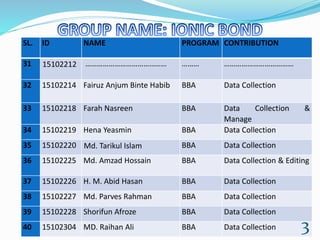
SL. ID NAME PROGRAM CONTRIBUTION
31 15102212 …………………………………… ……… ………………………………
32 15102214 Fairuz Anjum Binte Habib BBA Data Collection
33 15102218 Farah Nasreen BBA Data Collection &
Manage
34 15102219 Hena Yeasmin BBA Data Collection
35 15102220 Md. Tarikul Islam BBA Data Collection
36 15102225 Md. Amzad Hossain BBA Data Collection & Editing
37 15102226 H. M. Abid Hasan BBA Data Collection
38 15102227 Md. Parves Rahman BBA Data Collection
39 15102228 Shorifun Afroze BBA Data Collection
40 15102304 MD. Raihan Ali BBA Data Collection 3
INTRODUCTION
Chemistry is a big part of our everyday life. We find
chemistry in daily life in the foods we eat, the air we
breathe, cleaning chemicals, our emotions and literally
every object we can see or touch. Some common
chemistry may be obvious, but others might surprise
us. Chemistry happens in the world around us, not just
in a lab. Chemistry is happening everywhere.
4
WHAT IS CHEMISTRY?
 Chemistry is the study of matter- its composition,
structure, properties, transformation from one form to
another, and the energy that accompanies its transaction.
5
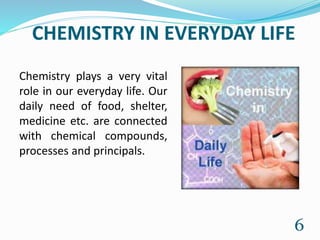
CHEMISTRY IN EVERYDAY LIFE
Chemistry plays a very vital
role in our everyday life. Our
daily need of food, shelter,
medicine etc. are connected
with chemical compounds,
processes and principals.
6
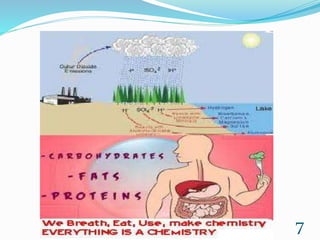
7
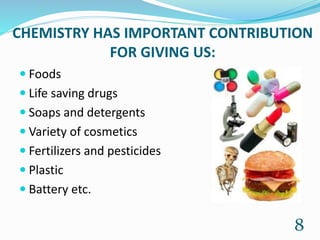
CHEMISTRY HAS IMPORTANT CONTRIBUTION
FOR GIVING US:
 Foods
 Life saving drugs
 Soaps and detergents
 Variety of cosmetics
 Fertilizers and pesticides
 Plastic
 Battery etc.
8
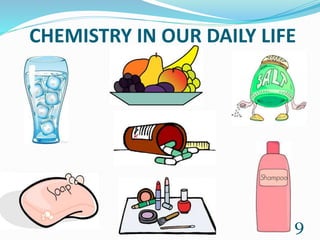
CHEMISTRY IN OUR DAILY LIFE
9
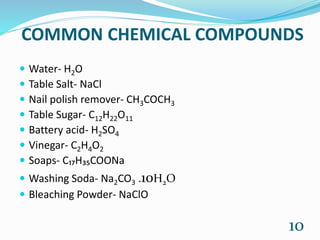
COMMON CHEMICAL COMPOUNDS
 Water- H2O
 Table Salt- NaCl
 Nail polish remover- CH3COCH3
 Table Sugar- C12H22O11
 Battery acid- H2SO4
 Vinegar- C2H4O2
 Soaps- C₁₇H₃₅COONa
 Washing Soda- Na2CO3 .10H2O
 Bleaching Powder- NaClO
10
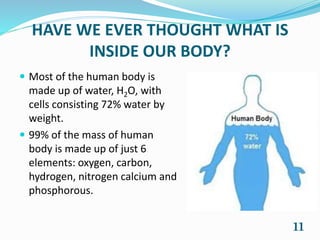
HAVE WE EVER THOUGHT WHAT IS
INSIDE OUR BODY?
 Most of the human body is
made up of water, H2O, with
cells consisting 72% water by
weight.
 99% of the mass of human
body is made up of just 6
elements: oxygen, carbon,
hydrogen, nitrogen calcium and
phosphorous.
11
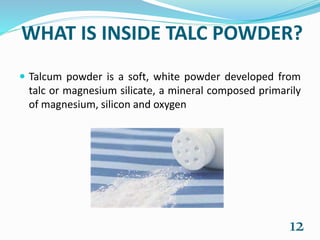
WHAT IS INSIDE TALC POWDER?
 Talcum powder is a soft, white powder developed from
talc or magnesium silicate, a mineral composed primarily
of magnesium, silicon and oxygen
12
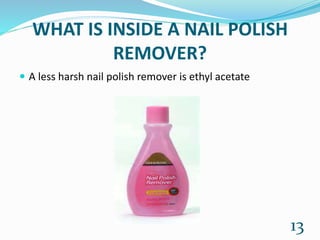
WHAT IS INSIDE A NAIL POLISH
REMOVER?
 A less harsh nail polish remover is ethyl acetate
13
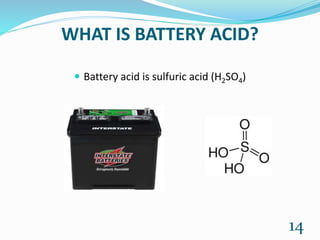
WHAT IS BATTERY ACID?
 Battery acid is sulfuric acid (H2SO4)
14
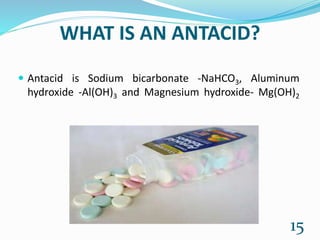
WHAT IS AN ANTACID?
 Antacid is Sodium bicarbonate -NaHCO3, Aluminum
hydroxide -Al(OH)3 and Magnesium hydroxide- Mg(OH)2
15
EVERYDAY CHEMICAL
REACTIONS
16
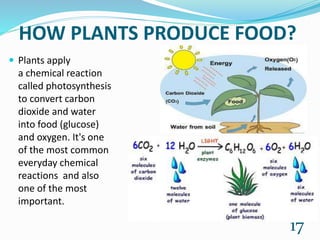
HOW PLANTS PRODUCE FOOD?
 Plants apply
a chemical reaction
called photosynthesis
to convert carbon
dioxide and water
into food (glucose)
and oxygen. It's one
of the most common
everyday chemical
reactions and also
one of the most
important.
17
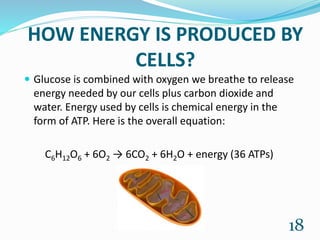
HOW ENERGY IS PRODUCED BY
CELLS?
 Glucose is combined with oxygen we breathe to release
energy needed by our cells plus carbon dioxide and
water. Energy used by cells is chemical energy in the
form of ATP. Here is the overall equation:
C6H12O6 + 6O2 → 6CO2 + 6H2O + energy (36 ATPs)
18
WHY IRON DECAYS WHEN IT IS KEPT
OUTSIDE FOR A LONG TIME?
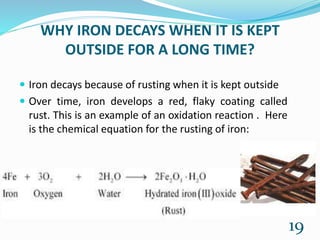
 Iron decays because of rusting when it is kept outside
 Over time, iron develops a red, flaky coating called
rust. This is an example of an oxidation reaction . Here
is the chemical equation for the rusting of iron:
19
WHAT HAPPENS WHEN FOOD GOES INSIDE
OUR STOMACH?
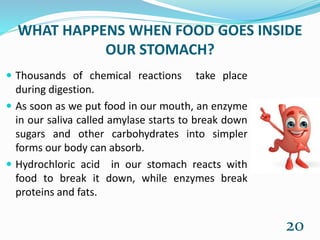
 Thousands of chemical reactions take place
during digestion.
 As soon as we put food in our mouth, an enzyme
in our saliva called amylase starts to break down
sugars and other carbohydrates into simpler
forms our body can absorb.
 Hydrochloric acid in our stomach reacts with
food to break it down, while enzymes break

proteins and fats.
20
WHAT HAPPENS WHEN WE STRIKE A MATCH, BURN
A CANDLE OR BUILD A FIRE?
 Every time we strike a match, burn a candle or build a fire,
we see the combustion reaction.
 In combustion, hydrocarbon and oxygen reacts and produce
carbon dioxide and water.
For example, the combustion reaction of methane is given
below:
21
HOW SOAPS CLEAN DIRT?
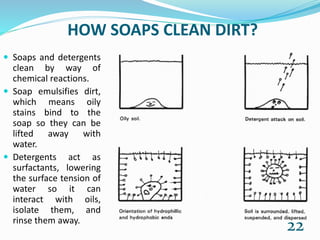
 Soaps and detergents
clean by way of
chemical reactions.
 Soap emulsifies dirt,
which means oily
stains bind to the
soap so they can be
lifted away with
water.
 Detergents act as
surfactants, lowering
the surface tension of
water so it can
interact with oils,
isolate them, and
rinse them away.
22
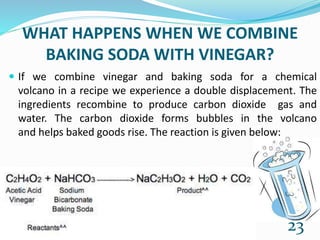
WHAT HAPPENS WHEN WE COMBINE
BAKING SODA WITH VINEGAR?
 If we combine vinegar and baking soda for a chemical
volcano in a recipe we experience a double displacement. The
ingredients recombine to produce carbon dioxide gas and
water. The carbon dioxide forms bubbles in the volcano
and helps baked goods rise. The reaction is given below:
23
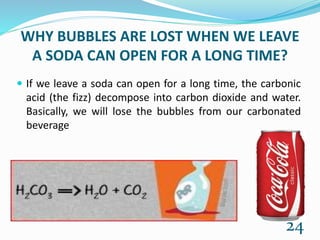
WHY BUBBLES ARE LOST WHEN WE LEAVE
A SODA CAN OPEN FOR A LONG TIME?
 If we leave a soda can open for a long time, the carbonic
acid (the fizz) decompose into carbon dioxide and water.
Basically, we will lose the bubbles from our carbonated
beverage
24
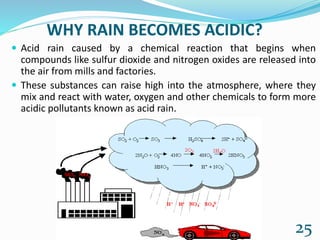
WHY RAIN BECOMES ACIDIC?
 Acid rain caused by a chemical reaction that begins when
compounds like sulfur dioxide and nitrogen oxides are released into
the air from mills and factories.
 These substances can raise high into the atmosphere, where they
mix and react with water, oxygen and other chemicals to form more
acidic pollutants known as acid rain.
25
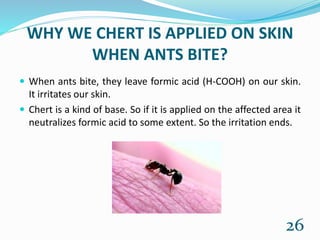
WHY WE CHERT IS APPLIED ON SKIN
WHEN ANTS BITE?
 When ants bite, they leave formic acid (H-COOH) on our skin.
It irritates our skin.
 Chert is a kind of base. So if it is applied on the affected area it
neutralizes formic acid to some extent. So the irritation ends.
26
WHY WATER BECOMES COLDER WHEN
GLUCOSE IS ADDED TO IT?
 Dissolution of glucose in water is an Endothermic process.
 In thermodynamics, the word “endothermic” refers to a
process or reaction in which the system absorbs energy from
its surroundings in the form of heat.
 Thus, when some glucose is added to water, the water glucose
system absorbs energy from its surroundings to form heat for
the dissolution of glucose to take place.
 Consequently the temperature of water decreases, thereby
making it colder.
27
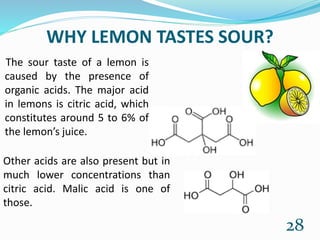
WHY LEMON TASTES SOUR?
The sour taste of a lemon is
caused by the presence of
organic acids. The major acid
in lemons is citric acid, which
constitutes around 5 to 6% of
the lemon’s juice.
28
Other acids are also present but in
much lower concentrations than
citric acid. Malic acid is one of
those.
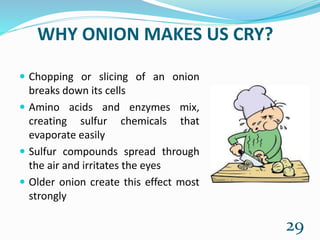
WHY ONION MAKES US CRY?
 Chopping or slicing of an onion
breaks down its cells
 Amino acids and enzymes mix,
creating sulfur chemicals that
evaporate easily
 Sulfur compounds spread through
the air and irritates the eyes
 Older onion create this effect most
strongly
29
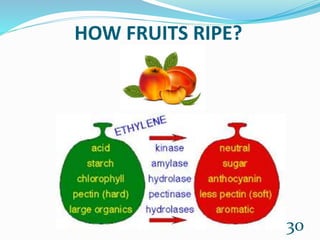
HOW FRUITS RIPE?
30
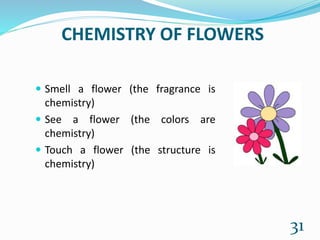
CHEMISTRY OF FLOWERS
 Smell a flower (the fragrance is
chemistry)
 See a flower (the colors are
chemistry)
 Touch a flower (the structure is
chemistry)
31
CONCLUSION
In the end we can say that chemistry is all around us, but
the only thing is that we need to observe it carefully and
notice everything around us. We should appreciate the
work of scientists who observed those things and bought it
to us.
32
33
IN A NUTSHELL….
Chemistry is life and……. everything
34
35
36

Chemistry around us

  • 1.
  • 2.
  • 3.
    SL. ID NAMEPROGRAM CONTRIBUTION 31 15102212 …………………………………… ……… ……………………………… 32 15102214 Fairuz Anjum Binte Habib BBA Data Collection 33 15102218 Farah Nasreen BBA Data Collection & Manage 34 15102219 Hena Yeasmin BBA Data Collection 35 15102220 Md. Tarikul Islam BBA Data Collection 36 15102225 Md. Amzad Hossain BBA Data Collection & Editing 37 15102226 H. M. Abid Hasan BBA Data Collection 38 15102227 Md. Parves Rahman BBA Data Collection 39 15102228 Shorifun Afroze BBA Data Collection 40 15102304 MD. Raihan Ali BBA Data Collection 3
  • 4.
    INTRODUCTION Chemistry is abig part of our everyday life. We find chemistry in daily life in the foods we eat, the air we breathe, cleaning chemicals, our emotions and literally every object we can see or touch. Some common chemistry may be obvious, but others might surprise us. Chemistry happens in the world around us, not just in a lab. Chemistry is happening everywhere. 4
  • 5.
    WHAT IS CHEMISTRY? Chemistry is the study of matter- its composition, structure, properties, transformation from one form to another, and the energy that accompanies its transaction. 5
  • 6.
    CHEMISTRY IN EVERYDAYLIFE Chemistry plays a very vital role in our everyday life. Our daily need of food, shelter, medicine etc. are connected with chemical compounds, processes and principals. 6
  • 7.
  • 8.
    CHEMISTRY HAS IMPORTANTCONTRIBUTION FOR GIVING US:  Foods  Life saving drugs  Soaps and detergents  Variety of cosmetics  Fertilizers and pesticides  Plastic  Battery etc. 8
  • 9.
    CHEMISTRY IN OURDAILY LIFE 9
  • 10.
    COMMON CHEMICAL COMPOUNDS Water- H2O  Table Salt- NaCl  Nail polish remover- CH3COCH3  Table Sugar- C12H22O11  Battery acid- H2SO4  Vinegar- C2H4O2  Soaps- C₁₇H₃₅COONa  Washing Soda- Na2CO3 .10H2O  Bleaching Powder- NaClO 10
  • 11.
    HAVE WE EVERTHOUGHT WHAT IS INSIDE OUR BODY?  Most of the human body is made up of water, H2O, with cells consisting 72% water by weight.  99% of the mass of human body is made up of just 6 elements: oxygen, carbon, hydrogen, nitrogen calcium and phosphorous. 11
  • 12.
    WHAT IS INSIDETALC POWDER?  Talcum powder is a soft, white powder developed from talc or magnesium silicate, a mineral composed primarily of magnesium, silicon and oxygen 12
  • 13.
    WHAT IS INSIDEA NAIL POLISH REMOVER?  A less harsh nail polish remover is ethyl acetate 13
  • 14.
    WHAT IS BATTERYACID?  Battery acid is sulfuric acid (H2SO4) 14
  • 15.
    WHAT IS ANANTACID?  Antacid is Sodium bicarbonate -NaHCO3, Aluminum hydroxide -Al(OH)3 and Magnesium hydroxide- Mg(OH)2 15
  • 16.
  • 17.
    HOW PLANTS PRODUCEFOOD?  Plants apply a chemical reaction called photosynthesis to convert carbon dioxide and water into food (glucose) and oxygen. It's one of the most common everyday chemical reactions and also one of the most important. 17
  • 18.
    HOW ENERGY ISPRODUCED BY CELLS?  Glucose is combined with oxygen we breathe to release energy needed by our cells plus carbon dioxide and water. Energy used by cells is chemical energy in the form of ATP. Here is the overall equation: C6H12O6 + 6O2 → 6CO2 + 6H2O + energy (36 ATPs) 18
  • 19.
    WHY IRON DECAYSWHEN IT IS KEPT OUTSIDE FOR A LONG TIME?  Iron decays because of rusting when it is kept outside  Over time, iron develops a red, flaky coating called rust. This is an example of an oxidation reaction . Here is the chemical equation for the rusting of iron: 19
  • 20.
    WHAT HAPPENS WHENFOOD GOES INSIDE OUR STOMACH?  Thousands of chemical reactions take place during digestion.  As soon as we put food in our mouth, an enzyme in our saliva called amylase starts to break down sugars and other carbohydrates into simpler forms our body can absorb.  Hydrochloric acid in our stomach reacts with food to break it down, while enzymes break proteins and fats. 20
  • 21.
    WHAT HAPPENS WHENWE STRIKE A MATCH, BURN A CANDLE OR BUILD A FIRE?  Every time we strike a match, burn a candle or build a fire, we see the combustion reaction.  In combustion, hydrocarbon and oxygen reacts and produce carbon dioxide and water. For example, the combustion reaction of methane is given below: 21
  • 22.
    HOW SOAPS CLEANDIRT?  Soaps and detergents clean by way of chemical reactions.  Soap emulsifies dirt, which means oily stains bind to the soap so they can be lifted away with water.  Detergents act as surfactants, lowering the surface tension of water so it can interact with oils, isolate them, and rinse them away. 22
  • 23.
    WHAT HAPPENS WHENWE COMBINE BAKING SODA WITH VINEGAR?  If we combine vinegar and baking soda for a chemical volcano in a recipe we experience a double displacement. The ingredients recombine to produce carbon dioxide gas and water. The carbon dioxide forms bubbles in the volcano and helps baked goods rise. The reaction is given below: 23
  • 24.
    WHY BUBBLES ARELOST WHEN WE LEAVE A SODA CAN OPEN FOR A LONG TIME?  If we leave a soda can open for a long time, the carbonic acid (the fizz) decompose into carbon dioxide and water. Basically, we will lose the bubbles from our carbonated beverage 24
  • 25.
    WHY RAIN BECOMESACIDIC?  Acid rain caused by a chemical reaction that begins when compounds like sulfur dioxide and nitrogen oxides are released into the air from mills and factories.  These substances can raise high into the atmosphere, where they mix and react with water, oxygen and other chemicals to form more acidic pollutants known as acid rain. 25
  • 26.
    WHY WE CHERTIS APPLIED ON SKIN WHEN ANTS BITE?  When ants bite, they leave formic acid (H-COOH) on our skin. It irritates our skin.  Chert is a kind of base. So if it is applied on the affected area it neutralizes formic acid to some extent. So the irritation ends. 26
  • 27.
    WHY WATER BECOMESCOLDER WHEN GLUCOSE IS ADDED TO IT?  Dissolution of glucose in water is an Endothermic process.  In thermodynamics, the word “endothermic” refers to a process or reaction in which the system absorbs energy from its surroundings in the form of heat.  Thus, when some glucose is added to water, the water glucose system absorbs energy from its surroundings to form heat for the dissolution of glucose to take place.  Consequently the temperature of water decreases, thereby making it colder. 27
  • 28.
    WHY LEMON TASTESSOUR? The sour taste of a lemon is caused by the presence of organic acids. The major acid in lemons is citric acid, which constitutes around 5 to 6% of the lemon’s juice. 28 Other acids are also present but in much lower concentrations than citric acid. Malic acid is one of those.
  • 29.
    WHY ONION MAKESUS CRY?  Chopping or slicing of an onion breaks down its cells  Amino acids and enzymes mix, creating sulfur chemicals that evaporate easily  Sulfur compounds spread through the air and irritates the eyes  Older onion create this effect most strongly 29
  • 30.
  • 31.
    CHEMISTRY OF FLOWERS Smell a flower (the fragrance is chemistry)  See a flower (the colors are chemistry)  Touch a flower (the structure is chemistry) 31
  • 32.
    CONCLUSION In the endwe can say that chemistry is all around us, but the only thing is that we need to observe it carefully and notice everything around us. We should appreciate the work of scientists who observed those things and bought it to us. 32
  • 33.
  • 34.
    IN A NUTSHELL…. Chemistryis life and……. everything 34
  • 35.
  • 36.