For more help contact me
Muhammad Umair Bukhari

        Engr.umair.bukhari@gmail.com

           www.bzuiam.webs.com
                03136050151
Outline
 History
 Introduction
 Types of Nuclear Reactor
 Heavy Water Reactor
 Production of Heavy Water
 Properties of Heavy Water
 Purpose of Heavy Water
 Application of Heavy Water
History
 Who first isolated heavy water?
           Existence of Isotopes(Francis Aston in 1913)
           Rutherford suggested the existence of heavier Isotope of
            hydrogen
           Harold Clayton Urey
           Found existence in 1931
           Urey succeeded in enriching samples of water in the heavier
            isotope.
           The next step was to isolate pure heavy water.
           American Scientist Gilbert Newton Lewis with his student
            Ronald T. MacDonald
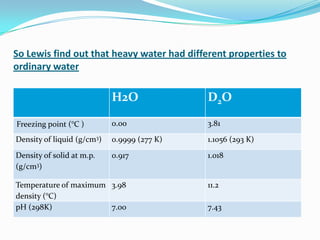
So Lewis find out that heavy water had different properties to
ordinary water

                            H2O              D2O

Freezing point (°C )        0.00             3.81

Density of liquid (g/cm3)   0.9999 (277 K)   1.1056 (293 K)

Density of solid at m.p.    0.917            1.018
(g/cm3)

Temperature of maximum 3.98                  11.2
density (°C)
pH (298K)              7.00                  7.43
Introduction
 Heavy Water (D2O) (compound of Deuterium (D) and oxygen)
 This is also known as Deuterium Oxide.
 Deuterium (atomic mass 2) for normal hydrogen (H)
  [due to presence of an extra neutron in the nucleus]
 Heavy Water resembles in its physical and chemical properties to
  ordinary water. (light Water)
 But its nuclear properties makes it an extremely efficient material for
  use as moderator in a nuclear reactor.
Types of Nuclear Reactors
Heavy Water Reactor
• The    Heavy Water Reactor (HWR) concept allow the
  use of natural uranium as a fuel without the need for its
  enrichment, especially if uranium is available for mining or for
  extraction as a by product of another industry such as gold mining .

• However, it needs the installation of a heavy water D2O production
  capability, which is a much simpler to separate the light isotopes (D
  from H) and the heavy isotopes (U235 from U238).

• HWRs have become a significant proportion of world reactor
  installations, second only to the Light Water Reactors (LWRs)
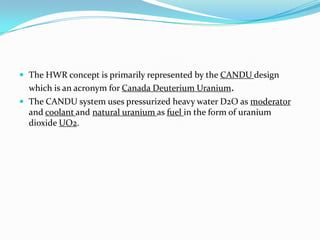
 The HWR concept is primarily represented by the CANDU design
  which is an acronym for Canada Deuterium Uranium.
 The CANDU system uses pressurized heavy water D2O as moderator
  and coolant and natural uranium as fuel in the form of uranium
  dioxide UO2.
Production of Heavy water
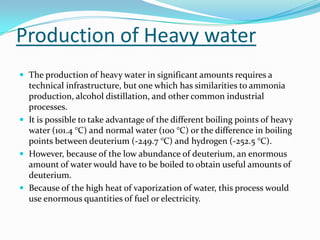
 The production of heavy water in significant amounts requires a
  technical infrastructure, but one which has similarities to ammonia
  production, alcohol distillation, and other common industrial
  processes.
 It is possible to take advantage of the different boiling points of heavy
  water (101.4 °C) and normal water (100 °C) or the difference in boiling
  points between deuterium (-249.7 °C) and hydrogen (-252.5 °C).
 However, because of the low abundance of deuterium, an enormous
  amount of water would have to be boiled to obtain useful amounts of
  deuterium.
 Because of the high heat of vaporization of water, this process would
  use enormous quantities of fuel or electricity.
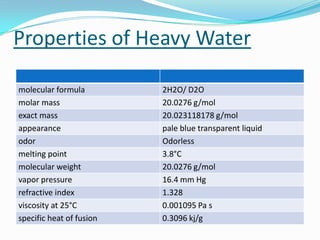
Properties of Heavy Water

molecular formula         2H2O/ D2O
molar mass                20.0276 g/mol
exact mass                20.023118178 g/mol
appearance                pale blue transparent liquid
odor                      Odorless
melting point             3.8°C
molecular weight          20.0276 g/mol
vapor pressure            16.4 mm Hg
refractive index          1.328
viscosity at 25°C         0.001095 Pa s
specific heat of fusion   0.3096 kj/g
Purpose of using Heavy Water in
         Nuclear Reactor
 Heavy water is used as a moderator.
 It is used to slow the neutrons being directed at the fissionable
  material, by means of the molecules of the moderator physically
  impacting the incoming neutrons and absorbing some of the kinetic
  energy they posses, thus slowing them down.
 The reason that the neutrons have to be slowed is that most fissionable
  materials are more likely to absorb thermal neutrons (2.2km/s) than
  fast neutrons (14,000km/s).
 This means that when heavy water is used as a moderator, enough
  neutrons get through that even with very low levels of U-235 (even the
  very low levels found in natural uranium), criticality can be
  maintained, and power is produced.
Application of Heavy Water
    Heavy water is used as tracer in the study of reactions occurring in living
    organisms and other chemical reactions.
 It has been used for the preparation of deuterium.
 Chemists can use D2O as a solvent for Nuclear Magnetic Resonance
    spectra.
Heavy water

Heavy water

  • 2.
    For more helpcontact me Muhammad Umair Bukhari Engr.umair.bukhari@gmail.com www.bzuiam.webs.com 03136050151
  • 3.
    Outline  History  Introduction Types of Nuclear Reactor  Heavy Water Reactor  Production of Heavy Water  Properties of Heavy Water  Purpose of Heavy Water  Application of Heavy Water
  • 4.
    History  Who firstisolated heavy water?  Existence of Isotopes(Francis Aston in 1913)  Rutherford suggested the existence of heavier Isotope of hydrogen  Harold Clayton Urey  Found existence in 1931  Urey succeeded in enriching samples of water in the heavier isotope.  The next step was to isolate pure heavy water.  American Scientist Gilbert Newton Lewis with his student Ronald T. MacDonald
  • 5.
    So Lewis findout that heavy water had different properties to ordinary water H2O D2O Freezing point (°C ) 0.00 3.81 Density of liquid (g/cm3) 0.9999 (277 K) 1.1056 (293 K) Density of solid at m.p. 0.917 1.018 (g/cm3) Temperature of maximum 3.98 11.2 density (°C) pH (298K) 7.00 7.43
  • 7.
    Introduction  Heavy Water(D2O) (compound of Deuterium (D) and oxygen)  This is also known as Deuterium Oxide.  Deuterium (atomic mass 2) for normal hydrogen (H) [due to presence of an extra neutron in the nucleus]  Heavy Water resembles in its physical and chemical properties to ordinary water. (light Water)  But its nuclear properties makes it an extremely efficient material for use as moderator in a nuclear reactor.
  • 8.
  • 9.
    Heavy Water Reactor •The Heavy Water Reactor (HWR) concept allow the use of natural uranium as a fuel without the need for its enrichment, especially if uranium is available for mining or for extraction as a by product of another industry such as gold mining . • However, it needs the installation of a heavy water D2O production capability, which is a much simpler to separate the light isotopes (D from H) and the heavy isotopes (U235 from U238). • HWRs have become a significant proportion of world reactor installations, second only to the Light Water Reactors (LWRs)
  • 10.
     The HWRconcept is primarily represented by the CANDU design which is an acronym for Canada Deuterium Uranium.  The CANDU system uses pressurized heavy water D2O as moderator and coolant and natural uranium as fuel in the form of uranium dioxide UO2.
  • 12.
    Production of Heavywater  The production of heavy water in significant amounts requires a technical infrastructure, but one which has similarities to ammonia production, alcohol distillation, and other common industrial processes.  It is possible to take advantage of the different boiling points of heavy water (101.4 °C) and normal water (100 °C) or the difference in boiling points between deuterium (-249.7 °C) and hydrogen (-252.5 °C).  However, because of the low abundance of deuterium, an enormous amount of water would have to be boiled to obtain useful amounts of deuterium.  Because of the high heat of vaporization of water, this process would use enormous quantities of fuel or electricity.
  • 13.
    Properties of HeavyWater molecular formula 2H2O/ D2O molar mass 20.0276 g/mol exact mass 20.023118178 g/mol appearance pale blue transparent liquid odor Odorless melting point 3.8°C molecular weight 20.0276 g/mol vapor pressure 16.4 mm Hg refractive index 1.328 viscosity at 25°C 0.001095 Pa s specific heat of fusion 0.3096 kj/g
  • 14.
    Purpose of usingHeavy Water in Nuclear Reactor  Heavy water is used as a moderator.  It is used to slow the neutrons being directed at the fissionable material, by means of the molecules of the moderator physically impacting the incoming neutrons and absorbing some of the kinetic energy they posses, thus slowing them down.  The reason that the neutrons have to be slowed is that most fissionable materials are more likely to absorb thermal neutrons (2.2km/s) than fast neutrons (14,000km/s).  This means that when heavy water is used as a moderator, enough neutrons get through that even with very low levels of U-235 (even the very low levels found in natural uranium), criticality can be maintained, and power is produced.
  • 15.
    Application of HeavyWater  Heavy water is used as tracer in the study of reactions occurring in living organisms and other chemical reactions.  It has been used for the preparation of deuterium.  Chemists can use D2O as a solvent for Nuclear Magnetic Resonance spectra.