WATER CHEMISTRY
1
Course: B.Tech
Subject: Engineering Chemistry
Unit:1
Water & Its treatment
1). Like air, water is one of the few basic materials which is of prime
importance for the preservation of life on this earth.
2). All are aware of the uses of water for drinking, cooking, cooking,
bathing & for farming etc.
3). But few know the importance of water as an engineering matrial.
4). As an engineering material water is used for producing steam, in
boilers to generate hydro-electric power, furnishing steam for
engines, for construction of concrete structures for manufacturing
purposes & as a solvent in chemical process.
Sources of Water
A) Surface Water
Rain Water - Pure but contaminated with gases
River Water - High dissolved salts moderate organics
Lake Water - Const. composition but high organics
Sea Water - High salinity, pathogens, organics
B) Underground/Sub-Surface Water
Spring/Well Water - Crystal clear but high dissolved
salts and high purity from organics 3
Sources of Water:
1). Rain water: Rain water is the purest form of natural water.
However, it dissolves considerable amount of gases (CO2 – SO2 - NO –
NO2 etc) and suspended solid particles from atmosphere, during its
journey through it and becomes polluted.
2). River water: River are formed by rain and spring waters. During
its flow over the surface of land, it dissolves minerals of the soil such as
chlorides, sulfates, bicarbonates of sodium, calcium, magnesium ions etc.
3). Spring or well water or Lake water: It contains constant
chemical composition. The minerals present in the lake water in the form
dissolved form and high quantity of organic matter.
4). Sea water: It is the most impure form of natural water. It contains
larger percentage of the dissolved salts (above 3.5%) out of which about
2.6% is NaCl. The NaCl which is present in the dissolved form in sea
water will come out as NaCl crystals due to evaporation of sea water.
The other salts present in the sea-water are sulphates of
sodium, bicarbonates of potassium, magnesium, calcium, bromides of
potassium, magnesium etc.
Underground water: Spring & well waters are the underground
water sources. They are in general clearer in appearance due to the
filtering action of the soil.
They contain more of the dissolved salts generally, underground water
is of high organic purity.
Types of impurities in water
The impurities present in water are classified as:
1). Dissolved impurities: Dissolved impurities may organic or inorganic.
Inorganic impurities: The carbonates, bicarbonates, sulphates, chlorides
of calcium, magnesium, iron potassium and aluminium.
Organic impurities: Organic water products, amino acids, proteins, etc.
Gases: O2 , CO2 , CH4, NH3, Oxides of nitrogen and sulphur, H2S etc.
2). Suspended impurities: It is of two types:
Inorganic - sand & clay;
Organic – vegetable and animal matter.
3) Biological Impurities: Micro-Organisms like Pathogenic bacteria,
fungi, algae etc
POTABLE WATER
 Water : safe to drink,
 Fit for human consumption, should satisfy the
following requirements:
1. Clear & odourless,
2. Pleasant in taste,
3. Perfectly cool,
4. Turbidity should not exceed 10ppm,
5. Free from objectionable dissolved gases
6. Objectionable minerals: lead,arsenic, Mn, Cr
7. pH:8.0
8. Reasonably soft,
9. Free from disease-producing microorganisms.
7
DISADVANTAGES OF HARDWATER / CAUSES OF HARDNESS:
The following are the disadvantages when hard water is used for
various purpose:
(i) DOMESTIC USE:
(a) Washing and Bathing : Hard water does not form lather easily
with soap is wasted
(b) Drinking : Hard water causes bad effects on our digestive system.
Sometimes, stone formation takes place in kidneys
(c) Cooking : The boiling point of water is increased due to the
presence of salts. Hence, more fuel and time are required for
cooking.
(ii) INDUSTRIAL USE:
(a) Textile Industry : Hard water causes wastage of soap. Precipitates
of calcium and magnesium soap adhere to the fabrics and cause
problem
(b) Paper Industry : Calcium and Magnesium salts in water may effect
the quality of paper.
(c) Sugar Industry : Water containing sulphates, carbonates, nitrates
affects the crystallisation of sugar.
(d) Pharmaceutical Industry : Hard water may form some undesirable
products while preparation of pharmaceutical products.
(iii) STEAM GENERATION IN BOILERS: For steam generation,
boilers are employed. If hard water is used in boilers, It may lead to the
following troubles
(a) Boiler Corrosion
(b) Scale and Sludge formation.
(c) Priming and Foaming
(d) Caustic embrittlement Pharmaceutical industry
HARDNESS OF WATER OR HARDWATER AND SOFT
WATER
11
• Hardness in Water is characteristic that prevents the ‘lathering
of soap’ thus water that does not produce lather with soap
solution readily, but forms a white curd is called hard water.
• Type of Hardness
– Temporary or Carbonate Hardness
– Permanent Hardness or non-carbonate Hardness.
Hard Water : Those water which does not produce lather (or) very little lather
with soap is called Hard Water
Soft Water : Soft water readily produce a lot of lather when mixed with little
soap.
The Hardness of water is caused by the presence of dissolved salts such as
Bicarbonates, Sulphates, Chlorides and Nitrates of bivalent metal ions like
Ca+2 & Mg+2
Soap is sodium/potassium salt of higher fatty acids like stearic, oleic and
palmetic acids.
When soap is mixed with soft water lather is produced due to stearic
acid and sodium stearate
 Na – Stearate + H2O  NaOH + Stearic Acid [C17H35COOH]
 Stearic Acid + Na-Stearate  Formatioin of lather.
When soap comes in contact with HARD WATER,
Sodium stearate will react with dissolved calcium and magnesium salts
and produce calcium stearate or magnesium stearate which is white
precipitate
 2Na – Stearate + Ca+2  Ca – Stearate ↓ + 2Na+
[2C17H35COONa] + Ca+2  [(C17H35COO)2 Ca] ↓ + 2Na+
(Soap) (Soluble) (Insoluble) (Soluble)
 [2C17H35COONa] + Mg+2  [(C17H35COO)2 Mg] ↓ + 2Na+
(Soluble) (Soluble) (Insoluble) (Soluble)
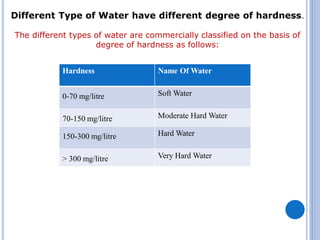
Hardness Name Of Water
0-70 mg/litre Soft Water
70-150 mg/litre Moderate Hard Water
150-300 mg/litre Hard Water
> 300 mg/litre Very Hard Water
Different Type of Water have different degree of hardness.
The different types of water are commercially classified on the basis of
degree of hardness as follows:
TYPES OF HARDNESS
The hardness of water is of two types
(1) Temporary hardness (or) Carbonate hardness
(2) Permanent hardness (or) Non-Carbonate hardness
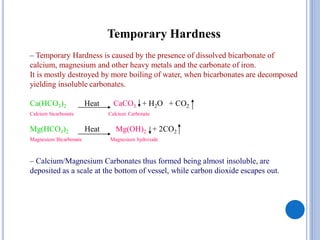
Temporary Hardness
– Temporary Hardness is caused by the presence of dissolved bicarbonate of
calcium, magnesium and other heavy metals and the carbonate of iron.
It is mostly destroyed by more boiling of water, when bicarbonates are decomposed
yielding insoluble carbonates.
Ca(HCO3)2 Heat CaCO3 + H2O + CO2
Calcium bicarbonate Calcium Carbonate
Mg(HCO3)2 Heat Mg(OH)2 + 2CO2
Magnesium Bicarbonate Magnesium hydroxide
– Calcium/Magnesium Carbonates thus formed being almost insoluble, are
deposited as a scale at the bottom of vessel, while carbon dioxide escapes out.
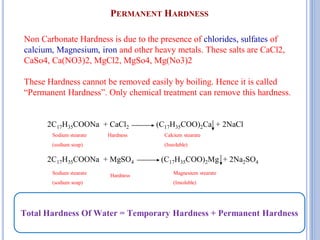
PERMANENT HARDNESS
16
Non Carbonate Hardness is due to the presence of chlorides, sulfates of
calcium, Magnesium, iron and other heavy metals. These salts are CaCl2,
CaSo4, Ca(NO3)2, MgCl2, MgSo4, Mg(No3)2
These Hardness cannot be removed easily by boiling. Hence it is called
“Permanent Hardness”. Only chemical treatment can remove this hardness.
2C17H35COONa + CaCl2 (C17H35COO)2Ca + 2NaCl
2C17H35COONa + MgSO4 (C17H35COO)2Mg + 2Na2SO4
Sodium stearate
(sodium soap)
Hardness Calcium stearate
(Insoluble)
Sodium stearate
(sodium soap)
Hardness Magnesium stearate
(Insoluble)
Total Hardness Of Water = Temporary Hardness + Permanent Hardness
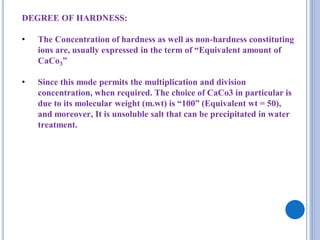
DEGREE OF HARDNESS:
• The Concentration of hardness as well as non-hardness constituting
ions are, usually expressed in the term of “Equivalent amount of
CaCo3”
• Since this mode permits the multiplication and division
concentration, when required. The choice of CaCo3 in particular is
due to its molecular weight (m.wt) is “100” (Equivalent wt = 50),
and moreover, It is unsoluble salt that can be precipitated in water
treatment.
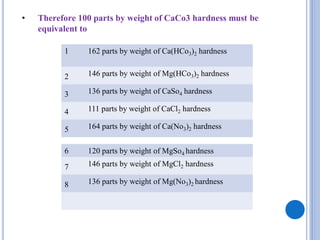
• Therefore 100 parts by weight of CaCo3 hardness must be
equivalent to
1 162 parts by weight of Ca(HCo3)2 hardness
2 146 parts by weight of Mg(HCo3)2 hardness
3 136 parts by weight of CaSo4 hardness
4 111 parts by weight of CaCl2 hardness
5 164 parts by weight of Ca(No3)2 hardness
6 120 parts by weight of MgSo4 hardness
7 146 parts by weight of MgCl2 hardness
8 136 parts by weight of Mg(No3)2 hardness
The method of calculating degree of hardness will be clear from the
following formula
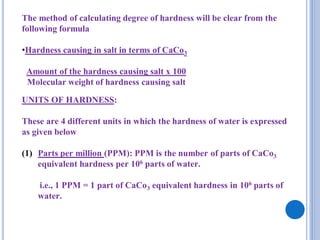
•Hardness causing in salt in terms of CaCo3
Amount of the hardness causing salt x 100
Molecular weight of hardness causing salt
UNITS OF HARDNESS:
These are 4 different units in which the hardness of water is expressed
as given below
(1) Parts per million (PPM): PPM is the number of parts of CaCo3
equivalent hardness per 106 parts of water.
i.e., 1 PPM = 1 part of CaCo3 equivalent hardness in 106 parts of
water.
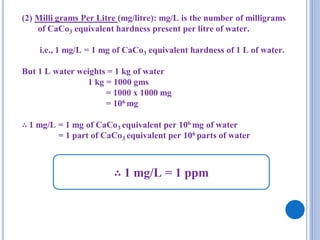
(2) Milli grams Per Litre (mg/litre): mg/L is the number of milligrams
of CaCo3 equivalent hardness present per litre of water.
i.e., 1 mg/L = 1 mg of CaCo3 equivalent hardness of 1 L of water.
But 1 L water weights = 1 kg of water
1 kg = 1000 gms
= 1000 x 1000 mg
= 106 mg
∴ 1 mg/L = 1 mg of CaCo3 equivalent per 106 mg of water
= 1 part of CaCo3 equivalent per 106 parts of water
∴ 1 mg/L = 1 ppm
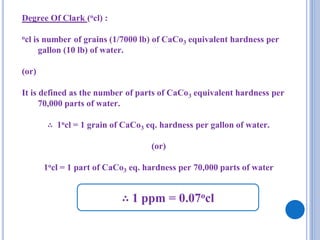
Degree Of Clark (ocl) :
ocl is number of grains (1/7000 lb) of CaCo3 equivalent hardness per
gallon (10 lb) of water.
(or)
It is defined as the number of parts of CaCo3 equivalent hardness per
70,000 parts of water.
∴ 1ocl = 1 grain of CaCo3 eq. hardness per gallon of water.
(or)
1ocl = 1 part of CaCo3 eq. hardness per 70,000 parts of water
∴ 1 ppm = 0.07ocl
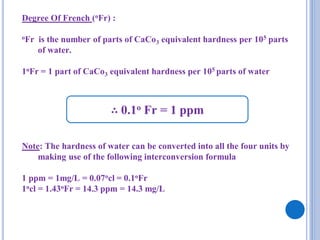
Degree Of French (oFr) :
oFr is the number of parts of CaCo3 equivalent hardness per 105 parts
of water.
1oFr = 1 part of CaCo3 equivalent hardness per 105 parts of water
Note: The hardness of water can be converted into all the four units by
making use of the following interconversion formula
1 ppm = 1mg/L = 0.07ocl = 0.1oFr
1ocl = 1.43oFr = 14.3 ppm = 14.3 mg/L
∴ 0.1o Fr = 1 ppm
Water Softening
Methods
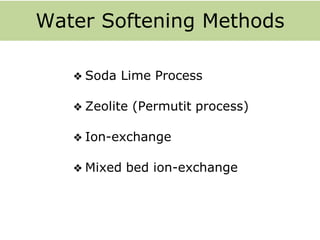
Water Softening Methods
❖ Soda Lime Process
❖ Zeolite (Permutit process)
❖ Ion-exchange
❖ Mixed bed ion-exchange
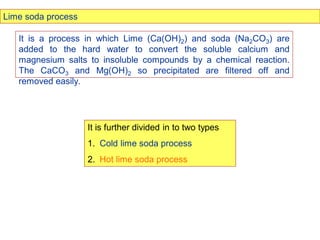
Lime soda process
It is a process in which Lime (Ca(OH)2) and soda (Na2CO3) are
added to the hard water to convert the soluble calcium and
magnesium salts to insoluble compounds by a chemical reaction.
The CaCO3 and Mg(OH)2 so precipitated are filtered off and
removed easily.
It is further divided in to two types
1. Cold lime soda process
2. Hot lime soda process
1. Cold lime soda process
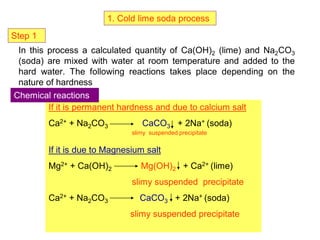
In this process a calculated quantity of Ca(OH)2 (lime) and Na2CO3
(soda) are mixed with water at room temperature and added to the
hard water. The following reactions takes place depending on the
nature of hardness
If it is permanent hardness and due to calcium salt
Ca2+ + Na2CO3 CaCO3 + 2Na+ (soda)
slimy suspended precipitate
If it is due to Magnesium salt
Mg2+ + Ca(OH)2 Mg(OH)2 + Ca2+ (lime)
slimy suspended precipitate
Ca2+ + Na2CO3 CaCO3 + 2Na+ (soda)
slimy suspended precipitate
Chemical reactions
Step 1
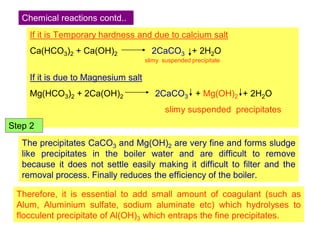
If it is Temporary hardness and due to calcium salt
Ca(HCO3)2 + Ca(OH)2 2CaCO3 + 2H2O
slimy suspended precipitate
If it is due to Magnesium salt
Mg(HCO3)2 + 2Ca(OH)2 2CaCO3 + Mg(OH)2 + 2H2O
slimy suspended precipitates
Chemical reactions contd..
The precipitates CaCO3 and Mg(OH)2 are very fine and forms sludge
like precipitates in the boiler water and are difficult to remove
because it does not settle easily making it difficult to filter and the
removal process. Finally reduces the efficiency of the boiler.
Therefore, it is essential to add small amount of coagulant (such as
Alum, Aluminium sulfate, sodium aluminate etc) which hydrolyses to
flocculent precipitate of Al(OH)3 which entraps the fine precipitates.
Step 2
28
8
Cold lime-soda process
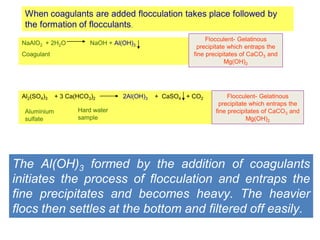
When coagulants are added flocculation takes place followed by
the formation of flocculants.
NaAlO2 + 2H2O NaOH + Al(OH)3
Coagulant
Flocculent- Gelatinous
precipitate which entraps the
fine precipitates of CaCO3 and
Mg(OH)2
Al2(SO4)3 + 3 Ca(HCO3)2 2Al(OH)3 + CaSO4 + CO2
Aluminium
sulfate
Hard water
sample
Flocculent- Gelatinous
precipitate which entraps the
fine precipitates of CaCO3 and
Mg(OH)2
The Al(OH)3 formed by the addition of coagulants
initiates the process of flocculation and entraps the
fine precipitates and becomes heavy. The heavier
flocs then settles at the bottom and filtered off easily.
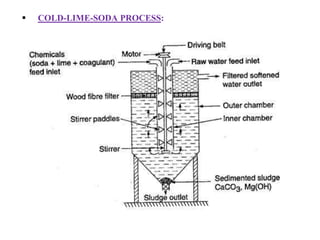
Softening Procedure
Method :
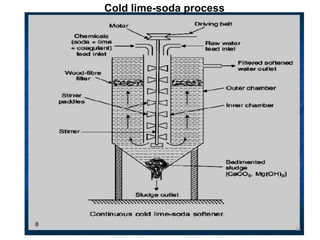
• Raw water & calculated quantities of chemicals: from the
top in to the inner vertical circular chamber.
• There is a vigorous stirring & continuous mixing : softening
of water take place.
• Softened water comes into the outer co-axial chamber, it
rises upwards.
• Heavy sludge settles down & softened water reaches up.
• Softened water : passes through a filtering media to ensure
complete removal of sludge.
• Filtered soft water finally flows out continuously through
the outlet at the top.
• Sludge settling at the bottom of the outer chamber is drawn
off occasionally.
30
 COLD-LIME-SODA PROCESS:
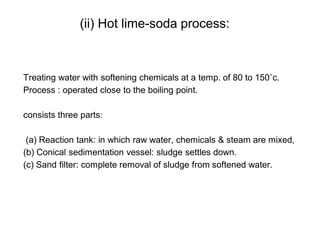
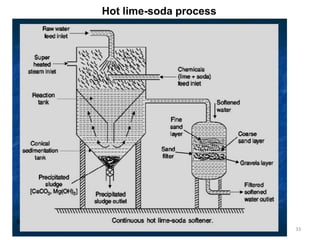
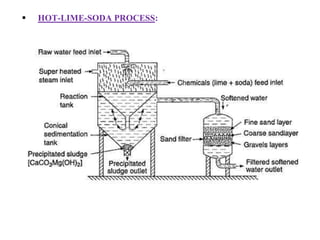
(ii) Hot lime-soda process:
Treating water with softening chemicals at a temp. of 80 to 150˚c.
Process : operated close to the boiling point.
consists three parts:
(a) Reaction tank: in which raw water, chemicals & steam are mixed,
(b) Conical sedimentation vessel: sludge settles down.
(c) Sand filter: complete removal of sludge from softened water.
32
33
9
Hot lime-soda process
Advantages of hot lime-soda process:
• The precipitation reaction is almost complete,
• Reaction takes place faster,
• Sludge settles down rapidly;
• No coagulant is needed,
• Dissolved gases (which may cause corrosion) are
removed,
• Viscosity of soft water is lower, hence filtered
easily,
• Residual hardness is low compared to cold lime-
soda process.
34
Advantages & Disadvantages of Lime-soda process
Advantages:
• 1.Economical
• 2.Process increses pH value of the treated water, thereby
corrosion of the distribution pipes is reduced.
• 3.Mineral content of water is reduced
• 4.pH of water raises thus reducing content of pathogenic
bacteria
• 5. iron & Mn: removed.
Disadvantages:
• 1.Huge amount of sludge is formed and its disposal is difficult
• 2.Due to residual hardness, water is not suitable for high
pressure boilers
35
 In this method the lime & soda are mixed with hard water at room
temperature with constant stirring
 Generally the precipitates formed by this process are finely divided and
in order to settle the precipitates, coagulants like alum, ferrous sulphate
etc are added
 The hard water to be softened is mixed with calculated quantity of
chemicals (Lime + Soda + Coagulant) from the top into the inner
chamberon vigorous stirring. The chemical reactions takes place and
the hardness producing salts get converted into insoluble precipitates
 The sludge is removed from the bottom of the outer chamber while the
softened water passes through a wood fibre filter to ensure the complete
removal of any residual sludge particles
 The clear softened water is withdrawn from the top of the outer
chamber. The softened water from this process contains a residual
hardness of 50-60ppm
 HOT-LIME-SODA PROCESS:
 This process is similar to the cold lime-soda process,
but no coagulant is needed.
 Here the process is carried at a temperature of 80o to 150o c. Since the
reaction carried out at high temperature.
(a) The reaction takes place faster
(b) The sludge settles rapidly
(c) Viscosity of soft water is lower, hence filtered easily
(d) The dissolved gases such as CO2, air etc driven out of the water
(e) The residual hardness is low, compared to cold lime-soda process. Hot
lime soda process consists of three parts
 “REACTION TANK” in which complete mixing of water, chemicals
and steam takes place and water gets softened.
 “Conical Sedimentation Vessel” where the sludge settle down.
 “SAND FILTER” where sludge is completely removed
 The softened water from this process contains a residual hardness of
15-30 ppm
ADVANTAGES OF LIME-SODA PROCESS:
I. This process is economical
II. Mineral content of the water is reduced
III. The process increases the pH value of water, which reduces the content
of pathogenic bacteria
IV. Manganese and Iron salts are also removed by this process
V. The process improves the corrosion resistance of the water
DISADVANTAGES OF LIME-SODA PROCESS:
1) Due to residual hardness, water is not useful for high pressure boilers
2) Large amount of sludge is formed which create disposal problem
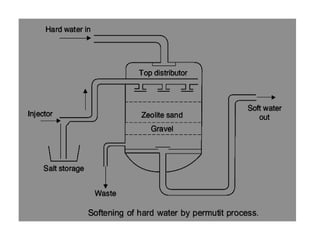
Permutit or Zeolite Process
o Zeolite is hydrated sodium aluminium silicate having a general formula,
Na2OAl2O3.xSiO2.yH2O where x = 2-10 and y = 2-6
o It exchanges Na+ ions for Ca2+ and Mg2+ ions.
o Common Zeolite is Na2OAl2O3.3SiO2.2H2O known as natrolith.
o Other gluconites, green sand (iron potassium phyllosilicate with characteristic
green colour, a mineral containing Glauconite)etc. are used for water softening.
o Artificial zeolite used for water softening is Permutit.
o These are porous, glassy particles having higher softening capacity compared to
green sand.
o They are prepared by heating china clay (hydrated aluminium silicate), feldspar
(KAlSi3O8-NaAlSi3O8 – CaAl2Si2O8) are a group of rock-forming tectosilicate
minerals which make up as much as 60% of the earth’s crust) and soda ash
(Na2CO3)
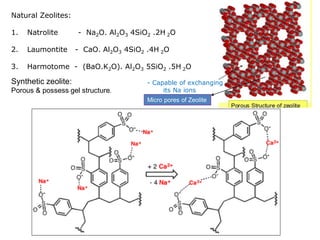
Natural Zeolites:
1. Natrolite - Na2O. Al2O3 4SiO2 .2H 2O
2. Laumontite - CaO. Al2O3 4SiO2 .4H 2O
3. Harmotome - (BaO.K2O). Al2O3 5SiO2 .5H 2O
Synthetic zeolite:
Porous & possess gel structure.
- Capable of exchanging
its Na ions
Micro pores of Zeolite
Permutit or Zeolite Process
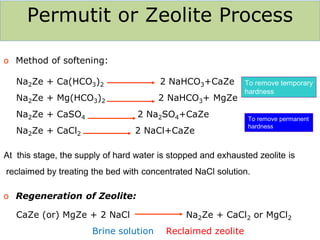
o Method of softening:
Na2Ze + Ca(HCO3)2 2 NaHCO3+CaZe
Na2Ze + Mg(HCO3)2 2 NaHCO3+ MgZe
Na2Ze + CaSO4 2 Na2SO4+CaZe
Na2Ze + CaCl2 2 NaCl+CaZe
At this stage, the supply of hard water is stopped and exhausted zeolite is
reclaimed by treating the bed with concentrated NaCl solution.
o Regeneration of Zeolite:
CaZe (or) MgZe + 2 NaCl Na2Ze + CaCl2 or MgCl2
Brine solution Reclaimed zeolite
To remove temporary
hardness
To remove permanent
hardness
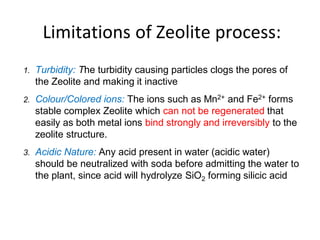
Limitations of Zeolite process:
1. Turbidity: The turbidity causing particles clogs the pores of
the Zeolite and making it inactive
2. Colour/Colored ions: The ions such as Mn2+ and Fe2+ forms
stable complex Zeolite which can not be regenerated that
easily as both metal ions bind strongly and irreversibly to the
zeolite structure.
3. Acidic Nature: Any acid present in water (acidic water)
should be neutralized with soda before admitting the water to
the plant, since acid will hydrolyze SiO2 forming silicic acid
45
Limitations of process:
1.If the supply of water is turbid, the suspended matter must be removed (by
coagulation, filtration, etc.), before the water is admitted to the zeolite bed ;
otherwise the turbidity will clog the pores of zeolite bed, thereby making it
inactive.
2.If water contains large quantities of coloured ions such as Mn2+ and Fe2+,they must
be removed first, because these ions produce maganese and iron zeolite, which
cannot be easily regenerated.
3.Mineral acids, if present in water, destroy the zeolite bed and,therefore, they must
be neutralised with soda, before admitting the water to the zeolite softening plant.
Zeolite Process
Advantages:
o Residual hardness of water is about 10 ppm only
o Equipment is small and easy to handle
o Time required for softening of water is small
o No sludge formation and the process is clean
o Zeolite can be regenerated easily using brine solution
o Any type of hardness can be removed without any modifications to the
process
Disadvantages:
o Coloured water or water containing suspended impurities cannot be
used without filtration
o Water containing acidic pH cannot be used for softening since acid will
destroy zeolite.
o It replaces only Ca2+ and Mg2+ with Na+ but leaves all the other ions
like HCO3
- and CO3
2- in the softened water (then it may form NaHCO3
and Na2CO3 which releases CO2 when the water is boiled and causes
corrosion)
o Soft water contains more sodium salts than in lime soda process
Ion-Exchange Process
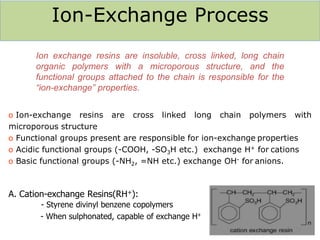
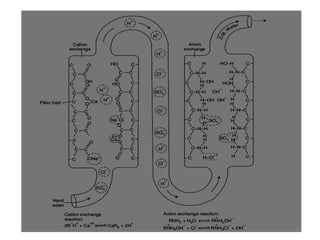
o Ion-exchange resins are cross linked long chain polymers with
microporous structure
o Functional groups present are responsible for ion-exchange properties
o Acidic functional groups (-COOH, -SO3H etc.) exchange H+ for cations
o Basic functional groups (-NH2, =NH etc.) exchange OH- for anions.
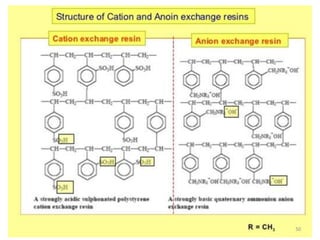
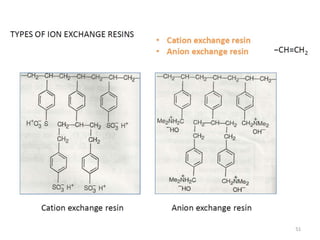
A. Cation-exchange Resins(RH+):
- Styrene divinyl benzene copolymers
- When sulphonated, capable of exchange H+
48
Ion exchange resins are insoluble, cross linked, long chain
organic polymers with a microporous structure, and the
functional groups attached to the chain is responsible for the
“ion-exchange” properties.
Ion-Exchange Process
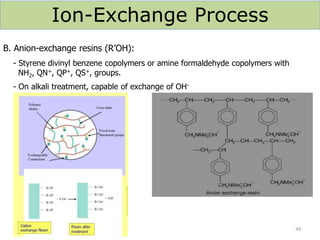
B. Anion-exchange resins (R’OH):
- Styrene divinyl benzene copolymers or amine formaldehyde copolymers with
NH2, QN+, QP+, QS+, groups.
- On alkali treatment, capable of exchange of OH-
49
50
51
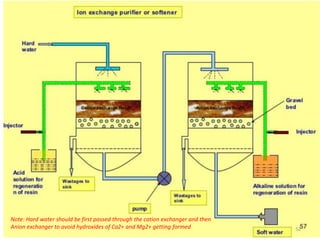
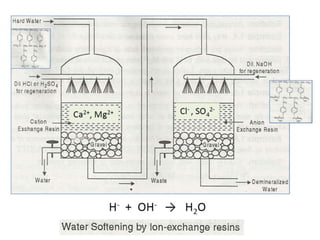
Note: Hard water should be first passed through the cation exchanger and then
Anion exchanger to avoid hydroxides of Ca2+ and Mg2+ getting formed 52
53
54
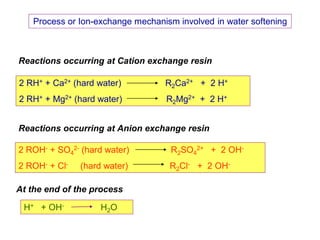
Process or Ion-exchange mechanism involved in water softening
2 RH+ + Ca2+ (hard water) R2Ca2+ + 2 H+
2 RH+ + Mg2+ (hard water) R2Mg2+ + 2 H+
2 ROH- + SO4
2- (hard water) R2SO4
2+ + 2 OH-
2 ROH- + Cl- (hard water) R2Cl- + 2 OH-
H+ + OH- H2O
Reactions occurring at Cation exchange resin
Reactions occurring at Anion exchange resin
At the end of the process
55
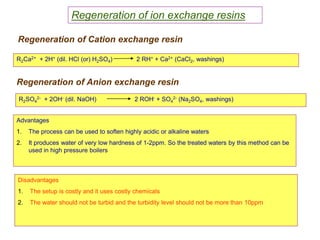
Regeneration of ion exchange resins
R2Ca2+ + 2H+ (dil. HCl (or) H2SO4) 2 RH+ + Ca2+ (CaCl2, washings)
R2SO4
2- + 2OH- (dil. NaOH) 2 ROH- + SO4
2- (Na2SO4, washings)
Advantages
1. The process can be used to soften highly acidic or alkaline waters
2. It produces water of very low hardness of 1-2ppm. So the treated waters by this method can be
used in high pressure boilers
Disadvantages
1. The setup is costly and it uses costly chemicals
2. The water should not be turbid and the turbidity level should not be more than 10ppm
Regeneration of Cation exchange resin
Regeneration of Anion exchange resin
56
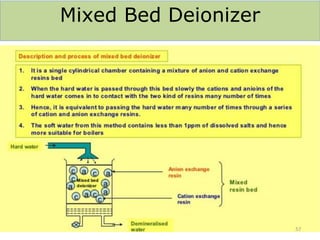
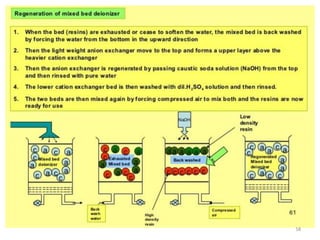
Mixed Bed Deionizer
57
58
Advantages & Disadvantages of
ion-exchange process
o Advantages:
- Can be used for highly acid and highly alkaline water
- Residual hardness of water is as low as 2 ppm.
- Very good for treating water for high pressure boilers
o Disadvantages:
- Expensive equipment and chemicals
- Turbidity of water should be < 10 ppm. Otherwise output will
reduce; turbidity needs to be coagulated before treatment.
- Needs skilled labour
59
WATER FOR DOMESTIC USE &
TREATMENT OF WATER FOR MUNICIPAL SUPPLY:
The following are the specification of water drinking purpose:
 This water should be clear, colourless and odourless.
 The water must be free from pathogenic bacteria and dissolved gases
like H2S.
 The optimum hardness of water must be 125 ppm and
pH must be 7.0 to 8.5
 The turbidity in drinking water should not exceed 25ppm
 The recommended maximum concentration of total dissolved solids in
potable water must not exceed 500ppm
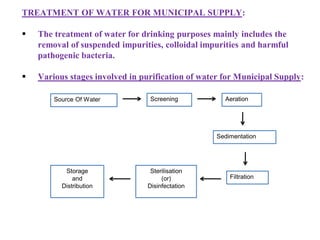
TREATMENT OF WATER FOR MUNICIPAL SUPPLY:
 The treatment of water for drinking purposes mainly includes the
removal of suspended impurities, colloidal impurities and harmful
pathogenic bacteria.
 Various stages involved in purification of water for Municipal Supply:
Source Of Water Screening Aeration
Sedimentation
Filtration
Sterilisation
(or)
Disinfectation
Storage
and
Distribution
1) SCREENING: The process of removing floating matter from water is
known as “Screening”
In this process, water is passed through a screen. The floating matter is
arrested by the screen and the water is free from the folating matter.
2) AERATION: The water is then subjected to aeration which
i) Helps in exchange of gases between water and air.
ii) Increases the oxygen content of water
iii) Removes the impurities like ‘Fe’ and ‘Mn’ by precipitating as their
hydroxides
3) SEDIMENTATION:
i) Plain Sedimentation: The process of removing big sized suspended solid
particles from water is called ‘Plain Sedimentation’. In this process,
water is stored in big tanks for several hours.
70% of solid particles settle down due to the force of gravity
ii) Sedimentation By Coagulation:
 This is the process of removing fine suspended and colloidal impurities
by adding coagulants like alum, ferrous sulpate and sodium aluminate.
When coagulant is added to water, “Floc Formation” takes place due to
hydroxide formation which can gather tiny particles together to form
bigger particles and settle down quickly
4) FILTRATION: This process of passing a liquid containing suspended
impurities through a suitable porous materials so as to effectively
remove suspended impurities and some micro-organisms is called
“Filtration”.
It is mechanical process. When water flows through a filter bed, many
suspended particles are unable to pass through the gaps and settle in the
bed.
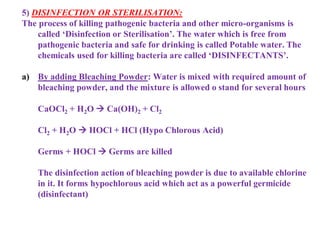
5) DISINFECTION OR STERILISATION:
The process of killing pathogenic bacteria and other micro-organisms is
called ‘Disinfection or Sterilisation’. The water which is free from
pathogenic bacteria and safe for drinking is called Potable water. The
chemicals used for killing bacteria are called ‘DISINFECTANTS’.
a) By adding Bleaching Powder: Water is mixed with required amount of
bleaching powder, and the mixture is allowed o stand for several hours
CaOCl2 + H2O  Ca(OH)2 + Cl2
Cl2 + H2O  HOCl + HCl (Hypo Chlorous Acid)
Germs + HOCl  Germs are killed
The disinfection action of bleaching powder is due to available chlorine
in it. It forms hypochlorous acid which act as a powerful germicide
(disinfectant)
b) CHLORINATION: Chlorine is mixed with water in a chlorinator, which
is a high tower having a number of baffle plates. Water and required
quantity of concentrated chlorine solutin are introduced from its top
during their passage through the tower. They get thoroughly mixed and
then sterilised water is taken out from the bottom.
ADVANTAGES:
i) Storage required less space
ii) Effective and economical
iii) Stable and does not deteriorate
iv) Produces no salts
v) Ideal disinfectant
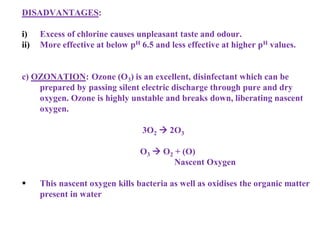
DISADVANTAGES:
i) Excess of chlorine causes unpleasant taste and odour.
ii) More effective at below pH 6.5 and less effective at higher pH values.
c) OZONATION: Ozone (O3) is an excellent, disinfectant which can be
prepared by passing silent electric discharge through pure and dry
oxygen. Ozone is highly unstable and breaks down, liberating nascent
oxygen.
3O2  2O3
O3  O2 + (O)
Nascent Oxygen
 This nascent oxygen kills bacteria as well as oxidises the organic matter
present in water
ADVANTAGES:
 Removes colour, odour and taste
DISADVANTAGES:
 The method is costly.
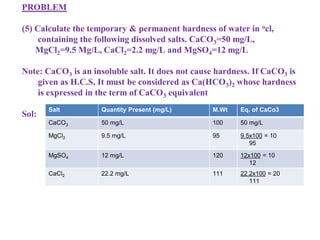
PROBLEM
(5) Calculate the temporary & permanent hardness of water in ocl,
containing the following dissolved salts. CaCO3=50 mg/L,
MgCl2=9.5 Mg/L, CaCl2=2.2 mg/L and MgSO4=12 mg/L
Note: CaCO3 is an insoluble salt. It does not cause hardness. If CaCO3 is
given as H.C.S, It must be considered as Ca(HCO3)2 whose hardness
is expressed in the term of CaCO3 equivalent
Sol:
Salt Quantity Present (mg/L) M.Wt Eq. of CaCo3
CaCO3 50 mg/L 100 50 mg/L
MgCl2 9.5 mg/L 95 9.5x100 = 10
95
MgSO4 12 mg/L 120 12x100 = 10
12
CaCl2 22.2 mg/L 111 22.2x100 = 20
111
Temporary Hardness Of Water = [Hardness Of CaCO3]
= 50 ppm/50 mg/L
= 50 x 0.7 = 3.5 ocl
Permanent Hardness Of Water = Hardness of MgCl2 + MgSO4 + CaCl2
= 10 + 10 + 20
= 40 mg/L
= 40 x 0.7
= 2.8o cl
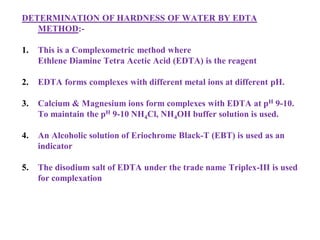
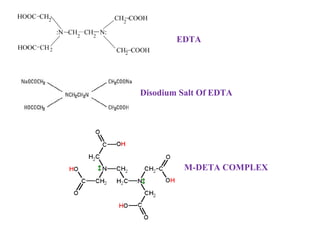
DETERMINATION OF HARDNESS OF WATER BY EDTA
METHOD:-
1. This is a Complexometric method where
Ethlene Diamine Tetra Acetic Acid (EDTA) is the reagent
2. EDTA forms complexes with different metal ions at different pH.
3. Calcium & Magnesium ions form complexes with EDTA at pH 9-10.
To maintain the pH 9-10 NH4Cl, NH4OH buffer solution is used.
4. An Alcoholic solution of Eriochrome Black-T (EBT) is used as an
indicator
5. The disodium salt of EDTA under the trade name Triplex-III is used
for complexation
EDTA
Disodium Salt Of EDTA
M-DETA COMPLEX
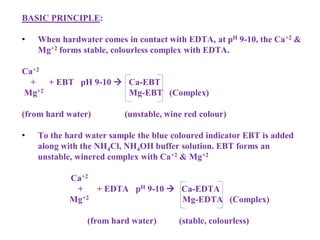
BASIC PRINCIPLE:
• When hardwater comes in contact with EDTA, at pH 9-10, the Ca+2 &
Mg+2 forms stable, colourless complex with EDTA.
Ca+2
+ + EBT pH 9-10  Ca-EBT
Mg+2 Mg-EBT (Complex)
(from hard water) (unstable, wine red colour)
• To the hard water sample the blue coloured indicator EBT is added
along with the NH4Cl, NH4OH buffer solution. EBT forms an
unstable, winered complex with Ca+2 & Mg+2
Ca+2
+ + EDTA pH 9-10  Ca-EDTA
Mg+2 Mg-EDTA (Complex)
(from hard water) (stable, colourless)
• The winered coloured [Ca-EBT, Mg-EBT] complex is titrated with
EDTA replaces EBT from Ca-EBT complex and form stable
colourless
Mg-EBT
[Ca-EDTA] [Mg-EDTA] complex releasing the blue coloured
indicator EBT into H2O
• Hence the colour change at the end point is winered to blue
colour
• The titration is carried out in the following steps
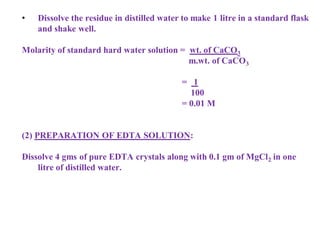
1. PREPARATION OF STANDARD HARD WATER:
Dissolve 1gm of pure, dry CaCO3 in minimum quantity of dilute
HCl and evaporate the solution to dryness on a waterbath.
• Dissolve the residue in distilled water to make 1 litre in a standard flask
and shake well.
Molarity of standard hard water solution = wt. of CaCO3
m.wt. of CaCO3
= 1
100
= 0.01 M
(2) PREPARATION OF EDTA SOLUTION:
Dissolve 4 gms of pure EDTA crystals along with 0.1 gm of MgCl2 in one
litre of distilled water.
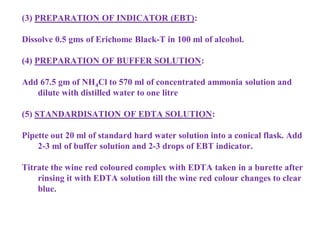
(3) PREPARATION OF INDICATOR (EBT):
Dissolve 0.5 gms of Erichome Black-T in 100 ml of alcohol.
(4) PREPARATION OF BUFFER SOLUTION:
Add 67.5 gm of NH4Cl to 570 ml of concentrated ammonia solution and
dilute with distilled water to one litre
(5) STANDARDISATION OF EDTA SOLUTION:
Pipette out 20 ml of standard hard water solution into a conical flask. Add
2-3 ml of buffer solution and 2-3 drops of EBT indicator.
Titrate the wine red coloured complex with EDTA taken in a burette after
rinsing it with EDTA solution till the wine red colour changes to clear
blue.
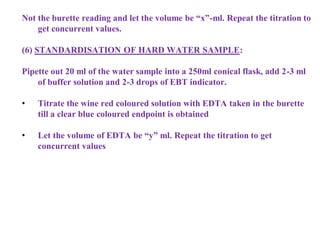
Not the burette reading and let the volume be “x”-ml. Repeat the titration to
get concurrent values.
(6) STANDARDISATION OF HARD WATER SAMPLE:
Pipette out 20 ml of the water sample into a 250ml conical flask, add 2-3 ml
of buffer solution and 2-3 drops of EBT indicator.
• Titrate the wine red coloured solution with EDTA taken in the burette
till a clear blue coloured endpoint is obtained
• Let the volume of EDTA be “y” ml. Repeat the titration to get
concurrent values
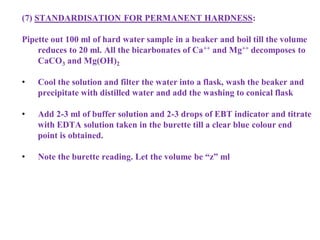
(7) STANDARDISATION FOR PERMANENT HARDNESS:
Pipette out 100 ml of hard water sample in a beaker and boil till the volume
reduces to 20 ml. All the bicarbonates of Ca++ and Mg++ decomposes to
CaCO3 and Mg(OH)2
• Cool the solution and filter the water into a flask, wash the beaker and
precipitate with distilled water and add the washing to conical flask
• Add 2-3 ml of buffer solution and 2-3 drops of EBT indicator and titrate
with EDTA solution taken in the burette till a clear blue colour end
point is obtained.
• Note the burette reading. Let the volume be “z” ml
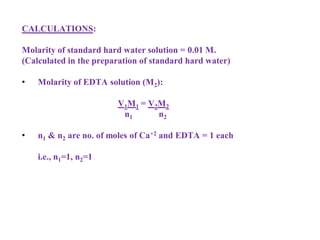
CALCULATIONS:
Molarity of standard hard water solution = 0.01 M.
(Calculated in the preparation of standard hard water)
• Molarity of EDTA solution (M2):
V1M1 = V2M2
n1 n2
• n1 & n2 are no. of moles of Ca+2 and EDTA = 1 each
i.e., n1=1, n2=1
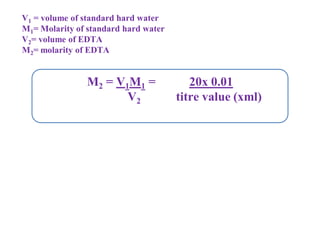
V1 = volume of standard hard water
M1= Molarity of standard hard water
V2= volume of EDTA
M2= molarity of EDTA
M2 = V1M1 = 20x 0.01
V2 titre value (xml)
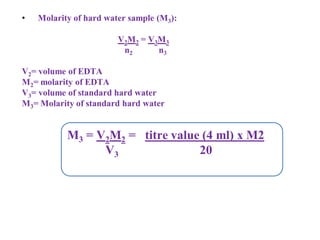
• Molarity of hard water sample (M3):
V2M2 = V3M3
n2 n3
V2= volume of EDTA
M2= molarity of EDTA
V3= volume of standard hard water
M3= Molarity of standard hard water
M3 = V2M2 = titre value (4 ml) x M2
V3 20
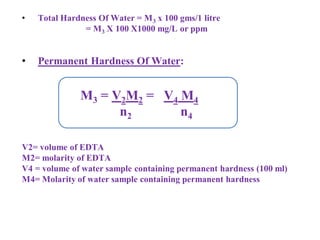
• Total Hardness Of Water = M3 x 100 gms/1 litre
= M3 X 100 X1000 mg/L or ppm
• Permanent Hardness Of Water:
V2= volume of EDTA
M2= molarity of EDTA
V4 = volume of water sample containing permanent hardness (100 ml)
M4= Molarity of water sample containing permanent hardness
M3 = V2M2 = V4 M4
n2 n4
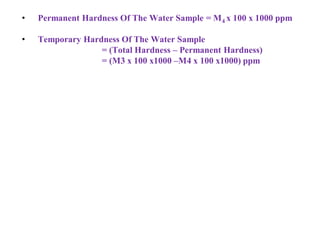
• Permanent Hardness Of The Water Sample = M4 x 100 x 1000 ppm
• Temporary Hardness Of The Water Sample
= (Total Hardness – Permanent Hardness)
= (M3 x 100 x1000 –M4 x 100 x1000) ppm
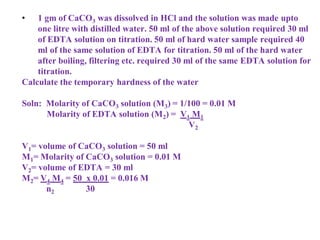
• 1 gm of CaCO3 was dissolved in HCl and the solution was made upto
one litre with distilled water. 50 ml of the above solution required 30 ml
of EDTA solution on titration. 50 ml of hard water sample required 40
ml of the same solution of EDTA for titration. 50 ml of the hard water
after boiling, filtering etc. required 30 ml of the same EDTA solution for
titration.
Calculate the temporary hardness of the water
Soln: Molarity of CaCO3 solution (M3) = 1/100 = 0.01 M
Molarity of EDTA solution (M2) = V1 M1
V2
V1= volume of CaCO3 solution = 50 ml
M1= Molarity of CaCO3 solution = 0.01 M
V2= volume of EDTA = 30 ml
M2= V4 M4 = 50 x 0.01 = 0.016 M
n2 30
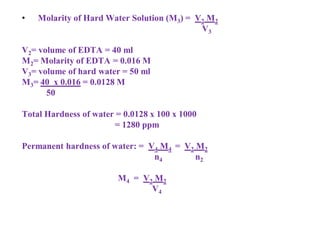
• Molarity of Hard Water Solution (M3) = V2 M2
V3
V2= volume of EDTA = 40 ml
M2= Molarity of EDTA = 0.016 M
V3= volume of hard water = 50 ml
M3= 40 x 0.016 = 0.0128 M
50
Total Hardness of water = 0.0128 x 100 x 1000
= 1280 ppm
Permanent hardness of water: = V4 M4 = V2 M2
n4 n2
M4 = V2 M2
V4
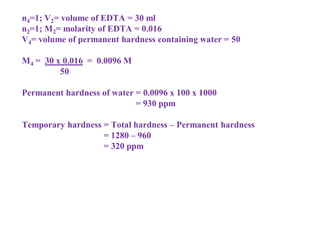
n4=1; V2= volume of EDTA = 30 ml
n2=1; M2= molarity of EDTA = 0.016
V4= volume of permanent hardness containing water = 50
M4 = 30 x 0.016 = 0.0096 M
50
Permanent hardness of water = 0.0096 x 100 x 1000
= 930 ppm
Temporary hardness = Total hardness – Permanent hardness
= 1280 – 960
= 320 ppm
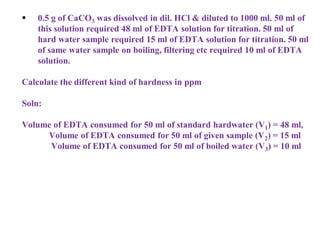
 0.5 g of CaCO3 was dissolved in dil. HCl & diluted to 1000 ml. 50 ml of
this solution required 48 ml of EDTA solution for titration. 50 ml of
hard water sample required 15 ml of EDTA solution for titration. 50 ml
of same water sample on boiling, filtering etc required 10 ml of EDTA
solution.
Calculate the different kind of hardness in ppm
Soln:
Volume of EDTA consumed for 50 ml of standard hardwater (V1) = 48 ml,
Volume of EDTA consumed for 50 ml of given sample (V2) = 15 ml
Volume of EDTA consumed for 50 ml of boiled water (V3) = 10 ml
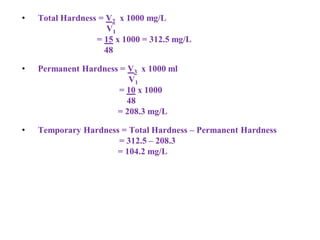
• Total Hardness = V2 x 1000 mg/L
V1
= 15 x 1000 = 312.5 mg/L
48
• Permanent Hardness = V3 x 1000 ml
V1
= 10 x 1000
48
= 208.3 mg/L
• Temporary Hardness = Total Hardness – Permanent Hardness
= 312.5 – 208.3
= 104.2 mg/L

water PPT.pdf notes and detailed notes ppt

  • 1.
    WATER CHEMISTRY 1 Course: B.Tech Subject:Engineering Chemistry Unit:1
  • 2.
    Water & Itstreatment 1). Like air, water is one of the few basic materials which is of prime importance for the preservation of life on this earth. 2). All are aware of the uses of water for drinking, cooking, cooking, bathing & for farming etc. 3). But few know the importance of water as an engineering matrial. 4). As an engineering material water is used for producing steam, in boilers to generate hydro-electric power, furnishing steam for engines, for construction of concrete structures for manufacturing purposes & as a solvent in chemical process.
  • 3.
    Sources of Water A)Surface Water Rain Water - Pure but contaminated with gases River Water - High dissolved salts moderate organics Lake Water - Const. composition but high organics Sea Water - High salinity, pathogens, organics B) Underground/Sub-Surface Water Spring/Well Water - Crystal clear but high dissolved salts and high purity from organics 3
  • 4.
    Sources of Water: 1).Rain water: Rain water is the purest form of natural water. However, it dissolves considerable amount of gases (CO2 – SO2 - NO – NO2 etc) and suspended solid particles from atmosphere, during its journey through it and becomes polluted. 2). River water: River are formed by rain and spring waters. During its flow over the surface of land, it dissolves minerals of the soil such as chlorides, sulfates, bicarbonates of sodium, calcium, magnesium ions etc. 3). Spring or well water or Lake water: It contains constant chemical composition. The minerals present in the lake water in the form dissolved form and high quantity of organic matter.
  • 5.
    4). Sea water:It is the most impure form of natural water. It contains larger percentage of the dissolved salts (above 3.5%) out of which about 2.6% is NaCl. The NaCl which is present in the dissolved form in sea water will come out as NaCl crystals due to evaporation of sea water. The other salts present in the sea-water are sulphates of sodium, bicarbonates of potassium, magnesium, calcium, bromides of potassium, magnesium etc. Underground water: Spring & well waters are the underground water sources. They are in general clearer in appearance due to the filtering action of the soil. They contain more of the dissolved salts generally, underground water is of high organic purity.
  • 6.
    Types of impuritiesin water The impurities present in water are classified as: 1). Dissolved impurities: Dissolved impurities may organic or inorganic. Inorganic impurities: The carbonates, bicarbonates, sulphates, chlorides of calcium, magnesium, iron potassium and aluminium. Organic impurities: Organic water products, amino acids, proteins, etc. Gases: O2 , CO2 , CH4, NH3, Oxides of nitrogen and sulphur, H2S etc. 2). Suspended impurities: It is of two types: Inorganic - sand & clay; Organic – vegetable and animal matter. 3) Biological Impurities: Micro-Organisms like Pathogenic bacteria, fungi, algae etc
  • 7.
    POTABLE WATER  Water: safe to drink,  Fit for human consumption, should satisfy the following requirements: 1. Clear & odourless, 2. Pleasant in taste, 3. Perfectly cool, 4. Turbidity should not exceed 10ppm, 5. Free from objectionable dissolved gases 6. Objectionable minerals: lead,arsenic, Mn, Cr 7. pH:8.0 8. Reasonably soft, 9. Free from disease-producing microorganisms. 7
  • 8.
    DISADVANTAGES OF HARDWATER/ CAUSES OF HARDNESS: The following are the disadvantages when hard water is used for various purpose: (i) DOMESTIC USE: (a) Washing and Bathing : Hard water does not form lather easily with soap is wasted (b) Drinking : Hard water causes bad effects on our digestive system. Sometimes, stone formation takes place in kidneys (c) Cooking : The boiling point of water is increased due to the presence of salts. Hence, more fuel and time are required for cooking.
  • 9.
    (ii) INDUSTRIAL USE: (a)Textile Industry : Hard water causes wastage of soap. Precipitates of calcium and magnesium soap adhere to the fabrics and cause problem (b) Paper Industry : Calcium and Magnesium salts in water may effect the quality of paper. (c) Sugar Industry : Water containing sulphates, carbonates, nitrates affects the crystallisation of sugar. (d) Pharmaceutical Industry : Hard water may form some undesirable products while preparation of pharmaceutical products.
  • 10.
    (iii) STEAM GENERATIONIN BOILERS: For steam generation, boilers are employed. If hard water is used in boilers, It may lead to the following troubles (a) Boiler Corrosion (b) Scale and Sludge formation. (c) Priming and Foaming (d) Caustic embrittlement Pharmaceutical industry
  • 11.
    HARDNESS OF WATEROR HARDWATER AND SOFT WATER 11 • Hardness in Water is characteristic that prevents the ‘lathering of soap’ thus water that does not produce lather with soap solution readily, but forms a white curd is called hard water. • Type of Hardness – Temporary or Carbonate Hardness – Permanent Hardness or non-carbonate Hardness. Hard Water : Those water which does not produce lather (or) very little lather with soap is called Hard Water Soft Water : Soft water readily produce a lot of lather when mixed with little soap. The Hardness of water is caused by the presence of dissolved salts such as Bicarbonates, Sulphates, Chlorides and Nitrates of bivalent metal ions like Ca+2 & Mg+2
  • 12.
    Soap is sodium/potassiumsalt of higher fatty acids like stearic, oleic and palmetic acids. When soap is mixed with soft water lather is produced due to stearic acid and sodium stearate  Na – Stearate + H2O  NaOH + Stearic Acid [C17H35COOH]  Stearic Acid + Na-Stearate  Formatioin of lather. When soap comes in contact with HARD WATER, Sodium stearate will react with dissolved calcium and magnesium salts and produce calcium stearate or magnesium stearate which is white precipitate  2Na – Stearate + Ca+2  Ca – Stearate ↓ + 2Na+ [2C17H35COONa] + Ca+2  [(C17H35COO)2 Ca] ↓ + 2Na+ (Soap) (Soluble) (Insoluble) (Soluble)  [2C17H35COONa] + Mg+2  [(C17H35COO)2 Mg] ↓ + 2Na+ (Soluble) (Soluble) (Insoluble) (Soluble)
  • 13.
    Hardness Name OfWater 0-70 mg/litre Soft Water 70-150 mg/litre Moderate Hard Water 150-300 mg/litre Hard Water > 300 mg/litre Very Hard Water Different Type of Water have different degree of hardness. The different types of water are commercially classified on the basis of degree of hardness as follows:
  • 14.
    TYPES OF HARDNESS Thehardness of water is of two types (1) Temporary hardness (or) Carbonate hardness (2) Permanent hardness (or) Non-Carbonate hardness
  • 15.
    Temporary Hardness – TemporaryHardness is caused by the presence of dissolved bicarbonate of calcium, magnesium and other heavy metals and the carbonate of iron. It is mostly destroyed by more boiling of water, when bicarbonates are decomposed yielding insoluble carbonates. Ca(HCO3)2 Heat CaCO3 + H2O + CO2 Calcium bicarbonate Calcium Carbonate Mg(HCO3)2 Heat Mg(OH)2 + 2CO2 Magnesium Bicarbonate Magnesium hydroxide – Calcium/Magnesium Carbonates thus formed being almost insoluble, are deposited as a scale at the bottom of vessel, while carbon dioxide escapes out.
  • 16.
    PERMANENT HARDNESS 16 Non CarbonateHardness is due to the presence of chlorides, sulfates of calcium, Magnesium, iron and other heavy metals. These salts are CaCl2, CaSo4, Ca(NO3)2, MgCl2, MgSo4, Mg(No3)2 These Hardness cannot be removed easily by boiling. Hence it is called “Permanent Hardness”. Only chemical treatment can remove this hardness. 2C17H35COONa + CaCl2 (C17H35COO)2Ca + 2NaCl 2C17H35COONa + MgSO4 (C17H35COO)2Mg + 2Na2SO4 Sodium stearate (sodium soap) Hardness Calcium stearate (Insoluble) Sodium stearate (sodium soap) Hardness Magnesium stearate (Insoluble) Total Hardness Of Water = Temporary Hardness + Permanent Hardness
  • 17.
    DEGREE OF HARDNESS: •The Concentration of hardness as well as non-hardness constituting ions are, usually expressed in the term of “Equivalent amount of CaCo3” • Since this mode permits the multiplication and division concentration, when required. The choice of CaCo3 in particular is due to its molecular weight (m.wt) is “100” (Equivalent wt = 50), and moreover, It is unsoluble salt that can be precipitated in water treatment.
  • 18.
    • Therefore 100parts by weight of CaCo3 hardness must be equivalent to 1 162 parts by weight of Ca(HCo3)2 hardness 2 146 parts by weight of Mg(HCo3)2 hardness 3 136 parts by weight of CaSo4 hardness 4 111 parts by weight of CaCl2 hardness 5 164 parts by weight of Ca(No3)2 hardness 6 120 parts by weight of MgSo4 hardness 7 146 parts by weight of MgCl2 hardness 8 136 parts by weight of Mg(No3)2 hardness
  • 19.
    The method ofcalculating degree of hardness will be clear from the following formula •Hardness causing in salt in terms of CaCo3 Amount of the hardness causing salt x 100 Molecular weight of hardness causing salt UNITS OF HARDNESS: These are 4 different units in which the hardness of water is expressed as given below (1) Parts per million (PPM): PPM is the number of parts of CaCo3 equivalent hardness per 106 parts of water. i.e., 1 PPM = 1 part of CaCo3 equivalent hardness in 106 parts of water.
  • 20.
    (2) Milli gramsPer Litre (mg/litre): mg/L is the number of milligrams of CaCo3 equivalent hardness present per litre of water. i.e., 1 mg/L = 1 mg of CaCo3 equivalent hardness of 1 L of water. But 1 L water weights = 1 kg of water 1 kg = 1000 gms = 1000 x 1000 mg = 106 mg ∴ 1 mg/L = 1 mg of CaCo3 equivalent per 106 mg of water = 1 part of CaCo3 equivalent per 106 parts of water ∴ 1 mg/L = 1 ppm
  • 21.
    Degree Of Clark(ocl) : ocl is number of grains (1/7000 lb) of CaCo3 equivalent hardness per gallon (10 lb) of water. (or) It is defined as the number of parts of CaCo3 equivalent hardness per 70,000 parts of water. ∴ 1ocl = 1 grain of CaCo3 eq. hardness per gallon of water. (or) 1ocl = 1 part of CaCo3 eq. hardness per 70,000 parts of water ∴ 1 ppm = 0.07ocl
  • 22.
    Degree Of French(oFr) : oFr is the number of parts of CaCo3 equivalent hardness per 105 parts of water. 1oFr = 1 part of CaCo3 equivalent hardness per 105 parts of water Note: The hardness of water can be converted into all the four units by making use of the following interconversion formula 1 ppm = 1mg/L = 0.07ocl = 0.1oFr 1ocl = 1.43oFr = 14.3 ppm = 14.3 mg/L ∴ 0.1o Fr = 1 ppm
  • 23.
  • 24.
    Water Softening Methods ❖Soda Lime Process ❖ Zeolite (Permutit process) ❖ Ion-exchange ❖ Mixed bed ion-exchange
  • 25.
    Lime soda process Itis a process in which Lime (Ca(OH)2) and soda (Na2CO3) are added to the hard water to convert the soluble calcium and magnesium salts to insoluble compounds by a chemical reaction. The CaCO3 and Mg(OH)2 so precipitated are filtered off and removed easily. It is further divided in to two types 1. Cold lime soda process 2. Hot lime soda process
  • 26.
    1. Cold limesoda process In this process a calculated quantity of Ca(OH)2 (lime) and Na2CO3 (soda) are mixed with water at room temperature and added to the hard water. The following reactions takes place depending on the nature of hardness If it is permanent hardness and due to calcium salt Ca2+ + Na2CO3 CaCO3 + 2Na+ (soda) slimy suspended precipitate If it is due to Magnesium salt Mg2+ + Ca(OH)2 Mg(OH)2 + Ca2+ (lime) slimy suspended precipitate Ca2+ + Na2CO3 CaCO3 + 2Na+ (soda) slimy suspended precipitate Chemical reactions Step 1
  • 27.
    If it isTemporary hardness and due to calcium salt Ca(HCO3)2 + Ca(OH)2 2CaCO3 + 2H2O slimy suspended precipitate If it is due to Magnesium salt Mg(HCO3)2 + 2Ca(OH)2 2CaCO3 + Mg(OH)2 + 2H2O slimy suspended precipitates Chemical reactions contd.. The precipitates CaCO3 and Mg(OH)2 are very fine and forms sludge like precipitates in the boiler water and are difficult to remove because it does not settle easily making it difficult to filter and the removal process. Finally reduces the efficiency of the boiler. Therefore, it is essential to add small amount of coagulant (such as Alum, Aluminium sulfate, sodium aluminate etc) which hydrolyses to flocculent precipitate of Al(OH)3 which entraps the fine precipitates. Step 2
  • 28.
  • 29.
    When coagulants areadded flocculation takes place followed by the formation of flocculants. NaAlO2 + 2H2O NaOH + Al(OH)3 Coagulant Flocculent- Gelatinous precipitate which entraps the fine precipitates of CaCO3 and Mg(OH)2 Al2(SO4)3 + 3 Ca(HCO3)2 2Al(OH)3 + CaSO4 + CO2 Aluminium sulfate Hard water sample Flocculent- Gelatinous precipitate which entraps the fine precipitates of CaCO3 and Mg(OH)2 The Al(OH)3 formed by the addition of coagulants initiates the process of flocculation and entraps the fine precipitates and becomes heavy. The heavier flocs then settles at the bottom and filtered off easily.
  • 30.
    Softening Procedure Method : •Raw water & calculated quantities of chemicals: from the top in to the inner vertical circular chamber. • There is a vigorous stirring & continuous mixing : softening of water take place. • Softened water comes into the outer co-axial chamber, it rises upwards. • Heavy sludge settles down & softened water reaches up. • Softened water : passes through a filtering media to ensure complete removal of sludge. • Filtered soft water finally flows out continuously through the outlet at the top. • Sludge settling at the bottom of the outer chamber is drawn off occasionally. 30
  • 31.
  • 32.
    (ii) Hot lime-sodaprocess: Treating water with softening chemicals at a temp. of 80 to 150˚c. Process : operated close to the boiling point. consists three parts: (a) Reaction tank: in which raw water, chemicals & steam are mixed, (b) Conical sedimentation vessel: sludge settles down. (c) Sand filter: complete removal of sludge from softened water. 32
  • 33.
  • 34.
    Advantages of hotlime-soda process: • The precipitation reaction is almost complete, • Reaction takes place faster, • Sludge settles down rapidly; • No coagulant is needed, • Dissolved gases (which may cause corrosion) are removed, • Viscosity of soft water is lower, hence filtered easily, • Residual hardness is low compared to cold lime- soda process. 34
  • 35.
    Advantages & Disadvantagesof Lime-soda process Advantages: • 1.Economical • 2.Process increses pH value of the treated water, thereby corrosion of the distribution pipes is reduced. • 3.Mineral content of water is reduced • 4.pH of water raises thus reducing content of pathogenic bacteria • 5. iron & Mn: removed. Disadvantages: • 1.Huge amount of sludge is formed and its disposal is difficult • 2.Due to residual hardness, water is not suitable for high pressure boilers 35
  • 36.
     In thismethod the lime & soda are mixed with hard water at room temperature with constant stirring  Generally the precipitates formed by this process are finely divided and in order to settle the precipitates, coagulants like alum, ferrous sulphate etc are added  The hard water to be softened is mixed with calculated quantity of chemicals (Lime + Soda + Coagulant) from the top into the inner chamberon vigorous stirring. The chemical reactions takes place and the hardness producing salts get converted into insoluble precipitates  The sludge is removed from the bottom of the outer chamber while the softened water passes through a wood fibre filter to ensure the complete removal of any residual sludge particles  The clear softened water is withdrawn from the top of the outer chamber. The softened water from this process contains a residual hardness of 50-60ppm
  • 37.
  • 38.
     This processis similar to the cold lime-soda process, but no coagulant is needed.  Here the process is carried at a temperature of 80o to 150o c. Since the reaction carried out at high temperature. (a) The reaction takes place faster (b) The sludge settles rapidly (c) Viscosity of soft water is lower, hence filtered easily (d) The dissolved gases such as CO2, air etc driven out of the water (e) The residual hardness is low, compared to cold lime-soda process. Hot lime soda process consists of three parts  “REACTION TANK” in which complete mixing of water, chemicals and steam takes place and water gets softened.  “Conical Sedimentation Vessel” where the sludge settle down.
  • 39.
     “SAND FILTER”where sludge is completely removed  The softened water from this process contains a residual hardness of 15-30 ppm ADVANTAGES OF LIME-SODA PROCESS: I. This process is economical II. Mineral content of the water is reduced III. The process increases the pH value of water, which reduces the content of pathogenic bacteria IV. Manganese and Iron salts are also removed by this process V. The process improves the corrosion resistance of the water
  • 40.
    DISADVANTAGES OF LIME-SODAPROCESS: 1) Due to residual hardness, water is not useful for high pressure boilers 2) Large amount of sludge is formed which create disposal problem
  • 41.
    Permutit or ZeoliteProcess o Zeolite is hydrated sodium aluminium silicate having a general formula, Na2OAl2O3.xSiO2.yH2O where x = 2-10 and y = 2-6 o It exchanges Na+ ions for Ca2+ and Mg2+ ions. o Common Zeolite is Na2OAl2O3.3SiO2.2H2O known as natrolith. o Other gluconites, green sand (iron potassium phyllosilicate with characteristic green colour, a mineral containing Glauconite)etc. are used for water softening. o Artificial zeolite used for water softening is Permutit. o These are porous, glassy particles having higher softening capacity compared to green sand. o They are prepared by heating china clay (hydrated aluminium silicate), feldspar (KAlSi3O8-NaAlSi3O8 – CaAl2Si2O8) are a group of rock-forming tectosilicate minerals which make up as much as 60% of the earth’s crust) and soda ash (Na2CO3)
  • 42.
    Natural Zeolites: 1. Natrolite- Na2O. Al2O3 4SiO2 .2H 2O 2. Laumontite - CaO. Al2O3 4SiO2 .4H 2O 3. Harmotome - (BaO.K2O). Al2O3 5SiO2 .5H 2O Synthetic zeolite: Porous & possess gel structure. - Capable of exchanging its Na ions Micro pores of Zeolite
  • 43.
    Permutit or ZeoliteProcess o Method of softening: Na2Ze + Ca(HCO3)2 2 NaHCO3+CaZe Na2Ze + Mg(HCO3)2 2 NaHCO3+ MgZe Na2Ze + CaSO4 2 Na2SO4+CaZe Na2Ze + CaCl2 2 NaCl+CaZe At this stage, the supply of hard water is stopped and exhausted zeolite is reclaimed by treating the bed with concentrated NaCl solution. o Regeneration of Zeolite: CaZe (or) MgZe + 2 NaCl Na2Ze + CaCl2 or MgCl2 Brine solution Reclaimed zeolite To remove temporary hardness To remove permanent hardness
  • 45.
    Limitations of Zeoliteprocess: 1. Turbidity: The turbidity causing particles clogs the pores of the Zeolite and making it inactive 2. Colour/Colored ions: The ions such as Mn2+ and Fe2+ forms stable complex Zeolite which can not be regenerated that easily as both metal ions bind strongly and irreversibly to the zeolite structure. 3. Acidic Nature: Any acid present in water (acidic water) should be neutralized with soda before admitting the water to the plant, since acid will hydrolyze SiO2 forming silicic acid 45
  • 46.
    Limitations of process: 1.Ifthe supply of water is turbid, the suspended matter must be removed (by coagulation, filtration, etc.), before the water is admitted to the zeolite bed ; otherwise the turbidity will clog the pores of zeolite bed, thereby making it inactive. 2.If water contains large quantities of coloured ions such as Mn2+ and Fe2+,they must be removed first, because these ions produce maganese and iron zeolite, which cannot be easily regenerated. 3.Mineral acids, if present in water, destroy the zeolite bed and,therefore, they must be neutralised with soda, before admitting the water to the zeolite softening plant.
  • 47.
    Zeolite Process Advantages: o Residualhardness of water is about 10 ppm only o Equipment is small and easy to handle o Time required for softening of water is small o No sludge formation and the process is clean o Zeolite can be regenerated easily using brine solution o Any type of hardness can be removed without any modifications to the process Disadvantages: o Coloured water or water containing suspended impurities cannot be used without filtration o Water containing acidic pH cannot be used for softening since acid will destroy zeolite. o It replaces only Ca2+ and Mg2+ with Na+ but leaves all the other ions like HCO3 - and CO3 2- in the softened water (then it may form NaHCO3 and Na2CO3 which releases CO2 when the water is boiled and causes corrosion) o Soft water contains more sodium salts than in lime soda process
  • 48.
    Ion-Exchange Process o Ion-exchangeresins are cross linked long chain polymers with microporous structure o Functional groups present are responsible for ion-exchange properties o Acidic functional groups (-COOH, -SO3H etc.) exchange H+ for cations o Basic functional groups (-NH2, =NH etc.) exchange OH- for anions. A. Cation-exchange Resins(RH+): - Styrene divinyl benzene copolymers - When sulphonated, capable of exchange H+ 48 Ion exchange resins are insoluble, cross linked, long chain organic polymers with a microporous structure, and the functional groups attached to the chain is responsible for the “ion-exchange” properties.
  • 49.
    Ion-Exchange Process B. Anion-exchangeresins (R’OH): - Styrene divinyl benzene copolymers or amine formaldehyde copolymers with NH2, QN+, QP+, QS+, groups. - On alkali treatment, capable of exchange of OH- 49
  • 50.
  • 51.
  • 52.
    Note: Hard watershould be first passed through the cation exchanger and then Anion exchanger to avoid hydroxides of Ca2+ and Mg2+ getting formed 52
  • 53.
  • 54.
    54 Process or Ion-exchangemechanism involved in water softening 2 RH+ + Ca2+ (hard water) R2Ca2+ + 2 H+ 2 RH+ + Mg2+ (hard water) R2Mg2+ + 2 H+ 2 ROH- + SO4 2- (hard water) R2SO4 2+ + 2 OH- 2 ROH- + Cl- (hard water) R2Cl- + 2 OH- H+ + OH- H2O Reactions occurring at Cation exchange resin Reactions occurring at Anion exchange resin At the end of the process
  • 55.
    55 Regeneration of ionexchange resins R2Ca2+ + 2H+ (dil. HCl (or) H2SO4) 2 RH+ + Ca2+ (CaCl2, washings) R2SO4 2- + 2OH- (dil. NaOH) 2 ROH- + SO4 2- (Na2SO4, washings) Advantages 1. The process can be used to soften highly acidic or alkaline waters 2. It produces water of very low hardness of 1-2ppm. So the treated waters by this method can be used in high pressure boilers Disadvantages 1. The setup is costly and it uses costly chemicals 2. The water should not be turbid and the turbidity level should not be more than 10ppm Regeneration of Cation exchange resin Regeneration of Anion exchange resin
  • 56.
  • 57.
  • 58.
  • 59.
    Advantages & Disadvantagesof ion-exchange process o Advantages: - Can be used for highly acid and highly alkaline water - Residual hardness of water is as low as 2 ppm. - Very good for treating water for high pressure boilers o Disadvantages: - Expensive equipment and chemicals - Turbidity of water should be < 10 ppm. Otherwise output will reduce; turbidity needs to be coagulated before treatment. - Needs skilled labour 59
  • 60.
    WATER FOR DOMESTICUSE & TREATMENT OF WATER FOR MUNICIPAL SUPPLY: The following are the specification of water drinking purpose:  This water should be clear, colourless and odourless.  The water must be free from pathogenic bacteria and dissolved gases like H2S.  The optimum hardness of water must be 125 ppm and pH must be 7.0 to 8.5  The turbidity in drinking water should not exceed 25ppm  The recommended maximum concentration of total dissolved solids in potable water must not exceed 500ppm
  • 61.
    TREATMENT OF WATERFOR MUNICIPAL SUPPLY:  The treatment of water for drinking purposes mainly includes the removal of suspended impurities, colloidal impurities and harmful pathogenic bacteria.  Various stages involved in purification of water for Municipal Supply: Source Of Water Screening Aeration Sedimentation Filtration Sterilisation (or) Disinfectation Storage and Distribution
  • 62.
    1) SCREENING: Theprocess of removing floating matter from water is known as “Screening” In this process, water is passed through a screen. The floating matter is arrested by the screen and the water is free from the folating matter. 2) AERATION: The water is then subjected to aeration which i) Helps in exchange of gases between water and air. ii) Increases the oxygen content of water iii) Removes the impurities like ‘Fe’ and ‘Mn’ by precipitating as their hydroxides
  • 63.
    3) SEDIMENTATION: i) PlainSedimentation: The process of removing big sized suspended solid particles from water is called ‘Plain Sedimentation’. In this process, water is stored in big tanks for several hours. 70% of solid particles settle down due to the force of gravity ii) Sedimentation By Coagulation:  This is the process of removing fine suspended and colloidal impurities by adding coagulants like alum, ferrous sulpate and sodium aluminate. When coagulant is added to water, “Floc Formation” takes place due to hydroxide formation which can gather tiny particles together to form bigger particles and settle down quickly
  • 64.
    4) FILTRATION: Thisprocess of passing a liquid containing suspended impurities through a suitable porous materials so as to effectively remove suspended impurities and some micro-organisms is called “Filtration”. It is mechanical process. When water flows through a filter bed, many suspended particles are unable to pass through the gaps and settle in the bed.
  • 65.
    5) DISINFECTION ORSTERILISATION: The process of killing pathogenic bacteria and other micro-organisms is called ‘Disinfection or Sterilisation’. The water which is free from pathogenic bacteria and safe for drinking is called Potable water. The chemicals used for killing bacteria are called ‘DISINFECTANTS’. a) By adding Bleaching Powder: Water is mixed with required amount of bleaching powder, and the mixture is allowed o stand for several hours CaOCl2 + H2O  Ca(OH)2 + Cl2 Cl2 + H2O  HOCl + HCl (Hypo Chlorous Acid) Germs + HOCl  Germs are killed The disinfection action of bleaching powder is due to available chlorine in it. It forms hypochlorous acid which act as a powerful germicide (disinfectant)
  • 66.
    b) CHLORINATION: Chlorineis mixed with water in a chlorinator, which is a high tower having a number of baffle plates. Water and required quantity of concentrated chlorine solutin are introduced from its top during their passage through the tower. They get thoroughly mixed and then sterilised water is taken out from the bottom. ADVANTAGES: i) Storage required less space ii) Effective and economical iii) Stable and does not deteriorate iv) Produces no salts v) Ideal disinfectant
  • 67.
    DISADVANTAGES: i) Excess ofchlorine causes unpleasant taste and odour. ii) More effective at below pH 6.5 and less effective at higher pH values. c) OZONATION: Ozone (O3) is an excellent, disinfectant which can be prepared by passing silent electric discharge through pure and dry oxygen. Ozone is highly unstable and breaks down, liberating nascent oxygen. 3O2  2O3 O3  O2 + (O) Nascent Oxygen  This nascent oxygen kills bacteria as well as oxidises the organic matter present in water
  • 68.
    ADVANTAGES:  Removes colour,odour and taste DISADVANTAGES:  The method is costly.
  • 69.
    PROBLEM (5) Calculate thetemporary & permanent hardness of water in ocl, containing the following dissolved salts. CaCO3=50 mg/L, MgCl2=9.5 Mg/L, CaCl2=2.2 mg/L and MgSO4=12 mg/L Note: CaCO3 is an insoluble salt. It does not cause hardness. If CaCO3 is given as H.C.S, It must be considered as Ca(HCO3)2 whose hardness is expressed in the term of CaCO3 equivalent Sol: Salt Quantity Present (mg/L) M.Wt Eq. of CaCo3 CaCO3 50 mg/L 100 50 mg/L MgCl2 9.5 mg/L 95 9.5x100 = 10 95 MgSO4 12 mg/L 120 12x100 = 10 12 CaCl2 22.2 mg/L 111 22.2x100 = 20 111
  • 70.
    Temporary Hardness OfWater = [Hardness Of CaCO3] = 50 ppm/50 mg/L = 50 x 0.7 = 3.5 ocl Permanent Hardness Of Water = Hardness of MgCl2 + MgSO4 + CaCl2 = 10 + 10 + 20 = 40 mg/L = 40 x 0.7 = 2.8o cl
  • 71.
    DETERMINATION OF HARDNESSOF WATER BY EDTA METHOD:- 1. This is a Complexometric method where Ethlene Diamine Tetra Acetic Acid (EDTA) is the reagent 2. EDTA forms complexes with different metal ions at different pH. 3. Calcium & Magnesium ions form complexes with EDTA at pH 9-10. To maintain the pH 9-10 NH4Cl, NH4OH buffer solution is used. 4. An Alcoholic solution of Eriochrome Black-T (EBT) is used as an indicator 5. The disodium salt of EDTA under the trade name Triplex-III is used for complexation
  • 72.
    EDTA Disodium Salt OfEDTA M-DETA COMPLEX
  • 73.
    BASIC PRINCIPLE: • Whenhardwater comes in contact with EDTA, at pH 9-10, the Ca+2 & Mg+2 forms stable, colourless complex with EDTA. Ca+2 + + EBT pH 9-10  Ca-EBT Mg+2 Mg-EBT (Complex) (from hard water) (unstable, wine red colour) • To the hard water sample the blue coloured indicator EBT is added along with the NH4Cl, NH4OH buffer solution. EBT forms an unstable, winered complex with Ca+2 & Mg+2 Ca+2 + + EDTA pH 9-10  Ca-EDTA Mg+2 Mg-EDTA (Complex) (from hard water) (stable, colourless)
  • 74.
    • The wineredcoloured [Ca-EBT, Mg-EBT] complex is titrated with EDTA replaces EBT from Ca-EBT complex and form stable colourless Mg-EBT [Ca-EDTA] [Mg-EDTA] complex releasing the blue coloured indicator EBT into H2O • Hence the colour change at the end point is winered to blue colour • The titration is carried out in the following steps 1. PREPARATION OF STANDARD HARD WATER: Dissolve 1gm of pure, dry CaCO3 in minimum quantity of dilute HCl and evaporate the solution to dryness on a waterbath.
  • 75.
    • Dissolve theresidue in distilled water to make 1 litre in a standard flask and shake well. Molarity of standard hard water solution = wt. of CaCO3 m.wt. of CaCO3 = 1 100 = 0.01 M (2) PREPARATION OF EDTA SOLUTION: Dissolve 4 gms of pure EDTA crystals along with 0.1 gm of MgCl2 in one litre of distilled water.
  • 76.
    (3) PREPARATION OFINDICATOR (EBT): Dissolve 0.5 gms of Erichome Black-T in 100 ml of alcohol. (4) PREPARATION OF BUFFER SOLUTION: Add 67.5 gm of NH4Cl to 570 ml of concentrated ammonia solution and dilute with distilled water to one litre (5) STANDARDISATION OF EDTA SOLUTION: Pipette out 20 ml of standard hard water solution into a conical flask. Add 2-3 ml of buffer solution and 2-3 drops of EBT indicator. Titrate the wine red coloured complex with EDTA taken in a burette after rinsing it with EDTA solution till the wine red colour changes to clear blue.
  • 77.
    Not the burettereading and let the volume be “x”-ml. Repeat the titration to get concurrent values. (6) STANDARDISATION OF HARD WATER SAMPLE: Pipette out 20 ml of the water sample into a 250ml conical flask, add 2-3 ml of buffer solution and 2-3 drops of EBT indicator. • Titrate the wine red coloured solution with EDTA taken in the burette till a clear blue coloured endpoint is obtained • Let the volume of EDTA be “y” ml. Repeat the titration to get concurrent values
  • 78.
    (7) STANDARDISATION FORPERMANENT HARDNESS: Pipette out 100 ml of hard water sample in a beaker and boil till the volume reduces to 20 ml. All the bicarbonates of Ca++ and Mg++ decomposes to CaCO3 and Mg(OH)2 • Cool the solution and filter the water into a flask, wash the beaker and precipitate with distilled water and add the washing to conical flask • Add 2-3 ml of buffer solution and 2-3 drops of EBT indicator and titrate with EDTA solution taken in the burette till a clear blue colour end point is obtained. • Note the burette reading. Let the volume be “z” ml
  • 79.
    CALCULATIONS: Molarity of standardhard water solution = 0.01 M. (Calculated in the preparation of standard hard water) • Molarity of EDTA solution (M2): V1M1 = V2M2 n1 n2 • n1 & n2 are no. of moles of Ca+2 and EDTA = 1 each i.e., n1=1, n2=1
  • 80.
    V1 = volumeof standard hard water M1= Molarity of standard hard water V2= volume of EDTA M2= molarity of EDTA M2 = V1M1 = 20x 0.01 V2 titre value (xml)
  • 81.
    • Molarity ofhard water sample (M3): V2M2 = V3M3 n2 n3 V2= volume of EDTA M2= molarity of EDTA V3= volume of standard hard water M3= Molarity of standard hard water M3 = V2M2 = titre value (4 ml) x M2 V3 20
  • 82.
    • Total HardnessOf Water = M3 x 100 gms/1 litre = M3 X 100 X1000 mg/L or ppm • Permanent Hardness Of Water: V2= volume of EDTA M2= molarity of EDTA V4 = volume of water sample containing permanent hardness (100 ml) M4= Molarity of water sample containing permanent hardness M3 = V2M2 = V4 M4 n2 n4
  • 83.
    • Permanent HardnessOf The Water Sample = M4 x 100 x 1000 ppm • Temporary Hardness Of The Water Sample = (Total Hardness – Permanent Hardness) = (M3 x 100 x1000 –M4 x 100 x1000) ppm
  • 84.
    • 1 gmof CaCO3 was dissolved in HCl and the solution was made upto one litre with distilled water. 50 ml of the above solution required 30 ml of EDTA solution on titration. 50 ml of hard water sample required 40 ml of the same solution of EDTA for titration. 50 ml of the hard water after boiling, filtering etc. required 30 ml of the same EDTA solution for titration. Calculate the temporary hardness of the water Soln: Molarity of CaCO3 solution (M3) = 1/100 = 0.01 M Molarity of EDTA solution (M2) = V1 M1 V2 V1= volume of CaCO3 solution = 50 ml M1= Molarity of CaCO3 solution = 0.01 M V2= volume of EDTA = 30 ml M2= V4 M4 = 50 x 0.01 = 0.016 M n2 30
  • 85.
    • Molarity ofHard Water Solution (M3) = V2 M2 V3 V2= volume of EDTA = 40 ml M2= Molarity of EDTA = 0.016 M V3= volume of hard water = 50 ml M3= 40 x 0.016 = 0.0128 M 50 Total Hardness of water = 0.0128 x 100 x 1000 = 1280 ppm Permanent hardness of water: = V4 M4 = V2 M2 n4 n2 M4 = V2 M2 V4
  • 86.
    n4=1; V2= volumeof EDTA = 30 ml n2=1; M2= molarity of EDTA = 0.016 V4= volume of permanent hardness containing water = 50 M4 = 30 x 0.016 = 0.0096 M 50 Permanent hardness of water = 0.0096 x 100 x 1000 = 930 ppm Temporary hardness = Total hardness – Permanent hardness = 1280 – 960 = 320 ppm
  • 87.
     0.5 gof CaCO3 was dissolved in dil. HCl & diluted to 1000 ml. 50 ml of this solution required 48 ml of EDTA solution for titration. 50 ml of hard water sample required 15 ml of EDTA solution for titration. 50 ml of same water sample on boiling, filtering etc required 10 ml of EDTA solution. Calculate the different kind of hardness in ppm Soln: Volume of EDTA consumed for 50 ml of standard hardwater (V1) = 48 ml, Volume of EDTA consumed for 50 ml of given sample (V2) = 15 ml Volume of EDTA consumed for 50 ml of boiled water (V3) = 10 ml
  • 88.
    • Total Hardness= V2 x 1000 mg/L V1 = 15 x 1000 = 312.5 mg/L 48 • Permanent Hardness = V3 x 1000 ml V1 = 10 x 1000 48 = 208.3 mg/L • Temporary Hardness = Total Hardness – Permanent Hardness = 312.5 – 208.3 = 104.2 mg/L