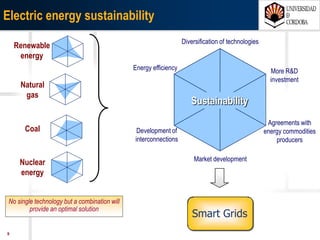
Master en Energías Renovables Distribuidas.
Antonio Moreno Muñoz
Introduction to Smart Grids
207/03/15 Antonio Moreno Muñoz. Área de Electrónica. Universidad de Córdoba.
■ Population growth
7.5 bill. in 2020 (+1.1 bill.)
■ Megacities (>10 mill. people)
27 megacities by 2025
Scarce resources
■ Geopolitics
70% of global oil and gas
reserves are located in just
a few countries
■ Oil price fluctuations
Climate change
■ Climate goals
Political programs aimed at
long-term reduction in
CO2 emissions
The world is changing
Source: UNO
Rising
energy consumption
Due to efficiency increases:
Growing electrification of
society
Growing
demand for
“clean” electricity
Demographic dynamics
307/03/15 Antonio Moreno Muñoz. Área de Electrónica. Universidad de Córdoba.
What is happening?
CO2
emissions
contribute to climate
change, which impacts
water systems.
Energy production results
in CO2
emissions.
Water is needed to
generate energy and
energy is needed to
provide water.
WATERWATER
CARBONCARBONENERGYENERGY
 Organizations will need to optimize their use of energy and water and minimize GHG
emissions.
407/03/15 Antonio Moreno Muñoz. Área de Electrónica. Universidad de Córdoba.
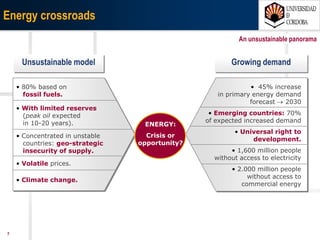
Energy crossroads
Unsustainable modelUnsustainable model Growing demandGrowing demand
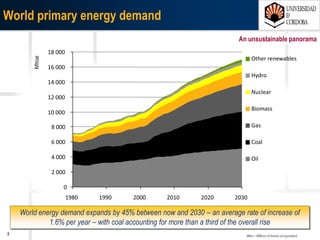
• 45% increase
in primary energy demand
forecast → 2030
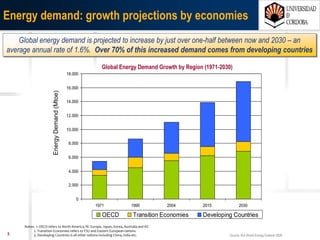
• Emerging countries: 70%
of expected increased demand
• Universal right to
development.
• 1,600 million people
without access to electricity
• 2.000 million people
without access to
commercial energy
ENERGY:
Crisis or
opportunity?
• 80% based on
fossil fuels.
• With limited reserves
(peak oil expected
in 10-20 years).
• Concentrated in unstable
countries: geo-strategic
insecurity of supply.
• Volatile prices.
• Climate change.
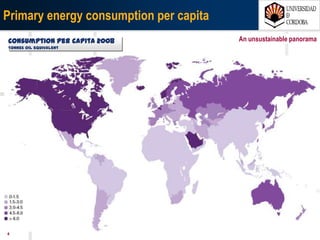
An unsustainable panorama
507/03/15 Antonio Moreno Muñoz. Área de Electrónica. Universidad de Córdoba.
The EU's 20-20-20 goals
-20% -20%
20%
Primary energy use Greenhouse gas
emissions
Renewable
resources
Efficiency Renewables
The EU set a series of demanding climate and energy targets to be met by 2020 in order to
strengthen competitiveness, to increase energy security and to combat climate change
607/03/15 Antonio Moreno Muñoz. Área de Electrónica. Universidad de Córdoba.
The global utilities industry faces a number of fundamental changes that are transforming
the industry landscape
Key drivers for change
707/03/15 Antonio Moreno Muñoz. Área de Electrónica. Universidad de Córdoba.
Trending insights.
807/03/15 Antonio Moreno Muñoz. Área de Electrónica. Universidad de Córdoba.
The energy value chain is evolving from a
traditional model …
Consumer
Power Flow
Periodic Information Flow
Continuous Information Flow
Coal/Natural Gas
NuclearHydroelectric
UTILITY
907/03/15 Antonio Moreno Muñoz. Área de Electrónica. Universidad de Córdoba.
…. to a modern, transformed and powerful
value chain
Consumer
Power Flow
Periodic Information Flow
Continuous Information Flow
Solar
Wind
Wind
Hydroelectric
Solar
Nuclear
Wind
Energy Storage
Energy Storage
UTILITY
Plug-in Vehicle
Coal/Natural Gas
1007/03/15 Antonio Moreno Muñoz. Área de Electrónica. Universidad de Córdoba.
Market forces are creating the need for
an evolution in the energy sector.
Solar
Wind
Solar
Wind
Hydroelectric
Solar
Nuclear
Wind
Energy Storage
Energy Storage
Energy Storage
UTILITY
Plug-in Vehicle
Consumer
Power Flow
Periodic Information Flow
Continuous Information Flow
Coal/Natural Gas
NuclearHydroelectric
UTILITY
TRADITIONAL TRANSFORMED
Coal/Natural Gas
1107/03/15 Antonio Moreno Muñoz. Área de Electrónica. Universidad de Córdoba.
What can be done?
ENSURING CLEANER ENERGY SUPPLY
Meeting stringent greenhouse gas
emissions targets
while maintaining sufficient, cost-effective
power supply.
TRANSFORMATION OF THE GRID
Transforming the grid from a
rigid analog system to
a dynamic and automated
energy delivery system.
EMPOWERMENT OF CONSUMERS
Empowering consumers by providing
them with near
real-time, detailed information
about their energy usage.
ENERGY ANDENERGY AND
UTILITIESUTILITIES
To deliver power more responsibly and more efficiently, energy and utilities organizations
are working toward a smarter energy value chain.
1207/03/15 Antonio Moreno Muñoz. Área de Electrónica. Universidad de Córdoba.
New capabilities to redefine the relationship
between utilities and end-users
CONSUMERS UTILITIES
Take advantage of variable
pricing by purchasing
electricity when it’s cheapest.
Generate their own
electricity and sell it
back to the grid.
Decrease carbon
emissions by choosing
clean electricity
sources.
Automatically monitor
the health of the grid.
Remotely sense
damage to grid
assets and dispatch
repair crews.
Better predict demand
and manage supply
accordingly.
1307/03/15 Antonio Moreno Muñoz. Área de Electrónica. Universidad de Córdoba.
Smart Grids
Informal Energy Council, Seville, 15 January 2010 The Spanish Presidency of the
European Union, Main topics for the European Energy Action Plan 2010-
2014:
• “The EU has defined six large interconnection and external connection
projects, considered essential to guarantee its EU energy security”.
• “It should also be possible for interconnection networks to be considered as
Smart Grids. Transition may be needed towards this new concept. The
networks thus drawn up will need optimally to match supply and demand in
real time and will be most useful for specifically decentralized or intermittent
generation, or for electric vehicle needs.”
• “Information technologies and communication (ITC) will play an
indispensable part in the management and control of the transport,
distribution and access system.”
The ambitious EU target for the year 2020 include 20% reduction in greenhouse gas emissions, 20% EU
renewables share and 20% savings in consumption by improving energy efficiency
1407/03/15 Antonio Moreno Muñoz. Área de Electrónica. Universidad de Córdoba.
What is the Smart Grid?
• Although there is no standard global definition, the EU’s Smart Grids
Technology Platform (www.smartgrids.eu) defines Smart Grids as:
 “electricity networks that can intelligently integrate the actions of all
users connected to it - generators, consumers and those that do both – in
order to efficiently deliver sustainable, economic and secure electricity
supplies”.
• But what does this “smartness” mean?
 Rather than a recipe for specific implementations, the “smartness”
provides a conceptual framework that defines new criteria for the design
and implementation of a reliable power delivery grid.
• Other initiatives:
 http://intelligrid.epri.com/
 http://www.oe.energy.gov/smartgrid.htm
 http://www.environment.gov.au/smartgrid/
1507/03/15 Antonio Moreno Muñoz. Área de Electrónica. Universidad de Córdoba.
Today’s Grid
Before
 One-way limited communication
 One-way power flow
 No electric vehicles
 Centralized generation
 Few sensors and analog control
 Little to no consumer choice
 Reactive maintenance
 Limited usage transparency
1607/03/15 Antonio Moreno Muñoz. Área de Electrónica. Universidad de Córdoba.
Tomorrow's Grid
 Bi-directional communication
and metering
 Bi-directional power flow
 Millions of electric vehicles
 Applications
 Pervasive monitoring and digital control
 Self-monitoring & high visibility
 Many consumer choices
 Condition-based maintenance
 Proliferation of numerous applications
Power
After
Information
1707/03/15 Antonio Moreno Muñoz. Área de Electrónica. Universidad de Córdoba.
Role of the Smart Grids
Smart Grids are about building, operating and maintaining the future electricity networks by:
1807/03/15 Antonio Moreno Muñoz. Área de Electrónica. Universidad de Córdoba.
Value Chain
 The customer has more to offer in reciprocal
value to power providers and other
participants than just payment for energy
 At the same time, customers are becoming
more demanding.
Emerging industry value model:
Value to customers (continuous)
 Power
 Reliability
 Universal service
 Environmental
impact reduction
 Cost saving
 Personalization
 Power
 Reliability
 Universal service
 Environmental
impact reduction
 Cost saving
 Personalization
 Information
 Services
 Revenue
 Information
 Services
 Revenue
 Information
 Services
 Environmental
impact reduction
 Revenue
 Information
 Services
 Environmental
impact reduction
 Revenue
 Information
 Personalization
 Services
 Cost savings
 Environmental
impact reduction
 Information
 Personalization
 Services
 Cost savings
 Environmental
impact reduction
 Revenue
 Information
 Connections
/ personal
networks
 Revenue
 Information
 Connections
/ personal
networks
 Power
 Demand
response
 Power
 Demand
response
Reciprocal value from
customers (intermittent)
Third- party product/
service providers
Traditional industry value model:
Value to customers
(continuous)
 Revenue Revenue
Reciprocal value from
customers (intermittent)
 Power
 Reliability
 Universal service
 Power
 Reliability
 Universal service
1907/03/15 Antonio Moreno Muñoz. Área de Electrónica. Universidad de Córdoba.
While the traditional value chain stopped at the meter to the premises, the new value chain will
integrate devices beyond the meter and the actions of customers themselves.
End-use
customers
Power
distribution
Energy
service
(retail)
Power
transmission
Power
generation
and trading
Electric
devices and
appliances
End-use
customers
Power
distribution
Energy
service
(retail)
Power
transmission
Power
generation
and trading
Electric
devices and
appliances
Distributed resources (generation, storage, electric vehicles)
Traditional electricity value chain
Emerging electricity value chain
Information and
services
platform owner
Information
devices
and appliances
Information
services
Power flow
Information flow
Value Chain
2007/03/15 Antonio Moreno Muñoz. Área de Electrónica. Universidad de Córdoba.
What the Smart Grid does not mean?
2107/03/15 Antonio Moreno Muñoz. Área de Electrónica. Universidad de Córdoba.
The roles in a Smart Grid market
2207/03/15 Antonio Moreno Muñoz. Área de Electrónica. Universidad de Córdoba.
Benefits of the Smart Grids
Smart Grids employ intelligent monitoring, control, communication, and self-healing technologies in
order to:
2307/03/15 Antonio Moreno Muñoz. Área de Electrónica. Universidad de Córdoba.
Challenges of the Smart Grids
From this perspective, there are certain clear needs that emerge, essential to the future
success of this initiative:
2407/03/15 Antonio Moreno Muñoz. Área de Electrónica. Universidad de Córdoba.
Service&End-to-endSecurity
Grid and
Enterprise IT
Grid Application
Demand Response (DR)
Grid Operation
GenerationGeneration TransmissionTransmission ConsumptionConsumptionDistributionDistributionRail
Electrification
Rail
Electrification
Field Devices
(Sensors,
Controllers, RTUs
IEDs, PMUs)
Protection Sensors
AMI/AMR
Smart Meters
Power
Quality
Communication
and Automation
CommunicationAutomation / SCADA
Virtual Power Plant
Outage Mgmt & rest.
(OMR)
Meter Data Mgmt.
(MDM)
Big Data Analytics, IT integration, Energy Trading and Risk ManagementBig Data Analytics, IT integration, Energy Trading and Risk Management
Smart Grid building blocks
Distribution Mgmt.
Sys. (DMS)
2507/03/15 Antonio Moreno Muñoz. Área de Electrónica. Universidad de Córdoba.
Advanced Meter Infrastructure
• Meter
• Head-End Device
• Meter Data Management System (MDMS)
• Communications Layer
• Home Area Network
Transmission & Distribution Network
• Communications Layer
• Data Historians
• SCADA RTU
• Substation Assets (not managed by
SCADA)
• Electrical Grid Field Assets (downstream of
substation)
Power Generation
• Fossil / Nuclear plant devices monitoring
(Non-Operational)
• Distributed Generation Communications
Layer
• Distributed Generation Assets (Wind,
Solar, Hyrdo, Diesel)
Central
Generation
Transmission
Network
Substation
Distribution Network
Residential
Customer
Commercial
Customer
Distributed
Generation
Renewable
Generation
Mobile
Workforce
Data Communication Network
1
4
4
4
2
2
3
3
4
1
4
1
5
5 5
1
2
3
4
5
1
23 4
55
5
1
2
1
2
3
1
2
2
3
3
1
Integration of the physical and digital
instrumentation systems
Utility Operation Center
2607/03/15 Antonio Moreno Muñoz. Área de Electrónica. Universidad de Córdoba.
PHEV
Natural Gas Engine
Wind Energy
Solar Energy
DC/AC
Inverter
Fuel Cells
Battery Storage Ultra Capacitor
UTILITY GRID
DC/AC
Inverter
DC/AC
InverterGenerator
DC/AC
Inverter
Smart Meter
Residential/ Commercial
Building
Priority LoadsPriority Loads
Micro GridMicro Grid
Control and Energy
Management
Control and Energy
Management
Generator
Transformer /CB
Distributed Micro
Energy Sources
Distributed Micro
Energy Sources
Local LoadsLocal Loads
Distributed
Storage
Distributed
Storage
Generator
Flywheel Storage
DFIG
Micro Turbine
2707/03/15 Antonio Moreno Muñoz. Área de Electrónica. Universidad de Córdoba.
Demand reduction is emerging to drive smart metering deployments in developed countries;
replacing operational efficiency drivers
 Efficiencies
 Grid automation
 Competitive markets
 Governance model
 Policy agenda
 Energy independence
 Demand reduction
 Renewable energy integration
Grid Efficiency Drivers
Demand Reduction Drivers
1st
Generation
2nd
Generation
3rd
Generation
Latin America,
Asia & Pacific
North America
& Western
Europe
 Growth capacity
 Electricity theft reduction
 Access
 Energy demand growth
 Reliability
Reliability Drivers
Grid Efficiency
Drivers
Demand Reduction
Drivers
Reliability
Drivers
Probable evolution scenarios
2807/03/15 Antonio Moreno Muñoz. Área de Electrónica. Universidad de Córdoba.
Smart Grid Roadmap
Phase 1
Phase 2
Phase 3
Smart Meter
2 way communications
Substation automation
Demand Response
Cyber security
Fault detection
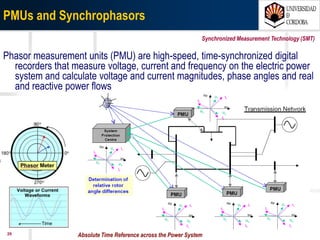
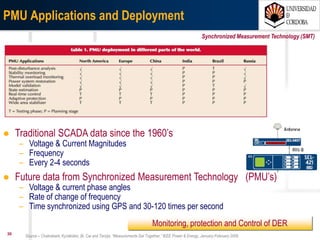
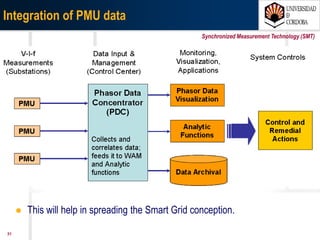
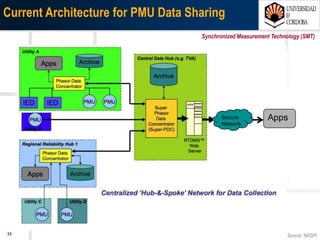
Transmission network stability (PMU)
Volt/VAR management
Distributed generation
Consumer portal
Automated restoration
Predictive maintenance
Home area networks
2907/03/15 Antonio Moreno Muñoz. Área de Electrónica. Universidad de Córdoba.
AMI T&D DRAdvanced Metering Infrastructure Transmission & Distribution
T&D
DR
1ª
Oleada
2ª
Oleada
3ª
Oleada
AMI
T&D
DR
1ª
Oleada
2ª
Oleada
3ª
Oleada
AMI
Latam (p.e.
Brasil)
India
AMI
T&D
DR
1ª
Oleada
2ª
Oleada
3ª
Oleada
T&D
DR
1ª
Oleada
2ª
Oleada
3ª
Oleada
AMI
EuropaUSA
Momento
actual
Momento
actual
Momento
actual
Momento
actual
Volumen de
inversión
acumulado
2020 2020
2020 2020
Volumen de
inversión
acumulado
Volumen de
inversión
acumulado
Volumen de
inversión
acumulado
Fuente: Elaboración propia a partir de datos de “Smart Grid: The next Infrastructure revolution”, Morgan Stanley
Probable evolution scenarios
•Demand Response
3007/03/15 Antonio Moreno Muñoz. Área de Electrónica. Universidad de Córdoba.
Traditional
“One way delivery”
AMI
“Bi-directional communication“
Demand Response
“Efficient markets”
Smart grid
“Smart Bi-directional delivery”
EnergyMarketEnergyMarket
Traditional meters Traditional meters
• Automation / Self-healing
• De-centralizing storage
• Distributed generation
• Mobility / Electronic cars
• New payment solutions
• Elastic pricing
• Reducing peaks
• Reducing CO2 in generation
• Resizing distribution capacity
• Reducing operational costs
• Automated processes
• Billing on actual consumption
• Manual meter readings
• Manual processes
• Overcapacity in grid / generation
Price signals
Generation capabilities
Consum
ption
dem
and
Customer
Electric cars
Traditional services /
Estimated billing
Traditional services /
Estimated billing
Knowledge / Control of
consumption
Knowledge / Control of
consumption
Lower consumption /
New pricing products
Lower consumption /
New pricing products
Micro generation
Smart meters Smart meters
Energy StorageEnergy Storage
Utility companyUtility company
Price SignalPrice Signal Price SignalPrice SignalPrice SignalPrice Signal
Traditional SystemTraditional System AutomationAutomation Real-time BillingReal-time Billing Complex SolutionsComplex Solutions
2030+-1930 2010 20202015
Distributed generation /
E-mobility
Distributed generation /
E-mobility
Real-time changing consumption patternsReal-time changing consumption patterns
30
3107/03/15 Antonio Moreno Muñoz. Área de Electrónica. Universidad de Córdoba.
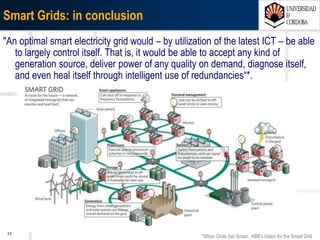
Smart Grids: in conclusion
Smart Homes
& Meters
Distribution
Intelligence
Grid Operation
Centers
Renewable
Energy
Plug-In Electric
Vehicles
Consumer
Engagement
"An optimal smart electricity grid would – by utilization of the latest ICT – be able to largely
control itself. That is, it would be able to accept any kind of generation source, deliver
power of any quality on demand, diagnose itself, and even heal itself through intelligent
use of redundancies“.
Master en Energías Renovables Distribuidas
Introduction to Smart Grids

Looking forward to Smart Grids

  • 1.
    Master en EnergíasRenovables Distribuidas. Antonio Moreno Muñoz Introduction to Smart Grids
  • 2.
    207/03/15 Antonio MorenoMuñoz. Área de Electrónica. Universidad de Córdoba. ■ Population growth 7.5 bill. in 2020 (+1.1 bill.) ■ Megacities (>10 mill. people) 27 megacities by 2025 Scarce resources ■ Geopolitics 70% of global oil and gas reserves are located in just a few countries ■ Oil price fluctuations Climate change ■ Climate goals Political programs aimed at long-term reduction in CO2 emissions The world is changing Source: UNO Rising energy consumption Due to efficiency increases: Growing electrification of society Growing demand for “clean” electricity Demographic dynamics
  • 3.
    307/03/15 Antonio MorenoMuñoz. Área de Electrónica. Universidad de Córdoba. What is happening? CO2 emissions contribute to climate change, which impacts water systems. Energy production results in CO2 emissions. Water is needed to generate energy and energy is needed to provide water. WATERWATER CARBONCARBONENERGYENERGY  Organizations will need to optimize their use of energy and water and minimize GHG emissions.
  • 4.
    407/03/15 Antonio MorenoMuñoz. Área de Electrónica. Universidad de Córdoba. Energy crossroads Unsustainable modelUnsustainable model Growing demandGrowing demand • 45% increase in primary energy demand forecast → 2030 • Emerging countries: 70% of expected increased demand • Universal right to development. • 1,600 million people without access to electricity • 2.000 million people without access to commercial energy ENERGY: Crisis or opportunity? • 80% based on fossil fuels. • With limited reserves (peak oil expected in 10-20 years). • Concentrated in unstable countries: geo-strategic insecurity of supply. • Volatile prices. • Climate change. An unsustainable panorama
  • 5.
    507/03/15 Antonio MorenoMuñoz. Área de Electrónica. Universidad de Córdoba. The EU's 20-20-20 goals -20% -20% 20% Primary energy use Greenhouse gas emissions Renewable resources Efficiency Renewables The EU set a series of demanding climate and energy targets to be met by 2020 in order to strengthen competitiveness, to increase energy security and to combat climate change
  • 6.
    607/03/15 Antonio MorenoMuñoz. Área de Electrónica. Universidad de Córdoba. The global utilities industry faces a number of fundamental changes that are transforming the industry landscape Key drivers for change
  • 7.
    707/03/15 Antonio MorenoMuñoz. Área de Electrónica. Universidad de Córdoba. Trending insights.
  • 8.
    807/03/15 Antonio MorenoMuñoz. Área de Electrónica. Universidad de Córdoba. The energy value chain is evolving from a traditional model … Consumer Power Flow Periodic Information Flow Continuous Information Flow Coal/Natural Gas NuclearHydroelectric UTILITY
  • 9.
    907/03/15 Antonio MorenoMuñoz. Área de Electrónica. Universidad de Córdoba. …. to a modern, transformed and powerful value chain Consumer Power Flow Periodic Information Flow Continuous Information Flow Solar Wind Wind Hydroelectric Solar Nuclear Wind Energy Storage Energy Storage UTILITY Plug-in Vehicle Coal/Natural Gas
  • 10.
    1007/03/15 Antonio MorenoMuñoz. Área de Electrónica. Universidad de Córdoba. Market forces are creating the need for an evolution in the energy sector. Solar Wind Solar Wind Hydroelectric Solar Nuclear Wind Energy Storage Energy Storage Energy Storage UTILITY Plug-in Vehicle Consumer Power Flow Periodic Information Flow Continuous Information Flow Coal/Natural Gas NuclearHydroelectric UTILITY TRADITIONAL TRANSFORMED Coal/Natural Gas
  • 11.
    1107/03/15 Antonio MorenoMuñoz. Área de Electrónica. Universidad de Córdoba. What can be done? ENSURING CLEANER ENERGY SUPPLY Meeting stringent greenhouse gas emissions targets while maintaining sufficient, cost-effective power supply. TRANSFORMATION OF THE GRID Transforming the grid from a rigid analog system to a dynamic and automated energy delivery system. EMPOWERMENT OF CONSUMERS Empowering consumers by providing them with near real-time, detailed information about their energy usage. ENERGY ANDENERGY AND UTILITIESUTILITIES To deliver power more responsibly and more efficiently, energy and utilities organizations are working toward a smarter energy value chain.
  • 12.
    1207/03/15 Antonio MorenoMuñoz. Área de Electrónica. Universidad de Córdoba. New capabilities to redefine the relationship between utilities and end-users CONSUMERS UTILITIES Take advantage of variable pricing by purchasing electricity when it’s cheapest. Generate their own electricity and sell it back to the grid. Decrease carbon emissions by choosing clean electricity sources. Automatically monitor the health of the grid. Remotely sense damage to grid assets and dispatch repair crews. Better predict demand and manage supply accordingly.
  • 13.
    1307/03/15 Antonio MorenoMuñoz. Área de Electrónica. Universidad de Córdoba. Smart Grids Informal Energy Council, Seville, 15 January 2010 The Spanish Presidency of the European Union, Main topics for the European Energy Action Plan 2010- 2014: • “The EU has defined six large interconnection and external connection projects, considered essential to guarantee its EU energy security”. • “It should also be possible for interconnection networks to be considered as Smart Grids. Transition may be needed towards this new concept. The networks thus drawn up will need optimally to match supply and demand in real time and will be most useful for specifically decentralized or intermittent generation, or for electric vehicle needs.” • “Information technologies and communication (ITC) will play an indispensable part in the management and control of the transport, distribution and access system.” The ambitious EU target for the year 2020 include 20% reduction in greenhouse gas emissions, 20% EU renewables share and 20% savings in consumption by improving energy efficiency
  • 14.
    1407/03/15 Antonio MorenoMuñoz. Área de Electrónica. Universidad de Córdoba. What is the Smart Grid? • Although there is no standard global definition, the EU’s Smart Grids Technology Platform (www.smartgrids.eu) defines Smart Grids as:  “electricity networks that can intelligently integrate the actions of all users connected to it - generators, consumers and those that do both – in order to efficiently deliver sustainable, economic and secure electricity supplies”. • But what does this “smartness” mean?  Rather than a recipe for specific implementations, the “smartness” provides a conceptual framework that defines new criteria for the design and implementation of a reliable power delivery grid. • Other initiatives:  http://intelligrid.epri.com/  http://www.oe.energy.gov/smartgrid.htm  http://www.environment.gov.au/smartgrid/
  • 15.
    1507/03/15 Antonio MorenoMuñoz. Área de Electrónica. Universidad de Córdoba. Today’s Grid Before  One-way limited communication  One-way power flow  No electric vehicles  Centralized generation  Few sensors and analog control  Little to no consumer choice  Reactive maintenance  Limited usage transparency
  • 16.
    1607/03/15 Antonio MorenoMuñoz. Área de Electrónica. Universidad de Córdoba. Tomorrow's Grid  Bi-directional communication and metering  Bi-directional power flow  Millions of electric vehicles  Applications  Pervasive monitoring and digital control  Self-monitoring & high visibility  Many consumer choices  Condition-based maintenance  Proliferation of numerous applications Power After Information
  • 17.
    1707/03/15 Antonio MorenoMuñoz. Área de Electrónica. Universidad de Córdoba. Role of the Smart Grids Smart Grids are about building, operating and maintaining the future electricity networks by:
  • 18.
    1807/03/15 Antonio MorenoMuñoz. Área de Electrónica. Universidad de Córdoba. Value Chain  The customer has more to offer in reciprocal value to power providers and other participants than just payment for energy  At the same time, customers are becoming more demanding. Emerging industry value model: Value to customers (continuous)  Power  Reliability  Universal service  Environmental impact reduction  Cost saving  Personalization  Power  Reliability  Universal service  Environmental impact reduction  Cost saving  Personalization  Information  Services  Revenue  Information  Services  Revenue  Information  Services  Environmental impact reduction  Revenue  Information  Services  Environmental impact reduction  Revenue  Information  Personalization  Services  Cost savings  Environmental impact reduction  Information  Personalization  Services  Cost savings  Environmental impact reduction  Revenue  Information  Connections / personal networks  Revenue  Information  Connections / personal networks  Power  Demand response  Power  Demand response Reciprocal value from customers (intermittent) Third- party product/ service providers Traditional industry value model: Value to customers (continuous)  Revenue Revenue Reciprocal value from customers (intermittent)  Power  Reliability  Universal service  Power  Reliability  Universal service
  • 19.
    1907/03/15 Antonio MorenoMuñoz. Área de Electrónica. Universidad de Córdoba. While the traditional value chain stopped at the meter to the premises, the new value chain will integrate devices beyond the meter and the actions of customers themselves. End-use customers Power distribution Energy service (retail) Power transmission Power generation and trading Electric devices and appliances End-use customers Power distribution Energy service (retail) Power transmission Power generation and trading Electric devices and appliances Distributed resources (generation, storage, electric vehicles) Traditional electricity value chain Emerging electricity value chain Information and services platform owner Information devices and appliances Information services Power flow Information flow Value Chain
  • 20.
    2007/03/15 Antonio MorenoMuñoz. Área de Electrónica. Universidad de Córdoba. What the Smart Grid does not mean?
  • 21.
    2107/03/15 Antonio MorenoMuñoz. Área de Electrónica. Universidad de Córdoba. The roles in a Smart Grid market
  • 22.
    2207/03/15 Antonio MorenoMuñoz. Área de Electrónica. Universidad de Córdoba. Benefits of the Smart Grids Smart Grids employ intelligent monitoring, control, communication, and self-healing technologies in order to:
  • 23.
    2307/03/15 Antonio MorenoMuñoz. Área de Electrónica. Universidad de Córdoba. Challenges of the Smart Grids From this perspective, there are certain clear needs that emerge, essential to the future success of this initiative:
  • 24.
    2407/03/15 Antonio MorenoMuñoz. Área de Electrónica. Universidad de Córdoba. Service&End-to-endSecurity Grid and Enterprise IT Grid Application Demand Response (DR) Grid Operation GenerationGeneration TransmissionTransmission ConsumptionConsumptionDistributionDistributionRail Electrification Rail Electrification Field Devices (Sensors, Controllers, RTUs IEDs, PMUs) Protection Sensors AMI/AMR Smart Meters Power Quality Communication and Automation CommunicationAutomation / SCADA Virtual Power Plant Outage Mgmt & rest. (OMR) Meter Data Mgmt. (MDM) Big Data Analytics, IT integration, Energy Trading and Risk ManagementBig Data Analytics, IT integration, Energy Trading and Risk Management Smart Grid building blocks Distribution Mgmt. Sys. (DMS)
  • 25.
    2507/03/15 Antonio MorenoMuñoz. Área de Electrónica. Universidad de Córdoba. Advanced Meter Infrastructure • Meter • Head-End Device • Meter Data Management System (MDMS) • Communications Layer • Home Area Network Transmission & Distribution Network • Communications Layer • Data Historians • SCADA RTU • Substation Assets (not managed by SCADA) • Electrical Grid Field Assets (downstream of substation) Power Generation • Fossil / Nuclear plant devices monitoring (Non-Operational) • Distributed Generation Communications Layer • Distributed Generation Assets (Wind, Solar, Hyrdo, Diesel) Central Generation Transmission Network Substation Distribution Network Residential Customer Commercial Customer Distributed Generation Renewable Generation Mobile Workforce Data Communication Network 1 4 4 4 2 2 3 3 4 1 4 1 5 5 5 1 2 3 4 5 1 23 4 55 5 1 2 1 2 3 1 2 2 3 3 1 Integration of the physical and digital instrumentation systems Utility Operation Center
  • 26.
    2607/03/15 Antonio MorenoMuñoz. Área de Electrónica. Universidad de Córdoba. PHEV Natural Gas Engine Wind Energy Solar Energy DC/AC Inverter Fuel Cells Battery Storage Ultra Capacitor UTILITY GRID DC/AC Inverter DC/AC InverterGenerator DC/AC Inverter Smart Meter Residential/ Commercial Building Priority LoadsPriority Loads Micro GridMicro Grid Control and Energy Management Control and Energy Management Generator Transformer /CB Distributed Micro Energy Sources Distributed Micro Energy Sources Local LoadsLocal Loads Distributed Storage Distributed Storage Generator Flywheel Storage DFIG Micro Turbine
  • 27.
    2707/03/15 Antonio MorenoMuñoz. Área de Electrónica. Universidad de Córdoba. Demand reduction is emerging to drive smart metering deployments in developed countries; replacing operational efficiency drivers  Efficiencies  Grid automation  Competitive markets  Governance model  Policy agenda  Energy independence  Demand reduction  Renewable energy integration Grid Efficiency Drivers Demand Reduction Drivers 1st Generation 2nd Generation 3rd Generation Latin America, Asia & Pacific North America & Western Europe  Growth capacity  Electricity theft reduction  Access  Energy demand growth  Reliability Reliability Drivers Grid Efficiency Drivers Demand Reduction Drivers Reliability Drivers Probable evolution scenarios
  • 28.
    2807/03/15 Antonio MorenoMuñoz. Área de Electrónica. Universidad de Córdoba. Smart Grid Roadmap Phase 1 Phase 2 Phase 3 Smart Meter 2 way communications Substation automation Demand Response Cyber security Fault detection Transmission network stability (PMU) Volt/VAR management Distributed generation Consumer portal Automated restoration Predictive maintenance Home area networks
  • 29.
    2907/03/15 Antonio MorenoMuñoz. Área de Electrónica. Universidad de Córdoba. AMI T&D DRAdvanced Metering Infrastructure Transmission & Distribution T&D DR 1ª Oleada 2ª Oleada 3ª Oleada AMI T&D DR 1ª Oleada 2ª Oleada 3ª Oleada AMI Latam (p.e. Brasil) India AMI T&D DR 1ª Oleada 2ª Oleada 3ª Oleada T&D DR 1ª Oleada 2ª Oleada 3ª Oleada AMI EuropaUSA Momento actual Momento actual Momento actual Momento actual Volumen de inversión acumulado 2020 2020 2020 2020 Volumen de inversión acumulado Volumen de inversión acumulado Volumen de inversión acumulado Fuente: Elaboración propia a partir de datos de “Smart Grid: The next Infrastructure revolution”, Morgan Stanley Probable evolution scenarios •Demand Response
  • 30.
    3007/03/15 Antonio MorenoMuñoz. Área de Electrónica. Universidad de Córdoba. Traditional “One way delivery” AMI “Bi-directional communication“ Demand Response “Efficient markets” Smart grid “Smart Bi-directional delivery” EnergyMarketEnergyMarket Traditional meters Traditional meters • Automation / Self-healing • De-centralizing storage • Distributed generation • Mobility / Electronic cars • New payment solutions • Elastic pricing • Reducing peaks • Reducing CO2 in generation • Resizing distribution capacity • Reducing operational costs • Automated processes • Billing on actual consumption • Manual meter readings • Manual processes • Overcapacity in grid / generation Price signals Generation capabilities Consum ption dem and Customer Electric cars Traditional services / Estimated billing Traditional services / Estimated billing Knowledge / Control of consumption Knowledge / Control of consumption Lower consumption / New pricing products Lower consumption / New pricing products Micro generation Smart meters Smart meters Energy StorageEnergy Storage Utility companyUtility company Price SignalPrice Signal Price SignalPrice SignalPrice SignalPrice Signal Traditional SystemTraditional System AutomationAutomation Real-time BillingReal-time Billing Complex SolutionsComplex Solutions 2030+-1930 2010 20202015 Distributed generation / E-mobility Distributed generation / E-mobility Real-time changing consumption patternsReal-time changing consumption patterns 30
  • 31.
    3107/03/15 Antonio MorenoMuñoz. Área de Electrónica. Universidad de Córdoba. Smart Grids: in conclusion Smart Homes & Meters Distribution Intelligence Grid Operation Centers Renewable Energy Plug-In Electric Vehicles Consumer Engagement "An optimal smart electricity grid would – by utilization of the latest ICT – be able to largely control itself. That is, it would be able to accept any kind of generation source, deliver power of any quality on demand, diagnose itself, and even heal itself through intelligent use of redundancies“.
  • 32.
    Master en EnergíasRenovables Distribuidas Introduction to Smart Grids

Editor's Notes

  • #5 The present production and use of energy is causing depletion of resources and serious environmental problems. We need to change this situation
  • #7 Ron
  • #11 You will notice here that the traditional energy value chain has more of a hierarchical or even centralized structure. The energy value chain is evolving and has been moving to a more distributed structure and will continue to evolve into a more networked structure.
  • #12 To deliver power more responsibly and more efficiently, smart energy and utilities organizations are working toward a smarter energy value chain. The good news is that Utilities are now able to transform the way power is sourced, distributed, and consumed. “Smart grids" use sensors, smart meters, digital controls and analytic tools to automatically monitor and control two-way energy flow and that allow consumers to manage energy usage right down to the individual networked appliance. With information about their consumption and automated energy management tools, consumers can proactively manage their energy use and choose sources of power. With smart grids, energy companies will be able to detect a power outage instantly, know the exact location and cause, re-route power, and tell users when power will be restored. Smart grids also allow energy and utility companies to better understand power demand in near real time, so they can improve delivery and dynamically incorporate energy from different sources. These capabilities support greater use of more sustainable energy sources, such as wind and solar generation, and will help meet rapidly growing energy demand around the world such as enabling widespread charging of new devices like "plug-in" electric vehicles.
  • #14 The European Union is actually impelling the concept of Smart Grids!!… And within this paradigm, the Information Technologies and Communication (ITC) will play an important role
  • #15 Like other initiatives, “Smart Grid” means different things to different people. The term itself has become abused in the sense that nowadays it is “fuzzy”.
  • #18 Smart Grids are about building, operating and maintaining the electricity networks of the future by:
  • #19 This recharacterization of the industry value chain will dramatically reshape the value proposition among energy, service and product providers, as well as customers of these enterprises and the value model of the industry as a whole. A value model is the combination of value provided to customers and the reciprocal value received from customers in return. In the case of the electric power industry, the traditional value model involves customers receiving reliable and universal power at reasonable rates, for which they offer providers reciprocal value in the form of intermittent (usually monthly) revenue. Today, customers are demanding more from their providers than merely reliable power at reasonable rates. Our global utility consumer surveys show consumers want more control over their expenditures and environmental impact and more information about their energy usage – both in content and frequency. While customers are becoming more demanding, they also have much more to offer in return to power providers and other participants than just payment for energy consumed. Some of these new elements of reciprocal value are primarily operational in nature; demand response, load profile flexibility, and distributed power and storage (where the customer has these on their premises) allow for optimization of system performance and asset utilization. Others, such as information on energy consumption patterns, other consumer demographic and behavioral information, and access to personal connections/networks for marketing purposes, are the foundation for new revenue sources for companies able to effectively leverage the information. Not only are there many more types of reciprocal value, the very nature of the value has changed from an intermittent source of reciprocal value to a continuous flow. As the number and frequency of reciprocal value exchanges grow, the complexity of the ecosystem increases and the total amount of value in the system available for capture by ecosystem participants increases dramatically.
  • #20 Although the “grow-and-build” philosophy reached its practical limit during the latter part of the century, there has been little evolution of business models from that of the “grow-and-build” years. The introduction of smart grid technologies in particular will add complexity to the network, moving power and information in multiple directions and enabling a host of new participants and business models. Distributed energy resources such as customer-owned renewable generation, plug-in electric vehicles and energy storage will extend the value chain to include assets operated closer to the end user. The end users themselves, who may be capable of providing some combination of demand response, power or energy storage to the system, will also be an integral part of the new value chain. Meters are not just the cash register in this context, but the gateway and infrastructure for enabling deeper customer engagement
  • #21 The Smart Grid relates to the electricity network only (not gas) – it concerns both distribution and transmission levels. Smart Grids are not new “super grids”. They will not look significantly different to today’s “conventional” electricity grids. However, Smart Grids will lead to improved effectiveness. The Smart Grid is no revolution but rather an evolution or a process within which electricity grids are being continuously involved.
  • #23 Between the benefits we have:
  • #24 There are certain clear needs that emerge
  • #26 Do an example of how this fits together
  • #28 Key takeways: Few complete projects with results Technology decisions already made in US, but largest percentage still to be decided North America, Europe and Australia/New Zealand have smart meter focus China and India focus on electricity access and grid operations Utilities dealing with new participants providing energy services and products Progressive geographies drive competition and smart meters; For competitive markets, HAN integration more important and more complex
  • #31 The project ”Manage Smart in SmartGrid” explores the potential of Advanced Metering Infrastructure (AMI) for improving energy management both in private homes and public buildings.