AUTHOR 1:
M.KRISHNA KANTH REDDY
B.TECH III-II , E.E.E.
ANNAMACHARYA INSTITUTE OF TECHNOLOGY AND SCIENCES,
KADAPA.
SMART GRID
Cost of Power
Disturbances:
$25 - $188
billion per
year
~$6 billion lost
due to
8/14/03
blackout
Northeast Blackout – August 14, 2003
4
 Affected 55 million people
 $6 billion lost
 Per year $135 billions lost for
power interruption
http://en.wikipedia.org/wiki/Northeast_Blackout_of_2003
What does the concept of Smart GridWhat does the concept of Smart Grid
look like?look like?
3
Electrical Infrastructure
“Intelligence” Infrastructure
Smart Grid Applications
4
Distributed Generation and Alternate Energy SourcesDistributed Generation and Alternate Energy Sources
Self-Healing Wide-Area Protection and IslandingSelf-Healing Wide-Area Protection and Islanding
Asset Management and On-Line Equipment MonitoringAsset Management and On-Line Equipment Monitoring
Demand Response and Dynamic PricingDemand Response and Dynamic Pricing
Participation in Energy MarketsParticipation in Energy Markets
Shared Information – Continuously Optimizing – Intelligent Responses!
Real-time Simulation and Contingency AnalysisReal-time Simulation and Contingency Analysis
Outline
• Motivation
• Sensing and Measurement
• Communications and Security
• Components and Subsystems
• Interfaces and Decision Support
• Control Methods and Topologies
Wireless Mesh Networking for theWireless Mesh Networking for the
Smart GridSmart Grid
6
www.elstermetering.com
Advanced Sensing and
Measurement
 Advanced Metering Infrastructure
 (AMI)
 Provide interface between the utility
and its customers: bi-direction control
 Advanced functionality
 Real-time electricity pricing
 Accurate load characterization
 Outage detection/restoration
 California asked all the utilities to deploy the
new smart meter
Advanced Sensing and
Measurement
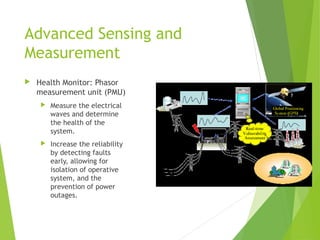
 Health Monitor: Phasor
measurement unit (PMU)
 Measure the electrical
waves and determine
the health of the
system.
 Increase the reliability
by detecting faults
early, allowing for
isolation of operative
system, and the
prevention of power
outages.
Advanced Sensing and
Measurement
 Distributed weather sensing
 Widely distributed solar irradiance, wind
speed, temperature measurement
systems to improve the predictability of
renewable energy.
 The grid control systems can dynamically
adjust the source of power supply.
Integrated Communications
and Security
 High-speed, fully integrated, two-way communication
technologies that make the smart grid a dynamic,
interactive “mega-infrastructure” for real-time
information and power exchange.
 Cyber Security: the new communication mechanism
should consider security, reliability, QoS.
Experiments for Noise and
Interference
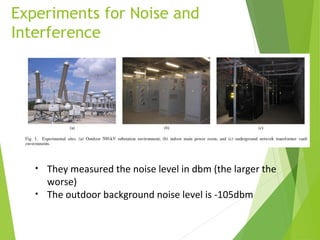
• They measured the noise level in dbm (the larger the
worse)
• The outdoor background noise level is -105dbm
Advanced Components and
Subsystems
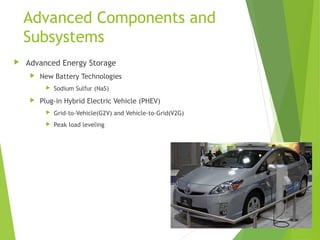
 Advanced Energy Storage
 New Battery Technologies
 Sodium Sulfur (NaS)
 Plug-in Hybrid Electric Vehicle (PHEV)
 Grid-to-Vehicle(G2V) and Vehicle-to-Grid(V2G)
 Peak load leveling
Improved Interfaces and
Decision Support
 The smart grid will require wide, seamless, often real-
time use of applications and tools that enable grid
operators and managers to make decisions quickly.
 Decision support and improved interfaces will enable
more accurate and timely human decision making at all
levels of the grid, including the consumer level, while
also enabling more advanced operator training.
Control Methods and
Topologies
 Traditional power system problems:
 Centralized
 No local supervisory control unit
 No fault isolation
 Relied entirely on electricity from the grid
APS: Autonomous Power System
 A localized group of electricity
sources and loads
 Locally utilizing natural gas or
renewable energy
 Reducing the waste during transmission
 Using Combined Heat and Power (CHP)
Diverse Energy Sources
http://powerelectronics.com/power_systems/smart-grid-success-rely-system-solutions-20091001/
Wind
Solar
Nuclear
Fossil
References
1. S. Massoud Amin and Bruce F. Wollenberg, “Toward a
Smart Grid,” IEEE Power and Energy Magazine,
September/October 2005.
2. M. Pipattanasomporn and S. Rahman, “Intelligent
Distributed Autonomous Power Systems (IDAPS) and
their Impact on Critical Electrical Loads,” IEEE IWCIP
2005.
3. R. Li, J. Li, G. Poulton, and G. James, “Agent-Based
Optimization Systems for Electrical Load
Management,” OPTMAS 2008.
4. J. Li, G. Poulton, and G. James, “Agent-based
distributed energy management,” In Proc. 20th
Australian Joint Conference on Artificial Intelligence,
pages 569–578. Gold Coast, Australia, 2007.
5. http://www.smartgrid.gov/, November 2010.
smart Grid

smart Grid

  • 1.
    AUTHOR 1: M.KRISHNA KANTHREDDY B.TECH III-II , E.E.E. ANNAMACHARYA INSTITUTE OF TECHNOLOGY AND SCIENCES, KADAPA. SMART GRID
  • 2.
    Cost of Power Disturbances: $25- $188 billion per year ~$6 billion lost due to 8/14/03 blackout Northeast Blackout – August 14, 2003 4  Affected 55 million people  $6 billion lost  Per year $135 billions lost for power interruption http://en.wikipedia.org/wiki/Northeast_Blackout_of_2003
  • 3.
    What does theconcept of Smart GridWhat does the concept of Smart Grid look like?look like? 3 Electrical Infrastructure “Intelligence” Infrastructure
  • 4.
    Smart Grid Applications 4 DistributedGeneration and Alternate Energy SourcesDistributed Generation and Alternate Energy Sources Self-Healing Wide-Area Protection and IslandingSelf-Healing Wide-Area Protection and Islanding Asset Management and On-Line Equipment MonitoringAsset Management and On-Line Equipment Monitoring Demand Response and Dynamic PricingDemand Response and Dynamic Pricing Participation in Energy MarketsParticipation in Energy Markets Shared Information – Continuously Optimizing – Intelligent Responses! Real-time Simulation and Contingency AnalysisReal-time Simulation and Contingency Analysis
  • 5.
    Outline • Motivation • Sensingand Measurement • Communications and Security • Components and Subsystems • Interfaces and Decision Support • Control Methods and Topologies
  • 6.
    Wireless Mesh Networkingfor theWireless Mesh Networking for the Smart GridSmart Grid 6 www.elstermetering.com
  • 7.
    Advanced Sensing and Measurement Advanced Metering Infrastructure  (AMI)  Provide interface between the utility and its customers: bi-direction control  Advanced functionality  Real-time electricity pricing  Accurate load characterization  Outage detection/restoration  California asked all the utilities to deploy the new smart meter
  • 8.
    Advanced Sensing and Measurement Health Monitor: Phasor measurement unit (PMU)  Measure the electrical waves and determine the health of the system.  Increase the reliability by detecting faults early, allowing for isolation of operative system, and the prevention of power outages.
  • 9.
    Advanced Sensing and Measurement Distributed weather sensing  Widely distributed solar irradiance, wind speed, temperature measurement systems to improve the predictability of renewable energy.  The grid control systems can dynamically adjust the source of power supply.
  • 10.
    Integrated Communications and Security High-speed, fully integrated, two-way communication technologies that make the smart grid a dynamic, interactive “mega-infrastructure” for real-time information and power exchange.  Cyber Security: the new communication mechanism should consider security, reliability, QoS.
  • 11.
    Experiments for Noiseand Interference • They measured the noise level in dbm (the larger the worse) • The outdoor background noise level is -105dbm
  • 12.
    Advanced Components and Subsystems Advanced Energy Storage  New Battery Technologies  Sodium Sulfur (NaS)  Plug-in Hybrid Electric Vehicle (PHEV)  Grid-to-Vehicle(G2V) and Vehicle-to-Grid(V2G)  Peak load leveling
  • 13.
    Improved Interfaces and DecisionSupport  The smart grid will require wide, seamless, often real- time use of applications and tools that enable grid operators and managers to make decisions quickly.  Decision support and improved interfaces will enable more accurate and timely human decision making at all levels of the grid, including the consumer level, while also enabling more advanced operator training.
  • 14.
    Control Methods and Topologies Traditional power system problems:  Centralized  No local supervisory control unit  No fault isolation  Relied entirely on electricity from the grid
  • 15.
    APS: Autonomous PowerSystem  A localized group of electricity sources and loads  Locally utilizing natural gas or renewable energy  Reducing the waste during transmission  Using Combined Heat and Power (CHP)
  • 16.
  • 17.
    References 1. S. MassoudAmin and Bruce F. Wollenberg, “Toward a Smart Grid,” IEEE Power and Energy Magazine, September/October 2005. 2. M. Pipattanasomporn and S. Rahman, “Intelligent Distributed Autonomous Power Systems (IDAPS) and their Impact on Critical Electrical Loads,” IEEE IWCIP 2005. 3. R. Li, J. Li, G. Poulton, and G. James, “Agent-Based Optimization Systems for Electrical Load Management,” OPTMAS 2008. 4. J. Li, G. Poulton, and G. James, “Agent-based distributed energy management,” In Proc. 20th Australian Joint Conference on Artificial Intelligence, pages 569–578. Gold Coast, Australia, 2007. 5. http://www.smartgrid.gov/, November 2010.

Editor's Notes

  • #4 An overlapping of electrical and intelligence\telecommunications infrastructures… the energy internet . In thinking of the power delivery system of the future, we found it helpful to think of bringing together two distinctly different but highly inter-related infrastructures. The electrical infrastructure (i.e., the poles, towers and wires) that has been created over the last 100 years and the “intelligence” infrastructure (i.e., the communications networks, distributed computing and sensors). The Intelligence infrastructure enhances the operation and maintenance of the electrical infrastructure and adds new functionality to the electrical infrastructure. The electrical infrastructure is very mature (at least in North America and Europe) – that is the processes, tools, standards and fundamental technologies for the electrical infrastructure are well established. New technologies will enhance the electrical infrastructure – and many programs within EPRI are working to develop that technology. The “intelligence infrastructure” is much newer – and companies thinking of this as a tightly integrated (networked) infrastructure is very new. The methods, tools and standards for creating the intelligence infrastructure are only beginning to be created. Essentially, when it comes to the intelligence infrastructure, it’s the wild west – almost completely lawless. In looking at the intelligence infrastructure – we see that it isn’t limited by technology. There is an abundance of technology that has been developed by other industries. Many times, in fact, there is too much technology. Today, pieces of the intelligence are installed in an isolated, fragmented way. this approach will not create an intelligence Infrastructure For the vision of the vision of the power delivery system of the future to be achieved, the intelligence infrastructure needs to be as pervasive and integrated as the electrical infrastructure – incorporating generation, transmission, distribution, energy markets and the consumer. The integration of these two infrastructures is what we see creating the intelligent grid or IntelliGrid.
  • #5 These are key applications that will be enabled by the merged electrical/intelligence infrastructure. It is important to note that the intelligence infrastructure will be created through applications like these. That is, a utility is not going to invest in creating the infrastructure for the sake of creating an infrastructure