11
SCADA SYSTEMSCADA SYSTEM
CLASSIFICATIONCLASSIFICATION
By- Rahul MehraBy- Rahul Mehra
22
AGENDAAGENDA
 IntroductionIntroduction
 HistoryHistory
 What is SCADA?What is SCADA?
 Classifications of a SCADA systemClassifications of a SCADA system
 Elements of SCADA system?Elements of SCADA system?
 Where is SCADA used?Where is SCADA used?
 What types of SCADA are there?What types of SCADA are there?
 Purpose of this researchPurpose of this research
 ConclusionConclusion
33
INTRODUCTIONINTRODUCTION
SCADA (Supervisory Control and Data Acquisition)SCADA (Supervisory Control and Data Acquisition) SystemSystem
 HistoryHistory
 Why SCADA?Why SCADA?
 Definition of SCADADefinition of SCADA
44
HISTORYHISTORY
 Egyptian supervisoryEgyptian supervisory
 First half of the 20First half of the 20thth
centurycentury
 Development from telemetry systemDevelopment from telemetry system
 Weather predictionsWeather predictions
 Rail road tracksRail road tracks
 Two way systemTwo way system
 1960s idea for supervisory1960s idea for supervisory
 1970s radio system1970s radio system
55
WHY SCADA?WHY SCADA?
 Saves Time and MoneySaves Time and Money
 Less traveling for workers (e.g. helicopter ride)Less traveling for workers (e.g. helicopter ride)
 Reduces man-power needsReduces man-power needs
 Increases production efficiency of a companyIncreases production efficiency of a company
 Cost effective for power systemsCost effective for power systems
 Saves energySaves energy
 ReliableReliable
 Supervisory control over a particular systemSupervisory control over a particular system
66
WHAT IS SCADA?WHAT IS SCADA?
 Supervisory Control and Data AcquisitionSupervisory Control and Data Acquisition
 SupervisorySupervisory
 Operator/s, engineer/s, supervisor/s, etcOperator/s, engineer/s, supervisor/s, etc
 ControlControl
 MonitoringMonitoring
 LimitedLimited
 TelemetryTelemetry
 Remote/LocalRemote/Local
 Data acquisitionData acquisition
 Access and acquire information or data from theAccess and acquire information or data from the
equipmentequipment
 Sends it to different sites through telemetrySends it to different sites through telemetry
 Analog / DigitalAnalog / Digital
77
CLASSIFICATIONSCLASSIFICATIONS
 Anatomy of a SCADA system?Anatomy of a SCADA system?
 Elements of SCADAElements of SCADA
 Levels of SCADALevels of SCADA
 Where is SCADA used?Where is SCADA used?
 Different applications of SCADA systems?Different applications of SCADA systems?
 What types of SCADA are there?What types of SCADA are there?
 Component manufacturers and system manufacturersComponent manufacturers and system manufacturers
of the SCADA systems?of the SCADA systems?
 Automation SolutionsAutomation Solutions
 SoftwareSoftware
 HardwareHardware
88
ELEMENTS OFELEMENTS OF
SCADASCADA
Elements of a SCADA systemElements of a SCADA system
 Sensors and actuatorsSensors and actuators
 RTUs/PLCsRTUs/PLCs
 CommunicationCommunication
 MTUMTU
 Front End ProcessorFront End Processor
 SCADA serverSCADA server
 Historical/Redundant/Safety ServerHistorical/Redundant/Safety Server
 HMI computerHMI computer
 HMI softwareHMI software
99
SENSORSSENSORS
Types of sensors:Types of sensors:
 Pressure sensorsPressure sensors
 Temperature sensorsTemperature sensors
 Light sensorsLight sensors
 Humidity sensorsHumidity sensors
 Wind speed sensorsWind speed sensors
 Water level sensorsWater level sensors
 Distance sensorsDistance sensors
1010
ACTUATORSACTUATORS
Actuators:Actuators:
 ValvesValves
 PumpsPumps
 MotorsMotors
1111
RTUSRTUS
RTU – Remote Terminal UnitRTU – Remote Terminal Unit
 Intelligent to control a process and multiple processesIntelligent to control a process and multiple processes
 Data logging and alarm handlingData logging and alarm handling
 ExpandableExpandable
 Asks the field devices for informationAsks the field devices for information
 Can control IEDs (Intelligent Electronic Device)Can control IEDs (Intelligent Electronic Device)
 Slave/Master deviceSlave/Master device
1212
ALARMSALARMS
Types of alarms:Types of alarms:
 Good alarmsGood alarms
 Critical failure alarmsCritical failure alarms
1313
SAFETYSAFETY
INSTRUMENTEDINSTRUMENTED
SYSTEMSSYSTEMS
Actions:Actions:
 Override the normal control systemOverride the normal control system
 Take over the actuatorsTake over the actuators
1414
PLCSPLCS
PLC – Programmable Logic ControllerPLC – Programmable Logic Controller
 Ladder logicLadder logic
 Industrial computer that replaced relaysIndustrial computer that replaced relays
 Not a protocol converterNot a protocol converter
 Cannot control IEDsCannot control IEDs
 Communication compatibilitiesCommunication compatibilities
 Takes actions based on its inputsTakes actions based on its inputs
1515
COMMUNICATIONCOMMUNICATION
Communication systems:Communication systems:
 Switched Telephone NetworkSwitched Telephone Network
 Leased linesLeased lines
 Private Network (LAN/RS-485)Private Network (LAN/RS-485)
 InternetInternet
 Wireless Communication systemsWireless Communication systems
 Wireless LANWireless LAN
 Global System for Mobile CommunicationGlobal System for Mobile Communication
(GSM) Network(GSM) Network
 Radio modemsRadio modems
1616
COMMUNICATIONCOMMUNICATION
CONT.CONT.
Protocols:Protocols:
 MODBUSMODBUS
 DNP 3.0DNP 3.0
 FieldbusFieldbus
 Controller Area Network (CAN)Controller Area Network (CAN)
 ProfibusProfibus
 DirectNetDirectNet
 TCP/IPTCP/IP
 EthernetEthernet
1717
FRONT ENDFRONT END
PROCESSORPROCESSOR
Front End ProcessorFront End Processor
 Gathers all communications and converts themGathers all communications and converts them
into SCADA friendly communicationinto SCADA friendly communication
 Communication interface between several RTUCommunication interface between several RTU
channels and the host Master Station computerchannels and the host Master Station computer
1818
SCADA SERVERSCADA SERVER
SCADA ServerSCADA Server
 It can be a Web serverIt can be a Web server
 Data loggingData logging
 Analyzing dataAnalyzing data
 Serve the clients through a firewallServe the clients through a firewall
 Clients connected in the corporation or connectedClients connected in the corporation or connected
outside through internetoutside through internet
 Real-time decision makerReal-time decision maker
 Asks RTU for informationAsks RTU for information
1919
HISTORICALHISTORICAL
SERVERSERVER
Historical/Safety/Redundant ServerHistorical/Safety/Redundant Server
 Logs the data from the SCADA server andLogs the data from the SCADA server and
stores it as a backup, in case of a disasterstores it as a backup, in case of a disaster
 It is basically a safety serverIt is basically a safety server
2020
HMI COMPUTERHMI COMPUTER
Human Machine Interface ComputerHuman Machine Interface Computer
 Access on the SCADA ServerAccess on the SCADA Server
 Control the systemControl the system
 Operator InterfaceOperator Interface
 SoftwareSoftware
 User friendlyUser friendly
 Programmable (C, C++)Programmable (C, C++)
2121
DCSDCS
DCS – Distributed Control SystemDCS – Distributed Control System
 Process oriented – tendency to do somethingProcess oriented – tendency to do something
 Not event oriented – does not depend on circumstancesNot event oriented – does not depend on circumstances
 Local control over the devicesLocal control over the devices
 Subordinate to SCADASubordinate to SCADA
2222
LEVELS OF SCADALEVELS OF SCADA
Four levels of SCADA systemFour levels of SCADA system
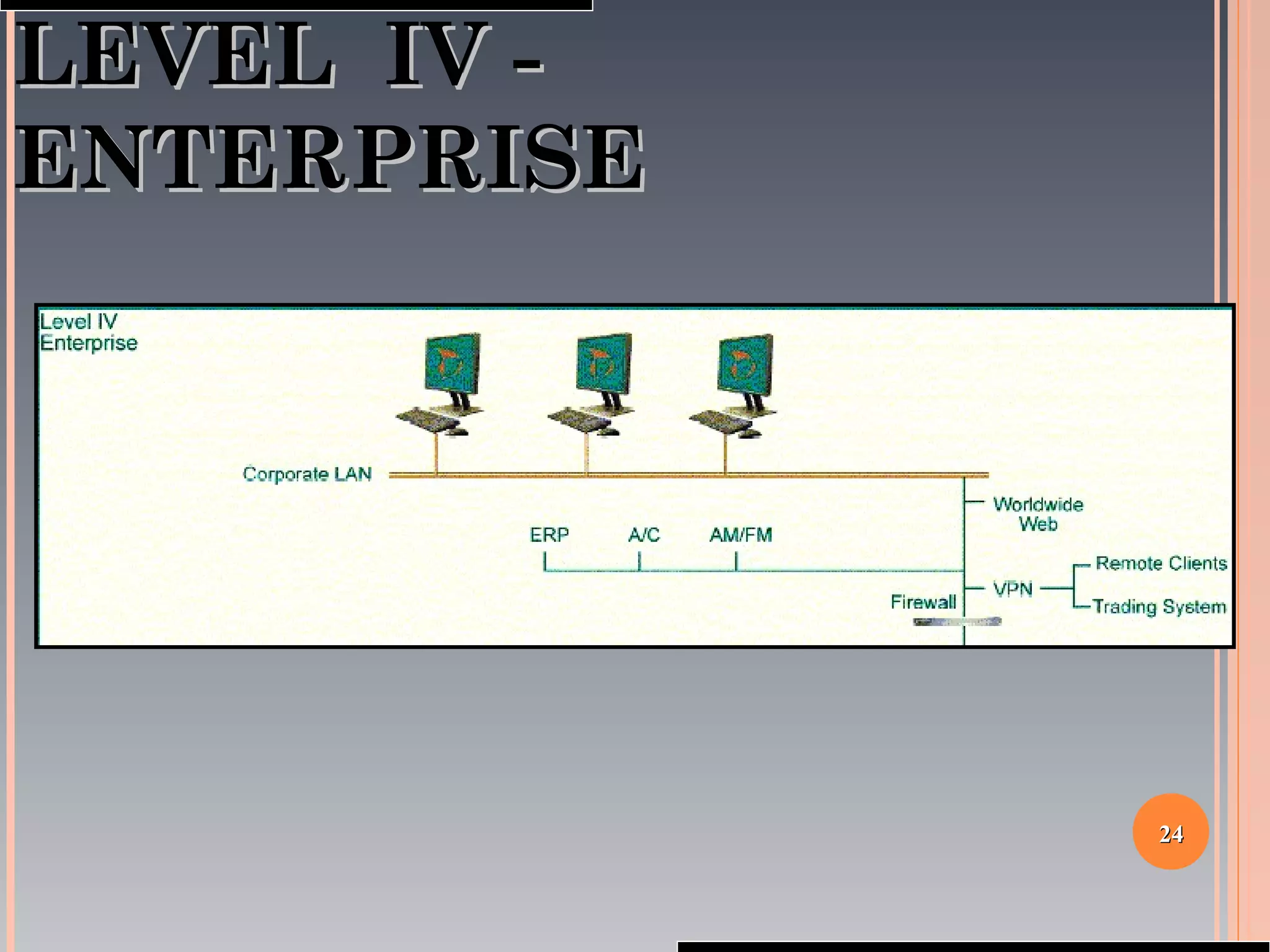
 Level IV - EnterpriseLevel IV - Enterprise
 Corporate LAN/WANCorporate LAN/WAN
 World Wide WebWorld Wide Web
 Virtual Private NetworkVirtual Private Network
 Firewall for remote usersFirewall for remote users
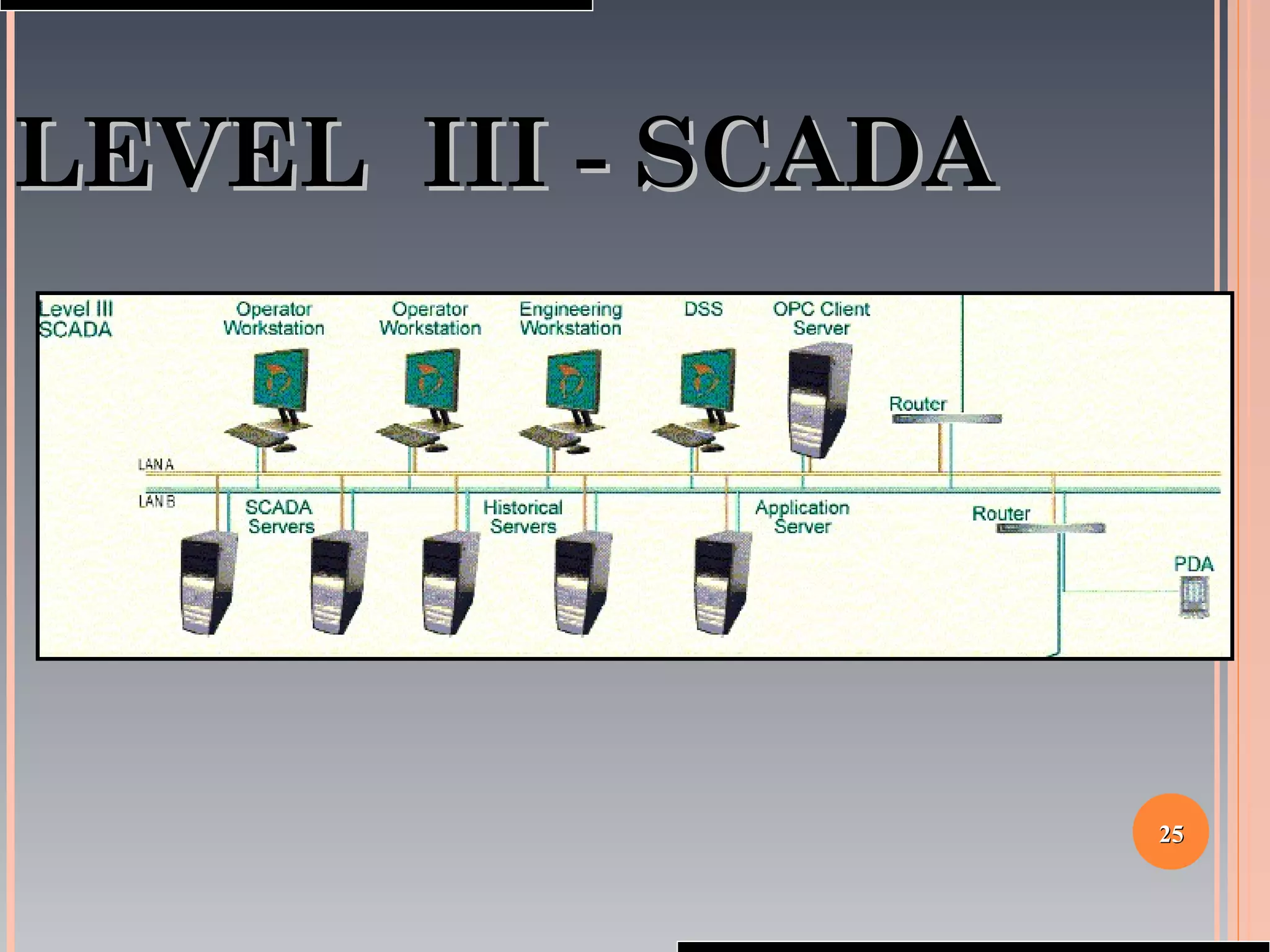
 Level III – SCADA / MTULevel III – SCADA / MTU
 Operator WorkstationsOperator Workstations
 ControlControl
 Engineering WorkstationsEngineering Workstations
 Servers – Data loggingServers – Data logging
2323
LEVELS OF SCADALEVELS OF SCADA
CONT.CONT.
Four levels of SCADA systemFour levels of SCADA system
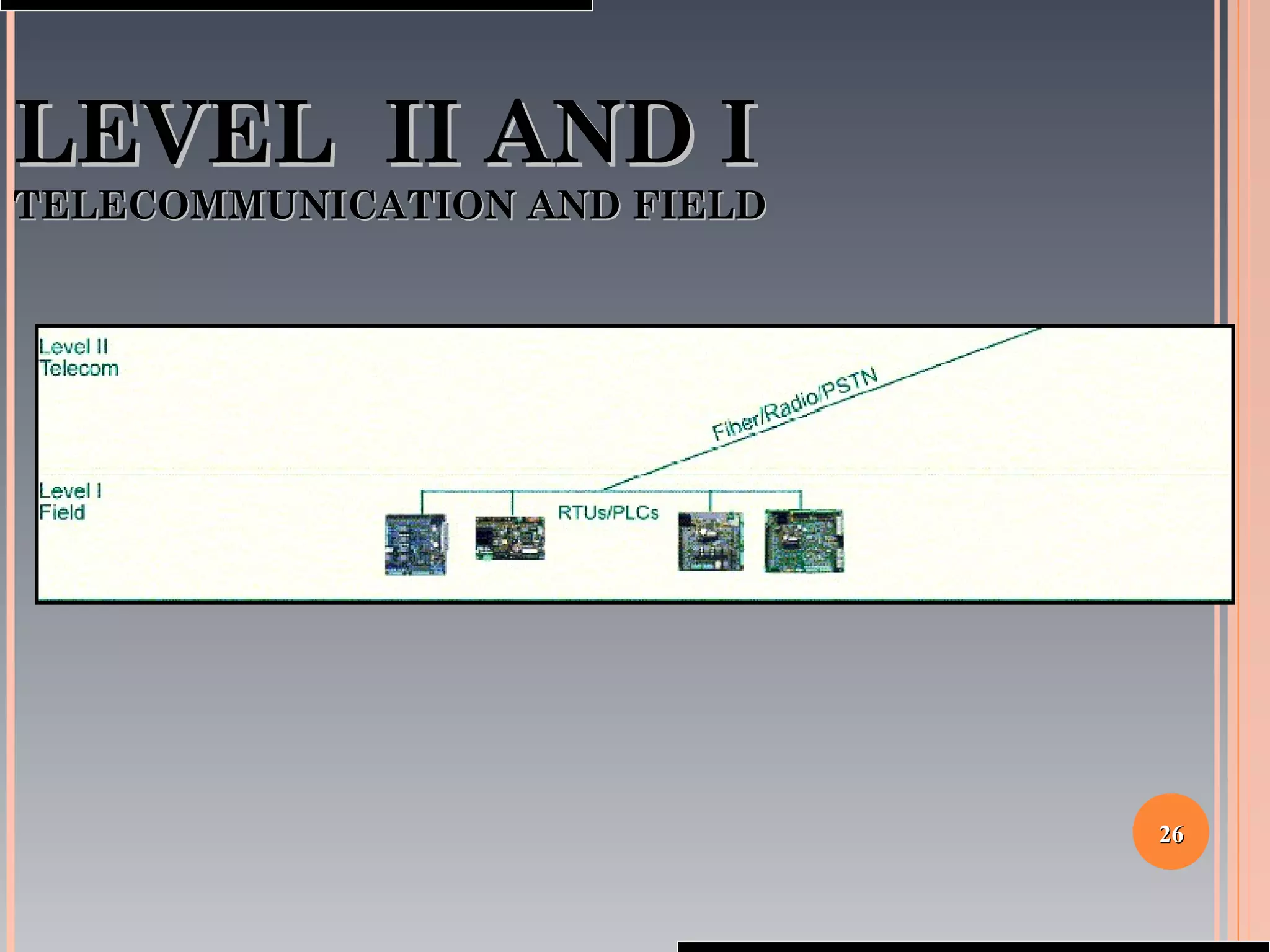
 Level II – TelecommunicationLevel II – Telecommunication
 FiberFiber
 RadioRadio
 Telephone leased lineTelephone leased line
 ProtocolsProtocols
 Level I – FieldLevel I – Field
 DevicesDevices
 RTUs / PLCsRTUs / PLCs
 SensorsSensors
2424
LEVEL IV -LEVEL IV -
ENTERPRISEENTERPRISE
2525
LEVEL III - SCADALEVEL III - SCADA
2626
LEVEL II AND ILEVEL II AND I
TELECOMMUNICATION AND FIELDTELECOMMUNICATION AND FIELD
2727
WHERE IS SCADAWHERE IS SCADA
USED?USED?
Main SCADA applications:Main SCADA applications:
 Water and WastewaterWater and Wastewater
 PowerPower
 Oil and GasOil and Gas
 Research facilitiesResearch facilities
 TransportationTransportation
 Security systemsSecurity systems
 Siren systemsSiren systems
 IrrigationIrrigation
 Communication controlCommunication control
2828
SCADA EXAMPLESSCADA EXAMPLES
SCADA examples:SCADA examples:
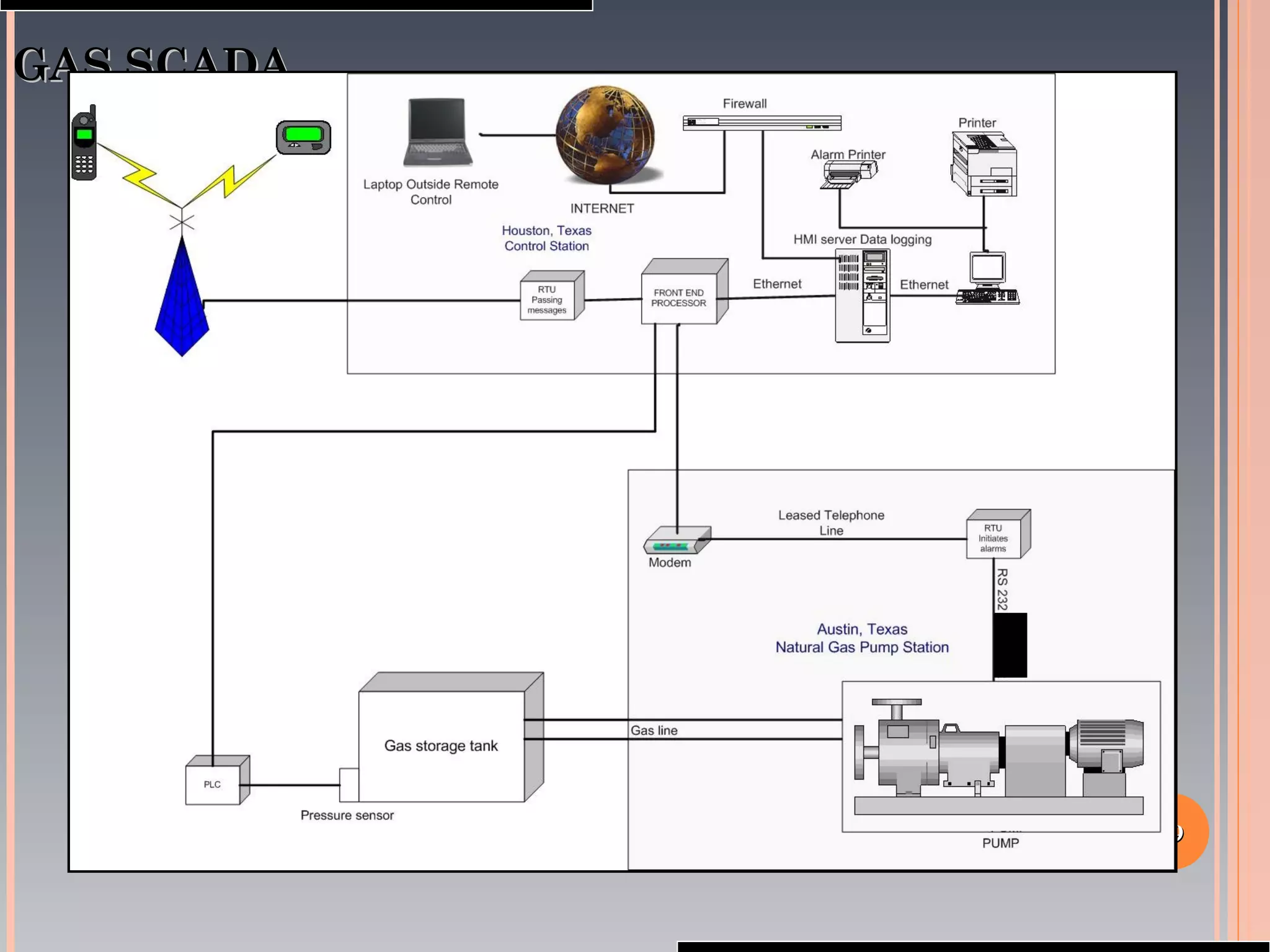
 Gas control systemsGas control systems
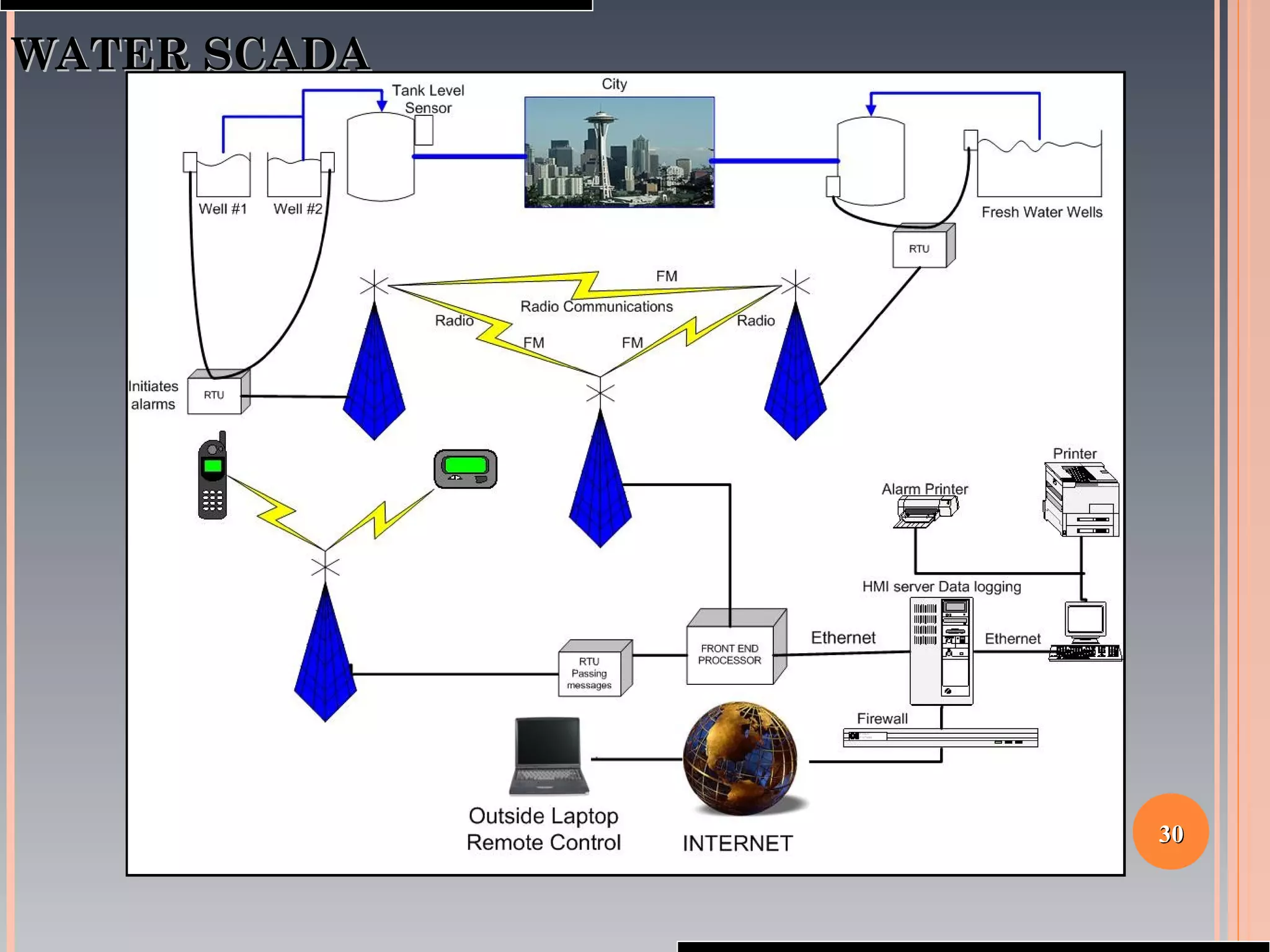
 Water control systemsWater control systems
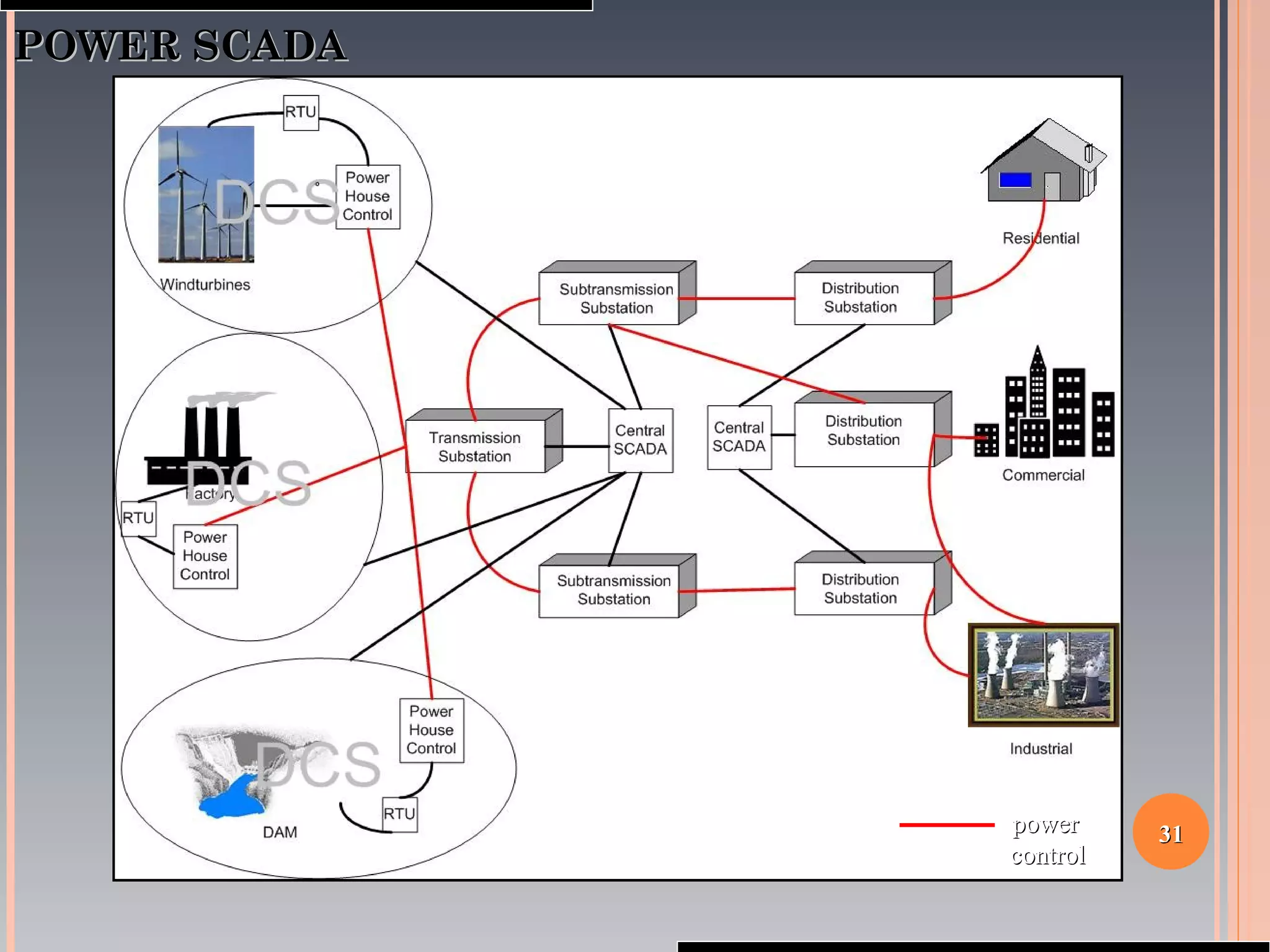
 Power systemsPower systems
2929
GAS SCADAGAS SCADA
3030
WATER SCADAWATER SCADA
3131
POWER SCADAPOWER SCADA
powerpower
controlcontrol
3232
SCADA SYSTEMSCADA SYSTEM
TYPESTYPES
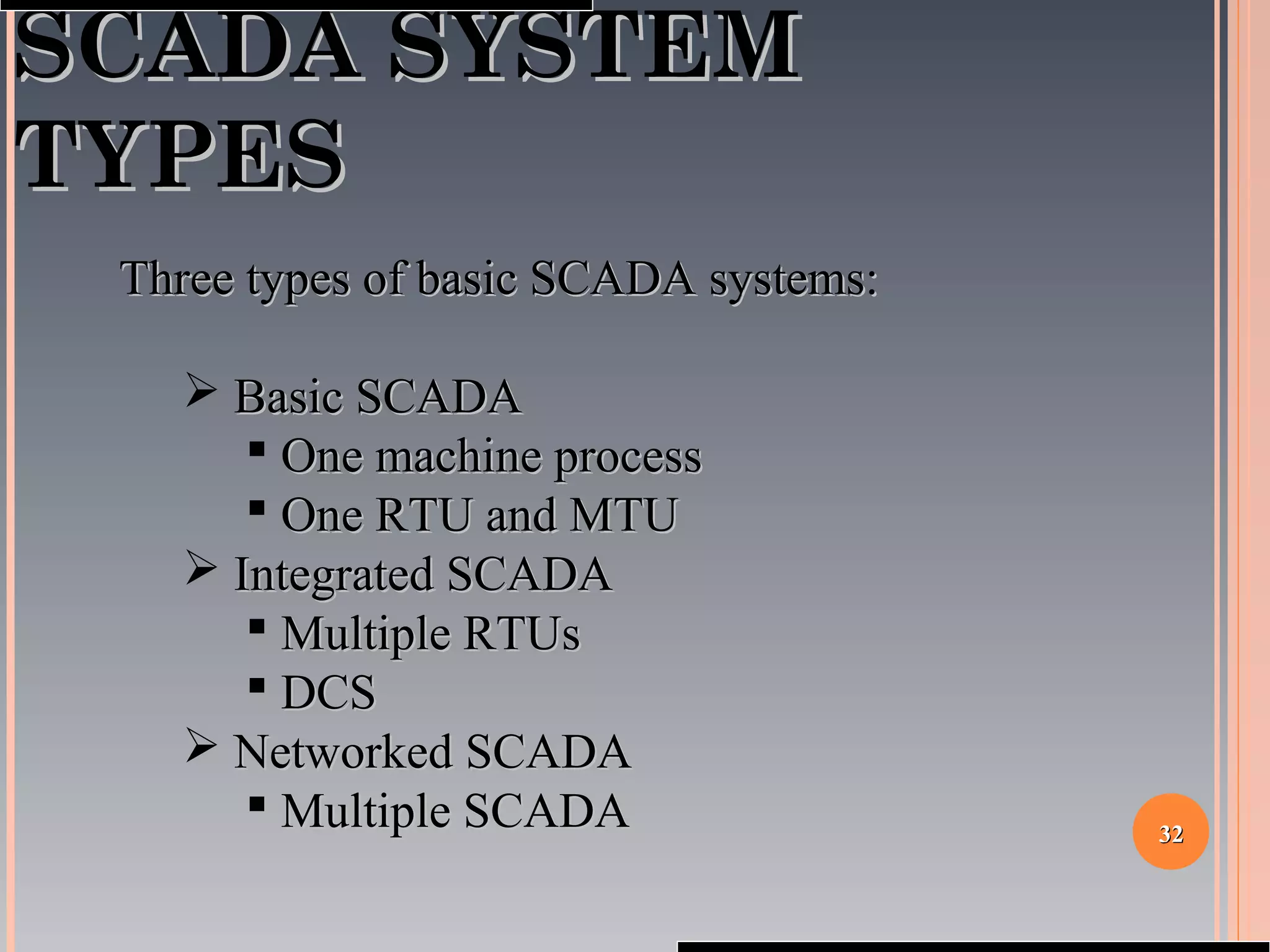
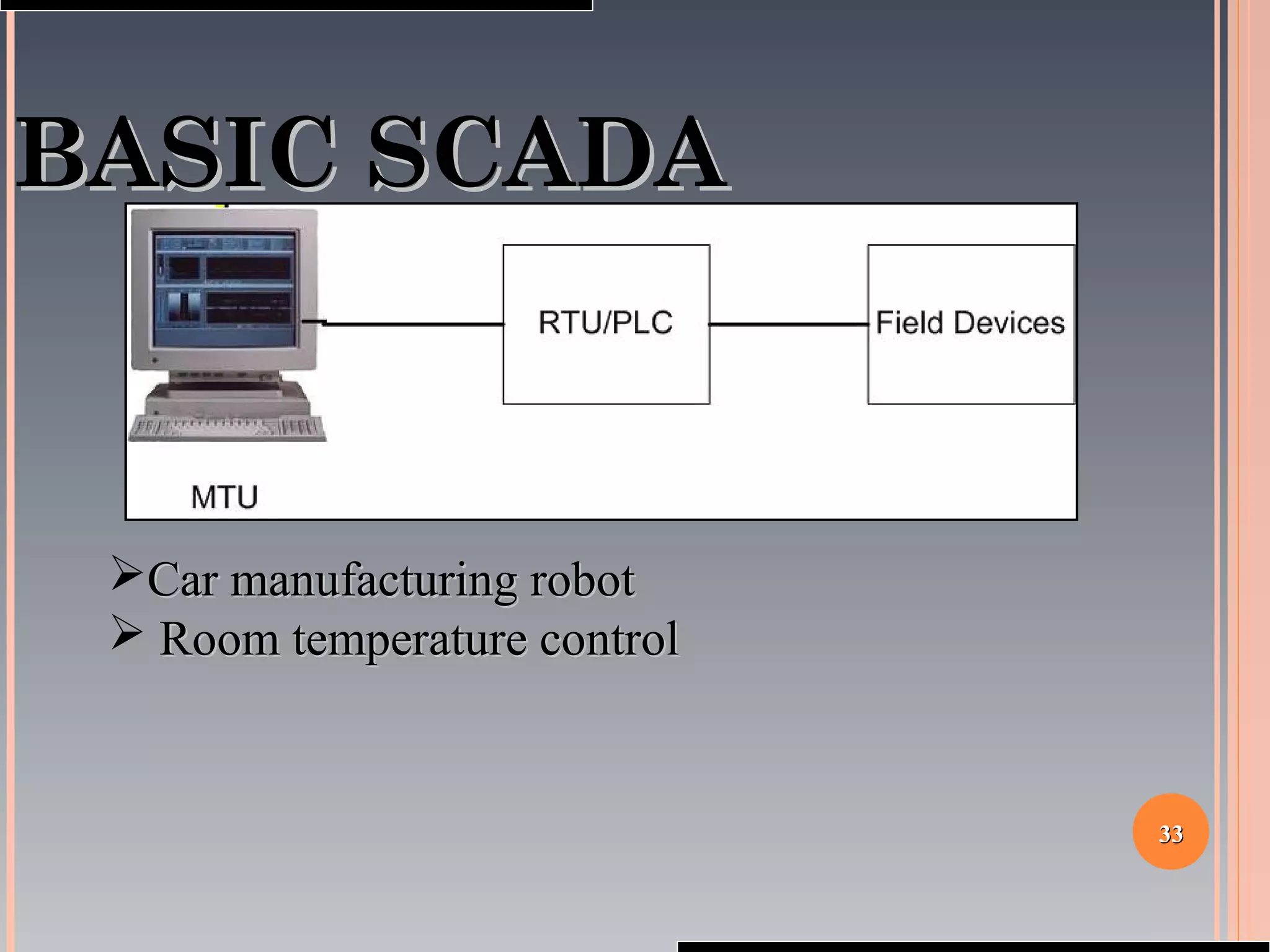
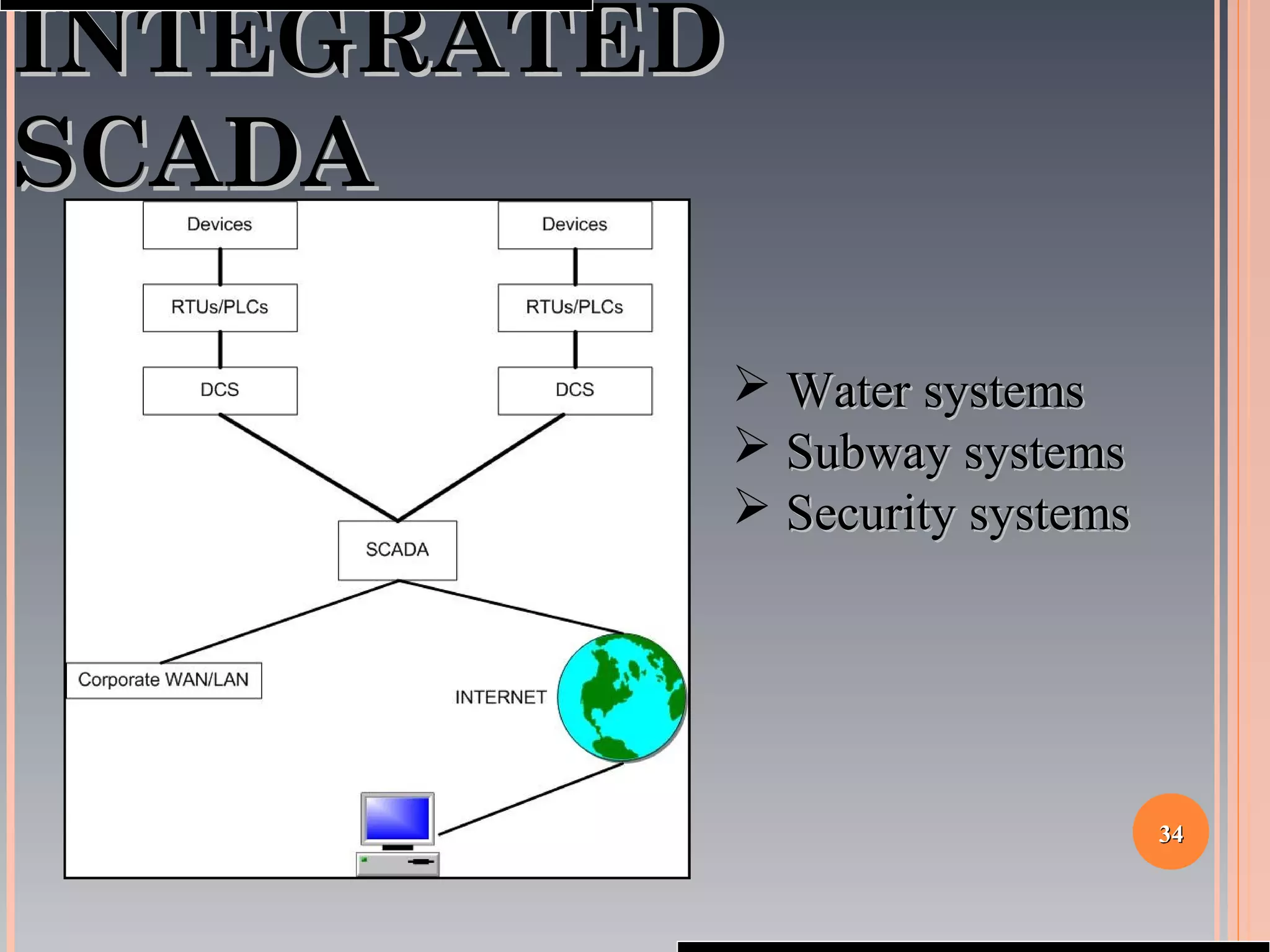
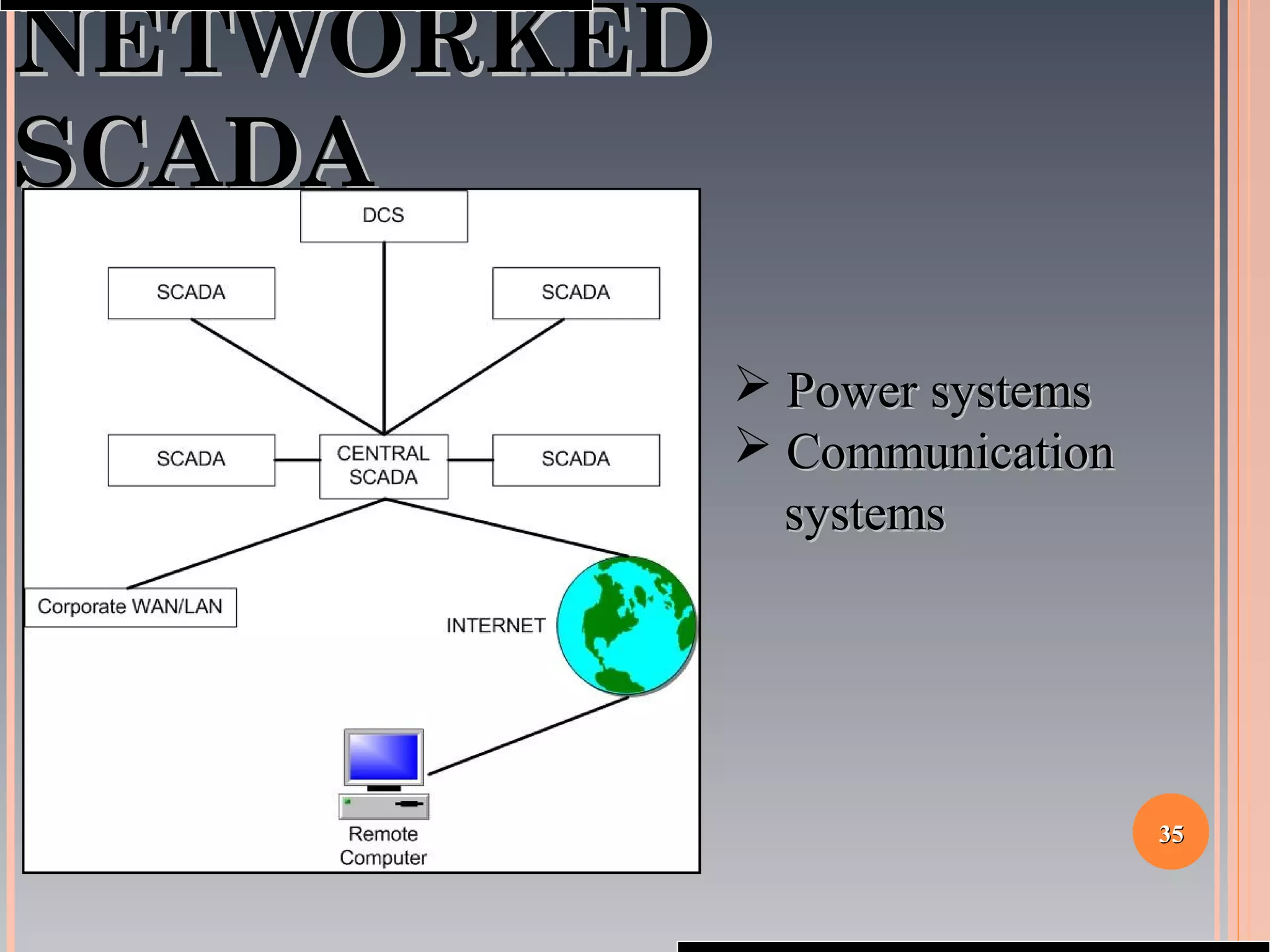
Three types of basic SCADA systems:Three types of basic SCADA systems:
 Basic SCADABasic SCADA
 One machine processOne machine process
 One RTU and MTUOne RTU and MTU
 Integrated SCADAIntegrated SCADA
 Multiple RTUsMultiple RTUs
 DCSDCS
 Networked SCADANetworked SCADA
 Multiple SCADAMultiple SCADA
3333
BASIC SCADABASIC SCADA
Car manufacturing robotCar manufacturing robot
 Room temperature controlRoom temperature control
3434
INTEGRATEDINTEGRATED
SCADASCADA
 Water systemsWater systems
 Subway systemsSubway systems
 Security systemsSecurity systems
3535
NETWORKEDNETWORKED
SCADASCADA
 Power systemsPower systems
 CommunicationCommunication
systemssystems
3636
AUTOMATIONAUTOMATION
SOLUTIONSSOLUTIONS
SCADA system manufacturersSCADA system manufacturers
 Modular SCADA, UKModular SCADA, UK
 MOSCAD, MotorolaMOSCAD, Motorola
 Rockwell AutomationRockwell Automation
 ABCOABCO
 ABBABB
 LantronixLantronix
3737
SCADA HARDWARESCADA HARDWARE
SCADA Hardware manufacturersSCADA Hardware manufacturers
 Rockwell Allen BradleyRockwell Allen Bradley
 General Electric (GE)General Electric (GE)
 EmersonEmerson
 Schneider ElectricSchneider Electric
3838
SCADA SOFTWARESCADA SOFTWARE
SCADA Software manufacturersSCADA Software manufacturers
 Intellution (Fix 32)Intellution (Fix 32)
 Iconics (Genesis32 v7.0)Iconics (Genesis32 v7.0)
 Wonderware (InTouch)Wonderware (InTouch)
 Citect (CitectSCADA 5.42)Citect (CitectSCADA 5.42)
 National Instruments (Lookout SCADA)National Instruments (Lookout SCADA)
3939
PURPOSE OF THISPURPOSE OF THIS
RESEARCHRESEARCH
 Develop a teaching module for a general SCADA systemDevelop a teaching module for a general SCADA system
 Develop a general model of a SCADA systemDevelop a general model of a SCADA system
 Use LabView and wireless communication computersUse LabView and wireless communication computers
to illustrate an example of the SCADA systemto illustrate an example of the SCADA system
 Study the vulnerabilities of the SCADA systemStudy the vulnerabilities of the SCADA system
 Create a freshman introduction moduleCreate a freshman introduction module
 Create an upper level course for SCADACreate an upper level course for SCADA
4040
WHAT IS NEXT?WHAT IS NEXT?
 Use the Laptop1 to generate the wells, tanks, servers, RTUsUse the Laptop1 to generate the wells, tanks, servers, RTUs
PLCs and the front end processor through SubVIsPLCs and the front end processor through SubVIs
 Use the Laptop2 to be the HMI Computer that connects toUse the Laptop2 to be the HMI Computer that connects to
Laptop1 and reads the data and also affect the devicesLaptop1 and reads the data and also affect the devices
 And Laptop3 to simulate an attack at the SCADA systemAnd Laptop3 to simulate an attack at the SCADA system
4141
CONCLUSIONCONCLUSION
 There are thousands of SCADA systems installed and theyThere are thousands of SCADA systems installed and they
can be completely different from each other, in terms ofcan be completely different from each other, in terms of
their structures but they all have common elements andtheir structures but they all have common elements and
a common purpose – to supervise control and collect data.a common purpose – to supervise control and collect data.
 There are three types of SCADA systems that describeThere are three types of SCADA systems that describe
all of the SCADA systems.all of the SCADA systems.
 Communication is the most significant part of SCADACommunication is the most significant part of SCADA
 Power and communication systems are most likely toPower and communication systems are most likely to
get attacked by terrorists.get attacked by terrorists.
4242
DISCUSSIONDISCUSSION
r.mehra151093@gmail.comr.mehra151093@gmail.com

Scada Classification By-Rahul Mehra

  • 1.
  • 2.
    22 AGENDAAGENDA  IntroductionIntroduction  HistoryHistory What is SCADA?What is SCADA?  Classifications of a SCADA systemClassifications of a SCADA system  Elements of SCADA system?Elements of SCADA system?  Where is SCADA used?Where is SCADA used?  What types of SCADA are there?What types of SCADA are there?  Purpose of this researchPurpose of this research  ConclusionConclusion
  • 3.
    33 INTRODUCTIONINTRODUCTION SCADA (Supervisory Controland Data Acquisition)SCADA (Supervisory Control and Data Acquisition) SystemSystem  HistoryHistory  Why SCADA?Why SCADA?  Definition of SCADADefinition of SCADA
  • 4.
    44 HISTORYHISTORY  Egyptian supervisoryEgyptiansupervisory  First half of the 20First half of the 20thth centurycentury  Development from telemetry systemDevelopment from telemetry system  Weather predictionsWeather predictions  Rail road tracksRail road tracks  Two way systemTwo way system  1960s idea for supervisory1960s idea for supervisory  1970s radio system1970s radio system
  • 5.
    55 WHY SCADA?WHY SCADA? Saves Time and MoneySaves Time and Money  Less traveling for workers (e.g. helicopter ride)Less traveling for workers (e.g. helicopter ride)  Reduces man-power needsReduces man-power needs  Increases production efficiency of a companyIncreases production efficiency of a company  Cost effective for power systemsCost effective for power systems  Saves energySaves energy  ReliableReliable  Supervisory control over a particular systemSupervisory control over a particular system
  • 6.
    66 WHAT IS SCADA?WHATIS SCADA?  Supervisory Control and Data AcquisitionSupervisory Control and Data Acquisition  SupervisorySupervisory  Operator/s, engineer/s, supervisor/s, etcOperator/s, engineer/s, supervisor/s, etc  ControlControl  MonitoringMonitoring  LimitedLimited  TelemetryTelemetry  Remote/LocalRemote/Local  Data acquisitionData acquisition  Access and acquire information or data from theAccess and acquire information or data from the equipmentequipment  Sends it to different sites through telemetrySends it to different sites through telemetry  Analog / DigitalAnalog / Digital
  • 7.
    77 CLASSIFICATIONSCLASSIFICATIONS  Anatomy ofa SCADA system?Anatomy of a SCADA system?  Elements of SCADAElements of SCADA  Levels of SCADALevels of SCADA  Where is SCADA used?Where is SCADA used?  Different applications of SCADA systems?Different applications of SCADA systems?  What types of SCADA are there?What types of SCADA are there?  Component manufacturers and system manufacturersComponent manufacturers and system manufacturers of the SCADA systems?of the SCADA systems?  Automation SolutionsAutomation Solutions  SoftwareSoftware  HardwareHardware
  • 8.
    88 ELEMENTS OFELEMENTS OF SCADASCADA Elementsof a SCADA systemElements of a SCADA system  Sensors and actuatorsSensors and actuators  RTUs/PLCsRTUs/PLCs  CommunicationCommunication  MTUMTU  Front End ProcessorFront End Processor  SCADA serverSCADA server  Historical/Redundant/Safety ServerHistorical/Redundant/Safety Server  HMI computerHMI computer  HMI softwareHMI software
  • 9.
    99 SENSORSSENSORS Types of sensors:Typesof sensors:  Pressure sensorsPressure sensors  Temperature sensorsTemperature sensors  Light sensorsLight sensors  Humidity sensorsHumidity sensors  Wind speed sensorsWind speed sensors  Water level sensorsWater level sensors  Distance sensorsDistance sensors
  • 10.
  • 11.
    1111 RTUSRTUS RTU – RemoteTerminal UnitRTU – Remote Terminal Unit  Intelligent to control a process and multiple processesIntelligent to control a process and multiple processes  Data logging and alarm handlingData logging and alarm handling  ExpandableExpandable  Asks the field devices for informationAsks the field devices for information  Can control IEDs (Intelligent Electronic Device)Can control IEDs (Intelligent Electronic Device)  Slave/Master deviceSlave/Master device
  • 12.
    1212 ALARMSALARMS Types of alarms:Typesof alarms:  Good alarmsGood alarms  Critical failure alarmsCritical failure alarms
  • 13.
    1313 SAFETYSAFETY INSTRUMENTEDINSTRUMENTED SYSTEMSSYSTEMS Actions:Actions:  Override thenormal control systemOverride the normal control system  Take over the actuatorsTake over the actuators
  • 14.
    1414 PLCSPLCS PLC – ProgrammableLogic ControllerPLC – Programmable Logic Controller  Ladder logicLadder logic  Industrial computer that replaced relaysIndustrial computer that replaced relays  Not a protocol converterNot a protocol converter  Cannot control IEDsCannot control IEDs  Communication compatibilitiesCommunication compatibilities  Takes actions based on its inputsTakes actions based on its inputs
  • 15.
    1515 COMMUNICATIONCOMMUNICATION Communication systems:Communication systems: Switched Telephone NetworkSwitched Telephone Network  Leased linesLeased lines  Private Network (LAN/RS-485)Private Network (LAN/RS-485)  InternetInternet  Wireless Communication systemsWireless Communication systems  Wireless LANWireless LAN  Global System for Mobile CommunicationGlobal System for Mobile Communication (GSM) Network(GSM) Network  Radio modemsRadio modems
  • 16.
    1616 COMMUNICATIONCOMMUNICATION CONT.CONT. Protocols:Protocols:  MODBUSMODBUS  DNP3.0DNP 3.0  FieldbusFieldbus  Controller Area Network (CAN)Controller Area Network (CAN)  ProfibusProfibus  DirectNetDirectNet  TCP/IPTCP/IP  EthernetEthernet
  • 17.
    1717 FRONT ENDFRONT END PROCESSORPROCESSOR FrontEnd ProcessorFront End Processor  Gathers all communications and converts themGathers all communications and converts them into SCADA friendly communicationinto SCADA friendly communication  Communication interface between several RTUCommunication interface between several RTU channels and the host Master Station computerchannels and the host Master Station computer
  • 18.
    1818 SCADA SERVERSCADA SERVER SCADAServerSCADA Server  It can be a Web serverIt can be a Web server  Data loggingData logging  Analyzing dataAnalyzing data  Serve the clients through a firewallServe the clients through a firewall  Clients connected in the corporation or connectedClients connected in the corporation or connected outside through internetoutside through internet  Real-time decision makerReal-time decision maker  Asks RTU for informationAsks RTU for information
  • 19.
    1919 HISTORICALHISTORICAL SERVERSERVER Historical/Safety/Redundant ServerHistorical/Safety/Redundant Server Logs the data from the SCADA server andLogs the data from the SCADA server and stores it as a backup, in case of a disasterstores it as a backup, in case of a disaster  It is basically a safety serverIt is basically a safety server
  • 20.
    2020 HMI COMPUTERHMI COMPUTER HumanMachine Interface ComputerHuman Machine Interface Computer  Access on the SCADA ServerAccess on the SCADA Server  Control the systemControl the system  Operator InterfaceOperator Interface  SoftwareSoftware  User friendlyUser friendly  Programmable (C, C++)Programmable (C, C++)
  • 21.
    2121 DCSDCS DCS – DistributedControl SystemDCS – Distributed Control System  Process oriented – tendency to do somethingProcess oriented – tendency to do something  Not event oriented – does not depend on circumstancesNot event oriented – does not depend on circumstances  Local control over the devicesLocal control over the devices  Subordinate to SCADASubordinate to SCADA
  • 22.
    2222 LEVELS OF SCADALEVELSOF SCADA Four levels of SCADA systemFour levels of SCADA system  Level IV - EnterpriseLevel IV - Enterprise  Corporate LAN/WANCorporate LAN/WAN  World Wide WebWorld Wide Web  Virtual Private NetworkVirtual Private Network  Firewall for remote usersFirewall for remote users  Level III – SCADA / MTULevel III – SCADA / MTU  Operator WorkstationsOperator Workstations  ControlControl  Engineering WorkstationsEngineering Workstations  Servers – Data loggingServers – Data logging
  • 23.
    2323 LEVELS OF SCADALEVELSOF SCADA CONT.CONT. Four levels of SCADA systemFour levels of SCADA system  Level II – TelecommunicationLevel II – Telecommunication  FiberFiber  RadioRadio  Telephone leased lineTelephone leased line  ProtocolsProtocols  Level I – FieldLevel I – Field  DevicesDevices  RTUs / PLCsRTUs / PLCs  SensorsSensors
  • 24.
    2424 LEVEL IV -LEVELIV - ENTERPRISEENTERPRISE
  • 25.
    2525 LEVEL III -SCADALEVEL III - SCADA
  • 26.
    2626 LEVEL II ANDILEVEL II AND I TELECOMMUNICATION AND FIELDTELECOMMUNICATION AND FIELD
  • 27.
    2727 WHERE IS SCADAWHEREIS SCADA USED?USED? Main SCADA applications:Main SCADA applications:  Water and WastewaterWater and Wastewater  PowerPower  Oil and GasOil and Gas  Research facilitiesResearch facilities  TransportationTransportation  Security systemsSecurity systems  Siren systemsSiren systems  IrrigationIrrigation  Communication controlCommunication control
  • 28.
    2828 SCADA EXAMPLESSCADA EXAMPLES SCADAexamples:SCADA examples:  Gas control systemsGas control systems  Water control systemsWater control systems  Power systemsPower systems
  • 29.
  • 30.
  • 31.
  • 32.
    3232 SCADA SYSTEMSCADA SYSTEM TYPESTYPES Threetypes of basic SCADA systems:Three types of basic SCADA systems:  Basic SCADABasic SCADA  One machine processOne machine process  One RTU and MTUOne RTU and MTU  Integrated SCADAIntegrated SCADA  Multiple RTUsMultiple RTUs  DCSDCS  Networked SCADANetworked SCADA  Multiple SCADAMultiple SCADA
  • 33.
    3333 BASIC SCADABASIC SCADA Carmanufacturing robotCar manufacturing robot  Room temperature controlRoom temperature control
  • 34.
    3434 INTEGRATEDINTEGRATED SCADASCADA  Water systemsWatersystems  Subway systemsSubway systems  Security systemsSecurity systems
  • 35.
    3535 NETWORKEDNETWORKED SCADASCADA  Power systemsPowersystems  CommunicationCommunication systemssystems
  • 36.
    3636 AUTOMATIONAUTOMATION SOLUTIONSSOLUTIONS SCADA system manufacturersSCADAsystem manufacturers  Modular SCADA, UKModular SCADA, UK  MOSCAD, MotorolaMOSCAD, Motorola  Rockwell AutomationRockwell Automation  ABCOABCO  ABBABB  LantronixLantronix
  • 37.
    3737 SCADA HARDWARESCADA HARDWARE SCADAHardware manufacturersSCADA Hardware manufacturers  Rockwell Allen BradleyRockwell Allen Bradley  General Electric (GE)General Electric (GE)  EmersonEmerson  Schneider ElectricSchneider Electric
  • 38.
    3838 SCADA SOFTWARESCADA SOFTWARE SCADASoftware manufacturersSCADA Software manufacturers  Intellution (Fix 32)Intellution (Fix 32)  Iconics (Genesis32 v7.0)Iconics (Genesis32 v7.0)  Wonderware (InTouch)Wonderware (InTouch)  Citect (CitectSCADA 5.42)Citect (CitectSCADA 5.42)  National Instruments (Lookout SCADA)National Instruments (Lookout SCADA)
  • 39.
    3939 PURPOSE OF THISPURPOSEOF THIS RESEARCHRESEARCH  Develop a teaching module for a general SCADA systemDevelop a teaching module for a general SCADA system  Develop a general model of a SCADA systemDevelop a general model of a SCADA system  Use LabView and wireless communication computersUse LabView and wireless communication computers to illustrate an example of the SCADA systemto illustrate an example of the SCADA system  Study the vulnerabilities of the SCADA systemStudy the vulnerabilities of the SCADA system  Create a freshman introduction moduleCreate a freshman introduction module  Create an upper level course for SCADACreate an upper level course for SCADA
  • 40.
    4040 WHAT IS NEXT?WHATIS NEXT?  Use the Laptop1 to generate the wells, tanks, servers, RTUsUse the Laptop1 to generate the wells, tanks, servers, RTUs PLCs and the front end processor through SubVIsPLCs and the front end processor through SubVIs  Use the Laptop2 to be the HMI Computer that connects toUse the Laptop2 to be the HMI Computer that connects to Laptop1 and reads the data and also affect the devicesLaptop1 and reads the data and also affect the devices  And Laptop3 to simulate an attack at the SCADA systemAnd Laptop3 to simulate an attack at the SCADA system
  • 41.
    4141 CONCLUSIONCONCLUSION  There arethousands of SCADA systems installed and theyThere are thousands of SCADA systems installed and they can be completely different from each other, in terms ofcan be completely different from each other, in terms of their structures but they all have common elements andtheir structures but they all have common elements and a common purpose – to supervise control and collect data.a common purpose – to supervise control and collect data.  There are three types of SCADA systems that describeThere are three types of SCADA systems that describe all of the SCADA systems.all of the SCADA systems.  Communication is the most significant part of SCADACommunication is the most significant part of SCADA  Power and communication systems are most likely toPower and communication systems are most likely to get attacked by terrorists.get attacked by terrorists.
  • 42.