SLEEP &
REST
By:
Mr. M. Shivanandha Reddy
Definition
• Rest is a condition in which the body is in a
decreased state of activity without physical
emotional stress and freedom from anxiety.
• Sleep is a state of rest accompanied by
altered level of consciousness and relative
inactivity, and perception to environment are
decreased
PHYSIOLOGY OF SLEEP
• The cyclic nature of sleep is thought to be
controlled by Centers located in the brain and
by Circadian Rhythms.
• Reticular activating system (RAS) located at
the brain stem and Cerebral Cortex plays an
important role in sleep wake cycle.
…………….PHYSIOLOGY OF SLEEP
• Sleep begins with the activation of the pre
optic area of the anterior hypothalamus.
• Sleep promoting neurons act over wake
promoting neurons by releasing Gamma
Amino Butyric Acid (GABA).
• The inhibition of wake promoting neurons
results in intensifying sleep process.
…………….PHYSIOLOGY OF SLEEP
• Another key factor to sleep is exposure to
darkness.
• Darkness and preparing for sleep (e.g., lying
down, decreasing noise) cause a decrease in
stimulation of the RAS.
• During this time, the Pineal gland in the brain
begins to actively secrete the natural hormone
Melatonin, and the person feels less alert.
…………….PHYSIOLOGY OF SLEEP
• With the beginning of daylight, Melatonin is at
its lowest level in the body and the stimulating
hormone, Cortisol , is at its highest causing
wakefulness.
Circadian Rhythms
• It is a sort of 24-hour internal biological clock.
The term circadian is from the Latin “circa
dies”, meaning “about a day.”
• Biological rhythms exist in plants, animals, and
humans.
• In humans, these are controlled from within
the body and synchronized with
environmental factors, such as light and
darkness.
Types/ Stages/ Phases Of Sleep
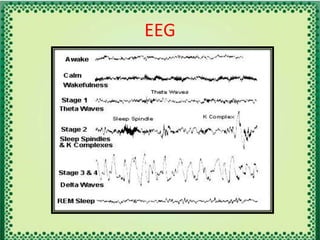
• Electroencephalogram (EEG) patterns, eye movements
and muscle activity are used to identify stages of sleep.
The stages of sleep are classified into two stages:
• Non Rapid Eye Movement (NREM) Sleep
o Stage 1
o Stage 2
o Stage 3
o Stage 4
• Rapid Eye Movement Stage(rem) Sleep.
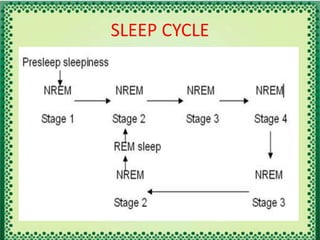
During sleep, NREM and REM sleep alternate in cycles
EEG
Non Rapid Eye Movement (NREM) Sleep
• First stage of sleep is known as NREM sleep.
• About 75% to 80% of sleep during a night is
NREM sleep.
• It consists of four stages:
o Stage 1
o Stage 2
o Stage 3
o Stage 4
NREM Sleep
• Stage 1: NREM
• Stage lasts a few minutes.
• It includes lightest level of sleep.
• Gradual fall in vital signs and metabolism.
• General slowing of EEG frequency
• Eyes tend to roll slowly from side to side
• Sensory stimuli such as noise easily arouses
person.
• Sleeper may deny he is sleeping.
NREM Sleep
• Stage 2: NREM
• Stage lasts 10 to 20 minutes.
• It is a period of sound sleep.
• Relaxation progresses.
• Further slowing of EEG
• Absent eye ball movements
• Body functions continue to slow.
• Arousal remains relatively easy
NREM Sleep
• Stage 3: NREM
• Stage lasts 15 to 30 minutes.
• It involves initial stages of deep sleep.
• Muscles are completely relaxed.
• Large slow waves in EEG
• Vital signs decline but remain regular.
• Sleeper is difficult to arouse and rarely moves
NREM Sleep
• Stage 4: NREM
• Stage lasts approximately 15 to 30 minutes.
• It is the deepest stage of sleep.
• If sleep loss has occurred, sleeper spends considerable
portion of night in this stage.
• Vital signs are significantly lower than during waking
hours.
• Further slowing of EEG
• Sleepwalking and enuresis (bed-wetting) sometimes
occur.
• It is very difficult to arouse sleeper
REM Sleep
• Stage usually begins about 90 minutes after
sleep has begun.
• Dreaming occurs in this stage
• Stage is typified by rapidly moving eyes,
fluctuating heart and respiratory rates,
increased or fluctuating blood pressure, loss
of skeletal muscle tone, and increase of gastric
secretions.
• EEG pattern resembles that of awake state.
• It is very difficult to arouse sleeper.
SLEEP CYCLE
FUNCTIONS OF SLEEP
• Conservation of energy
• Restoration of tissues and growth
• Thermoregulation
• Regulation of emotions- sleep deprivation causes
emotional disorders like irritability, anxiety,
depression etc.
• Neural maturation
• Memory and learning- there will be information
transfer between cerebral cortex and
hippocampus during sleep
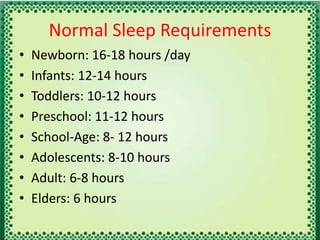
Normal Sleep Requirements
• Newborn: 16-18 hours /day
• Infants: 12-14 hours
• Toddlers: 10-12 hours
• Preschool: 11-12 hours
• School-Age: 8- 12 hours
• Adolescents: 8-10 hours
• Adult: 6-8 hours
• Elders: 6 hours
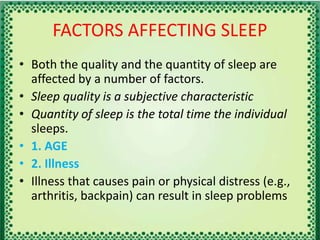
FACTORS AFFECTING SLEEP
• Both the quality and the quantity of sleep are
affected by a number of factors.
• Sleep quality is a subjective characteristic
• Quantity of sleep is the total time the individual
sleeps.
• 1. AGE
• 2. Illness
• Illness that causes pain or physical distress (e.g.,
arthritis, backpain) can result in sleep problems
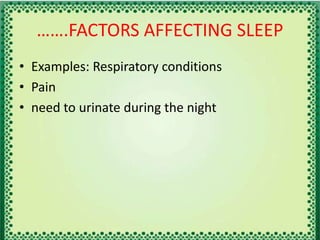
…….FACTORS AFFECTING SLEEP
• Examples: Respiratory conditions
• Pain
• need to urinate during the night
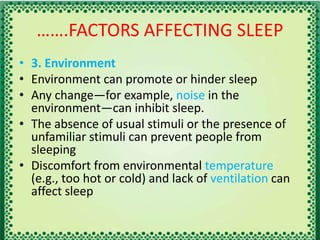
…….FACTORS AFFECTING SLEEP
• 3. Environment
• Environment can promote or hinder sleep
• Any change—for example, noise in the
environment—can inhibit sleep.
• The absence of usual stimuli or the presence of
unfamiliar stimuli can prevent people from
sleeping
• Discomfort from environmental temperature
(e.g., too hot or cold) and lack of ventilation can
affect sleep
…….FACTORS AFFECTING SLEEP
• Light levels can be another factor
• Another influence includes the comfort and
size of the bed.
• A person’s partner who has different sleep
habits, snores, or has other sleep difficulties
may become a problem for the person also.
…….FACTORS AFFECTING SLEEP
• 4. Lifestyle
• Following an irregular morning and night time
schedule can affect sleep.
• Night shift workers frequently obtain less
sleep than other workers and have difficulty
falling asleep.
…….FACTORS AFFECTING SLEEP
• 5. Emotional Stress
• Stress is considered to be the major cause of
short-term sleeping difficulties .
• A person preoccupied with personal problems
(e.g., school- or job-related pressures, family
or marriage problems) may be unable to relax
sufficiently to get to sleep.
…….FACTORS AFFECTING SLEEP
• 6. Stimulants and Alcohol
• Caffeine-containing beverages act as
stimulants of the central nervous system
(CNS).
• Drinking beverages containing Caffeine in the
afternoon or evening may interfere with sleep.
• Even though alcohol induces sleep, it disturbs
REM sleep causing irritability.
…….FACTORS AFFECTING SLEEP
• 7. Diet
• Certain foods induces sleep
• Ex: the L- tryptophan present in the milk
induces sleep
• 8. Smoking
• Nicotine has a stimulating effect on the body,
and smokers often have more difficulty falling
asleep than non smokers.
• Smokers can be easily aroused
…….FACTORS AFFECTING SLEEP
• 9. Motivation
• Motivation can increase alertness in some
situations
• Ex: During the time of examination
Browsing internet in the late night
…….FACTORS AFFECTING SLEEP
• 10. Medications:
• Beta-blockers have been known to cause
insomnia.
• Narcotics, such as morphine, are known to
suppress REM sleep and to cause frequent
awakenings and drowsiness.
• Most Hypnotics suppresses REM sleep
SLEEP DISORDERS
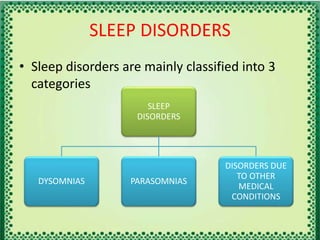
• Sleep disorders are mainly classified into 3
categories
SLEEP
DISORDERS
DYSOMNIAS PARASOMNIAS
DISORDERS DUE
TO OTHER
MEDICAL
CONDITIONS
DYSOMNIAS
• The sleep itself is pretty normal.
• But the client sleeps too little, too much, or at
the wrong time.
• So, the problem is with the amount (quantity),
or with its timing, and sometimes with the
quality of sleep.
DYSOMNIAS
• Common Dysomnias are:
• Insomnia
• Hypersomnia
• Narcolepsy
• Sleep Apnea
• Insufficient Sleep/ Sleep Deprivation
Insomnia
• Insomnia is described as the inability to fall
asleep or remain asleep.
• Persons with insomnia awaken not feeling
rested.
• Insomnia is the most common sleep
complaint.
• Acute insomnia lasts one to several nights and
is often caused by personal stressors or worry.
• If the insomnia persists for longer than a
month, it is considered Chronic insomnia
……..Insomnia
• Insomnia can result from physicl discomfort
and more often from mental tension or
anxiety.
• People who are habituated to drugs or who
takes large amounts of alcohol are at high risk
for insomnia.
Insomnia
Clinical manifestations:
■ Difficulty falling asleep
■ Waking up frequently during the night
■ Difficulty returning to sleep
■ Waking up too early in the morning
■ Unrefreshing sleep
■ Daytime sleepiness
■ Difficulty concentrating
■ Irritability
Insomnia
• Treatment is development of new behavioral
patterns that induces sleep
• Create a sleeping environment that induces
sleep
• Create positive sleep thoughts
Hypersomnia
• Hypersomnia refers to conditions where the
affected individual obtains sufficient sleep at
night but still cannot stay awake during the
day.
• Hypersomnia can be caused by medical
conditions, for example, CNS damage and
certain kidney, liver, or metabolic disorders,
such as diabetic acidosis and hypothyroidism.
Hypersomnia
• Treatment of hypersomnias include treating
the underlying disease conditions
Narcolepsy
• Narcolepsy is a disorder of excessive daytime
sleepiness caused by the lack of the chemical
hypocretin in the area of the CNS that
regulates sleep.
• Clients with narcolepsy have sleep attacks or
excessive daytime sleepiness, and their sleep
at night usually begins with a sleep-onset REM
period (dreaming sleep occurs within the first
15 minutes of falling asleep).
Narcolepsy
• People sleeps several times a day even when
they are conversing with people or while
driving.
• CNS stimulants and Antidepressants are the
drugs used to treat narcolepsy.
Sleep Apnea
• Sleep Apnea is characterized by frequent short
breathing pauses during sleep.
• Although all individuals have occasional
periods of apnea during sleep, more than five
apneic episodes longer than 10 seconds in an
hour is considered abnormal and should be
evaluated by a sleep medicine specialist.
…….Sleep Apnea
• Sleep Apnea is most frequently diagnosed in
men and postmenopausal women, it may
occur during childhood.
• Three types of apnoea based on the cause
• 1. Obstructive Apnoea
• 2. Central Apnea
• 3. Mixed Apnea
…….Sleep Apnea
• 1. OBSTRUCTIVE APNOEA:
• Obstructive apnea occurs when the structures of
the pharynx or oral cavity block the flow of air.
• Enlarged tonsils and adenoids, a deviated nasal
septum, nasal polyps, and obesity predispose the
client to obstructive apnea
• Treatment includes surgical removal of tonsills,
correcting nasal septum, weight loss may be
helpful.
…….Sleep Apnea
• 2. CENTRAL APNEA:
• Due to defect in the respiratory centre of the
brain.
• Clients who have brainstem injuries and often
have central sleep apnea.
• 3.MIXED APNOEA
• Mixed apnoea is combination of obstructive
and central apnea
Insufficient Sleep/ Sleep Deprivation
• A prolonged disturbance in quality and
quantity of sleep can lead to a syndrome
called as sleep deprivation.
• It is not a sleep disorder but result of
prolonged sleep disturbance.
• It produces various physiological and
behavioural symptoms based on the severity
of deprivation.
Insufficient Sleep/ Sleep Deprivation
Individuals may develop:
• Attention and concentration deficits
• Reduced vigilance
• Distractibility
• Reduced motivation
• Fatigue
• Diplopia and dry mouth.
PARASOMNIAS
• Something abnormal occurs during sleep itself, or
during the times when the client is falling asleep
or waking up
• The quality, quantity, and timing of the sleep are
essentially normal.
Most common DISORDERS are:
• Bruxism
• Enuresis
• Periodic limb movement disorder
• Sleep talking
• Sleep walking
…….PARASOMNIAS
■ Bruxism. Usually occurring during stage II
NREM sleep, characterized by clenching and
grinding of the teeth.
• This clenching and grinding of the teeth can
eventually erode dental crowns, cause teeth
to come loose, and lead to deterioration of
the temporomandibular (TMJ) joint, called
TMJ syndrome
…….PARASOMNIAS
■ Enuresis. Bed-wetting during sleep occuring
in children over 3 years old.
• More males than females are affected.
• It often occurs 1 to 2 hours after falling asleep.
…….PARASOMNIAS
• Periodic limb movement disorder (PLMD).
In this condition, the legs jerk twice or three
times per minute during sleep.
• It is most common among older adults.
• Respond well to medications such as
levodopa, pramipexole , ropinirole, and
gabapentin
…….PARASOMNIAS
• Sleeptalking. Talking during sleep occurs
during NREM sleep before REM sleep.
• It rarely presents a problem to the person
unless it becomes troublesome to others
…….PARASOMNIAS
• Sleepwalking. Sleepwalking (somnambulism)
occurs during stages III and IV of NREM sleep.
It is episodic and usually occurs 1 to 2 hours
after falling asleep.
• Sleepwalkers tend not to notice dangers (e.g.,
stairs) and often need to be protected from
injury
Disorders due to other medical
conditions
• These disorders are associated with Medical
or Psychiatric or other illness
• Usually the disorders that cause sleep
disturbance includes:
• Depression
• Alcolism
• Thyroid dysfunction
• Peptic ulcer
• COPD- chronic obstructive pulmonary disease
Nursing Interventions To Promote
Sleep
• 1. Sleep-Wake Pattern
• Maintain a regular bedtime and wake-up
schedule
• Eliminate day time naps. If naps are taken,
limit to 20 minutes or less twice a day
• Instruct the client to go to bed when sleepy.
• Use warm bath and relaxation techniques
• If unable to sleep in 15 to 30 minutes, get out
of bed and persue some relaxation activity.
…..Nursing Interventions To Promote
Sleep
• Establish a regular, relaxing bedtime routine
before sleep such as reading, listening to soft
music, taking a warm bath, or doing some
other quiet activity.
• Avoid dealing with office work or family
problems before bedtime
• Get adequate exercise during the day to
reduce stress, but avoid excessive physical
exertion at least 3 hours before bedtime.
…….Nursing Interventions To Promote
Sleep
• 2. Environment:
• Create a sleep-conducive environment that is
dark, quiet, comfortable, and cool.
• Keep noise to a minimum; block out
extraneous noise as necessary with white
noise from a fan, air conditioner.
• Sleep on a comfortable mattress and pillows.
• Listen to relaxing music
• Increase exposure to bright light during the
day
……..Nursing Interventions To Promote
Sleep
• 3. Diet:
• Limit alcohol, caffeine, and nicotine in late
afternoon and evening
• Consume carbohydrates or milk as a light snack
before bedtime.
• Avoid heavy and spicy foods. Heavy or spicy foods
can cause gastrointestinal upsets that disturb
sleep
• Decrease fluids 2 to 4 hours before sleep
……Nursing Interventions To Promote
Sleep
• 4.Medications:
• Use sleeping medications only as a last resort
• Minimize the usage of medicines as much as
possible because many contain antihistamines
that cause daytime drowsiness.
• Take analgesics 30 mins before bedtime to
relieve aches and pains.
• Consult the health care provider about
adjusting other medications that may cause
insomnia.
Sleep & rest

Sleep & rest

  • 1.
    SLEEP & REST By: Mr. M.Shivanandha Reddy
  • 2.
    Definition • Rest isa condition in which the body is in a decreased state of activity without physical emotional stress and freedom from anxiety. • Sleep is a state of rest accompanied by altered level of consciousness and relative inactivity, and perception to environment are decreased
  • 3.
    PHYSIOLOGY OF SLEEP •The cyclic nature of sleep is thought to be controlled by Centers located in the brain and by Circadian Rhythms. • Reticular activating system (RAS) located at the brain stem and Cerebral Cortex plays an important role in sleep wake cycle.
  • 4.
    …………….PHYSIOLOGY OF SLEEP •Sleep begins with the activation of the pre optic area of the anterior hypothalamus. • Sleep promoting neurons act over wake promoting neurons by releasing Gamma Amino Butyric Acid (GABA). • The inhibition of wake promoting neurons results in intensifying sleep process.
  • 5.
    …………….PHYSIOLOGY OF SLEEP •Another key factor to sleep is exposure to darkness. • Darkness and preparing for sleep (e.g., lying down, decreasing noise) cause a decrease in stimulation of the RAS. • During this time, the Pineal gland in the brain begins to actively secrete the natural hormone Melatonin, and the person feels less alert.
  • 6.
    …………….PHYSIOLOGY OF SLEEP •With the beginning of daylight, Melatonin is at its lowest level in the body and the stimulating hormone, Cortisol , is at its highest causing wakefulness.
  • 7.
    Circadian Rhythms • Itis a sort of 24-hour internal biological clock. The term circadian is from the Latin “circa dies”, meaning “about a day.” • Biological rhythms exist in plants, animals, and humans. • In humans, these are controlled from within the body and synchronized with environmental factors, such as light and darkness.
  • 8.
    Types/ Stages/ PhasesOf Sleep • Electroencephalogram (EEG) patterns, eye movements and muscle activity are used to identify stages of sleep. The stages of sleep are classified into two stages: • Non Rapid Eye Movement (NREM) Sleep o Stage 1 o Stage 2 o Stage 3 o Stage 4 • Rapid Eye Movement Stage(rem) Sleep. During sleep, NREM and REM sleep alternate in cycles
  • 9.
  • 10.
    Non Rapid EyeMovement (NREM) Sleep • First stage of sleep is known as NREM sleep. • About 75% to 80% of sleep during a night is NREM sleep. • It consists of four stages: o Stage 1 o Stage 2 o Stage 3 o Stage 4
  • 11.
    NREM Sleep • Stage1: NREM • Stage lasts a few minutes. • It includes lightest level of sleep. • Gradual fall in vital signs and metabolism. • General slowing of EEG frequency • Eyes tend to roll slowly from side to side • Sensory stimuli such as noise easily arouses person. • Sleeper may deny he is sleeping.
  • 12.
    NREM Sleep • Stage2: NREM • Stage lasts 10 to 20 minutes. • It is a period of sound sleep. • Relaxation progresses. • Further slowing of EEG • Absent eye ball movements • Body functions continue to slow. • Arousal remains relatively easy
  • 13.
    NREM Sleep • Stage3: NREM • Stage lasts 15 to 30 minutes. • It involves initial stages of deep sleep. • Muscles are completely relaxed. • Large slow waves in EEG • Vital signs decline but remain regular. • Sleeper is difficult to arouse and rarely moves
  • 14.
    NREM Sleep • Stage4: NREM • Stage lasts approximately 15 to 30 minutes. • It is the deepest stage of sleep. • If sleep loss has occurred, sleeper spends considerable portion of night in this stage. • Vital signs are significantly lower than during waking hours. • Further slowing of EEG • Sleepwalking and enuresis (bed-wetting) sometimes occur. • It is very difficult to arouse sleeper
  • 15.
    REM Sleep • Stageusually begins about 90 minutes after sleep has begun. • Dreaming occurs in this stage • Stage is typified by rapidly moving eyes, fluctuating heart and respiratory rates, increased or fluctuating blood pressure, loss of skeletal muscle tone, and increase of gastric secretions. • EEG pattern resembles that of awake state. • It is very difficult to arouse sleeper.
  • 16.
  • 17.
    FUNCTIONS OF SLEEP •Conservation of energy • Restoration of tissues and growth • Thermoregulation • Regulation of emotions- sleep deprivation causes emotional disorders like irritability, anxiety, depression etc. • Neural maturation • Memory and learning- there will be information transfer between cerebral cortex and hippocampus during sleep
  • 18.
    Normal Sleep Requirements •Newborn: 16-18 hours /day • Infants: 12-14 hours • Toddlers: 10-12 hours • Preschool: 11-12 hours • School-Age: 8- 12 hours • Adolescents: 8-10 hours • Adult: 6-8 hours • Elders: 6 hours
  • 19.
    FACTORS AFFECTING SLEEP •Both the quality and the quantity of sleep are affected by a number of factors. • Sleep quality is a subjective characteristic • Quantity of sleep is the total time the individual sleeps. • 1. AGE • 2. Illness • Illness that causes pain or physical distress (e.g., arthritis, backpain) can result in sleep problems
  • 20.
    …….FACTORS AFFECTING SLEEP •Examples: Respiratory conditions • Pain • need to urinate during the night
  • 21.
    …….FACTORS AFFECTING SLEEP •3. Environment • Environment can promote or hinder sleep • Any change—for example, noise in the environment—can inhibit sleep. • The absence of usual stimuli or the presence of unfamiliar stimuli can prevent people from sleeping • Discomfort from environmental temperature (e.g., too hot or cold) and lack of ventilation can affect sleep
  • 22.
    …….FACTORS AFFECTING SLEEP •Light levels can be another factor • Another influence includes the comfort and size of the bed. • A person’s partner who has different sleep habits, snores, or has other sleep difficulties may become a problem for the person also.
  • 23.
    …….FACTORS AFFECTING SLEEP •4. Lifestyle • Following an irregular morning and night time schedule can affect sleep. • Night shift workers frequently obtain less sleep than other workers and have difficulty falling asleep.
  • 24.
    …….FACTORS AFFECTING SLEEP •5. Emotional Stress • Stress is considered to be the major cause of short-term sleeping difficulties . • A person preoccupied with personal problems (e.g., school- or job-related pressures, family or marriage problems) may be unable to relax sufficiently to get to sleep.
  • 25.
    …….FACTORS AFFECTING SLEEP •6. Stimulants and Alcohol • Caffeine-containing beverages act as stimulants of the central nervous system (CNS). • Drinking beverages containing Caffeine in the afternoon or evening may interfere with sleep. • Even though alcohol induces sleep, it disturbs REM sleep causing irritability.
  • 26.
    …….FACTORS AFFECTING SLEEP •7. Diet • Certain foods induces sleep • Ex: the L- tryptophan present in the milk induces sleep
  • 27.
    • 8. Smoking •Nicotine has a stimulating effect on the body, and smokers often have more difficulty falling asleep than non smokers. • Smokers can be easily aroused
  • 28.
    …….FACTORS AFFECTING SLEEP •9. Motivation • Motivation can increase alertness in some situations • Ex: During the time of examination Browsing internet in the late night
  • 29.
    …….FACTORS AFFECTING SLEEP •10. Medications: • Beta-blockers have been known to cause insomnia. • Narcotics, such as morphine, are known to suppress REM sleep and to cause frequent awakenings and drowsiness. • Most Hypnotics suppresses REM sleep
  • 30.
    SLEEP DISORDERS • Sleepdisorders are mainly classified into 3 categories SLEEP DISORDERS DYSOMNIAS PARASOMNIAS DISORDERS DUE TO OTHER MEDICAL CONDITIONS
  • 31.
    DYSOMNIAS • The sleepitself is pretty normal. • But the client sleeps too little, too much, or at the wrong time. • So, the problem is with the amount (quantity), or with its timing, and sometimes with the quality of sleep.
  • 32.
    DYSOMNIAS • Common Dysomniasare: • Insomnia • Hypersomnia • Narcolepsy • Sleep Apnea • Insufficient Sleep/ Sleep Deprivation
  • 33.
    Insomnia • Insomnia isdescribed as the inability to fall asleep or remain asleep. • Persons with insomnia awaken not feeling rested. • Insomnia is the most common sleep complaint. • Acute insomnia lasts one to several nights and is often caused by personal stressors or worry. • If the insomnia persists for longer than a month, it is considered Chronic insomnia
  • 34.
    ……..Insomnia • Insomnia canresult from physicl discomfort and more often from mental tension or anxiety. • People who are habituated to drugs or who takes large amounts of alcohol are at high risk for insomnia.
  • 35.
    Insomnia Clinical manifestations: ■ Difficultyfalling asleep ■ Waking up frequently during the night ■ Difficulty returning to sleep ■ Waking up too early in the morning ■ Unrefreshing sleep ■ Daytime sleepiness ■ Difficulty concentrating ■ Irritability
  • 36.
    Insomnia • Treatment isdevelopment of new behavioral patterns that induces sleep • Create a sleeping environment that induces sleep • Create positive sleep thoughts
  • 37.
    Hypersomnia • Hypersomnia refersto conditions where the affected individual obtains sufficient sleep at night but still cannot stay awake during the day. • Hypersomnia can be caused by medical conditions, for example, CNS damage and certain kidney, liver, or metabolic disorders, such as diabetic acidosis and hypothyroidism.
  • 38.
    Hypersomnia • Treatment ofhypersomnias include treating the underlying disease conditions
  • 39.
    Narcolepsy • Narcolepsy isa disorder of excessive daytime sleepiness caused by the lack of the chemical hypocretin in the area of the CNS that regulates sleep. • Clients with narcolepsy have sleep attacks or excessive daytime sleepiness, and their sleep at night usually begins with a sleep-onset REM period (dreaming sleep occurs within the first 15 minutes of falling asleep).
  • 40.
    Narcolepsy • People sleepsseveral times a day even when they are conversing with people or while driving. • CNS stimulants and Antidepressants are the drugs used to treat narcolepsy.
  • 41.
    Sleep Apnea • SleepApnea is characterized by frequent short breathing pauses during sleep. • Although all individuals have occasional periods of apnea during sleep, more than five apneic episodes longer than 10 seconds in an hour is considered abnormal and should be evaluated by a sleep medicine specialist.
  • 42.
    …….Sleep Apnea • SleepApnea is most frequently diagnosed in men and postmenopausal women, it may occur during childhood. • Three types of apnoea based on the cause • 1. Obstructive Apnoea • 2. Central Apnea • 3. Mixed Apnea
  • 43.
    …….Sleep Apnea • 1.OBSTRUCTIVE APNOEA: • Obstructive apnea occurs when the structures of the pharynx or oral cavity block the flow of air. • Enlarged tonsils and adenoids, a deviated nasal septum, nasal polyps, and obesity predispose the client to obstructive apnea • Treatment includes surgical removal of tonsills, correcting nasal septum, weight loss may be helpful.
  • 44.
    …….Sleep Apnea • 2.CENTRAL APNEA: • Due to defect in the respiratory centre of the brain. • Clients who have brainstem injuries and often have central sleep apnea. • 3.MIXED APNOEA • Mixed apnoea is combination of obstructive and central apnea
  • 45.
    Insufficient Sleep/ SleepDeprivation • A prolonged disturbance in quality and quantity of sleep can lead to a syndrome called as sleep deprivation. • It is not a sleep disorder but result of prolonged sleep disturbance. • It produces various physiological and behavioural symptoms based on the severity of deprivation.
  • 46.
    Insufficient Sleep/ SleepDeprivation Individuals may develop: • Attention and concentration deficits • Reduced vigilance • Distractibility • Reduced motivation • Fatigue • Diplopia and dry mouth.
  • 47.
    PARASOMNIAS • Something abnormaloccurs during sleep itself, or during the times when the client is falling asleep or waking up • The quality, quantity, and timing of the sleep are essentially normal. Most common DISORDERS are: • Bruxism • Enuresis • Periodic limb movement disorder • Sleep talking • Sleep walking
  • 48.
    …….PARASOMNIAS ■ Bruxism. Usuallyoccurring during stage II NREM sleep, characterized by clenching and grinding of the teeth. • This clenching and grinding of the teeth can eventually erode dental crowns, cause teeth to come loose, and lead to deterioration of the temporomandibular (TMJ) joint, called TMJ syndrome
  • 49.
    …….PARASOMNIAS ■ Enuresis. Bed-wettingduring sleep occuring in children over 3 years old. • More males than females are affected. • It often occurs 1 to 2 hours after falling asleep.
  • 50.
    …….PARASOMNIAS • Periodic limbmovement disorder (PLMD). In this condition, the legs jerk twice or three times per minute during sleep. • It is most common among older adults. • Respond well to medications such as levodopa, pramipexole , ropinirole, and gabapentin
  • 51.
    …….PARASOMNIAS • Sleeptalking. Talkingduring sleep occurs during NREM sleep before REM sleep. • It rarely presents a problem to the person unless it becomes troublesome to others
  • 52.
    …….PARASOMNIAS • Sleepwalking. Sleepwalking(somnambulism) occurs during stages III and IV of NREM sleep. It is episodic and usually occurs 1 to 2 hours after falling asleep. • Sleepwalkers tend not to notice dangers (e.g., stairs) and often need to be protected from injury
  • 53.
    Disorders due toother medical conditions • These disorders are associated with Medical or Psychiatric or other illness • Usually the disorders that cause sleep disturbance includes: • Depression • Alcolism • Thyroid dysfunction • Peptic ulcer • COPD- chronic obstructive pulmonary disease
  • 54.
    Nursing Interventions ToPromote Sleep • 1. Sleep-Wake Pattern • Maintain a regular bedtime and wake-up schedule • Eliminate day time naps. If naps are taken, limit to 20 minutes or less twice a day • Instruct the client to go to bed when sleepy. • Use warm bath and relaxation techniques • If unable to sleep in 15 to 30 minutes, get out of bed and persue some relaxation activity.
  • 55.
    …..Nursing Interventions ToPromote Sleep • Establish a regular, relaxing bedtime routine before sleep such as reading, listening to soft music, taking a warm bath, or doing some other quiet activity. • Avoid dealing with office work or family problems before bedtime • Get adequate exercise during the day to reduce stress, but avoid excessive physical exertion at least 3 hours before bedtime.
  • 56.
    …….Nursing Interventions ToPromote Sleep • 2. Environment: • Create a sleep-conducive environment that is dark, quiet, comfortable, and cool. • Keep noise to a minimum; block out extraneous noise as necessary with white noise from a fan, air conditioner. • Sleep on a comfortable mattress and pillows. • Listen to relaxing music • Increase exposure to bright light during the day
  • 57.
    ……..Nursing Interventions ToPromote Sleep • 3. Diet: • Limit alcohol, caffeine, and nicotine in late afternoon and evening • Consume carbohydrates or milk as a light snack before bedtime. • Avoid heavy and spicy foods. Heavy or spicy foods can cause gastrointestinal upsets that disturb sleep • Decrease fluids 2 to 4 hours before sleep
  • 58.
    ……Nursing Interventions ToPromote Sleep • 4.Medications: • Use sleeping medications only as a last resort • Minimize the usage of medicines as much as possible because many contain antihistamines that cause daytime drowsiness. • Take analgesics 30 mins before bedtime to relieve aches and pains. • Consult the health care provider about adjusting other medications that may cause insomnia.