 DEFINITION:-
 rest is defined as a state of relatively
decreased bodily work either, physical, mental or both
which leaves the individual feeling refreshed and revived.
SLEEP.
 DEFINITION:-
 is a state of rest accompained by altered
level of conciounsness and relative inactivity and
perception to the environment are decreased.
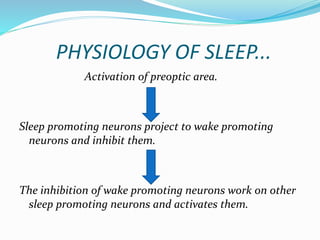
PHYSIOLOGY OF SLEEP...
Activation of preoptic area.
Sleep promoting neurons project to wake promoting
neurons and inhibit them.
The inhibition of wake promoting neurons work on other
sleep promoting neurons and activates them.
 Which result in intensifying the sleep process.
TYPES OF SLEEP..
 N.R.E.M.:-(NON RAPID EYE MOVEMENT SLEEP..)
 R.E.M.:-(RAPID EYE MOVEMENT SLEEP..)
N.R.E.M SLEEP
It consist of four stages:--
STAGE 1(TRANSITION TO SLEEP)
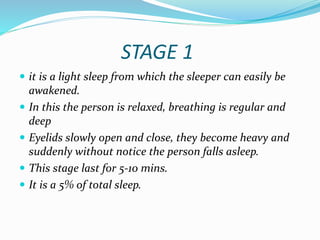
STAGE 1
 it is a light sleep from which the sleeper can easily be
awakened.
 In this the person is relaxed, breathing is regular and
deep
 Eyelids slowly open and close, they become heavy and
suddenly without notice the person falls asleep.
 This stage last for 5-10 mins.
 It is a 5% of total sleep.
STAGE 2(LIGHT SLEEP)
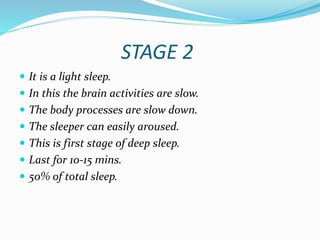
STAGE 2
 It is a light sleep.
 In this the brain activities are slow.
 The body processes are slow down.
 The sleeper can easily aroused.
 This is first stage of deep sleep.
 Last for 10-15 mins.
 50% of total sleep.
STAGE 3(DEEP SLEEP)
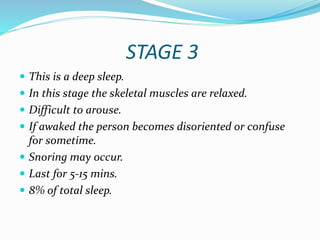
STAGE 3
 This is a deep sleep.
 In this stage the skeletal muscles are relaxed.
 Difficult to arouse.
 If awaked the person becomes disoriented or confuse
for sometime.
 Snoring may occur.
 Last for 5-15 mins.
 8% of total sleep.
STAGE 4(MORE INTENSE DEEP
SLEEP)
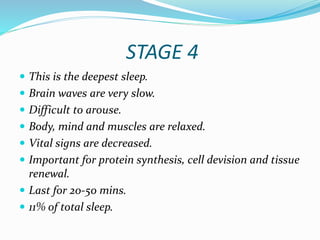
STAGE 4
 This is the deepest sleep.
 Brain waves are very slow.
 Difficult to arouse.
 Body, mind and muscles are relaxed.
 Vital signs are decreased.
 Important for protein synthesis, cell devision and tissue
renewal.
 Last for 20-50 mins.
 11% of total sleep.
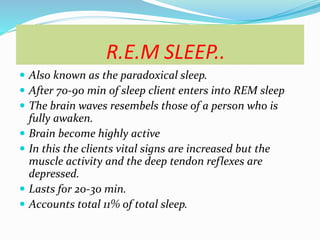
R.E.M SLEEP..
 Also known as the paradoxical sleep.
 After 70-90 min of sleep client enters into REM sleep
 The brain waves resembels those of a person who is
fully awaken.
 Brain become highly active
 In this the clients vital signs are increased but the
muscle activity and the deep tendon reflexes are
depressed.
 Lasts for 20-30 min.
 Accounts total 11% of total sleep.
FACTORS AFFECTING SLEEP...
 Degree of comfort
 Anxiety
 Environment
 Life style
 Food
 Drugs and alcohol
 Life span considerations
COMMON SLEEP DISORDERS...
 Insomnia
 Hypersomnia
 Sleep apnea
 Narcolepsy
 Sleep walking
 Sleep talking
 Bruxism(grinding and clenching of theeth)
 Enuresis
NURSING MEASURES..
 provide comfort to the client.
 Provide quite and calm environment to the client.
 Provide adequate ventilation.
 Encourage the client to sleep at regular intervals.
 Induce sleep by a warm bath in the evening.
 Provide loose garments at night.
 Give comfortable position.
 Relive fear and anxiety of the client.
 Gentle massage on the back, arms, and legs to induce
sleep.
Rest and sleep

Rest and sleep

  • 2.
     DEFINITION:-  restis defined as a state of relatively decreased bodily work either, physical, mental or both which leaves the individual feeling refreshed and revived.
  • 3.
    SLEEP.  DEFINITION:-  isa state of rest accompained by altered level of conciounsness and relative inactivity and perception to the environment are decreased.
  • 4.
    PHYSIOLOGY OF SLEEP... Activationof preoptic area. Sleep promoting neurons project to wake promoting neurons and inhibit them. The inhibition of wake promoting neurons work on other sleep promoting neurons and activates them.
  • 5.
     Which resultin intensifying the sleep process.
  • 6.
    TYPES OF SLEEP.. N.R.E.M.:-(NON RAPID EYE MOVEMENT SLEEP..)  R.E.M.:-(RAPID EYE MOVEMENT SLEEP..)
  • 7.
    N.R.E.M SLEEP It consistof four stages:--
  • 8.
  • 9.
    STAGE 1  itis a light sleep from which the sleeper can easily be awakened.  In this the person is relaxed, breathing is regular and deep  Eyelids slowly open and close, they become heavy and suddenly without notice the person falls asleep.  This stage last for 5-10 mins.  It is a 5% of total sleep.
  • 10.
  • 11.
    STAGE 2  Itis a light sleep.  In this the brain activities are slow.  The body processes are slow down.  The sleeper can easily aroused.  This is first stage of deep sleep.  Last for 10-15 mins.  50% of total sleep.
  • 12.
  • 13.
    STAGE 3  Thisis a deep sleep.  In this stage the skeletal muscles are relaxed.  Difficult to arouse.  If awaked the person becomes disoriented or confuse for sometime.  Snoring may occur.  Last for 5-15 mins.  8% of total sleep.
  • 14.
  • 15.
    STAGE 4  Thisis the deepest sleep.  Brain waves are very slow.  Difficult to arouse.  Body, mind and muscles are relaxed.  Vital signs are decreased.  Important for protein synthesis, cell devision and tissue renewal.  Last for 20-50 mins.  11% of total sleep.
  • 16.
    R.E.M SLEEP..  Alsoknown as the paradoxical sleep.  After 70-90 min of sleep client enters into REM sleep  The brain waves resembels those of a person who is fully awaken.  Brain become highly active  In this the clients vital signs are increased but the muscle activity and the deep tendon reflexes are depressed.  Lasts for 20-30 min.  Accounts total 11% of total sleep.
  • 17.
    FACTORS AFFECTING SLEEP... Degree of comfort  Anxiety  Environment  Life style  Food  Drugs and alcohol  Life span considerations
  • 18.
    COMMON SLEEP DISORDERS... Insomnia  Hypersomnia  Sleep apnea  Narcolepsy  Sleep walking  Sleep talking  Bruxism(grinding and clenching of theeth)  Enuresis
  • 19.
    NURSING MEASURES..  providecomfort to the client.  Provide quite and calm environment to the client.  Provide adequate ventilation.  Encourage the client to sleep at regular intervals.  Induce sleep by a warm bath in the evening.  Provide loose garments at night.  Give comfortable position.  Relive fear and anxiety of the client.  Gentle massage on the back, arms, and legs to induce sleep.