X.ARON CHRISTY M.Sc (N).,
PROFESSOR, PSYCHIATRIC NURSING.
SRM TRICHY COLLEGE OF NURSING
INTRODUCTION
The bodily organs form the basis for all
behaviour. Whether an individual walks or talks
or runs or reads, the body is invariably involved
in all actions. Therefore, it is essential that
students of psychology understand the
importance and the role of different body
organs in behaviour.
The relationship between the functioning
of the human body and human behaviour had
led early philosophers to bestow a lot of
attention on the relationship between the
body and the mind. Broadly speaking these
approaches could be categorized into dualistic
and monistic theories.
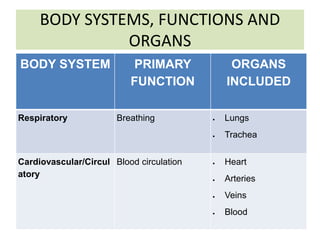
BODY SYSTEMS, FUNCTIONS AND
ORGANS
BODY SYSTEM PRIMARY
FUNCTION
ORGANS
INCLUDED
Respiratory Breathing  Lungs
 Trachea
Cardiovascular/Circul
atory
Blood circulation  Heart
 Arteries
 Veins
 Blood
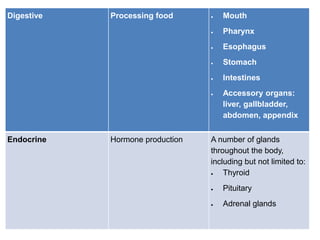
Digestive Processing food  Mouth
 Pharynx
 Esophagus
 Stomach
 Intestines
 Accessory organs:
liver, gallbladder,
abdomen, appendix
Endocrine Hormone production A number of glands
throughout the body,
including but not limited to:
 Thyroid
 Pituitary
 Adrenal glands
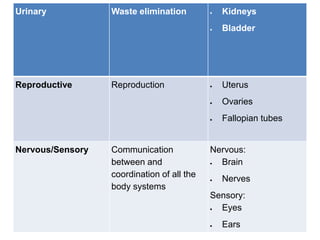
Urinary Waste elimination  Kidneys
 Bladder
Reproductive Reproduction  Uterus
 Ovaries
 Fallopian tubes
Nervous/Sensory Communication
between and
coordination of all the
body systems
Nervous:
 Brain
 Nerves
Sensory:
 Eyes
 Ears
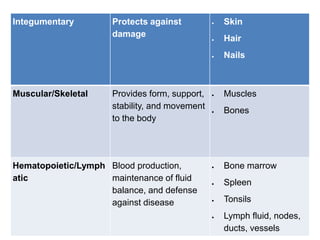
Integumentary Protects against
damage
 Skin
 Hair
 Nails
Muscular/Skeletal Provides form, support,
stability, and movement
to the body
 Muscles
 Bones
Hematopoietic/Lymph
atic
Blood production,
maintenance of fluid
balance, and defense
against disease
 Bone marrow
 Spleen
 Tonsils
 Lymph fluid, nodes,
ducts, vessels
MIND AND ITS FUNCTIONS
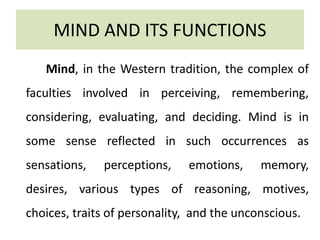
Mind, in the Western tradition, the complex of
faculties involved in perceiving, remembering,
considering, evaluating, and deciding. Mind is in
some sense reflected in such occurrences as
sensations, perceptions, emotions, memory,
desires, various types of reasoning, motives,
choices, traits of personality, and the unconscious.
BASIC ASSUMPTIONS OF MIND
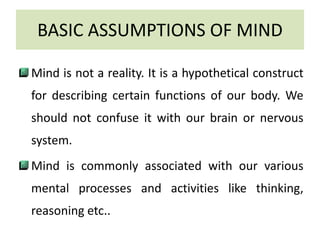
Mind is not a reality. It is a hypothetical construct
for describing certain functions of our body. We
should not confuse it with our brain or nervous
system.
Mind is commonly associated with our various
mental processes and activities like thinking,
reasoning etc..
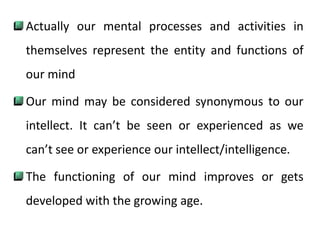
Actually our mental processes and activities in
themselves represent the entity and functions of
our mind
Our mind may be considered synonymous to our
intellect. It can’t be seen or experienced as we
can’t see or experience our intellect/intelligence.
The functioning of our mind improves or gets
developed with the growing age.
LEVELS OF FUNCTIONS OF MIND
We can view
consciousness as three
distinct levels:
The Conscious,
The Subconscious (Or
Preconscious), And
The Unconscious.
THE CONSCIOUS MIND
The first level of consciousness is known as
the conscious state, and this refers to our
immediate awareness that you are experiencing
as you read this. We make use of our conscious
mind when we take in input from our senses,
analyse the information, and then make
decisions based on this information.
The conscious mind consists of what we are aware of at any
given point in time. It includes the things that we are thinking
about right now, whether it’s in the front of our minds or the
back. If we’re aware of it, then it is in the conscious mind.
For example, at this moment you may be consciously aware
of the information you’re reading, the sound of the music you’re
listening to, or a conversation you’re having. All of the thoughts
that pass through your mind, the sensations and perceptions
from the outside world, and the memories that you bring into
your awareness are all part of that conscious experience.
THE SUBCONSCIOUS MIND
The next level of consciousness, the subconscious (or
preconscious), is the stuff from which dreams are made. We
can consider it as the storehouse of all remembered
experiences, impressions that are left on the mind by such
experiences, and tendencies that are awakened or
reinforced by these impressions.
Every experience you’ve ever had, every thought, every
impression lives in the subconscious mind and influences our
patterns of thought and behaviour far more than we realise.
The subconscious holds information that is just below the
surface of awareness. An individual can retrieve such
information with relative ease, and we usually refer to these as
memories.
For example, if someone asked you right now what your
middle name was, you would be able to recall it, or when your
father’s birthday was or when it last rained. The memories of
past experiences live in what Freud referred to as the
subconscious part of our minds, that we might not be aware of
one moment, and then fully focused on the next.
THE UNCONSCIOUS MIND
The final level of consciousness is known as
the unconscious. This is made up of thoughts,
memories, and primitive/instinctual desires that
are buried deep within ourselves, far below our
conscious awareness. Even though we’re not
aware of their existence, they have a significant
influence on our behaviour.
Although our behaviours tend to indicate the unconscious forces
driving them, we can’t readily access the information which is stored in
the unconscious mind. Throughout our childhood, we gathered many
different memories and experiences that formed the beliefs, fears and
insecurities that we carry today. However, we cannot recall most of
these memories. They are unconscious forces that drive our behaviours.
For example, things in your unconscious that might be forgotten
include negative experiences from your past or a traumatic event that
you pushed out of your subconscious. There might be some life
experiences or thoughts that are too threatening for some people to
fully acknowledge and are therefore mediated by the
preconscious/subconscious part of the mind.
BODY MIND RELATIONSHIP
There is much truth in the proverbial
saying that “a healthy mind exists in a healthy
body and vice versa. It happens so because
body and mind are tied in an intimate bond.
They interact with each other.
Body acting or affecting mind:
It is illustrated in variety of ways:
When we are not tired and feel fresh, we can pay
attention and concentrate on an intellectual task in an
effective way compared to our bodily state when we
are tired and fatigued.
Any act of caressing, slapping and tickling of the
body parts may result in the likewise pleasant or
unpleasant mental experiences.
Malfunctioning of digestive system such as the
problem of constipation, stomachache may
interfere with the mental functioning.
Increase in blood pressure may lead to mental
excitement whereas its decrease may cause
depression and under activity to the suffering
individual.
Mind acting or affecting body
It is rightly said that “ nothing is good or bad
thinking of our mind makes it so”. As a result, we may
observe that mental state of an individual may
adversely or favorably functioning.
The negative or unpleasant emotions and feelings
like anger, fear and anxiety may prove a potent source
for bringing disorders and mal functioning in the body
resulting to headaches, irritability, indigestion,
insomnia etc.
Negative thinking and emotional tensions may
be found to give birth bodily problems and
disorders like peptic ulcer, ulcerative colitis.
Over activity on the part of the mind in terms
of abstract thinking, pure reasoning, stress on
the memory and other types of strenuous
mental work may cause excessive fatigue and
tiredness to the body.
Modulation process in health and illness
By the term modulation process in health and
illness, we mean “ the process of modulating,
regulating or varying the state of health and illness
of an individual”.
The efforts of keeping one’s body healthy and
mind active may result into a sound upkeep and
healthy functioning of one’s body and mind devoid
of any abnormality, illness or disease.
The mental emotional conflict problems may a quite
damaging role in worsening the condition of a patient
suffering from the physical or bodily ailments especially
in case of chronic diseases ailments like coronary artery
disease, diabetes etc.
Physical care and introduction of regular proper doses of
the prescribed medicines in the body may help the
patient to a fast recovery.
For the proper modulation of the health and illness of the
patient it is important to maintain positive attitude
towards his fast recovery.