SLEEP AND REST
PRESENTED BY
Kshirabdhi Tanaya
Tutor(mhn), SUM Nursing college
S‘O’A DTU,Bbsr.
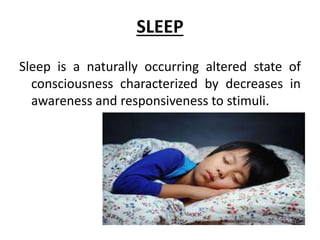
SLEEP
Sleep is a naturally occurring altered state of
consciousness characterized by decreases in
awareness and responsiveness to stimuli.
PHYSIOLOGY OF SLEEP
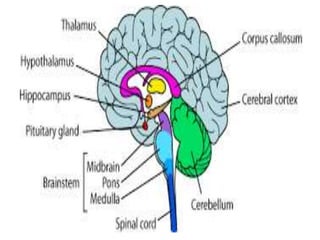
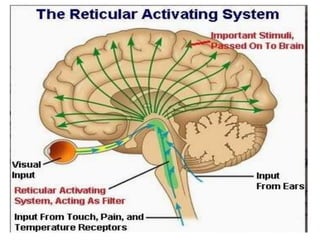
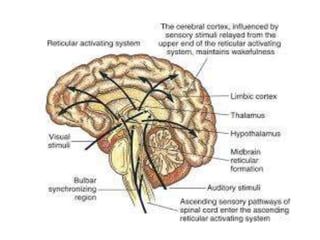
• Two systems in brain stem, the reticular
activating system and the bulbar synchronizing
region are believed to work together to control
the cyclic nature of sleep
• The reticular formation is found in the brain stem
and comprises many nerve cells and fibers
• The fibers have connections that relay impulses
into the cerebral cortex and into the spinal cord
• Wakefulness occurs when the reticular system
is activated with stimuli from the cerebral
cortex and from periphery sensory organs and
cells.
• The hypothalamus has control centers for
several involuntary activities of the body, one
of which concerns sleeping and waking.
• Injury to the hypothalamus may cause a
person to sleep for abnormally long periods.
PHYSIOLOGIC FUNCTION
• The physiology of sleep can be discussed in
relation to two basic research approaches. The
approaches are the electro- physiologic
approach and neurotransmitter balance.
1. Electro- physiologic Approach
• Electro-physiologic changes in brain waves,
eye movements, and muscles show five sleep
stages. The first four stages are classified as
non-rapid eye movement (NREM) sleep and
the other stage is called rapid eye movement
(REM) sleep
Non-Rapid Eye Movement Sleep
• Stage 1: stage 1 is the transitional stage between
drowsiness and sleep. Muscles relax, respirations
become even and pulse rate decreases. This stage
usually lasts only a few minutes and if awakened
the person may say he or she was not asleep.
• Stage 2: Stage2 is still a relatively light sleep from
which the person is easily wakened. Rolling eye
movements continue and snoring may occur.
Cont…
• Stage 3 and stage 4: These stages constitute
“deep” sleep, some-times termed slow-wave
sleep. During this sleep, the muscles are
relaxed but muscles tone is maintained,
respirations are even and blood pressure,
pulse, temperature, urine formation and
oxygen consumption by muscle decrease. In
these stages snoring, sleepwalking and bed
wetting are most likely to occur. Strong stimuli
are necessary to awaken people during these
stages.
1. Rapid Eye Movement: (REM)
• REM sleep closely resembles wakefulness except
for very low muscle tone . The rapid eye
movement sleep may also be noted by careful
observation of tiny eye movements detectable
through closed lids. Blood pressure and pulse rate
show wide variations and may fluctuate rapidly.
Respirations are irregular and oxygen
consumption increases.
2. Neurotransmitter Balance:-
• Serotonin is a major neurotransmitter
associated with sleep. Serotonin is thought to
decrease the activity of the RAS, thereby
inducing and sustaining sleep. Other
neurotransmitters acetylcholine and nor-
epinephrine appear to be required for the
REM sleep cycle.
FACTORS AFFECTING SLEEP
• Physical activity: Activity and exercise
influence sleep by increasing fatigue. It
appears that physical activity increases both
REM and NREM sleep.
• Psychologic stress: Illness and situations in
daily living that cause Psychologic stress tend
to disturb sleep. Generally Psychologic stress
affects sleep.
Motivation:
A desire to be wakeful and alert helps
overcome sleepiness and sleep. E.g. a tired
person may be wakeful and alert when at a
party or when attending an interesting play
and when there is minimal motivation to be
awake, sleep generally follows.
Diet:
IT has long been believed that the dietary
amino acid acts to promote sleep. A small
protein snack before bed time was frequently
recommended for clients with insomnia.
carbohydrates appear to have an effect on
brain serotonin levels and promote feeling of
calmness and relaxation.
cont..
• Alcohol Intake: Alcoholic beverages when
used in moderation seem to help induce sleep
in some people.
• Caffeine-containing Beverages: caffeine is a
central nervous system stimulant. For many
people, beverages containing caffeine
interfere with the ability to fall a sleep e.g.
coffee, tea and chocolate etc.
cont..
• Smoking: The total withdrawal from smoking
may be associated with sleep disturbances.
Clients who stop smoking have an increase in
periods of day time sleepiness and report
restlessness at night.
• Environmental Factors: most people sleep
best in their usual home environments.
Sleeping in a strange or new environment
tends to influence both REM AND NREM
sleep.
cont..
• Lifestyle: Various lifestyles affect the ability to
sleep well. Sleep disorders are the major
problem associated with shift work and
developing a sleep pattern is difficult if the
shift changes periodically.
• Illness: Illness act as a physiologic and
psychologic stressor, as a result influences
sleep. Certain illnesses are more closely
related to sleep disturbances e.g. Gastric
secretions increases during REM sleep. Many
people with peptic ulcers awaken at night with
pain
Cont…
• Medications: sleep quality is also influenced
by certain drugs. The drugs which decrease
REM sleep are barbiturates, amphetamines
and antidepressants. Short-acting
benzodiazepines are used to initiate and
maintain sleep.
SLEEP DISORDERS
Insomnia
• It is most common sleep disorder. Insomnia is a
perception of inadequate sleep and characterized
by difficulty in initiating sleep and frequent
awakening from sleep.
• It may be caused by a neurochemical imbalance.
The syndrome is usually associated with a
decreased feeling of wellbeing during the day, a
deterioration of mood and motivation, decreased
attention span, low levels of energy and
concentration and increased fatigue
Hypersomnia
• Hypersomnia is a condition characterized by
excessive sleep, particularly during the day.
Although this may result from medical
conditions.
Narcolepsy
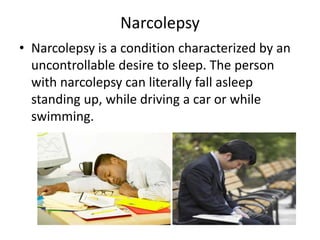
• Narcolepsy is a condition characterized by an
uncontrollable desire to sleep. The person
with narcolepsy can literally fall asleep
standing up, while driving a car or while
swimming.
PARASOMNIAS
• Parasomnias are patterns of waking behavior that
appear during sleep. Parasomnias are conditions
associated with activities that cause arousal or partial
arousal usually during NREM periods of sleep. They are
not life threatening but they disturb others. The
examples of parasomnias are;
• Somnambulism: sleep-walking
• Nocturnal enuresis: bedwetting
• Sleep-talking
• Nightmares and night terrors
• Bruxism: grinding of teeth
Sleep

Sleep

  • 1.
    SLEEP AND REST PRESENTEDBY Kshirabdhi Tanaya Tutor(mhn), SUM Nursing college S‘O’A DTU,Bbsr.
  • 2.
    SLEEP Sleep is anaturally occurring altered state of consciousness characterized by decreases in awareness and responsiveness to stimuli.
  • 3.
    PHYSIOLOGY OF SLEEP •Two systems in brain stem, the reticular activating system and the bulbar synchronizing region are believed to work together to control the cyclic nature of sleep • The reticular formation is found in the brain stem and comprises many nerve cells and fibers • The fibers have connections that relay impulses into the cerebral cortex and into the spinal cord
  • 7.
    • Wakefulness occurswhen the reticular system is activated with stimuli from the cerebral cortex and from periphery sensory organs and cells. • The hypothalamus has control centers for several involuntary activities of the body, one of which concerns sleeping and waking. • Injury to the hypothalamus may cause a person to sleep for abnormally long periods.
  • 8.
    PHYSIOLOGIC FUNCTION • Thephysiology of sleep can be discussed in relation to two basic research approaches. The approaches are the electro- physiologic approach and neurotransmitter balance.
  • 9.
    1. Electro- physiologicApproach • Electro-physiologic changes in brain waves, eye movements, and muscles show five sleep stages. The first four stages are classified as non-rapid eye movement (NREM) sleep and the other stage is called rapid eye movement (REM) sleep
  • 10.
    Non-Rapid Eye MovementSleep • Stage 1: stage 1 is the transitional stage between drowsiness and sleep. Muscles relax, respirations become even and pulse rate decreases. This stage usually lasts only a few minutes and if awakened the person may say he or she was not asleep. • Stage 2: Stage2 is still a relatively light sleep from which the person is easily wakened. Rolling eye movements continue and snoring may occur.
  • 11.
    Cont… • Stage 3and stage 4: These stages constitute “deep” sleep, some-times termed slow-wave sleep. During this sleep, the muscles are relaxed but muscles tone is maintained, respirations are even and blood pressure, pulse, temperature, urine formation and oxygen consumption by muscle decrease. In these stages snoring, sleepwalking and bed wetting are most likely to occur. Strong stimuli are necessary to awaken people during these stages.
  • 12.
    1. Rapid EyeMovement: (REM) • REM sleep closely resembles wakefulness except for very low muscle tone . The rapid eye movement sleep may also be noted by careful observation of tiny eye movements detectable through closed lids. Blood pressure and pulse rate show wide variations and may fluctuate rapidly. Respirations are irregular and oxygen consumption increases.
  • 13.
    2. Neurotransmitter Balance:- •Serotonin is a major neurotransmitter associated with sleep. Serotonin is thought to decrease the activity of the RAS, thereby inducing and sustaining sleep. Other neurotransmitters acetylcholine and nor- epinephrine appear to be required for the REM sleep cycle.
  • 14.
    FACTORS AFFECTING SLEEP •Physical activity: Activity and exercise influence sleep by increasing fatigue. It appears that physical activity increases both REM and NREM sleep. • Psychologic stress: Illness and situations in daily living that cause Psychologic stress tend to disturb sleep. Generally Psychologic stress affects sleep.
  • 15.
    Motivation: A desire tobe wakeful and alert helps overcome sleepiness and sleep. E.g. a tired person may be wakeful and alert when at a party or when attending an interesting play and when there is minimal motivation to be awake, sleep generally follows.
  • 16.
    Diet: IT has longbeen believed that the dietary amino acid acts to promote sleep. A small protein snack before bed time was frequently recommended for clients with insomnia. carbohydrates appear to have an effect on brain serotonin levels and promote feeling of calmness and relaxation.
  • 17.
    cont.. • Alcohol Intake:Alcoholic beverages when used in moderation seem to help induce sleep in some people. • Caffeine-containing Beverages: caffeine is a central nervous system stimulant. For many people, beverages containing caffeine interfere with the ability to fall a sleep e.g. coffee, tea and chocolate etc.
  • 18.
    cont.. • Smoking: Thetotal withdrawal from smoking may be associated with sleep disturbances. Clients who stop smoking have an increase in periods of day time sleepiness and report restlessness at night. • Environmental Factors: most people sleep best in their usual home environments. Sleeping in a strange or new environment tends to influence both REM AND NREM sleep.
  • 19.
    cont.. • Lifestyle: Variouslifestyles affect the ability to sleep well. Sleep disorders are the major problem associated with shift work and developing a sleep pattern is difficult if the shift changes periodically. • Illness: Illness act as a physiologic and psychologic stressor, as a result influences sleep. Certain illnesses are more closely related to sleep disturbances e.g. Gastric secretions increases during REM sleep. Many people with peptic ulcers awaken at night with pain
  • 20.
    Cont… • Medications: sleepquality is also influenced by certain drugs. The drugs which decrease REM sleep are barbiturates, amphetamines and antidepressants. Short-acting benzodiazepines are used to initiate and maintain sleep.
  • 21.
  • 22.
    Insomnia • It ismost common sleep disorder. Insomnia is a perception of inadequate sleep and characterized by difficulty in initiating sleep and frequent awakening from sleep. • It may be caused by a neurochemical imbalance. The syndrome is usually associated with a decreased feeling of wellbeing during the day, a deterioration of mood and motivation, decreased attention span, low levels of energy and concentration and increased fatigue
  • 23.
    Hypersomnia • Hypersomnia isa condition characterized by excessive sleep, particularly during the day. Although this may result from medical conditions.
  • 24.
    Narcolepsy • Narcolepsy isa condition characterized by an uncontrollable desire to sleep. The person with narcolepsy can literally fall asleep standing up, while driving a car or while swimming.
  • 25.
    PARASOMNIAS • Parasomnias arepatterns of waking behavior that appear during sleep. Parasomnias are conditions associated with activities that cause arousal or partial arousal usually during NREM periods of sleep. They are not life threatening but they disturb others. The examples of parasomnias are; • Somnambulism: sleep-walking • Nocturnal enuresis: bedwetting • Sleep-talking • Nightmares and night terrors • Bruxism: grinding of teeth