Sleep, sleep disorders Professor Yasser Metwally
Each of us will spend about  27 years  of our lifetime sleeping…..  … ..And  1/3 part  of the population has  sleep disorder  About the sleep…
„ Why we sleep remains one of nature’s greatest mysteries” (MG Frank, The function of sleep, 2006) Somatic theories of sleep function Neural metabolic theories: detoxification and regeneration Cognitive theories of sleep function: learning and brain development
Regulation of sleep Cirkadian timing:  lasts about 24 hours Hypothalamus Suprachiasmatic nucleus Pituitary gland: melatonin Ultradian timing :  lasts less than 24 hours  Prepontin nuclei Raphe nuclei L. coeruleus
Normal human sleep Sleep cycle  – occurs about every 90 minutes,  approximately 4-6 cycles occur per  major sleep episode Microarousal NREM (70-80%)  slow wave sleep heart rate, BP, breathing  ↓ body temperature, muscle tone  ↓   REM (20-25%)  rapid eye movement, paradox, fast wave sleep heart rate, BP, breathing  ↑ , metabolic rate  ↑   dreaming, erection muscleatonia, BUT: myoclonus!
NREM stage (3-8%) ~  drowsiness, sleepiness  EEG:  α -activity, muscle tone, eye movement ↓, myoclonus!  stage (45-55%) ~ EEG: K-complexes, sleep spindles, no  eye movement stage (5-10%)  EEG: delta waves stage (15-20%)  slow wave sleep
Tonic   stage (desyncronized EEG ~ low voltage, frequency  ↑ , muscle atonia)  Phasic   stage (rapid eye movements ~ fast, saccadic eye movements ~, irregular breathing, heart rate  ↑ , myoclonus, apnea, hyperpnea, dreaming!!!) REM
Sleep disorders
Polysomnography multiparametric monitoring during 1 sleep period (1 night)  EEG Electrooculogram EMG ECG Respiratory effort  SpO 2   Body position Snoring
More than 80 sleep disorders are known   (International Classification of Sleep Disorders, 2 nd  Edition American Academy of Sleep Medicine, 2005) Insomnias  (33%) Sleep related breathing disorders  (1,4-40%) Hypersomnias  (0,3-16,3%) Cirkadian rhythm sleep disorders Parasomnia  Sleep related movement disorders Isolated symptoms, normal variants Other sleep disorders
Traditional classification of sleep disorders Dyssomnias :  abnormalities in the quantity, quality or timing of sleep. They are associated with difficulty initiating or maintaining the sleep or daytime sleepiness. Parasomnias :  abnormal behavioral or physiological events occurring during sleep but don’t involve the sleep mechanisms per se.
I. Insomnias Difficulty in initiating sleep or in staying asleep or waking up earlier Nonrefreshing, nonrestorative sleep Fatigue, concentration or memory impairment Mood disturbances, motivation, initiative reduction Daytime sleepiness Tension headache
I. Insomnias Prevalence: 33% Accompanied with daytime consequences: 10% Last less than 1 month: 4%  (transient insomnia) Last more than 1 year: 85%  (persistent insomnia) Male:female = 1:1.4 Increase with age:  above 65 years: 50%
I. Insomnias Primary (idiopathic) Secunder Inadequate sleep hygiene (10%) Paradoxical insomnia (10%) Insomnia due to mental disorder (30-40%) Psychophysiological insomnia (15%) Insomnia due to drug or substance Insomnia due to medical conditions  Sunday night insomnia
Treatment Treating the medical or psychiatric conditions (sec. insomnias) Nonpharmacologic:  behavioral treatments: normalizing the circadian rhythm  sleep hygiene cognitive behavior therapy sleep restriction therapy Pharmacologic treatment
Pharmacologic treatment Benzodiazepines midazolam, triazolam  ~  rebound insomnia cinolazepam, quazepam brotizolam, temazepam  nitrazepam  ~  drowsiness
Pharmacologic treatment Selective GABA A  agonists: nonbenzodiazepines no rebound insomnia zolpidem, zopiclon Melatonin receptor agonist ramelteon
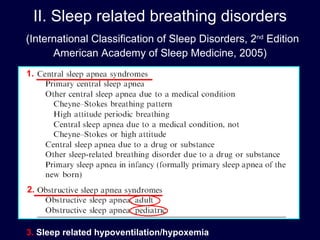
II. Sleep related breathing disorders   (International Classification of Sleep Disorders, 2 nd  Edition American Academy of Sleep Medicine, 2005) 3.  Sleep related hypoventilation/hypoxemia 1. 2.
Apnea-hypopnea index (AHI) Numbers of apneas and hypopneas/ 1 sleeping hour Severity of sleep related breathing disorders:   Normal:  AHI<5/h Mild:  AHI: 5-15/h Moderate:  AHI:16-30/h Sever:  AHI>30/h Sleep, 1999:22:667-89.
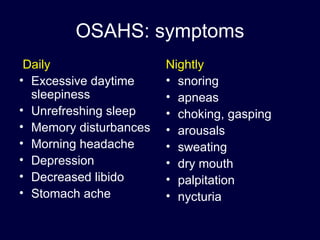
OSAHS: symptoms Daily Excessive daytime sleepiness Unrefreshing sleep Memory disturbances Morning headache Depression Decreased libido Stomach ache Nightly snoring apneas choking, gasping arousals sweating dry mouth palpitation nycturia
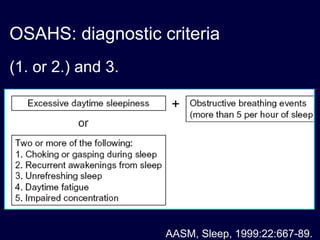
OSAHS: diagnostic criteria (1. or 2.) and 3. AASM, Sleep, 1999:22:667-89.
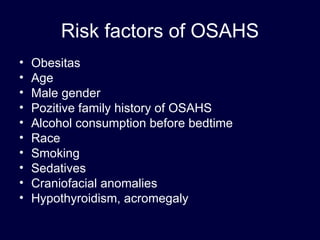
Risk factors of OSAHS Obesitas Age Male gender Pozitive family history of OSAHS Alcohol consumption before bedtime Race Smoking Sedatives Craniofacial anomalies Hypothyroidism, acromegaly
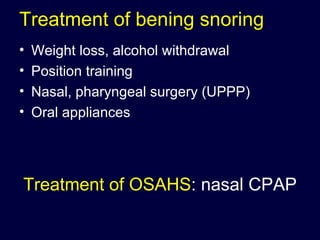
Treatment of bening snoring Weight loss, alcohol withdrawal  Position training Nasal, pharyngeal surgery (UPPP)  Oral appliances Treatment of OSAHS : nasal CPAP
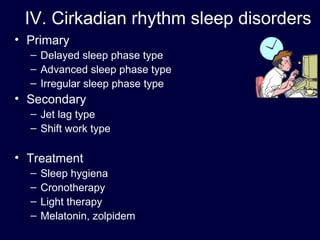
IV. Cirkadian rhythm sleep disorders Primary Delayed sleep phase type  Advanced sleep phase type  Irregular sleep phase type Secondary Jet lag type Shift work type Treatment  Sleep hygiena  Cronotherapy Light therapy Melatonin, zolpidem
V. Parasomnias In NREM Myoclonus Enuresis nocturna Pavor nocturnus, night terrors Sleep walking  - somnambulism Bruxism In REM Nightmares REM sleep behavior disorder
VI. Sleep related movement disorders Restless legs syndroma Therapy: dopamin agonists Periodic limb movement disorder Sleep related leg cramps  Sleep related rhythmic movement disorder

Sleep disorders

  • 1.
    Sleep, sleep disordersProfessor Yasser Metwally
  • 2.
    Each of uswill spend about 27 years of our lifetime sleeping….. … ..And 1/3 part of the population has sleep disorder About the sleep…
  • 3.
    „ Why wesleep remains one of nature’s greatest mysteries” (MG Frank, The function of sleep, 2006) Somatic theories of sleep function Neural metabolic theories: detoxification and regeneration Cognitive theories of sleep function: learning and brain development
  • 4.
    Regulation of sleepCirkadian timing: lasts about 24 hours Hypothalamus Suprachiasmatic nucleus Pituitary gland: melatonin Ultradian timing : lasts less than 24 hours Prepontin nuclei Raphe nuclei L. coeruleus
  • 5.
    Normal human sleepSleep cycle – occurs about every 90 minutes, approximately 4-6 cycles occur per major sleep episode Microarousal NREM (70-80%) slow wave sleep heart rate, BP, breathing ↓ body temperature, muscle tone ↓ REM (20-25%) rapid eye movement, paradox, fast wave sleep heart rate, BP, breathing ↑ , metabolic rate ↑ dreaming, erection muscleatonia, BUT: myoclonus!
  • 6.
    NREM stage (3-8%)~ drowsiness, sleepiness EEG: α -activity, muscle tone, eye movement ↓, myoclonus! stage (45-55%) ~ EEG: K-complexes, sleep spindles, no eye movement stage (5-10%) EEG: delta waves stage (15-20%) slow wave sleep
  • 7.
    Tonic stage (desyncronized EEG ~ low voltage, frequency ↑ , muscle atonia) Phasic stage (rapid eye movements ~ fast, saccadic eye movements ~, irregular breathing, heart rate ↑ , myoclonus, apnea, hyperpnea, dreaming!!!) REM
  • 8.
  • 9.
    Polysomnography multiparametric monitoringduring 1 sleep period (1 night) EEG Electrooculogram EMG ECG Respiratory effort SpO 2 Body position Snoring
  • 10.
    More than 80sleep disorders are known (International Classification of Sleep Disorders, 2 nd Edition American Academy of Sleep Medicine, 2005) Insomnias (33%) Sleep related breathing disorders (1,4-40%) Hypersomnias (0,3-16,3%) Cirkadian rhythm sleep disorders Parasomnia Sleep related movement disorders Isolated symptoms, normal variants Other sleep disorders
  • 11.
    Traditional classification ofsleep disorders Dyssomnias : abnormalities in the quantity, quality or timing of sleep. They are associated with difficulty initiating or maintaining the sleep or daytime sleepiness. Parasomnias : abnormal behavioral or physiological events occurring during sleep but don’t involve the sleep mechanisms per se.
  • 12.
    I. Insomnias Difficultyin initiating sleep or in staying asleep or waking up earlier Nonrefreshing, nonrestorative sleep Fatigue, concentration or memory impairment Mood disturbances, motivation, initiative reduction Daytime sleepiness Tension headache
  • 13.
    I. Insomnias Prevalence:33% Accompanied with daytime consequences: 10% Last less than 1 month: 4% (transient insomnia) Last more than 1 year: 85% (persistent insomnia) Male:female = 1:1.4 Increase with age: above 65 years: 50%
  • 14.
    I. Insomnias Primary(idiopathic) Secunder Inadequate sleep hygiene (10%) Paradoxical insomnia (10%) Insomnia due to mental disorder (30-40%) Psychophysiological insomnia (15%) Insomnia due to drug or substance Insomnia due to medical conditions Sunday night insomnia
  • 15.
    Treatment Treating themedical or psychiatric conditions (sec. insomnias) Nonpharmacologic: behavioral treatments: normalizing the circadian rhythm sleep hygiene cognitive behavior therapy sleep restriction therapy Pharmacologic treatment
  • 16.
    Pharmacologic treatment Benzodiazepinesmidazolam, triazolam ~ rebound insomnia cinolazepam, quazepam brotizolam, temazepam nitrazepam ~ drowsiness
  • 17.
    Pharmacologic treatment SelectiveGABA A agonists: nonbenzodiazepines no rebound insomnia zolpidem, zopiclon Melatonin receptor agonist ramelteon
  • 18.
    II. Sleep relatedbreathing disorders (International Classification of Sleep Disorders, 2 nd Edition American Academy of Sleep Medicine, 2005) 3. Sleep related hypoventilation/hypoxemia 1. 2.
  • 19.
    Apnea-hypopnea index (AHI)Numbers of apneas and hypopneas/ 1 sleeping hour Severity of sleep related breathing disorders: Normal: AHI<5/h Mild: AHI: 5-15/h Moderate: AHI:16-30/h Sever: AHI>30/h Sleep, 1999:22:667-89.
  • 20.
    OSAHS: symptoms DailyExcessive daytime sleepiness Unrefreshing sleep Memory disturbances Morning headache Depression Decreased libido Stomach ache Nightly snoring apneas choking, gasping arousals sweating dry mouth palpitation nycturia
  • 21.
    OSAHS: diagnostic criteria(1. or 2.) and 3. AASM, Sleep, 1999:22:667-89.
  • 22.
    Risk factors ofOSAHS Obesitas Age Male gender Pozitive family history of OSAHS Alcohol consumption before bedtime Race Smoking Sedatives Craniofacial anomalies Hypothyroidism, acromegaly
  • 23.
    Treatment of beningsnoring Weight loss, alcohol withdrawal Position training Nasal, pharyngeal surgery (UPPP) Oral appliances Treatment of OSAHS : nasal CPAP
  • 24.
    IV. Cirkadian rhythmsleep disorders Primary Delayed sleep phase type Advanced sleep phase type Irregular sleep phase type Secondary Jet lag type Shift work type Treatment Sleep hygiena Cronotherapy Light therapy Melatonin, zolpidem
  • 25.
    V. Parasomnias InNREM Myoclonus Enuresis nocturna Pavor nocturnus, night terrors Sleep walking - somnambulism Bruxism In REM Nightmares REM sleep behavior disorder
  • 26.
    VI. Sleep relatedmovement disorders Restless legs syndroma Therapy: dopamin agonists Periodic limb movement disorder Sleep related leg cramps Sleep related rhythmic movement disorder