It is what a baby always does,
A child forced to do,
An adolescent pretends to do,
A mother wants to do,
last but not the least A nurse logs to do……
SLEEP
SLEEPAND ITS
DISORDERS
BY JOSLIN JOSEPH
1ST YEAR MSc NURSING
S.N.D.T. WOMEN’S UNIVERSITY
L.T. COLLEGE OF NURSING
AIMS
At the end of the seminar the group
will be able to understand/ recollect sleep
pattern and its disturbances.
OBJECTIVES
The group will be able to:
 Define sleep.
 Describe physiology of sleep.
 Enumerate the stages of sleep.
 Explain the sleep requirements and pattern.
 Describe the sleep cycle.
 List and explain the Lifespan considerations growth via.
 Understand and enumerate the common sleep disorders or
disturbances.
 Enlist and describe the assessment, nursing diagnosis and
management of sleep.
DEFINITION
Sleep is a naturally recurring state of mind
characterized by altered consciousness, relatively
inhibited sensory activity, inhibition of nearly all
voluntary muscles, and reduced interactions with
surroundings.
PHYSIOLOGY OF SLEEP
 Reticular activating system(RAS) and bulbar synchronizing
region controls cyclic nature of sleep.
 During sleep RAS experiences few stimuli from the
cerebral cortex and the periphery of the body.
 Wakefulness occurs when this system is activated with
stimuli from the cerebral cortex and from periphery sensory
organs and cells.
 Norepinephrine and acetylcholine, in addition to dopamine,
serotonin and histamine are involved with excitation.
 Gamma-aminobutryric acid(GABA) appears to be
necessary for inhibition.
STAGES OF SLEEP
o Non-rapid eye movement (NREM)
sleep
o Rapid eye movement (REM) sleep
NREM Sleep
 NREM Sleep (comprising about 75% of total sleep)
consists of four stages.
 Stage I and stage II consuming about 5% and 50% of a
person’s sleep time, respectively, are light sleep.
 Stages III and IV, each representing about 10% of total
sleep time, are deep-sleep stages, termed delta sleep or
slow-wave sleep.
CHARACTERISTICS
STAGE I
 Transitional stage
between wakefulness and
sleep.
 A relaxed state
 Involuntary muscle
jerking
 Stage normally lasts only
minutes.
 Can be aroused easily.
 constitutes only about 5%
of total sleep.
STAGE II
 Person falls into a stage
of sleep.
 Can be aroused with
relative ease.
 Constitutes 50% to 55%
of sleep.
STAGE III
 Depth of sleep
increase and arousal
becomes increasingly
difficult.
 Composes about 10%
of sleep.
STAGE IV
 Reaches the greatest
depth of sleep.
 Arousal from sleep is
difficult.
 Physiologic changes
in the body
REM Sleep
 It is more difficult to arouse a person during
REM sleep than during NREM sleep.
 In normal adults, the REM state consumes 20%
to 25% of a person’s nightly sleep time.
 People who are awakened during the REM state
almost always report that they have been
dreaming.
 A person who is deprived of REM sleep for
several nights generally then spend more time in
REM sleep on successive nights. This
phenomenon, termed REM rebound, allows the
total amount of REM sleep to remain fairly
constant over time.
CHARACTERISTICS
 Eyes dart back and forth quickly.
 Small muscle twitching, such as on the face.
 Large muscle immobility, resembling
paralysis.
 Respirations irregular; sometimes
interspersed with apnea.
 Rapid or irregular pulse.
 Blood pressure increases of fluctuates.
 Increase in gastric secretions.
 Metabolism increases; body
temperature increases.
 Encephalogram tracings active.
 REM sleep enters from stage II of
NREM sleep and reenters NREM sleep
at stage II; arousal from sleep difficult.
 Constitutes of about 20% to 25% of
sleep.
SLEEP REQUIRMENTS AND
PATTERN
 8 hours of sleep at night has been the accepted
standard for adults.
 On the average, infants require 14 to 20 hours
each day.
 Growing children require from 10 to 14 hours of
sleep.
 for adults is 7 to 9 hours.
 Sleep pattern for older adults vary.
 Patterns of sleep periodicity appear to be learned.
FACTORS AFFECTING
SLEEP
 Developmental considerations
 Motivation
 Culture
 Lifestyle habits
 Environmental factors
 Psychological stress
SLEEP CYCLE
LIFE SPAN
CONSIDERATIONS
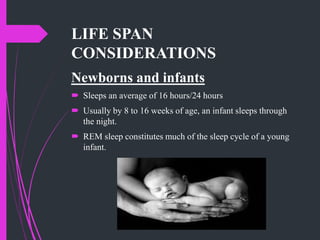
Newborns and infants
 Sleeps an average of 16 hours/24 hours
 Usually by 8 to 16 weeks of age, an infant sleeps through
the night.
 REM sleep constitutes much of the sleep cycle of a young
infant.
Toddlers
 May initially sleep 12 hours at night with two
naps during the day and end this stage sleeping 8
to 10 a night and napping once during the day.
 Begin to resist naps and going to bed at night.
Preschoolers
 Sleep 9to16 hours at night, with 12 hours being the
average.
 The rem sleep pattern is similar to that of an adult.
 Daytime napping decreases
 This age group may continue to resist going to bed at night.
School-aged Children
10-12 hours of sleep.
Sleep needs usually increase when
physical growth peaks.
Adolescents
 The growth spurt that normally occurs at this
stage may necessitate the need for more sleep.
 Many adolescents do not get enough sleep.
Young Adults
 Average amount of sleep required is 8 hours
 Sleep is affected by many factors; physical
health, type of occupation, lifestyle etc.
 Rem sleep averages about 20% of sleep.
Middle-Aged adults
 Total sleep time decreases during these years
with a decrease in stage IV sleep.
 The percentage of time spend awake in bed
begins to increase.
 Individuals become more aware of sleep
disturbances during this period.
Older Adults
 Average of 5 to 7 hours of sleep
 Sleep is less sound and stage IV sleep is absent
or considerably decreased. Periods of REM sleep
shorten.
 Elderly people frequently have great difficulty
falling asleep and have more complaints of
problems sleeping.
SLEEP DISORDERS
A nurse who interviews a patient to obtain a sleep
history needs to understand common sleep disturbances to
recognize significant data.
The more common sleep disorders are the
dyssomnias and parasomnias.
 Dyssomnias: they are sleep disorders characterized by
insomnias or excessive sleepiness.
 Parasomnias: they are patterns of waking behavior that
appear during sleep
INSOMNIA
 Insomnia is difficulty falling asleep or staying asleep, even
when a person has the chance to do so.
Based on its duration it is classified as:
• Acute insomnia- it is brief and often happens because of
life circumstances.
• Chronic insomnia- is disrupted sleep that occurs at least
three nights per week and lasts at least three months.
Causes:
 Insomnia can be caused by psychiatric and medical
conditions, unhealthy sleep habits, specific substances,
and/or certain biological factors.
 Nasal/sinus allergies
 Gastrointestinal problems such as reflux
 Endocrine problems such as hyperthyroidism
 Arthritis
 Asthma
 Neurological conditions such as Parkinson's disease
 Chronic pain
 Low back pain
HOW INSOMNIA IS RELATED?
 Insomnia & Depression - by psychiatric conditions such
as depression.
 Insomnia & Anxiety - Most adults have had some trouble
sleeping because they feel worried.
 Insomnia & Lifestyle - Unhealthy lifestyles and sleep
habits can create insomnia.
 Insomnia & Food- Alcohol , Caffeine, Nicotine, Heavy
meals, etc.
 Insomnia & The Brain- may be caused by certain
neurotransmitters in the brain that are known to be
involved with sleep and wakefulness.
RESEARCH
A 2005 National Sleep Foundation poll found that
people who drank four or more cups/cans of caffeinated
drinks a day were more likely than those who drank zero
to one cups/cans daily to experience at least one symptom
of insomnia at least a few nights each week.
Symptoms
 Difficulty falling asleep
 Difficulty staying asleep (waking up during the night and having
trouble returning to sleep)
 Waking up too early in the morning
 Unrefreshing sleep (also called "non-restorative sleep")
 Fatigue or low energy
 Cognitive impairment, such as difficulty concentrating
 Mood disturbance, such as irritability
 Behavior problems, such as feeling impulsive or aggression
 Difficulty at work or school
 Difficulty in personal relationships, including family, friends and
caregivers
DIAGNOSTIC TEST
Sleep log
Blood tests
Sleep study
Treatment
 Non-Medical (Cognitive & Behavioral) Treatments for
Insomnia
 There are psychological and behavioral techniques that can be
helpful for treating insomnia.
 Relaxation training, or progressive muscle relaxation, teaches
the person to systematically tense and relax muscles in different
areas of the body.
 Stimulus control helps to build an association between the
bedroom and sleep by limiting the type of activities allowed in the
bedroom.
 Cognitive behavioral therapy (CBT) includes behavioral
changes
 Major classes of prescription insomnia medications include
benzodiazepine hypnotics, non-benzodiazepine hypnotics, and
melatonin receptor agonists.
Hypersomnia
 It is a sleep related disorder that causes excessive daytime
sleepiness in people, often regardless of the presence of
other sleeping disorders, or poor sleep hygiene.
 People with hypersomnia will often sleep in excess of 10
hours
 Hypersomnia is a relatively rare sleeping disorder, affecting
under 1% of the population. It is slightly more common in
females than in males, and typically starts in early
adulthood. It is very rarely found in children.
DIAGNOSIS
 Polysomnogram and multiple sleep latency tests are both
good tools in detecting hypersomnia and other sleeping
disorders.
 The multiple sleep latency test measures the speed at which
a person enters deep sleep over numerous 2 hour intervals.
 People with hypersomnia and other related disorders like
narcolepsy tend to fall asleep very quickly, and this is
considered the best test for detected these sleeping
disorders.
 The polysomnogram test measures the subject’s brain
waves and bodily movements during sleep phases, and this
is good for detecting other sleep disorders that may be
leading to the daytime sleepiness.
TREATMENT
 Hypersomnia is most commonly treated with stimulants like
amphetamine and modafinil.
 Antidepressants, Behavioural changes are also instituted in
most cases, and for those with idiopathic hypersomnia, this
is one of the only treatment methods available at present.
 Proper sleep hygiene is the most important behavioural
change that must be implemented.
Narcolepsy
 It is a neurological disorder caused by the
brain's inability to regulate sleep-wake
cycles normally.
 The main features of narcolepsy
are fatigue and cataplexy.
 . Its prevalence in the developed world is
approximately the same as that
of multiple sclerosis or Parkinson's
disease
 Despite the perception that people with
narcolepsy are perpetually sleepy, they do
not typically sleep more than the average
person.
 Narcolepsy is considered a "state
boundary" control abnormality.
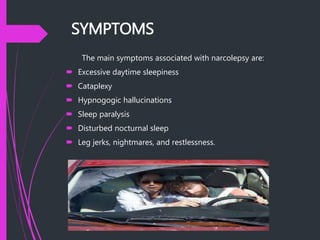
SYMPTOMS
The main symptoms associated with narcolepsy are:
 Excessive daytime sleepiness
 Cataplexy
 Hypnogogic hallucinations
 Sleep paralysis
 Disturbed nocturnal sleep
 Leg jerks, nightmares, and restlessness.
TREATMENT
 Treatment for narcolepsy includes the use of medication as
well as behavioral therapy.
 Behavioral therapies
 Counseling
 Antidepressants are also often used to treat cataplexy,
hypnagogic hallucinations and sleep paralysis.
 sodium oxybate, a strong sleep-inducing agent, may be
given at night to improve disturbed nocturnal sleep and
reduce daytime sleepiness and cataplexy.
Sleep Apnea
 Obstructive sleep apnea is a sleep disorder in which
breathing is briefly and repeatedly interrupted during sleep.
 Obstructive sleep apnea occurs when the muscles in the
back of the throat fail to keep the airway open, despite
efforts to breathe.
Symptoms
 Chronic snoring
 Difficulty concentrating
 Depression, irritability
 Sexual dysfunction
 Learning and memory difficulties
 Falling asleep while at work
 On the phone or driving.
TREATMENT
 The treatment of choice for obstructive sleep apnea is
continuous positive airway pressure device (CPAP).
 Second-line methods of treating sleep apnea include dental
appliances, which reposition the lower jaw and tongue, and
upper airway surgery to remove tissue in the airway. In
general, these approaches are most helpful for mild disease
or heavy snoring.
 Lose weight
 Avoid alcohol
 Quit smoking
Restless Legs Syndrome (RLS)
 Restless Legs Syndrome (RLS), also known as Willis-Ekbom
Disease, is a neurologic sensorimotor disorder that is
characterized by an overwhelming urge to move the legs
when they are at rest.
 The urge to move the legs is usually, but not always,
accompanied by unpleasant sensations.
 RLS symptoms occur during inactivity and they are
temporarily relieved by movement or pressure
CAUSES
 The exact cause of RLS is unknown.
 Primary RLS is the most common type of RLS. It is also
referred to as familial (because it is hereditary) or idiopathic
(because the causes are unknown) RLS.
 Secondary RLS, on the other hand, is believed to be caused
by a separate underlying medical condition or in association
with the use of certain drugs.
RESEARCH
recent studies at Johns Hopkins and Pennsylvania State
Colleges have found evidence for brain iron deficiency as a
cause for primary RLS. This was first demonstrated in
cerebrospinal fluid studies and more recently by the first-ever
autopsy analysis of the brains of people with RLS. The
autopsy studies reported that cells from the portion of the brain
called the substantia nigra showed a deficit in one of the
proteins that regulates iron status. However, this evidence
suggests that the iron insufficiency in the brain of RLS patients
comes directly from a failure of normal iron regulation. In
terms of finding a cure, this is good news.
The results of this study show that there is no brain damage in
people with RLS and that drugs that target the problem of iron
uptake may be one way to approach future developments of a
treatment.
Symptoms
 The urge to move the legs is usually, but not always,
accompanied by unpleasant sensations.
 The symptoms of restless legs syndrome (RLS) are often
difficult to put into words, as each person’s experience with
RLS is different. Some people use comparisons, such as
"like ants crawling through my legs" or "like soda running
through my veins" to try to describe the symptoms and
feelings
Treatment
 Lifestyle changes
 Underlying iron or vitamin deficiency
 Healthy and balanced
 Horizant® (gabapentin enacarbil) was approved by the
FDA in 2011 for the treatment of moderate-to-severe
primary RLS.
 Mirapex® was approved by the fda in 2006 for the
treatment of moderate-to-severe primary rls.
 Requip® (ropinirole hydrochloride), a drug commonly
used to treat parkinson disease, was given fda approval at
lower doses for the treatment of moderate-to-severe
primary rls in 2005.
HOME REMEDIES
 walking
 massaging the legs
 stretching
 hot or cold packs
 vibration
 acupressure.
 Practicing relaxation techniques such as meditation or yoga
have been known to alleviate symptoms
Sleep Deprivation
 Sleep deprivation occurs when an individual fails to get
enough sleep.
CAUSES:
 Voluntary behavior People who engage in voluntary, but
unintentional, chronic sleep deprivation are classified as
having a sleep disorder called behaviorally induced
insufficient sleep syndrome.
 Work hours
 Personal obligations
SYMPTOMS
 Mood
 Irritability
 Lack of motivation
 Anxiety
 Symptoms of depression
 Performance
 Lack of concentration
 Attention deficits
 Reduced vigilance
 Longer reaction times
 Distractibility
 Lack of energy
 Fatigue
 Restlessness
 Lack of coordination
 Forgetfulness
TREATMENT:
The only sure way for an individual to overcome sleep
deprivation is to increase nightly sleep time to satisfy his or
her biological sleep need; there is no substitute for sufficient
sleep.
PARASOMNIAS
 The term “parasomnia” refers to all the abnormal things that
can happen to people while they sleep, apart from sleep
apnea .
 Some examples are sleep-related eating
disorder, sleepwalking nightmares, sleep paralysis, REM
sleep behavior disorder, and sleep aggression. Sexsomnia,
sometimes called “sleepsex,” is also a parasomnia. It refers
to sexual acts that are carried out by a person who is
sleeping. Parasomnias can have negative effects on people
during the daytime, including sleepiness.
 Parasomnias can occur as a person is falling asleep or at any
point in the sleep cycle.
 Sleep paralysis can be quite frightening, especially when it
occurs with hallucinations.
ASSESSMENT OF PATIENTS
WITH SLEEP DISORDERS
 Usual sleep
 Time of sleeping and waking time
 Number of hours of undisturbed sleep
 Quality of sleep
 No. of naps
 Effect on daily chores
 Energy level
 Means of relaxing before bedtime
 Bedtime rituals
 Sleep environment
 Pharmacological aids
 Nature of sleep disturbance
 Onset
 Cause
 Severity
 Symptoms
 Interventions attempted and its result
SLEEP AND ITS DISORDERS

SLEEP AND ITS DISORDERS

  • 1.
    It is whata baby always does, A child forced to do, An adolescent pretends to do, A mother wants to do, last but not the least A nurse logs to do…… SLEEP
  • 2.
    SLEEPAND ITS DISORDERS BY JOSLINJOSEPH 1ST YEAR MSc NURSING S.N.D.T. WOMEN’S UNIVERSITY L.T. COLLEGE OF NURSING
  • 3.
    AIMS At the endof the seminar the group will be able to understand/ recollect sleep pattern and its disturbances.
  • 4.
    OBJECTIVES The group willbe able to:  Define sleep.  Describe physiology of sleep.  Enumerate the stages of sleep.  Explain the sleep requirements and pattern.  Describe the sleep cycle.  List and explain the Lifespan considerations growth via.  Understand and enumerate the common sleep disorders or disturbances.  Enlist and describe the assessment, nursing diagnosis and management of sleep.
  • 5.
    DEFINITION Sleep is anaturally recurring state of mind characterized by altered consciousness, relatively inhibited sensory activity, inhibition of nearly all voluntary muscles, and reduced interactions with surroundings.
  • 6.
    PHYSIOLOGY OF SLEEP Reticular activating system(RAS) and bulbar synchronizing region controls cyclic nature of sleep.  During sleep RAS experiences few stimuli from the cerebral cortex and the periphery of the body.  Wakefulness occurs when this system is activated with stimuli from the cerebral cortex and from periphery sensory organs and cells.  Norepinephrine and acetylcholine, in addition to dopamine, serotonin and histamine are involved with excitation.  Gamma-aminobutryric acid(GABA) appears to be necessary for inhibition.
  • 7.
    STAGES OF SLEEP oNon-rapid eye movement (NREM) sleep o Rapid eye movement (REM) sleep
  • 8.
    NREM Sleep  NREMSleep (comprising about 75% of total sleep) consists of four stages.  Stage I and stage II consuming about 5% and 50% of a person’s sleep time, respectively, are light sleep.  Stages III and IV, each representing about 10% of total sleep time, are deep-sleep stages, termed delta sleep or slow-wave sleep.
  • 9.
    CHARACTERISTICS STAGE I  Transitionalstage between wakefulness and sleep.  A relaxed state  Involuntary muscle jerking  Stage normally lasts only minutes.  Can be aroused easily.  constitutes only about 5% of total sleep. STAGE II  Person falls into a stage of sleep.  Can be aroused with relative ease.  Constitutes 50% to 55% of sleep.
  • 10.
    STAGE III  Depthof sleep increase and arousal becomes increasingly difficult.  Composes about 10% of sleep. STAGE IV  Reaches the greatest depth of sleep.  Arousal from sleep is difficult.  Physiologic changes in the body
  • 11.
    REM Sleep  Itis more difficult to arouse a person during REM sleep than during NREM sleep.  In normal adults, the REM state consumes 20% to 25% of a person’s nightly sleep time.  People who are awakened during the REM state almost always report that they have been dreaming.  A person who is deprived of REM sleep for several nights generally then spend more time in REM sleep on successive nights. This phenomenon, termed REM rebound, allows the total amount of REM sleep to remain fairly constant over time.
  • 12.
    CHARACTERISTICS  Eyes dartback and forth quickly.  Small muscle twitching, such as on the face.  Large muscle immobility, resembling paralysis.  Respirations irregular; sometimes interspersed with apnea.  Rapid or irregular pulse.  Blood pressure increases of fluctuates.
  • 13.
     Increase ingastric secretions.  Metabolism increases; body temperature increases.  Encephalogram tracings active.  REM sleep enters from stage II of NREM sleep and reenters NREM sleep at stage II; arousal from sleep difficult.  Constitutes of about 20% to 25% of sleep.
  • 14.
    SLEEP REQUIRMENTS AND PATTERN 8 hours of sleep at night has been the accepted standard for adults.  On the average, infants require 14 to 20 hours each day.  Growing children require from 10 to 14 hours of sleep.  for adults is 7 to 9 hours.  Sleep pattern for older adults vary.  Patterns of sleep periodicity appear to be learned.
  • 15.
    FACTORS AFFECTING SLEEP  Developmentalconsiderations  Motivation  Culture  Lifestyle habits  Environmental factors  Psychological stress
  • 16.
  • 17.
    LIFE SPAN CONSIDERATIONS Newborns andinfants  Sleeps an average of 16 hours/24 hours  Usually by 8 to 16 weeks of age, an infant sleeps through the night.  REM sleep constitutes much of the sleep cycle of a young infant.
  • 18.
    Toddlers  May initiallysleep 12 hours at night with two naps during the day and end this stage sleeping 8 to 10 a night and napping once during the day.  Begin to resist naps and going to bed at night.
  • 19.
    Preschoolers  Sleep 9to16hours at night, with 12 hours being the average.  The rem sleep pattern is similar to that of an adult.  Daytime napping decreases  This age group may continue to resist going to bed at night.
  • 20.
    School-aged Children 10-12 hoursof sleep. Sleep needs usually increase when physical growth peaks.
  • 21.
    Adolescents  The growthspurt that normally occurs at this stage may necessitate the need for more sleep.  Many adolescents do not get enough sleep.
  • 22.
    Young Adults  Averageamount of sleep required is 8 hours  Sleep is affected by many factors; physical health, type of occupation, lifestyle etc.  Rem sleep averages about 20% of sleep.
  • 23.
    Middle-Aged adults  Totalsleep time decreases during these years with a decrease in stage IV sleep.  The percentage of time spend awake in bed begins to increase.  Individuals become more aware of sleep disturbances during this period.
  • 24.
    Older Adults  Averageof 5 to 7 hours of sleep  Sleep is less sound and stage IV sleep is absent or considerably decreased. Periods of REM sleep shorten.  Elderly people frequently have great difficulty falling asleep and have more complaints of problems sleeping.
  • 25.
    SLEEP DISORDERS A nursewho interviews a patient to obtain a sleep history needs to understand common sleep disturbances to recognize significant data. The more common sleep disorders are the dyssomnias and parasomnias.  Dyssomnias: they are sleep disorders characterized by insomnias or excessive sleepiness.  Parasomnias: they are patterns of waking behavior that appear during sleep
  • 26.
    INSOMNIA  Insomnia isdifficulty falling asleep or staying asleep, even when a person has the chance to do so. Based on its duration it is classified as: • Acute insomnia- it is brief and often happens because of life circumstances. • Chronic insomnia- is disrupted sleep that occurs at least three nights per week and lasts at least three months.
  • 27.
    Causes:  Insomnia canbe caused by psychiatric and medical conditions, unhealthy sleep habits, specific substances, and/or certain biological factors.  Nasal/sinus allergies  Gastrointestinal problems such as reflux  Endocrine problems such as hyperthyroidism  Arthritis  Asthma  Neurological conditions such as Parkinson's disease  Chronic pain  Low back pain
  • 28.
    HOW INSOMNIA ISRELATED?  Insomnia & Depression - by psychiatric conditions such as depression.  Insomnia & Anxiety - Most adults have had some trouble sleeping because they feel worried.  Insomnia & Lifestyle - Unhealthy lifestyles and sleep habits can create insomnia.  Insomnia & Food- Alcohol , Caffeine, Nicotine, Heavy meals, etc.  Insomnia & The Brain- may be caused by certain neurotransmitters in the brain that are known to be involved with sleep and wakefulness.
  • 29.
    RESEARCH A 2005 NationalSleep Foundation poll found that people who drank four or more cups/cans of caffeinated drinks a day were more likely than those who drank zero to one cups/cans daily to experience at least one symptom of insomnia at least a few nights each week.
  • 30.
    Symptoms  Difficulty fallingasleep  Difficulty staying asleep (waking up during the night and having trouble returning to sleep)  Waking up too early in the morning  Unrefreshing sleep (also called "non-restorative sleep")  Fatigue or low energy  Cognitive impairment, such as difficulty concentrating  Mood disturbance, such as irritability  Behavior problems, such as feeling impulsive or aggression  Difficulty at work or school  Difficulty in personal relationships, including family, friends and caregivers
  • 31.
  • 32.
    Treatment  Non-Medical (Cognitive& Behavioral) Treatments for Insomnia  There are psychological and behavioral techniques that can be helpful for treating insomnia.  Relaxation training, or progressive muscle relaxation, teaches the person to systematically tense and relax muscles in different areas of the body.  Stimulus control helps to build an association between the bedroom and sleep by limiting the type of activities allowed in the bedroom.  Cognitive behavioral therapy (CBT) includes behavioral changes  Major classes of prescription insomnia medications include benzodiazepine hypnotics, non-benzodiazepine hypnotics, and melatonin receptor agonists.
  • 33.
    Hypersomnia  It isa sleep related disorder that causes excessive daytime sleepiness in people, often regardless of the presence of other sleeping disorders, or poor sleep hygiene.  People with hypersomnia will often sleep in excess of 10 hours  Hypersomnia is a relatively rare sleeping disorder, affecting under 1% of the population. It is slightly more common in females than in males, and typically starts in early adulthood. It is very rarely found in children.
  • 34.
    DIAGNOSIS  Polysomnogram andmultiple sleep latency tests are both good tools in detecting hypersomnia and other sleeping disorders.  The multiple sleep latency test measures the speed at which a person enters deep sleep over numerous 2 hour intervals.  People with hypersomnia and other related disorders like narcolepsy tend to fall asleep very quickly, and this is considered the best test for detected these sleeping disorders.  The polysomnogram test measures the subject’s brain waves and bodily movements during sleep phases, and this is good for detecting other sleep disorders that may be leading to the daytime sleepiness.
  • 35.
    TREATMENT  Hypersomnia ismost commonly treated with stimulants like amphetamine and modafinil.  Antidepressants, Behavioural changes are also instituted in most cases, and for those with idiopathic hypersomnia, this is one of the only treatment methods available at present.  Proper sleep hygiene is the most important behavioural change that must be implemented.
  • 36.
    Narcolepsy  It isa neurological disorder caused by the brain's inability to regulate sleep-wake cycles normally.  The main features of narcolepsy are fatigue and cataplexy.  . Its prevalence in the developed world is approximately the same as that of multiple sclerosis or Parkinson's disease  Despite the perception that people with narcolepsy are perpetually sleepy, they do not typically sleep more than the average person.  Narcolepsy is considered a "state boundary" control abnormality.
  • 37.
    SYMPTOMS The main symptomsassociated with narcolepsy are:  Excessive daytime sleepiness  Cataplexy  Hypnogogic hallucinations  Sleep paralysis  Disturbed nocturnal sleep  Leg jerks, nightmares, and restlessness.
  • 38.
    TREATMENT  Treatment fornarcolepsy includes the use of medication as well as behavioral therapy.  Behavioral therapies  Counseling  Antidepressants are also often used to treat cataplexy, hypnagogic hallucinations and sleep paralysis.  sodium oxybate, a strong sleep-inducing agent, may be given at night to improve disturbed nocturnal sleep and reduce daytime sleepiness and cataplexy.
  • 39.
    Sleep Apnea  Obstructivesleep apnea is a sleep disorder in which breathing is briefly and repeatedly interrupted during sleep.  Obstructive sleep apnea occurs when the muscles in the back of the throat fail to keep the airway open, despite efforts to breathe.
  • 40.
    Symptoms  Chronic snoring Difficulty concentrating  Depression, irritability  Sexual dysfunction  Learning and memory difficulties  Falling asleep while at work  On the phone or driving.
  • 41.
    TREATMENT  The treatmentof choice for obstructive sleep apnea is continuous positive airway pressure device (CPAP).  Second-line methods of treating sleep apnea include dental appliances, which reposition the lower jaw and tongue, and upper airway surgery to remove tissue in the airway. In general, these approaches are most helpful for mild disease or heavy snoring.  Lose weight  Avoid alcohol  Quit smoking
  • 42.
    Restless Legs Syndrome(RLS)  Restless Legs Syndrome (RLS), also known as Willis-Ekbom Disease, is a neurologic sensorimotor disorder that is characterized by an overwhelming urge to move the legs when they are at rest.  The urge to move the legs is usually, but not always, accompanied by unpleasant sensations.  RLS symptoms occur during inactivity and they are temporarily relieved by movement or pressure
  • 43.
    CAUSES  The exactcause of RLS is unknown.  Primary RLS is the most common type of RLS. It is also referred to as familial (because it is hereditary) or idiopathic (because the causes are unknown) RLS.  Secondary RLS, on the other hand, is believed to be caused by a separate underlying medical condition or in association with the use of certain drugs.
  • 44.
    RESEARCH recent studies atJohns Hopkins and Pennsylvania State Colleges have found evidence for brain iron deficiency as a cause for primary RLS. This was first demonstrated in cerebrospinal fluid studies and more recently by the first-ever autopsy analysis of the brains of people with RLS. The autopsy studies reported that cells from the portion of the brain called the substantia nigra showed a deficit in one of the proteins that regulates iron status. However, this evidence suggests that the iron insufficiency in the brain of RLS patients comes directly from a failure of normal iron regulation. In terms of finding a cure, this is good news. The results of this study show that there is no brain damage in people with RLS and that drugs that target the problem of iron uptake may be one way to approach future developments of a treatment.
  • 45.
    Symptoms  The urgeto move the legs is usually, but not always, accompanied by unpleasant sensations.  The symptoms of restless legs syndrome (RLS) are often difficult to put into words, as each person’s experience with RLS is different. Some people use comparisons, such as "like ants crawling through my legs" or "like soda running through my veins" to try to describe the symptoms and feelings
  • 46.
    Treatment  Lifestyle changes Underlying iron or vitamin deficiency  Healthy and balanced  Horizant® (gabapentin enacarbil) was approved by the FDA in 2011 for the treatment of moderate-to-severe primary RLS.  Mirapex® was approved by the fda in 2006 for the treatment of moderate-to-severe primary rls.  Requip® (ropinirole hydrochloride), a drug commonly used to treat parkinson disease, was given fda approval at lower doses for the treatment of moderate-to-severe primary rls in 2005.
  • 47.
    HOME REMEDIES  walking massaging the legs  stretching  hot or cold packs  vibration  acupressure.  Practicing relaxation techniques such as meditation or yoga have been known to alleviate symptoms
  • 48.
    Sleep Deprivation  Sleepdeprivation occurs when an individual fails to get enough sleep. CAUSES:  Voluntary behavior People who engage in voluntary, but unintentional, chronic sleep deprivation are classified as having a sleep disorder called behaviorally induced insufficient sleep syndrome.  Work hours  Personal obligations
  • 49.
    SYMPTOMS  Mood  Irritability Lack of motivation  Anxiety  Symptoms of depression  Performance  Lack of concentration  Attention deficits  Reduced vigilance  Longer reaction times
  • 50.
     Distractibility  Lackof energy  Fatigue  Restlessness  Lack of coordination  Forgetfulness TREATMENT: The only sure way for an individual to overcome sleep deprivation is to increase nightly sleep time to satisfy his or her biological sleep need; there is no substitute for sufficient sleep.
  • 51.
    PARASOMNIAS  The term“parasomnia” refers to all the abnormal things that can happen to people while they sleep, apart from sleep apnea .  Some examples are sleep-related eating disorder, sleepwalking nightmares, sleep paralysis, REM sleep behavior disorder, and sleep aggression. Sexsomnia, sometimes called “sleepsex,” is also a parasomnia. It refers to sexual acts that are carried out by a person who is sleeping. Parasomnias can have negative effects on people during the daytime, including sleepiness.  Parasomnias can occur as a person is falling asleep or at any point in the sleep cycle.  Sleep paralysis can be quite frightening, especially when it occurs with hallucinations.
  • 52.
    ASSESSMENT OF PATIENTS WITHSLEEP DISORDERS  Usual sleep  Time of sleeping and waking time  Number of hours of undisturbed sleep  Quality of sleep  No. of naps  Effect on daily chores  Energy level  Means of relaxing before bedtime  Bedtime rituals
  • 53.
     Sleep environment Pharmacological aids  Nature of sleep disturbance  Onset  Cause  Severity  Symptoms  Interventions attempted and its result