NURSING FUNDAMENTALS FOCUS IX

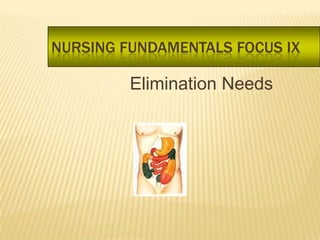
         Elimination Needs
OBJECTIVES:SOLID

   Describe the physiology of stool formation and the
    elimination process.
   List the common problems of bowel elimination.
   Discuss nursing responsibilities involved with each
    problem.
   Define and explain some of the basic but important
    measures to promote normal bowel elimination.
   Compare and contrast the different types of altered
    means of bowel elimination.
   Identify the procedures/technical skills and related
    nursing responsibilities.
   Identify the common diagnostic procedures related to
    the bowel elimination need and the associated
    nursing responsibilities
OBJECTIVES:FLUID

   Describe the normal micturition process mechanism.
   Discuss common conditions /situations responsible for
    a disruption in the normal micturition process.
   List the commonly recognizable signs (behaviors)
    indicating a disruption in urinary elimination.
   Compare and contrast the altered means of urinary
    elimination and explain the related procedures and
    nursing responsibilities.
   Report the basic but important nursing interventions
    to promote normal urinary elimination.
   Examine the common diagnostic procedures related to
    urinary elimination and the associated nursing
    responsibilities.
BLADDER AND BOWEL FUNCTION

Overview:
   The human body eliminates waste of metabolism
    through urine and stool.
   Normal function depends on these factors:
     - anatomic integrity
     - intact neurologic components for both voluntary and
       synergistic emptying
     - a predictable pattern of waste production
     - physical and mental ability and the psycho-social
        willingness to carry out toileting related tasks
Structures and Functions Related To
          Bowel Elimination


STRUCTURES AND FUNCTIONS
RELATED TO BOWEL ELIMINATION
DIGESTION
HTTP://WWW.MEDTROPOLIS.COM/VBODY.ASP
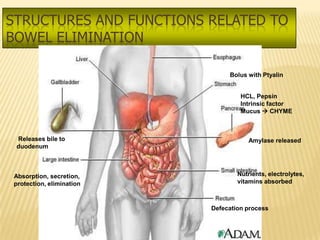
STRUCTURES AND FUNCTIONS RELATED TO
BOWEL ELIMINATION

                               Bolus with Ptyalin


                                   HCL, Pepsin
                                   Intrinsic factor
                                   Mucus  CHYME


 Releases bile to                     Amylase released
 duodenum


Absorption, secretion,            Nutrients, electrolytes,
protection, elimination           vitamins absorbed


                          Defecation process
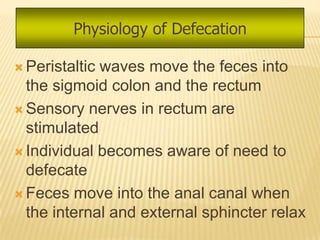
Physiology of Defecation

 Peristalticwaves move the feces into
  the sigmoid colon and the rectum
 Sensory nerves in rectum are
  stimulated
 Individual becomes aware of need to
  defecate
 Feces move into the anal canal when
  the internal and external sphincter relax
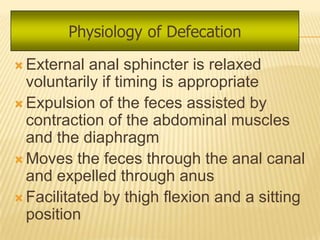
 External  anal sphincter is relaxed
  voluntarily if timing is appropriate
 Expulsion of the feces assisted by
  contraction of the abdominal muscles
  and the diaphragm
 Moves the feces through the anal canal
  and expelled through anus
 Facilitated by thigh flexion and a sitting
  position
FACTORS AFFECTING BOWEL
ELIMINATION

    Lifestyle
        Personal habits
        Nutrition and fluid intake
        Physical activity
    Culture
        Norms of western culture
    Age
        Infancy
        Elders
FACTORS AFFECTING BOWEL ELIMINATION

   Physiological factors
     Pregnancy

     Motor  and or sensory disturbance
     Intestinal pathology

     Medications

     Surgery and anesthesia

   Psychosocial factors
     Anxiety

     Depression
CHARACTERISTICS OF NORMAL
STOOL

 Color
 Odor

 Consistency

 Frequency

 Amount

 Shape

 Constituents
SELECTED FECAL ELIMINATION
PROBLEMS

Constipation

Diarrhea

Bowel  incontinence
Flatulence
CONSTIPATION
 A symptom not a disease
 Decreased frequency of defecation

 Hard, dry, formed stools

 Straining at stools

 Painful defecation

 Causes include:

 Insufficient fiber and fluid intake

 Insufficient activity

 Irregular habits
FECAL IMPACTION
 Mass or collection of hardened feces in folds
  of rectum that cannot be expelled
 Passage of liquid fecal seepage and no
  normal stool
 Causes usually:
       Poor defecation habits
       Results from unrelieved constipation
   Treatment
       Removed manually
       Must have physician order
       Monitor patient for Valsalva reaction
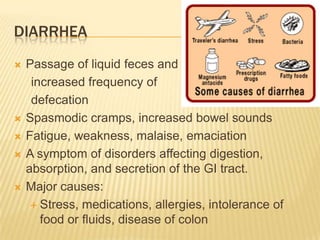
DIARRHEA
   Passage of liquid feces and
     increased frequency of
     defecation
   Spasmodic cramps, increased bowel sounds
   Fatigue, weakness, malaise, emaciation
   A symptom of disorders affecting digestion,
    absorption, and secretion of the GI tract.
   Major causes:
      Stress, medications, allergies, intolerance of
       food or fluids, disease of colon
FECAL INCONTINENCE
 Loss of voluntary ability to control fecal and
  gaseous discharges
 Generally associated with:
     Impaired functioning of anal sphincter or nerve
      supply
     Neuromuscular diseases
     Spinal trauma
     Tumor
   Nursing Considerations
     Incontinence can harm a clients body image
     Incontinence predisposes the skin to breakdown
FLATUENCE

 Excessive  flatus in intestines
 Leads to stretching and inflation of
  intestines
 Can occur from variety of causes:
  Foods

  Abdominal   surgery
  Narcotics
ASSESSMENT OF BOWEL FUNCTION

   History of bowel prior patterns
       usual time
       frequency of stool
       past reliance on aids
   Present status and pattern
       Time
       Characteristics of stool
   Medications that may affect bowel functioning
       sedatives
       diuretics
       antihistamines
ASSESSMENT OF BOWEL FUNCTION

   Infection, trauma, or stress may affect
    stool formation

   Physical Abdominal Assessment
       Inspection
       Auscultation
       Palpitation
           determine abdominal discomfort
           palpable obstruction would indicate need for rectal
            exam
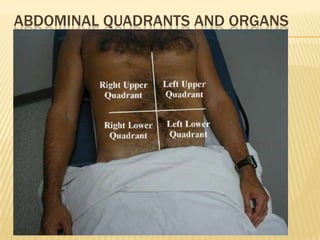
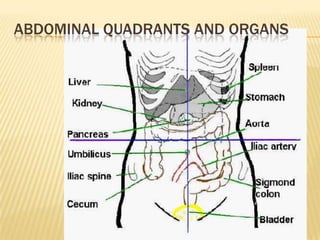
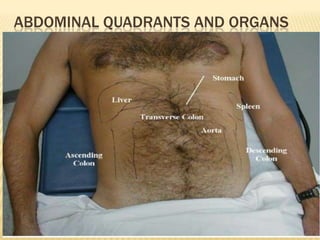
ABDOMINAL QUADRANTS AND ORGANS
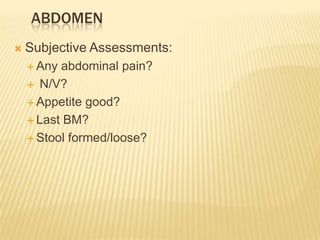
ABDOMEN
   Subjective Assessments:
     Any abdominal pain?
     N/V?

     Appetite good?

     Last BM?

     Stool formed/loose?
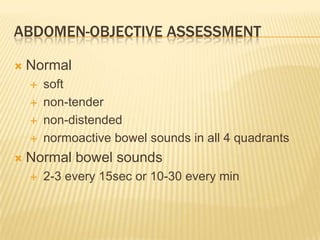
ABDOMEN-OBJECTIVE ASSESSMENT

   Normal
       soft
       non-tender
       non-distended
       normoactive bowel sounds in all 4 quadrants
   Normal bowel sounds
       2-3 every 15sec or 10-30 every min
ABDOMEN – ABNORMAL ASSESSMENTS
 Distended
 Rigid
 Tender
 Hypoactive bowel sounds (<10/min)
 Hyperactive bowel sounds (>30/min)
 Absence of bowel sounds
 Presence of mass
 Ascities
 Abnormal pulsations
 Tubes, drains, ostomies
AIDS TO NORMAL BOWEL ELIMINATION


   Fluid intake and fiber:

       Adequate fiber
       Adequate fluid intake
       Upright posture
CONSTIPATION
    Managing constipation:
   Diet
       25 -35 G of fiber + WATER!
   Medications
       Laxatives
       cathartics
   Enemas
       high – cleanse entire colon
       low – cleanse rectum and sigmoid colon
       hypotonic and isotonic
            – immediate large colonic emptying
       hypertonic and mineral - fleets
FECAL INCONTINENCE
Assessment key factors:

 Is the problem correctable or manageable?
 What is the timeline or duration of
  situation?
 Any associated symptoms?
NANDA NURSING DIAGNOSIS

 Bowel Incontinence
 Constipation

 Risk for Constipation

 Perceived Constipation

 Diarrhea
RELATED NURSING DIAGNOSIS

 Risk for Deficient Fluid Volume
 Risk for Impaired Skin Integrity

 Low Self-esteem

 Disturbed Body Image

 Deficient Knowledge
     Bowel Training
     Ostomy Management

     Anxiety
DESIRED OUTCOMES

 Maintain  or restore normal bowel
  elimination pattern
 Maintain or regain normal stool
  consistency
 Prevent associated risks such as fluid
  and electrolyte imbalance, skin
  breakdown, abdominal distention and
  pain
NURSING CONSIDERATIONS
 Promoting regular defecations
 Teaching about medications
 Decreasing flatulence
 Administering enemas
 Digital removal of a fecal impaction
       (if agency policy permits)
 Instituting bowel training programs
 Applying a fecal incontinence pouch
 Ostomy management
FECAL ELIMINATION PATTERNS

 Privacy

 Timing

 Nutrition   and fluids
 Exercise

 Positioning
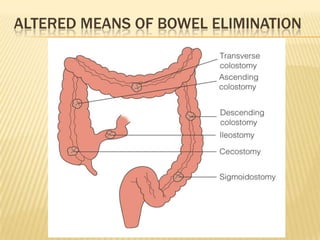
ALTERED MEANS OF BOWEL ELIMINATION


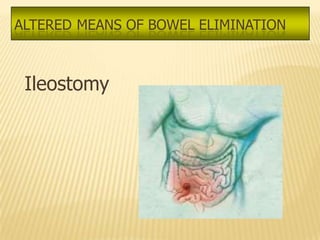
 Ileostomy
ALTERED MEANS OF BOWEL
ELIMINATION


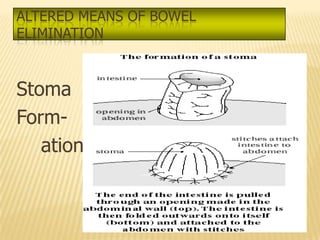
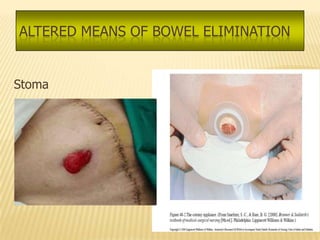
Stoma
Form-
   ation
ALTERED MEANS OF BOWEL ELIMINATION


Stoma
STOMA CARE FOR CLIENTS WITH AN OSTOMY

 Normal stoma should appear red and may
  bleed slightly when touched
 Assess the peristomal skin for irritation each
  time the appliance is changed
 Treat any irritation or skin breakdown
  immediately
 Keep skin clean by washing off any excretion
  and drying thoroughly
 Protect skin, collect stool, and control odor
  with an ostomy appliance
COMMON TESTS
   Direct Visualization
       fiber optic endoscopic instruments introduced through the
        mouth or rectum to inspect integrity of mucosa blood vessels,
        and organs.

   UGI Endoscopy

   Colonoscopy
http://www.swarminteractive.com/patient_ed_animations.html
COMMON TESTS

   Fecal specimens
     Ova   and Parasites


   Guaiac testing
     Hidden   (occult) blood
Urinary Elimination
KIDNEYS

http://www.youtube.com/watch?v=chhNaLi9P3E


Urine Formation
http://www.argosymedical.com/flash/urine_formation/landing.html
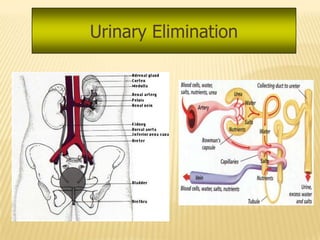
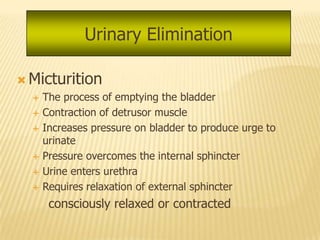
Urinary Elimination

 Micturition
   The process of emptying the bladder

   Contraction of detrusor muscle

   Increases pressure on bladder to produce urge to
    urinate
   Pressure overcomes the internal sphincter

   Urine enters urethra

   Requires relaxation of external sphincter

      consciously relaxed or contracted
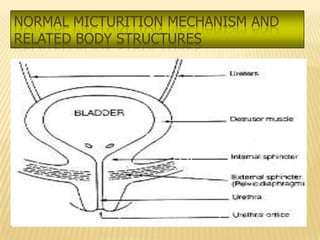
NORMAL MICTURITION MECHANISM AND
RELATED BODY STRUCTURES
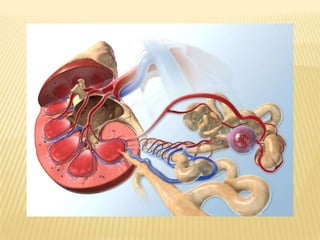
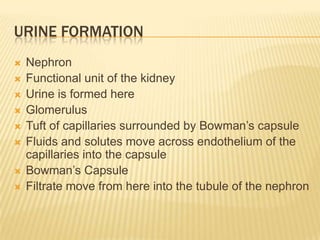
URINE FORMATION
   Nephron
   Functional unit of the kidney
   Urine is formed here
   Glomerulus
   Tuft of capillaries surrounded by Bowman’s capsule
   Fluids and solutes move across endothelium of the
    capillaries into the capsule
   Bowman’s Capsule
   Filtrate move from here into the tubule of the nephron
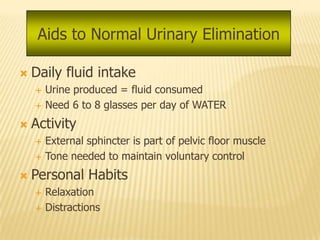
Aids to Normal Urinary Elimination

   Daily fluid intake
       Urine produced = fluid consumed
       Need 6 to 8 glasses per day of WATER
   Activity
       External sphincter is part of pelvic floor muscle
       Tone needed to maintain voluntary control
   Personal Habits
       Relaxation
       Distractions
STRUCTURES AND FUNCTIONS RELATED
TO FLUID ELIMINATION
   Characteristics of normal urine:

     Color

     Clarity

     Odor
ALTERED AMOUNT


   Oliguria
       Diminished, scanty amount <30cc

   Anuria
       absence of urine

   Polyuria
       >1500 cc/24 hours
       consider intake

   Enuresis
COMMON DISRUPTIONS IN URINARY
    ELIMINATION

   Dysuria
     Painful   urination:


     Frequency


     Hesitancy


     Urgency
COMMON DISRUPTIONS IN URINARY
    ELIMINATION
   Urinary Tract Infection (UTI)
     Can   occur anywhere in the urinary tract
       Cystitis

       Ureteritis

       Pyleonephritis

       More     common in women than
        men
COMMON DISRUPTIONS IN URINARY
    ELIMINATION

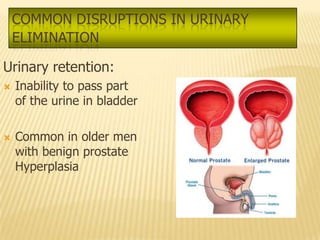
Urinary retention:
   Inability to pass part
    of the urine in bladder

   Common in older men
    with benign prostate
    Hyperplasia
COMMON DISRUPTIONS IN URINARY
     ELIMINATION
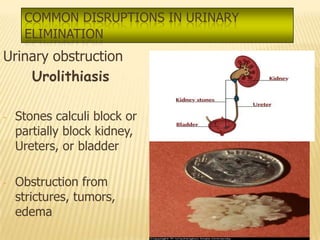
Urinary obstruction
    Urolithiasis

-   Stones calculi block or
    partially block kidney,
    Ureters, or bladder

-   Obstruction from
    strictures, tumors,
    edema
FORMS OF INCONTINENCE


Urinary Incontinence:
  Failure of major smooth muscle strength of
  Detrusor muscle of the bladder, instability
  or obstruction. Incontinences divided into 4
  types. Pt may have mixed pattern:
FORMS OF INCONTINENCE

   Urge Incontinence
    Urgency following strong sense to void
         Decreased bladder capacity
         Alcohol or caffeine ingestion
         infection


   Stress Incontinence
    Small amts with laughing, sneezing, coughing
         Urgency, frequency
FORMS OF INCONTINENCE

   Overflow Incontinence:
    Retention


   Functional Incontinence:
    Intact urinary and nervous system
        Change in environment
        Sensory, cognitive or mobility deficit
            Void before reaching bathroom
LOSS OF URINARY CONTROL
Nursing ASSESSMENT of Urinary Incontinence:
   Confirm factors related to episodes
   Determine cognitive function and the ability of patient
    to participate interventions
   Make observations during caregiving regarding the
    amount and frequency of loss of urine and situations
    surrounding incontinent episodes
   Assess abdominal and suprapubic palpation for
    tenderness and fullness
   Determine hydration status and possibility of
    constipation
   Ask specific questions regarding situations that lead to
    urine loss
ALTERED MEANS OF URINARY
ELIMINATION


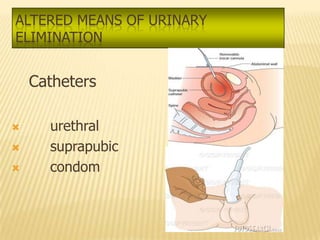
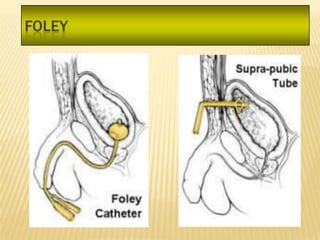
    Catheters

     urethral
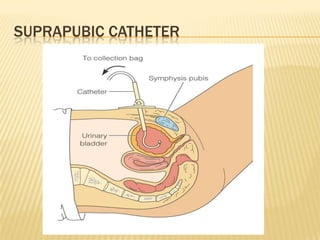
     suprapubic
     condom
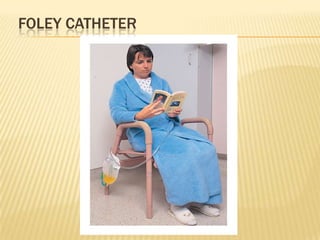
FOLEY CATHETER
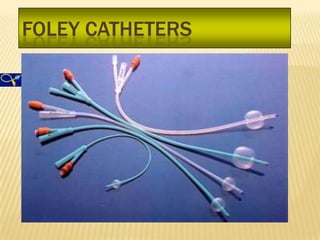
FOLEY CATHETERS
FOLEY


http://www.youtube.com/watch?v=tynS0E4hBn0
FOLEY
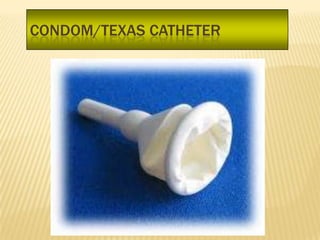
CONDOM/TEXAS CATHETER
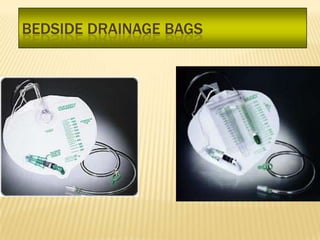
BEDSIDE DRAINAGE BAGS
SUPRAPUBIC CATHETER
ALTERED MEANS OF URINARY ELIMINATION
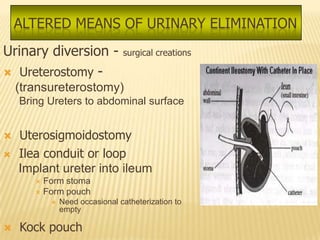
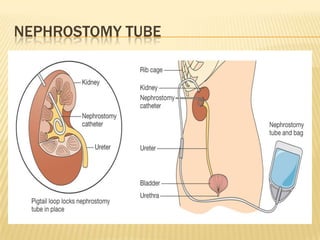
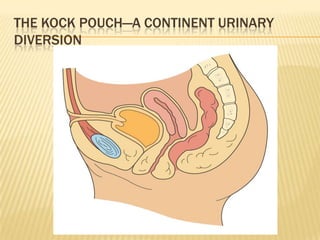
Urinary diversion -             surgical creations

 Ureterostomy -
    (transureterostomy)
    Bring Ureters to abdominal surface


   Uterosigmoidostomy
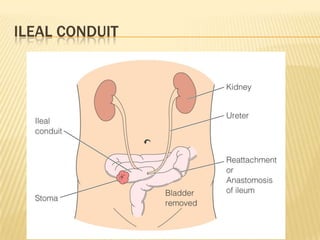
   Ilea conduit or loop
    Implant ureter into ileum
        Form stoma
        Form pouch
              Need occasional catheterization to
               empty

   Kock pouch
ILEAL CONDUIT
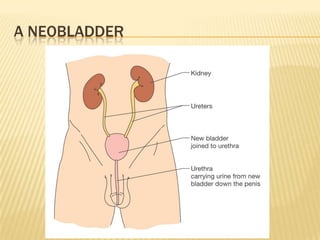
A NEOBLADDER
NEPHROSTOMY TUBE
THE KOCK POUCH—A CONTINENT URINARY
DIVERSION
COMMON TESTS

   BUN
   http://video.google.com/videoplay?docid=7519331476907982001&q=urinary+system&total=83&start=0&num=10&so=0&type
    =search&plindex=0


   Creatinine Clearance

   Urinalysis
COMMON TESTS

Visualization procedures
 KUB
An X-ray showing the kidney, ureter, and bladder. This is in reality a plain abdominal X-ray
    and
includes other structures such as the diaphragm above and the pelvis below.
http://trismus1.files.wordpress.com/2007/04/eg-kub_2_1withpaint.jpg


   Retrograde Pyleography

   CT scan

elimination, nursing

  • 1.
    NURSING FUNDAMENTALS FOCUSIX Elimination Needs
  • 2.
    OBJECTIVES:SOLID  Describe the physiology of stool formation and the elimination process.  List the common problems of bowel elimination.  Discuss nursing responsibilities involved with each problem.  Define and explain some of the basic but important measures to promote normal bowel elimination.  Compare and contrast the different types of altered means of bowel elimination.  Identify the procedures/technical skills and related nursing responsibilities.  Identify the common diagnostic procedures related to the bowel elimination need and the associated nursing responsibilities
  • 3.
    OBJECTIVES:FLUID  Describe the normal micturition process mechanism.  Discuss common conditions /situations responsible for a disruption in the normal micturition process.  List the commonly recognizable signs (behaviors) indicating a disruption in urinary elimination.  Compare and contrast the altered means of urinary elimination and explain the related procedures and nursing responsibilities.  Report the basic but important nursing interventions to promote normal urinary elimination.  Examine the common diagnostic procedures related to urinary elimination and the associated nursing responsibilities.
  • 4.
    BLADDER AND BOWELFUNCTION Overview:  The human body eliminates waste of metabolism through urine and stool.  Normal function depends on these factors: - anatomic integrity - intact neurologic components for both voluntary and synergistic emptying - a predictable pattern of waste production - physical and mental ability and the psycho-social willingness to carry out toileting related tasks
  • 5.
    Structures and FunctionsRelated To Bowel Elimination STRUCTURES AND FUNCTIONS RELATED TO BOWEL ELIMINATION DIGESTION HTTP://WWW.MEDTROPOLIS.COM/VBODY.ASP
  • 6.
    STRUCTURES AND FUNCTIONSRELATED TO BOWEL ELIMINATION Bolus with Ptyalin HCL, Pepsin Intrinsic factor Mucus  CHYME Releases bile to Amylase released duodenum Absorption, secretion, Nutrients, electrolytes, protection, elimination vitamins absorbed Defecation process
  • 7.
    Physiology of Defecation Peristalticwaves move the feces into the sigmoid colon and the rectum  Sensory nerves in rectum are stimulated  Individual becomes aware of need to defecate  Feces move into the anal canal when the internal and external sphincter relax
  • 8.
     External anal sphincter is relaxed voluntarily if timing is appropriate  Expulsion of the feces assisted by contraction of the abdominal muscles and the diaphragm  Moves the feces through the anal canal and expelled through anus  Facilitated by thigh flexion and a sitting position
  • 9.
    FACTORS AFFECTING BOWEL ELIMINATION  Lifestyle  Personal habits  Nutrition and fluid intake  Physical activity  Culture  Norms of western culture  Age  Infancy  Elders
  • 10.
    FACTORS AFFECTING BOWELELIMINATION  Physiological factors  Pregnancy  Motor and or sensory disturbance  Intestinal pathology  Medications  Surgery and anesthesia  Psychosocial factors  Anxiety  Depression
  • 11.
    CHARACTERISTICS OF NORMAL STOOL Color  Odor  Consistency  Frequency  Amount  Shape  Constituents
  • 12.
  • 13.
    CONSTIPATION  A symptomnot a disease  Decreased frequency of defecation  Hard, dry, formed stools  Straining at stools  Painful defecation  Causes include:  Insufficient fiber and fluid intake  Insufficient activity  Irregular habits
  • 14.
    FECAL IMPACTION  Massor collection of hardened feces in folds of rectum that cannot be expelled  Passage of liquid fecal seepage and no normal stool  Causes usually:  Poor defecation habits  Results from unrelieved constipation  Treatment  Removed manually  Must have physician order  Monitor patient for Valsalva reaction
  • 15.
    DIARRHEA  Passage of liquid feces and increased frequency of defecation  Spasmodic cramps, increased bowel sounds  Fatigue, weakness, malaise, emaciation  A symptom of disorders affecting digestion, absorption, and secretion of the GI tract.  Major causes:  Stress, medications, allergies, intolerance of food or fluids, disease of colon
  • 16.
    FECAL INCONTINENCE  Lossof voluntary ability to control fecal and gaseous discharges  Generally associated with:  Impaired functioning of anal sphincter or nerve supply  Neuromuscular diseases  Spinal trauma  Tumor  Nursing Considerations  Incontinence can harm a clients body image  Incontinence predisposes the skin to breakdown
  • 17.
    FLATUENCE  Excessive flatus in intestines  Leads to stretching and inflation of intestines  Can occur from variety of causes: Foods Abdominal surgery Narcotics
  • 18.
    ASSESSMENT OF BOWELFUNCTION  History of bowel prior patterns  usual time  frequency of stool  past reliance on aids  Present status and pattern  Time  Characteristics of stool  Medications that may affect bowel functioning  sedatives  diuretics  antihistamines
  • 19.
    ASSESSMENT OF BOWELFUNCTION  Infection, trauma, or stress may affect stool formation  Physical Abdominal Assessment  Inspection  Auscultation  Palpitation  determine abdominal discomfort  palpable obstruction would indicate need for rectal exam
  • 20.
  • 21.
  • 22.
  • 23.
    ABDOMEN  Subjective Assessments:  Any abdominal pain?  N/V?  Appetite good?  Last BM?  Stool formed/loose?
  • 24.
    ABDOMEN-OBJECTIVE ASSESSMENT  Normal  soft  non-tender  non-distended  normoactive bowel sounds in all 4 quadrants  Normal bowel sounds  2-3 every 15sec or 10-30 every min
  • 25.
    ABDOMEN – ABNORMALASSESSMENTS  Distended  Rigid  Tender  Hypoactive bowel sounds (<10/min)  Hyperactive bowel sounds (>30/min)  Absence of bowel sounds  Presence of mass  Ascities  Abnormal pulsations  Tubes, drains, ostomies
  • 26.
    AIDS TO NORMALBOWEL ELIMINATION  Fluid intake and fiber:  Adequate fiber  Adequate fluid intake  Upright posture
  • 27.
    CONSTIPATION Managing constipation:  Diet  25 -35 G of fiber + WATER!  Medications  Laxatives  cathartics  Enemas  high – cleanse entire colon  low – cleanse rectum and sigmoid colon  hypotonic and isotonic  – immediate large colonic emptying  hypertonic and mineral - fleets
  • 28.
    FECAL INCONTINENCE Assessment keyfactors:  Is the problem correctable or manageable?  What is the timeline or duration of situation?  Any associated symptoms?
  • 29.
    NANDA NURSING DIAGNOSIS Bowel Incontinence  Constipation  Risk for Constipation  Perceived Constipation  Diarrhea
  • 30.
    RELATED NURSING DIAGNOSIS Risk for Deficient Fluid Volume  Risk for Impaired Skin Integrity  Low Self-esteem  Disturbed Body Image  Deficient Knowledge  Bowel Training  Ostomy Management  Anxiety
  • 31.
    DESIRED OUTCOMES  Maintain or restore normal bowel elimination pattern  Maintain or regain normal stool consistency  Prevent associated risks such as fluid and electrolyte imbalance, skin breakdown, abdominal distention and pain
  • 32.
    NURSING CONSIDERATIONS  Promotingregular defecations  Teaching about medications  Decreasing flatulence  Administering enemas  Digital removal of a fecal impaction  (if agency policy permits)  Instituting bowel training programs  Applying a fecal incontinence pouch  Ostomy management
  • 33.
    FECAL ELIMINATION PATTERNS Privacy  Timing  Nutrition and fluids  Exercise  Positioning
  • 34.
    ALTERED MEANS OFBOWEL ELIMINATION
  • 35.
    ALTERED MEANS OFBOWEL ELIMINATION Ileostomy
  • 36.
    ALTERED MEANS OFBOWEL ELIMINATION Stoma Form- ation
  • 37.
    ALTERED MEANS OFBOWEL ELIMINATION Stoma
  • 38.
    STOMA CARE FORCLIENTS WITH AN OSTOMY  Normal stoma should appear red and may bleed slightly when touched  Assess the peristomal skin for irritation each time the appliance is changed  Treat any irritation or skin breakdown immediately  Keep skin clean by washing off any excretion and drying thoroughly  Protect skin, collect stool, and control odor with an ostomy appliance
  • 39.
    COMMON TESTS  Direct Visualization  fiber optic endoscopic instruments introduced through the mouth or rectum to inspect integrity of mucosa blood vessels, and organs.  UGI Endoscopy  Colonoscopy http://www.swarminteractive.com/patient_ed_animations.html
  • 40.
    COMMON TESTS  Fecal specimens  Ova and Parasites  Guaiac testing  Hidden (occult) blood
  • 41.
  • 42.
  • 44.
    Urinary Elimination  Micturition  The process of emptying the bladder  Contraction of detrusor muscle  Increases pressure on bladder to produce urge to urinate  Pressure overcomes the internal sphincter  Urine enters urethra  Requires relaxation of external sphincter consciously relaxed or contracted
  • 45.
    NORMAL MICTURITION MECHANISMAND RELATED BODY STRUCTURES
  • 46.
    URINE FORMATION  Nephron  Functional unit of the kidney  Urine is formed here  Glomerulus  Tuft of capillaries surrounded by Bowman’s capsule  Fluids and solutes move across endothelium of the capillaries into the capsule  Bowman’s Capsule  Filtrate move from here into the tubule of the nephron
  • 47.
    Aids to NormalUrinary Elimination  Daily fluid intake  Urine produced = fluid consumed  Need 6 to 8 glasses per day of WATER  Activity  External sphincter is part of pelvic floor muscle  Tone needed to maintain voluntary control  Personal Habits  Relaxation  Distractions
  • 48.
    STRUCTURES AND FUNCTIONSRELATED TO FLUID ELIMINATION  Characteristics of normal urine:  Color  Clarity  Odor
  • 49.
    ALTERED AMOUNT  Oliguria  Diminished, scanty amount <30cc  Anuria  absence of urine  Polyuria  >1500 cc/24 hours  consider intake  Enuresis
  • 50.
    COMMON DISRUPTIONS INURINARY ELIMINATION  Dysuria  Painful urination:  Frequency  Hesitancy  Urgency
  • 51.
    COMMON DISRUPTIONS INURINARY ELIMINATION  Urinary Tract Infection (UTI)  Can occur anywhere in the urinary tract Cystitis Ureteritis Pyleonephritis More common in women than men
  • 52.
    COMMON DISRUPTIONS INURINARY ELIMINATION Urinary retention:  Inability to pass part of the urine in bladder  Common in older men with benign prostate Hyperplasia
  • 53.
    COMMON DISRUPTIONS INURINARY ELIMINATION Urinary obstruction Urolithiasis - Stones calculi block or partially block kidney, Ureters, or bladder - Obstruction from strictures, tumors, edema
  • 54.
    FORMS OF INCONTINENCE UrinaryIncontinence: Failure of major smooth muscle strength of Detrusor muscle of the bladder, instability or obstruction. Incontinences divided into 4 types. Pt may have mixed pattern:
  • 55.
    FORMS OF INCONTINENCE  Urge Incontinence Urgency following strong sense to void  Decreased bladder capacity  Alcohol or caffeine ingestion  infection  Stress Incontinence Small amts with laughing, sneezing, coughing  Urgency, frequency
  • 56.
    FORMS OF INCONTINENCE  Overflow Incontinence: Retention  Functional Incontinence: Intact urinary and nervous system  Change in environment  Sensory, cognitive or mobility deficit  Void before reaching bathroom
  • 57.
    LOSS OF URINARYCONTROL Nursing ASSESSMENT of Urinary Incontinence:  Confirm factors related to episodes  Determine cognitive function and the ability of patient to participate interventions  Make observations during caregiving regarding the amount and frequency of loss of urine and situations surrounding incontinent episodes  Assess abdominal and suprapubic palpation for tenderness and fullness  Determine hydration status and possibility of constipation  Ask specific questions regarding situations that lead to urine loss
  • 58.
    ALTERED MEANS OFURINARY ELIMINATION Catheters  urethral  suprapubic  condom
  • 59.
  • 60.
  • 61.
  • 62.
  • 63.
  • 64.
  • 65.
  • 66.
    ALTERED MEANS OFURINARY ELIMINATION Urinary diversion - surgical creations  Ureterostomy - (transureterostomy) Bring Ureters to abdominal surface  Uterosigmoidostomy  Ilea conduit or loop Implant ureter into ileum  Form stoma  Form pouch  Need occasional catheterization to empty  Kock pouch
  • 67.
  • 68.
  • 69.
  • 70.
    THE KOCK POUCH—ACONTINENT URINARY DIVERSION
  • 71.
    COMMON TESTS  BUN  http://video.google.com/videoplay?docid=7519331476907982001&q=urinary+system&total=83&start=0&num=10&so=0&type =search&plindex=0  Creatinine Clearance  Urinalysis
  • 72.
    COMMON TESTS Visualization procedures KUB An X-ray showing the kidney, ureter, and bladder. This is in reality a plain abdominal X-ray and includes other structures such as the diaphragm above and the pelvis below. http://trismus1.files.wordpress.com/2007/04/eg-kub_2_1withpaint.jpg  Retrograde Pyleography  CT scan