BY
      Mr. SHON DAVIS
1ST   YEAR MSc NURSING
           MCON
A NURSE..

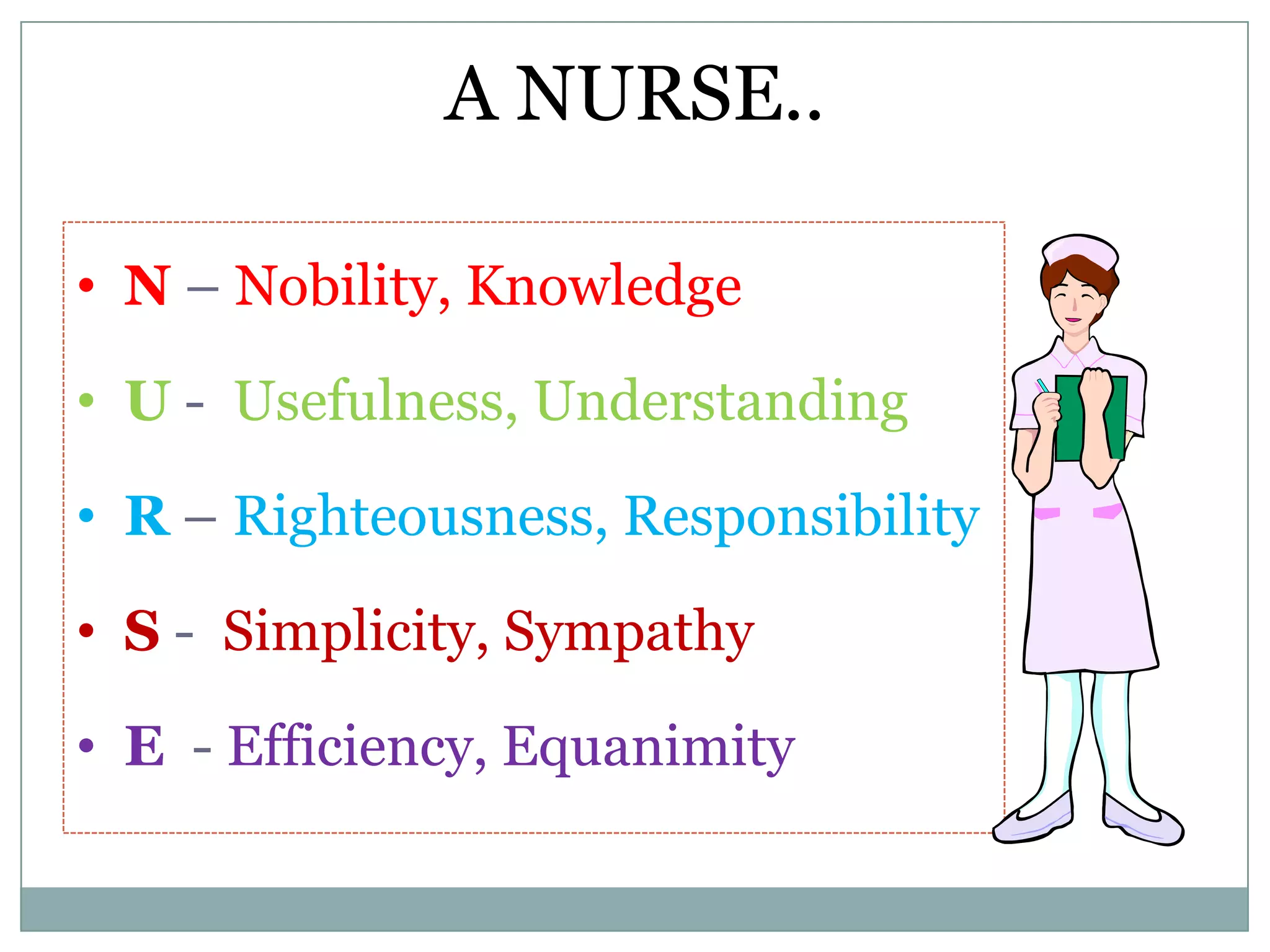
• N – Nobility, Knowledge

• U - Usefulness, Understanding

• R – Righteousness, Responsibility

• S - Simplicity, Sympathy

• E - Efficiency, Equanimity
Nursing is the unique function of the nurse, that is to assist the
  individual (sick or well) in the performance of those activities
  contributing to health or its recovery (or to a peaceful death) that
  he would perform unaided if he had the necessary strength, will or
  knowledge.”

                                       - ICN
According to ANA “Nursing is the
 protection, and optimisation of health and
 abilities, prevention of illness and
 injury, alleviation of suffering through the
 diagnosis and treatment of human response
 and advocacy in the care of
 individuals, families, communities and
 population.”
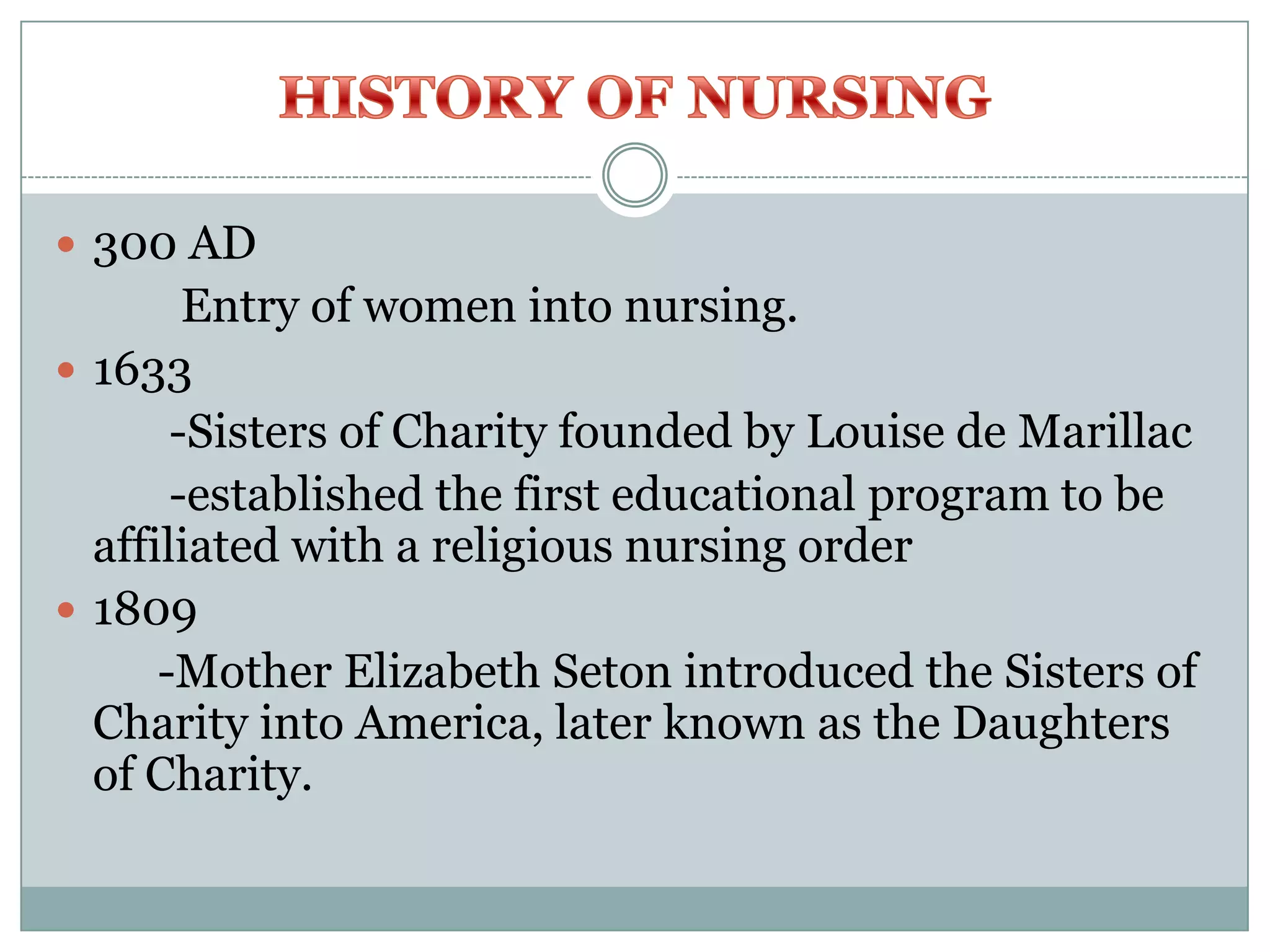
 300 AD
        Entry of women into nursing.
 1633
       -Sisters of Charity founded by Louise de Marillac
       -established the first educational program to be
  affiliated with a religious nursing order
 1809
      -Mother Elizabeth Seton introduced the Sisters of
  Charity into America, later known as the Daughters
  of Charity.
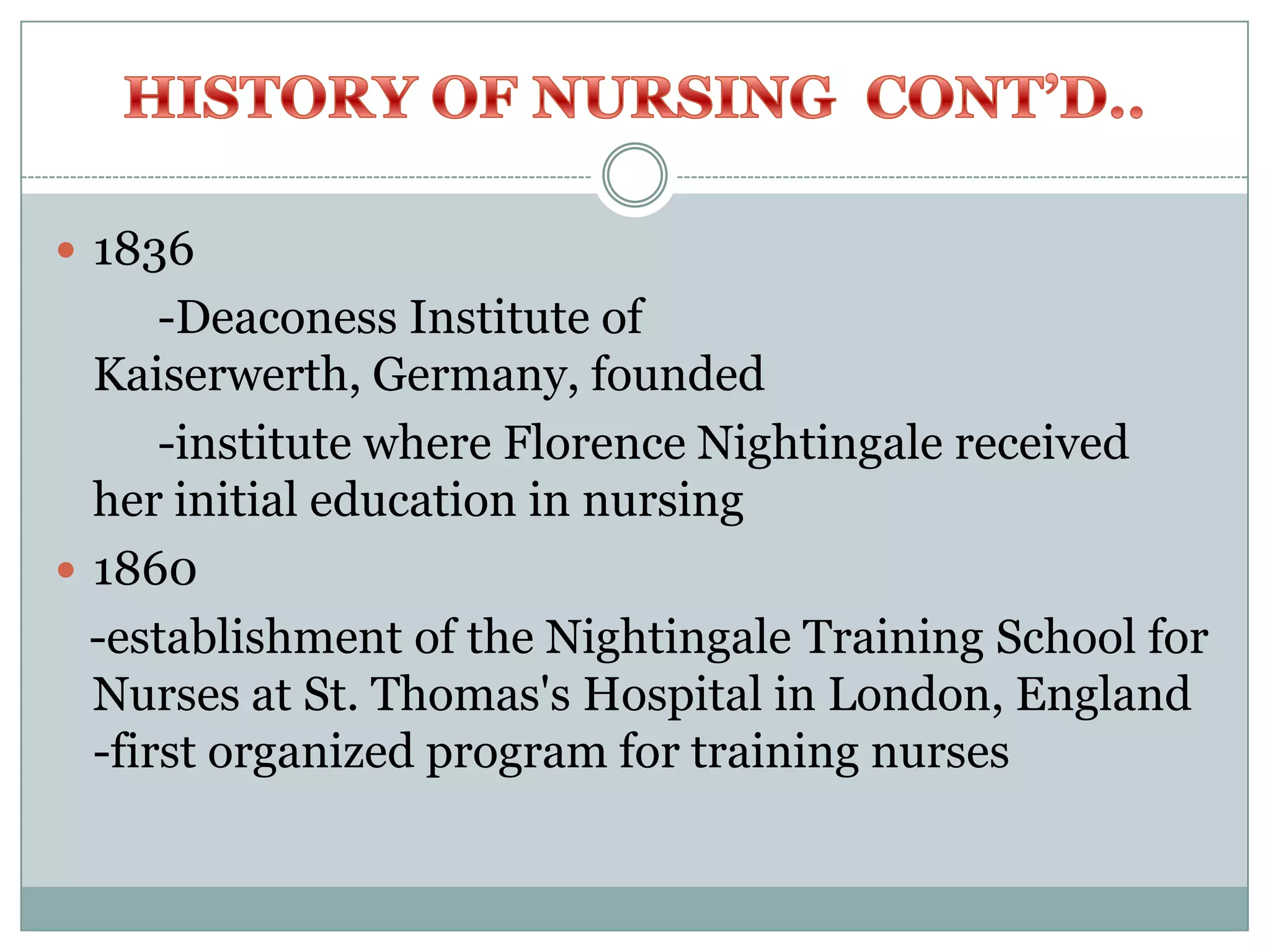
 1836
      -Deaconess Institute of
  Kaiserwerth, Germany, founded
      -institute where Florence Nightingale received
  her initial education in nursing
 1860
  -establishment of the Nightingale Training School for
  Nurses at St. Thomas's Hospital in London, England
  -first organized program for training nurses
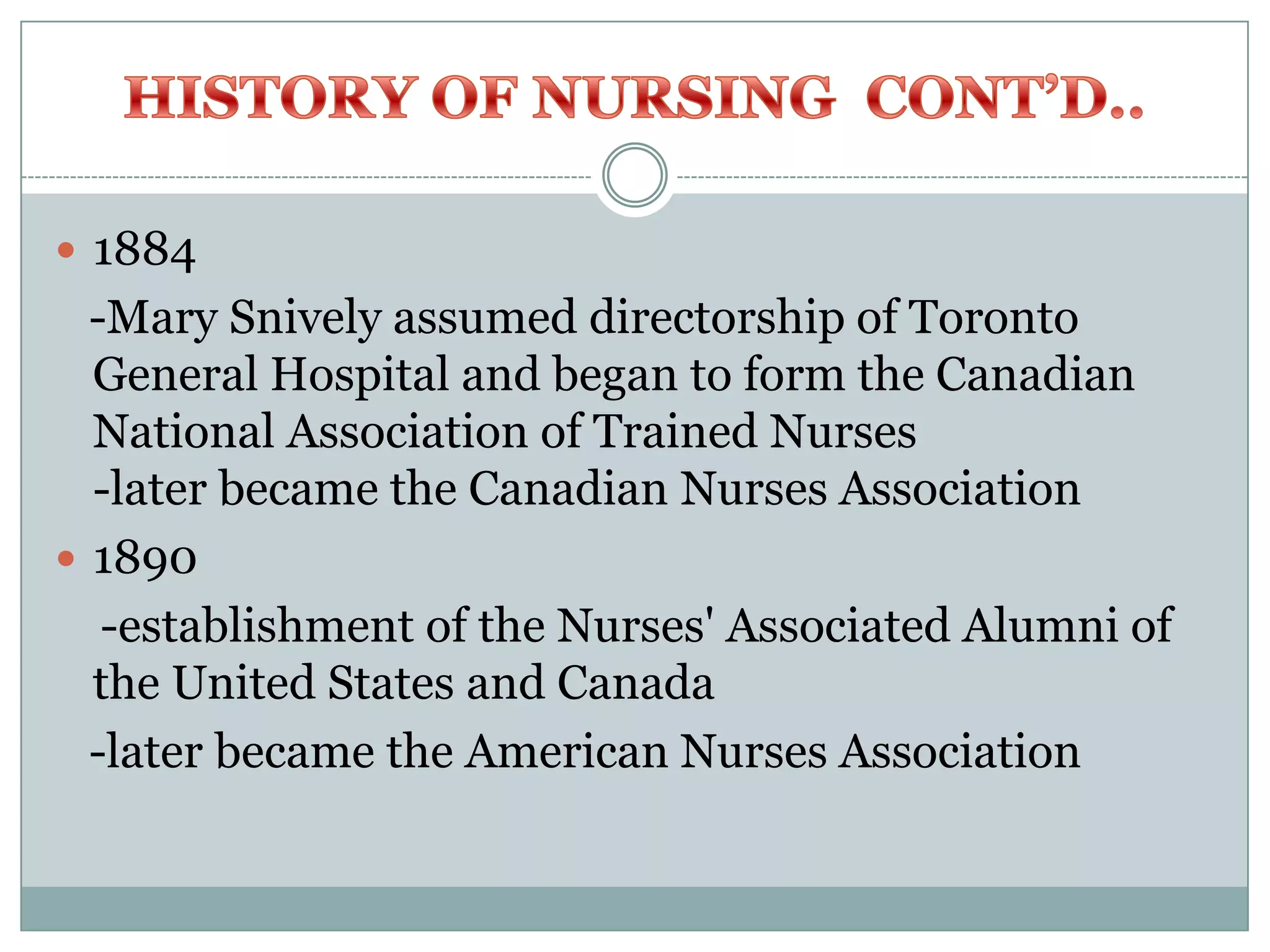
 1884
  -Mary Snively assumed directorship of Toronto
  General Hospital and began to form the Canadian
  National Association of Trained Nurses
  -later became the Canadian Nurses Association
 1890
   -establishment of the Nurses' Associated Alumni of
  the United States and Canada
  -later became the American Nurses Association
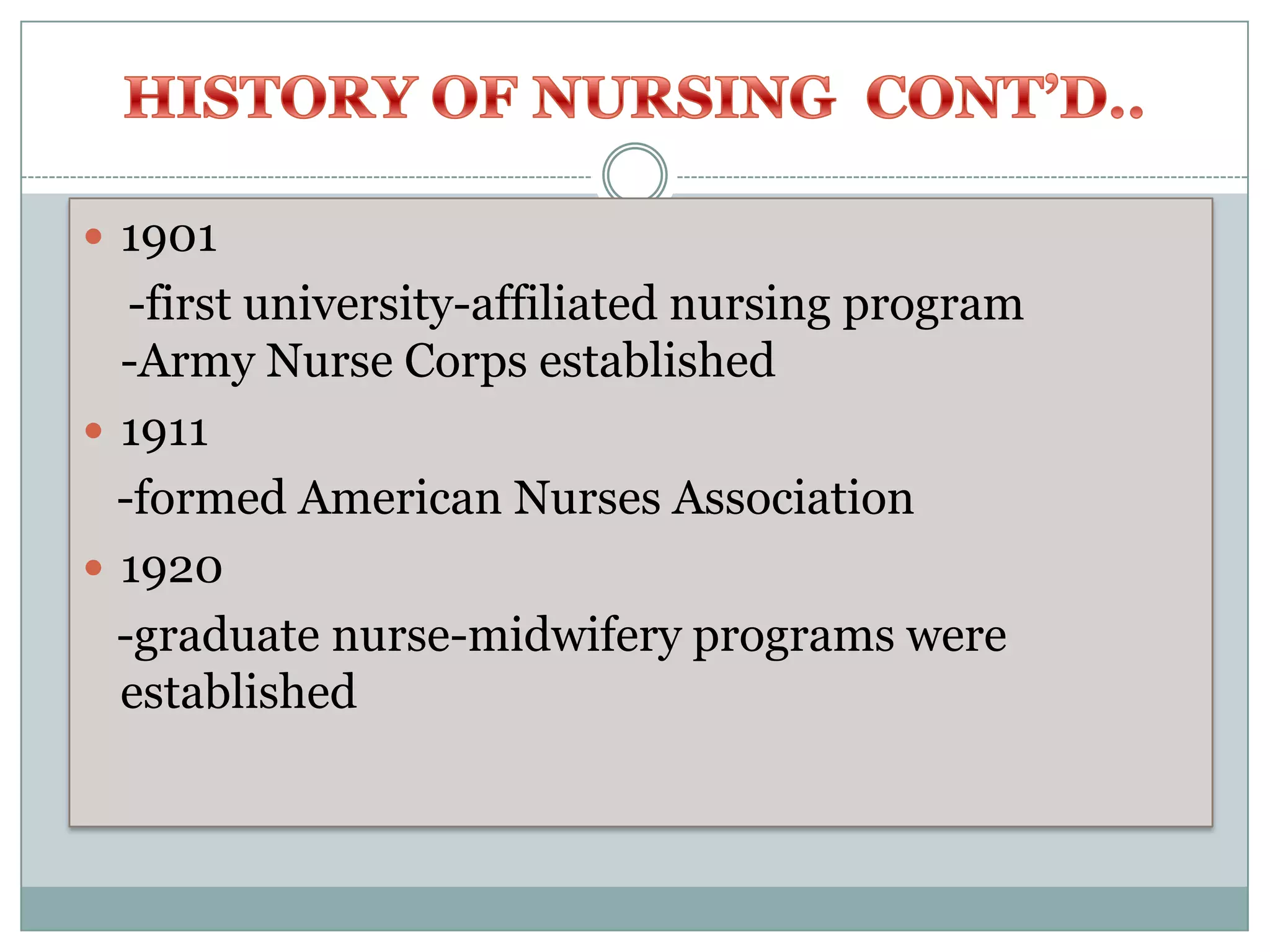
 1901
   -first university-affiliated nursing program
  -Army Nurse Corps established
 1911
  -formed American Nurses Association
 1920
  -graduate nurse-midwifery programs were
  established
 1926
  -ANA Code of Ethics approved
 1953
  -National League for Nursing in collaboration with
  other universities, developed graduate nursing
  education
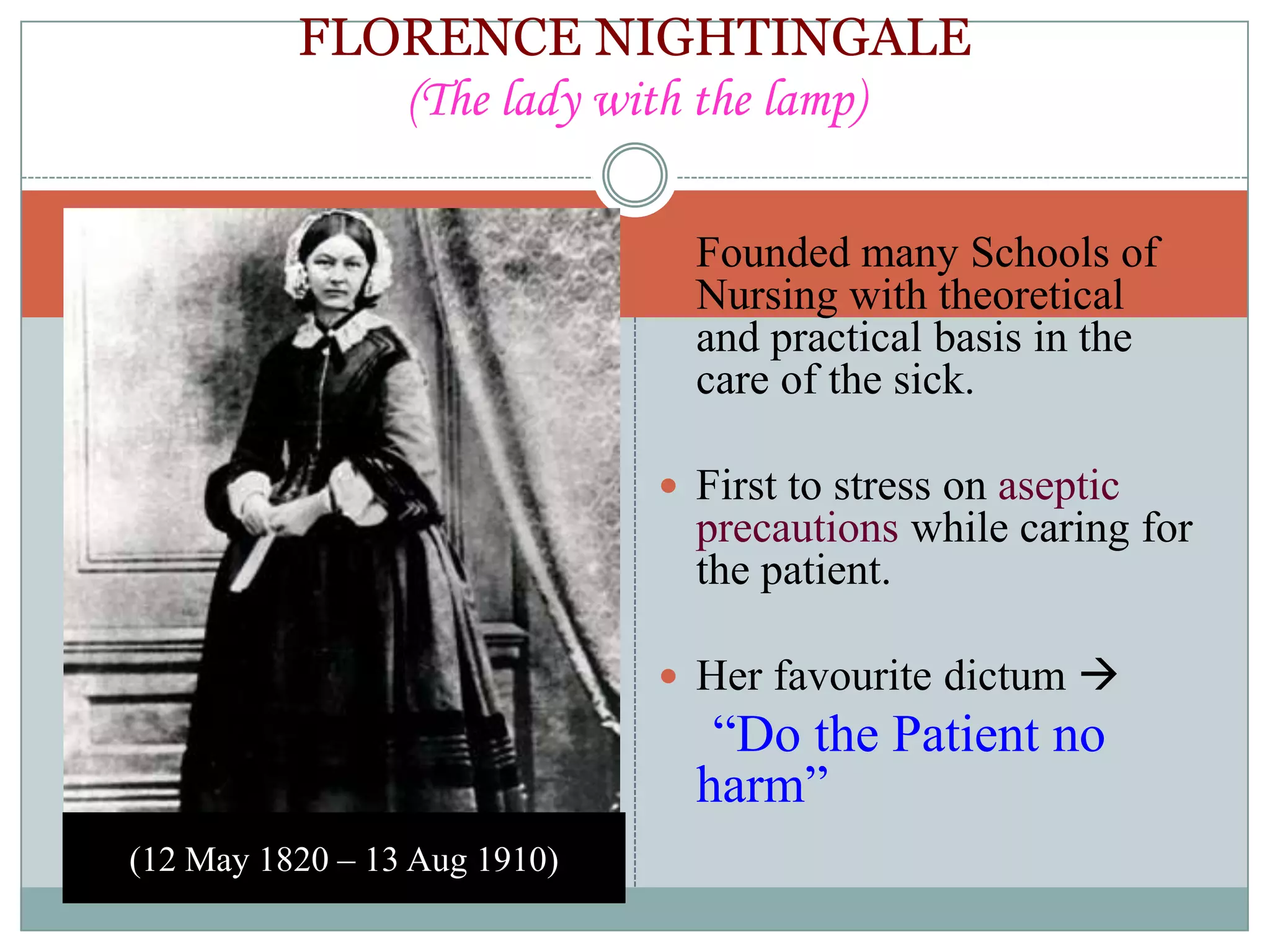
FLORENCE NIGHTINGALE
             (The lady with the lamp)

                               Founded many Schools of
                                Nursing with theoretical
                                and practical basis in the
                                care of the sick.

                               First to stress on aseptic
                                precautions while caring for
                                the patient.

                               Her favourite dictum 
                                 “Do the Patient no
                                harm”
(12 May 1820 – 13 Aug 1910)
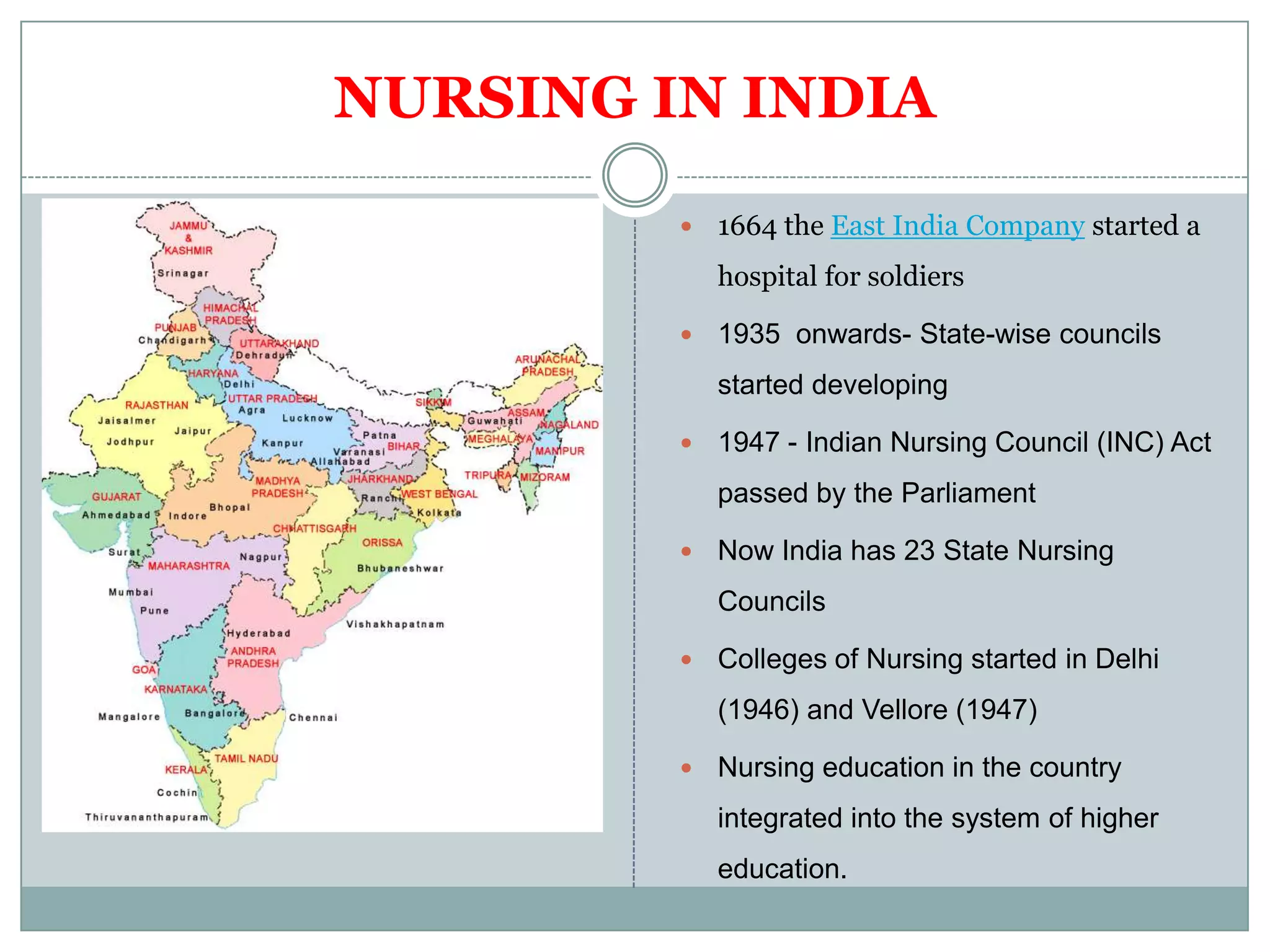
NURSING IN INDIA

            1664 the East India Company started a
             hospital for soldiers

            1935 onwards- State-wise councils
             started developing

            1947 - Indian Nursing Council (INC) Act
             passed by the Parliament

            Now India has 23 State Nursing
             Councils

            Colleges of Nursing started in Delhi
             (1946) and Vellore (1947)

            Nursing education in the country
             integrated into the system of higher
             education.
NURSING CODE OF ETHICS

o A code of ethics is a formal statement of a   group’s
  ideals and values.
 It is a set of ethical principles that
     (a) Is shared by members of the group
     (b) Reflects their moral judgements over time
      (c) Serves as a standard for their professional
  actions.
THE ICN CODE OF ETHICS

An international code of ethics for nurses was first
adopted by the International Council of Nurses (ICN) in
1953.

              1.NURSES AND PEOPLE
              2.NURSES AND PRACTICE
              3.NURSES AND THE PROFESSION
              4.NURSES AND CO-WORKERS
THE ICN CODE OF ETHICS,CONT’D..

1. NURSES AND PEOPLE
  The nurse’s primary professional responsibility is
 to people requiring nursing care. In providing
 care, the nurse promotes an environment in which
 the human rights, values, customs and spiritual
 beliefs of the individual, family and community are
 respected. The nurse ensures that the individual
 receives sufficient information on which to base
 consent for care and related treatment. The nurse
 holds in confidence personal information and uses
 judgement in sharing this information.
THE ICN CODE OF ETHICS,CONT’D..
2. NURSES AND PRACTICE
   The nurse carries personal responsibility and
  accountability for nursing practice, and for maintaining
  competence by continual learning. The nurse maintains
  a standard of personal health such that the ability to
  provide care is not compromised. The nurse uses
  judgement regarding individual competence when
  accepting and delegating responsibility. The nurse at
  all times maintains standards of personal conduct
  which reflect well on the profession and enhance public
  confidence. The nurse, in providing care, ensures that
  use of technology and scientific advances are
  compatible with the safety, dignity and rights of people.
THE ICN CODE OF ETHICS,CONT’D..

3. NURSES AND THE PROFESSION
 The nurse assumes the major role in determining
  and implementing acceptable standards of clinical
  nursing practice, management, research and
  education. The nurse is active in developing a core of
  research-based professional knowledge. The nurse,
  acting through the professional organisation,
  participates in creating and maintaining safe,
  equitable social and economic working conditions in
  nursing.
THE ICN CODE OF ETHICS,CONT’D..


4. NURSES AND CO-WORKERS
 The nurse sustains a co-operative relationship with
 co-workers in nursing and other fields. The nurse
 takes appropriate action to safeguard
 individuals, families and communities when their
 health is endangered by a co-worker or any other
 person.
THE ANA CODE OF ETHICS

1. The nurse, in all              6. The nurse participates in
   professional relationships,       establishing values of the
   practices with compassion         profession.
   and respect.                   7. The nurse participates in the
2. The nurse’s primary               advancement of the profession.
   commitment is to the           8. The nurse collaborates with
   patient.                          others to meet health needs.
3. The nurse promotes,            9.Associations and their members
   advocates for the rights of       are responsible for the
   the patient.                      articulating of nursing values.
4. The nurse is responsible
   and accountable for
   individual nursing practice
   .
5. The nurse owes the same
   duties to self as to others.
CODES OF PROFESSIONAL CONDUCT
            FOR NURSES:


1.Professional responsibility and accountability

2. Nursing practice

3. Communication and interpersonal relationship

4. Valuing human being

5. Management

6. Professional advancement
AUTONOMY

 Autonomy means that individuals are able to act for
themselves to the level of their capacity. It is the
right of individuals, governing their actions
according to their own purpose and reason.
 Professional nurse autonomy is defined as belief in
the centrality of the client when making responsible
discretionary decisions, both independently and
interdependently, that reflect advocacy for the client.
ACCOUNTABLITY

  According to Sullivan and Deekan,
  “accountability is being responsible for ones
  actions and accepting the consequences of one’s
  behaviour”.
Accountable to whom?
 Your patients, through a duty of care
 Your employer, as defined by your contract of employment and
  job description;
 Your profession, as stated in the relevant codes of conduct
 The public
Nurses are accountable for;
 Providing safe and therapeutic environment for the
  patients.
 Delivering component and personalized care.
 Maintaining adequate supplies of materials and equipments
  for smooth functioning of ward.
 Maintaining accurate and up-to-date records and reports.
 Protecting client’s legal rights and privacy.
 Maintaining good interpersonal relationships.
 Working within ethical and legal boundaries.
 Delegating responsibility appropriately.
 Contributing to the development of profession.
 Assertiveness is a style of behaviour to interact with
 people while standing up for your rights. It is a tool for
 expressing ourselves confidently and a way of saying
 yes and no in an appropriate way.

  1. Helps to create healthy and meaningful relations.
  2. Less friction and conflicts.
  3. Enhances the self esteem.
  4. Increases the productivity.
  5. Improves emotional and physical health.
  6. Lessen the stress at work.
TALK IT
       OUT                 ASK


 REQUEST                      STATE
 CHANGE
   AND                         THE
FEEDBACK                     PROBLEM


                 EXPRESS
                YOURSELF
The word visibility means capacity of providing a
clear unobstructed view. Although nurses comprise
the majority of healthcare professionals, they are
largely invisible. The public views of nursing and
nurses are typically based on personal experiences
with nurses, which can lead to a narrow view of a
nurse often based only on a brief personal
experience. Profession needs to be more concerned
about visibility because nursing is struggling to
attract qualified students and keep current nurses
in practice.
STEPS TO IMPROVE THE VISIBILITY
 Nurses Week is used as an opportunity to recognize
  nurses in practice and to advertise the profession of
  nursing, increasing its visibility and portraying a
  positive image. During Nurses’ Week, healthcare
  organizations typically hold special celebrations to
  honour nurses, and announce via the media.
 Attract more men in to nursing profession.
 Give out awards for leadership and other
  accomplishments in nursing
 Uphold the professional dignity.
 Ensure active participation in society, i.e. by
  involvement through rescue mission in natural
  calamities like flood, storm etc.
History of nursing