L/O/G/O
MS. BHARTI SHARMA
NURSING TUTOR
BECON, JAMMU
SLEEP PATTERN AND ITS
DISTURBANCES , PAIN AND
SENSORY DEPRIVATION
General objective
• Attheendofthepresentationthegroup
willbeabletoacquireknowledge
regardingsleep anditsdisturbances,pain
andsensorydeprivationandwillbeable
toapply thisknowledgeinclinicaland
institutionalsettings.
L/O/G/O
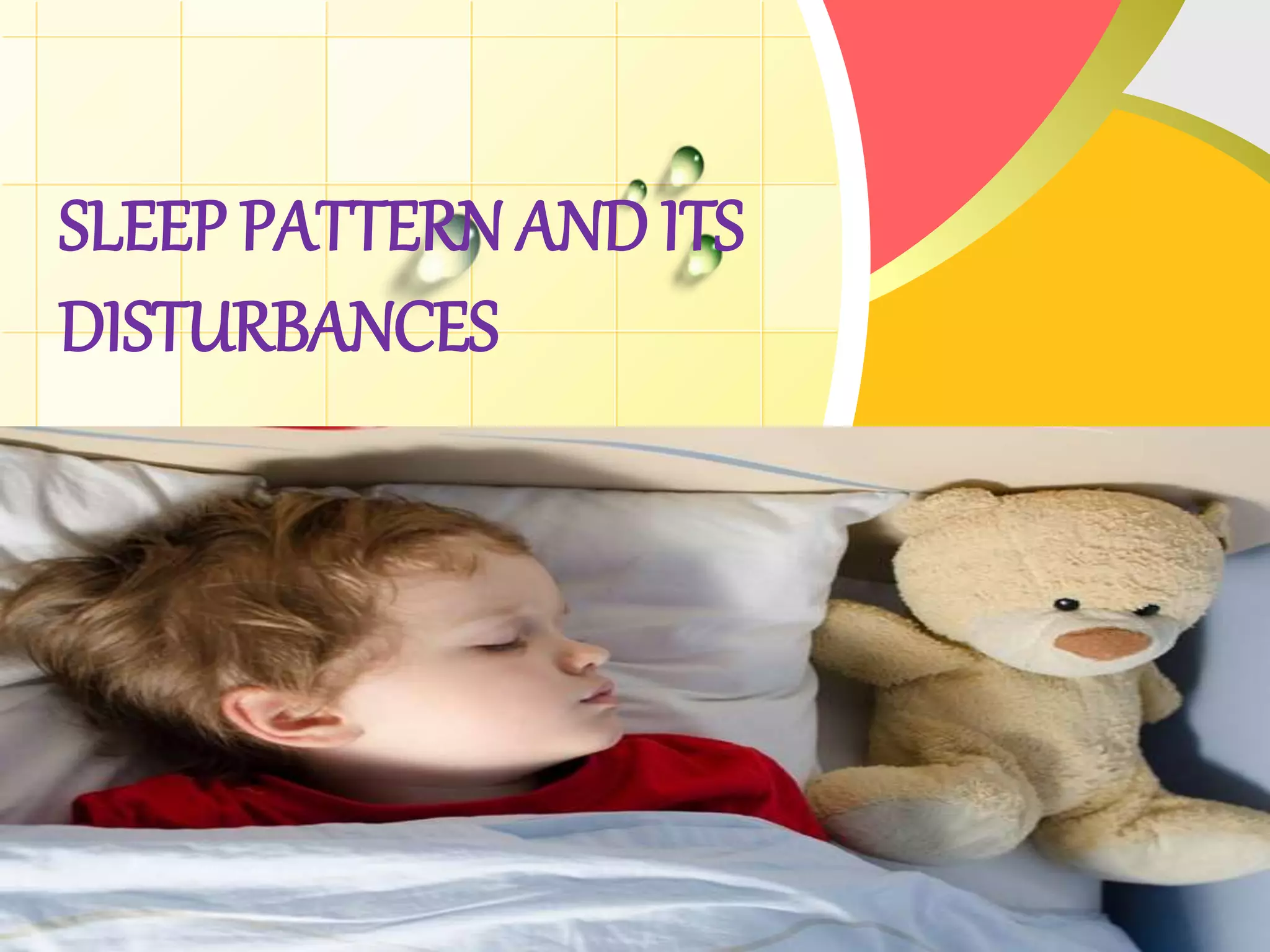
SLEEP PATTERN AND ITS
DISTURBANCES
INTRODUCTION
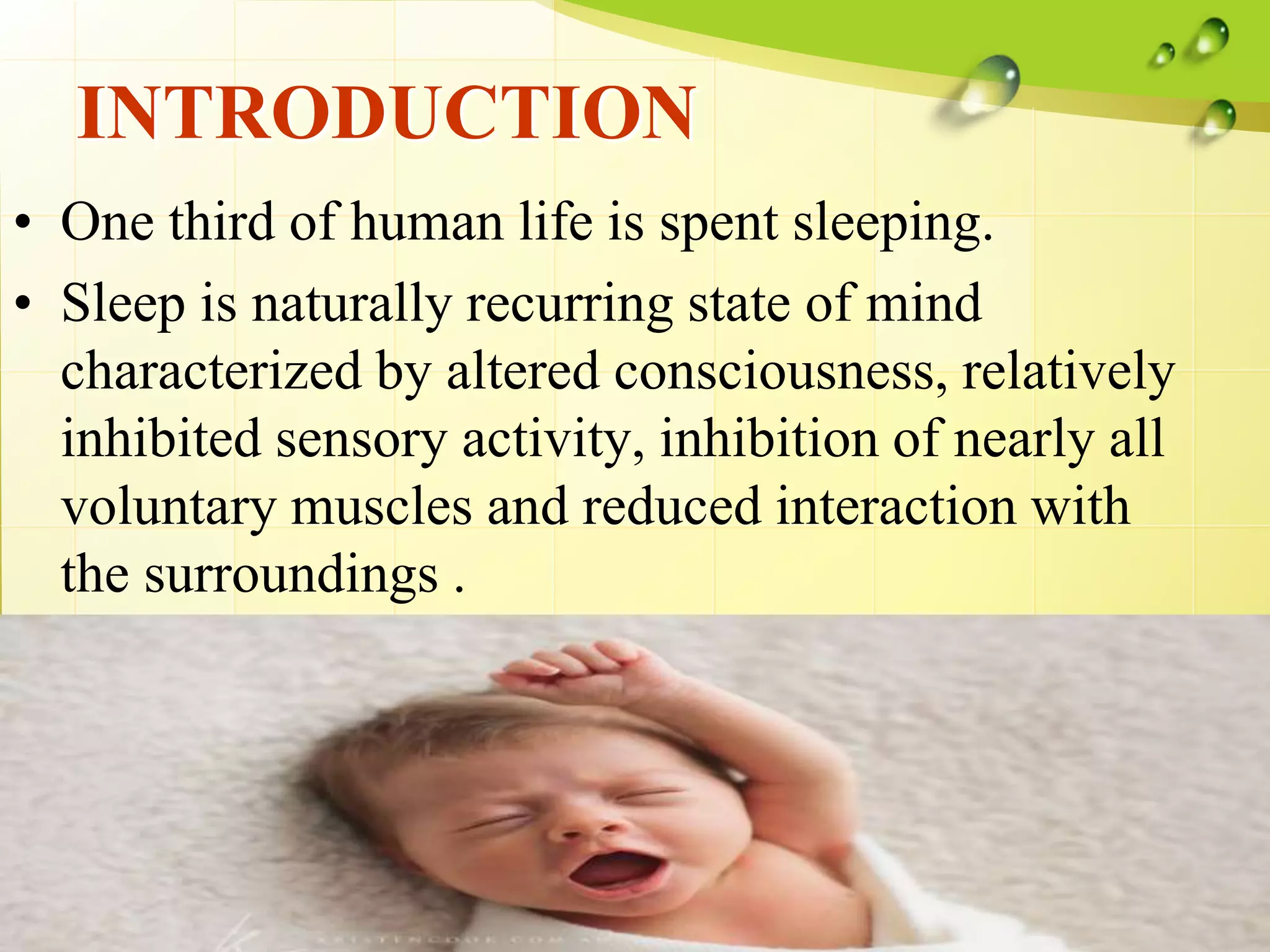
• One third of human life is spent sleeping.
• Sleep is naturally recurring state of mind
characterized by altered consciousness, relatively
inhibited sensory activity, inhibition of nearly all
voluntary muscles and reduced interaction with
the surroundings .
DEFINITION
• Sleep is a naturally occurring altered state
of consciousness characterized by
decreases in awareness and
responsiveness to stimuli.
• Sleep is distinguished from abnormal
states of consciousness by being readily
reversible.
PHYSIOLOGY OF SLEEP:
• Two system in brain stems, the recticular
activating system and bulbar synchronizing
region are believed to work together to control
the cyclic nature of sleep.
• The reticular formation is found in the brain
stem and comprises many nerve cells and
fibers.
• The fibers have connection that relay impulses
into the cerebral cortex and into the spinal
cord.
ELECTRO-PHYSIOLOGIC
APPROACH:
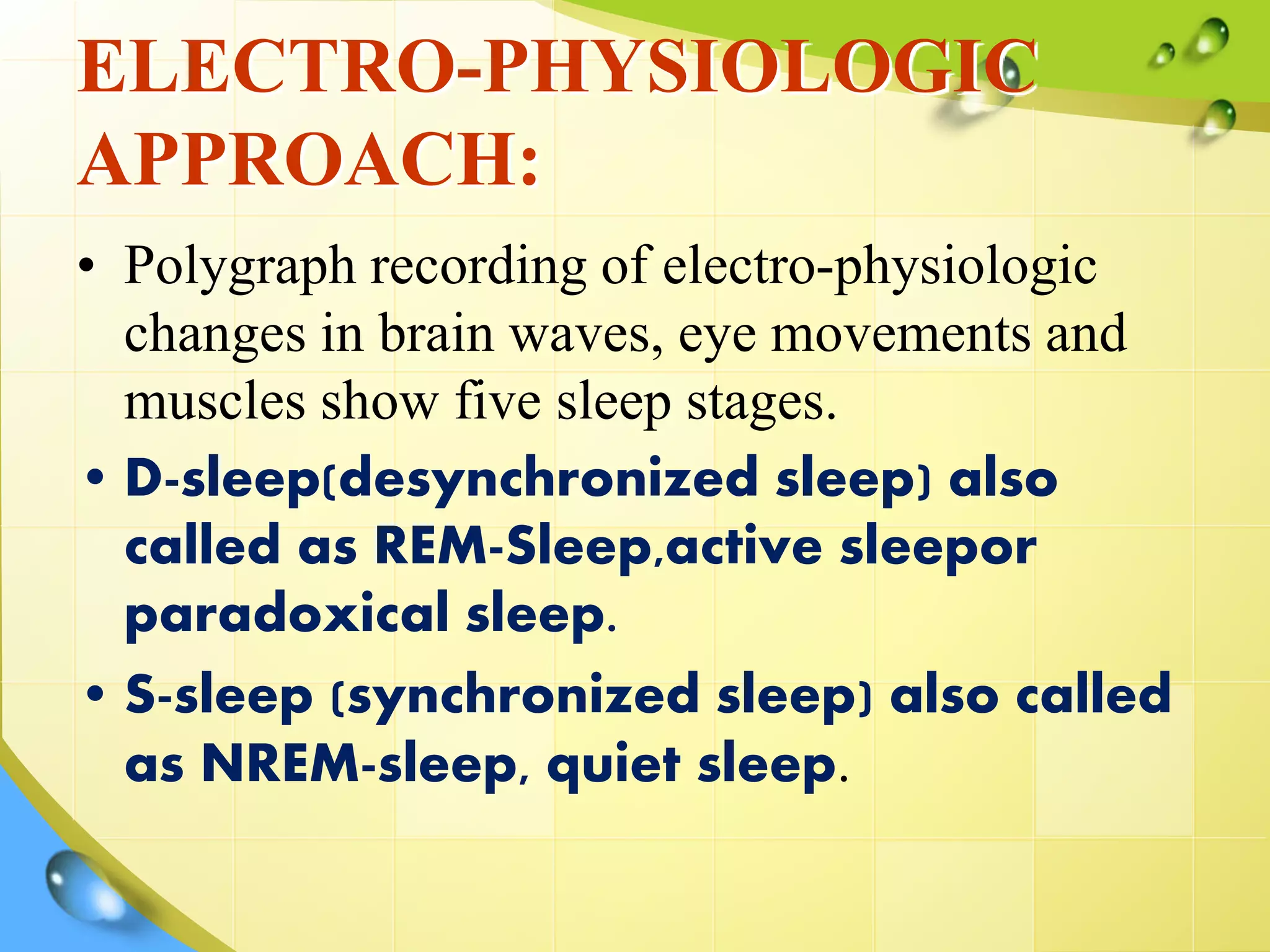
• Polygraph recording of electro-physiologic
changes in brain waves, eye movements and
muscles show five sleep stages.
• D-sleep(desynchronized sleep) also
called as REM-Sleep,active sleepor
paradoxical sleep.
• S-sleep (synchronized sleep) also called
as NREM-sleep, quiet sleep.
STAGES OF SLEEP :
• STAGES 0 (ALPHA RHYTHM)
• STAGES 1(BETA RHYTHM)
• STAGES 2 (THETA RHYTHM)
• STAGES 4 (DELTA RHTYM)
• STAGES 3(DELTA RHYTHM )
• REM SLEEP- (BETA RHYTHM).
STAGES OF SLEEP
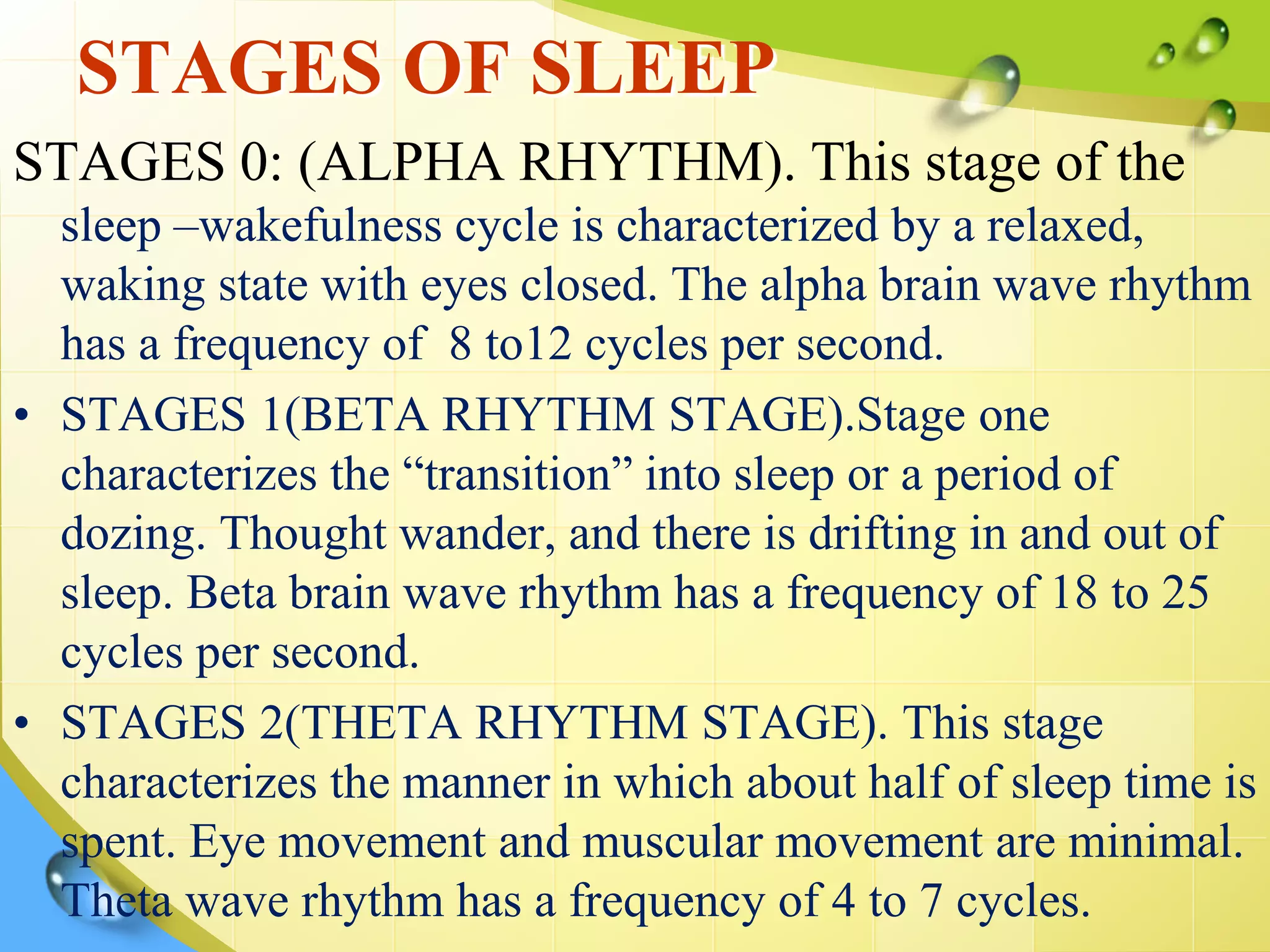
STAGES 0: (ALPHA RHYTHM). This stage of the
sleep –wakefulness cycle is characterized by a relaxed,
waking state with eyes closed. The alpha brain wave rhythm
has a frequency of 8 to12 cycles per second.
• STAGES 1(BETA RHYTHM STAGE).Stage one
characterizes the “transition” into sleep or a period of
dozing. Thought wander, and there is drifting in and out of
sleep. Beta brain wave rhythm has a frequency of 18 to 25
cycles per second.
• STAGES 2(THETA RHYTHM STAGE). This stage
characterizes the manner in which about half of sleep time is
spent. Eye movement and muscular movement are minimal.
Theta wave rhythm has a frequency of 4 to 7 cycles.
• STAGES 3(DELTA RHYTHM). This is a period of deep
and restfulness sleep. Muscles are relaxed, heart rate and
blood pressure is fall, breathing slowly. No eye movement
occur .delta brain wave rhythm has a frequency of 1.5 to 3
cycles per second.
• STAGES 4 (DELTA RHTYM). This is the stage of deepest
sleep. Individual who is suffer from insomnia or other sleep
disorder often do not experience this stage of sleep. Eye
movement and muscular movement are minimal.
• REM SLEEP- (BETA RHYTHM). This is a dream cycles.
Eyes dart about beneath closed eyelids, moving more rapid
then when awake. The brain wave is similar to that of stage
1 sleep. Heat and respiration rate is increase; blood pressure
may increase or decrease. Muscles are hypotonic during
REM sleep.
SLEEP CYCLE: FIVE stages of
NREM sleep.
COMPARISON OF WAKEFULNESS, NON
REM AND REM SLEEP
CATEGORY EEG
CHARACTERISTICS
EYE
MOVEMENT
MUSCLE TONE
Waking fast ,Low voltage Normal tracking Present
Non- REM sleep Slow , high voltage Absent Variable generally
reduced
REM sleep Fast , low volatage Specific pattern of
rapid eye movement
Absent (except
ocular muscle
movement )
NEUROTRANSMITTER
BALANCE
• Sleep is an active process involving the
reticular activating system (RAS) and a
dynamic interaction of neurotransmitters.
• The RAS consists of a network of
interconnecting neurons in the medulla, pones
and midbrain with projections to the spinal
cord, hypothalamus, cerebellum and cerebral
cortex.
Physiological function
• Sorting and discarding of neurophysiologic data:
Much short-term memory is filled with
inconsequential detail that the brain sifts through
and discards. A person can usually remember what
he or she ate for breakfast that day or how long the
bus took to come, but a month later those data will
probably be beyond recall.
• Character reinforcement and adaptation: REM
stage of sleep appears to be important for mental and
emotional stability.
Life considerations
• Newborn and infant
• Toddler and preschooler
• Adult and older adult
Timing
• HOURS BY AGE: Children need a greater
amount of sleep per day than adults to develop
and function properly: up to 18 hours for
newborn babies, with a declining rate as a child
ages.
• A newborn baby spends almost 9 hours a day in
REM-sleep.
• By the age of five or so, only a bit over two hours
is spent in REM.
day
Newborn Up to 18 hours
1-2 months 14-18 hours
1-3 years 12-15 hours
3-5 years 11-13 hours
5-12 years 9-11 hours
Adolescents 9-10 hours
Adults, including elderly 7-8 (+)hours
Pregnant women 8(+)hours
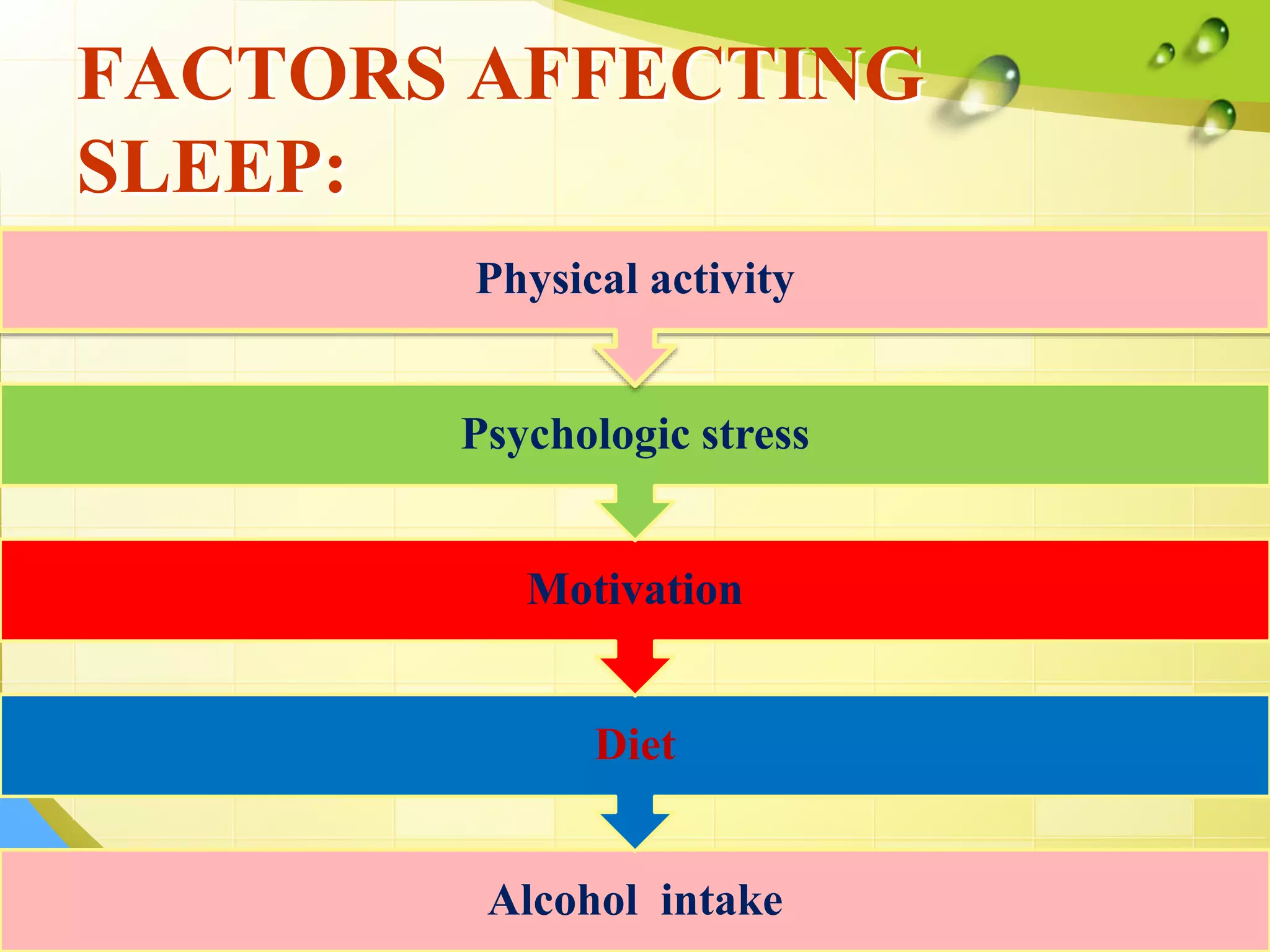
FACTORS AFFECTING
SLEEP:
Alcohol intake
Diet
Motivation
Psychologic stress
Physical activity
FACTORS AFFECTING
SLEEP:
SMOKING
ENVIRONMENTAL FACTORS
LIFE STYLE
ILLNESS
MEDICATIONS
L/O/G/O
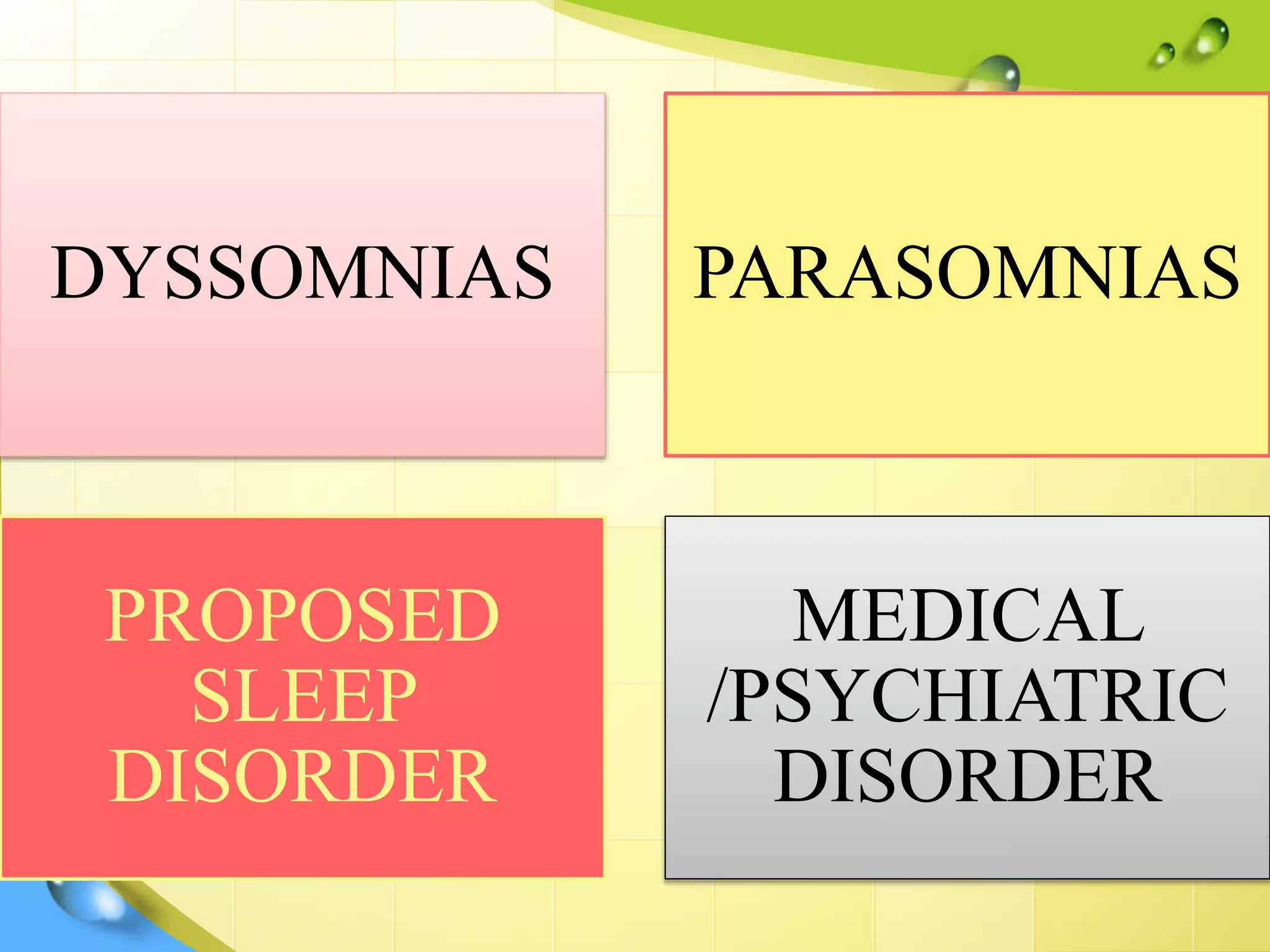
SLEEP DISORDERS
DYSSOMNIAS PARASOMNIAS
PROPOSED
SLEEP
DISORDER
MEDICAL
/PSYCHIATRIC
DISORDER
DYSOMNIAS
• Abnormality in amount ,quality or
timing of sleep .
• A broad category of sleep disorders
characterized by either hyper
somnolence or insomnia.
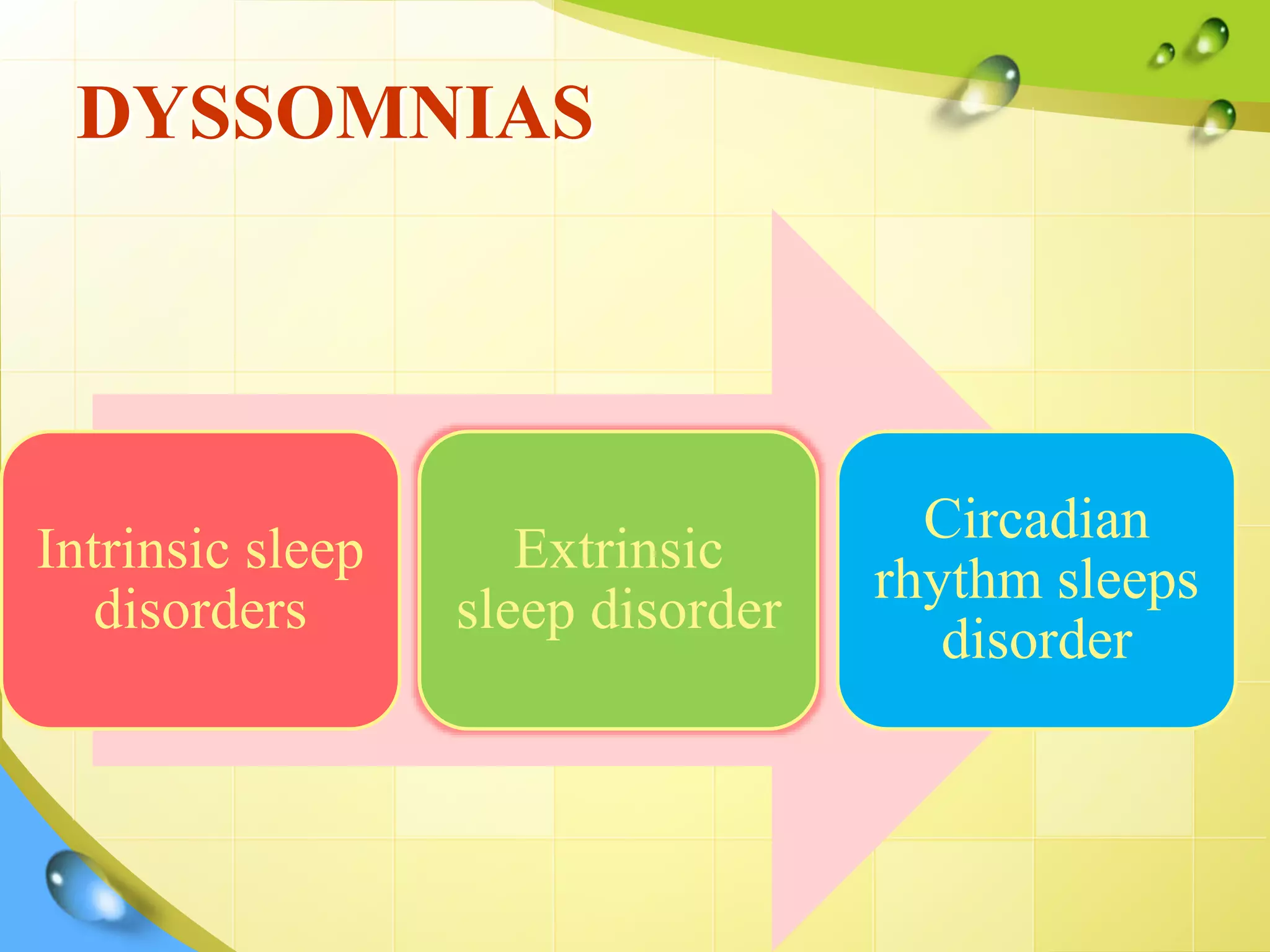
DYSSOMNIAS
Intrinsic sleep
disorders
Extrinsic
sleep disorder
Circadian
rhythm sleeps
disorder
• Intrinsic sleep disorders: Idiopathic insomnia,
Narcolepsy, Recurrent, hypersomnia, Idiopathic,
hypersomnia, Post-traumatic hypersomnia,
Obstructive sleep apnea syndrome,.
• Extrinsic sleep disorder: Inadequate sleep
hygiene, Environmental sleep disorder, Food
allergy insomnia, Nocturnal eating (drinking)
syndrome,, Alcohol- dependent sleep disorder,
Toxin-induced sleep disorder.
• Circadian rhythm sleeps disorder: Time zone
change syndrome, Shift work sleep disorder,
Irregular sleep phase syndrome, Delayed sleep
phase syndrome, Advanced sleep phase
syndrome, Non 24-hour sleep- wake disorder.
Parasomnias
• Parasomnias are patterns of waking
behavior that appear during sleep.
Parasomnias are conditions associated
with activities that cause arousal or
partial arousal usually during
transitions in NREM periods of sleep.
• They are not life threatening but they
disturb others.
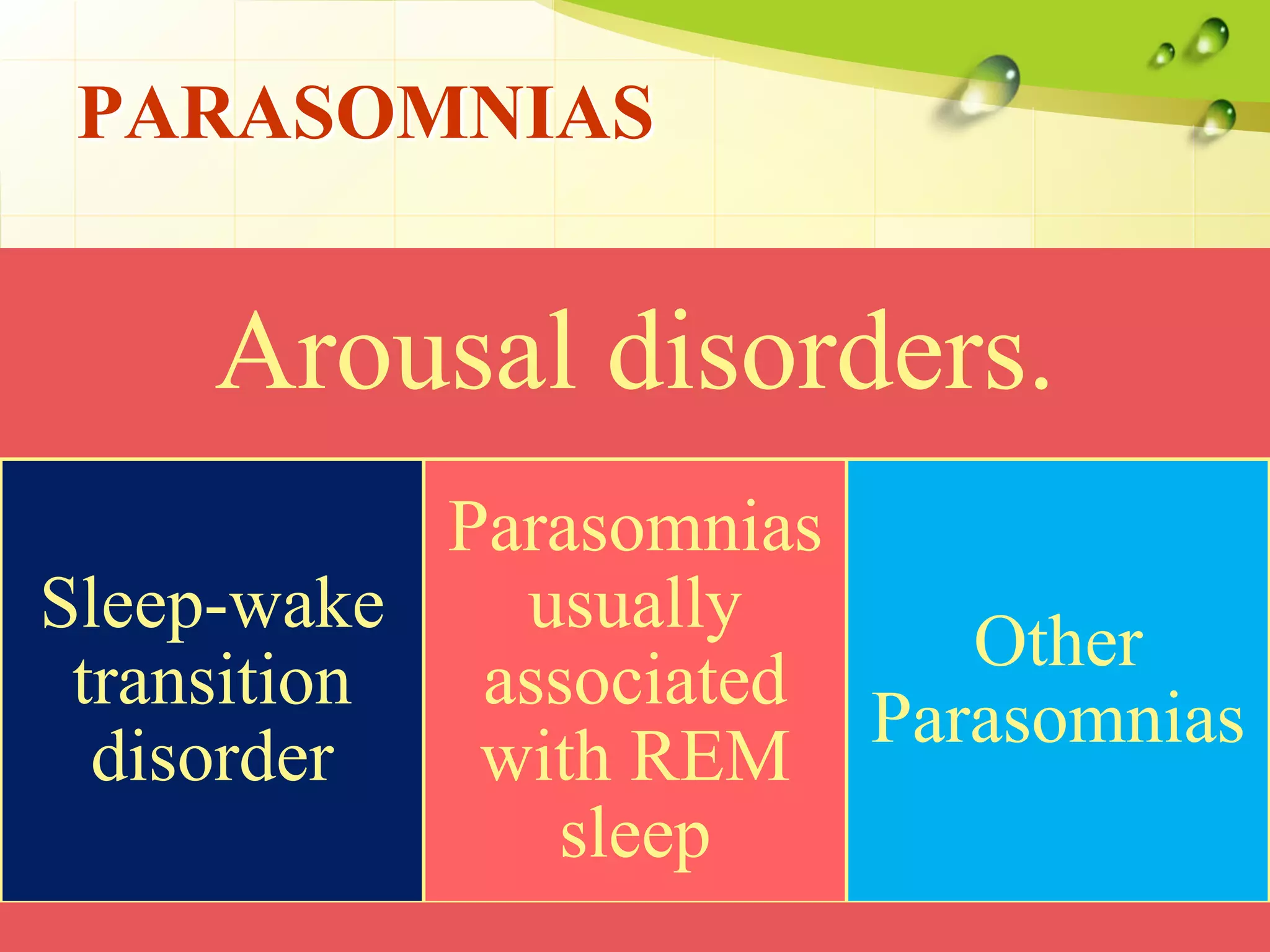
PARASOMNIAS
• ,
Arousal disorders.
Sleep-wake
transition
disorder
Parasomnias
usually
associated
with REM
sleep
Other
Parasomnias
• Arousal disorders: Confessional arousals, Sleep
walking, Sleep terrors.
• Sleep-wake transition disorder: Rhythmic
movement disorder, Sleep talking.
• Parasomnias usually associated with REM sleep:
Nightmares, Sleep paralysis, impaired sleep- related
penile reactions, REM sleep behavior disorder.
• Other Parasomnias: Sleep bruxims, sleep enuresis,
sleep-related abnormal swallowing syndrome,
nocturnal paroxysmal dystopia, sudden unexplained
nocturnal death syndrome, primary snoring, infant
sleep apnea,
OTHERS PARASOMINAS
Bruxism: grinding of teeth.
Nightmares and night terrors.
Sleep-talking.
Nocturnal enuresis: bedwetting.
Somnambulism: sleep-walking.
MEDICAL SLEEP DISODER
Associated
with
mental
disorder.
Associated
with
neurologic
al
disorders:
Associated
with other
medical
disorders
Proposed Sleep Disorder:
Short sleeper, long sleeper, sub-
wakefulness syndrome, menstrual
associated sleep disorder, pregnancy
associated sleep disorder, sleep
choking syndrome, sleep related
laryngospasm, sleep related neurogenic
tachypnea.
COMMON SLEEP DISORDER
INSOMNIA
HYPERSOM
NIA
NARCOLEPS
Y
SLEEP
APNEA
• Insomnia: It is most common sleep disorder.
Insomnia is a perception of inadequate sleep and
characterized by difficulty in initiating sleep and
frequent awakening from sleep. Insomnia may be
classified as idiopathic or psycho physiological.
Idiopathic insomnia usually begins in childhood
• Hypersomnia: Hypersomnia is a condition
characterized by excessive sleep, particularly during
the day. it is frequently used as a coping mechanism
when someone has no desire or energy to face a new
day
• Narcolepsy: Narcolepsy is a condition characterized
by an uncontrollable desire to sleep. The person with
narcolepsy can literally fall asleep standing up,
while driving a car or while swimming. Although
the diagnosis of narcolepsy generally requires a
multiple sleep latency test and polysomnography.
• Sleep Apnea: Sleep apnea refers to periods of no
breathing between snoring intervals. The person
may not breathe for periods of 10 to 20 seconds to as
long as 2 minutes. The accumulation of carbon
dioxide and the fall in oxygen cause brief periods of
awakening throughout night.
SLEEP DEPRIVATION
• Sleep deprivation refers to a decrease
in the amount, consistency and
quality of sleep
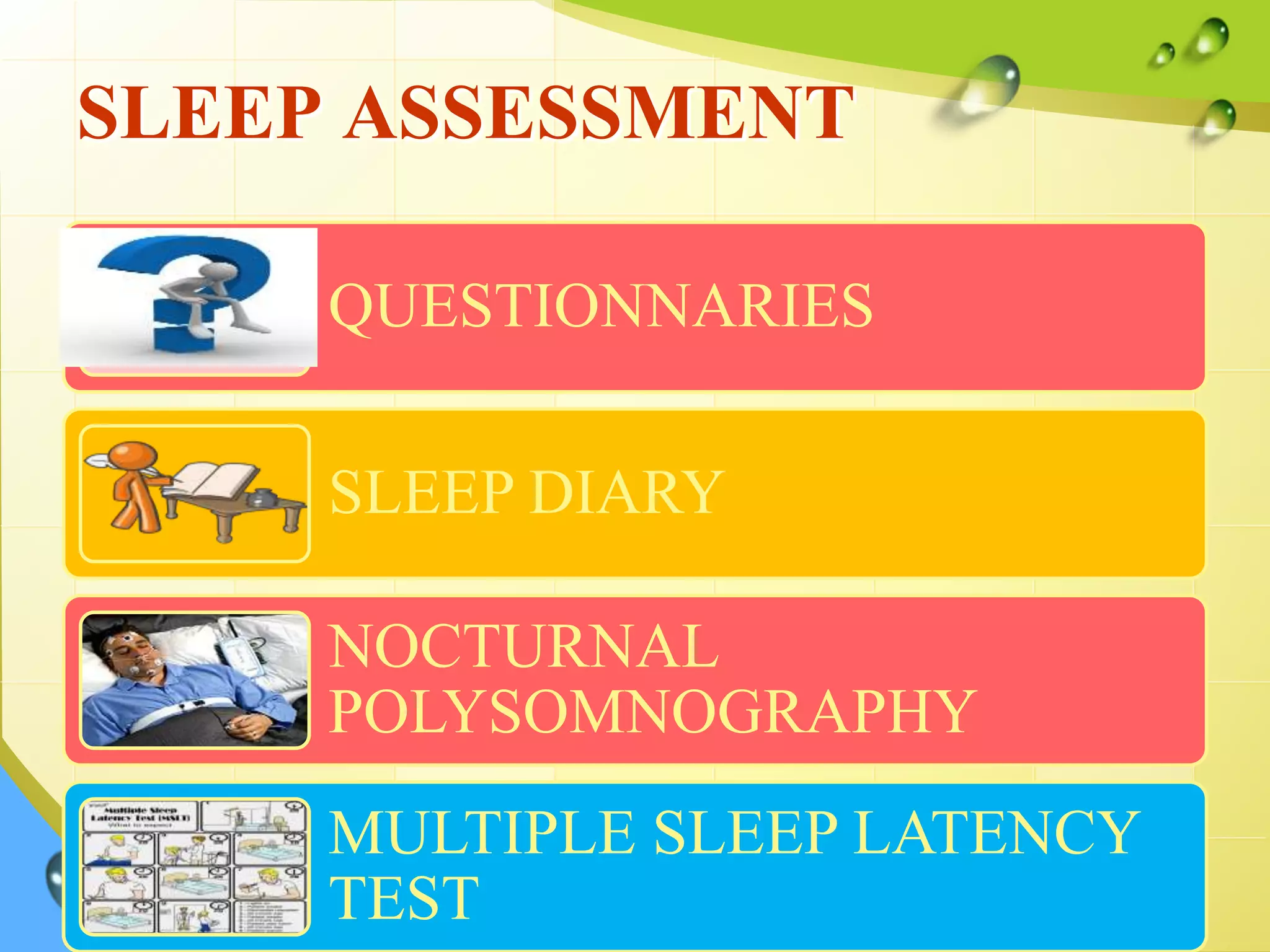
1.
• Hospital acquired sleep disturbance
2.
• Sleep onset difficulty
3
• Sleep maintenance disturbance
4.
• Early morning awakening
5.
• REM Rebound
SLEEP ASSESSMENT
QUESTIONNARIES
SLEEP DIARY
NOCTURNAL
POLYSOMNOGRAPHY
MULTIPLE SLEEP LATENCY
TEST
MANAGEMENT
1. • PREPARING A RESTFUL ENVIRONMENT
2. • PROMOTING BEDTIME RITUALS
3.
• OFFERING APPROPRIATE BEDTIME SNACKS AND
BEVERAGES
4. • PROMOTING RELAXATION
5. • PROMOTING COMFORT
6. • RESPECTING NORMAL SLEEP-WAKE PATTERNS
7.
• SCHEDULING NURSING CARE TO AVOID
UNNECESSARY DISTURBANCE
8. • USING MEDICATIONS TO PRODUCE SLEEP
9. • TEACHING ABOUT REST AND SLEEP
L/O/G/O
PAIN
INTRODUCTION
• Pain is defined as an unpleasant, subjective sensory
and emotional experience associated with actual or
potential issues , damage or described in terms of
such damage.
• McCaffery and Pasero (1999) say it best by defining
pain as “whatever the person experiencing it says it
is , existing whenever (he/she)says it does”
NATURE OF PAIN
Painis muchmore thana physical sensationcaused by a
specific stimulus.The pain experience is complex , involving
physical emotional and cognitive components.
Paincan be subjectiveand highly individualized. Paincannot be
objectively measured only the clientknows whether pain is
present.
TYPESNOF PAIN (ORIGIN )
SOMATIC OR DEEP PAIN
CUTANEOUS PAIN
VISCERAL OR
SPLANCHIC PAIN
• Cutaneous pain: caused by cutaneous nerve
ending in the skin and result in a well organized
‘burning and prickling’ sensation.
• Somatic or deep pain: originates in supporting
structures such as tendon, ligaments and nerves.
Deep pain mainly localized, may produce nausea
,associated with sweating and changes in blood
pressure. pain from lumbar disc is felt along the
sciatic nerve.
• Visceral or splanchic pain: visceral pain is a
discomfort in the internal organs, is less localized
and more slowly transmitted then the cutaneous
pain. Visceral pain is transmitted through
parasympathetic and sympathetic fibers of ANS
with the pain often referred to the body surface.
ON THE BASIS OF NATURE
ACUTE
PAIN
CHRONIC
PAIN
OTHER CLASSIFICATION
Psychogenic pain
Idiopathic pain
Nociceptive
pain
Neuropathic
pain
Differentiation
pain
PURPOSE OF PAIN
PHYSIOLOGY OF PAIN
• The opioid system and the non opioid system
are the two known endogenous analgesia
systems in humans. The best known is the
opiod system. It is medicated by endorphins.
• The opioid system is medicated by monoamine
substance such as norepinephrine.and
serotonin.
DIMENSIONS OF PAIN
• PHYSIOLOGIC DIMENSIONS OF PAIN
• SENSORY,AFFECTIVE,BEHAVIORAL ,
COGNITIVE AND SOCIOCULTURAL DIMENSIONS
OF PAIN
PHYSIOLOGIC DIMENSIONS OF
PAIN
The neural mechanism , thermal by which pain
is perceived consists of four major steps:
Transduction:
• it is the conversion of a mechanical, thermal
or chemical stimulus into a neuronal action
potential
• The noxious stimuli causes cell damage with
the release of sensitizing chemicals like
prostaglandins , serotonin , histamine.
• These substance activates nociceptors and
lead to generation of action potential.
•Transmission: it is the movement of
pain impulses from the site of
transduction to the brain.
•Perception: it occurs when pain is
recognized , defined and responded to
by the individual experiencing the pain.
•It is the conscious experience of the
pain.
•Modulation: it is the pain signals can
occur at the level of the periphery,
spinal cord, brainstem and cerebral
cortex.
THERIOES OF PAIN
THEORIES
OF PAIN
PATTERN
THEORY
SPECIFICITY
THEORY
GATE CONTROL
THEORY
SPECIFICITY OF PAIN
• This theory is based on the assumption
that pain was perceived following
injury because there was a single,
dedicated, hard wired system of
afferent nerves which carried messages
from specific pain receptors in the
periphery to a pain centre in the brain.
PATTERN THEORIES
• This theory to the perception of pain to
pattern of impulses in the nervous
system rather than to impulses in
dedicated pain pathways.
• The patterns may be temporal (in time)
or spatial (in space). Pattern theories
may explain some chronic or recurrent
pains which occur when explain there
are nerve lesions.
GATE CONTROL THEORY
• Melzack and wall 1965 has proposed a theory of
pain that has stimulate considerable interest &
debate has centainly been very improvement on
the early theories of pain.
• According to his theory, pain stimulation is carried
by small, slow fibers that enter the dorsal horn of
the spinal cord; then other cells transmit the
impulses from the spinal cord up to the brain.
• These fibers are called T-cells. The T-cells can be
located in a specific area of the spinal cord, known
as the substantial gelatinosa.
GATE CONTROL THEORY
According to the theory, the gate can
sometimes be overwhelmed by a large
number of small activated fibers.
In other words, the greater the level of
pain stimulation, the less adequate the
gate in blocking the communication of
this information.
FACTORS AFFECTING THE
PAIN EXPERIENCE
AGE
PREVIOUS
PAIN
EXPOSURE
CULTURE
ANIXETY
AND OTHERS
STRESSORS
PAIN ASSESSEMENT
Fifth vital sign.
1) History:-
• P- Pattern, position, precipitating factors
• Q- Quality
• R- Relieving factors
• S- Severity
• T- Time of onset/duration
•
PAIN SCALE
• Visual analogue scales
OTHER INTENSITY PAIN
SCALE
MANAGEMENT
NON PHARMACOLOGICAL
THERAPY
• Transcutaneous electrical nerve stimulation
(TENS): This is a portable, pocket-sized,
battery-powered device that attaches to the
skin.
• TENS is generally used in chronic pain
conditions. TENS has been used to treat
patients with various pain condition, including
neck pain and low back pain.
• DISTRACTION: focus attention on
something other than pain.
Distraction alone may relieve mild pain but is
best used before pain begins or soon
thereafter. Techniques that distract
attention include the following:
• visual – counting objects ,
• reading or watching television.
ACUPUNCTURE: it is a technique that uses
needles of various lengths to prick specific parts of
the body to produce insensitivity in pain.
• It is an alternative intervention to help control
discomfort from disorders such as headache.
• Massage: Massage therapy is a “hands –on”
treatment in which a therapist manipulates
muscles and muscles and other soft tissues to
improve health and well being. Massage
triggers nervous system response in the body
which reduces stress , anxiety, and depression.
• Music therapy.
Music therapy has
evidence to
support its use to
reduce chronic
pain , anxiety and
depression in
older adults. It can
be active or
passive or
recorded music.
• Physical
therapy: This
teaches you
exercises to help
improve
movement and
strength, and to
decrease pain.
• Spinal cord stimulation (SCS): An electrode
is implanted near your spinal cord during a
simple procedure. The electrode uses mild,
safe electrical signals to relax the nerves that
cause your pain.
• Aromatherapy: This is the way of using good
smells to help client relax and decrease pain .
Candles, massage oils, baking cookies are all
ways that smells are used.
Relaxation therapy. Relaxation
is mental and physical freedom
from tension or stress.
Relaxation techniques reduce
muscle tension, oxygen
consumption, pulse, blood
pressure, respiration and lessen
anxiety.
Meditation, deep breathing,
stretching and social support
are some methods client can use
to relax in an effort to control
pain.
• Guided imagery: In this
the client creates an image
or pictures of sights,
sounds, tastes, smells, and
feelings in their mind ,
concentrate on that image
and gradually becomes
less aware of pain.
• With guided imagery,
client learns how to
change the way body
senses and responds to
pain.
• Hypnosis. Hypnosis means achieving an intense
state of relaxation or trance and receiving
suggestions to alter sensations, behavior, feelings or
thoughts.
• Hypnosis is a technique that produces a
subconscious state accomplished by suggestions
made by hypnotist, has been used successfully to
control pain.
Laughter therapy: It has been said that”10 minutes of
belly laughter gives 2 hours of pain-free sleep!”
laughter helps client breathe deeper and stomach
digest(breakdown)food. It lowers blood pressure and
may cause brain to make endorphins. Laughter can
also help change moods. It helps client relax and let
go of stress, anger, fear, depression, and
hopelessness. These are all parts of chronic pain.
• Thermotherapy: Thermotherapy is the
application of hot and cold treatments for the
alleviation of chronic pain. Heat therapy
promotes circulation, relaxes muscles, relieves
pain, increases joint range of motion, and
stimulates metabolism and new tissue growth.
Cold therapy causes vasoconstriction
• Exercise therapy: Exercise therapy can come in
several forms, depending on the mobility of the
patient.
• Mobile patients can use a combination of range of
motion exercises, walking , stretching , simple and
yoga movements to reduce pain levels and maintain
muscle strength .patients who are immobile can
have their muscles and joints moved for the to
maintain joint and muscle flexibility an tissue
health.
• This is usually referred to as passive range of
motion(PROM).
• Biofeedback: It is a
behavioral therapy that
involves giving
individual’s information
about physiological
responses and way to
exercise voluntary control
over those responses. It is
a technique that uses a
machine to monitor
physiologic responses
through electrode sensor
on client’s skin.
PHARMACOLOGICAL
MANAGEMENT
OPIOID ANALGESICS
• Goal of administering opioids is to relieve pain
and improve quality of life , therefore
• the route of administration , dose , and
frequency of administration are determined on
an individual basis.
• Example: morphine 30 – 60 (oral) , codeine 15
– 30 (oral) , meperidine(Demerol) 10 –
20(oral)
• NONOPIOID ANALGESICS
Aspirin and other related compounds constitute a
class of drugs known as non steroidal anti-
inflammatory drugs (NSAIDs).
NSAIDs have 3 desirable pharmacological
effects: anti-inflammatory, analgesic, and
antipyretic effects.
Acetaminophen has analgesic and anti-pyretic
effects similar to NSAIDs.
SEVERE
PAIN
• STEP3:
• Strong opioids (e. g morphine) with or without
non-opioids
MODERATE
PAIN
• STEP2:
• Mild opioids (e. g codeine), with or without
non- opioids
MILD PAIN
• STEP1:
• Non- opioids- Aspirin, non steroidal anti-
Inflammatory drugs (NSAIDS) or Paracetamol
• Patient controlled analgesics (PCA): PCA is
a small, lightweight , battery –operated pump
attached to a syringe filled with pain
medication . The syringe is hooked to an IV
tube .
• A catheter is placed IV or SQ and the IV tube
is conned to this. A “basal rate” is the amount
of medicine which infuses at a constant rate . a
button is pushed to allow a break through dose
of analgesic to be given at the patient’s
discretion after a fixed interval of time.
• Tricyclic Antidepressant agents and
anticonvulsant medications
• Amitriptyline (elavil) or imipramine (tofranil)
are prescribed in doses considerably smaller
than those generally used for depression.
• Antiseizure medications such as phenytoin
(dilantin) or carbamazepine (tegretol) also
used in doses lower than those prescribed for
seizure disorders
• PLACEBO RESPONSE: The term placebo
comes from latin word meaning “I shall
please”. It consists of an inactive substance
often given to satisfy a person’s demand for a
drug. It reduces anxiety.
Route of administration:
• Oral
• Sublingual and buccal
• Intranasal
• Rectal
• Transdermal
• Parentral route
• Intraspinal deliver
NURSING MANAGEMENT
• In relation to the person in pain.
• Assessor
• Preventer
• Supporter of patient ‘s methods of control
• Teacher of coping strategies
• In relationship to other careers.
• Advocate and evaluator
• Team member
• Team coordinator
• In relationship to the environment.
• Planner , provider or controller of ambient temperature, noise etc..
NURSING DIAGNOSIS
• Acute pain
• Chronic pain
• Activity intolerance
• Anxiety
• Constipation
• Deficient knowledge
• Disturbed body image
• Disturbed sleep pattern
NURSING DIAGNOSIS
• Fatigue
• Fear
• Hopelessness
• Impaired social interaction
• Ineffective breathing pattern
• Ineffective individual coping
NURSING PLANNING
• Assessment of pain to include location,
characteristics, onset , duration ,frequency, intensity
, or severity , and precipitating factors of pain.
• Assess to what degree cultural , environmental ,
intrapersonal and intra psychic factors may
contribute to pain or pain relief.
• Eliminate additional stressors or sources of
discomfort whenever possible.
•
• Provide rest periods to facilitate comfort , sleep and
relaxation.
• A quiet environment , a darkened room , and a
disconnected phone are all measures geared toward
facilitating rest.
• Reduce or eliminate factors that precipitate or
increase pain experience (e.g. fear , fatigue and lack
of knowledge).
• Elicit behaviors that are conditioned to produce
relaxation, such as deep breathing, yawning,
abdominal breathing , or peaceful imaging.
Relaxations techniques help reduce skeletal muscle
tension, which will reduce the intensity of the pain.
• Teach the use of non-pharmacologic techniques
before, after , and if possible during painful
activities
• Evaluate the effectiveness of analgesic
• observing for any signs and symptoms untoward
effects(e.g. respiratory depression , nausea and
vomiting , dry mouth , and constipation)
• Provide comfort measures such as changing
positions , back massage , oral care, skin care,
and changing bed linen.
L/O/G/O
SENSORY DEPRIVATION
INTODUCTION
• It is a process by which someone is deprived
of normal external stimuli such as sight and
sound for an extended period of time,
especially as an experimental technique in
psychology.
DEFINITION
• It is a process by which someone is deprived
of normal external stimuli such as sight and
sound for an extended period of time,
especially as an experimental technique in
psychology.
• Sensory deprivation results when a person
experiences decreased sensory input or
input that is monotonous, unpatterned, or
meaningless
Factors affecting sensory
function
DEVELOPMENTAL
STAGE
CULTURE
SMOKING AGE
ENVIRONMENT
NOISE LEVEL STRESS
MEDICATIONS
LIFE STYLE
Factors affecting sensory function
• DEVELOPMENTAL STAGE
CULTURE
• Cultural deprivation or cultural care deprivation is a
lack of culturally assistive, supportive, or facilitative
acts.
SMOKING
• Due to smoking,
neurogenic and other cells
functioning gets
deteriorate and thus
stimulation to receiving
the impulses affective.
AGE
• with increasing age,
neurogenic stimuli
are not stimulated
properly.
Environment
• :Due to stressful
or anxious
environment,
person do not
receive sensory
stimulation
adequately
NOISE LEVEL
STRESS
MEDICATIONS AND ILLNESS
•
LIFESTYLE AND PERSONALITY
CLINICAL SIGNS OF
SENSORY DEPRIVATION
• Physical behavior: Excessive yawning,
drowsiness, sleeping
Escape behaviors: Eating, exercising,
sleeping, running, away from deprived
environment.
Cognitive behavior changes: Decreased attention span,
difficulty concentrating, decreased problem solving,
impaired memory, periodic disorientation, general
confusion, or nocturnal confusion.
Perceptual changes: Preoccupation with
somatic complaints, such as palpitations,
hallucination, or delusions.
Affective behavior changes: Crying,
annoyance over small matters, depression,
apathy, emotional liability.
CAUSATIVE FACTORS:
• Psychologic disorder: such as Panic, mental
confusion ,Depression, & Hallucination.
• Physiologic disorder: It is also associated
with various Handicaps & conditions such as
blindness,heavy sedation & prolonged
isolation
• Environmental disorder: due to stressful and
anxious environment
Techniques of sensory deprivation
• Wall standing: forcing the detainees to remain for periods
of some hours in a “strees positi”, described by those who
underwent it as being “spread-eagled against the wall, with
their fingers put high above the head against the wall, the
legs spread apart and feet back, causing them to stand on
their toes with the weight of the body mainly on the
fingers”.
Techniques of sensory deprivation
• Hooding: putting a black or navy coloured bag
over the detainees heads and, at least coloured
bag over the detainees heads and at least initially,
keeping it there all the time except during
interrogation
• Subjection to noise: Pending their interrogations,
holding the detainees in a room where there was a
continuous loud and hissing noise.
Techniques of sensory deprivation
• Deprivation of sleep: pending their
interrogations, depriving the detainees of
sleep.
Techniques of sensory
deprivation
Deprivation of food and drink: Subjecting the
detainees to a reduced diet during their stay at
the centre and pending interrogation.
NURSING MANAGEMENT
• Assessment:
Nursing history, mental status examination,
physical examination, identification of clients
at risk, the client’s environment and social
support network.
Diagnosis:
• Disturbed sensory perception (visual, auditory,
kinesthetic, gustatory, tactile, olfactory)
• Risk for injury related to sensory perceptual
disturbance (specify)
• Decreased sense of smell
• Hearing impairment
• Decreased kinesthetic sense
• Circulatory alterations
• Reduced tactile stimulation
• Visual impairment
• Risk for impaired skin integrity (altered tactile
stimulation)
• Impaired verbal communication r/t altered level of
consciousness, hearing impairment, sensory
deprivation, sensory overload.
• Self care deficit r/t visual impairment, diminished
kinesthetic sense, inability to perceive body part or
spatial relationship.
• Social isolation r/t impaired vision, impaired hearing
acute confusion, chronic confusion, impaired
memory, impaired social interaction.
PLANNING
Planning includes:
• Care of clients independent of setting.
• Care of clients in the home environment.
Planning independent setting
• maintain the function of existing senses, develop an
effective communication mechanism, prevent injury,
prevent sensory deprivation/ overload, y.
Planning for home care
• Self care abilities, safety, level of knowledge.
IMPLEMENTATION
• Promoting healthy sensory function
• Adjusting environmental stimuli
• Preventing sensory overload.
• Preventing sensory deprivation
• Visual stimulation
• Auditory stimulation
• Olfactory stimulation
• Tactile stimulation
• Cognitive input
• Emotional output
• Impaired vision
• Impaired hearing
• Impaired olfactory sense
• Impaired tactile sense
EVALUATION
• Using the measurable desired outcomes
developed during the planning stage as a guide,
the nurse collects data needed to judge whether
client goals and outcomes have been achieved.
• If outcomes are not achieved, the nurse and
client, and support people if appropriate need to
explore the reasons before modifying the care
plan
RESEARCH STUDY
• A randomized controlled pilot study feasibility of a tablet-based
guided audio-visual relaxation intervention for reducing stress
and pain in adults with sickle cell disease.
AIM:
• To test feasibility of a guided audio-visual relaxation intervention
protocol for reducing stress and pain in adults with sickle cell disease.
BACKGROUND:
• Sickle cell pain is inadequately controlled using opioids, necessitating
further intervention such as guided relaxation to reduce stress and
pain.
DESIGN:
• Attention-control, randomized clinical feasibility pilot study with
repeated measures.
METHODS:
• Randomized to guided relaxation or control groups, all
patients recruited between 2013-2014 during clinical visits,
completed stress and pain measures via a Galaxy Internet-
enabled Android tablet at the Baseline visit (pre/post
intervention), 2-week posttest visit and also daily at home
between the two visits. Experimental group patients were
asked to use a guided relaxation intervention at the Baseline
visit and at least once daily for 2 weeks. Control group
patients engaged in a recorded sickle cell discussion at the
Baseline visit. Data were analysed using linear regression
with bootstrapping.
RESULTS:
• At baseline, 27/28 of consented patients completed the study protocol.
Group comparison showed that guided relaxation significantly
reduced current stress and pain. At the 2-week posttest, 24/27 of
patients completed the study, all of whom reported liking the study.
Patients completed tablet-based measures on 71% of study days (69%
in control group, 72% in experiment group). At the 2-week posttest,
the experimental group had significantly lower composite pain index
scores, but the two groups did not differ significantly on stress
intensity.
CONCLUSION:
• This study protocol appears feasible. The tablet-based guided
relaxation intervention shows promise for reducing sickle cell pain
and warrants a larger efficacy trial.
SUMMARIZATION
• Introduction, definition physiology, stages of sleep
• Sleep disorders and management
• Introduction of pain
• Definition ,etiology, dimensions of pain and pain
process, path physiology of pain, types of pain
• Theories of pain, factors affecting pain experiences
and management
• Sensory deprivation definition , causative factors
and nursing management
RECAPULIZATION
BIBLIOGRAPHY
• Basher. P. shebeer “text book Advanced Nursing
Practices”, EMMESS Medical publisher, pp 264-
283.
• “Sleep the visualMD.com Retrieved 2015
• WWW.WIKIPEDIA.COM
• Black M Joycee, “Medical Surgical Nursing”, 7th
edition, Pp- 189-200.
Sleep pattern and its disturbances

Sleep pattern and its disturbances

  • 2.
    L/O/G/O MS. BHARTI SHARMA NURSINGTUTOR BECON, JAMMU SLEEP PATTERN AND ITS DISTURBANCES , PAIN AND SENSORY DEPRIVATION
  • 3.
    General objective • Attheendofthepresentationthegroup willbeabletoacquireknowledge regardingsleepanditsdisturbances,pain andsensorydeprivationandwillbeable toapply thisknowledgeinclinicaland institutionalsettings.
  • 4.
    L/O/G/O SLEEP PATTERN ANDITS DISTURBANCES
  • 5.
    INTRODUCTION • One thirdof human life is spent sleeping. • Sleep is naturally recurring state of mind characterized by altered consciousness, relatively inhibited sensory activity, inhibition of nearly all voluntary muscles and reduced interaction with the surroundings .
  • 6.
    DEFINITION • Sleep isa naturally occurring altered state of consciousness characterized by decreases in awareness and responsiveness to stimuli. • Sleep is distinguished from abnormal states of consciousness by being readily reversible.
  • 7.
    PHYSIOLOGY OF SLEEP: •Two system in brain stems, the recticular activating system and bulbar synchronizing region are believed to work together to control the cyclic nature of sleep. • The reticular formation is found in the brain stem and comprises many nerve cells and fibers. • The fibers have connection that relay impulses into the cerebral cortex and into the spinal cord.
  • 8.
    ELECTRO-PHYSIOLOGIC APPROACH: • Polygraph recordingof electro-physiologic changes in brain waves, eye movements and muscles show five sleep stages. • D-sleep(desynchronized sleep) also called as REM-Sleep,active sleepor paradoxical sleep. • S-sleep (synchronized sleep) also called as NREM-sleep, quiet sleep.
  • 10.
    STAGES OF SLEEP: • STAGES 0 (ALPHA RHYTHM) • STAGES 1(BETA RHYTHM) • STAGES 2 (THETA RHYTHM) • STAGES 4 (DELTA RHTYM) • STAGES 3(DELTA RHYTHM ) • REM SLEEP- (BETA RHYTHM).
  • 11.
    STAGES OF SLEEP STAGES0: (ALPHA RHYTHM). This stage of the sleep –wakefulness cycle is characterized by a relaxed, waking state with eyes closed. The alpha brain wave rhythm has a frequency of 8 to12 cycles per second. • STAGES 1(BETA RHYTHM STAGE).Stage one characterizes the “transition” into sleep or a period of dozing. Thought wander, and there is drifting in and out of sleep. Beta brain wave rhythm has a frequency of 18 to 25 cycles per second. • STAGES 2(THETA RHYTHM STAGE). This stage characterizes the manner in which about half of sleep time is spent. Eye movement and muscular movement are minimal. Theta wave rhythm has a frequency of 4 to 7 cycles.
  • 13.
    • STAGES 3(DELTARHYTHM). This is a period of deep and restfulness sleep. Muscles are relaxed, heart rate and blood pressure is fall, breathing slowly. No eye movement occur .delta brain wave rhythm has a frequency of 1.5 to 3 cycles per second. • STAGES 4 (DELTA RHTYM). This is the stage of deepest sleep. Individual who is suffer from insomnia or other sleep disorder often do not experience this stage of sleep. Eye movement and muscular movement are minimal. • REM SLEEP- (BETA RHYTHM). This is a dream cycles. Eyes dart about beneath closed eyelids, moving more rapid then when awake. The brain wave is similar to that of stage 1 sleep. Heat and respiration rate is increase; blood pressure may increase or decrease. Muscles are hypotonic during REM sleep.
  • 14.
    SLEEP CYCLE: FIVEstages of NREM sleep.
  • 15.
    COMPARISON OF WAKEFULNESS,NON REM AND REM SLEEP CATEGORY EEG CHARACTERISTICS EYE MOVEMENT MUSCLE TONE Waking fast ,Low voltage Normal tracking Present Non- REM sleep Slow , high voltage Absent Variable generally reduced REM sleep Fast , low volatage Specific pattern of rapid eye movement Absent (except ocular muscle movement )
  • 16.
    NEUROTRANSMITTER BALANCE • Sleep isan active process involving the reticular activating system (RAS) and a dynamic interaction of neurotransmitters. • The RAS consists of a network of interconnecting neurons in the medulla, pones and midbrain with projections to the spinal cord, hypothalamus, cerebellum and cerebral cortex.
  • 17.
    Physiological function • Sortingand discarding of neurophysiologic data: Much short-term memory is filled with inconsequential detail that the brain sifts through and discards. A person can usually remember what he or she ate for breakfast that day or how long the bus took to come, but a month later those data will probably be beyond recall. • Character reinforcement and adaptation: REM stage of sleep appears to be important for mental and emotional stability.
  • 18.
    Life considerations • Newbornand infant • Toddler and preschooler • Adult and older adult
  • 19.
    Timing • HOURS BYAGE: Children need a greater amount of sleep per day than adults to develop and function properly: up to 18 hours for newborn babies, with a declining rate as a child ages. • A newborn baby spends almost 9 hours a day in REM-sleep. • By the age of five or so, only a bit over two hours is spent in REM.
  • 20.
    day Newborn Up to18 hours 1-2 months 14-18 hours 1-3 years 12-15 hours 3-5 years 11-13 hours 5-12 years 9-11 hours Adolescents 9-10 hours Adults, including elderly 7-8 (+)hours Pregnant women 8(+)hours
  • 21.
  • 22.
  • 23.
  • 24.
  • 25.
    DYSOMNIAS • Abnormality inamount ,quality or timing of sleep . • A broad category of sleep disorders characterized by either hyper somnolence or insomnia.
  • 26.
  • 27.
    • Intrinsic sleepdisorders: Idiopathic insomnia, Narcolepsy, Recurrent, hypersomnia, Idiopathic, hypersomnia, Post-traumatic hypersomnia, Obstructive sleep apnea syndrome,. • Extrinsic sleep disorder: Inadequate sleep hygiene, Environmental sleep disorder, Food allergy insomnia, Nocturnal eating (drinking) syndrome,, Alcohol- dependent sleep disorder, Toxin-induced sleep disorder. • Circadian rhythm sleeps disorder: Time zone change syndrome, Shift work sleep disorder, Irregular sleep phase syndrome, Delayed sleep phase syndrome, Advanced sleep phase syndrome, Non 24-hour sleep- wake disorder.
  • 28.
    Parasomnias • Parasomnias arepatterns of waking behavior that appear during sleep. Parasomnias are conditions associated with activities that cause arousal or partial arousal usually during transitions in NREM periods of sleep. • They are not life threatening but they disturb others.
  • 29.
  • 30.
    • Arousal disorders:Confessional arousals, Sleep walking, Sleep terrors. • Sleep-wake transition disorder: Rhythmic movement disorder, Sleep talking. • Parasomnias usually associated with REM sleep: Nightmares, Sleep paralysis, impaired sleep- related penile reactions, REM sleep behavior disorder. • Other Parasomnias: Sleep bruxims, sleep enuresis, sleep-related abnormal swallowing syndrome, nocturnal paroxysmal dystopia, sudden unexplained nocturnal death syndrome, primary snoring, infant sleep apnea,
  • 31.
    OTHERS PARASOMINAS Bruxism: grindingof teeth. Nightmares and night terrors. Sleep-talking. Nocturnal enuresis: bedwetting. Somnambulism: sleep-walking.
  • 32.
  • 33.
    Proposed Sleep Disorder: Shortsleeper, long sleeper, sub- wakefulness syndrome, menstrual associated sleep disorder, pregnancy associated sleep disorder, sleep choking syndrome, sleep related laryngospasm, sleep related neurogenic tachypnea.
  • 34.
  • 35.
    • Insomnia: Itis most common sleep disorder. Insomnia is a perception of inadequate sleep and characterized by difficulty in initiating sleep and frequent awakening from sleep. Insomnia may be classified as idiopathic or psycho physiological. Idiopathic insomnia usually begins in childhood • Hypersomnia: Hypersomnia is a condition characterized by excessive sleep, particularly during the day. it is frequently used as a coping mechanism when someone has no desire or energy to face a new day
  • 36.
    • Narcolepsy: Narcolepsyis a condition characterized by an uncontrollable desire to sleep. The person with narcolepsy can literally fall asleep standing up, while driving a car or while swimming. Although the diagnosis of narcolepsy generally requires a multiple sleep latency test and polysomnography. • Sleep Apnea: Sleep apnea refers to periods of no breathing between snoring intervals. The person may not breathe for periods of 10 to 20 seconds to as long as 2 minutes. The accumulation of carbon dioxide and the fall in oxygen cause brief periods of awakening throughout night.
  • 37.
    SLEEP DEPRIVATION • Sleepdeprivation refers to a decrease in the amount, consistency and quality of sleep
  • 38.
    1. • Hospital acquiredsleep disturbance 2. • Sleep onset difficulty 3 • Sleep maintenance disturbance 4. • Early morning awakening 5. • REM Rebound
  • 39.
  • 41.
    MANAGEMENT 1. • PREPARINGA RESTFUL ENVIRONMENT 2. • PROMOTING BEDTIME RITUALS 3. • OFFERING APPROPRIATE BEDTIME SNACKS AND BEVERAGES 4. • PROMOTING RELAXATION 5. • PROMOTING COMFORT 6. • RESPECTING NORMAL SLEEP-WAKE PATTERNS 7. • SCHEDULING NURSING CARE TO AVOID UNNECESSARY DISTURBANCE 8. • USING MEDICATIONS TO PRODUCE SLEEP 9. • TEACHING ABOUT REST AND SLEEP
  • 42.
  • 43.
    INTRODUCTION • Pain isdefined as an unpleasant, subjective sensory and emotional experience associated with actual or potential issues , damage or described in terms of such damage. • McCaffery and Pasero (1999) say it best by defining pain as “whatever the person experiencing it says it is , existing whenever (he/she)says it does”
  • 44.
    NATURE OF PAIN Painismuchmore thana physical sensationcaused by a specific stimulus.The pain experience is complex , involving physical emotional and cognitive components. Paincan be subjectiveand highly individualized. Paincannot be objectively measured only the clientknows whether pain is present.
  • 45.
    TYPESNOF PAIN (ORIGIN) SOMATIC OR DEEP PAIN CUTANEOUS PAIN VISCERAL OR SPLANCHIC PAIN
  • 46.
    • Cutaneous pain:caused by cutaneous nerve ending in the skin and result in a well organized ‘burning and prickling’ sensation. • Somatic or deep pain: originates in supporting structures such as tendon, ligaments and nerves. Deep pain mainly localized, may produce nausea ,associated with sweating and changes in blood pressure. pain from lumbar disc is felt along the sciatic nerve. • Visceral or splanchic pain: visceral pain is a discomfort in the internal organs, is less localized and more slowly transmitted then the cutaneous pain. Visceral pain is transmitted through parasympathetic and sympathetic fibers of ANS with the pain often referred to the body surface.
  • 47.
    ON THE BASISOF NATURE ACUTE PAIN CHRONIC PAIN
  • 48.
    OTHER CLASSIFICATION Psychogenic pain Idiopathicpain Nociceptive pain Neuropathic pain Differentiation pain
  • 49.
  • 50.
    PHYSIOLOGY OF PAIN •The opioid system and the non opioid system are the two known endogenous analgesia systems in humans. The best known is the opiod system. It is medicated by endorphins. • The opioid system is medicated by monoamine substance such as norepinephrine.and serotonin.
  • 51.
    DIMENSIONS OF PAIN •PHYSIOLOGIC DIMENSIONS OF PAIN • SENSORY,AFFECTIVE,BEHAVIORAL , COGNITIVE AND SOCIOCULTURAL DIMENSIONS OF PAIN
  • 52.
    PHYSIOLOGIC DIMENSIONS OF PAIN Theneural mechanism , thermal by which pain is perceived consists of four major steps: Transduction: • it is the conversion of a mechanical, thermal or chemical stimulus into a neuronal action potential • The noxious stimuli causes cell damage with the release of sensitizing chemicals like prostaglandins , serotonin , histamine. • These substance activates nociceptors and lead to generation of action potential.
  • 54.
    •Transmission: it isthe movement of pain impulses from the site of transduction to the brain. •Perception: it occurs when pain is recognized , defined and responded to by the individual experiencing the pain. •It is the conscious experience of the pain. •Modulation: it is the pain signals can occur at the level of the periphery, spinal cord, brainstem and cerebral cortex.
  • 55.
    THERIOES OF PAIN THEORIES OFPAIN PATTERN THEORY SPECIFICITY THEORY GATE CONTROL THEORY
  • 56.
    SPECIFICITY OF PAIN •This theory is based on the assumption that pain was perceived following injury because there was a single, dedicated, hard wired system of afferent nerves which carried messages from specific pain receptors in the periphery to a pain centre in the brain.
  • 57.
    PATTERN THEORIES • Thistheory to the perception of pain to pattern of impulses in the nervous system rather than to impulses in dedicated pain pathways. • The patterns may be temporal (in time) or spatial (in space). Pattern theories may explain some chronic or recurrent pains which occur when explain there are nerve lesions.
  • 58.
    GATE CONTROL THEORY •Melzack and wall 1965 has proposed a theory of pain that has stimulate considerable interest & debate has centainly been very improvement on the early theories of pain. • According to his theory, pain stimulation is carried by small, slow fibers that enter the dorsal horn of the spinal cord; then other cells transmit the impulses from the spinal cord up to the brain. • These fibers are called T-cells. The T-cells can be located in a specific area of the spinal cord, known as the substantial gelatinosa.
  • 60.
    GATE CONTROL THEORY Accordingto the theory, the gate can sometimes be overwhelmed by a large number of small activated fibers. In other words, the greater the level of pain stimulation, the less adequate the gate in blocking the communication of this information.
  • 61.
    FACTORS AFFECTING THE PAINEXPERIENCE AGE PREVIOUS PAIN EXPOSURE CULTURE ANIXETY AND OTHERS STRESSORS
  • 62.
    PAIN ASSESSEMENT Fifth vitalsign. 1) History:- • P- Pattern, position, precipitating factors • Q- Quality • R- Relieving factors • S- Severity • T- Time of onset/duration •
  • 63.
    PAIN SCALE • Visualanalogue scales
  • 64.
  • 66.
  • 67.
    NON PHARMACOLOGICAL THERAPY • Transcutaneouselectrical nerve stimulation (TENS): This is a portable, pocket-sized, battery-powered device that attaches to the skin. • TENS is generally used in chronic pain conditions. TENS has been used to treat patients with various pain condition, including neck pain and low back pain.
  • 68.
    • DISTRACTION: focusattention on something other than pain. Distraction alone may relieve mild pain but is best used before pain begins or soon thereafter. Techniques that distract attention include the following: • visual – counting objects , • reading or watching television.
  • 69.
    ACUPUNCTURE: it isa technique that uses needles of various lengths to prick specific parts of the body to produce insensitivity in pain. • It is an alternative intervention to help control discomfort from disorders such as headache.
  • 70.
    • Massage: Massagetherapy is a “hands –on” treatment in which a therapist manipulates muscles and muscles and other soft tissues to improve health and well being. Massage triggers nervous system response in the body which reduces stress , anxiety, and depression.
  • 71.
    • Music therapy. Musictherapy has evidence to support its use to reduce chronic pain , anxiety and depression in older adults. It can be active or passive or recorded music.
  • 72.
    • Physical therapy: This teachesyou exercises to help improve movement and strength, and to decrease pain.
  • 73.
    • Spinal cordstimulation (SCS): An electrode is implanted near your spinal cord during a simple procedure. The electrode uses mild, safe electrical signals to relax the nerves that cause your pain.
  • 74.
    • Aromatherapy: Thisis the way of using good smells to help client relax and decrease pain . Candles, massage oils, baking cookies are all ways that smells are used.
  • 75.
    Relaxation therapy. Relaxation ismental and physical freedom from tension or stress. Relaxation techniques reduce muscle tension, oxygen consumption, pulse, blood pressure, respiration and lessen anxiety. Meditation, deep breathing, stretching and social support are some methods client can use to relax in an effort to control pain.
  • 76.
    • Guided imagery:In this the client creates an image or pictures of sights, sounds, tastes, smells, and feelings in their mind , concentrate on that image and gradually becomes less aware of pain. • With guided imagery, client learns how to change the way body senses and responds to pain.
  • 77.
    • Hypnosis. Hypnosismeans achieving an intense state of relaxation or trance and receiving suggestions to alter sensations, behavior, feelings or thoughts. • Hypnosis is a technique that produces a subconscious state accomplished by suggestions made by hypnotist, has been used successfully to control pain.
  • 78.
    Laughter therapy: Ithas been said that”10 minutes of belly laughter gives 2 hours of pain-free sleep!” laughter helps client breathe deeper and stomach digest(breakdown)food. It lowers blood pressure and may cause brain to make endorphins. Laughter can also help change moods. It helps client relax and let go of stress, anger, fear, depression, and hopelessness. These are all parts of chronic pain.
  • 79.
    • Thermotherapy: Thermotherapyis the application of hot and cold treatments for the alleviation of chronic pain. Heat therapy promotes circulation, relaxes muscles, relieves pain, increases joint range of motion, and stimulates metabolism and new tissue growth. Cold therapy causes vasoconstriction
  • 80.
    • Exercise therapy:Exercise therapy can come in several forms, depending on the mobility of the patient. • Mobile patients can use a combination of range of motion exercises, walking , stretching , simple and yoga movements to reduce pain levels and maintain muscle strength .patients who are immobile can have their muscles and joints moved for the to maintain joint and muscle flexibility an tissue health. • This is usually referred to as passive range of motion(PROM).
  • 81.
    • Biofeedback: Itis a behavioral therapy that involves giving individual’s information about physiological responses and way to exercise voluntary control over those responses. It is a technique that uses a machine to monitor physiologic responses through electrode sensor on client’s skin.
  • 82.
  • 83.
    OPIOID ANALGESICS • Goalof administering opioids is to relieve pain and improve quality of life , therefore • the route of administration , dose , and frequency of administration are determined on an individual basis. • Example: morphine 30 – 60 (oral) , codeine 15 – 30 (oral) , meperidine(Demerol) 10 – 20(oral)
  • 84.
    • NONOPIOID ANALGESICS Aspirinand other related compounds constitute a class of drugs known as non steroidal anti- inflammatory drugs (NSAIDs). NSAIDs have 3 desirable pharmacological effects: anti-inflammatory, analgesic, and antipyretic effects. Acetaminophen has analgesic and anti-pyretic effects similar to NSAIDs.
  • 85.
    SEVERE PAIN • STEP3: • Strongopioids (e. g morphine) with or without non-opioids MODERATE PAIN • STEP2: • Mild opioids (e. g codeine), with or without non- opioids MILD PAIN • STEP1: • Non- opioids- Aspirin, non steroidal anti- Inflammatory drugs (NSAIDS) or Paracetamol
  • 86.
    • Patient controlledanalgesics (PCA): PCA is a small, lightweight , battery –operated pump attached to a syringe filled with pain medication . The syringe is hooked to an IV tube . • A catheter is placed IV or SQ and the IV tube is conned to this. A “basal rate” is the amount of medicine which infuses at a constant rate . a button is pushed to allow a break through dose of analgesic to be given at the patient’s discretion after a fixed interval of time.
  • 87.
    • Tricyclic Antidepressantagents and anticonvulsant medications • Amitriptyline (elavil) or imipramine (tofranil) are prescribed in doses considerably smaller than those generally used for depression. • Antiseizure medications such as phenytoin (dilantin) or carbamazepine (tegretol) also used in doses lower than those prescribed for seizure disorders
  • 88.
    • PLACEBO RESPONSE:The term placebo comes from latin word meaning “I shall please”. It consists of an inactive substance often given to satisfy a person’s demand for a drug. It reduces anxiety.
  • 89.
    Route of administration: •Oral • Sublingual and buccal • Intranasal • Rectal • Transdermal • Parentral route • Intraspinal deliver
  • 90.
    NURSING MANAGEMENT • Inrelation to the person in pain. • Assessor • Preventer • Supporter of patient ‘s methods of control • Teacher of coping strategies • In relationship to other careers. • Advocate and evaluator • Team member • Team coordinator • In relationship to the environment. • Planner , provider or controller of ambient temperature, noise etc..
  • 91.
    NURSING DIAGNOSIS • Acutepain • Chronic pain • Activity intolerance • Anxiety • Constipation • Deficient knowledge • Disturbed body image • Disturbed sleep pattern • Disturbed sleep pattern
  • 92.
    NURSING DIAGNOSIS • Fatigue •Fear • Hopelessness • Impaired social interaction • Ineffective breathing pattern • Ineffective individual coping
  • 93.
    NURSING PLANNING • Assessmentof pain to include location, characteristics, onset , duration ,frequency, intensity , or severity , and precipitating factors of pain. • Assess to what degree cultural , environmental , intrapersonal and intra psychic factors may contribute to pain or pain relief. • Eliminate additional stressors or sources of discomfort whenever possible. •
  • 94.
    • Provide restperiods to facilitate comfort , sleep and relaxation. • A quiet environment , a darkened room , and a disconnected phone are all measures geared toward facilitating rest. • Reduce or eliminate factors that precipitate or increase pain experience (e.g. fear , fatigue and lack of knowledge). • Elicit behaviors that are conditioned to produce relaxation, such as deep breathing, yawning, abdominal breathing , or peaceful imaging. Relaxations techniques help reduce skeletal muscle tension, which will reduce the intensity of the pain.
  • 95.
    • Teach theuse of non-pharmacologic techniques before, after , and if possible during painful activities • Evaluate the effectiveness of analgesic • observing for any signs and symptoms untoward effects(e.g. respiratory depression , nausea and vomiting , dry mouth , and constipation) • Provide comfort measures such as changing positions , back massage , oral care, skin care, and changing bed linen.
  • 96.
  • 97.
    INTODUCTION • It isa process by which someone is deprived of normal external stimuli such as sight and sound for an extended period of time, especially as an experimental technique in psychology.
  • 98.
    DEFINITION • It isa process by which someone is deprived of normal external stimuli such as sight and sound for an extended period of time, especially as an experimental technique in psychology. • Sensory deprivation results when a person experiences decreased sensory input or input that is monotonous, unpatterned, or meaningless
  • 99.
    Factors affecting sensory function DEVELOPMENTAL STAGE CULTURE SMOKINGAGE ENVIRONMENT NOISE LEVEL STRESS MEDICATIONS LIFE STYLE
  • 100.
    Factors affecting sensoryfunction • DEVELOPMENTAL STAGE
  • 101.
    CULTURE • Cultural deprivationor cultural care deprivation is a lack of culturally assistive, supportive, or facilitative acts.
  • 102.
    SMOKING • Due tosmoking, neurogenic and other cells functioning gets deteriorate and thus stimulation to receiving the impulses affective.
  • 103.
    AGE • with increasingage, neurogenic stimuli are not stimulated properly.
  • 104.
    Environment • :Due tostressful or anxious environment, person do not receive sensory stimulation adequately
  • 105.
  • 106.
  • 107.
  • 108.
  • 109.
    CLINICAL SIGNS OF SENSORYDEPRIVATION • Physical behavior: Excessive yawning, drowsiness, sleeping
  • 110.
    Escape behaviors: Eating,exercising, sleeping, running, away from deprived environment.
  • 111.
    Cognitive behavior changes:Decreased attention span, difficulty concentrating, decreased problem solving, impaired memory, periodic disorientation, general confusion, or nocturnal confusion.
  • 112.
    Perceptual changes: Preoccupationwith somatic complaints, such as palpitations, hallucination, or delusions.
  • 113.
    Affective behavior changes:Crying, annoyance over small matters, depression, apathy, emotional liability.
  • 114.
    CAUSATIVE FACTORS: • Psychologicdisorder: such as Panic, mental confusion ,Depression, & Hallucination. • Physiologic disorder: It is also associated with various Handicaps & conditions such as blindness,heavy sedation & prolonged isolation • Environmental disorder: due to stressful and anxious environment
  • 115.
    Techniques of sensorydeprivation • Wall standing: forcing the detainees to remain for periods of some hours in a “strees positi”, described by those who underwent it as being “spread-eagled against the wall, with their fingers put high above the head against the wall, the legs spread apart and feet back, causing them to stand on their toes with the weight of the body mainly on the fingers”.
  • 116.
    Techniques of sensorydeprivation • Hooding: putting a black or navy coloured bag over the detainees heads and, at least coloured bag over the detainees heads and at least initially, keeping it there all the time except during interrogation
  • 117.
    • Subjection tonoise: Pending their interrogations, holding the detainees in a room where there was a continuous loud and hissing noise.
  • 118.
    Techniques of sensorydeprivation • Deprivation of sleep: pending their interrogations, depriving the detainees of sleep.
  • 119.
    Techniques of sensory deprivation Deprivationof food and drink: Subjecting the detainees to a reduced diet during their stay at the centre and pending interrogation.
  • 120.
    NURSING MANAGEMENT • Assessment: Nursinghistory, mental status examination, physical examination, identification of clients at risk, the client’s environment and social support network.
  • 121.
    Diagnosis: • Disturbed sensoryperception (visual, auditory, kinesthetic, gustatory, tactile, olfactory) • Risk for injury related to sensory perceptual disturbance (specify) • Decreased sense of smell • Hearing impairment • Decreased kinesthetic sense • Circulatory alterations
  • 122.
    • Reduced tactilestimulation • Visual impairment • Risk for impaired skin integrity (altered tactile stimulation) • Impaired verbal communication r/t altered level of consciousness, hearing impairment, sensory deprivation, sensory overload. • Self care deficit r/t visual impairment, diminished kinesthetic sense, inability to perceive body part or spatial relationship. • Social isolation r/t impaired vision, impaired hearing acute confusion, chronic confusion, impaired memory, impaired social interaction.
  • 123.
    PLANNING Planning includes: • Careof clients independent of setting. • Care of clients in the home environment. Planning independent setting • maintain the function of existing senses, develop an effective communication mechanism, prevent injury, prevent sensory deprivation/ overload, y. Planning for home care • Self care abilities, safety, level of knowledge.
  • 124.
    IMPLEMENTATION • Promoting healthysensory function • Adjusting environmental stimuli • Preventing sensory overload. • Preventing sensory deprivation • Preventing sensory deprivation • Visual stimulation • Auditory stimulation • Olfactory stimulation
  • 125.
    • Tactile stimulation •Cognitive input • Emotional output • Impaired vision • Impaired hearing • Impaired olfactory sense • Impaired tactile sense
  • 126.
    EVALUATION • Using themeasurable desired outcomes developed during the planning stage as a guide, the nurse collects data needed to judge whether client goals and outcomes have been achieved. • If outcomes are not achieved, the nurse and client, and support people if appropriate need to explore the reasons before modifying the care plan
  • 127.
    RESEARCH STUDY • Arandomized controlled pilot study feasibility of a tablet-based guided audio-visual relaxation intervention for reducing stress and pain in adults with sickle cell disease. AIM: • To test feasibility of a guided audio-visual relaxation intervention protocol for reducing stress and pain in adults with sickle cell disease. BACKGROUND: • Sickle cell pain is inadequately controlled using opioids, necessitating further intervention such as guided relaxation to reduce stress and pain. DESIGN: • Attention-control, randomized clinical feasibility pilot study with repeated measures.
  • 128.
    METHODS: • Randomized toguided relaxation or control groups, all patients recruited between 2013-2014 during clinical visits, completed stress and pain measures via a Galaxy Internet- enabled Android tablet at the Baseline visit (pre/post intervention), 2-week posttest visit and also daily at home between the two visits. Experimental group patients were asked to use a guided relaxation intervention at the Baseline visit and at least once daily for 2 weeks. Control group patients engaged in a recorded sickle cell discussion at the Baseline visit. Data were analysed using linear regression with bootstrapping.
  • 129.
    RESULTS: • At baseline,27/28 of consented patients completed the study protocol. Group comparison showed that guided relaxation significantly reduced current stress and pain. At the 2-week posttest, 24/27 of patients completed the study, all of whom reported liking the study. Patients completed tablet-based measures on 71% of study days (69% in control group, 72% in experiment group). At the 2-week posttest, the experimental group had significantly lower composite pain index scores, but the two groups did not differ significantly on stress intensity. CONCLUSION: • This study protocol appears feasible. The tablet-based guided relaxation intervention shows promise for reducing sickle cell pain and warrants a larger efficacy trial.
  • 130.
    SUMMARIZATION • Introduction, definitionphysiology, stages of sleep • Sleep disorders and management • Introduction of pain • Definition ,etiology, dimensions of pain and pain process, path physiology of pain, types of pain • Theories of pain, factors affecting pain experiences and management • Sensory deprivation definition , causative factors and nursing management
  • 132.
  • 133.
    BIBLIOGRAPHY • Basher. P.shebeer “text book Advanced Nursing Practices”, EMMESS Medical publisher, pp 264- 283. • “Sleep the visualMD.com Retrieved 2015 • WWW.WIKIPEDIA.COM • Black M Joycee, “Medical Surgical Nursing”, 7th edition, Pp- 189-200.