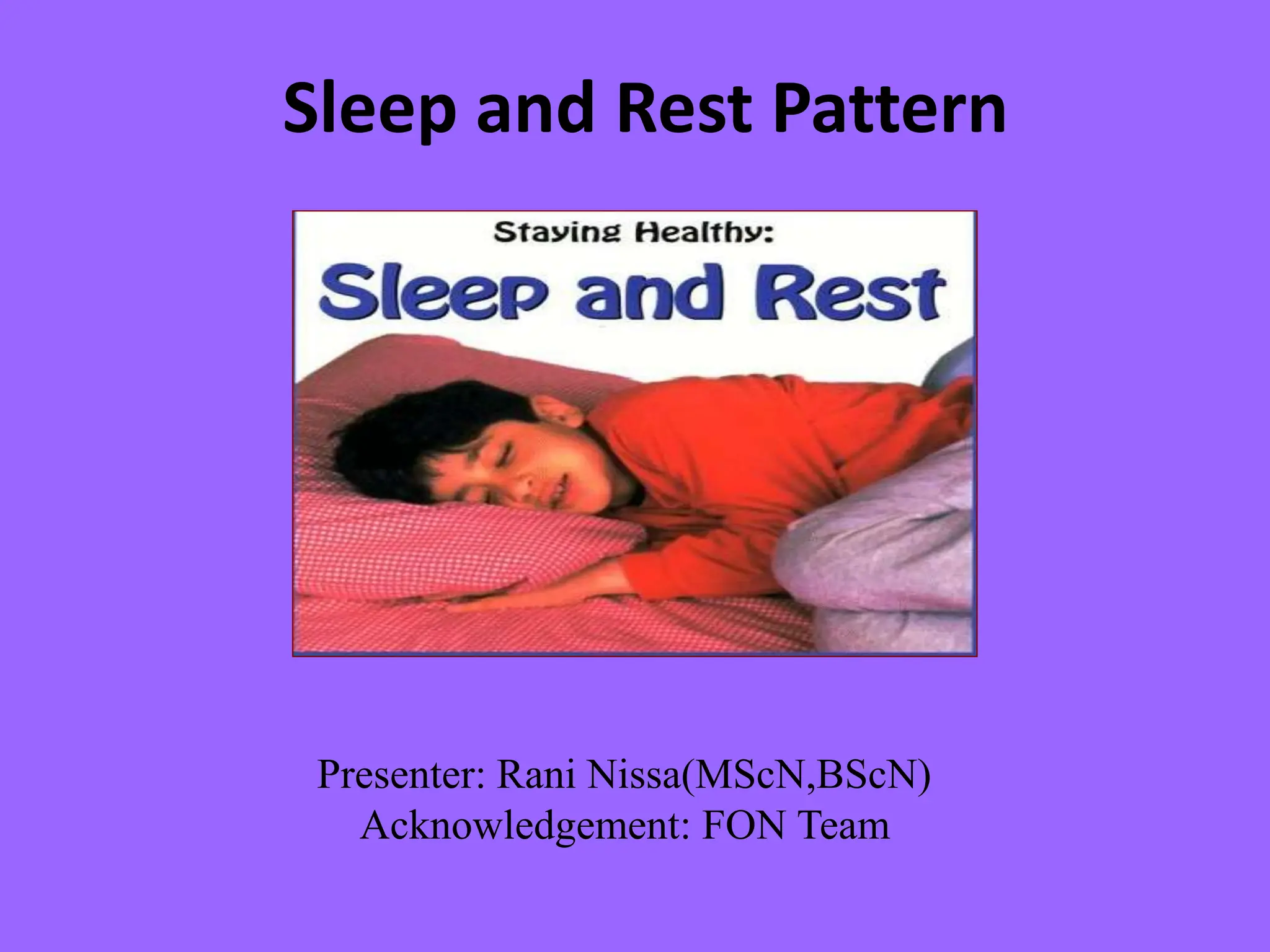
Sleep and Rest Pattern
Presenter: Rani Nissa(MScN,BScN)
Acknowledgement: FON Team
OBJECTIVES
• Define sleep and rest pattern
• Define terms related to rest and sleep.
• Compare the characteristics of sleep and rest.
• Discuss the characteristics of two kinds of sleep.
• Enumerate the functions of sleep.
• Discuss factors affecting sleep.
• Identify common sleep disorders.
• Identify conditions necessary to promote sleep.
• Discuss nursing process for a patient to promote
sleep.
Definition
Rest refers to a state of relaxation and calmness.
Sleep refers to a state of altered consciousness in which
the individual's perception of and reaction to the
environment are decreased. An individual experiences
minimal physical activity and a general slowing of the
body’s physiological processes.
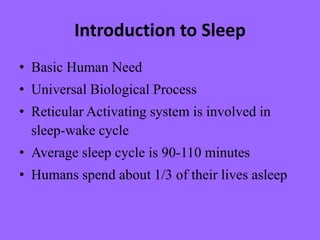
Introduction to Sleep
• Basic Human Need
• Universal Biological Process
• Reticular Activating system is involved in
sleep-wake cycle
• Average sleep cycle is 90-110 minutes
• Humans spend about 1/3 of their lives asleep
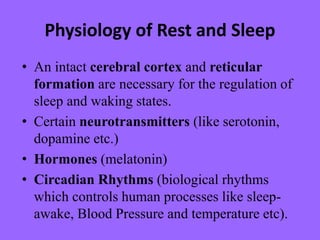
Physiology of Rest and Sleep
• An intact cerebral cortex and reticular
formation are necessary for the regulation of
sleep and waking states.
• Certain neurotransmitters (like serotonin,
dopamine etc.)
• Hormones (melatonin)
• Circadian Rhythms (biological rhythms
which controls human processes like sleep-
awake, Blood Pressure and temperature etc).
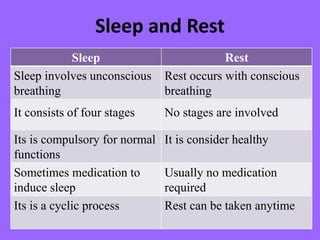
Sleep and Rest
Sleep Rest
Sleep involves unconscious
breathing
Rest occurs with conscious
breathing
It consists of four stages No stages are involved
Its is compulsory for normal
functions
It is consider healthy
Sometimes medication to
induce sleep
Usually no medication
required
Its is a cyclic process Rest can be taken anytime
Types of Sleep
–NREM Sleep
• Non –Rapid Eye Movement sleep
–REM Sleep
• Rapid Eye Movement Sleep
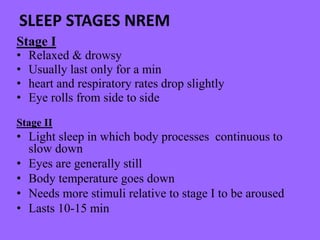
SLEEP STAGES NREM
Stage I
• Relaxed & drowsy
• Usually last only for a min
• heart and respiratory rates drop slightly
• Eye rolls from side to side
Stage II
• Light sleep in which body processes continuous to
slow down
• Eyes are generally still
• Body temperature goes down
• Needs more stimuli relative to stage I to be aroused
• Lasts 10-15 min
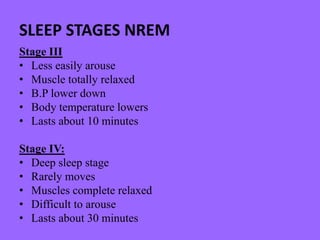
SLEEP STAGES NREM
Stage III
• Less easily arouse
• Muscle totally relaxed
• B.P lower down
• Body temperature lowers
• Lasts about 10 minutes
Stage IV:
• Deep sleep stage
• Rarely moves
• Muscles complete relaxed
• Difficult to arouse
• Lasts about 30 minutes
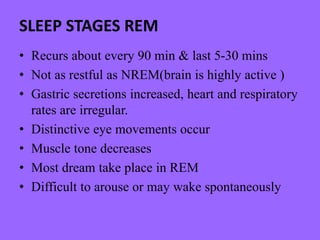
SLEEP STAGES REM
• Recurs about every 90 min & last 5-30 mins
• Not as restful as NREM(brain is highly active )
• Gastric secretions increased, heart and respiratory
rates are irregular.
• Distinctive eye movements occur
• Muscle tone decreases
• Most dream take place in REM
• Difficult to arouse or may wake spontaneously
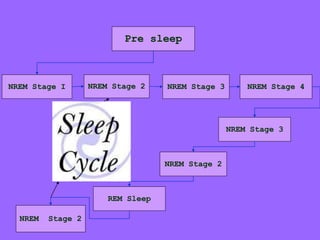
NREM Stage I NREM Stage 2 NREM Stage 3 NREM Stage 4
Pre sleep
NREM Stage 3
NREM Stage 2
REM Sleep
NREM Stage 2
Sleep Cycle
• During a sleep cycle, people typically pass
through NREM and REM sleep.
• The complete cycle usually lasting about 90 to
110 minutes in adults.
• The healthy adult sleeper usually experiences
four to six cycles of sleep during 7 to 8 hours
• The sleeper who is awakened during any stage
must begin anew at stage I NREM sleep and
proceed through all the stages to REM sleep.
Dreaming
When people sleep, they experience period of
Rapid Eye Movement. During this stage, which is
associated with dreaming, the brain becomes very
active. REM sleep and dreaming are triggered by
the Pons and neighboring structures in the
brainstem.
Functions of Sleep
• Optimal Psychological Functioning
• Cope with daily stresses
• Prevent fatigue
• Save Energy for day time activities
• Restore Mind and Body
• Enjoy Life fully
• Enhances daytime functioning
• Physiological Functioning such as:
– Healing of damaged Tissues increases
– Strengthens immunity
Factors Affecting Sleep
• Age
• Illness
• Life style
• Environment
• Change of environment
• Emotional stress
• Stimulants and alcohols
• Diet
• Smoking
• Change in circadian rhythm
• Motivation
• Medication (refer to Article 01)
Common Sleep Disorders
• Insomnia
1. Inability to falling asleep or remaining asleep
• Excessive Day time sleepiness
1. Hypersomnia :affected individual obtains
sufficient sleep at night but still cannot stay
awake during the day.
2. Narcolepsy : extreme tendency to fall
asleep caused by the lack of the chemical
hypocretin in the area of the central nervous
system that regulates sleep.
Common Sleep Disorders
• Sleep Apnea: Sleep apnea is
characterized by frequent short breathing
pauses during sleep.
• Parasomnia: sleep disorders that involve
abnormal movements (sleep walking,
talking and nightmares)
How to Promote Sleep
• Sleep pattern
• Environment
• Diet
• Medication
Nursing Management
Assessing
– Sleep History
– Health History
– Physical Examination
– Diagnostic Studies
Nursing Management
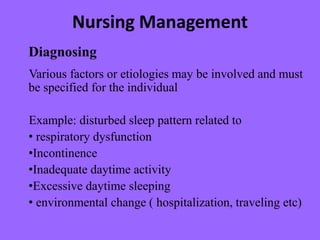
Diagnosing
Various factors or etiologies may be involved and must
be specified for the individual
Example: disturbed sleep pattern related to
• respiratory dysfunction
•Incontinence
•Inadequate daytime activity
•Excessive daytime sleeping
• environmental change ( hospitalization, traveling etc)
Nursing Management
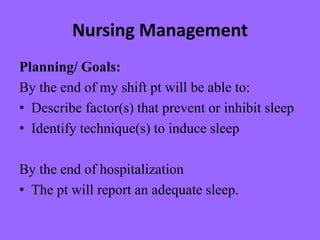
Planning/ Goals:
By the end of my shift pt will be able to:
• Describe factor(s) that prevent or inhibit sleep
• Identify technique(s) to induce sleep
By the end of hospitalization
• The pt will report an adequate sleep.
Nursing Management
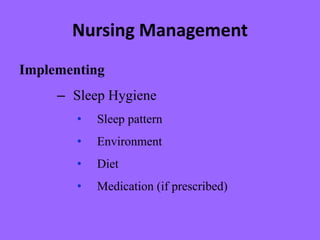
Implementing
– Sleep Hygiene
• Sleep pattern
• Environment
• Diet
• Medication (if prescribed)
Nursing Management
• Client Teaching
• Supporting Bed Time Rituals
• Creating a Restful Environment (noiseless, night
lamp/bulb)
• Promoting Comfort and Relaxation
• Limit caffeine intake
• Plan daytime activities
• Void before sleeping
• Enhancing Sleep with Medication (if prescribed)
• (refer to Article 2)
Evaluation
By the end of my shift pt was able to:
• Described two factors that prevent or inhibit
sleep
• Identified several techniques to induce sleep
By the end of hospitalization
• The pt reported an adequate sleep.
Rest and Sleep pattern.pptnnkkkkkkkllllll

Rest and Sleep pattern.pptnnkkkkkkkllllll

  • 1.
    Sleep and RestPattern Presenter: Rani Nissa(MScN,BScN) Acknowledgement: FON Team
  • 2.
    OBJECTIVES • Define sleepand rest pattern • Define terms related to rest and sleep. • Compare the characteristics of sleep and rest. • Discuss the characteristics of two kinds of sleep. • Enumerate the functions of sleep. • Discuss factors affecting sleep. • Identify common sleep disorders. • Identify conditions necessary to promote sleep. • Discuss nursing process for a patient to promote sleep.
  • 3.
    Definition Rest refers toa state of relaxation and calmness. Sleep refers to a state of altered consciousness in which the individual's perception of and reaction to the environment are decreased. An individual experiences minimal physical activity and a general slowing of the body’s physiological processes.
  • 4.
    Introduction to Sleep •Basic Human Need • Universal Biological Process • Reticular Activating system is involved in sleep-wake cycle • Average sleep cycle is 90-110 minutes • Humans spend about 1/3 of their lives asleep
  • 5.
    Physiology of Restand Sleep • An intact cerebral cortex and reticular formation are necessary for the regulation of sleep and waking states. • Certain neurotransmitters (like serotonin, dopamine etc.) • Hormones (melatonin) • Circadian Rhythms (biological rhythms which controls human processes like sleep- awake, Blood Pressure and temperature etc).
  • 6.
    Sleep and Rest SleepRest Sleep involves unconscious breathing Rest occurs with conscious breathing It consists of four stages No stages are involved Its is compulsory for normal functions It is consider healthy Sometimes medication to induce sleep Usually no medication required Its is a cyclic process Rest can be taken anytime
  • 7.
    Types of Sleep –NREMSleep • Non –Rapid Eye Movement sleep –REM Sleep • Rapid Eye Movement Sleep
  • 8.
    SLEEP STAGES NREM StageI • Relaxed & drowsy • Usually last only for a min • heart and respiratory rates drop slightly • Eye rolls from side to side Stage II • Light sleep in which body processes continuous to slow down • Eyes are generally still • Body temperature goes down • Needs more stimuli relative to stage I to be aroused • Lasts 10-15 min
  • 9.
    SLEEP STAGES NREM StageIII • Less easily arouse • Muscle totally relaxed • B.P lower down • Body temperature lowers • Lasts about 10 minutes Stage IV: • Deep sleep stage • Rarely moves • Muscles complete relaxed • Difficult to arouse • Lasts about 30 minutes
  • 10.
    SLEEP STAGES REM •Recurs about every 90 min & last 5-30 mins • Not as restful as NREM(brain is highly active ) • Gastric secretions increased, heart and respiratory rates are irregular. • Distinctive eye movements occur • Muscle tone decreases • Most dream take place in REM • Difficult to arouse or may wake spontaneously
  • 11.
    NREM Stage INREM Stage 2 NREM Stage 3 NREM Stage 4 Pre sleep NREM Stage 3 NREM Stage 2 REM Sleep NREM Stage 2
  • 12.
    Sleep Cycle • Duringa sleep cycle, people typically pass through NREM and REM sleep. • The complete cycle usually lasting about 90 to 110 minutes in adults. • The healthy adult sleeper usually experiences four to six cycles of sleep during 7 to 8 hours • The sleeper who is awakened during any stage must begin anew at stage I NREM sleep and proceed through all the stages to REM sleep.
  • 13.
    Dreaming When people sleep,they experience period of Rapid Eye Movement. During this stage, which is associated with dreaming, the brain becomes very active. REM sleep and dreaming are triggered by the Pons and neighboring structures in the brainstem.
  • 14.
    Functions of Sleep •Optimal Psychological Functioning • Cope with daily stresses • Prevent fatigue • Save Energy for day time activities • Restore Mind and Body • Enjoy Life fully • Enhances daytime functioning • Physiological Functioning such as: – Healing of damaged Tissues increases – Strengthens immunity
  • 15.
    Factors Affecting Sleep •Age • Illness • Life style • Environment • Change of environment • Emotional stress • Stimulants and alcohols • Diet • Smoking • Change in circadian rhythm • Motivation • Medication (refer to Article 01)
  • 16.
    Common Sleep Disorders •Insomnia 1. Inability to falling asleep or remaining asleep • Excessive Day time sleepiness 1. Hypersomnia :affected individual obtains sufficient sleep at night but still cannot stay awake during the day. 2. Narcolepsy : extreme tendency to fall asleep caused by the lack of the chemical hypocretin in the area of the central nervous system that regulates sleep.
  • 17.
    Common Sleep Disorders •Sleep Apnea: Sleep apnea is characterized by frequent short breathing pauses during sleep. • Parasomnia: sleep disorders that involve abnormal movements (sleep walking, talking and nightmares)
  • 18.
    How to PromoteSleep • Sleep pattern • Environment • Diet • Medication
  • 19.
    Nursing Management Assessing – SleepHistory – Health History – Physical Examination – Diagnostic Studies
  • 21.
    Nursing Management Diagnosing Various factorsor etiologies may be involved and must be specified for the individual Example: disturbed sleep pattern related to • respiratory dysfunction •Incontinence •Inadequate daytime activity •Excessive daytime sleeping • environmental change ( hospitalization, traveling etc)
  • 22.
    Nursing Management Planning/ Goals: Bythe end of my shift pt will be able to: • Describe factor(s) that prevent or inhibit sleep • Identify technique(s) to induce sleep By the end of hospitalization • The pt will report an adequate sleep.
  • 23.
    Nursing Management Implementing – SleepHygiene • Sleep pattern • Environment • Diet • Medication (if prescribed)
  • 24.
    Nursing Management • ClientTeaching • Supporting Bed Time Rituals • Creating a Restful Environment (noiseless, night lamp/bulb) • Promoting Comfort and Relaxation • Limit caffeine intake • Plan daytime activities • Void before sleeping • Enhancing Sleep with Medication (if prescribed) • (refer to Article 2)
  • 25.
    Evaluation By the endof my shift pt was able to: • Described two factors that prevent or inhibit sleep • Identified several techniques to induce sleep By the end of hospitalization • The pt reported an adequate sleep.