JYOTI
MSC 1st yr
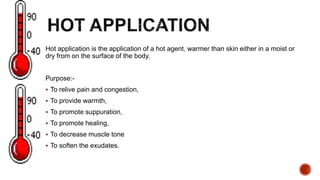
Hot application is the application of a hot agent, warmer than skin either in a moist or
dry from on the surface of the body.
Purpose:-
 To relive pain and congestion,
 To provide warmth,
 To promote suppuration,
 To promote healing,
 To decrease muscle tone
 To soften the exudates.
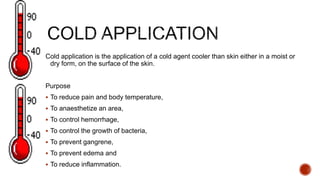
Cold application is the application of a cold agent cooler than skin either in a moist or
dry form, on the surface of the skin.
Purpose
 To reduce pain and body temperature,
 To anaesthetize an area,
 To control hemorrhage,
 To control the growth of bacteria,
 To prevent gangrene,
 To prevent edema and
 To reduce inflammation.
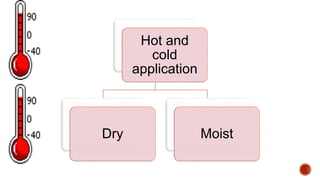
Hot and
cold
application
Dry Moist
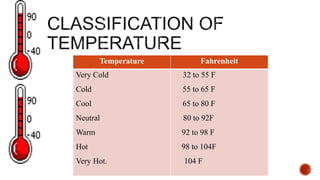
Temperature Fahrenheit
Very Cold
Cold
Cool
Neutral
Warm
Hot
Very Hot.
32 to 55 F
55 to 65 F
65 to 80 F
80 to 92F
92 to 98 F
98 to 104F
104 F
 Conduction: Contact
 Convection: movement
 Evaporation: through liquid-gas transfer
 Radiation: electromagnetic waves
 Conversion: transfer from one energy type to another
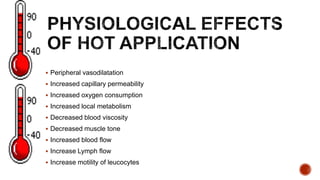
 Peripheral vasodilatation
 Increased capillary permeability
 Increased oxygen consumption
 Increased local metabolism
 Decreased blood viscosity
 Decreased muscle tone
 Increased blood flow
 Increase Lymph flow
 Increase motility of leucocytes
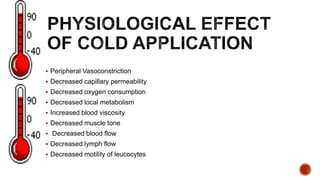
 Peripheral Vasoconstriction
 Decreased capillary permeability
 Decreased oxygen consumption
 Decreased local metabolism
 Increased blood viscosity
 Decreased muscle tone
 Decreased blood flow
 Decreased lymph flow
 Decreased motility of leucocytes
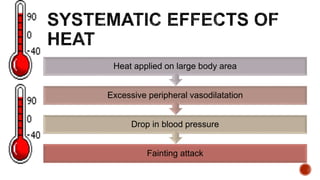
Fainting attack
Drop in blood pressure
Excessive peripheral vasodilatation
Heat applied on large body area
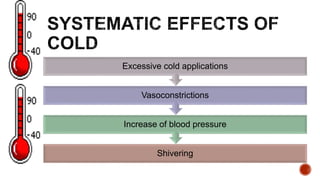
Shivering
Increase of blood pressure
Vasoconstrictions
Excessive cold applications
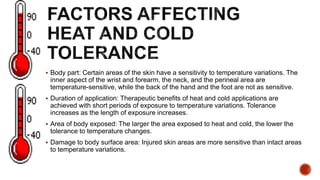
 Body part: Certain areas of the skin have a sensitivity to temperature variations. The
inner aspect of the wrist and forearm, the neck, and the perineal area are
temperature-sensitive, while the back of the hand and the foot are not as sensitive.
 Duration of application: Therapeutic benefits of heat and cold applications are
achieved with short periods of exposure to temperature variations. Tolerance
increases as the length of exposure increases.
 Area of body exposed: The larger the area exposed to heat and cold, the lower the
tolerance to temperature changes.
 Damage to body surface area: Injured skin areas are more sensitive than intact areas
to temperature variations.
 Individual tolerance: Tolerance to temperature variations is affected by age and
physical condition. The young and the aged are especially susceptible to heat and
cold.
 Neurosensory impairments may interfere with the reception and perception of stimuli,
increasing the risk of injury.
 Age: Thinner skin layers in children and elderly people increase the risk for burns from
the heat and cold applications.
 Water is a good conductor of heat
 Air is a poor conductor of heat
 The flow of heat is from the hotter are to the less hot area
 Prolonged exposure to moisture increases the skin’s susceptibility to maceration and
skin breakdown, reducing the protection of the intact skin.
 Moisture left on the skin causes rapid cooling due to evaporation of the moisture
 Presence of steam increases the temperature of the hot application
 Oil acts as insulator and delays the transmission of heat
 Woolen absorb moisture slowly, but hold moisture longer and cool off less quickly than
the cotton materials.
 The temperature tolerance varies with individuals and according to the site and area
covered
 Friction produce heat.
Indication of hot application:-
 Decreases pain
 Decreases muscle tone
 Promote healing
 Promotes suppuration
 Relives deep congestion
 Softens the exudates
 Provide warmth
 Stimulates peristalsis
 Malignancies
 Impaired kidney, heart & lung functions
 Acutely inflammed areas
 On clients with paralysis
 Open wounds
 Edema associated with venous or lymphatic diseases
 Headache
 Client with metabolic disorders
 Very young & very old client
 Client with very high temperature
 Pain
 Burns
 Maceration (with moist heat)
 Redness of the skin
 Edema
 Pallor (secondary effect)
 Hyperthermia
Therapeutic Uses Of Local Cold Applications
 Relieves pain
 Prevent gangrene
 Prevent edema & reduce inflammation
 Control hemorrhage
 Control the growth of bacteria
 Reduces the body temperature
 Anaesthetize an area
 Client in the state of shock & collapse
 Edema
 Diseases associated with impaired circulation
 Muscle spasm
 Decreased sensation
 Client have shivering or having very low temperature
 Cold hypersensitivity or intolerance
 Raynaud’s Disease
 Tissue Death
 Frost Bite
 Nerve damage :- Unwanted vasodilation due to prolonged vasoconstriction, ischemia,
thromboses in smaller vessels.
 Freezing of tissues
 Check the order, check armband
 Assess general condition of the patient
Assess the skin area where application going
 Check functioning of equipment
 Reassess patient and response in 15 minutes
 Stop treatment at designated time
 Examine the place where the treatment will occur.
 Record the patient’s response
 Do explain to the patient sensations to be felt during the procedure
 Do instruct the patient to report changes in sensation or discomfort immediately
 Do provide a timer, clock, or watch so that the patient can help the nurse time the
application
 Do keep the call light within the patients reach
 Do refer to the hospital’s policy and procedure manual for safe temperatures
 Do not allow the patient to adjust the temperature
 Do not allow the patient to move an application
 Do not place the patient in a position that prevents movement away from the
temperature source
 Do not leave unattended a patient who is neurological impaired.

Hot and cold application

  • 1.
  • 2.
    Hot application isthe application of a hot agent, warmer than skin either in a moist or dry from on the surface of the body. Purpose:-  To relive pain and congestion,  To provide warmth,  To promote suppuration,  To promote healing,  To decrease muscle tone  To soften the exudates.
  • 3.
    Cold application isthe application of a cold agent cooler than skin either in a moist or dry form, on the surface of the skin. Purpose  To reduce pain and body temperature,  To anaesthetize an area,  To control hemorrhage,  To control the growth of bacteria,  To prevent gangrene,  To prevent edema and  To reduce inflammation.
  • 4.
  • 5.
    Temperature Fahrenheit Very Cold Cold Cool Neutral Warm Hot VeryHot. 32 to 55 F 55 to 65 F 65 to 80 F 80 to 92F 92 to 98 F 98 to 104F 104 F
  • 7.
     Conduction: Contact Convection: movement  Evaporation: through liquid-gas transfer  Radiation: electromagnetic waves  Conversion: transfer from one energy type to another
  • 8.
     Peripheral vasodilatation Increased capillary permeability  Increased oxygen consumption  Increased local metabolism  Decreased blood viscosity  Decreased muscle tone  Increased blood flow  Increase Lymph flow  Increase motility of leucocytes
  • 9.
     Peripheral Vasoconstriction Decreased capillary permeability  Decreased oxygen consumption  Decreased local metabolism  Increased blood viscosity  Decreased muscle tone  Decreased blood flow  Decreased lymph flow  Decreased motility of leucocytes
  • 10.
    Fainting attack Drop inblood pressure Excessive peripheral vasodilatation Heat applied on large body area
  • 11.
    Shivering Increase of bloodpressure Vasoconstrictions Excessive cold applications
  • 13.
     Body part:Certain areas of the skin have a sensitivity to temperature variations. The inner aspect of the wrist and forearm, the neck, and the perineal area are temperature-sensitive, while the back of the hand and the foot are not as sensitive.  Duration of application: Therapeutic benefits of heat and cold applications are achieved with short periods of exposure to temperature variations. Tolerance increases as the length of exposure increases.  Area of body exposed: The larger the area exposed to heat and cold, the lower the tolerance to temperature changes.  Damage to body surface area: Injured skin areas are more sensitive than intact areas to temperature variations.
  • 14.
     Individual tolerance:Tolerance to temperature variations is affected by age and physical condition. The young and the aged are especially susceptible to heat and cold.  Neurosensory impairments may interfere with the reception and perception of stimuli, increasing the risk of injury.  Age: Thinner skin layers in children and elderly people increase the risk for burns from the heat and cold applications.
  • 15.
     Water isa good conductor of heat  Air is a poor conductor of heat  The flow of heat is from the hotter are to the less hot area  Prolonged exposure to moisture increases the skin’s susceptibility to maceration and skin breakdown, reducing the protection of the intact skin.
  • 16.
     Moisture lefton the skin causes rapid cooling due to evaporation of the moisture  Presence of steam increases the temperature of the hot application  Oil acts as insulator and delays the transmission of heat  Woolen absorb moisture slowly, but hold moisture longer and cool off less quickly than the cotton materials.  The temperature tolerance varies with individuals and according to the site and area covered  Friction produce heat.
  • 17.
    Indication of hotapplication:-  Decreases pain  Decreases muscle tone  Promote healing  Promotes suppuration  Relives deep congestion  Softens the exudates  Provide warmth  Stimulates peristalsis
  • 18.
     Malignancies  Impairedkidney, heart & lung functions  Acutely inflammed areas  On clients with paralysis  Open wounds  Edema associated with venous or lymphatic diseases  Headache  Client with metabolic disorders  Very young & very old client  Client with very high temperature
  • 19.
     Pain  Burns Maceration (with moist heat)  Redness of the skin  Edema  Pallor (secondary effect)  Hyperthermia
  • 20.
    Therapeutic Uses OfLocal Cold Applications  Relieves pain  Prevent gangrene  Prevent edema & reduce inflammation  Control hemorrhage  Control the growth of bacteria  Reduces the body temperature  Anaesthetize an area
  • 21.
     Client inthe state of shock & collapse  Edema  Diseases associated with impaired circulation  Muscle spasm  Decreased sensation  Client have shivering or having very low temperature  Cold hypersensitivity or intolerance  Raynaud’s Disease
  • 22.
     Tissue Death Frost Bite  Nerve damage :- Unwanted vasodilation due to prolonged vasoconstriction, ischemia, thromboses in smaller vessels.  Freezing of tissues
  • 23.
     Check theorder, check armband  Assess general condition of the patient Assess the skin area where application going  Check functioning of equipment  Reassess patient and response in 15 minutes  Stop treatment at designated time  Examine the place where the treatment will occur.  Record the patient’s response
  • 24.
     Do explainto the patient sensations to be felt during the procedure  Do instruct the patient to report changes in sensation or discomfort immediately  Do provide a timer, clock, or watch so that the patient can help the nurse time the application  Do keep the call light within the patients reach  Do refer to the hospital’s policy and procedure manual for safe temperatures
  • 25.
     Do notallow the patient to adjust the temperature  Do not allow the patient to move an application  Do not place the patient in a position that prevents movement away from the temperature source  Do not leave unattended a patient who is neurological impaired.